


Introduction
A name suggested by an artificial intelligence tool may, in principle, be registered and protected as a trademark. According to the French Intek, the method used to create the sign is not itself a condition for protection. What matters is whether the sign performs the function of a trademark and satisfies the requirements laid down by the French intellectual property code.
Generative AI can therefore be used as a naming tool. However, a name produced within seconds is not necessarily distinctive, legally available or safe to use. The crucial issue begins once the AI has produced the suggestion: the proposed name must still undergo full trademark clearance and legal assessment. Dreyfus & associés assists companies at precisely this stage, combining trademark clearance searches, distinctiveness analysis and filing strategy.
Why can an AI-generated name qualify for trademark protection?
Trademark law focuses on the sign, not on how it was created
When a company asks a generative AI system to suggest a name for a new product, service or business, the algorithmic origin of that suggestion is not, in itself, a ground for refusing trademark registration.
The proposed name must satisfy exactly the same substantive requirements as one created by a branding agency, an employee or a company founder.
Under Articles L.711-1 to L.711-3 of the French Intellectual Property Code, the sign must meet the following conditions:
- Distinctiveness: The sign must be capable of distinguishing a company’s goods or services from those of other companies.
- Lawfulness: The sign must not be contrary to public policy or public morals.
- Non-misleading: The sign must not mislead the public, particularly regarding the nature, quality, or origin of the goods or services.
- Availability: The sign must not infringe upon prior rights, such as already registered trademarks or protected business names
AI-generated names must still be distinctive
Generative AI prompted about a particular industry may suggest expressions closely associated with the characteristics, qualities or intended purpose of the relevant products or services. Such expressions may be unsuitable for strong trademark protection.
The challenge, therefore, is not merely to have AI generate a name that “sounds good” or is easily understood by the public. It is also necessary to ensure that the name can fulfill the essential function of a trademark: enabling consumers to identify the commercial origin of the relevant products or services.
In practice, the initial suggestions generated by AI should therefore be viewed as a starting point. A legal review is still necessary to rule out names that are overly descriptive, generic, or lack distinctiveness.The main legal risk remains trademark availability This legal screening is at the heart of the support provided by our trademark team, which assesses each candidate against INPI and EUIPO practice.
A name that appears original may already conflict with third-party rights.
Article L.711-3 of the French Intellectual Property Code identifies numerous earlier rights that may prevent valid registration, including earlier trademarks, corporate names, trade names, business signs, certain domain names, geographical indications, copyright and personality rights.
Businesses should therefore not ask an AI tool whether a suggested name is “available” and treat its answer as legal clearance.
The INPI itself states that it does not verify the availability of a trademark as part of the filing process. An identical-name search is only an initial check; a proper clearance search should also consider phonetic, visual and conceptual similarities. This is why the firm conducts comprehensive clearance searches in France, the European Union and internationally, together with a risk assessment and practical recommendations before any filing.
AI-generated names, trademarks and copyright are different questions
Copyright must be analysed separately. The Court of Justice of the European Union has consistently linked originality to the author's own intellectual creation, reflecting free and creative choices. A purely machine-generated output with no identifiable human creative choices therefore raises distinct copyright questions.
This does not prevent the same sign from functioning as a trademark. Copyright and trademark law protect different interests and apply different tests. A short name may fail to qualify for copyright protection yet remain perfectly capable of trademark registration.
Businesses should also review the contractual terms governing the AI system they use. Where prompts contain personal data, data-protection requirements must additionally be considered. The French Data Protection Authority (CNIL), notably stresses the importance of assessing the origin, reuse and lawful processing of data used in connection with AI systems. Our data protection team helps companies frame these uses, from reviewing the tool’s contractual terms to ensuring compliant processing.
How should an AI-generated trademark be secured before filing?
We recommend treating generative AI as a naming and shortlisting tool rather than a legal clearance mechanism.
The strongest process combines :
- human selection of the most distinctive candidates
- an assessment of absolute grounds for refusal and trademark searches
- careful identification of the relevant goods, services and territories
- an appropriate filing and monitoring strategy.
Dreyfus & associés handles all of these steps as an integrated service: legal screening of candidate names, clearance searches, drafting of goods and services specifications, filing in France, the European Union and internationally, followed by monitoring and enforcement of the trademark (oppositions, negotiations, litigation).
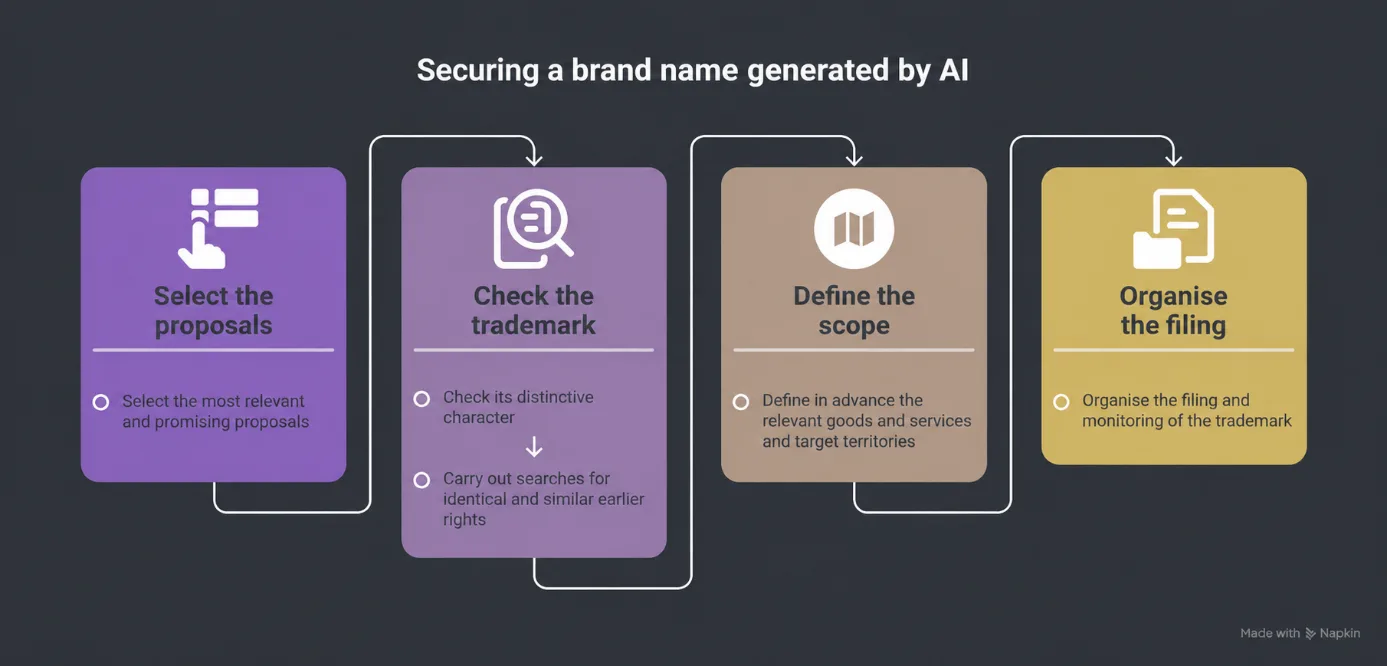
Clearance should take place before significant investment is made in branding, packaging, websites or advertising campaigns. The EUIPO likewise recommends searching for identical and similar earlier trademarks before filing in order to reduce the risk of conflict.
The EU Artificial Intelligence Act does not replace these trademark requirements. The AI Act now imposes a progressively applicable regulatory framework for AI systems and models, with a number of provisions applying in 2026, but trademark registrability continues to be governed by the relevant intellectual property rules.
Conclusion
An AI-generated name can therefore be protected as a trademark in France and the European Union. The strength of the resulting right depends however on distinctiveness, legal availability, the goods and services covered and the territorial filing strategy.
Dreyfus Law Firm assists companies that use AI to create their brand names: clearance searches and availability opinions, distinctiveness analysis, filing strategy in France, the European Union and internationally through its network of correspondents, monitoring and enforcement (oppositions, negotiations, litigation). To secure an AI-generated name before launch, contact us: contact@dreyfus.fr.
Nathalie Dreyfus with the support of the entire Dreyfus team
Q&A
Does registering a domain name before filing the trademark automatically create trademark rights?
No. Domain names and trademarks are governed by different legal regimes. However, under certain circumstances, an earlier domain name may constitute an earlier right capable of being invoked against a subsequent French trademark under Article L.711-3 CPI.
Can an AI-generated trademark be extended internationally after an initial French filing?
Yes. International protection can be structured following an initial French application, subject to territorial requirements and any applicable priority rules. Availability should also be assessed separately in each target jurisdiction. The firm designs these extension strategies (Madrid international registrations, national filings) and coordinates local searches through its network of correspondents.
Must an applicant tell the French IP Office that a trademark name was generated using AI?
No specific declaration to that effect is required. Article L.712-2 CPI requires information including the representation of the trademark, the relevant goods or services and identification of the applicant; it does not require disclosure of the creative process used to select the name.
Does the fact that an AI tool may suggest the same name to several users prevent that name from being registered as a trademark?
The possibility that an AI system may generate the same or a similar name for different users does not, in itself, prevent trademark registration. The key issues remain whether the sign satisfies the applicable requirements for trademark protection and whether it conflicts with earlier rights.
Can an AI provider be held liable if a suggested name infringes an earlier trademark?
In practice, an AI provider cannot be presumed liable solely because a generated name infringes an earlier trademark. It is therefore for the company to carry out the necessary checks before any filing or use, in particular by conducting a trademark clearance search. The provider’s liability could only be considered in specific circumstances, depending on its contractual commitments and the facts of the case.
This publication is intended for general public guidance and to highlight issues. It is not intended to apply to specific circumstances or to constitute legal advice.