

Introduction
Since January 1, 2026, the 13th edition of the International Nice Classification (“NCL 13-2026”) has entered into force in the jurisdictions that are party to the Nice Agreement. This update applies to all new trademark applications filed as from that date. As the wording of goods and services has evolved significantly across several classes, this reform has direct consequences for filing strategies, scope of protection, and the management of global trademark portfolios.
Understanding the Nice Classification
Origins and legal function
The Nice Classification is an international system that categorizes goods and services into 45 classes used for trademark registration purposes:
- Goods: Classes 1 to 34
- Services: Classes 35 to 45
It was established under the Nice Agreement (1957) in order to harmonize classification practices among national and international trademark offices, thereby facilitating filings, prior art searches, opposition proceedings, and contractual negotiations.
Why a 13th edition in 2026?
The previous version (NCL 12-2023) no longer adequately reflected current market and technological developments. NCL 13-2026 was introduced in order to:
- Clarify overloaded classes (notably Class 9)
- Adapt the classification to new uses and emerging technologies
- Reduce overlaps and ambiguities in the wording of goods and services
Key changes in NCL 13-2026
Major reclassifications of goods
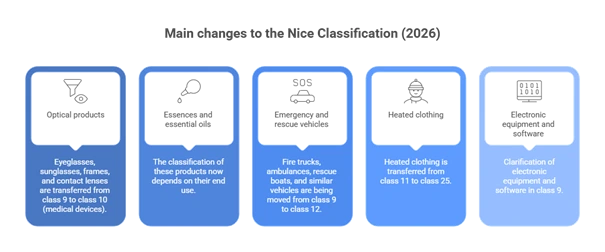
– Optical products (glasses, lenses, accessories)
Prescription glasses, sunglasses, frames, and contact lenses have been transferred from Class 9 to Class 10 (medical devices). This reorganization is based on their medical or therapeutic function rather than their electronic nature.
– Essences and essential oils
The classification of these products now depends on their intended use:
- Essential oils for cosmetic purposes → Class 3
- Essential oils for medical/therapeutic purposes → Class 5
- Essential oils for food flavoring purposes → Class 30
– Emergency and rescue vehicles
Fire trucks, ambulances, lifeboats, and similar vehicles have moved from Class 9 to Class 12, consolidating all vehicles within the same class.
– Other reclassifications
- Heated clothing → from Class 11 to Class 25
- Further clarification regarding electronic equipment and software in Class 9
Services and new definitions
NCL 13-2026 also introduces changes in the services sector. Certain services related to artificial intelligence (AI as a Service – AIaaS) are now clarified within Class 42, reflecting the realities of the modern digital economy.
Practical impact on trademark filings
Selection of classes for filings as from 2026
From January 1, 2026 onwards, all trademark applications (national, regional, or international via the Madrid System) must be classified in accordance with NCL 13-2026. Any misclassification may result in office actions, procedural delays, or additional costs.
Pending applications and risk of objections
Applications filed before January 1, 2026 will continue to be examined under NCL 12-2025. However, objections may arise where the wording already corresponds to a new entry introduced under NCL 13-2026.
Consequences for existing portfolios
Clearance searches and trademark monitoring
From 2026 onwards, search and monitoring practices must simultaneously consider both the former and the new editions in order to avoid blind spots in enforcement and risk analysis strategies.
Renewals and official fees: INPI vs EUIPO/WIPO
The French Trademark Office (INPI) may require reclassification of specifications upon renewal from 2026 onwards, potentially triggering additional fees. By contrast, the EUIPO and WIPO generally do not automatically reclassify existing registrations.
Proactive strategies to implement
Comprehensive audit of specifications
A detailed audit of the specifications of pending and future applications is essential in order to prevent gaps in protection, particularly in sectors affected by significant reclassifications.
Licence agreements and coexistence agreements
Contracts referring solely to class numbers, without a detailed description of goods and services, may become outdated or contentious. A legal audit and revision of contractual wording are strongly recommended.
Updating portfolio management tools
Internal databases, monitoring tools, and classification protocols must be updated to integrate NCL 13-2026. This also includes standard filing templates and internal filing workflows.
Conclusion
The Nice Classification NCL 13-2026 is not merely an administrative update. It introduces significant reclassifications, generates direct operational consequences for trademark protection, and requires structured adjustments to intellectual property strategies.
Careful anticipation remains essential in order to secure your rights, optimize future filings, and ensure robust legal coverage.
Dreyfus & Associés assists its clients in managing complex intellectual property cases, offering personalized advice and comprehensive operational support for the complete protection of intellectual property.
Nathalie Dreyfus with the support of the entire Dreyfus team
Q&A
1. Does the Nice Classification 2026 modify the legal scope of my trademark protection?
No. The classification has no retroactive effect on the intrinsic scope of rights conferred by a trademark. However, the exact wording of the specification remains decisive. Future reclassifications may influence the interpretation of imprecise wording in litigation.
2. Will the 2026 update affect opposition proceedings?
Indirectly, yes. Oppositions will continue to rely on the comparison of goods and services as registered. However, changes in classification may influence how offices assess similarity between certain goods.
3. Is the Nice Classification mandatory in all countries?
Most jurisdictions apply the Nice Classification, although certain national practices may vary. Particular attention should be paid to specific local requirements in strategic filings.
4. Can a classification error invalidate a trademark?
An incorrect class does not automatically invalidate a trademark. However, an overly narrow or inappropriate designation may limit the scope of protection or weaken the trademark in non-use cancellation proceedings.
5. Does the 2026 update impact international clearance searches?
Yes. Search tools must incorporate correspondences between former and new classes. A search limited to a single edition may overlook relevant prior rights, especially in sectors affected by class transfers.
This publication is intended for general public guidance and to highlight issues. It is not intended to apply to specific circumstances or to constitute legal advice.