

Introduction
France was the first Member State of the European Union to establish an autonomous legal framework for e-sports. Law No. 2016-1321 of October 7, 2016 for a Digital Republic introduced into the French Internal Security Code a dedicated chapter governing video game competitions, thereby putting an end to a legal vacuum affecting the entire industry.
This pioneering framework rests on three pillars:
- the regulated authorisation of in-person competitions offering prizes,
- the prohibition of paid online competitions offering cash prizes, and
- the creation of a specific employment contract for salaried professional players.
This is a sui generis framework, at the crossroads of digital law, employment law and the law applicable to video games, without, however, granting esports the sporting recognition provided for under the French Sports Code. A bill tabled in November 2025 could further this structuring process.
The organisation of e-sports competitions : obligations and limitations
The prior notification requirement
Any in-person video game competition organised in France and offering financial prizes is subject to a prior notification requirement before the Ministry of the Interior. This formality must be completed no earlier than one year and no later than one month before the date of the event. Several competitions may be notified simultaneously.
Failure to comply with this requirement is not insignificant: the organiser may become subject to the general regime governing games of chance and gambling, which is particularly stringent and may even entail criminal sanctions.
Regulation of entry fees
The law imposes a cap on entry fees collected from players in order to prevent any shift towards classification as gambling. The proportionality between such fees and the prizes actually awarded is a central criterion of legality, which each organiser must assess carefully before the event.
Prohibition of paid online competitions offering cash prizes
The current legal framework formally prohibits the collection of entry fees for online competitions offering cash prizes, pursuant to Articles L. 320-1 et seq. of the French Internal Security Code. This prohibition clearly distinguishes regulated but authorised in-person tournaments from fully online formats involving financial stakes, which remain treated as gambling activities.
The status of professional competitive video game players
The salaried professional player contract
France has created a derogatory employment contract specifically designed for professional e-sports players : the salaried professional competitive video game player contract. This mechanism enables clubs to recruit players under employment law while taking into account the specific features of the sector, in particular the especially short duration of professional careers.
This contract has several essential characteristics :
- a term ranging from one to five years;
- a prohibition on engaging players under the age of 12 in competitions offering financial rewards;
- affiliation to the general social security regime applicable to employees, including health coverage, pension rights and social security contributions;
- adaptation to the specific constraints of the sector, including training, travel and career duration.
Enhanced protection for minor players
French law pays particular attention to minor players. The engagement of a minor requires parental authorisation, compliance with child labour rules and continued educational supervision. The commercial exploitation of a minor player is strictly limited.
Competition organisers also have specific obligations : they must avoid violent content unsuitable for minors, addictive mechanics and mechanisms that may be assimilated to disguised betting.
Risks of reclassification
Despite the existence of this specific contract, some organisations continue to rely on service agreements or self-employed status. This practice exposes the organisation to a significant risk of reclassification as an employment contract, resulting in retroactive payment of social security contributions, dismissal indemnities and, in the most serious cases, criminal penalties for concealed employment.
E-sports and online gambling : a decisive legal boundary
The online gambling regime established by the 2010 law
Law No. 2010-476 of May 12, 2010 opened three activities to competition : sports betting, horse-race betting and online poker, while maintaining the prohibition of online casinos. Betting on e-sports competitions falls within the category of sports betting and is subject to authorisation by the French National Gambling Authority (ANJ), created in 2019.
JONUM : a European regulatory innovation
France has taken a pioneering step in Europe with the regime applicable to games involving monetisable digital objects, known as JONUM, introduced by the SREN Law of May 21, 2024 and made operational by the ANJ in February 2026.
This three-year experimental framework targets games at the boundary between video games and regulated gambling, allowing players to acquire digital objects, NFTs or blockchain tokens that may be traded on secondary markets.
JONUM operators are subject to substantial obligations. They must comply with a cap on non-monetary rewards of EUR 1,000 per player, per game and per year, as well as a limitation on crypto-asset rewards to 20% of the game’s annual turnover.
They must also implement responsible gaming tools, such as time limits, weekly spending caps and self-exclusion mechanisms. A prior declaration to the ANJ is required before any launch. Finally, operators must retain transaction data and provide detailed reporting.
Enforcement against prediction markets
In 2026, the ANJ adopted an enforcement policy against prediction market platforms, such as Kalshi and Polymarket, which it considered to be unlicensed gambling services. These operators received formal warnings and implemented geoblocking of French IP addresses.
France is not acting in isolation: the Belgian Gaming Commission and the Spanish authority adopted similar positions in early 2026.
The 2025 bill : towards a responsible and attractive e-sports framework
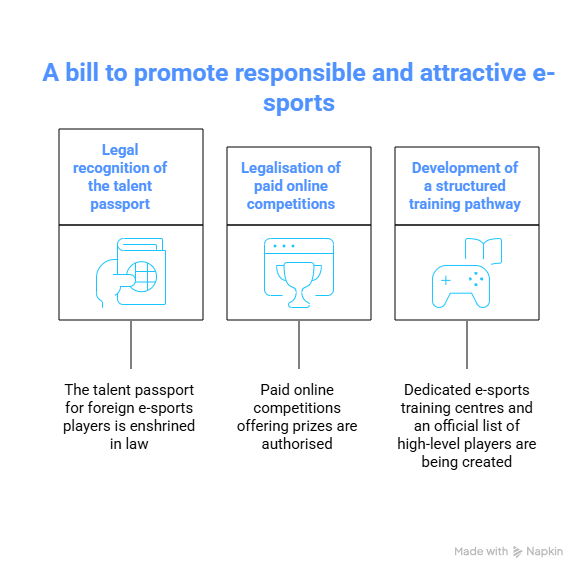
A bill “for a responsible and attractive e-sport” was introduced before the French National Assembly on November 18, 2025. Although it has not yet been placed on the parliamentary agenda, it announces three major developments that stakeholders in the sector should anticipate now.
Statutory recognition of the talent passport
The talent passport granted to foreign e-sports players and coaches, which has until now been issued on the basis of a mere interministerial instruction, would be expressly enshrined in law. Securing this residence permit is crucial to France’s international attractiveness in a sector where talent circulates globally.
Opening up paid online competitions
The bill provides for the authorisation of paid online competitions with prizes, which would constitute a significant relaxation of the current regime. The prohibition of such formats, based on Articles L. 320-1 et seq. of the French Internal Security Code, is currently one of the main obstacles to the economic development of French e-sports.
Creation of a structured training pathway
The bill provides for the creation of dedicated e-sports training centres subject to approval and training agreements, as well as the establishment of an official list of high-level players granting them access to support mechanisms reserved for elite athletes. This symbolic and practical recognition has long been awaited by professional clubs.
Intellectual property in the e-sports ecosystem
The specific position of publishers
E-sports has a fundamental structural feature : the video game used in competition is protected by copyright and related rights held by the publisher. Licence agreements between publishers and tournament organisers allow publishers to define, to a significant extent, the conditions under which the competitive ecosystem may be exploited.
This concentration of rights in a single actor for each title makes contractual negotiations particularly sensitive.
Protection of club trademarks
E-sports organisations build their value around a recognisable trademark identity, including names, logos, slogans and visual elements. Protecting these assets through registration is essential.
An effective strategy includes filing before the French National Institute of Industrial Property, INPI, in France in Classes 9, 25, 28, 35 and 41; filing at European level before the EUIPO; international filing through the WIPO Madrid System; and filing designs for logos and visual identities.
Monitoring and combating infringement
The protection of trademarks and domain names requires proactive monitoring of online infringements, including cybersquatting, fake social media accounts and illegal betting websites reproducing the visual identity of licensed operators.
Several out-of-court procedures make it possible to recover an abusively registered domain name : the UDRP procedure administered by WIPO for generic extensions such as .com, .org and .net; the SYRELI procedure administered by AFNIC for French national extensions such as .fr; and the URS system for clear cases of cybersquatting.
A broader domain name strategy is therefore essential for e-sports stakeholders seeking to protect their online presence.
Rights of professional players
Professional players and streamers may, in practice, benefit from several layers of protection :
- image rights over their person, which must be contractually assigned for any commercial exploitation;
- neighbouring rights as performers where their performance displays original artistic features;
- rights over their name and voice, enforceable against unauthorised uses, particularly artificial intelligence generated deepfakes.
Conclusion
The regulatory framework for e-sports in France is one of the most advanced in Europe, yet it remains incomplete. Between the legal architecture established by the 2016 law, regulatory innovations such as the JONUM regime, the growing importance of the 2025 bill and the overlapping issues of intellectual property, employment law and advertising compliance, stakeholders in the sector are operating in a constantly evolving legal environment.
Dreyfus assists clients in managing complex intellectual property matters by providing tailored advice and comprehensive operational support for the full protection of intellectual property rights.
Nathalie Dreyfus, with the assistance of the entire team at Dreyfus.
Q&A
1. Who owns the rights to an esports tournament ?
Rights are generally shared among several stakeholders depending on the elements concerned: the game publisher, which owns the intellectual property rights in the video game; the organiser, which may hold rights in the event, its recording, related content and the tournament brand; and the players or teams, who notably have rights over their image, name or voice, and, in certain cases, rights over their performances where these are original. Contractual clarification is therefore essential before any commercial exploitation or broadcast.
2. Can a publisher control the organisation of esports competitions based on its game ?
Yes. Unlike traditional sports, esports are based on video games protected by copyright. The publisher may therefore regulate the use of its game in competitions, including through licences, tournament rules, broadcasting restrictions or commercial exploitation terms.
3. What are the legal risks relating to esports players’ image rights ?
The use of a player’s image, name, voice or pseudonym should be governed by a clear authorisation, particularly for advertising campaigns, merchandising, sponsored content or event recordings. Clubs and organisers should also anticipate risks linked to deepfakes and unauthorised uses generated by artificial intelligence.
4. Are non-compete clauses valid in esports player contracts ?
Yes, provided that they are strictly framed. A non-compete clause must be justified by the team’s legitimate interests, limited in time and geographical scope, proportionate to the player’s role, and accompanied by financial compensation.
5. Must the personal data of players and spectators be protected ?
Yes. Clubs, platforms and organisers must comply with the GDPR when collecting data relating to players, spectators, users, minors, payments, rankings or competition registrations. More broadly, personal data protection is a key compliance issue for e-sports stakeholders.
This publication is intended to provide general guidance to the public and to highlight certain issues. It is not intended to apply to specific situations or to constitute legal advice.