

Introduction
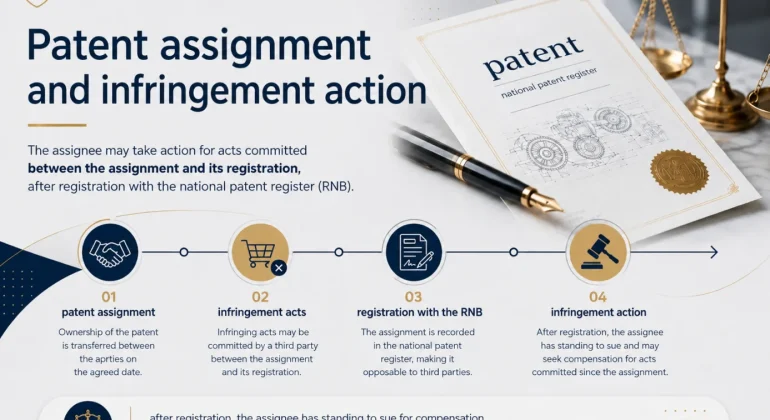
A patent assignee may seek compensation for counterfeiting acts committed by a third party between the effective date of the transfer and the date on which it is recorded in the French National Patent Register. However, the assignee only becomes entitled to pursue the infringement action once the transfer has been registered.
Where proceedings were commenced before recordal, the initial lack of standing may be cured during the proceedings, provided that the cause of inadmissibility has disappeared by the time the court gives its decision.
This solution, established by the French Cour de cassation in its decision ofApril 24, 2024 (case no. 22-22.999) and subsequently applied by the Paris Court of Appeal in its judgment on remand dated April 15, 2026 (case No.24-11672). It draws a clear distinction between the date on which ownership is transferred and the date on which that transfer may be relied upon against third parties.
The assignment takes effect between the contracting parties
A valid assignment transfers ownership of the patent to the assignee in accordance with the agreement and the law governing the transaction. As between the assignor and the assignee, ownership therefore passes on the effective date specified in the agreement.
That transfer is not automatically enforceable against third parties. Under Article L. 613-9 of the French Intellectual Property Code, instruments transferring or modifying rights attached to a patent must be recorded in the National Patent Register to be enforceable against third parties.
The unregistered assignee cannot rely on its ownership against an alleged infringer
Article L. 615-2 of the French Intellectual Property Code provides that patent infringement proceedings are, in principle, brought by the patent owner.
Until the assignment has been registered, the assignee cannot rely on the rights arising from the transfer against third parties. The Cour de cassation therefore held that an unregistered assignee lacks standing to bring an infringement action. This affects the procedural admissibility of the claim, not the validity of the transfer between the contracting parties.
Can subsequent recordal cover infringement committed since the assignment?
Recordal may cure the defect during pending proceedings
Article 126 of the French Code of Civil Procedure provides that an objection based on inadmissibility must be dismissed where the underlying defect can be cured and has disappeared by the time the court rules.
Accordingly, proceedings commenced before recordal are not necessarily irretrievably inadmissible. If the assignment is duly registered while the case is pending, the assignee acquires the standing required to continue the action.
Recoverable loss may extend back to the transfer date
Once recordal has been completed, the assignee may seek compensation for loss caused by infringing acts committed from the effective date of the transfer. This includes acts occurring during the interval between the assignment and its recordal.
Recordal does not retroactively make the transfer enforceable before its publication. Instead, from the date of recordal, it enables the assignee to enforce the financial consequences of infringements committed since it acquired ownership.
Counterfeitings committed before the patent assignment
A separate rule applies to acts committed before the assignee acquired the patent. Compensation for those acts may be claimed by the assignee only where the assignment expressly transfers the corresponding claims and causes of action.
The agreement should therefore specify whether the transfer includes claims arising from earlier infringements; accrued rights to damages; pending court proceedings; authority to settle disputes concerning earlier acts.
Without sufficiently clear wording, the loss suffered before the transfer will generally remain the assignor’s loss. The Cour de cassation therefore distinguishes between post-transfer infringements, which affect the new owner directly, and pre-transfer infringements, which require an express contractual transfer.
Decision of the Paris Court of Appeal on April 15, 2026
The dispute pitted Sony against Subsonic, which was accused of selling video game controllers that replicated features protected by three European patents related to the PlayStation. Although these patents had been transferred to Sony Interactive Entertainment as part of a restructuring, they were not registered in its name in the National Patent Register until June 28, 2018,after the lawsuit was filed in January 2017.
Ruling on remand, the Paris Court of Appeal held that the patent assignee was entitled to pursue claims relating to acts committed from the transfer date, although recordal had occurred after the proceedings were commenced. This prevents an alleged infringer from escaping liability solely because publication of the transfer was delayed.
Standing must nevertheless be distinguished from the merits. In the case concerned, the infringement claims were ultimately dismissed because the claimants had not sufficiently established that every feature of the asserted patent claims was reproduced. Recordal establishes standing; it does not establish infringement.
How should an assignee secure its infringement strategy?
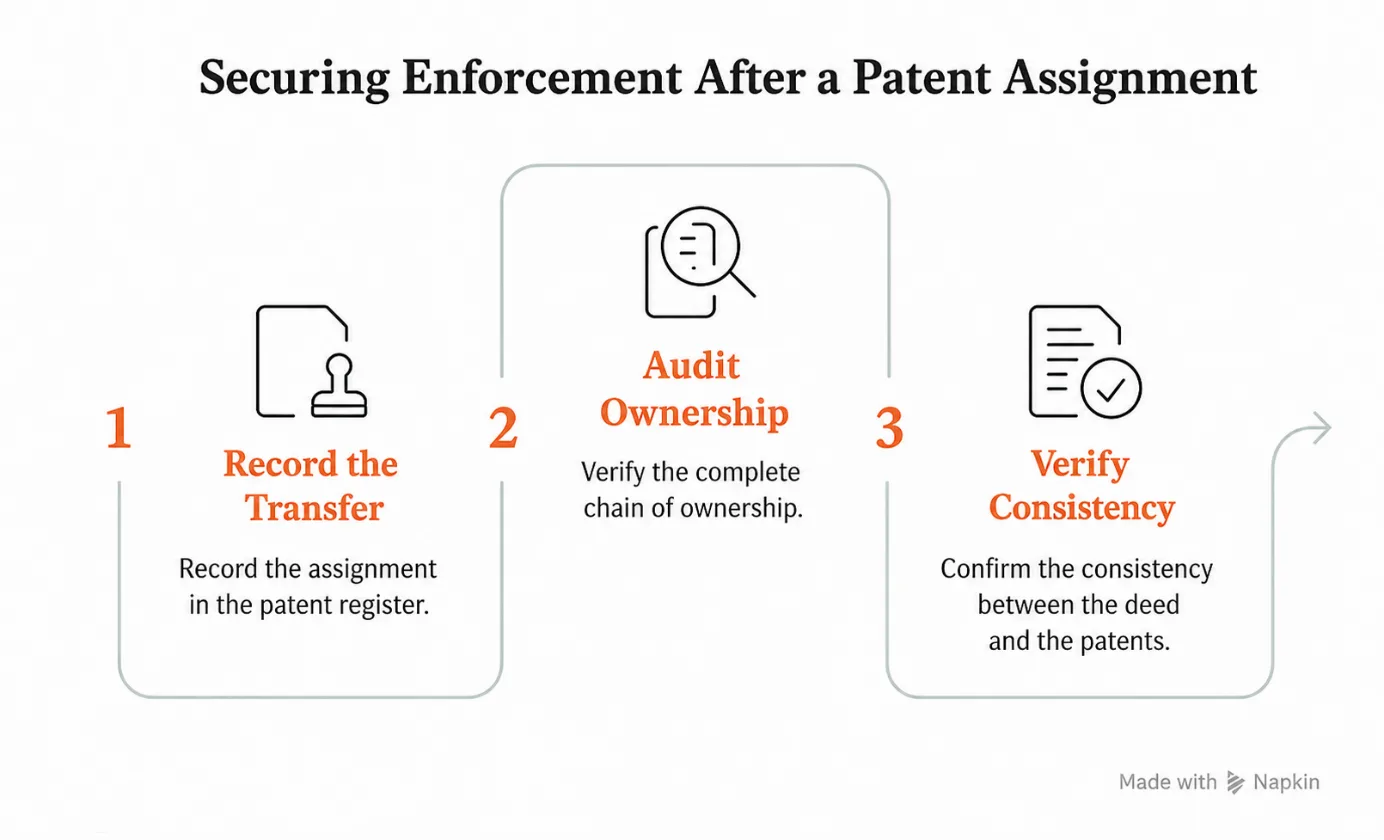
The transfer should be registered promptly, and the complete chain of title should be audited before any enforcement measure is initiated. The INPI notably requires earlier transfers to be recorded where successive assignments have not been entered in the register.
Before applying for an infringement seizure or issuing proceedings, we recommend verifying:
- the patents and territories covered by the assignment;
- the precise effective date of the transfer;
- the current entries in the National Patent Register;
- the transfer of claims relating to earlier infringements;
- the technical evidence establishing reproduction of the patented features;
- the individual loss suffered by each entity involved.
Conclusion
A patent assignee may bring a counterfeiting action concerning acts committed between the assignment and its recordal, but it becomes entitled to pursue that action only after recordal of the transfer. Recordal during pending proceedings may cure the initial lack of standing. Claims concerning acts committed before the transfer must be expressly assigned.
Dreyfus Law Firm assists its clients in managing complex intellectual property cases, offering personalized advice and comprehensive operational support for the complete protection of intellectual property.
Q&A
Does recordal have retroactive effect?
Recordal does not retrospectively make the transfer enforceable. Once completed, however, it permits the assignee to claim compensation for infringements committed since the effective transfer date.
Can the assignee recover the assignor’s earlier losses?
Only where the agreement expressly transfers the relevant claims or causes of action arising before the assignment.
Is recordal sufficient to obtain an infringement judgment?
No. The claimant must still prove the validity and scope of the patent, reproduction of every relevant claim feature, the loss suffered and the causal connection with the alleged infringement.
Must every successive patent assignment be registered?
Yes. Where the patent has been transferred several times, gaps in the chain of registered ownership should be corrected before enforcement proceedings are pursued.
May a patent licensee bring infringement proceedings?
An exclusive licensee and, in certain circumstances, a non-exclusive licensee may bring proceedings under Article L. 615-2 of the French Intellectual Property Code. A licensee may also intervene in an action brought by the patent owner to recover its own loss.
This publication is intended for general public guidance and to highlight issues. It is not intended to apply to specific circumstances or to constitute legal advice.