

Introduction
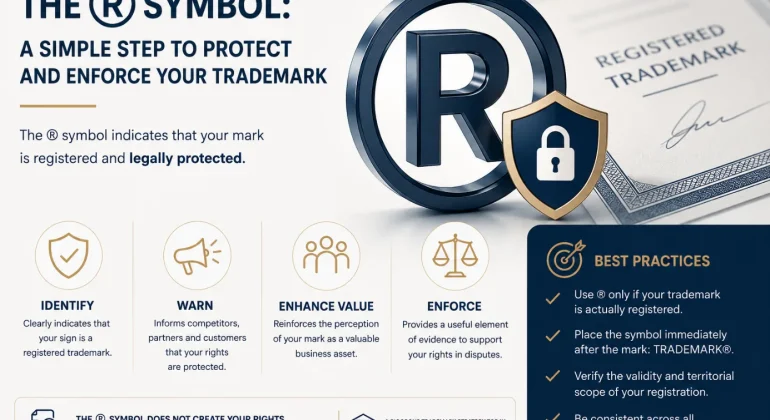
The ® symbol does not create trade mark rights. In France and the European Union, protection derives from the registration of the sign for specified goods and services—not from adding a symbol to packaging, a website or an advertising campaign.
This does not make the ® symbol insignificant. Where a trade mark is validly registered, we recommend using it as a legal communication tool, a commercial notice and a component of an organised evidence strategy. Judgment of the General Court Les Éditions Albert René v EUIPO (T-24/25) of May 2026, concerning the OBELIX trade mark, demonstrates that this apparently minor graphical feature may affect the assessment of how the public perceives a sign.
The symbol must nevertheless remain consistent with the underlying registration. It cannot extend protection to unregistered goods, enlarge the geographical scope of the rights or compensate for the absence of genuine use.
OBELIX Case: the ® symbol in the assessment of trade mark reputation
Facts
A Polish undertaking had obtained registration of the EU word trademark Obelix for goods in Class 13, including weapons, ammunition and explosives. Les Éditions Albert René applied for a cancellation action on the basis of its earlier OBELIX mark, relying in particular on its reputation under Article 8(5) and Article 60(1)(a) of the EU Trade Mark Regulation.
The EUIPO Board of Appeal dismissed the application. It considered that most of the evidence concerned the expression “Asterix & Obelix” or the popularity of the character, without sufficiently demonstrating that the public perceived OBELIX as a trade mark with a reputation. It also ruled out a link between the marks, relying mainly on the differences between the goods, market sectors and relevant publics.
Decision
The General Court annulled the Board of Appeal’s decision. It recalled that reputation must be assessed in the light of all relevant factors and that an accumulation of evidence may establish the necessary facts even where each item, considered individually, would be insufficient.
In particular, the Board should have considered materials on which the ® symbol appeared to the right of the word “Obelix” or “Obélix”. For members of the relevant public purchasing the goods, that presentation indicates that the term is a registered trade mark and serves as an indication of commercial origin. The Court also clarified that an earlier mark need not be used independently: where ASTERIX and OBELIX appear together and each is separately accompanied by the ® symbol, they may be perceived as two distinct trademarks.
Finally, the existence of a link between the marks required a global assessment. The Board could not focus solely on the differences between the goods and the absence of overlap between the relevant publics; it also had to examine the other relevant factors, including the exceptional distinctive character of the earlier mark.
Significance
The judgment does not itself recognise the reputation of OBELIX or declare the contested mark invalid. It annuls the Board’s decision because the evidence and the link between the marks were assessed incompletely; EUIPO must therefore reconsider those issues.
Its practical significance is nonetheless important: the ® symbol may be a relevant indicator of how the public perceives a sign. It is not autonomous or decisive proof, but it cannot be disregarded where it forms part of a coherent body of materials showing how the trade mark is commercially presented.
Consistent presentation may become relevant evidence
A trade mark is frequently used alongside product names, slogans, corporate names, characters and descriptive wording. In a dispute, it may therefore be difficult to establish whether the public perceived the relied-upon sign as an autonomous trade mark.
Placing the ® symbol immediately after the registered sign may make that function more visible. It may be relevant in opposition and cancellation proceedings based on an earlier mark; cases requiring proof of reputation or enhanced distinctiveness; trade mark counterfeiting and unfair competition actions; domain name and social media disputes; takedown requests submitted to platforms, hosting providers or online marketplaces.
The ® symbol cannot make a descriptive sign distinctive
The addition of the ® symbol does not render a descriptive, commonplace or non-distinctive sign distinctive. Nor is it sufficient, by itself, to demonstrate that the sign is being used as a trade mark, that is to say, to identify the commercial origin of goods or services.
The General Court reiterated this in its judgments in Cystus of 14 February 2017 (T-15/16), I-cosmetics of 7 July 2021 (T-205/20) and Genussländer of 28 January 2026 (T-46/25). The presence of the ® symbol constitutes only one element among others and cannot be accorded decisive weight.
The OBELIX judgment does not call this approach into question. It merely clarifies that, when placed within a coherent body of evidence, the ® symbol may contribute to showing that the public perceives the sign as a trade mark.
The ® symbol does not prove genuine use
A registration may become vulnerable to revocation where the mark has not been put to genuine use for the registered goods or services during the relevant period. The presence of the ® symbol does not establish sales volumes, duration of use, geographical coverage or genuine commercial activity.
Evidence of genuine use must address the place, time, extent and nature of the use. According to article L714-5 of the Intellectual Property Code, the registered trade mark symbol is consequently no substitute for invoices, sales records, advertising materials, dated screenshots and distribution evidence.
How should the ® symbol be used in a trade mark strategy?
The ® symbol should be used consistently and only in relation to a duly registered trade mark.
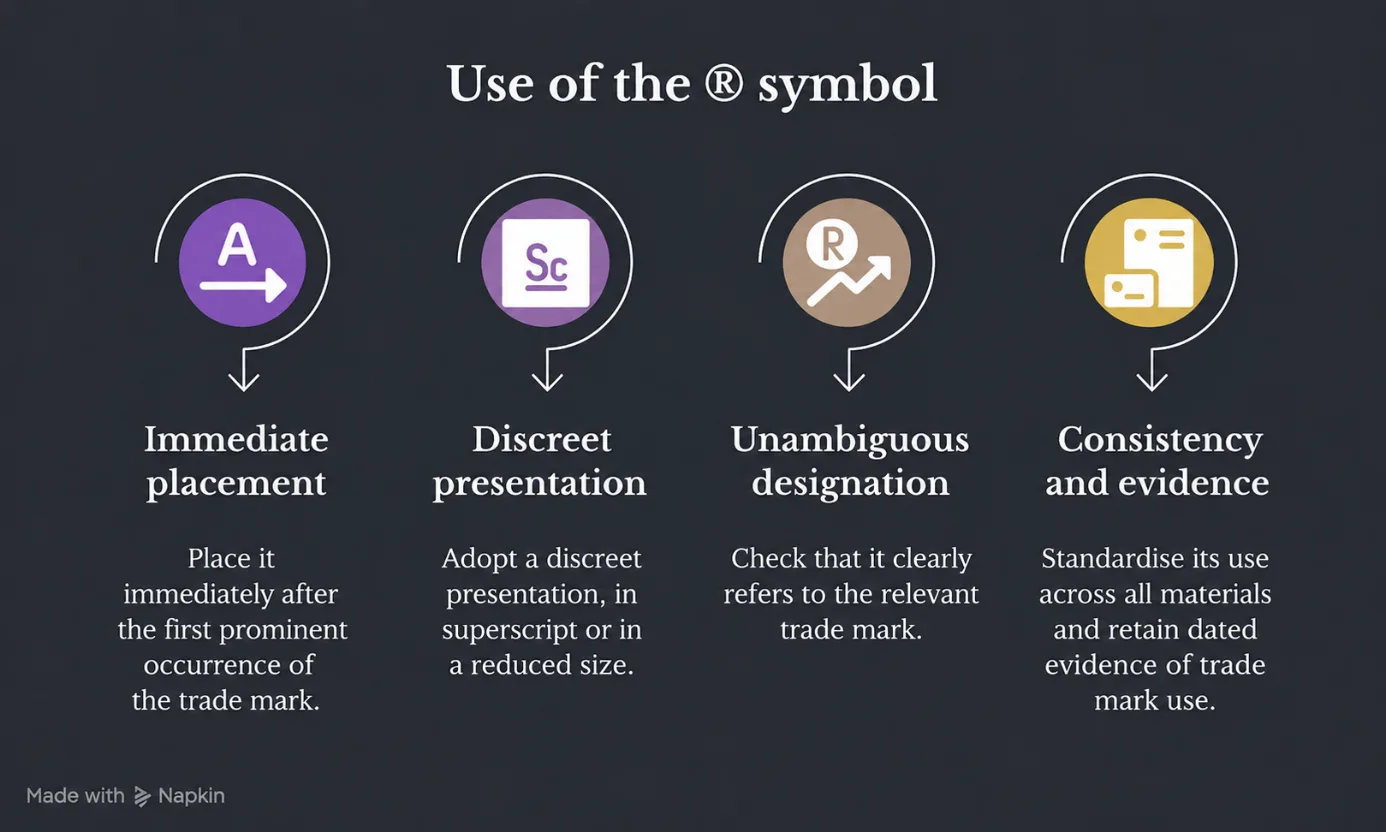
- Place it immediately after the first prominent occurrence of the trade mark: TRADE MARK®.
- Use a discreet presentation, either in superscript or in a reduced size.
- Ensure that it clearly refers to the relevant trade mark, particularly where several signs appear together.
- Harmonise its use and retain dated evidence of the trade mark’s commercial use.
In the OBELIX case, placing the ® symbol separately next to each sign contributed to their being perceived as distinct trademarks.
Conclusion
It is recommended using the ® symbol to protect and enforce a registered trade mark, provided that the validity and territorial scope of the registration have first been verified. The symbol does not generate protection. Its value lies in making the trade mark function more visible, discouraging generic or unauthorised use and supporting the consistency of evidence submitted in a dispute.
The OBELIX decision demonstrates that a graphical detail may have evidential significance when it forms part of a coherent commercial presentation.
Dreyfus Law Firm assists its clients in managing complex intellectual property cases, offering personalized advice and comprehensive operational support for the complete protection of intellectual property.
Dreyfus Law Firm works in partnership with a global network of attorneys specializing in Intellectual Property.
Q&A
Can the ® symbol be used before a trade mark is registered?
A pending application is not yet a registered trade mark. The symbol should normally be adopted only once registration has been granted and only in territories where that registration is effective.
Is the ® symbol mandatory in France or the European Union?
No. Failure to use the symbol does not remove the rights arising from registration. Its use is nevertheless advisable as a means of clarifying the status of the sign and supporting a consistent trade mark protection policy.
What is the difference between ™ and ®?
The ® symbol refers to a registered trade mark. ™ generally signals that a business claims a sign as a trade mark, although registration may not have been obtained. The legal implications of both symbols vary between jurisdictions.
Where should the ® symbol be placed?
It should normally appear immediately after the registered mark, often in superscript: TRADEMARK®. On longer materials, using it after the first prominent occurrence may be sufficient, depending on the applicable brand guidelines.
Can a licensee use the ® symbol?
Yes, provided that the trademark owner has authorised such use and that the trademark is duly registered for the relevant goods, services and territories. The licence or distribution agreement should regulate this use, including the exact form of the trademark, the placement of the symbol, ownership notices and the authorised materials. This helps reduce the risk of presenting the trademark’s legal status inaccurately.
This publication is intended for general public guidance and to highlight issues. It is not intended to apply to specific circumstances or to constitute legal advice.