

Introduction
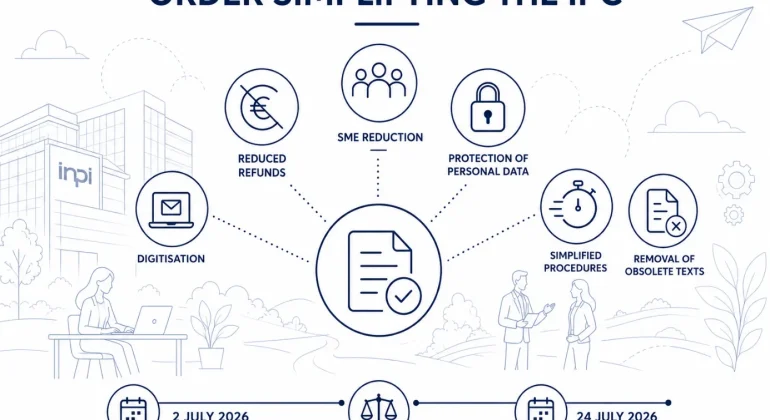
The Order simplifying the French Intellectual Property Code, dated July 8, 2026 and published in the Official Journal on July 23, 2026, completes the reform introduced by Decree No. 2026-576 of June 30, 2026. The Order entered into force on July 24, 2026 and removes several mechanisms that had become incompatible with the digitisation of procedures before the INPI.
The reform directly affects the daily practices of applicants, IP rights holders, employee inventors, companies and professional representatives through electronic notifications, restrictions on fee refunds, a new SME threshold, increased protection of residential addresses, the rectification of trademark oppositions and simplified patent procedures.
Why was an implementing order adopted after the decree?
Decree No. 2026-576 of June 30, 2026 amended 35 provisions of the French Intellectual Property Code to harmonise, simplify and modernise INPI procedures. Subject to specific transitional rules, it applies to pending proceedings from July 2, 2026.
The Order of July 8, 2026 aligns the relevant implementing instruments with this revised regulatory framework. It repeals procedures that are no longer required and updates the wording of the INPI fee schedule.
Abolition of the INPI employee-invention declaration envelope
The Order repeals the Order of August 29, 1985, which governed the use of a special double envelope filed with the INPI for the purpose of transmitting an employee-invention declaration to the employer. However, envelopes filed before the reform entered into force remain subject to the former rules.
The employee’s obligation to report an invention has not been abolished. An employee inventor must still inform the employer without delay and disclose sufficient information for the invention to be classified under the applicable statutory regime. The declaration must now be communicated directly by registered letter with acknowledgement of receipt or by another method capable of proving receipt.
Repeal of obsolete patent, trademark and design instruments
The Order also repeals an Order from September 19, 1979 concerning patent and utility certificate procedures, several trademark orders adopted between 1992 and 1995, and an Order from August 13, 1992 concerning registered designs. These rules had been superseded by subsequent regulatory reforms and the widespread use of online procedures.
Electronic notifications become the standard operational channel
The INPI presents the reform as completing the digitisation of industrial property notifications. An email informs the recipient that a notification is available in the recipient’s personal account on the INPI e-procedures portal. Where no email address is available, a notice may be published in the French Official Bulletin of Industrial Property.
The alert email should not be confused with the procedural document itself. Businesses should monitor the portal regularly, update correspondence details in each relevant application and establish continuity arrangements during holidays, employee absences and staff changes.
Fee refunds become exceptional
The Decree removes several grounds for reimbursement, including certain cases involving inadmissible applications, the termination of patent limitation proceedings, the absence of a required translation for the conversion of a European patent application and the non-transmission of an international application.
The case-law research report fee may still be refunded where preparation of the report has not begun. These rules apply to requests submitted from July 2, 2026.
Applicants should consequently verify admissibility, translations, supporting documents and procedural strategy before paying a fee.
The SME threshold is reduced from 1,000 to 250 employees
For French patent applications filed from July 2, 2026, the workforce threshold for claiming the reduced fee regime is now 250 employees. The applicant must declare its relevant category, SME or non-profit organization, at the filing date. The supporting certificate previously required no longer needs to be attached.
Full residential addresses are no longer published
Where an applicant or rights holder is a natural person, published identifying information is now limited to the person’s surname, given names, municipality and country of residence. The new rules apply to publications concerning patents, trademarks and registered designs.
This measure reflects the data-minimisation principle, under which personal data should be adequate, relevant and limited to what is necessary for the stated purpose.
Trademark opposition and cancellation proceedings
The regulatory decision-making period has been extended from three to four months in trademark opposition and administrative cancellation proceedings. The change also applies to proceedings pending on July 2, 2026.
Certain deficiencies affecting a trademark opposition may now be corrected by completing missing information or submitting missing documents. This possibility does not dispense the opponent from complying with the applicable rules on standing, time limits and substantive admissibility.
Patent and utility certificate procedures
The reform introduces several additional adjustments:
- applicants no longer need to provide a copy of an earlier filing when claiming internal priority if the INPI already has access to it;
- the INPI may prepare the abstract of a patent application itself;
- proposed amendments to a patent may be considered until the end of the oral stage of opposition proceedings, provided that the adversarial principle is respected;
- third-party observations on a utility certificate must be filed within three months of publication;
- printed patent specifications are discontinued.
These changes should be incorporated into internal French patent filing and portfolio-management procedures.
What immediate measures should businesses take?
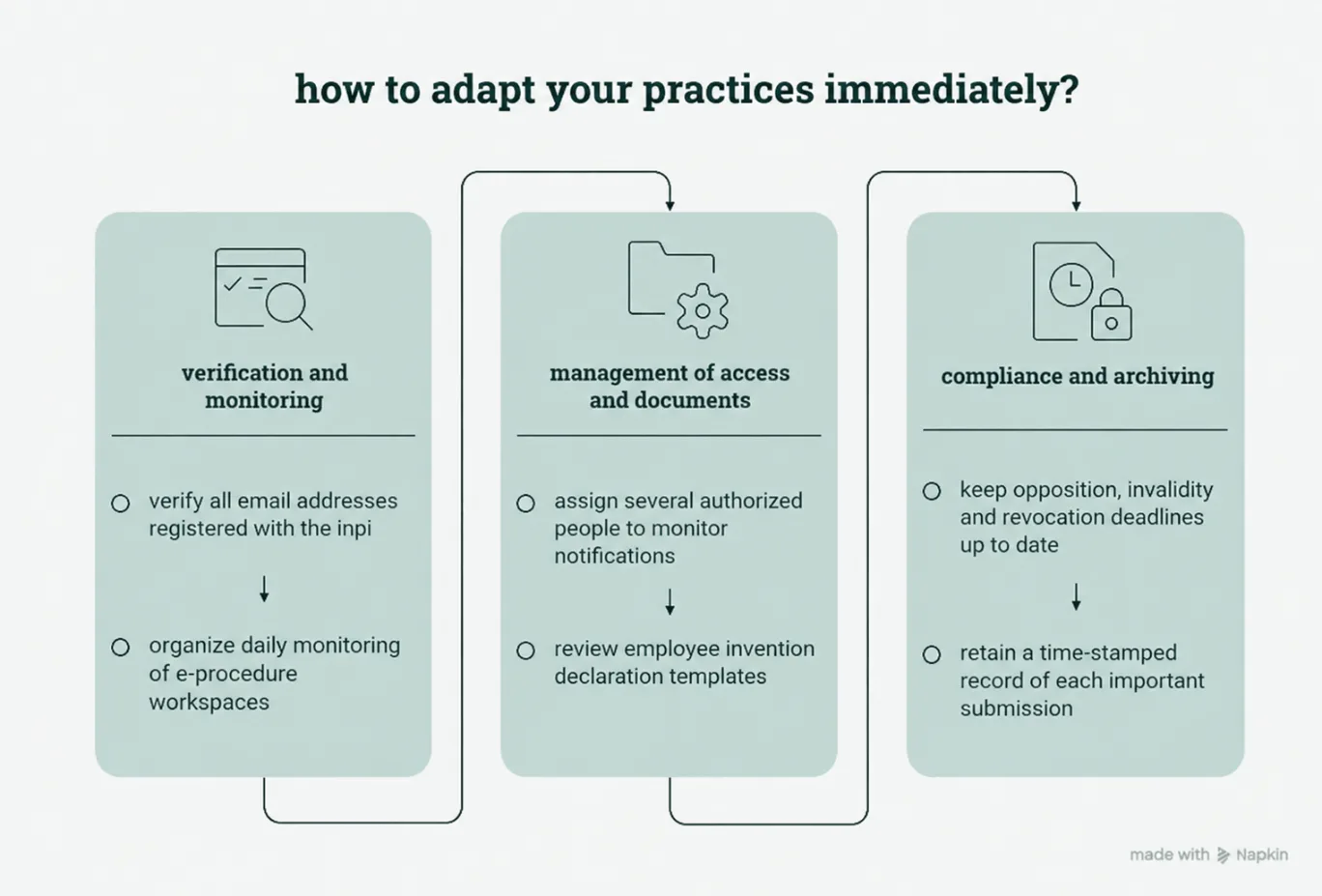
We recommend that businesses:
- verify all email addresses registered with the INPI;
- monitor their e-procedures accounts on a daily basis;
- authorise more than one person to review procedural notifications;
- revise employee-invention declaration templates;
- update opposition, invalidity and non-use revocation calendars;
- retain timestamped evidence of all material communications.
Conclusion
The Order simplifying the French Intellectual Property Code and the Decree of June 30, 2026 remove a number of formalities, but place greater responsibility on applicants to monitor notifications, confirm admissibility and anticipate procedural costs. Digitisation should therefore not be confused with a reduction in the level of legal vigilance required.
Dreyfus Law Firm assists its clients in managing complex intellectual property cases, offering personalized advice and comprehensive operational support for the complete protection of intellectual property.
Q&A
What happens if the email alerting the recipient to an INPI notification is not received?
Failure to receive the email alert should not be treated as meaning that no notification has been issued. Companies should therefore consult their e-procedures account directly and regularly, secure access to that account and establish a back-up procedure for periods when the person responsible for monitoring it is absent.
Should existing powers of attorney, correspondence details or INPI access rights be updated?
The reform warrants an audit of the contact details and access rights associated with each portfolio. In particular, companies should verify the correspondence email address, the identity of authorised users, access permissions for the portal and the arrangements for forwarding notifications between the company and its representative.
Do the new rules also apply to proceedings initiated before July 2026?
The temporal application of the reform depends on the measure concerned. Certain provisions apply immediately to pending proceedings, while others apply only to applications filed or actions initiated on or after July 2, 2026. Each case should therefore be reviewed individually.
Does restricting the publication of residential addresses make applicants completely anonymous?
No. Certain identifying information remains publicly available, including the individual’s surname, given names, municipality and country of residence. The reform limits the disclosure of the full residential address, but it does not remove the public nature of the registers or the identification of the rights holder.
Do fully digital procedures genuinely reduce the risk of missing a deadline?
Digitisation accelerates communications, but it may also create new risks, including expired access rights, outdated email addresses, filtered messages, failures in internal circulation or the absence of the person managing the matter. Procedural security therefore depends increasingly on the company’s internal organisation rather than solely on the operation of the portal.
This publication is intended for general public guidance and to highlight issues. It is not intended to apply to specific circumstances or to constitute legal advice.