

Introduction
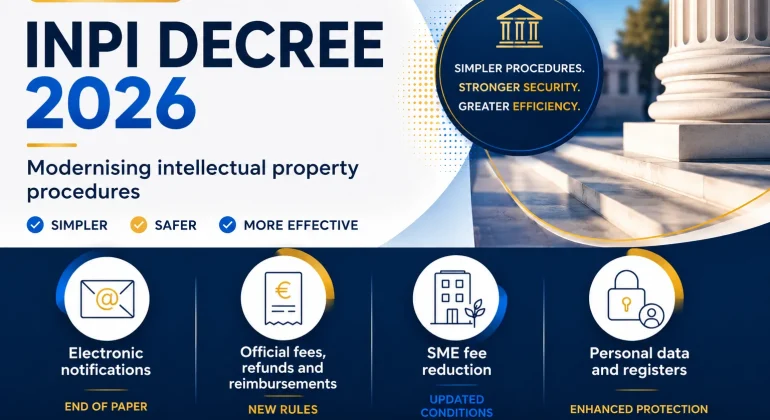
Decree No. 2026-576 of June 30, 2026 modernizes procedures before the French National Institute of Industrial Property and requires companies to strengthen the way they monitor, manage and protect their intellectual property rights. Applicable from July 2, 2026, the decree amends several provisions of the French Intellectual Property Code to simplify exchanges with the INPI, reinforce electronic procedures and improve the protection of applicants’ personal data.
This reform is not merely administrative. It changes the daily management of trademarks, patents, designs, official deadlines, electronic notifications and procedural costs.
Why does the June 30, 2026 decree modernize INPI procedures?
The decree aims to harmonize, simplify and modernize procedures before the INPI. The decree amends 35 articles of the French Intellectual Property Code and applies, subject to certain exceptions, to procedures pending on July 2, 2026.
The policy objective is clear: remove outdated paper-based formalities, align procedural rules across different IP rights and adapt the INPI’s practice to a digital environment. For companies, however, simplification does not reduce the need for vigilance. It requires stronger management of deadlines, e-procedure accounts and internal approval processes.
Dreyfus & Associés can assist companies in navigating these key procedural changes.
Electronic notifications: what should rights holders monitor?
The most visible change is the generalization of electronic notifications. Notifications in the relevant INPI procedures must now be made through an electronic communication method capable of certifying the date of receipt. If the recipient’s email address is unknown, notification may be made through publication of a notice in the French Official Bulletin of Industrial Property.
This development is consistent with the existing digitization of IP procedures. Yet it also shifts the risk. Previously, a registered letter created a tangible alert. Now, the digital portal and the correspondence email address become the operational trigger for procedural deadlines. It is also recommended that you:
- verify all email addresses associated with INPI accounts
- create a dedicated address for official IP notifications
- ensure dual monitoring by the legal team and the IP representative
- integrate INPI notifications into a deadline management system
- preserve evidence of receipt and consultation

Official fees, refunds and SME reductions: what practical consequences?
The decree also changes the rules governing official fees. Fees paid will no longer be reimbursed in the following situations:
- in case of inadmissibility;
- in case of closure of the limitation procedure in opposition proceedings;
- in the absence of a translation when transforming a European patent, or in the event of non-transmission to the World Intellectual Property Organization of an international patent extension request.
This development makes applicants more accountable. A strategic, timing or filing error may no longer be limited to a procedural delay: it may also result in a definitive financial cost. Companies should therefore secure, before filing, the admissibility requirements of their applications, the applicant’s status and the supporting documents required.
In this context, involving an IP/IT attorney from the outset helps secure the procedure, anticipate risks of rejection or inadmissibility and prevent formal errors from turning into irreversible costs for the company.
This measure applies to all applications filed as from July 2, 2026.
Is the SME reduction still available under the same conditions?
As a reminder, official fees are due for the filing, examination and grant of a patent, as well as for its maintenance in force. However, Article L. 612-20 of the French Intellectual Property Code provides for certain situations in which the amount of these fees may be reduced, in particular where the applicant qualifies as a small or medium-sized enterprise (SME).
The decree harmonizes the definition of small and medium-sized enterprises by aligning it with the European definition, with a threshold of 250 employees instead of 1,000 (Article R. 613-63 of the French Intellectual Property Code). As a result, from July 2, 2026, the benefit of the SME reduction will only be granted to companies meeting this definition. In addition, the request must now be made at the time of filing, which requires a prior assessment of eligibility. For groups, subsidiaries or structures with cross-shareholdings, it is not sufficient to look at headcount in isolation: the shareholding structure and links between entities must be reviewed before any request is filed.
This new SME definition applies to requests made as from July 2, 2026.
In addition, requests for fee reductions must now be submitted at the time of filing, rather than within one month following filing. The applicant must also indicate, at this stage, the category under which the reduction is being requested, namely, SME or nonprofit organization.
Personal data and registers: what protection for applicants?
The decree strengthens the protection of personal data published in IP registers and in the French Official Bulletin of Industrial Property, thereby aligning the system more closely with CNIL requirements. For individuals, the published identification is limited to the surname, first names, municipality and country of residence. This development concerns, in particular, trademarks (Article R. 712-8 of the French Intellectual Property Code), designs (Article R. 512-10 of the French Intellectual Property Code) and patents.
This creates a useful balance: IP registers must continue to inform third parties and ensure legal certainty, without unnecessarily exposing complete home addresses. Independent inventors, designers, sole traders and creators therefore benefit from stronger privacy protection.
Trademarks, patents and designs: what new practices should companies adopt?
- For trademarks, oppositions may now be regularized in certain inadmissibility situations. This reduces the risk of rejection based solely on formal defects when missing elements can be completed. In parallel, the decision period for trademark opposition and cancellation proceedings is extended from three to four months, including for proceedings pending on July 2, 2026.
- For patents, the reform removes the printing of patent fascicles and modernizes several procedural steps. The INPI may establish the patent abstract, and proposed amendments may be introduced in patent opposition proceedings until the end of the oral phase, provided the adversarial principle is respected.
- For designs, attention should focus on the consistency of declared information, confidentiality of personal data and electronic monitoring of notifications.
Conclusion
The June 30, 2026 decree marks an important step in the modernization of French intellectual property procedures. The reform should be understood as a call for stronger operational management of intangible assets. Intellectual property rights are not protected only by filing; they require continuous, documented and anticipatory monitoring.
Dreyfus & Associés assists its clients in managing complex intellectual property cases, offering personalized advice and comprehensive operational support for the complete protection of intellectual property.
Q&A
What practical checks should be carried out before filing with the INPI?
Applicants should review the filing project before submission: exact identity of the applicant, authority of the signatory, supporting documents, possible translations, eligibility for fee reductions and consistency of the protection strategy. This preliminary review helps reduce the risk of inadmissibility and non-recoverable costs.
How can companies organize electronic notification monitoring in practice?
A robust process should include a dedicated email address for official notifications, secure shared access to the e-procedures portal and dual monitoring by internal teams and the IP representative. The aim is to prevent a notification received during an absence or busy period from triggering a deadline without effective follow-up.
What evidence should be kept after a filing or notification?
Companies should retain acknowledgements of receipt, filing confirmations, payment receipts, correspondence with the INPI, proof of portal consultation and copies of the documents submitted. These records are useful for case management and may become decisive in the event of a dispute, regularization or portfolio audit.
Does the reform require companies to review their internal approval procedures?
In practice, yes. Although the decree does not impose a general internal audit obligation, it makes validation errors more sensitive, especially where official fees are no longer refundable. Internal workflows should therefore enable fast, documented and legally secure decisions before each filing or response to the INPI.
Why is support from an IP/IT attorney becoming more strategic?
Because the reform shifts part of the risk to the preparation of the file and the operational monitoring of deadlines. An industrial property attorney can help qualify the applicant, anticipate irregularities, review supporting documents, secure fee reduction requests and integrate these new requirements into a broader portfolio strategy.