


Introduction
A collective trademark or guarantee trademark should be selected according to the legal promise made to the public. Where the sign tells consumers that an operator belongs to an organised group, the collective trademark is generally appropriate. Where it indicates that goods or services satisfy defined characteristics controlled by a proprietor that remains independent from supplying them, the French guarantee trademark is the relevant tool. This classification determines who may file, how the regulations of use must be drafted, how authorised users are supervised and, ultimately, whether the right remains defensible. The French trademark reform introduced by Ordinance No. 2019-1169 of November 13, 2019, which entered into force on December 15, 2019, notably overhauled the collective trademark regime by expressly distinguishing certification trademarks from collective trademarks, each of which is now governed by a separate legal framework. The chosen status must be expressly indicated at the time of filing. It is therefore important to determine the intended function of the sign in advance, before defining its name, logo or governing regulations.
What is the difference between a collective trademark and a guarantee trademark?
A collective trademark identifies membership of an organised group
Article L. 715-6 of the French Intellectual Property Code defines a collective trademark as a trademark distinguishing the goods or services of persons authorised to use it under its regulations of use. Its core function is therefore to indicate a collective commercial origin: the user belongs to the association, network or group that owns the trademark. The regulations may impose strict membership and use requirements, but the trademark is not primarily designed to certify an objectively defined level of quality.
A guarantee trademark attests to controlled characteristics
Under Article L. 715-1 of the French Intellectual Property Code, a French guarantee trademark distinguishes goods or services whose material, method of manufacture or performance, quality, accuracy or other characteristics are guaranteed. The proprietor must remain neutral and may not carry on a business supplying goods or services of the same kind as those guaranteed. The 2019 reform deliberately replaced the former French expression “collective certification trademark” with “guarantee trademark” to avoid confusion with conformity certification under French law.
Which practical test should be applied before filing?
- “This operator belongs to our network”: a collective trademark will usually reflect the intended function.
- “This product or service complies with a verified standard”: a guarantee trademark will generally be more coherent.
- The future proprietor itself supplies the same type of goods or services: a guarantee trademark is legally unsuitable.
Who may own and use these trademarks?
A collective trademark requires a legally organised collective
Article L. 715-7 of the French Intellectual Property Code limits ownership to associations or groups with legal personality representing manufacturers, producers, service providers or traders, and to legal persons governed by public law. A standalone trading company does not become eligible merely because it wishes to let several commercial partners use the same sign.
A guarantee-trademark proprietor must remain independent over time
Any natural or legal person, including a public-law entity, may apply for a French guarantee trademark provided that it does not supply goods or services of the same kind as those guaranteed. The requirement continues after registration: losing that neutrality may expose the trademark to revocation. The proprietor does not necessarily have to be an accredited certification body, accreditation information is required where the applicable legislation makes the corresponding certification mandatory. The INPI expressly distinguishes guarantee, control and collective membership.
How should legally robust regulations of use be drafted?
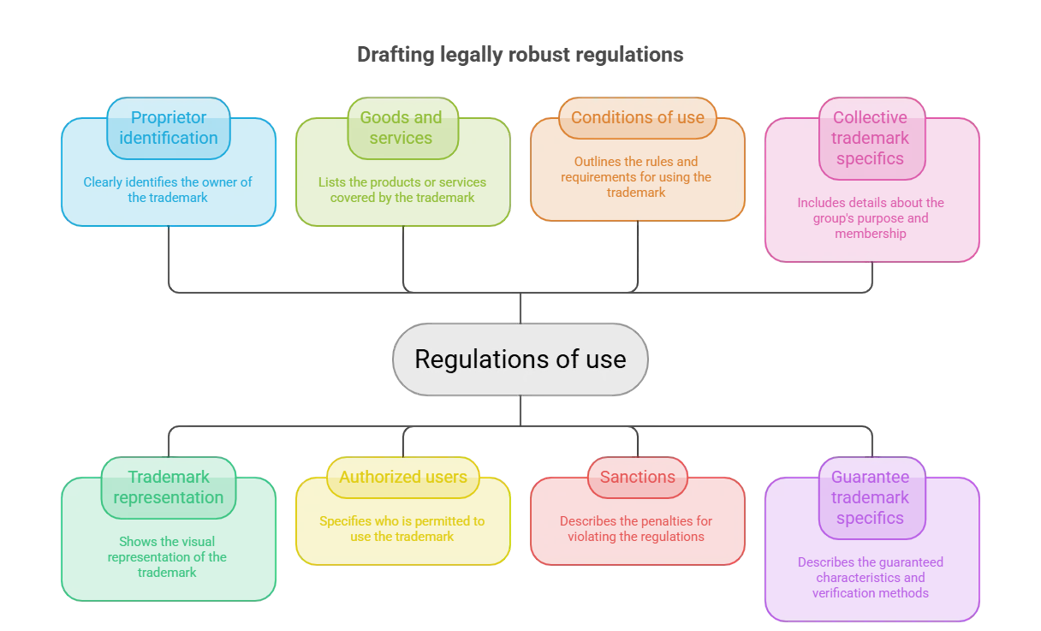
The regulations of use are both the legal charter for the sign and the operational benchmark for control. Articles R. 715-1 and R. 715-2 require both categories to identify:
- the proprietor,
- representation of the trademark,
- goods and services,
- authorised users,
- conditions of use,
- sanctions.
A collective trademark must also state the purpose of the group, its representative bodies and, where relevant, membership conditions. A guarantee trademark must describe the guaranteed characteristics, verification method, monitoring of use and any legally required accreditation data.
In practice, we seek a genuine mirror effect between the sign, the specification of goods and services and the regulations. A sign suggesting a “label” or certification without a coherent control mechanism may mislead the public. Conversely, rules drafted with excessive technical detail can freeze the scheme and generate repeated non-compliance. They should be precise enough to audit, operational enough to enforce and flexible enough to evolve. Later amendments must be notified to the INPI, and the proprietor must take reasonable measures against non-compliant use if the right is to remain secure.
How can a filing be secured in France and the European Union?
The legal classification should be settled before filing. Beyond the special regulations, the sign must also meet the ordinary validity requirements for trademarks. We therefore recommend a prior-rights review and an accurate goods-and-services strategy. Our trademark law page sets out the principal checks to carry out before registration.
At EU level, the functional counterpart of the French guarantee trademark is the European Union certification trademark. The EUIPO also imposes a neutrality requirement and specifies that an EU certification trademark cannot certify the geographical origin of goods or services. Regulations of use must be filed within two months of the application. An EU filing therefore requires a fresh review of the sign, proprietor, certification scheme and any potential conflict with protected designations of origin or geographical indications.
Before filing, we verify five points:
- the precise promise conveyed by the sign;
- eligibility of the proprietor and intended users;
- consistency between the sign, regulations and goods or services;
- availability of the sign and earlier rights;
- the practical ability to monitor use and enforce sanctions.
- For a more general overview of the issues involved in trademark filing and management, we invite you to consult our article: “How to build a trademark filing and management strategy in 2026 to secure, structure and anticipate risks?”.
Conclusion
Choosing between a collective trademark and a guarantee trademark means choosing a governance architecture. The first federates members around a collective commercial origin; the second gives credibility to a promise concerning verifiable characteristics under the responsibility of an independent proprietor. Accurate classification, workable regulations of use and genuine supervision are the three conditions that turn the sign into a durable asset rather than a source of legal vulnerability.
Dreyfus Law Firm assists its clients in managing complex intellectual property cases, offering personalized advice and comprehensive operational support for the complete protection of intellectual property.
Dreyfus Law Firm works in partnership with a global network of attorneys specializing in Intellectual Property.
Nathalie Dreyfus, with the assistance of the entire Dreyfus team.
Q&A
Can a collective trademark or guarantee trademark be assigned to a third party?
An assignment is possible only if the assignee satisfies the statutory eligibility rules for the relevant category. A guarantee-trademark assignee must in particular remain independent from the supply of the guaranteed goods or services, while a collective-trademark assignee must have the legal status required to own that type of trademark.
What should be done when a former member continues to use a collective trademark?
The regulations of use, evidence that membership has ended and the manner in which the sign continues to be used should be reviewed immediately. Depending on the circumstances, a cease-and-desist letter, the contractual or regulatory sanctions provided for by the scheme, and trademark enforcement may be appropriate.
Can a French guarantee trademark be extended unchanged as an EU certification trademark?
Automatic transposition is risky. The EUIPO applies its own substantive requirements, including the exclusion of geographical origin from the certification function. The sign, specification, proprietor’s status and regulations of use should therefore be re-audited before an EU application is filed.
Can a collective trademark contain a geographical indication?
The answer depends on the territory and the function of the sign. EU trademark law provides a specific route for certain geographical indications in collective trademarks, whereas the French 2019 reform did not adopt the corresponding derogation from the distinctiveness requirement. Existing PDO and PGI rights must in all cases be cleared before filing.
How often should the regulations of use be audited?
No single statutory timetable replaces a risk-based review. An audit is particularly appropriate when new users join, the technical standard changes, control procedures are modified, territorial protection is extended or the proprietor changes its own commercial activities.
This publication is intended for general public guidance and to highlight issues. It is not intended to apply to specific circumstances or to constitute legal advice.