Unicorns, those private companies characterized by innovation and whose valuation reaches or exceeds one billion dollars, prefer short domain names (1). This was considered by researchers at the Stanford University Graduate School of Business and reported by one of the professors, Ilya Strebulaev, on LinkedIn.
On average, unicorns use domain names composed of 8.4 symbols, thus domain names with less than 7 characters have a 36% chance of belonging to unicorn companies. One reason for this result is that short domain names are more likely to attract consumers. Being more attractive, these names are also more expensive to resell. Therefore, once a company enters the unicorn category, it can afford to change its domain name to a shorter one.
Therefore, when creating a company, the search for priorities on the envisaged name is essential both on a legal and marketing level. The search for the domain names makes it possible to identify the names that are relevant to the foreseen activity. Occasionally, they will not be a problem from a legal perspective because they are not used or are used for very different activities. On the other hand, if the .COM or .FR corresponding to the sign is available, it allows the avoidance of a repurchase attempt which can be refused or sometimes accepted for an amount in 6 or 7 figures.
Trademarks are a key intellectual property asset for companies of all sizes. They enable you to differentiate your products and services from those of competitors and provide legal protection allowing you to defend your protected names and logos. If you are considering filing a trademark benefiting from protection throughout the European Union (EU), this article briefly explains the different steps to follow.
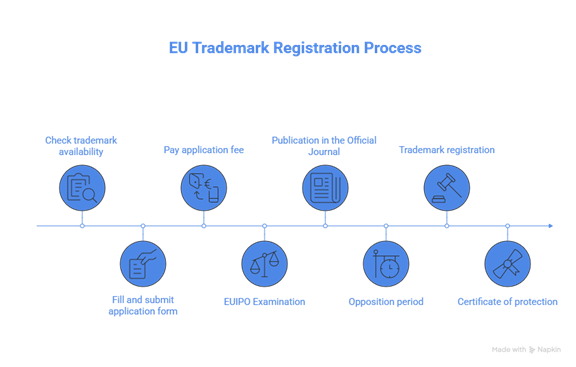
Step 1: Prior art search
The first step is to verify the availability of the trademark you wish to file. Before any filing, it is essential to carry out a “prior rights search” to ensure that the name or logo you wish to protect is not already registered by a third party for identical or similar products or services. This approach helps to prevent the risk of future legal conflicts.
At first, the EUIPO’s trademark search tool is a good starting point to obtain an initial indication of any identical prior rights, both among EU trademarks and national trademarks of the various EU member states.
For an EU trademark project, it is generally essential to carry out a more in-depth search. This can be done with the assistance of an intellectual property attorney who has access to specialized tools and the expertise necessary to identify not only identical but also similar trademarks that basic identity searches may miss.
If no blocking prior rights are detected, you can then move confidently to the next step of the filing process.
Step 2: Filing of the trademark
The second step is to complete a trademark application form. This form must include several pieces of information: the name of the trademark and/or logo, the name of the company that will own the trademark, its contact details, and the classes of the goods and services covered. Drafting the specification of goods and services should be done with the assistance of an attorney. Once the form is completed and submitted, you must pay a so-called “filing” fee.
Step 3: Examination of the trademark application
The third step is no longer under your control. Once the trademark application has been submitted to the EUIPO, it will undergo a rapid examination of the substantive and formal conditions that every trademark application must meet, including notably:
Are the goods and/or services for which your trademark is filed correctly classified?
Has the application been correctly completed?
Has the fee been paid?
Please note: the EUIPO does not carry out a prior check of your trademark’s availability in relation to trademarks already registered in the European Union. However, it informs holders of earlier rights when a trademark application appears similar to their rights.
After this examination, the EUIPO will publish your trademark application in the Official Journal of the European Union. This informs third parties of your filing. From the date of publication, third parties have three months to oppose the registration of the trademark if they believe it infringes their own rights.
Step 4: Trademark registration
At the end of the examination process, the trademark is either accepted or refused for registration. If accepted, you will receive a digital registration certificate. This certificate provides proof of the legal protection granted to your trademark in the EU.
Finally, keep in mind that the EU trademark is protected for 10 years and is indefinitely renewable at the end of the initial protection period. A renewal fee must be paid to extend the protection for a new 10-year period.
Conclusion
To register a trademark in the EU and maintain its protection, each of these steps must be followed. The prior rights search is an essential prerequisite as it helps ensure, as far as possible, that no opposition will be filed after your trademark application.
Dreyfus & Associés can assist you at every stage of your trademark filing, from the prior rights search to its official registration, to secure your rights effectively.
1. What is an EU trademark and what are its advantages? An EU trademark (EUTM) is a single title granted by the EUIPO which provides uniform protection in all 27 Member States. It simplifies and centralizes the filing, management and enforcement of your rights in the EU.
2. How much does it cost to file an EU trademark?
Official fees start at €850 for one class of goods or services. Additional fees apply for each extra class. Attorney’s fees are charged separately.
3. Is it better to file a national trademark or an EU trademark? This depends on your objectives and geographic scope. Filing a national trademark is often suitable for companies that are just starting out and targeting only the French market. However, opting from the outset for an EU trademark offers the advantage of a single protection in 27 Member States and anticipates future expansion of the project to other countries, even if the activity initially remains focused on France.
4. Is a prior rights search mandatory before filing a trademark?
It is not legally mandatory but is strongly recommended to identify identical or similar trademarks already registered and reduce the risk of opposition.
5. What happens if I forget to renew my trademark?
Do not worry: if you forget to renew your trademark at the end of the 10-year period, the law provides for a six-month grace period from the date of expiration. During this period, you can still renew and preserve your rights, but an additional fee will be charged on top of the standard renewal fee. After this period, the trademark falls into the public domain and must be refiled to regain protection.
Registering a trademark is one of the most important steps in protecting it. A trademark is a sign or symbol that distinguishes your products and services from those of your competitors, and it can be a valuable asset for your business. But if you want to register a trademark in the EU, you will need to work with a lawyer or, more specifically, an Industrial Property Attorney (IPA), a professional specially qualified to assist you in this area. This article explains the cost of registering a European trademark when you seek the assistance of a lawyer or industrial property attorney.
Preliminary step: eligibility of the proposed sign as a trademark
The first step in the process of registering a trademark with a lawyer or industrial property attorney in the EU is to determine whether your trademark is eligible for registration. Under European law, a trademark must be capable of distinguishing the goods or services of its owner from those of other companies. It must also meet other strict criteria:
Non-descriptive character: the trademark must not consist exclusively of signs describing the quality, quantity, intended purpose, value, or origin of the goods/services designated.
Non-generic nature: the trademark must not consist of signs or indications that have become customary in the current language of trade.
The sign must not be contrary to public policy or morality.
The sign must not be deceptive, i.e., it must not be likely to mislead the public as to the nature, quality, or origin of the goods or services.
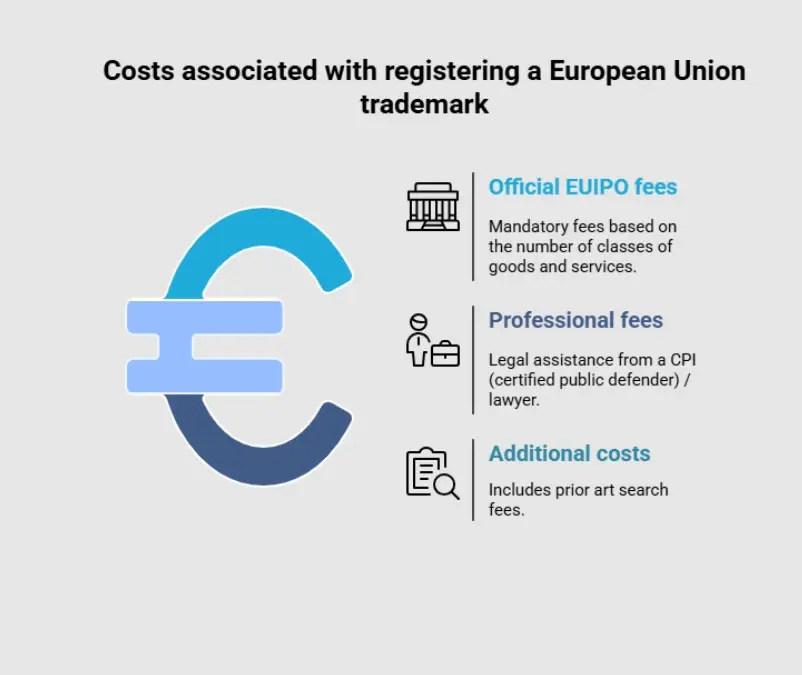
The next step is to determine the cost of registering a trademark with a lawyer or industrial property attorney. The cost of registration varies depending on the number of classes of goods and services designated. In addition, the fees of the lawyer or industrial property attorney must also be considered, as well as optional costs such as those related to prior art searches.
Application submission and registration
Once the registration cost has been determined, you will then need to file an application with the EUIPO (European Union Intellectual Property Office). This application must include all the necessary information about your trademark, the subject of the registration, such as the sign (word mark or logo) and the classes of goods and services designated. The EUIPO will then examine your application.
If there are no oppositions filed against the trademark application, the registration process, from the date of filing to official registration, generally takes around four to six months.
Once accepted by the EUIPO, the trademark will be officially registered for a period of 10 years and you will receive a registration certificate.
2025 Update: What you need to know about official taxes
To ensure that this article remains up to date, it is important to note that the official filing fees of the European Union Intellectual Property Office (EUIPO) are subject to annual adjustments. It is essential to check the official fee schedules directly on the EUIPO website at the time of filing each year.
For example, in 2024, the basic fees for a European Union trademark (EUTM) covering one class have generally remained stable compared to 2023, but an increase in agency fees and specialized prior art search fees should be anticipated.
The importance of using an Industrial Property Attorney remains unchanged, as this professional ensures that your application complies with current regulations and administrative practices of the EUIPO.
Conclusion
The cost of registering a European trademark with a lawyer or industrial property attorney is an important consideration for any company wishing to protect its trademark. Although the cost of registering a trademark may vary, it remains a necessary and significant investment in the protection of your intangible assets, guaranteeing you protection for a minimum of 10 years (a trademark can be renewed indefinitely).
Dreyfus & Associés assists its clients in managing complex intellectual property cases, offering personalized advice and comprehensive operational support for the complete protection of intellectual property.
The European Union Intellectual Property Office (EUIPO) is the entity responsible for registering European Union trademarks (EUTMs).
2. Is a prior art search mandatory before filing a trademark?
A prior art search is not strictly mandatory for filing a trademark with the EUIPO, but it is strongly recommended. It allows you to check whether an identical or similar trademark already exists and to assess the risks of opposition, thus avoiding unnecessary costs and procedures.
3. What rights does registering a European Union trademark with the EUIPO confer?
Registering a European Union Trademark (EUTM) with the EUIPO provides uniform protection in all current EU member states. The filing fees cover this pan-European protection.
4. How long is a European trademark valid for?
The registration of a European Union trademark (EUTM) is valid for a period of 10 years from the date of filing the application and is renewable indefinitely for periods of 10 years.
5. What is an opposition procedure and how does it affect the registration timeframe?
An opposition procedure is legal action brought by the owner of an earlier trademark who believes that your new trademark application infringes on their rights. If an opposition is filed, the registration timeframe can be significantly extended (often by more than a year) and requires the intervention of your attorney or industrial property attorney to reply to the opposition.
Paris Judicial Court, 3rd section, April 5, 2022, 20/12763
Sun Consulting SARL and M. Y W vs H&M Hennes & Mauritz LP et H&M Hennes & Mauritz SARL
In a judgment dated April 5, 2022, the Third Chamber of the Paris Court of Justice ruled on an infringement action between the European Union trademark “CREMIEUX” covering clothing, footwear and apparel products and the trademark “RUE CREMIEUX” under which perfumes are marketed.
In this case, despite the plaintiffs’ argument that stated that clothing and perfumes were similar goods regarding their complementarity and the close connection of their aesthetic function, the Court rejected the infringement action for lack of similarity between these products.
The owner of a trademark may prohibit the use, without their consent of a sign identical or similar to their trademark by a third party. This is to be noted in such circumstances, for example
• when such use occurs in the course of a trade,
• when relating to identical or similar goods and services to those for which the trademark has been registered and
• when there is the possibility for a likelihood of confusion, ie. undermining or initiating liability that could undermine the guarantee of the identity of origin, which is an essential function of the trademark.
Although French and European courts regularly encounter the issue of similarity between perfumes and clothing, uncertainties persist concerning the assessment of this similarity.
Which factors should be used to assess the degree of similarity between goods?
On several occasions, the Court of Justice of the European Union has stated different relevant factors to be used in assessing the degree of similarity between goods or services. The nature, purpose, use, distribution channels, or the competitive or complementary nature of the goods or services concerned, are taken into account.
Nevertheless, if such criteria is lacking, the European Court of Justice admits that a degree of similarity can remain if the goods present a certain aesthetic complementarity.
This complementarity will be retained when three cumulative conditions are fulfilled.
i) One product must be indispensable or important over the use of another.
ii) Consumers must consider the use of the goods together as usual and normal.
iii) Consumers must consider it common place for these goods to be marked under the same trademark.
The Court of Cassation (Supreme Court) adopts a different approach in comparison to that of the Court of Justice, whereby they look at whether the consumer is able to attribute to a common origin the goods and/or services at issue. However, if this interpretation is applied too widely, it could lead to qualifying goods as similar, thereby confirming that a risk of confusion is not altogether impossible or out of the question.
Even though the condition of trademark infringement must be interpreted in light of the risk of confusion, Article 9 of Regulation 2017/1001 states that the concept of similarity is both a necessary condition and an interdependent criteria of the risk of confusion. Therefore, the similarity of goods or services cannot depend on the possibility of a likelihood of confusion as it is the latter that depends in part on the similarity.
Can perfumes and clothing be considered similar goods under these factors?
In the present case, the Third Chamber of the Court of First Instance, considers that clothes and perfumes do not share the same nature or purpose and are not usually sold in the same stores.
Although they may have a similar function of enhancing the wearers appearance, this function is secondary and not convincing.
The primary function of clothing obeys and follows the rules of a purely functional purpose while perfume has for finality, the diffusion or intermingling of a pleasant smell. Therefore, the common use of both clothes and perfume during daily outdoor activities is not sufficient enough to characterize a relevant factor of similarity.
But what about aesthetic complementarity?
The Court found that perfumes were not important or even indispensable for the use of clothing, and that clothing was not important for the use of perfumes either.
This judgment may seem surprising regarding the jurisprudence issued by the Court of Appeal on the similarity between perfumes and clothing.
Indeed, in a decision dated September 23, 2021, the Court of Appeal of Aix-en-Provence had recognized as justified, the opposition to the registration of a trademark filed with the INPI for clothing. This was purely on the basis of an earlier trademark registered for perfumes and cosmetics.
The decision by the Court of Appeal was mainly based on the presence of identical distribution networks.
The Court of Appeal also attributed a significant role to the aesthetic function, which, according to the Court of Justice, cannot be considered as a sufficient factor.
This trend, which aims to make the principle of speciality more flexible, is mainly reflected in the luxury sector where well-known trademarks are very present.
In consideration of this fact, many decisions recognize the similarity between goods in class 3 (perfumes and cosmetics), goods in class 25 (clothing) or even classes 14 (jewellery) and 18 (leather goods).
Indeed, houses such as Louis Vuitton or Maison Margiela offer both clothes for sale and, to conquer a wider audience, perfumes. However, this diversity of products can also be found in non-luxury brands, with different ranges, such as Zara or Lacoste.
In this judgment, the Court of Justice goes against a French jurisprudential trend which qualifies perfumes and clothing as similar. Furthermore, according to the Third Chamber of the Court, the fact that fashion companies market perfumes under their own brand name, cannot be a sufficient factor to make these products similar.
Is it impossible to file an infringement action against a trademark offering perfumes for sale on the basis of an earlier trademark registered for clothing? And is this also the case vice versa?
In retrospect, it must be noted that even though it may not be necessarily so, the decision shows that the chances of success could very well be limited.
Nevertheless, French courts do not yet give a unified and homogeneous answer on this subject and decisions remain casuistic and sophistically cautious.
For example, the Paris Court of Appeal recently ruled in a decision dated September 14, 2022 that there was a risk of confusion between an earlier trademark filed for perfumery and cosmetics and a trademark intended to designate clothing. To determine this similarity, the Court based its decision on the fact that these products belong to the field of fashion, have the same aesthetic function, are targeted at the same clientele and can be marketed under the same trademarks by the same companies and distributed through the same distribution network.
Therefore, we will surely have to wait for the Court of Cassation‘s decision on this matter to obtain a standard and clearer answer in determining and ensuring a more specific and higher level of legal security and protection for trademark owners.
We offer our clients a dedicated and unique experience of expertise that is necessary for the exploitation of intangible assets. We will also endeavor to keep you informed and up-to-date about intellectual property and digital economic issues through our articles and newsletters written by the Dreyfus Legal Team.
NFTs, or non-fungible token is one the biggest digital revolutions of our century. An NFT is a digital token operating on a blockchain.
Because it is non-fungible, an NFT guarantees someone’s property over a digital artwork. When it is combined with an artwork, an NFT can be considered as a certificate of authenticity.
Although an NFT is a revolution within the digital world, some issues may be raised. In fact, what about artists’ copyrights in this digital environment? How can artists’ copyrights be protected within NFT platforms? Can an NFT platform be held liable for copyright infringement? There are many proposals for reasonable responses called forth by intellectual property attorneys.
Everybody can sell or buy digital artworks on a blockchain. Therefore, what about platforms’ liability? If every one of us can sell or buy artworks, there is absolutely no guarantee that the artworks has been put on the platform by its author. As such, it is fairly common that an artwork put on a blockchain infringes the author’s copyrights. In such case, it is crucial that the author defends for their rights in collaboration with the intellectual property attorneys.
The answer to know whether an NFT platform can be held liable for copyright infringement has been raised in the case Shenzhen Qice Diechu Culture Creation Co. Ltd v. Hangzhou Yuanyuzhou Technology Co., Ltd a.k.a “Chubby tiger having its shot”.
In this case, Ma Qianli, the author of the cartoon at stake gave to Shenzhen Qice Diechu Culture Creation an exclusive license to use his copyright over the “Chubby tiger having its shot” artwork. Defendant, Hangzhou, owns an NFT platform. This latter authorized a third party to sell NFT derivative products of the “Chubby tiger having its shot” artwork. Shenzhen then brought a lawsuit for copyright infringement against the NFT platform.
This decision is important for two reasons. Firstly, it is the first decision where copyright infringement is involved on an NFT platform in China. Secondly, the action is brought against an NFT platform.
The first question raised by this case deals with NFT platforms liability. By definition, a blockchain is decentralized. That means that nobody nor any entity checks the identity of a person.
Therefore, NFT platforms do not check the paternity of an artwork linked to an NFT. A person can sell or buy NFT-artworks and it is not even the author nor a licensee. Hence, counterfeit artworks can freely circulate on NFT platforms, infringing artists/creators’ copyrights.
Because it is difficult to sanction platforms when a content is illicit or infringe someone’s copyright, it is rare for authors to assert their rights on the Web 3.0.
In this case, defendant raises some arguments to avoid liability. First of all, defendant mentions that his platform is a third-party platform. Artworks are downloaded by the platform’s users. This latter cannot be held liable for its users’ activities. Thus, the platform put the concerned NFT on its address form. Therefore, it fulfilled its notification/deletion obligation. At last, a platform cannot divulgate which blockchain has been used nor where the NFT is.
The Internet Tribunal refuses the arguments raised by defendant. In fact, it considers that the platform at stake is a professional platform. Consequently, the Tribunal highlighted a major distinction between NFT platforms. Here, the platform is considered as being a professional NFT platform. The underlying idea is that as soon as a platform is qualified as professional, its liability can be engaged for copyright infringement.
Even though the Tribunal does not when an NFT platform is a professional, it can still be deduced. In fact, the platform at sake is qualified as professional because it proposed transactional services. Consequently, it is a professional NFT platform when it invoices certain percentages fees for each transaction.
Because a transaction has been made and because the platform obtained a financial gain, the platform must fulfil higher obligations when it comes to copyright protection. For example, a professional platform must proceed with preliminary examination regarding the digital artworks’ property that are sold or bought on their platforms. This activity may be efficiently conducted in collaboration an intellectual property attorney.
The Tribunal here considers that the platform failed its duty of care. In this regard, when an NFT platform is professional, it must put in place reasonable measures to check the artworks’ property once they are put on a blockchain by askingto the seller/artist to prove the artworks’ copyright.
The first Chinese NFT copyright infringement was made against a platform since the appellant could not obtain the name of the seller. Claimant, during the proceeding, asked for the seller’s identity in order to sue him for copyright infringement. Consequently, this case is not over yet.
Nevertheless, this case set the pace as for NFT platforms. This decision can be seen as a warning for every NFT platforms which will have to be careful regarding each NFT digital artworks sold or bought on their platforms.
This agreement will set out AFNIC‘s work priorities for the years to come. One of the main aims is the development of the <.fr>.
The growth of the <.fr> will be achieved through concrete actions such as helping companies in their digital transition. In fact, AFNIC has implemented a support system to enable SMEs and VSEs to develop their presence online.
In this Convention, AFNIC has committed to investing 2% of its turnover in order to apply tariff cuts as well as to simplify registration interfaces and to organise a faster and more efficient data management system.
AFNIC has also committed to investing 10% of its turnover in innovation to consolidate its social and environmental responsibility and is committed to achieve carbon neutrality for the <.fr>.
AFNIC and the French State wish to continue the work that has already been started with the aim of developing and strengthening the <.fr>.
The Palestinian territory is the subject of much controversy, however, trademark rights are not as insignificant as they might seem.
There are several reasons why the Palestinian market should be considered in a Middle East brand protection strategy. In fact, despite the separation of the Israeli and Palestinian legal systems, it is almost impossible to separate the two markets into two jurisdictions.
How to protect your trademark rights in Palestine?
There are a number of elements that illustrate the obvious geographical and commercial links that confirm that, in order to ensure full protection of trademark rights in the Middle East, it is essential to register trademarks not only in Israel, but also in Palestine. For Palestine, it is necessary to register trademarks in both the West Bank and Gaza, which have separate trademark jurisdictions. Naturally, Israeli and Palestinian jurisdictions require separate registration in each territory in order to fully protect and enforce trademark rights. However, obtaining protection in Israel is far from providing full protection if the mark has not been registered in Palestine. The opposite is also true.
So, what are the reasons for registering trademarks in both Israel and Palestine?
This is due to the geographical situation between Israel and Palestine. The economic reality is clear: 80% of Palestine’s foreign trade is with Israel.
This necessarily has an impact on the circulation of goods and services in the region. It is therefore advisable to register trademarks in both Israel and Palestine if you want to protect your trademark in the Middl East.
Thus, given the obvious geographical and commercial links between the two states, it seems crucial to have valid registrations in three different jurisdictions, namely Israel, the West Bank and the Gaza Strip, in order to obtain trademark rights in the region and ensure full protection.
Following the UDRP ‘s new gTLD program, new Rights Protection Review Mechanisms (RPM) have been implemented to protect trademark holders, such as the Uniform Rapid Suspension System (URS) procedure.
ICANN has now decided to address changes suggested by trademark holders and intellectual property experts regarding the UDRP. For instance, one of these suggestions is that a domain name should be considered abusive if it is registered OR if it is used in bad faith, instead of requiring that both these conditions are met. The idea is to lighten the burden of proof on the rights owner to take into account a more up-to-date reality. Another suggestion is to provide for an accelerated procedure in case of abusive conduct and to get a decision more rapidly if the defendant fails to respond to the complaint.
It has also been proposed to provide for a presumption of bad faith if the registrant has lost three UDRP complaints and to require any repeat offender to pay a response fee to defend the case. The central issue at this stage of the study is to understand the extent to which the UDRP principles should be changed in favour of trademark owners, while knowingt hat it may weaken the UDRP principles.
A right or legitimate interest in a domain name may be demonstrated by its use in the context of a bona fide offer of goods or services. This assessment requires to take into account how the domain name has been used, but also the space-time framework: When was the domain name registered? By whom? In which country?
Founded in 2003, Ba & sh is a French company operating in the field of design, manufacturing and distribution of women’s ready-to-wear clothing and fashion accessories.
Having detected the registration of the domain names <bashshitever.com> registered in 2014 and <bashclothing.co> in 2020, Ba & sh filed a complaint with the WIPO Arbitration and Mediation Center in order to obtain the transfer of these domain names.
While the construction of the <bashshitever.com> domain name is somewhat intriguing, the fact that the <bashclothing.co> name contains the term “clothing” may have led Ba & sh to consider that its rights were being infringed.
In any event, since the domain names include the sign “BASH” except for the ampersand, the panellist acknowledges a likelihood of confusion.
Nevertheless, the panellist deems that Respondent has chosen these domain names independently of Complainant’s trademark and has used them in the context of a bona fide offer of its goods on the corresponding websites.
Indeed, Respondent is from Malaysia, where the company was founded in 2015, while Ba & sh has provided no evidence of actual use of its BA & SH mark in that territory. Khor Xin Yu, Respondent, explains that he co-founded “BASH CLOTHING” in 2013 when he was 18 years old and that the mark was also used in Singapore in 2017. Initially, the sign used was “Bash Shit Ever”, later changed in 2020 to “Bash Clothing” as part of a branding update.
Similarly, Respondent provided an explanation and documentation justifying the selection of the sign BASH because of the meaning of the dictionary term “bash”. Finally, Respondent used a logo that differs from that of Complainant.
Complainant has not shown that Respondent registered and used the disputed domain names in bad faith.
Indeed, when the first disputed domain name <bashshitever.com> was acquired by Respondent, Complainant had been operating in France and worldwide for about 11 years and had owned an international trademark for about 7 years, designating Malaysia. However, Complainant has not presented any evidence of actual use of its BA & SH trademark in Malaysia at the time of registration of the first disputed domain name.
In addition, a Google search for “bash” shows several results unrelated to Complainant or its trademark. Respondent has also provided a plausible explanation as to why he chose the term “bash”, an English dictionary term related to the idea of a party insofar as its initial target was female students.
Finally, although the parties operate in the same market segment (i.e. ready-to-wear and accessories), Respondent’s use of the disputed domain names does not show an intention to compete with Complainant and its trademark, given the different logos/layouts, the significantly lower prices at which the Respondent’s clothing is offered for sale, and the absence of any information on Respondent’s website that would lead users to believe that the website is operated by Complainant or any of its affiliated entities.
The complaint is, therefore, dismissed.
Ba & sh should have investigated Respondent’s motives before initiating a UDRP proceeding, including whether its trademark was known in Respondent’s country when the first domain name was registered. It should also have determined for how long Respondent had been using the “Bash” sign for fashion activities. An investigation could have revealed these elements. Respondent explains that he first marketed the Bash clothing on social networks. And, depending on the answers to these two questions, write a proper letter to the defendant
La notoriété d’une marque ne suffit pas à garantir le transfert d’un nom de domaine similaire
Rémy Martin & C fait partie du groupe Rémy Cointreau, une grande entreprise de cognac. Fondée en 1724, cette maison est l’un des principaux acteurs de la production et de la fabrication du cognac en France.
Le groupe détient un large portefeuille de la notoriété d’une marque comprenant les éléments verbaux « louis » et « louis xiii » en lien avec son cognac Louis XIII le plus célèbre et le plus cher.
Suite à la détection du nom de domaine < louisthirteen.com >, E. Remy Martin & C a déposé une plainte auprès du Centre d’Arbitrage et de Médiation de l’OMPI, afin d’obtenir le transfert de ce nom de domaine.
Le nom de domaine est composé de « louis » qui est identique à la première partie de la marque et est suivi de « treize ». Un nom de domaine qui consiste en une traduction d’une marque est généralement considéré comme identique ou similaire à cette marque . « Treize » est la traduction littérale en anglais du chiffre romain « xiii », comme l’a reconnu l’expert.
Or, en examinant les différentes pages du site Internet de l’intimé, le panéliste constate que le nom est utilisé pour une véritable offre de produits en marque blanche, notamment des masques de protection contre les bactéries et les virus dans le cadre de la lutte contre le Covid-19. Bien que le Défendeur n’ait pas répondu à la plainte, des mentions légales sont présentes sur le site et une recherche rapide sur Internet des sociétés britanniques montre un enregistrement de la société Louis Thirteen Group Limited en juin 2019, soit 18 mois avant le dépôt de la plainte.
Même si la marque antérieure bénéficie d’une large protection, l’expert précise qu’il n’est pas évident que le Plaignant puisse s’opposer à l’utilisation d’un nom commercial « louis thirtheen » pour des activités aussi différentes des siennes.
La lourde charge de la preuve incombant au Plaignant pour s’opposer à l’usage de la notoriété d’une marque.
Dans l’Union européenne et au Royaume-Uni, le titulaire d’une marque notoirement connue ne peut s’opposer à l’utilisation d’une marque similaire/identique que si l’utilisation par le tiers tire indûment profit de ladite marque ou porte atteinte au caractère distinctif ou à la renommée. de cette marque.
L’expert constate que le Plaignant a manqué à sa charge de la preuve dans la mesure où il existe une possibilité réelle que le nom correspondant au nom de domaine ait été utilisé dans le cadre d’une offre de bonne foi de biens et de services antérieure à la notification du litige.
Dès lors, l’expert considère qu’il n’est pas prouvé que l’intimé n’ait aucun droit ou intérêt légitime sur le nom de domaine. Ainsi, il n’a pas à établir que le nom de domaine a été enregistré et utilisé de mauvaise foi.
La possibilité de saisir la justice reste ouverte
Pour les motifs qui précèdent, la plainte est rejetée. Cependant, l’expert déclare que cette décision n’affecte pas le droit du Plaignant d’intenter une action en contrefaçon de marque contre le Défendeur devant les tribunaux.
Une recherche rapide sur Internet aurait dû permettre au Plaignant d’identifier l’existence de Louis Thirteen Group Limited et de conclure que l’UDRP n’était pas un for approprié pour ce litige, qui devait être abordé de manière globale et non limité au seul nom de domaine. .
Par ailleurs, Louis XIII est le nom d’un roi de France et la marque antérieure n’est donc pas fantaisiste , élément que le panéliste a pu prendre en compte dans son analyse, même s’il ne l’a pas mentionné explicitement.
Our site uses cookies to offer you the best service and to produce statistics, and measure the website's audience. You can change your preferences at any time by clicking on the "Customise my choices" section.
When browsing the Website, Internet users leave digital traces. This information is collected by a connection indicator called "cookie".
Dreyfus uses cookies for statistical analysis purposes to offer you the best experience on its Website.
In compliance with the applicable regulations and with your prior consent, Dreyfus may collect information relating to your terminal or the networks from which you access the Website.
The cookies associated with our Website are intended to store only information relating to your navigation on the Website. This information can be directly read or modified during your subsequent visits and searches on the Website.
Necessary cookies are absolutely essential for the website to function properly. These cookies ensure basic functionalities and security features of the website, anonymously.
Dreyfus is concerned about protecting your privacy and the Personal Data ("Data"; "Personal Data") it collects and processes for you.
Hence, Dreyfus complies every day with the European Union legislation regarding Data protection and particularly the European General Data Protection Regulation Number 2016/679 of 27 April 2016 (GDPR).
This Privacy Policy is aimed at informing you clearly and comprehensively about how Dreyfus, as Data Controller, collects and uses your Personal Data. In addition, the purpose of this Policy is to inform you about the means at your disposal to control this use and exercise your rights related to the said processing, collection and use of your Personal Data.
This Privacy Policy describes how Dreyfus collects and processes your Personal Data. The collection happens when you visit our Website, when you exchange with Dreyfus by e-mail or post, when exercising our Intellectual Property Attorney and representative roles, when we interact with our clients and fellow practitioners, or on any other occasion when you provide your Personal Data to Dreyfus, in particular when you register for our professional events.


 Written by Dreyfus26/05/2023
  Unicorns, those private companies characterized by innovation and whose valuation reaches or exceeds one billion dollars, prefer short domain names (1). This was considered by researchers at the Stanford University Graduate School of Business and reported by one of the professors, Ilya Strebulaev, on LinkedIn.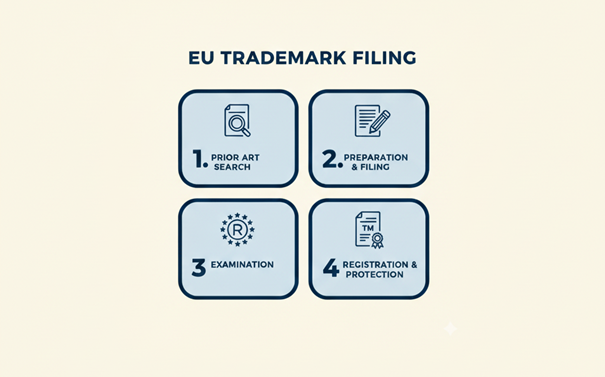




 NFTs, or non-fungible token is one the biggest digital revolutions of our century. An NFT is a digital token operating on a blockchain.

 The Palestinian territory is the subject of much controversy, however, trademark rights are not as insignificant as they might seem.