The 2019 Finance Act harmonizes French and European tax rules in order to best promote the investment of patentable creations and inventions. We are talking about the French IP Box.
Thus, the taxation regime for the products of patents and similar industrial property rights is brought into line with OECD provisions.
While Irelandwas the first country to set up this system (1973), other countries followed suit, such as Belgium, China and, more recently, the United Kingdom (2013).
The principle allows companies to benefit from a tax advantage on their intellectual property assets with a tax rate that amount to 10% instead of 33% previously.
Eligible assets
The assets that are eligible for this plan are:
Patents and patentable inventions
Certificates of utility
Plant variety certificates
Copyrighted software
To be eligible, inventions must have been filed. Taking into account that the regime is open to software protected by copyright. It should also be added that this plan is applicable to annual net income calculated after deducting research and development expenses. The aim is to encourage research and development efforts in relation to the overall effect, i.e. in relation to all the investments that the company can make.
To be eligible for the reduction rate, the company will have to provide several elementsto establish its file such as:
Eligible assets
The rule for determining the protection of the proportion of net income taxable at a reduced rate
The method for allocating research and development expenses.
This makes it possible to monitor the company’s expenses and, above all, to justify the request for a reduction in the tax rate. It will be necessary to submit this file to the tax authorities under penalty of a 5% penalty.
The tax rate
The regime consists in deducting first the proceeds of sale and concession as well as research and development expenses and then, in a second step, calculating from this deduction the net result in order to obtain the net result of the assets on the basis of the Nexus ratio.
What is the Nexus ratio?
The idea is to limit “the preferential regime in proportion to the part of the expenditure relating to intellectual property. »
This is how the OECD defines this ratio. This is intended to sanction patents acquired and research and development costs subcontracted to affiliated companies. It should be noted that research and development costs in third party companies will not penalize the Nexus ratio. This ratio will be calculated on a cumulative expenditure basis.
Some consider this ratio a “not irrefutable presumption.”
Conclusion
The advantage of this regime is that it will encourage companies to their research and development in France and produce quality intellectual property assets that generate income.
strategies to protect the company and its leaders.
The legal, regulatory and fiscal constraints (resulting in particular from the Sapin 2 Law, the LCEN or the EU
Directive of 23 October 2019 on the protection of whistleblowers) that weigh on companies are increasingly rigorous. Companies must implement a governance policy capable of minimizing their responsibility and exposure to their customers, shareholders and the competent authorities.
Among the aspects to be considered in the context of this compliance are domain names. While they are an undeniable corporate asset, they are also vectors of risk: phishing, fraud against the president, fake sites, identity theft, forged e-mails, and so on.
In the event of a breach, they can also damage the reputation of the company and its managers, resulting in a loss of customers. It is therefore imperative to put in place the appropriate strategies to anticipate the dangers, react effectively in the event of an attack and ultimately protect the company.
The current situation linked to the coronavirus epidemic is increasing the risks, with the number of frauds increasing considerably while companies are disorganized and vulnerable.
We propose to analyse these issues with you, sharing our experience. In particular, we will be able to answer the following questions:
– What are the obligations of companies with regard to compliance?
– What are the risks to be anticipated?
– What strategies should be implemented to do so?
– What are the control points?
– What levers should be implemented to react effectively in the event of a proven breach?
As of April 1, 2020, it is now possible to bring actions for cancellation on grounds of invalidity and revocation on grounds of nonuse of trademarks at the French trademark Office –INPI.
Among the new developments resulting from the implementation of European Directive 2015/2436 of December 16, 2015, (known as the “Trademark reform Package”) into French law, the new procedures for the cancellation on grounds of invalidity and revocation on grounds of nonuse of trademarks are those that will undoubtedly change the landscape of intellectual property law in France.
The European directive placed an obligation on member states to create an administrative procedure to bring invalidity and revocation proceedings. The aim of this measure being to facilitate challenges to registrations in order to declutter the trademark register.
In France, since April 1, 2020, these actions can be brought before the French Trademark Office INPI, bringing French trademark law increasingly closer to European law. Until now, only the Court was able to hear these cases. From now on, the competence is shared between some specialized courts and the INPI.
How is this to be done?
The division of competences is set out in Article L.716-5 of the French Intellectual Property Code. With the exception of applications for invalidity based on a prior Copyright, Design right or Personality right (which must be brought before a competent judicial Court), INPI has exclusive jurisdiction for applications for invalidity where no other legal issue arises based on an absolute ground, and applications for invalidity (again where no other legal issue arises) based on the following relative grounds :
– A trademark right
– A corporate name
– An appellation of origin or geographical indication
– The name of a local authority or public entity.
The judicial court has exclusive jurisdiction over counterclaims for invalidity or revocation of rights, applications for invalidity or revocation of rights on any grounds whatsoever where the application is connected with another action falling within its jurisdiction and, finally, applications for invalidity of rights brought as a principal claim on the following relative grounds:
– Copyright
– Design
– Personality rights.
In order to avoid any delaying measures, it is provided that the principle of “res judicata” will apply to such decisions of the Director of INPI and of the judicial court.
The French legislator has gone beyond the provisions of the European Directive, which only requires Member States to confer jurisdiction on the Trademark Offices with respect to certain grounds of invalidity (invalidity based on absolute grounds or on an earlier similar or identical trademark).
Which trademark registration can be challenged?
An application for invalidity or revocation may be filed against a registered French trademark or on the French part of an international trademark.
What is the procedure before the INPI?
Like the new trademark opposition procedure, the invalidity or revocation procedure follows the principle of a fair hearing. Following the examination phase, which starts from the day on which the action was filed, and as soon as the action is considered admissible, the owner has a period of 2 months to submit his observations in the case of an invalidity action or to provide proof of use in a revocation action.
The applicant has then one month to file a response. The parties may make up to three contradictory written exchanges at the end of which, and where appropriate, an oral presentation of the observations may be requested by either party but also requested by the INPI.
Depending on the number of exchanges carried out, this investigation phase may last between two and six months. The INPI then has a maximum period of three months to render its decision.
Thus, the total duration of the procedure should last a maximum of nine months from the date of notification of the action to the adverse party, which is much faster than the legal action hitherto open to the applicant.
A stay of proceedings may be requested jointly by the parties for a period of four months, renewable twice. It may also be suspended at the initiative of the INPI, in particular pending the receipt of information and elements likely to have an impact on the outcome of the dispute or the situation of the parties.
Finally, unlike court proceedings, the applicant need not demonstrate a specific legal interest. This will therefore allow a greater number of actions and give rise to new strategies for the release of rights.
In conclusion, the introduction of these new administrative procedures by the implementation of the “Trademark reform Package” in France provides a fast and inexpensive procedure, against a registered nuisance trademark avoiding the much more restrictive judicial process.
The UDRP procedure is an effective tool for obtaining the transfer or cancellation of a domain name registered and used in bad faith. However, it should not be used as a pressure tactic to recover a domain name that is legitimately held by a third party. Where a complaint is filed without a serious legal basis, or primarily with the aim of depriving the registrant of a domain name, the panel may find Reverse Domain Name Hijacking, meaning that the complainant has used the UDRP procedure in bad faith.
The case Advice Group S.p.A. v. Privacy Administrator, Anonymize, Inc. / Michele Dinoia, Macrosten LTD (WIPO Case No. D2019-2441) is an illustration of this risk.
The Advice group case: a warning against insufficiently grounded complaints
Advice Group is an Italian company founded in 2006 and specialized in marketing. It is based in Turin and also has offices in Rome and Bari, as well as subsidiaries in Bulgaria, Kosovo, Portugal, Colombia and Peru. After becoming aware of the registration of the domain name <advicegroup.com> by a third party, the company filed a UDRP complaint with the WIPO Arbitration and Mediation Center, seeking transfer of the domain name.
The disputed domain name had originally been registered in 2005 and was later acquired by Michele Dinoia, of Macrosten LTD, in September 2014. The domain name resolved to a parking page displaying commercial links and indicating that Internet users could contact the registrant if they were interested in acquiring the domain name.
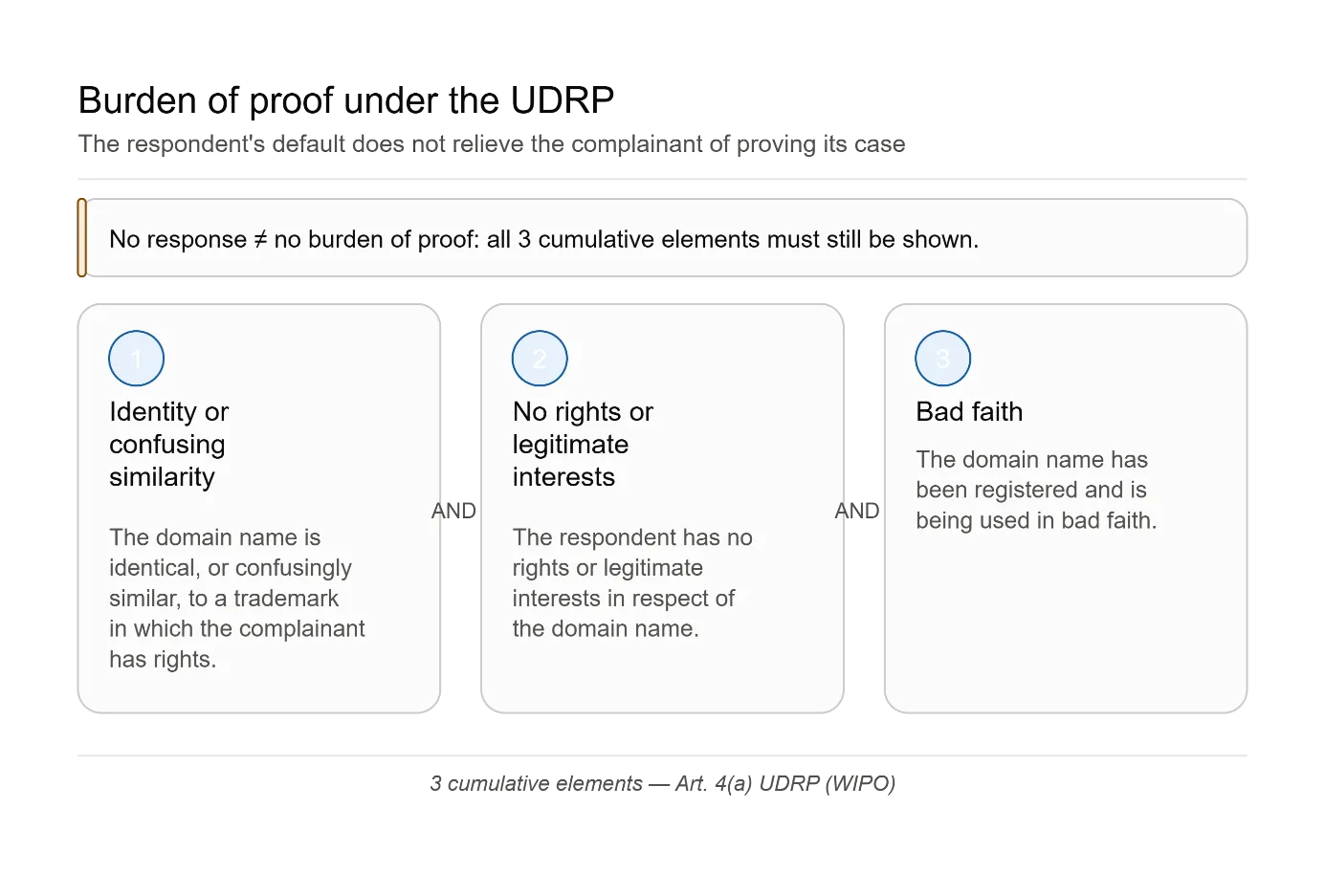
First, that the domain name is identical or confusingly similar to a trademark in which the Complainant has rights
Second, that the Respondent has no rights or legitimate interests in respect of the domain name
Third, that the domain name was registered and is being used in bad faith.
In this case, the panel accepted that the domain name was confusingly similar to the Complainant’s Italian figurative trademark “ ” No. 2015000025292. However, this was not sufficient to justify a transfer.
The panel chose not to make a definitive finding on the issue of rights or legitimate interests, given its conclusions on bad faith. Nevertheless, it made several observations that were favorable to the Respondent. In particular, the domain name was composed of dictionary terms, namely “advice” and “group”, and the Respondent had not actively used the domain name to target the Complainant. The domain name merely resolved to a standard parking page, with a message allowing interested users to contact the registrant regarding a possible purchase.
The panel also noted that there were many companies throughout the world using the name “Advice Group”. This weakened the Complainant’s argument that the Respondent must necessarily have had the Complainant in mind when acquiring the domain name.
Bad faith as the decisive issue
The issue of bad faith was decisive. The panel emphasized that, at the time the Respondent acquired the domain name in September 2014, the Complainant had not yet registered its trademark. The trademark was filed only in June 2015 and registered in December 2016. As a result, the domain name predated the Complainant’s trademark rights.
Nothing in the evidence suggested that the Respondent had targeted the Complainant when acquiring a domain name made up of common English words. The fact that Internet users could make an offer to acquire the domain name did not, in itself, prove that the Respondent had registered it with the specific intention of selling it to Advice Group at an excessive price.
The complaint was therefore rejected.
Reverse Domain Name Hijacking: when the complaint itself becomes abusive
More importantly, the panel found that the complaint constituted a case of Reverse Domain Name Hijacking. The Complainant had accused the Respondent of cybersquatting even though it had not provided evidence of targeting, and despite the fact that the domain name, composed of generic terms, predated the Complainant’s trademark registration. The panel considered that the Complainant should have known that it could not establish bad faith registration.
This decision remains highly relevant today. The updated WIPO practice, including the WIPO Overview 3.1, confirms the importance of a rigorous evidentiary analysis, particularly in relation to bad faith and abusive UDRP complaints. Panels continue to be attentive to cases where a trademark owner attempts to use the UDRP procedure to obtain a domain name that it could not acquire through ordinary commercial negotiation.
Practical lessons for trademark owners
The practical lesson is clear: where a domain name consists of generic, descriptive or common terms, proving bad faith is particularly difficult. It is not enough to show that the domain name is identical or similar to a trademark. The complainant must establish that the respondent specifically targeted its trademark, business, reputation or customers.
Conversely, certain elements may strengthen a UDRP complaint, such as trademark rights predating the domain name, reproduction of the complainant’s official website, use of the domain name for the same goods or services, fraudulent email activity, a direct offer to sell the domain name to the trademark owner, or a documented pattern of cybersquatting.
Before filing a UDRP complaint, trademark owners should therefore carefully verify the date of registration or acquisition of the domain name, the date on which their own trademark rights arose, the distinctive or generic nature of the sign, and the available evidence showing that the respondent actually targeted them.
Failing this, the complaint may not only be rejected, but may also result in a finding of Reverse Domain Name Hijacking, turning the procedure against the complainant itself.
Conclusion
The Advice Group decision serves as a useful reminder that the UDRP procedure is not intended to resolve all disputes involving a domain name. Its purpose is to address clear-cut cases of abusive registration and use, not to provide a shortcut to obtaining a domain name legitimately held by a third party.
For trademark owners, the key issue is therefore not merely whether the disputed domain name is identical or similar to their trademark, but whether there is sufficient evidence to show that the respondent specifically targeted their rights. This case thus demonstrates that filing a weak or opportunistic complaint can have consequences that go beyond the mere dismissal of the complaint.
Dreyfus law firm assists its clients in managing complex intellectual property cases, offering personalized advice and comprehensive operational support for the complete protection of intellectual property.
1.Can a trademark owner file a UDRP complaint if the domain name was registered before its trademark?
Yes, but the complaint will usually be more difficult to prove. Under the UDRP, the complainant must show that the domain name was registered and used in bad faith. If the domain name predates the trademark rights, it may be difficult to establish that the registrant targeted a trademark that did not yet exist. However, exceptions may arise where the complainant already had unregistered rights, strong reputation, or where the respondent clearly anticipated the complainant’s rights.
2.Is the UDRP the right procedure for every domain name dispute?
No. The UDRP is designed for clear cases of abusive domain name registration and use. It is not intended to resolve complex contractual disputes, business disagreements, former partnership issues, or conflicts involving competing legitimate rights. In such cases, court proceedings or negotiated solutions may be more appropriate.
3.Does a respondent have to actively use the domain name for bad faith to be found?
No. Passive ownership of a domain name may, under certain circumstances, constitute bad faith. However, passive ownership is evaluated with caution and does not automatically suffice to establish bad faith.
4.What type of evidence should be collected before filing a UDRP complaint?
A complainant should collect evidence of its trademark rights, reputation, chronology, screenshots of the website, WHOIS records, DNS records, MX records, redirections, phishing attempts, commercial links, offers for sale, prior correspondence, and any pattern of similar domain name registrations by the respondent. The stronger the factual record, the lower the risk of filing an insufficiently grounded complaint.
5.Can a domain name made of common words still infringe trademark rights?
Yes. A domain name made of common words may still infringe trademark rights if it is used to target a specific trademark owner. For example, bad faith may be found where the domain name reproduces the complainant’s branding, redirects to competing services, is used for phishing, or creates a misleading association with the complainant. The key issue is not only the wording of the domain name, but the respondent’s intent and use.
The Swiss company Blockwords AG, formerly known as Swiss Future Project AG, operates an encryption exchange under the sign SCX, which was registered as a Swiss trademark on December 19, 2017.
The company has filed a UDRP complaint with the WIPO Arbitration and Mediation Center for the transfer of the domain name <scx.ch>, alleging, among other things, that it infringes its trademark rights.
This domain name was registered on April 23, 2001 and acquired by the Swiss company in March 2018. In March 2019, the name was transferred to the company SwissClass Trade AG, which subsequently sold it to the Respondent in the same month for more than EUR 60,000.
The Swiss company claims that a fraud was committed when the domain name <scx.ch> was transferred to SwissClass Trade AG due to the absence of two signatures from Blockworks AG which would have made the transfer legal.
In addition, it considers that the transfer of the domain name is the result of a mismanagement on the part of a former member of the board of directors. Ultimately, the complainant fears misuse of the domain name by the Respondent although the latter has not changed the services offered on the website in question, which remain those of the Complainant.
The Respondent explains that it is incomprehensible that the Complainant would want to recover the domain name. Indeed, the Complainant sold the domain name to SwissClass Trade AG, which was free to resell it to the Respondent at a later date. Therefore, the Respondent believes that it was not at fault and that the issue is between the Complainant’s management and SwissClass Trade AG and not between the Complainant and the Respondent.
The Complainant’s position is not supported by the expert who believes that there was no fraud in the sale and transfer of the domain name to SwissClass Trade AG since the sale was signed by two legal representatives of the Complainant’s company. Therefore, the applicant cannot both sell its domain name and subsequently request its transfer. Furthermore, the expert did not accept the argument of mismanagement by one of the former members of the company’s board of directors, due to insufficient evidence.
The expert acknowledges, however, that the situation raises some questions: why did the Respondent purchase this domain name for more than 60,000 euros and what was its intention, even though it could immediately see that the name referred to a third party’s site?
The expert concludes that the complaint should be rejected. Due to the complex facts of the case, he is of the opinion that a judicial procedure would be more appropriate to gather the various pieces of evidence and to rule on them.
This scenario once again illustrates two problems. The first concerns the internal management of domain names: optimal security must always be ensured so that there is no risk of losing control of the names. The second issue related to the fact that UDRP is not an appropriate forum for all disputes. In the present case, it seemed clearly impossible to resolve the dispute between the parties without ruling both on the relationship between Blockwords AG and SwissClasse Trade AG and between Swiss Classe Trade AG and the Respondent.
Our site uses cookies to offer you the best service and to produce statistics, and measure the website's audience. You can change your preferences at any time by clicking on the "Customise my choices" section.
When browsing the Website, Internet users leave digital traces. This information is collected by a connection indicator called "cookie".
Dreyfus uses cookies for statistical analysis purposes to offer you the best experience on its Website.
In compliance with the applicable regulations and with your prior consent, Dreyfus may collect information relating to your terminal or the networks from which you access the Website.
The cookies associated with our Website are intended to store only information relating to your navigation on the Website. This information can be directly read or modified during your subsequent visits and searches on the Website.
Necessary cookies are absolutely essential for the website to function properly. These cookies ensure basic functionalities and security features of the website, anonymously.
Dreyfus is concerned about protecting your privacy and the Personal Data ("Data"; "Personal Data") it collects and processes for you.
Hence, Dreyfus complies every day with the European Union legislation regarding Data protection and particularly the European General Data Protection Regulation Number 2016/679 of 27 April 2016 (GDPR).
This Privacy Policy is aimed at informing you clearly and comprehensively about how Dreyfus, as Data Controller, collects and uses your Personal Data. In addition, the purpose of this Policy is to inform you about the means at your disposal to control this use and exercise your rights related to the said processing, collection and use of your Personal Data.
This Privacy Policy describes how Dreyfus collects and processes your Personal Data. The collection happens when you visit our Website, when you exchange with Dreyfus by e-mail or post, when exercising our Intellectual Property Attorney and representative roles, when we interact with our clients and fellow practitioners, or on any other occasion when you provide your Personal Data to Dreyfus, in particular when you register for our professional events.


 Written by Dreyfus17/04/2020
  The 2019 Finance Act harmonizes French and European tax rules in order to best promote the investment of patentable creations and inventions. We are talking about the French IP Box.
 As of April 1, 2020, it is now possible to bring actions for cancellation on grounds of invalidity and revocation on grounds of nonuse of trademarks at the French trademark Office –INPI.

 ” No.
” No. 
 The Swiss company Blockwords AG, formerly known as Swiss Future Project AG, operates an encryption exchange under the sign SCX, which was registered as a Swiss trademark on December 19, 2017.