In a decision of the Paris Cour d’appel dated November 8, 2016 (Pole 5, ch. 1, Mr X. / Team Reager AB and Stone Age Limited), the judges reversed an expert’s decision at the WIPO Arbitration and Mediation Center dated July 29, 2013 who ordered the transfer of a domain name to a community trademark owner prior to the registration of the disputed name.
Transfer of the domain name ordered by the WIPO
The Swedish company Team Reager AB, created on September 9, 2010 and specialized in design of products and services related to mobile phones, had launched through Moobitalk UK Limited its sister company, a hands-free device called “Moobitalk”. On February 10, 2011, it registered the community word mark Moobitalk, designating particularly telecommunication services, and assigned its rights on the trademark to Stone Age Limited on April 14, 2014.
Mr. X., managing director of companies operating in the Middle East, particularly in Yemen where he was born and is resident, had for several years operated communication services based on the “moobi” suffix (phonetic transcription of “mobi” meaning “mobile phone” in Arabic), and especially “chat” type services called MoobiChat and Moobitalk, in different countries of the Near East and the Middle East. On April 17, 2011, he registered the domain name <moobitalk.com>.
Team Reager had filed a UDRP complaint with the WIPO against Mr. X, and the Expert had ordered the transfer of the domain name <moobitalk.com> on July 29, 2013 on the grounds that Team Reager was the owner of the community trademark Moobitalk prior to the disputed name.
An ownership claim to the name
However, on August 27, 2013, 8 days following notification of the decision, Mr. X brought Team Reager before the TGI of Paris to settle whether he was the legitimate owner of the domain name <moobitalk.com> and to obtain its restitution. However, the TGI rejected the arguments put forward by Mr. X. It upheld the acts of infringement committed against the community trademark Moobitalk and ordered the transfer of the domain name ‘moobitalk.com’ as compensation.
However, Mr. X appealed against that decision in order to reclaim ownership of the disputed domain name. Indeed, the Cour d’Appel held that there was no trademark infringement insofar as the <moobitalk.com> site was not targeting an audience in the European Union but only in the Near and Middle East. Neither the use of the generic extension “.com” nor the use of the English language on the website demonstrated <moobitalk.com>’s owner’s will to target the European public.
The court therefore reversed the TGI judgment and dismissed the claims of Team Reager and Stone Age with respect to infringement of the community trademark Moobitalk and the violation of TeamReager’s rights over that trademark, and ordered restitution of the domain <moobitalk.com> to Mr. X., its owner.
Can we appeal a UDRP decision?
The decision recalls the rules for an appeal of a UDRP decision. This action is possible provided that it is brought within ten days following the notification, in order to avoid cancellation or transfer of the name. Thereafter, the competent court is either where the registered office is located or where the domicile of the domain name owner is located. In the context of proceedings relating to the domain name <moobitalk.com>, the independence of French judges from the WIPO must be emphasized, since the Paris Cour d’appel reversed the judgment of the WIPO experts and ordered restitution of the disputed name.
The Court of Justice of the European Union (CJEU), June 22, 2016, C-207-15P, Nissan/EUIPO
Nissan is the owner of a figurative Community trademark “CVTC” for which registration was sought in classes 7, 9 and 12. Nissan requested the renewal of the trademark, due in April of 2011, in respect of goods and services in classes 7 and 12 only.
The European Union Intellectual Property Office (EUIPO) refused Nissan’s request. The decision to refuse Nissan’s request for renewal of the “CVTC” trademark in class 9 was confirmed by both the First Board of Appeal of the EUIPO and the EUIPO General Court.
Nissan then appealed to the CJEU seeking annulment of the judgment of the General Court of the EU, which rejected the application for partial renewal of the mark in class 9.
The CJEU acknowledges the possibility to request successively for partial renewal of a trademark in different classes, not only before, but also during the grace period.
Therefore, the only prerequisite for successive requests for partial renewal of a Community trade mark to be accepted, is compliance with the grace period, together with payment of the surcharge.
By way of this decision, the CJEU establishes that the new Article 47 of the EUTMR, provides that the request for renewal should be submitted within a period of six months prior to the expiry of registration. In other words, 10 years following the date of application for registration.
An order of the European Court of Justice (ECJ) dated September 8, 2016 highlights the need for business trademark owners to register all relevant changes with the Trademark Register.
Changing one’s corporate name requires compliance with various formalities, such as amending the statutes or even advertising in a Journal of legal notices. When the business is a trademark owner, recording the change into the Trademarks Register is another formality requirement.
This recommendation is the result of an order of the ECJ dated September 8, 2016 where a company’s opposition to a trademark filing was dismissed on the grounds that its change of name did not allow it to oppose its trademarks to third parties insofar as it had not been entered into the Trademarks Register. This ECJ decision is contrary to the existing French legal framework with respect to trademarks.
ThecurrentFrench regulations
In accordance with Article L714-7 of the Intellectual Property Code, a trademark holder is required to make a recordal with the INPI only for some changes.
This article is at the root of the distinction made in practice between “compulsory” entries for changes in ownership of the trademark (transfer, merger…), and “optional” entries affecting the trademark owner (new legal form, new registered office, new corporate name).
Such an important distinction allowed businesses to prioritise the formalities to be carried out. As soon as a company was confronted with a “compulsory” entry, this change had to be entered with the INPI. If not, ownership was not enforceable against third parties. However, in the case of “optional” entry, the absence of entry in the INPI Trademarks Register did not impact the existing rights.
This policy is being questioned by the ECJ’s recent decision, which seems to require a balance between the business information with the Trade and Companies Register and trademark information with various Trademark Offices.
A policy weakened by the ECJ
While the ECJ has recently reduced its requirements for registration with the Trademarks Register of licences for trademarks or designs, this is not the case with respect to registration of changes concerning the trademark owner.
On September 8, 2016, the ECJ dismissed Real Express SRL’s opposition to the filing of a European Union trademark by MIP Metro Group Intellectual Property GmbH & Co KG. The Court then confirmed the position adopted by previous European institutions, namely the EUIPO and the General Court of the European Union, and considered that the applicant did not justify having rights over the registration of Romanian trademarks on which the opposition was based.
This debate arose as a result of a change of name from Real Express SRL to SC Unibrand SRL at the time of filing. The application for entry with the Romanian Office (OSIM) only took place a few days before the opposition. The various European bodies will judge this application for late registration insufficient and consider that Real Express SRL does not establish the existence of rights to earlier trademarks which was the reason for the opposition.
Late submission after filing of the opposition of a simple fax sent by OSIM confirming the request for registration of change of name and confirming the ownership of the trademarks since June 2011 will be considered insufficient. The ECJ therefore requires that the applicant’s situation be legitimate on the date of the application, otherwise his objection may be rejected.
This solution should be applied not only to changes in corporate name but also to changes in the registered office and changes in legal form.
Challenges and uncertainties
This ruling will have major implications for trademark owners. As soon as the details about the trademark owner become outdated, protecting a trademark right becomes risky.
It is obvious that a simple application with the Trademarks Register is insufficient, as registration of the entry must be effective. Depending on the country, this registration may take some time. There are, of course, fast-track procedures.
This decision encourages the anticipation and securing of trademark rights by entering all changes that may affect a trademark.
Following the French Digital Republic Law of October 7, 2016, Dreyfus presents a trilogy of articles on three essential features of the law.
The Digital Republic Law is centered around its’ title II called “Protection of rights in the society”. Within this Title II is the Second Chapter, entirely dedicated to “Protection of personal privacy online”, including “Protection of personal data”.
These new rules entail profound changes that the French legislator wished to anticipate in order to guide and the stakeholders and ensure compliance when processing personal data.
Power given to the data subjects
Both the Digital Republic Law and the GDPR focus on the person whose personal data will be processed (hereinafter called the “data subject”).
Article 4 of the GDPR defines personal data as “any information relating to an identified or identifiable natural person”. However, an identifiable person refers to “one who can be identified, directly or indirectly, in particular by reference to an identifier such as a name, an identification number, location data, an online identifier or to one or more factors specific to his or her physical, physiological, genetic, mental, economic, cultural or social identity”. Therefore, data is personal when it allows the identification of a natural person. This data does not have to identify the data subject directly, as it shall be sufficient to identify them with data roll-up.
A self-determination right is thus conferred on the data subject.
Control of Post-mortem data
The Digital Republic Law also incorporates the right for data subjects to control their post-mortem data by amending the Act of January 6, 1798, and Article 40-1, with the aim to empower them to exercise their right over their personal data. The law thus creates a system of directives on storage, deletion and communication of the data subject’s personal data.
These directives may be amended or revoked at any time by the data subject. The directives define the manner in which the person intends to exercise his various rights following his or her death.
There are two types of directives:
General directives: they concern all personal data relating to the data subject. They may be registered with a trusted third party certified by the National Commission on Informatics and Liberty (CNIL). The CNIL will be responsible for managing a single registry where the references to the general directives and the registered and trusted third party will be recorded.
Specific directives: they concern the processing of personal data mentioned in these directives. They shall be registered with the relevant data controllers and shall be subject to specific consent of the data subject. Thus, the mere approval of the general terms and conditions of use (GTC) does not allow the definition of these specific directives.
The directives may designate a person who, upon the death of the data holder concerned, will be responsible for executing directives and requesting their implementation from the data controllers. In the absence of the designated person and unless otherwise instructed, the heirs of the deceased shall take note of the instructions and request their execution.
Providers of a public online communication service are responsible for informing users about what is done with their personal data upon their death and must allow them to choose whether or not to communicate their data to a third party they designate. Additional information on this issue should be included in the GTC specifically, but also in the data protection policy.
The rights granted to a person to decide what should be done with their post mortem data cannot be limited. Thus, a clause in the GTCs regarding the processing of personal data limiting these prerogatives is considered null and void.
Strengthening information available to users
Article 32 of the French Data Protection Law already required certain informations to be communicated to data subjects by whose data is being processed. Thus, the data collection forms had to mention the identity of the data controller, the purpose of the data processing, the mandatory or optional character of the data, the recipients of the data, and so on. The Digital Republic Law includes an eighth point on the storage period in terms of the categories of data processed or, if not possible, the criteria used to determine this duration.
Thus, any data collection form, data protection policy and any general terms and conditions of use shall henceforth indicate the data storage period.
Henceforth, when a data controller fails to comply with his obligations, the CNIL’s chair shall be entitled to issue a formal notice to put an end to any identified infringement within a time limit set by him. In case of extreme emergency, this delay may be reduced to twenty-four hours. Previously, the timeframe was five days. If infringement does not cease, the CNIL Restricted Committee may then issue, following an adversarial hearing (procédure contradictoire), a warning, a penalty (except where the processing is made by the State), an injunction to cease the processing or a withdrawal of the authorisation issued pursuant to Article 25 of the Law of January 6, 1978.
Monetary penalties are a novelty because prior to the French Digital Republic Law, monetary penalties were set only in cases of violation of a formal notice. This penalty may not exceed three million euros.
– up to EUR 10,000,000 or, in the case of a company, up to 2% of the total annual worldwide turnover for the previous financial year, whichever is the greater;
– or up to EUR 20 000 000 or, in the case of a company, up to 4% of the total annual worldwide turnover for the previous financial year, whichever is the greater.
Since the European regulation is of direct application, these amounts should be applied by the CNIL as of May 25, 2018.
Such measures may also be taken by the Restricted Committee, without prior formal notice and following an adversarial hearing (procédure contradictoire), where the identified infringement cannot be brought into conformity in the context of a formal notice.
Where there has been a violation of rights and freedoms of the data subject following execution of the processed data, the Restricted Committee may also, when the matter is brought before it by the chairman of the CNIL andin the context of emergency proceedings defined by a decree of the Conseil d’Etat and following an adversarial hearing (procédure contradictoire):
– decide to suspend processing, for a maximum period of three months,
– issue a warning,
– decide to lock certain processed personal data, for a maximum period of three months,
– or, for certain processing, inform the Prime Minister so that he may take action toward putting an end to the infringement identified.
In the event of a serious and immediate violation of human rights and freedom of the data subject, the CNIL chair may request a court of law to order, by way of summary proceedings, any measure necessary to safeguard these rights and freedoms.
the intentional or negligent nature of the breach,
measures taken by the data controller to mitigate the damage suffered by the data subjects,
the level of cooperation with the CNIL in order to remedy the breach and to mitigate its possible negative effects,
categories of personal data,
and finally the way in which the breach was communicated to the Committee.
The Restricted Committee may make public the sanctions issued. It may also order sanctioned parties to inform the data subjects of this sanction individually, at their expense.
The Restricted Committee may also order the publication of sanctions in newspapers and other media, at the sanctioned person’s expense.
Certain developments and clarifications on this law will be specified in the decrees. To be continued…
Please see our two other articles on the Digital Republic Law:
Part 1: French Digital Republic Law – online platforms
Part 2: French Digital Republic Law – data recovery
Further to the French Digital Republic Law on October 7, 2016, Dreyfus presents a trilogy of articles on three major aspects of law.
As soon as the online consultation on the Digital Republic Law came into force in September 2015, the right to data portability was at the heart of debates. The participants displayed a keen interest and votes in favour of article were positive (out of 796 votes, 704 were in favour of the article).
The Act therefore inserted a new subsection 4 in Section 3 of Chapter IV of Book II of the French Consumers Code entitled “Data Recovery and Portability”. According to the new article L. 224-42-1 of the French Consumer Code, “The consumer has at all times a right of recovery of all his data.”
A right to data recovery in accordance with European Union law
So as not to be in conflict with its future provisions, the drafting and coming into force of the Digital Republic Law followed the new European Regulation on the protection of personal data
The new Article L. 224-4-2 provides that the recovery of personal data introduced by the Law for a digital Republic is in conformity with the provisions of Article 20 of the Regulation of April 27, 2016.
However, there is a difference between the Digital Republic Law and the Regulation: while the latter speaks of data portability, the Digital Republic Law only mentions data recovery, regardless of what the title of the new subdivision 4 implies.
Difference between data portability and data recovery
As the name suggests, recovery allows for the retrieval of one’s data from an online provider of communication services to the public, in an open and easily reusable way. Thus, the data possessed by this provider shall not be lost when unsubscribing from its services.
Portability, however, not only makes it possible to retrieve data from the provider but also to transfer data to another. This can be initiated by the owner of the files himself, or if technically feasible, directly between the operators. Its scope is therefore larger than mere data retrieval.
The difference between data portability in the Regulation and data recovery in the Act is that the former covers only personal data and not “all files uploaded by the consumer”, contrary to the Digital Republic Law. The aim is therefore to target data processors in the Regulation and to target online providers of communication services to the public through the Law..
The choice between portability and recovery therefore becomes clearer: personal data is sensitive data and it is normal for a person to make use of this information. “All the files uploaded by the consumer” however, makes the question to be asked a little more complex. It is understandable that the legislator did not wish to impose portability on the providers: this would have required considerable technical efforts and very high costs in terms of compliance. Nothing however, prevents the user from subsequently transmitting files to another provider, even if technically possible.
What data is involved in the recovery according to the Digital Republic Law?
The legislator sought to go further than personal data under the Regulation. The aim of these provisions is indeed to facilitate the access of new providers, in particular young innovative startups, to markets very often closed or at the very least dominated by oligopolies. The choice was made to lower the barriers to changes of service providers and to promote competition among different digital service providers. Thus, the choice was made to include, for example, online bank statements, order history on an electronic sales site or the content of music preferences progressively posted on an online streaming site.
The Act therefore provides that recovery must be a free-of-chargeservice for all providers of online communication services to the public. It therefore covers
“all the files uploaded by the consumer”;
“all the data resulting from the use of the user account of the consumer and viewable online by him, other than those that were subject to significant enhancements by the provider”;
And “other data related to the consumer’s user account that meets the following requirements: a) these data enables the change of service provider or allows access to other services; b) data identification takes into account the economic importance of services involved, the intense competition between providers, the usefulness to the consumer, the frequency and the financial issues in the use of those services.”
The data involved in the recovery is therefore significant and the criteria provided by the law allows for a wide scope of retrievable data. It includes files uploaded by the consumer, data available online on the consumer’s user-account, other data associated with the account as well as that of economic importance, useful for the consumer, that bear financial issues, etc.
However, there is one significant exception: data “thatwere subject to significant enhancements by the provider” are not in the scope of the recovery. This involves making a distinction between raw data and significantly enriched data. The latter are those that concern services offered by the platform; data transmitted by the consumer that have been modified, enhanced using algorithms created by the service provider. The contribution of this algorithm cannot therefore be retrieved by the consumer while recovering the data.
Furthermore, it is only information visible to the public and not that of the “back office” that is concerned.
What are the new obligations on online communication service providers?
They must set up this data recovery feature and offer it free of charge.
The service provider must take all necessary measures, in terms of interface programming and transmission of the information necessary for the change of provider. The consumer must be able to retrieve all of his/her data or files through a single request made to the provider.
The data must be recovered using an open standard, easily reusable and exploitable by an automated processing system. However, when this is impossible, the provider must clearly and transparently inform the consumer. Otherwise, where appropriate, the provider informs the consumer of the alternative methods of such data recovery and specifies the technical characteristics of the recovery file format, in particular its open and interoperable character.
A decree is expected to specify the list of the types of enrichments deemed to be insignificant that can not give rise to a recovery refusal to the consumer. In case of a dispute, the burden of proving the alleged insignificant enrichment will be that of the professional.
To this extent, the new Article L. 224-42-4 of the French Consumer Code specifies that these provisions do not apply to providers of an online public communication service with a number of user accounts subject to an active connectionion during the last six months less than a threshold number defined by decree.
What do these new provisions bring about?
The ability to retrieve data from an online communication service was highly anticipated by Internet users. For some, this is even the corollary of the recognition of the right to the free disposal of personal data.
The challenge here was to balance the needs of consumers with business economic needs. The aim was not to disadvantage young innovative companies struggling to find a place among the giants within the markets concerned .
Time will tell us whether this objective is achieved and the impact of these provisions. We will have to wait until May 25, 2018 to notice the first visible effects, when the European Regulation and these provisions on data portability and recovery will come into force.
Compliance of Zambian law with the Paris Convention, the TRIPS Agreement and the Harare Protocol.
On June 6, 2016, a new design law was introduced to Zambian intellectual property law , thus repealing the Registered Design Law of 1958.
The major contribution of this law resides in the possibility to enjoy protection afforded by design law once the said design has been registered. Under the Law of 1958 , the registration of a design only gives the registered proprietor the copyright (Article 14 of Registered Designs Law of 1958).
The law now provides for the principle of “absolute novelty”, thereby modifying the criterion of novelty.
In addition to the traditional criterion of novelty, the 2016 law introduces the requirement of the design’s individual character into Zambian law.
The individual nature of a design will be recognised where “the overall impression it produces on an informed user differs from the overall impression produced on an informed user by any earlier design differs from the overall impression produced on such a user by any earlier design, which has been made available to the public before the release date of such a design” (Article 18 of the Industrial Designs Act of 2016).
Introduction of an opposition period
It is now possible for a third party, including the State, to oppose the registration of a design within a period of two months from the date an application is published (Article 43).
Duration of protection
The duration of the protection of a design has been modified. It is no longer possible to renew the registration of a design for more than two consecutive periods of 5 years, but only for one, thus bringing the total duration of the protection of a design to 10 years rather than the initial period of 15 years.
Licences
Licencing contracts must be registered with the Registrar. The Registrar can refuse the registration of a licence if it imposes unjustified restrictions on the licensee. Furthermore, the licence contract shall not have effect against third parties until it is registered and a certificate of registration is issued in respect thereof (Article 78).
Creation of designs by employees
A whole section devoted to designs by employees has been introduced by the new law.
In principle, the designs created by employees during the course of their employment contract belong to the employer. However, where the design acquires an economic value much greater than that the parties could reasonably have foreseen at the time of concluding the contract, the employee shall be entitled to an equitable remuneration to be agreed upon by the parties or in default, to be determined by the court (Article 45).
Indeed, the agreement has led to a number of reforms, particularly in relation to intellectual property law. New types of trademarks such as holograms, olfactory and sound marks have emerged in Guatemala. In addition, the creation of an online newsletter published on the website of the Registry for Intellectual Property now allows individuals to view the trademarks which are registered in Guatemala online.
The year 2016 therefore marks a further step in the development of Guatemala’s intellectual property law.
The Trademark Law Treaty is expected to enter into force on December 12, 2016.
The accession of Guatemala to the TLT results in the harmonization and simplification of the procedures for the registration and renewal of trademarks in Guatemala (except for holograms, sound, olfactory and collective trademarks).
Simplifying trademark registration applications
It will be simpler in the future for a foreign trademark holder to register a trademark in Guatemala given that the same power can now be applied to one or more applications or to one or more trademark registrations.
The adoption of “multi-class” trademark applications
Another important development is the introduction of “multi-class” trademark applications in the intellectual property law of Guatemala.
This system has many advantages, including a simplified management of trademark applications and the reduction of examination time for trademark applications. It also facilitates the monitoring of trademark renewal procédures.
Dreyfus & associés can assist you with your applications for Guatemala trademark registration by selecting the best strategy for promoting and protecting your rights.
Hypertext links are central to the functioning of the Internet. They make it possible to direct users to an article, photograph, video or any other content published on a third-party website.
However, creating a hypertext link is not always neutral from a copyright perspective. Since 2014, the Court of Justice of the European Union has progressively clarified the circumstances in which a link may constitute an act of “communication to the public” requiring the authorisation of the right holder.
The principle of freedom to create hypertext links
In its Svensson decision of February 13, 2014 (C-466/12), the Court of Justice of the European Union held that creating a clickable link to a protected work that is already freely accessible on another website with the authorisation of the right holder does not require further authorisation.
Admittedly, providing the link enables Internet users to access the work. However, it does not target a “new public”. Where content is freely accessible online, the right holder is deemed to have taken all Internet users into account as the potential public.
A website may therefore, in principle, provide a hypertext link to a work that is freely and lawfully accessible on another website. This approach preserves the normal functioning of the Internet, which largely relies on the circulation of information through hypertext links.
Links to content published without authorisation
The position is different where the hypertext link leads to a work that has been made available online without the authorisation of the right holder.
The Court notably distinguishes between hypertext links published without a profit-making purpose and those made available in the course of a commercial activity.
Where a person creates a hypertext link without pursuing a profit-making purpose, it is necessary to determine whether that person was aware of the unlawful nature of the initial publication. The liability of the author of the link is not automatic. The risk nevertheless becomes significant where the person posting the link knows that the content is unlawful, has been informed of its unlawful nature by the right holder, maintains the link despite receiving a substantiated takedown request, or enables users to circumvent an access restriction.
Where a hypertext link is published in the course of an activity carried out for profit, the Court adopts a stricter approach. The person posting the link is presumed to have carried out the necessary checks and to have been aware that the initial publication may have been unlawful. This presumption may be rebutted, but it requires the professional operator to demonstrate that it could reasonably believe that the content had been published with authorisation.
The commercial nature of the website is not, in itself, sufficient to establish counterfeiting. It is nevertheless an important factor where the hypertext link is used to attract traffic, generate advertising revenue or facilitate access to manifestly unlawful content.
Circumvention of access restrictions
Even where a work was initially published with the authorisation of its author, a hypertext link may require authorisation if it makes the work accessible to a public that was not taken into account when it was first made available online.
This may be the case where the link circumvents a subscription, a paywall, an authentication system, a restriction limiting access to certain users or a technological protection measure.
In such circumstances, the hypertext link makes the work available to a “new public” and may therefore constitute a communication to the public.
A distinction must accordingly be drawn between a simple link to a freely accessible page and a link that neutralises a restriction effectively implemented by the right holder.
Framing and the embedding of third-party content
Framing consists in embedding content from another website into a webpage without necessarily creating a new copy of that content. A photograph or video may therefore appear directly on a third-party website while technically remaining hosted on the original website.
In its BestWater order of 2014, the CJEU accepted that a freely accessible work could, in principle, be embedded by means of framing, provided that it was neither communicated using a different technical means nor made available to a new public.
The Court subsequently clarified this approach in its VG Bild-Kunst decision of March 9, 2021 (C-392/19). Where the right holder has adopted or imposed technological measures intended to prevent framing, circumventing those measures constitutes a communication to a new public and therefore requires authorisation.
In practice, the direct embedding of content on a third-party website may therefore create greater legal risks than a simple clickable hypertext link clearly redirecting the user to the original website.
Services Facilitating Access to Unlawful Content
European case law is not limited to individual hypertext links. It also takes into account the role played by persons or services that organise, facilitate or encourage access to protected content made available without authorisation.
In the Filmspeler decision of April 26, 2017 (C-527/15), the Court held that the sale of a multimedia player preconfigured with links to unlawful streaming websites constituted a communication to the public. The seller deliberately intervened to enable its customers to access protected works easily.
In the Pirate Bay judgment of June 14, 2017 (C-610/15), the Court also held that the operation of a platform facilitating the location and sharing of protected works could constitute a communication to the public. The administrators did not necessarily upload the works themselves, but they played an essential role in making them available.
The distinction between a purely technical intermediary and an operator actively participating in the distribution of unlawful content is therefore decisive.
Its liability may nevertheless arise where, beyond merely providing the platform, it contributes to giving the public access to unlawful content.
This may notably be the case where the operator knows that protected content is unlawfully available and fails to remove it promptly, participates in its selection or promotion, provides tools specifically designed to facilitate its sharing, or adopts a business model that encourages copyright infringement.
This case law must now be considered together with the specific obligations applicable to online content-sharing platforms.
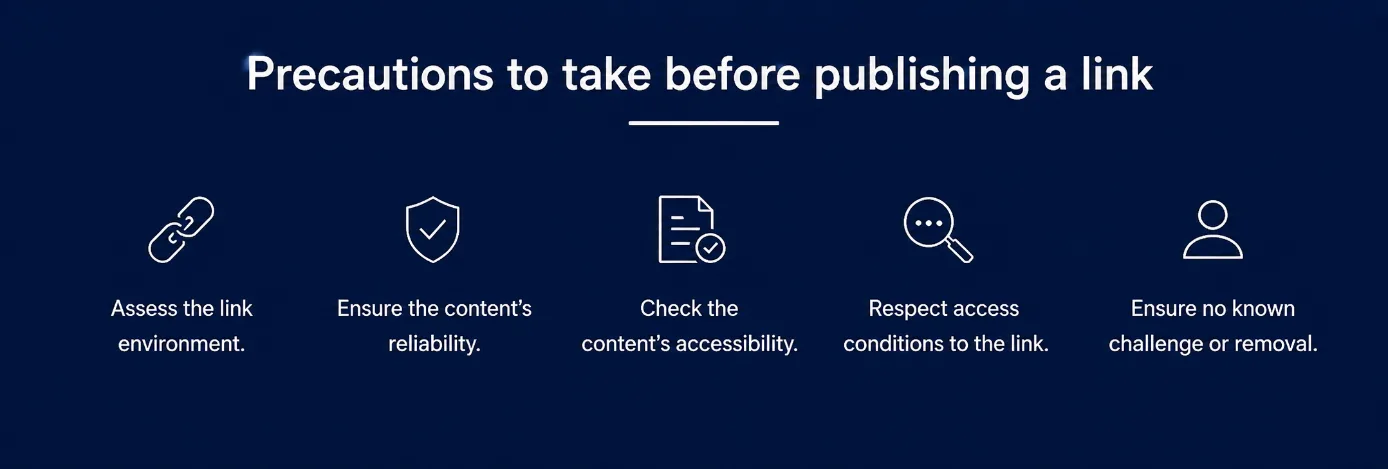
Precautions to take before publishing a hypertext link
Creating a hypertext link to protected content is not prohibited as a matter of principle. However, prior checks remain advisable, particularly in a professional context.
It is notably appropriate to verify:
that the content is freely accessible;
that the original website appears legitimate;
that the work appears to have been published with authorisation;
that the link does not circumvent any restriction;
that the content is not embedded in breach of an anti-framing measure;
and that no takedown request has been received.
Conclusion
The principle remains that hypertext links may freely be created to content that is freely and lawfully accessible.
That freedom is nevertheless subject to limits where the link knowingly leads to unlawful content, circumvents an access restriction, neutralises a technological measure or actively contributes to the distribution of infringing works.
The lawfulness of a hypertext link therefore depends on its context, the origin of the content, the purpose pursued and the role actually played by the person posting it.
Dreyfus Law Firm assists its clients in managing complex intellectual property cases, offering personalized advice and comprehensive operational support for the complete protection of intellectual property.
Is authorisation required to link to the homepage of a website?
In principle, no. A hypertext link to the homepage of a freely accessible website generally does not require authorisation, provided that it does not create confusion as to the existence of a partnership or commercial relationship.
Should a link that subsequently becomes unlawful be removed?
Yes, once the person who posted the link becomes aware of the change in circumstances. A link that was initially lawful may become problematic if the destination content is modified or replaced with unlawful content.
Can a link to a foreign website give rise to liability in France?
Yes. The location of the target website is not, in itself, sufficient to exclude the application of French law, particularly where the link is published on a website aimed at the French public or where the harm is liable to occur in France.
Does removing the link eliminate all liability?
Prompt removal may reduce the risk, but it does not necessarily erase an infringement that has already occurred. The circumstances, duration of publication and knowledge of the unlawful nature of the content may still be taken into account.
Does a shortened link create any particular risk?
Using a shortened hypertext link is not prohibited. However, it may conceal the actual destination and make it more difficult to identify the website concerned. A transparent presentation is therefore preferable.
This publication is intended for general public guidance and to highest issues. It is not intended to apply to specific circumstances or to constitute legal advice.
ICANN manages the global resources of the Internet, that is to say it handles the management and coordination of Internet addresses such as IP address allocation, DNS and IP Protocols. Such functions are referred to as IANA: Internet Assigned Numbers Authority function. This particular function, managed by ICANN, was carefully guarded by the U.S. government since it is a critical function.
The U.S. was committed to preserving the IANA function since the creation of ICANN in 1998. When the internet was handed over to the private sector, the U.S. government was awarded a contract placing the federal courts as the final arbiter of disputes. The U.S. thus had the final say on every ICANN decision and could block decisions perceived as contrary to its interests.
While this emancipation was a long-term stated objective since ICANN’s inception in 1998, the project materialised only after the revelations of Edward Snowden in summer 2013 and the surveillance scandal involving the NSA. Weakened with respect to global diplomacy, the U.S. had to give in to pressure from over 150 countries including China, Russia and France along with the Afnic association (Association Française pour le Nommage Internet en Coopération, historic operator of .fr). It was not only the U.S. who had control over the internet however: Chinese companies like Alibaba, Tencent or even Baidu hold the same value as GAFA(Google, Apple, Facebook and Amazon).
What does this mean for the Internet and its users?
Prior to the expiration of the contract, ICANN was under the control of the U.S. Department of Commerce which had the power to force ICANN into bankruptcy. But the U.S. control over the Board of Directors has now been eliminated.
Henceforth, all Internet stakeholders will have a say and can participate in decisions. A general assembly alongside counter powers was thus created. This general assembly is made up of four groups:
– the private sector, involving stakeholders like GAFA, large companies and SMEs;
– the technical community;
– governments, composed of 160 members with one vote each;
– the civil society: consumer protection associations, civil rights associations.
If there is a consensus, this assembly may block a decision of the Board.
Americans are not excluded from any decision of ICANN. They form part of the general assembly, have a voice and can oppose any decision of the board. But with time and changing power relations, they could lose their influence.
ICANN’s main concern will therefore be to implement this new multi stakeholder model. The organisation must introduce changes in its culture so that it duly takes into account differences in culture, age, gender, language, career paths. Each community should be able to voice their concerns fully and be capable of influencing the organisation.
A significant change in the trademark law of the Cayman Islands
Previously, under The Patents and Trade Marks Law 2011, it was possible to gain trade mark protection in the Cayman Islands by way of an application for a UK or Community trade mark registration. With only a registration number, extension of that trademark protection could be requested in the Cayman Islands. The CIIPO would then conduct only a minimal examination of the trademark.
Furthermore, since the Cayman Islands is not a signatory of the Paris Convention, priority could not be claimed and trademark protection would be effective as of the registration date. The International Classification system was used and multi-class applications were allowed to the extent that these classes were requested for the registration of a UK or European Community trademark. Previsouly, the law also required the payment of maintenance fees payable to the Government of the Cayman Islands in January of each year. These fees could be paid up until March 31st of that year. Failure to pay annual fees would result in the suspension of protection of the trademark until payment was received. Beyond twelve months, the Registrar may cancel the record of the trademark.
What changes does the new law bring about?
As of now, the CIIPO will only accept national registration applications made directly to the Registrar.
In addition, the examination process will not be minimal, as applications will be examined on both absolute and relative grounds. There will also be a provision for opposition to the registration of the trademark.
The requirement to pay annual maintenance fees in order to maintain a valid trademark registration has however been retained.
Recommendations for registering your trademark
With the new law, which should enter into force during 2017, the timeframe to obtain a trademark registration will be extended.
We encourage you to register your trademarks directly with the Cayman Islands Registrar so as to prepare for the coming into force of the new law and for the potential issues that could arise. It is better to take prompt action in order to anticipate delays and the difficulties that the national Registrar will encounter in order to adapt to the new law.
Dreyfus & associés will certainly inform you of the developments in trademark law in the Cayman Islands. We remain available should you require any additional information.
Our site uses cookies to offer you the best service and to produce statistics, and measure the website's audience. You can change your preferences at any time by clicking on the "Customise my choices" section.
When browsing the Website, Internet users leave digital traces. This information is collected by a connection indicator called "cookie".
Dreyfus uses cookies for statistical analysis purposes to offer you the best experience on its Website.
In compliance with the applicable regulations and with your prior consent, Dreyfus may collect information relating to your terminal or the networks from which you access the Website.
The cookies associated with our Website are intended to store only information relating to your navigation on the Website. This information can be directly read or modified during your subsequent visits and searches on the Website.
Necessary cookies are absolutely essential for the website to function properly. These cookies ensure basic functionalities and security features of the website, anonymously.
Dreyfus is concerned about protecting your privacy and the Personal Data ("Data"; "Personal Data") it collects and processes for you.
Hence, Dreyfus complies every day with the European Union legislation regarding Data protection and particularly the European General Data Protection Regulation Number 2016/679 of 27 April 2016 (GDPR).
This Privacy Policy is aimed at informing you clearly and comprehensively about how Dreyfus, as Data Controller, collects and uses your Personal Data. In addition, the purpose of this Policy is to inform you about the means at your disposal to control this use and exercise your rights related to the said processing, collection and use of your Personal Data.
This Privacy Policy describes how Dreyfus collects and processes your Personal Data. The collection happens when you visit our Website, when you exchange with Dreyfus by e-mail or post, when exercising our Intellectual Property Attorney and representative roles, when we interact with our clients and fellow practitioners, or on any other occasion when you provide your Personal Data to Dreyfus, in particular when you register for our professional events.


 Written by Nathalie Dreyfus21/02/2017
  In a decision of the Paris Cour d’appel dated November 8, 2016 (Pole 5, ch. 1, Mr X. / Team Reager AB and Stone Age Limited), the judges reversed an expert’s decision at the WIPO Arbitration and Mediation Center dated July 29, 2013 who ordered the transfer of a domain name to a community trademark owner prior to the registration of the disputed name.


 Compliance of Zambian law with the Paris Convention, the TRIPS Agreement and the Harare Protocol.