Trademark

Domain name monitoring: protecting your trademark against cybersquatting

In 2025, the World Intellectual Property Organization (WIPO) Arbitration and Mediation Center recorded a historic high of 6,282 domain name complaints, a 1.8% increase over 2024. Since the creation of the UDRP system in 1999, more than 80,000 disputes have been handled. These figures confirm a reality well known to intellectual property professionals: cybersquatting is not declining—it is growing in sophistication.

In this context, domain name monitoring is no longer optional—it is a fundamental pillar of any trademark protection strategy. Dreyfus & Associates, a firm specializing in intellectual and industrial property, supports companies in implementing effective monitoring systems. Nathalie Dreyfus, a court-appointed expert accredited by the French Supreme Court (Cour de cassation, Trademark specialty) and the Paris Court of Appeal (Trademarks and Designs specialty), leads this expertise for innovative businesses and business law attorneys.

This article explores the challenges of domain name monitoring in 2025, the tools and methods to deploy, and the legal remedies available in case of infringement.

Why has domain name monitoring become essential?

A constantly expanding threat landscape

The number of domain name extensions now exceeds 1,500, including gTLDs (.com, .net, .org), new generic extensions (.shop, .online, .tech, .law), and ccTLDs (.fr, .de, .co.uk). In 2024, ccTLD registrations grew by 3.7 million, a 2.7% increase. Each new extension multiplies the opportunities for abusive registration by cybersquatters.

Cybersquatting involves registering a domain name that reproduces or imitates a trademark with the intent to profit, whether through resale, traffic redirection, or customer diversion. Typosquatting exploits common user typos (for example, “dreyfuss.fr” instead of “dreyfus.fr”) to redirect visitors to fraudulent or competing websites.

Concrete consequences for businesses

The damages extend far beyond trademark image. According to the 2025 joint EUIPO-OECD report, global trade in counterfeit goods amounts to $467 billion, representing 2.3% of worldwide imports. Fraudulent domain names often serve as gateways to these networks: fake e-commerce sites, phishing pages impersonating legitimate brands, and counterfeit resale platforms.

ANSSI (France’s National Cybersecurity Agency), in its 2024 Cyber Threat Overview, reported 4,386 security events handled (+15% compared to 2023) and 5,629 data breaches notified to CNIL (+20%). Phishing through spoofed domain names remains one of the most common attack vectors.

Effective monitoring tools and methods

Automated multi-extension monitoring

Dreyfus & Associates implements continuous monitoring across all domain name extensions to detect any attempt at abusive registration. This monitoring relies on detection algorithms that analyze phonetic variations, intentional misspellings, and suspicious combinations incorporating the trademark name.

The advantages of this automated approach are twofold: it covers a volume of data impossible to process manually, and it enables a rapid response, often within 24 to 48 hours of a suspicious registration.

Detecting online trademark infringement

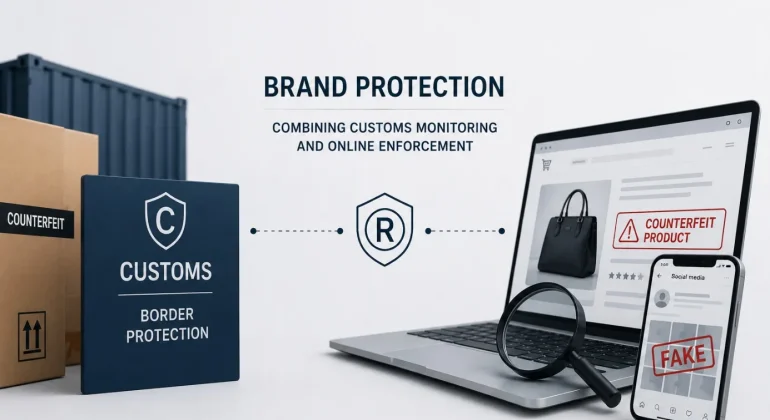
Beyond domain names, online trademark protection includes detecting abusive use on social media, marketplaces (Amazon, Alibaba, eBay), and search engines (ads misusing a brand). WIPO data shows that 95% of UDRP decisions result in the transfer of the domain name to the legitimate trademark holder, demonstrating the system’s effectiveness when monitoring enables timely action.

Integration with the overall trademark strategy

Domain name monitoring does not operate in isolation. It is part of a coherent approach to trademark portfolio management, encompassing prior art searches, filing, renewal, and monitoring. Dreyfus & Associates also uses its AI-powered trademark similarity analysis tool to cross-reference domain name alerts with existing trademark portfolios.

How to respond to a detected infringement

Cease and desist letter: the first amicable step

When an abusive registration is identified, a cease and desist letter is often the fastest and least expensive response. A formal letter drafted by an intellectual property specialist may be sufficient to obtain the transfer or deletion of the disputed domain name, particularly when the holder acts out of opportunism rather than organized malice.

The UDRP procedure: speed and efficiency

When the amicable route fails, the UDRP procedure administered by WIPO provides an effective alternative. It typically concludes within 45 to 60 days and costs between $1,500 and $4,000 depending on the number of domain names involved. In 2025, WIPO now covers more than 85 ccTLDs, significantly expanding the scope of this procedure.

Legal action: for the most complex cases

In cases involving significant economic damage or an organized cybersquatting network, infringement proceedings before the competent courts remain the most protective route. Nathalie Dreyfus’s role as a court-appointed expert accredited by the French Supreme Court gives the firm particular legitimacy in supporting business lawyers in these contentious proceedings where technical expertise makes the difference.

Dreyfus & Associates: comprehensive support

Dreyfus & Associates provides end-to-end support covering the entire intellectual property lifecycle. Prior art searches verify the availability of a sign before any filing. Trademark filing and renewal in France, Europe, and internationally are aligned with consistent digital naming strategies.

Watch and monitoring services cover all domain names, social networks, and trademark registries. This permanent vigilance is complemented by a cybersecurity framework adapted to current threats.

For attorneys specializing in business law who wish to collaborate on cases involving intellectual property issues, Dreyfus’s network of specialized attorneys offers a privileged framework for professional cooperation. Whether securing an M&A transaction, assisting a client who is a victim of cybersquatting, or structuring an international protection strategy, this collaboration brings together industry expertise and in-depth knowledge of IP law.


Conclusion

Domain name monitoring is not a cost—it is a strategic investment. Every day, new abusive registrations target the most exposed trademarks as well as lesser-known ones. Failing to monitor means leaving the door open to cybersquatters and exposing your business to financial and reputational damages that are often difficult to repair.

Dreyfus & Associates provides comprehensive expertise, from automated monitoring to litigation, to secure your digital presence for the long term. Contact us for a personalized assessment of your situation.


Frequently asked questions (FAQ)

What is domain name monitoring?

Domain name monitoring involves continuously tracking new domain name registrations to detect those that reproduce or imitate a protected trademark.

This monitoring makes it possible to quickly detect practices such as cybersquatting, typosquatting, or the registration of domain names used for phishing or fraudulent activities.

How long does it take to recover a domain name through the UDRP procedure?

The UDRP procedure administered by WIPO typically concludes within 45 to 60 days. Administered by WIPO, it represents a faster and less costly alternative to court proceedings. With a success rate exceeding 95% in favor of trademark holders, it is the preferred tool for combating cybersquatting.

It constitutes a fast and relatively cost-effective extrajudicial mechanism that allows the transfer or cancellation of a domain name registered in bad faith. It is considered the primary tool for combating cybersquatting.

Why engage a specialized firm rather than a registrar?

A registrar handles the technical aspects of registration. A specialized firm like Dreyfus & Associates provides comprehensive legal expertise: analysis of the registration’s legitimacy, conduct of UDRP proceedings, filing and monitoring strategy, and litigation support if necessary. The court-appointed expert designation also ensures an approach consistent with evidentiary standards.

What types of businesses need monitoring?

Any business with a registered trademark or significant online presence is concerned. WIPO data shows that SMEs represent 59% of parties in domain name disputes in 2025, proving that cybersquatting does not only affect large corporations. Dreyfus & Associates supports both startups and international groups.

Is monitoring useful if the business does not yet have a registered trademark?

Yes. Even without a registered trademark, a business using a distinctive sign as a trade name can assert its prior rights. However, trademark registration remains Dreyfus & Associates’ primary recommendation for effectively securing a digital strategy.

Read More

Trade Mark filing strategy and autonomous sub-categories: Securing your specification and anticipating proof of use

GPG Promo Kit TRADEMARKS & COPYRIGHT 2026 X Post with Logo eg[78]

European and French case law now imposes a renewed discipline on trade mark filing. The days when a broad specification was enough to guarantee solid protection are over. Here is a breakdown of the key issues and best practices.

Why case law on sub-categories is changing the game

Filing a trade mark confers an exclusive right. But this right only exists in relation to the specific goods and services designated in the registration. In practice, the value of a trade mark depends as much on the sign itself as on the specification accompanying it.

For several years now, European and French case law has consistently reiterated a straightforward principle: a trade mark must not confer a purely theoretical monopoly over markets that its owner does not actually exploit. This requirement finds very concrete expression in the concept of autonomous sub-categories and in the strengthened control of genuine use.

This context is all the more significant as companies face an increase in oppositions, invalidity actions and counterclaims for revocation, especially where older trade mark portfolios cover very broad specifications.

The specification of goods and services: the trade mark’s true legal perimeter

For a long time, a “broad filing” approach prevailed. Applicants sometimes opted for generic wording or simply reproduced class headings, with the aim of maximising protection without having to anticipate in detail how the trade mark would be used.

Today, however, this strategy entails increased risk. Where a trade mark is registered for a broad category but is only used for part of that category, it may be partially revoked. Protection then remains only for the segments actually used, which can drastically reduce the scope of enforcement.

The legal framework: genuine use, revocation and the burden of proof

French law provides for revocation where a trade mark has not been put to genuine use for five consecutive years. The reference provision is Article L.714-5 of the French Intellectual Property Code, interpreted in line with the applicable European framework, in particular Article 18 of the EU Trade Mark Regulation (EUTMR).

One essential point for businesses: the burden of proof lies with the trade mark owner. In the event of a challenge, it is not for the third party to demonstrate non-use, but for the proprietor to prove genuine, relevant and dated use.

Furthermore, where the specification is broad and divisible, proof must be provided for the relevant sub-categories. This explains why certain portfolios, despite being intensively exploited, are nevertheless weakened.

Understanding autonomous sub-categories: a jurisprudential concept

The concept of an autonomous sub-category does not stem from any express statutory definition. It is a concept developed through case law to reflect economic reality: within a broad category, certain goods or services may form distinct, identifiable and coherent groups.

Case law focuses in particular on criteria relating to the purpose and intended use of the goods and services. What matters is the expected use by the public and the economic function of the product or service, rather than its formal classification.

In practice, an overarching category such as “transport”, “cosmetics” or “software” may cover very different realities. The court may therefore consider that such a category is divisible into autonomous sub-categories and require segmented proof of use.

The European “Ferrari” case law: balancing protection and proportionality

The Ferrari cases (C-720/18 and C-721/18) of 22 October 2020 clarified the CJEU’s reasoning on use in relation to specifications covering categories of varying breadth. The logic is structured around a practical distinction:

  • Where a trade mark covers a precise and indivisible category, use in relation to part of that category may be sufficient.
  • Conversely, where the category is broad and divisible, use must be proven for each identifiable autonomous sub-category.

This distinction is particularly useful when building a filing strategy. It prompts a simple question: will the category claimed be perceived tomorrow as a “homogeneous whole”, or as a set of distinct segments?

French case law: the Court of Cassation decisions of 14 May 2025

First decision (No. 23-21.296): taxi services and the “transport” category

In a first decision (Cass. com., 14 May 2025, No. 23-21.296), the French Court of Cassation provides a very concrete illustration of the requirement to segment goods and services into sub-categories. The trade marks at issue were registered for “transport” and “passenger transport” services. The proprietor demonstrated genuine use for taxi services, and the Court of Appeal had considered this sufficient.

The Court of Cassation adopted a more demanding approach. It criticised the lower court for failing to assess whether taxi services constituted an autonomous and coherent sub-category within the broader category of transport services. It recalled that such an assessment must be objective and based on the purpose and intended use of the services.

Second decision (No. 23-21.866): cosmetics and essential oils

The second decision rendered on the same day (Cass. com., 14 May 2025, No. 23-21.866) further confirms and refines this requirement. The trade mark was registered for several broad categories of goods, including cosmetics and essential oils. The proprietor relied on use relating to specific products such as textiles impregnated with active substances or composite products incorporating essential oils.

The Court of Cassation overturned the Court of Appeal’s reasoning, criticising it for failing to examine whether those products genuinely corresponded to the goods as registered or whether they constituted autonomous sub-categories requiring specific proof of use.

These decisions confirm that the French Supreme Court now requires a strict alignment between the evidence of use relied upon and the exact scope of the specification.

The court’s power to subdivide the specification

One of the key lessons from recent case law is that the court is not bound by the wording of the specification as drafted. Even if the applicant has not provided for any subdivision, the court may carry out an objective division into autonomous sub-categories where justified by the purpose and intended use of the goods or services.

This power has very tangible effects. A simple and overarching specification may, in litigation, be broken down into multiple segments. The proprietor then faces a heavier evidentiary burden than anticipated.

In practice, this mechanism makes the filing strategy inseparable from the evidentiary strategy. Filing broadly is not merely a legal decision; it is also a documentary, internal and operational decision.

Filing a trade mark: the right level of precision

An effective filing strategy is based on a careful balance. If the specification is too broad, the trade mark may be vulnerable to revocation. If it is too narrow, the trade mark may be insufficient to support commercial development or to act against close competitors.

The question is therefore not whether to file broadly or narrowly, but how to file intelligently, calibrating the specification so that it is both commercially useful and legally defensible in the long term.

Anticipating proof of use: an operational component of trade mark strategy

In practice, the most sensitive issue is proof of use. When a trade mark is challenged, the question is not merely to prove that it is used. It is necessary to prove that it is used for the goods and services covered by the registration, and sometimes for autonomous sub-categories identified in litigation.

For each plausible sub-category, it is recommended to gather specific and segmented evidence:

  • Invoices or order forms identifying the type of product or service, with dates and geographical areas.
  • Catalogues, brochures, commercial leaflets or archived web pages showing the trade mark associated with the relevant segment.
  • Targeted advertising campaigns, announcements or promotional materials, dated and linked to a specific product or service.
  • Internal reports by business segment, where their content can be produced and relied upon in litigation.
  • Relevant contracts, in particular licences, distribution, maintenance, or evidence showing exploitation by an authorised third party.

Each item of evidence should be preserved within a structured file: not as an undifferentiated mass of documents, but as an organised set by sub-category.

Use by subsidiaries, licensees or distributors

In many corporate groups, trade mark use may be carried out by subsidiaries, distributors or licensees. Case law, in line with Article 18(2) EUTMR, generally accepts that use by an authorised third party may be taken into account, provided that such use takes place with the proprietor’s consent.

This nevertheless requires contractual and documentary organisation. It must be possible to establish the existence of authorisation and to demonstrate the reality of exploitation under the trade mark.

Use in a modified form: securing trade mark variants

Companies rarely use a trade mark in a form identical to the registered version. European and French courts, in line with Article L.714-5(3) of the French Intellectual Property Code and Article 18 EUTMR, accept use in a modified form provided that the modification does not alter the distinctive character of the sign.

As part of a filing strategy, it may therefore be advisable to anticipate certain variants by filing the word trade mark alone or by securing the main versions actually used.

Sub-categories and litigation: impact on opposition, invalidity and competition

The issue of sub-categories is not limited to revocation. It also affects disputes relating to likelihood of confusion, as the similarity of goods and services is assessed with increasing granularity.

For businesses, the key takeaway is that filing strategy must now be read in mirror with litigation strategy. A well-filed trade mark is easier to defend, easier to enforce, and more dissuasive.

Conclusion – Filing today means preparing tomorrow’s defence

Case law on autonomous sub-categories imposes a new discipline in trade mark filing strategy. Filing can no longer be conceived as abstract protection disconnected from actual use. It must be calibrated according to real markets and the evidence the company will be able to produce.

In practice, an effective filing strategy combines three dimensions:

  • An intelligently structured specification.
  • Anticipation of possible segmentation.
  • Proactive organisation of evidence.

This approach transforms the trade mark into a genuinely defensible and sustainable asset, serving the company’s growth and legal security.


FAQ – Frequently Asked Questions on Sub-Categories and Proof of Use

What is an autonomous sub-category in trade mark law?
An autonomous sub-category is a coherent group of goods or services, identifiable within a broader category, based on its purpose and intended use. This concept, developed through European case law (notably the CJEU’s Ferrari rulings) and adopted by the French Court of Cassation, allows the court to segment a trade mark specification and verify that genuine use is demonstrated for each relevant segment.

What is the time limit for demonstrating genuine use of a trade mark in France?
Under Article L.714-5 of the French Intellectual Property Code, the trade mark owner must demonstrate genuine use within five years following registration. After this period, the mark is exposed to a revocation action if no genuine use can be proven.

Who bears the burden of proving use?
It is the trade mark owner who must prove genuine use when challenged, not the third party initiating the revocation action. This rule follows from the principle that it would be disproportionate to require the applicant to prove a negative fact (non-use).

My trade mark is used by a licensee: does that count as genuine use?
Yes, case law accepts that use by an authorised third party (licensee, subsidiary, distributor) may constitute genuine use, provided it takes place with the proprietor’s consent and the mark continues to fulfil its essential function of guaranteeing origin. However, this must be properly documented (licence agreement, distribution agreement, group policy).

Can I use my trade mark in a slightly different form from the registered version?
Yes, both French and European law accept use in a modified form, provided the modification does not alter the distinctive character of the sign. However, substantial visual or conceptual changes may prevent recognition of use of the registered mark. It may be prudent to also register the main variants in use.

How should I organise my proof of use in practice?
It is recommended to build a structured file for each sub-category of goods or services, including dated invoices, catalogues, advertising materials, website screenshots, internal reports by business segment, and licence or distribution agreements. Each item should be dated, geographically located, and linked to a specific product or service.

Is an overly broad specification automatically vulnerable?
Not necessarily, but the risks are increased. If the mark is registered for a broad and divisible category, the court may subdivide that category into autonomous sub-categories and require segmented proof of use. If the proprietor only exploits part of the category and cannot document use for the other segments, the mark may be partially revoked.

What is the difference between the Nice Classification and autonomous sub-categories?
The Nice Classification is an international administrative tool that organises goods and services into 45 classes. Autonomous sub-categories are a jurisprudential concept based on economic and functional logic. The French Court of Cassation has expressly stated that the Nice Classification is merely an indication and does not bind the court in its analysis of genuine use.


This article is based on the contribution of Dreyfus & Associés to the “Trade Marks & Copyright 2026” Practice Guide published by Chambers and Partners.

For any questions regarding your trade mark filing strategy or the organisation of your proof of use, contact us: contact@dreyfus.fr

Read More

Trademark protection in the digital age: key issues and best practices

In summary

  • Anticipate before harm occurs : register your key domain names, including variations, as soon as you file your trademark.
  • Monitor continuously: set up online monitoring for domain names, social networks, and marketplaces.
  • React quickly: have a clear plan, defined procedures, and expert support to contain damage effectively.

Dreyfus law firm supports businesses in securing their digital presence by combining legal strategy, technical governance, and proactive monitoring.

Introduction

In today’s digital world, visibility drives reputation and growth , but it also exposes trademarks to ever-increasing risks.

The thematic report published by the French IP Office (INPI) entitledTrademarks and online presence: effectively protecting against digital infringements” has highlighted the wide range of digital threats faced by trademark holders trademark: cybersquatting, typosquatting, phishing, spam, identity theft on social networks, and counterfeiting on marketplaces.

Yet, these attacks can be anticipated and managed effectively through a structured strategy.

With more than 20 years of experience in intellectual property, this article explores the key risks, preventive measures, and best practices for effective trademark protection.

Dreyfus law firm helps companies move from a reactive approach to a proactive and resilient trademark protection strategy.

The main risks for a trademark online

  • Cybersquatting: registration of a domain name identical or similar to a trademark, often to divert traffic or resell it at a high price.
  • Typosquatting: creation of domains with slight spelling variations (e.g., “goggle.com”) to deceive users and collect their data.
  • Phishing: fake websites or emails imitating a trademark to steal confidential information.
  • Spam: mass email campaigns using domain names resembling the trademark, damaging its image and deliverability.
  • Counterfeiting on marketplaces and social media: unauthorized products sold under the trademark’s identity.
  • Identity theft: fake social accounts created in the trademark’s name to mislead consumers.

These risks combined can erode consumer trust, damage SEO performance, and severely impact trademark reputation.

Prevention: anticipating the threats

Register strategic domain names

We recommend securing domain names at the same time as filing a trademark.

Best practices include:

  • registering major extensions (.com, .fr, .eu, etc.);
  • reserving orthographic or phonetic variants;
  • considering new relevant extensions (e.g., .shop, .tech).

This proactive approach reduces exposure to domain-based attacks in a first-come, first-served environment.

Set up active monitoring

Continuous monitoring helps detect:

  • registrations of domains similar to your trademark;
  • fake social media accounts;
  • counterfeit products sold online.

Quick detection enables faster action and minimizes damage.

Secure your digital assets

  • Implement advanced security protocols (DNSSEC, HTTPS, DMARC, SPF, DKIM, MFA).
  • Manage subdomains and redirects with strict internal rules.
  • Integrate cybersecurity into trademark governance.

Dreyfus law firm also advises establishing a digital asset inventory, assigning responsibilities for each domain, and maintaining updated records.

Responding to an infringement

Identify and assess the infringement

When a potential infringement is detected:

  • determine the infringement type (cybersquatting, phishing, counterfeiting, etc.);
  • assess the level of urgency and potential damage;
  • identify the responsible party or domain holder.

Take immediate corrective actions

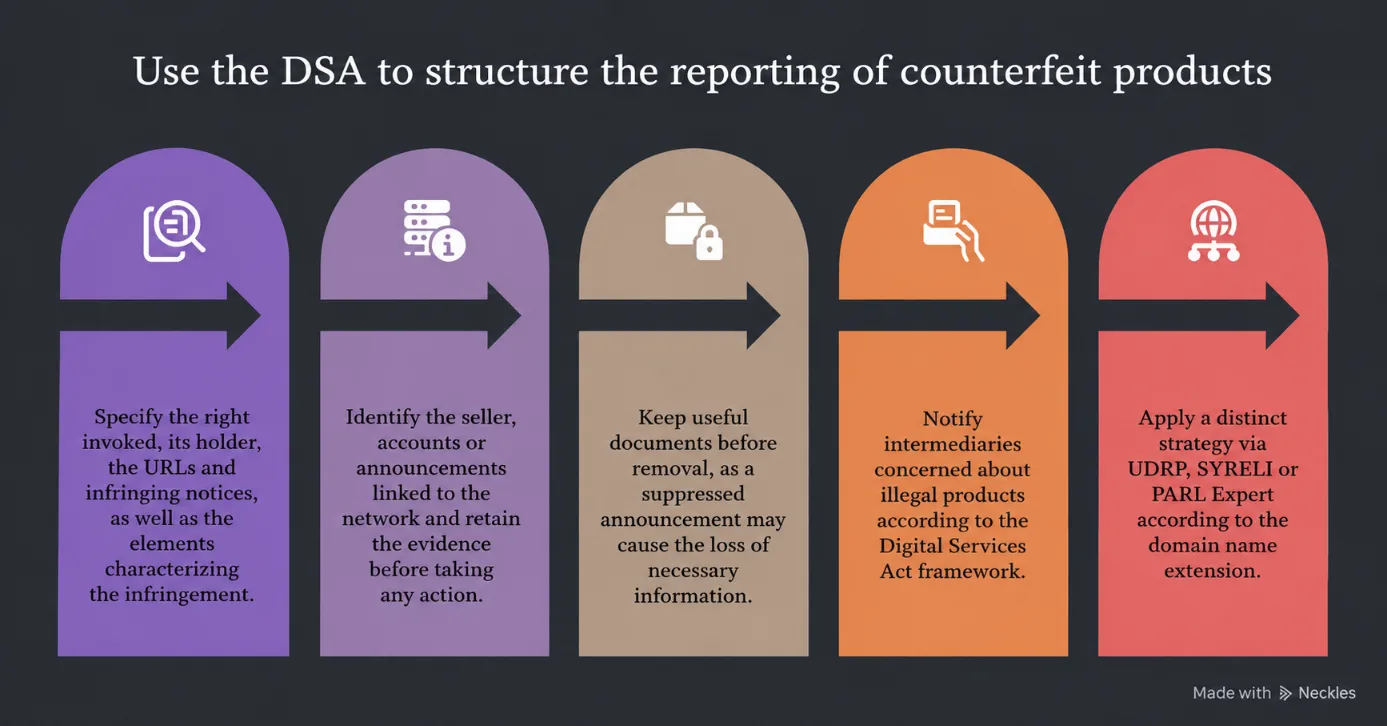
  • Request the suspension or transfer of the abusive domain through a UDRP or local procedure.
  • Report fake accounts to platforms for prompt removal.
  • Inform customers and partners transparently if their data or trust might be affected.
  • Launch a controlled communication plan to mitigate reputational damage.

Learn from every incident

Each incident is an opportunity to strengthen internal processes:

  • update security and governance procedures;
  • expand domain portfolio coverage;
  • provide regular staff training;
  • record incidents and outcomes to refine prevention.

The digital protection checklist

  • Map all official domain names and social accounts.
  • Reserve key domains and critical variants.
  • Activate DNSSEC, DMARC, HTTPS, and other core security measures.
  • Establish a multi-channel monitoring system (domains, social media, marketplaces).
  • Define a clear emergency response plan.
  • Train employees to identify early warning signs.
  • Measure key indicators: detection time, resolution time, and avoided costs.

Why this approach matters

A valuable intangible asset

Your trademark is more than a name ; it’s a strategic intangible asset.

Losing control online can destroy years of investment in trust and reputation.

A lever for trust and compliance

Consumers, partners, and authorities expect digital environments that are secure and transparent.

Robust online protection enhances credibility and demonstrates compliance.

A lasting competitive advantage

Prevention is always cheaper than crisis management.

Trademarks that anticipate risks gain in resilience and long-term performance.

How Dreyfus law firm supports companies

Dreyfus law firm helps trademark owners build a robust digital protection framework through six pillars:

  1. Risk audit: identifying vulnerabilities and prioritizing actions.
  2. Portfolio strategy: planning domain registrations and defensive coverage.
  3. Governance: defining internal policies for domain management.
  4. Monitoring: tracking domains, social networks, and marketplaces.
  5. Crisis management: legal and technical assistance during an infringement.
  6. Training: educating internal teams about digital threats and best practices.

With recognized expertise in intellectual property and digital law, the firm operates at the intersection of legal strategy, technology, and cybersecurity,  in France and internationally.


Conclusion

Protecting a trademark online is no longer optional,  it’s a core element of corporate strategy.

By combining preventive measures (registration, monitoring, security) and rapid response protocols, companies can reduce their exposure and strengthen customer trust.

Dreyfus law firm works alongside businesses to design and implement strong, adaptable digital protection strategies aligned with their global ambitions.


Q&A

What is cybersquatting?
It’s when a third party registers a domain name identical or similar to a trademark, intending to divert traffic or resell it.

How can a trademark protect itself online?
By combining trademark registration, strategic domain reservations, security protocols, and continuous monitoring.

What should I do if someone impersonates my trademark?
Gather evidence, identify the domain holder, and launch a UDRP or contact the relevant platform to request the blocking, deactivation or transfer of the domain name.

Why monitor social media?
Fake accounts can damage trademark trust, spread misinformation, or defraud customers , early detection is essential.

What does Dreyfus law firm offer?
The Dreyfus law firm helps companies design and implement legal and technical strategies for protecting and managing their trademark online.

Read More

Pre-litigation in trademark law: anticipating to avoid costly disputes

Introduction

In the field of intellectual property, trademark protection is a major issue for businesses. Beyond registering a trademark, there are strategies to anticipate conflicts and avoid costly litigation. Pre-litigation in trademark law is a crucial phase in which preventive actions help resolve disputes before they escalate into court proceedings. This process is essential to secure a company’s rights and preserve its reputation while avoiding unnecessary legal expenses.

This article explores the role of pre-litigation in trademark law, how it helps avoid conflicts, and the practical steps companies can take to use it effectively.

Protecting your brand : a strategic imperative

Protecting a trademark is essential to guarantee a company the exclusive use of its distinctive sign. This protection, obtained through registration with the INPI in France and the EUIPO in the European Union, helps prevent identity theft and preserves the uniqueness of the company’s image.

1.1 Standing out effectively in a competitive market

A registered trademark is a symbol of consumer recognition and loyalty. It ensures the company that its sign is protected against unauthorized use, allowing it to distinguish its products and services from those of competitors.

1.2 A brand as a valuable asset for the company

A trademark is not just a sign; it is also a valuable asset. A protected trademark enables the company to strengthen its market position, enhance its image, and even generate revenue through exploitation, assignment, or licensing.

Pre-litigation in trademark law: a strategic response before trial

Pre-litigation refers to the steps taken before any court proceedings in order to resolve a dispute amicably or preventively. The goal is to settle a potential trademark conflict without resorting to lengthy and costly legal procedures.

2.1 Identifying risks before they become disputes

One of the main tools in pre-litigation is monitoring. By quickly identifying any trademark infringement, the company can respond effectively to protect its rights before the situation worsens. Monitoring can cover both registered trademarks and unauthorized uses of distinctive signs on online platforms such as social networks, where third parties might use similar or identical marks for commercial purposes, as well as on e-commerce sites.

2.2 Reacting early: cease-and-desist letters and negotiation as key tools

When a conflict is detected, the first pre-litigation action is often to send a formal warning letter. This letter requests the other party to cease using the disputed trademark. If this step fails, a coexistence agreement or similar negotiation may be considered.

Pre-litigation: a lever to prevent legal escalation

3.1 Controlling costs and avoiding lengthy procedures

Judicial procedures can be extremely expensive in terms of legal fees and time. Pre-litigation helps identify issues as they arise and resolve them before they escalate into lawsuits. This avoids significant costs associated with court proceedings.

3.2 Protecting brand image discreetly

Legal disputes can be perceived negatively by consumers. Even a publicly won lawsuit can tarnish a brand’s image. Pre-litigation helps maintain a positive reputation by resolving conflicts discreetly and swiftly.

3.3 Optimizing resources: time, energy, finances

Legal conflicts demand considerable human and financial resources. Turning to pre-litigation allows the company to stay focused on its core business and avoid diverting energy toward a prolonged dispute.

  1. Trademark disputes : hidden but formidable costs

Costly disputes extend beyond legal fees and can severely affect a company’s strategy. Key examples include :

  • Legal and expert fees: Lawyers’ fees, court expenses, and expert reports can amount to substantial sums
    • Disruption to business operations: The company spends significant time defending itself rather than growing its business
    • Missed opportunities: Engaging in a conflict can block partnerships, damage brand image, and lead to lost economic prospects

image graphique enanglais


Anticipating such issues helps a company avoid the burden of a lengthy legal process, which may end up being far more expensive than preventive measures.

Building an effective strategy to avoid costly disputes

5.1 Implementing rigorous trademark monitoring
Implementing a trademark monitoring system is essential. This includes regularly checking new trademark filings and online activity. It helps detect potential infringements before they become major issues.

5.2 Smart negotiation with similar brands

In certain situations, it may be wise to negotiate coexistence agreements with companies using similar trademarks. This allows for clear boundaries regarding brand usage and helps prevent conflicts.

5.3 Acting without litigation: the amicable path as first response

If a conflict arises, sending a warning letter is often a prudent first step. If this proves ineffective, mediation or negotiation can help resolve the issue without resorting to court proceedings. These amicable approaches are usually quicker and less expensive.

5.4 Getting the right legal advice early On

It is advisable to consult a trademark law specialist to receive precise and tailored legal advice. A detailed legal assessment will help determine the most appropriate pre-litigation strategy.

Pre-litigation tools: anticipate to better protect

The following tools can be used to avoid costly trademark disputes:

  • Legal and commercial watch: Monitoring trademark databases and online platforms
    • Trademark opposition: Challenging the registration of similar trademarks upon filing
    • Mediation and amicable resolution: Using mediation services to reach a settlement without litigation

Conclusion : preventing means protecting your brand for the long term

Pre-litigation in trademark law is an essential tool for any company aiming to protect its brand identity without resorting to costly legal disputes. Through proactive measures, companies can minimize legal risks, maintain their brand reputation, and optimize internal resources.

Dreyfus & Associates offers recognized expertise in pre-litigation and trademark dispute management. We support our clients in designing preventive strategies to anticipate risks and effectively protect their intellectual assets.

Nathalie Dreyfus and the Dreyfus team.

FAQ


  1. What is pre-litigation in trademark law ?

Pre-litigation refers to all amicable actions taken before initiating legal proceedings to resolve a conflict related to the use of a trademark. It includes monitoring, risk analysis, sending cease-and-desist letters, and negotiating agreements. This phase often allows for resolving disputes without going to court, thereby reducing costs and preserving business relationships.

  1. Why monitor competing trademarks ?

Monitoring competing trademarks is essential for any business that wants to protect its identity effectively. A watch system allows companies to quickly identify new trademark applications that may cause confusion with their own, enabling them to act promptly to avoid disputes. It also helps detect unauthorized use of the brand online, on social media, or in points of sale, whether it involves imitation or abusive exploitation. Regular monitoring is also a tool for early detection of counterfeiting, which can seriously damage a company’s reputation and revenue if not addressed quickly.

  1. How can trademark conflicts be avoided ?

It is crucial to check, before filing, that the chosen trademark does not infringe on existing rights. The application should clearly define the targeted products, services, and territories. Regular monitoring helps identify similar uses or filings. In case of risk, swift action such as an opposition or cease-and-desist letter is necessary. Finally, being assisted from the outset by a specialized attorney helps secure the entire protection strategy.

Read More

The importance of actively defending your trademark: understanding foreclosure through tolerance

In the ever-changing world of intellectual property, trademarks are strategic assets that distinguish products and services in the marketplace. However, their value lies not only in their registration, but also in the vigilance shown by their owners to prevent unauthorized use. One of the major legal pitfalls in this regard is foreclosure by tolerance, a mechanism that can deprive the owner of their rights if they fail to act within the prescribed time limits.

Forfeiture by tolerance cannot be equated with prescription. Forfeiture is based on the voluntary inaction of the trademark owner, whereas prescription is a rule of common law linked to time. Forfeiture prevents any action for invalidity or infringement, even if the facts are recent.

I – Understanding forfeiture by tolerance in trademark law

Definition and legal framework

Laches refers to a situation in which the owner of an earlier trademark knowingly tolerates, for a continuous period of five years, the use of a later registered trademark without taking any action. In European law, Article 61 of the EU Trademark Regulation (EUTMR) codifies this mechanism:

1. The owner of a trademark of theEuropean Union who has, for five consecutive years, tolerated the use of a later European Union trademark in the European Union while being aware of that use may no longer apply for a declaration of invalidity of the later trademark on the basis of the earlier trademark for the goods or services for which the later trademark has been used, unless the registration of the later European Union trademark was made in bad faith.

  1. The proprietor of an earlier national trademark referred to in Article 8(2) or of another earlier sign referred to in Article 8(4) who has, for five consecutive years, tolerated the use of a later EU trademark in the Member State where that earlier trademark or other earlier sign is protected, while being aware of that use, may no longer apply for a declaration of invalidity of the later trade mark on the basis of the earlier trade mark or the other earlier sign in respect of the goods or services for which the later trade mark has been used, unless the registration of the later EU trade mark was made in bad faith.
  2. In the cases referred to in paragraphs 1 or 2, the proprietor of the later European Union trademark may not oppose the use of the earlier right, even if that right can no longer be invoked against the later European Union trademark.

Where the conditions are met, the person who has tolerated the use may no longer contest the validity of the later trademark or prohibit its use.

Essential conditions for forfeiture

For forfeiture by tolerance to occur, four cumulative conditions must be met:

  1. Knowledge: the proprietor of the earlier trademark must have been aware of the use of the later trademark.
  2. Continuous use: the later trademark must have been used continuously for five years.
  3. Good faith: the later trademark must have been registered and used in good faith.
  4. Absence of legal action: no legal action must have been taken during this period.

Clarification of the concept of “knowledge”

The condition of actual knowledge by the owner of the earlier trademark is a central criterion for forfeiture by acquiescence, but also one of the most debated.

According to the settled case law of the General Court of the European Union (Case T-150/17) and the Court of Justice of the European Union (Case C-381/12 P), knowledge must be actual, not merely presumed. In other words, implicit knowledge or knowledge inferred from the behavior of the proprietor is not sufficient. Proof of actual knowledge of the use of the later trademark is required.

In particular, the Court of Justice recalled in judgment C-381/12 P that:

The proprietor of an earlier trademark cannot be regarded as having had knowledge of the use of a later trademark unless he actually had knowledge of that use, and not merely implicit knowledge or knowledge inferred from the behavior of the proprietor of the trademark.

Similarly, the European Union Court of Justice in case T-150/17 clarified:

Consequently, the proprietor of a trade mark challenged by a declaration of invalidity cannot merely prove potential knowledge of the use of his trade mark by the proprietor of an earlier trade mark, nor can he adduce consistent evidence capable of giving rise to a presumption of such knowledge.

It is therefore not sufficient that the later trademark is visible on the market or that there are infringement proceedings in other jurisdictions. For example, the mere presence of the disputed trademark in the results of an automated monitoring system does not constitute sufficient evidence in the absence of other concrete evidence.

However, evidence of actual knowledge may result from:

  • correspondence between the parties referring to the use of the trademark;
  • joint presence at trade fairs where the trademarks are used;
  • or the signing of a prior coexistence agreement (case 3971 C).

In case R 1299/2007-2, the EUIPO clarified an important point concerning the condition of knowledge in the context of estoppel by acquiescence. It ruled that the proprietor of the earlier trademark does not need to be aware of the registration of the later trademark, i.e., it is not necessary for them to have formal knowledge that the later trademark has been filed or registered with the competent office. However, it is essential that the proprietor of the earlier trademark has actual knowledge of the use of the later trademark during the relevant period, i.e., that they know that the trademark is being used on the market, despite its registration.

Thus, the period of tolerance begins to run only from the moment when the proprietor of the earlier trademark has actual and objective knowledge of the use of the later trademark, and not simply of its existence as a filing or administrative registration, for five consecutive years. The Board of Appeal ruled, in particular:

What is important in this context is the objective circumstance that the sign (the use of which was knowingly tolerated by the applicant for annulment) must have existed for at least five years as a Community trademark (CTM).”

II – Risks associated with failure to defend trademark rights

Legal consequences

Failure to take timely action against the unauthorized use of an identical or similar trademark may result in a permanent loss of rights. Once the right has been forfeited through tolerance, the prior owner can no longer bring an action for invalidity or infringement against the later trademark for the products or services concerned. This legal barrier requires absolute responsiveness in order to maintain the enforceability of one’s rights.

Economic consequences

The economic effects of a failure to defend one’s rights are equally damaging:

  • Weakening of the trademark: The coexistence of similar trademarks weakens the uniqueness and symbolic value of the earlier trademark. The strength of a trademark lies largely in its ability to distinguish itself clearly from other signs used by competitors. When a similar trademark is tolerated or left unopposed, this differentiation gradually becomes diluted. The earlier trademark then loses some of its exclusivity, which can alter its symbolic value among consumers and business partners. This deterioration affects not only the qualitative perception of the trademark, but also its commercial strength and its ability to embody the identity and values of the company.
  • Consumer confusion: Similar trademarks can confuse the public, undermine trust, and divert sales. Consumers faced with a fragmented range of similar signs may find it difficult to clearly identify the origin of products or services. This uncertainty undermines consumer confidence, which can result in hesitation to purchase or even rejection of the market. Furthermore, confusion may encourage the misuse of the reputation and renown of the earlier trademark by the owners of later trademarks, to the detriment of consumer loyalty to the original trademark.
  • Loss of market share: Competitors taking advantage of the similarity may capture a share of the customer base by unfairly benefiting from the reputation of the original trademark. This capture of customers is often based on an illegitimate appropriation of the reputation and marketing efforts of the original owner. The impact is reflected in a decrease in sales and, ultimately, an erosion of the original brand’s competitive position. In a competitive market environment, this loss can permanently undermine the economic and strategic viability of the company.

III – Strategies for active trademark protection

Proactive monitoring and detection

Rigorous market monitoring is essential. The implementation of monitoring systems enables the rapid detection of infringing registrations or uses. Regular audits and analysis of national and international databases are also crucial tools for anticipating litigation.

Legal action and timely responses

As soon as unauthorized use is identified, it is advisable to act without delay. This may take the form of:

  • formal notices (see limitations below),
  • oppositions to the registration of conflicting trademarks,
  • or legal action if necessary.

These measures not only serve to avoid foreclosure, but also strengthen the legitimacy and exclusivity of the trademark.

Interruption of the foreclosure period

The starting point and suspension of the grace period are also the subject of extensive case law.

The CJEU ruling C-482/09 established that simply sending a formal notice is not sufficient to interrupt the foreclosure period, unless this letter leads to a concrete result (e.g., voluntary withdrawal, a coexistence agreement, or the initiation of legal proceedings).

Only administrative or judicial action—such as an action for invalidity before the INPI or the European Union Intellectual Property Office (EUIPO) or an action before the national courts, such as an action for infringement—can effectively interrupt the five-year period.

A recent ruling (Case C-466/20) confirmed that sending an unsuccessful warning, even if it proves clear opposition, is not sufficient to prevent foreclosure if no formal action follows. The Court specifies that:

Any interpretation of Article 9 of Directive 2008/95 and Articles 54, 110 and 111 of Regulation No 207/2009 as meaning that the sending of a warning letter is sufficient, in itself, to interrupt the limitation period would allow the proprietor of the earlier trademark orother earlier right to circumvent the limitation period by tolerance by repeatedly sending, at intervals of nearly five years, a letter of formal notice. Such a situation would undermine the objectives of the limitation period by tolerance, as recalled in paragraphs 46 to 48 of this judgment, and would deprive that system of its effectiveness.”

This decision highlights the importance of active vigilance and legal responsiveness in the face of unauthorized use of an earlier trademark.

Similarly, the signing of a coexistence agreement interrupts the period of foreclosure by tolerance, thereby suspending the period during which the owner of the earlier trademark could lose its rights due to its tolerance. However, if that agreement is subsequently breached or ceases to have effect, a new period of five years begins to run, provided that the proprietor of the earlier trademark again becomes effectively aware of the use of the later trademark. This rule was clarified by decision R 267/2014-2.

In that case, the Board of Appeal held, inter alia:

Consequently, since the application for a declaration of invalidity was filed on July 11, 2012, the contested decision correctly concluded that less than five consecutive years had elapsed between the end of the verbal agreement, i.e., from the moment when the applicant for invalidity had the opportunity not to tolerate the use of the contested Community trademark, and the application for a declaration of invalidity. On the other hand, even if it were considered that the verbal agreement between the parties had not been breached and had ended when the proprietor of the Community trademark filed opposition against the Community trademark application ‘BONASYSTEMS’ on February 16, 2010, that verbal agreement should, in the absence of evidence to the contrary, be considered still valid. Consequently, the proprietor of the earlier trade mark is still not in a position to refuse to tolerate the use of the latter Community trade mark in the United Kingdom. It follows that the application for a declaration of acquiescence must be dismissed.

Thus, the period of forfeiture can only be resumed if two conditions are met simultaneously: the effective termination of the coexistence agreement and the prior proprietor’s awareness of the continued use of the later trademark.

Conclusion

Actively defending your trademark is not just a legal obligation: it is a strategic imperative. Knowing and anticipating the effects of foreclosure by tolerance is essential to preserving the value, exclusivity, and integrity of a trademark portfolio. A policy of systematic vigilance, combined with targeted and rapid responses, is the best guarantee for ensuring the longevity of an asset as sensitive as a trademark.

The law firm Dreyfus & Associés assists its clients in managing complex intellectual property cases, offering personalized advice and comprehensive operational support for the complete protection of intellectual property.

Dreyfus & Associés is partnered with a global network of lawyers specializing in intellectual property.

Nathalie Dreyfus with the assistance of the entire Dreyfus team.

This article was published on the Village Justice website.

FAQ

1. What is foreclosure through tolerance in trademark law?

Foreclosure by tolerance occurs when the owner of an earlier trademark knowingly tolerates the use of a later registered trademark for five consecutive years without taking action. After this period, the owner of the earlier trademark can no longer seek to invalidate the later trademark, unless it was registered in bad faith.

2. What are the essential conditions for foreclosure by tolerance?

To trigger foreclosure by tolerance, four conditions must be met: the trademark owner must have knowledge of the use of the later trademark, the later trademark must have been used continuously for five years, the later trademark must have been used in good faith, and no legal action must have been taken during this period.

3. What are the legal consequences of not defending your trademark in time?

Failing to act against unauthorized use of a trademark within the prescribed period can result in a permanent loss of rights. Once foreclosure by tolerance is established, the owner can no longer challenge the validity or prevent the use of the later trademark for the relevant products or services.

Read More

Trademarks and AI: Can a Name Generated by Artificial Intelligence Be Protected?

The rise of artificial intelligence (AI) has revolutionized numerous sectors, including brand naming. Many companies now question whether a name generated by AI can benefit from legal protection as a trademark. This article reviews the relevant French legal framework and analyzes whether such a name can be registered, provided it complies with the provisions of the French Intellectual Property Code (Code de la propriété intellectuelle, CPI).

The Legal Framework for Trademarks in France

Definition and Acquisition of Trademark Rights

According to Article L.711-1 of the French Intellectual Property Code, a trademark is defined as a sign capable of distinguishing the goods or services of a natural or legal person from those of others. Ownership of a trademark is acquired through registration, pursuant to Article L.712-1 of the same code. Registration grants the holder exclusive rights over the trademark for the goods or services listed.

Conditions for Trademark Validity

For a trademark to be valid and registrable, it must meet the following conditions:

  • Distinctiveness: The sign must be capable of distinguishing the goods or services of one company from those of another.
  • Lawfulness: The sign must not be contrary to public order or accepted principles of morality.
  • Non-deceptiveness: The sign must not mislead the public, particularly regarding the nature, quality, or origin of the products or services.
  • Availability: The sign must not infringe any prior rights, such as already registered trademarks or protected business names.

These criteria are outlined in detail by the French National Institute of Industrial Property (INPI).

Applicability to AI-Generated Names

Compliance with Legal Requirements

A brand name generated by artificial intelligence may be registered in France as long as it complies with the above-mentioned conditions. The mere fact that the name is AI-generated does not preclude registration, provided it is distinctive, lawful, non-deceptive, and available. Notably, Article L.711-1 CPI does not impose any requirement regarding the origin of the sign, which means names generated by automated systems are not excluded from protection.

Specific Considerations Related to AI

Different considerations apply under copyright law. Unlike trademark law, which is focused on distinctiveness and availability, copyright protection requires human creative input and that the work reflects the author’s personality. Indeed, Article L.112-1 of the French Intellectual Property Code states that “works of the mind, whatever their genre, form of expression, merit, or purpose,” are protected, provided they are original.

As such, while a name generated by AI is unlikely to qualify for copyright protection without human input, it can nevertheless be registered as a trademark, assuming it fulfills the requirements set out in Articles L.711-1 et seq. of the CPI.

Recommendations for Businesses

Registering a trademark that results from a process involving AI requires a legally sound and strategic approach. Although the law does not exclude names generated by AI, their validity depends on a detailed legal analysis under the French Intellectual Property Code.

It is therefore essential to consult with an intellectual property expert – such as a specialized attorney or industrial property counsel – to secure the entire process. This professional can:

  • Assess the compliance of the name with the validity criteria set out in Articles L.711-1 and following, particularly its distinctiveness, lawfulness, and lack of conflict with prior rights;
  • Proceed with a thorough clearance search, which is critical to avoid future legal disputes;
  • Review the terms and conditions of the AI tools used, particularly regarding ownership or assignment of the generated content, which may include restrictive clauses;
  • Structure and document the name creation and selection process, to demonstrate, if necessary, a substantial and voluntary human intervention in the final choice.

This approach significantly strengthens the legal security of the trademark filing and helps anticipate risks related to the algorithmic origin of the sign.

Conclusion

Trademarks generated by artificial intelligence can be protected under French law, provided they meet the requirements of the Intellectual Property Code. By following the appropriate steps and involving qualified legal counsel, companies can effectively safeguard brand names created with the help of AI tools.

At Dreyfus Law Firm, we stand ready to provide comprehensive legal strategies tailored to each client’s needs. Our services include advising on trademark protection, and litigation support across multiple jurisdictions.

Dreyfus Law Firm is in partnership with a global network of Intellectual Property attorneys, ensuring comprehensive assistance for businesses worldwide.

Join us on social media !

LinkedIn  

Instagram

FAQ

1. Can an AI-generated name be registered as a trademark in France?

Yes, provided that it satisfies the criteria of distinctiveness, lawfulness, non-deceptiveness, and availability as outlined in the Intellectual Property Code.

2. Does the origin of the name (human or AI) affect its trademark validity?

No. The CPI does not distinguish based on the origin of the sign. What matters is compliance with the legal conditions for registration.

3. What are the risks of registering an AI-generated name without proper legal vetting?

There is a risk of refusal by the trademark office or future litigation if the name infringes prior rights.

Read More

Copyright and trademark in wine packaging and labeling

Key considerations for wineries and wine businesses in the United States

Wine labeling is more than just listing the varietal, region, or vintage—it’s a creative and strategic endeavor that shapes a winery’s public identity. Elements such as labels, logos, colors, fonts, taglines, and even bottle shapes can become critical assets, each subject to complex legal protections. In the United States, two primary areas of intellectual property (IP) come into play: copyright (for creative works) and trademark (for brand identifiers). When properly leveraged, these legal tools can protect a producer’s investment in design and branding, deter counterfeiters, and bolster a winery’s reputation in a crowded market.

This article delves into copyright and trademark laws as they affect the packaging and labeling of wine, highlighting the interplay with Alcohol and Tobacco Tax and Trade Bureau (TTB) regulations, and offering practical guidance for ensuring comprehensive protection of your label designs.

The importance of packaging and labeling in the wine industry

Brand differentiation and market perception

  • Visual Identity: In a sector where numerous bottles vie for attention on retail shelves, your label and packaging are often the first points of consumer engagement. A carefully crafted design can influence purchasing decisions.
  • Storytelling and Heritage: Many wineries infuse their labels with elements reflecting their history, terroir, or family legacy. Whether it’s a depiction of a vineyard landscape or a stylized crest passed down through generations, these creative visuals become a key part of the wine’s story.

(Stat Note: According to data from the Wine Market Council, up to 70% of wine-buying decisions are made in-store based on label appeal and perceived brand quality.)

The convergence of art and commerce

Wine labels transcend mere product description, often functioning as miniature works of art. This dual function—practical (identifying the wine) and artistic (evoking themes, emotions, stories)—can lead to overlapping legal protections under copyright law (protecting creative expression) and trademark law (protecting distinctive brand elements).

Copyright protection for wine labels and packaging

What copyright covers

Copyright in the United States protects “original works of authorship fixed in any tangible medium of expression.” For wine labels, this typically applies to:

  • Illustrations, graphics, and artwork: Any unique drawings, images, or decorative elements.
  • Photographs: If the label features original photography of a vineyard, estate, or other subjects.
  • Textual designs: Certain stylized text arrangements that reflect creative authorship, beyond merely stating the wine’s variety or region.

Under 17 U.S.C. § 102, you automatically hold the copyright to your label from the moment it’s created in a fixed form. However, registering the work with the U.S. Copyright Office (copyright.gov) offers additional legal benefits, including the ability to seek statutory damages and attorneys’ fees if you prevail in an infringement lawsuit.

Registration benefits and best practices

  • Enhanced enforcement: Registered copyrights provide a clear record of authorship and ownership.
  • Public notice: By registering, you publicly assert your claim, deterring would-be infringers.
  • Copyright notice: Including a notice (e.g., © [Year] [Owner Name]) on the label strengthens your position, though it is not mandatory for protection.

(Practical Tip: Some wineries register new label designs as soon as they’re finalized, particularly for high-end releases or limited-edition bottles that rely heavily on unique artwork.)

Limitations of copyright in labeling

Copyright protects creative expression, not functional or factual aspects. Consequently:

  • Mandatory statements: Label elements required by TTB regulations—such as alcohol content, origin, net contents—cannot be copyrighted. They are considered functional or factual.
  • Generic or descriptive terms: Words that merely name a varietal (e.g., “Cabernet Sauvignon”) or region (e.g., “Napa Valley”) are not subject to copyright protection.

Trademark protection in wine labeling and branding

Distinctive elements eligible for trademark

Trademarks can protect a wide range of “source identifiers,” such as:

  • Brand names and winery names: For instance, “Silver Oak” or “Jordan Winery.”
  • Logos and stylized text: A custom emblem or stylized brand wordmark.
  • Taglines or slogans: Marketing phrases that help consumers identify and recall your wine.
  • Bottle shapes or label configurations (Trade Dress): If they are distinctive and non-functional. For example, a uniquely shaped bottle could be considered protectable trade dress when the shape itself signifies the brand.

The role of the USPTO

In the U.S., trademark registration is handled by the United States Patent and Trademark Office (USPTO) (uspto.gov). A federal trademark registration confers:

  • Nationwide protection: Deters infringers beyond your immediate region.
  • Legal presumptions: Proof of ownership and exclusive rights to use the mark in connection with specified goods.
  • Potential for international filing: Serves as a basis for Madrid Protocol applications via the World Intellectual Property Organization (WIPO).

Label approval vs. trademark registration

It’s crucial to distinguish between TTB label approval and USPTO trademark registration:

  • TTB: Focuses on compliance with labeling regulations (alcohol content, origin, disclaimers). Approval does not guarantee any IP rights in the brand name or artwork.
  • USPTO: Examines distinctiveness, likelihood of confusion, and existing prior rights. A name greenlit by TTB might still face refusal or opposition at the USPTO if similar marks exist.

(Example: A wine label approved by TTB with the word “Sunset Ridge” could still be refused by the USPTO if “Sunset Ridge Cellars” is an existing registered trademark.)

Navigating overlaps and potential conflicts

Copyright vs. Trademark

  • Copyright covers the artistic aspects—illustrations, creative text layout, or photographs.
  • Trademark covers the brand name, logos, or distinct label designs recognized by consumers as indicating a particular source.
    These two can coexist. For instance, a visually ornate label design can have copyright protection for its artwork and trademark protection for the brand name or a stylized logo.

Confusion with geographic terms and appellations

Wine labeling often highlights regions or appellations (e.g., Napa Valley, Sonoma Coast, Willamette Valley). While these terms may be necessary to describe the product, they generally cannot serve as trademarks if they are considered primarily geographic.

  • Appellation conflicts: Groups like the Napa Valley Vintners Association actively defend the Napa name, ensuring it’s only used by wineries meeting certain AVA (American Viticultural Area) requirements.
  • Deceptive marks: A label referencing a region or type of wine (e.g., “Champagne,” “Port,” or “Burgundy”) without following legal standards or sourcing may be found deceptive by the USPTO and refused registration.

Common pitfalls

  1. Generic or descriptive brand names: A term like “Chardonnay Reserve” is unlikely to qualify for trademark registration if it only describes the wine.
  2. Overreliance on disclaimers: The USPTO may require disclaimers for descriptive words—such as “Winery,” “Estate,” or “Vineyards”—to avoid granting exclusive rights over generic or descriptive terms.
  3. Failure to monitor: Neglecting to keep an eye on new trademark filings or unauthorized uses of your art or brand name can allow infringers to establish competing rights.

Case studies, statistics, and a hypothetical scenario

Case study: artistic label dispute

A California boutique winery, “Moonlight Cellars,” hired a freelance artist to create a highly detailed label for its new Merlot. The label featured a watercolor painting of an owl perched under a moonlit sky.

  • Copyright conflict: The artist later discovered the winery had slightly modified her painting for limited-edition releases without seeking permission. She filed a copyright infringement claim.
  • Trademark overlap: The winery had successfully registered “Moonlight Cellars” as a trademark but had neglected to secure permission for derivative use of the artwork.
  • Outcome: Through negotiation, the winery purchased additional rights. This underscored the need for clear licensing agreements that address both the original and potential future uses of label artwork.

Stats on wine label design and IP registration

A 2025 report by the USPTO indicated that trademark applications within Class 33 (wines and spirits) rose by 12% year over year, reflecting the increasing number of independent labels and craft producers. Separately, the Graphic Artists Guild noted a 20% rise in requests for label design-related copyright registrations, emphasizing the growing commercial importance of visual identity in the wine sector.

Hypothetical client example: Golden Crest Wines

“Golden Crest Wines,” a Washington-based winery, launched a new Rosé line with a stylized gold crest design. They:

  1. Secured a trademark for the name “Golden Crest Wines” and the stylized crest logo via the USPTO.
  2. Registered the label artwork with the U.S. Copyright Office to protect the crest’s elaborate design and background art.
  3. Ensured TTB compliance by accurately listing the AVA and alcohol content.
  • Result: A cohesive IP strategy minimized the risks of both brand confusion and unauthorized replication of the label design.

Practical tips for protecting wine packaging and labels

Use written agreements for artwork

Whenever hiring freelance designers or agencies:

  • Clarify ownership: Decide whether you, as the winery, will own the full copyright upon creation, or whether the artist retains some rights.
  • License scope: Define if the artwork can be used across multiple product lines, websites, or future limited editions.
  • Work-for-hire provisions: In many cases, you must explicitly state that the work is “made for hire,” otherwise the artist may retain the copyright.

Conduct thorough searches before launch

  • USPTO TESS: Check for existing marks that could conflict with your proposed brand name, logo, or slogans.
  • Copyright Office records: If using stock imagery or previously commissioned art, ensure no overlapping claims or restrictions exist.
  • Appellation guidelines: Verify any TTB or AVA requirements for wording, disclaimers, or usage permissions.

Register, monitor, and enforce

  • Timely registration: File for trademark registration as soon as you decide on a brand. Similarly, register label designs or other major creative elements with the Copyright Office.
  • Monitoring new filings: Watch for potential conflicts in the USPTO Official Gazette and relevant creative marketplaces (e.g., popular design platforms).
  • Take swift action: If you spot an infringing label or brand name, consider sending a cease-and-desist letter or filing an opposition (for trademarks) or infringement suit (for copyright) where appropriate.

Plan for international protection

For wineries aiming to export or eventually tap into foreign markets (EU, UK, Asia, etc.):

  • Trademark extension: The Madrid Protocol allows you to extend your USPTO registration internationally through WIPO (wipo.int).
  • Labeling laws abroad: Investigate local regulations on disclaimers, mandatory health warnings, and protected geographical indications (like “Rioja” in Spain or “Bordeaux” in France).

Conclusion

In a competitive landscape where packaging and labeling speak volumes about your wine’s quality and origin, both copyright and trademark laws serve pivotal roles. Copyright can guard the creative essence of your label—its artwork, typography, and visual flair—while trademark secures your brand identity, ensuring that names and logos become cornerstones of consumer trust.

When carefully managed, these protections deter copycats, elevate brand perception, and may even become valuable business assets for expansions or partnerships. However, success hinges on anticipating legal hurdles, from TTB compliance to potential conflicts with existing marks or appellations.

Why work with Dreyfus?

  • Recognized Expertise: With over 20 years of experience in intellectual property and a deep understanding of wine regulations, our team assists clients in creating ironclad label strategies.
  • Global Network: We facilitate international registrations, ensuring that wineries eyeing overseas markets remain protected under multiple jurisdictions.
  • Tailored Guidance: Each winery’s story is unique. We offer strategic advice adapted to your creative vision, marketing goals, and compliance needs.

The cabinet Dreyfus et Associés is in partnership with a worldwide network of lawyers specialized in Intellectual Property.

Ready to protect your wine’s visual identity?

  • Contact us to develop a customized plan to safeguard your label and brand assets.
  • Subscribe to our newsletter for the latest legal updates in wine labeling and IP.
  • Download our practical guide, “5 Essential Tips for Copyright and Trademark Protection in Wine Labeling,” featuring case studies and checklists.

Additional Resources

Shape your wine’s story with confidence—fortify your labels and packaging using robust legal frameworks.

Read More

Trademark registration for a wine or a winery: key steps and common pitfalls

In the highly competitive world of wine production and distribution, standing out often hinges on building a distinctive identity—from the name of your winery or vineyard to the label on each bottle. In the United States, securing a trademark for your wine brand is one of the most effective ways to protect this identity. However, navigating the trademark system can be challenging, particularly when dealing with additional regulations related to wine labeling and geographical indications.

This article provides a detailed look at the trademark registration process for wines in the U.S., highlights frequent legal and regulatory pitfalls, and offers practical tips to safeguard your brand from costly conflicts. Whether you produce a Napa Valley Cabernet Sauvignon or a Willamette Valley Pinot Noir, a robust trademark strategy is vital for long-term success.

Why protect your wine brand or winery name?

Legal imperatives

  • Exclusive right to use the mark: By registering your trademark with the United States Patent and Trademark Office (USPTO), you gain nationwide priority over the use of the mark for the goods and services specified in your application.
  • Litigation leverage: Should a competitor attempt to adopt a similar name or label, holding a federal trademark registration bolsters your position in court. It allows you to potentially recover damages and attorneys’ fees, and it offers a legal presumption of validity and ownership of the mark throughout the U.S.
  • Protecting an intangible asset: Your brand is intellectual property that can be licensed, sold, or used as a valuable business asset. According to various industry reports, strong brand recognition can increase a winery’s overall valuation and attract investors, distributors, or joint-venture partners.

Economic stakes

  • Credibility for buyers and importers: Wine buyers—including restaurants, retailers, and wholesalers—gravitate toward well-branded products. A registered trademark signals professionalism and provides assurance that you take your business seriously.
  • Investor appeal: Private equity and other investors in the wine sector look favorably on wineries and wine brands that have protected their names. This is because a clear trademark strategy mitigates the risk of future legal complications.
  • Facilitating international expansion: With the U.S. as one of the largest wine-consuming nations in the world, many producers also aim to export. Having a federal registration can be a strong basis for filing in other countries through the Madrid System managed by the World Intellectual Property Organization (WIPO).

(Stat Note: According to the Wine Institute (wineinstitute.org), U.S. wine sales—domestic and imports—have consistently exceeded 400 million cases per year, reflecting robust demand and heightened competition in branding.)

Marketing and brand equity

  • Differentiating your AVA or winery story: American Viticultural Areas (AVAs) such as Napa Valley, Sonoma County, Willamette Valley, and Finger Lakes are integral to a wine’s identity. A trademark allows you to highlight unique qualities while avoiding consumer confusion with other wineries in the same region.
  • Long-term consumer loyalty: Once consumers come to trust a wine brand, they tend to become repeat buyers, seeking out new vintages or related labels under the same trademark.
  • Consistent branding across channels: A trademark gives you the foundation to unify your online presence, labeling, packaging, and promotional materials under a single, well-protected identity.

Trademark law and regulatory bodies in the U.S.

The USPTO

The United States Patent and Trademark Office (USPTO) is the primary federal agency for trademark registration. Once granted, a federal trademark registration offers protection across all 50 states and U.S. territories.

  • Term of protection: Initially valid for 10 years and renewable indefinitely, provided you file timely maintenance documents and demonstrate continued use.
  • Filing method: Online submission through the Trademark Electronic Application System (TEAS) is the standard.

State trademarks

In addition to federal registration, some wine producers opt for state-level trademarks (e.g., California Secretary of State for wineries in Napa). However, these provide limited geographic protection. For wineries hoping to sell across state lines, a USPTO registration is more robust.

TTB labeling regulations

The Alcohol and Tobacco Tax and Trade Bureau (TTB) (ttb.gov) oversees wine labeling and advertising. While TTB approval is separate from trademark registration, certain TTB regulations intersect with trademark considerations:

  • Brand name approval: The TTB might reject a label if it includes misleading geographic claims or references.
  • Appellation of Origin: Using names like “Napa Valley” or “Sonoma Coast” requires adherence to specific TTB and state-level rules regarding the percentage of grapes sourced from those regions.
  • Misleading terms: Terms that falsely imply certain winemaking practices or locations can run afoul of both TTB rules and trademark law.

Key steps for registering a wine trademark

Conducting a comprehensive clearance search

Before filing an application with the USPTO, it is crucial to perform a trademark clearance search.

  • USPTO Database: Search the TESS (Trademark Electronic Search System) to check for identical or similar marks.
  • Common Law Databases: Not all trademarks are registered. Many wineries rely on common law rights, so also search corporate names, domain names, and wine competition listings.
  • International Databases: If you plan to export, consider searching the databases of the EUIPO (European Union Intellectual Property Office) and the WIPO (World Intellectual Property Organization).

(Industry Stat: The USPTO receives tens of thousands of trademark applications per month across all industries. In the wine and spirits sector, the volume has been steadily increasing, reflecting the rise of boutique and craft producers.)

Classification and identifying goods/services

The USPTO uses International Classes under the Nice Classification System. Wine typically falls under:

  • Class 33: Alcoholic beverages (except beers).
  • Potential additional classes: If you provide wine club subscriptions (Class 35 for retail services) or tasting events (Class 41 for entertainment services), ensure they are included.

Precision in describing goods and services is crucial. An overly broad description might lead to either refusal or vulnerability to partial cancellation later, while an overly narrow description might limit brand expansion.

Filing the application

This step involves submitting a TEAS form via uspto.gov. Key elements of the application include:

  • Owner details: Whether you’re filing under an individual or corporate entity name.
  • Basis for filing: Use-based (Section 1(a)) if already in commerce, or intent-to-use (Section 1(b)) if you plan to commercialize soon.
  • Specimen (if applicable): If filing on a use basis, you must provide a label, packaging, or marketing materials showing how the mark is used in commerce.

Examination, publication, and opposition

  1. Initial review: A USPTO examining attorney checks for compliance with procedural and substantive requirements.
  2. Office actions: The examining attorney might issue an office action requesting clarifications, disclaimers, or refusals based on confusing similarity to an existing mark.
  3. Publication in the Official Gazette: Upon acceptance, the mark is published. Any party who believes they would be harmed by the registration has 30 days to file an opposition before the Trademark Trial and Appeal Board (TTAB).

Registration and maintenance

If unopposed (or if you win an opposition proceeding), the USPTO issues a Certificate of Registration. The trademark is initially valid for 10 years, with a Section 8 Declaration of continued use due between the 5th and 6th year, and subsequent renewals required every 10 years.

Common pitfalls in wine trademark filings

Geographic misdescriptions and AVA conflicts

Using a protected AVA name like “Napa Valley” or “Santa Barbara County” without meeting the TTB’s sourcing requirements can trigger:

  • Refusal by the USPTO: On grounds of deceptively misdescriptive or primarily geographically descriptive if you do not meet TTB criteria.
  • Challenges from regional associations: Groups like the Napa Valley Vintners or the Oregon Wine Board vigorously defend their geographic designations.

Likelihood of confusion with existing marks

A slight variation in spelling may not be enough to avoid confusing similarity.

  • Example: “Cascade Hills Winery” vs. “Cascade Hill Vineyards” could be considered too close in the eyes of the USPTO if both produce wine in overlapping markets.
  • Legal consequences: If your mark is deemed confusingly similar, it can lead to refusal during examination or, worse, an opposition proceeding by the existing mark owner.

Improper use of foreign terms

Wine producers sometimes use French, Italian, or Spanish terms to evoke Old World charm. However, terms that are generic or descriptive in a foreign language can face refusal under the doctrine of foreign equivalents.

  • Example: Using “Château” for a U.S. winery might raise descriptive issues unless the overall mark has distinctiveness.

Timing issues and lack of monitoring

  • Late filing: Launching a brand in multiple states before filing can allow competitors to preempt your rights.
  • No watch service: Failing to monitor the USPTO Gazette or other platforms means missing the chance to oppose similar wine marks within the TTAB’s strict deadlines.

Case studies, statistics, and a hypothetical client

Case study: Green Valley Vineyards

Green Valley Vineyards wanted to expand distribution throughout the U.S. While the owners had used “Green Valley” informally for years, they discovered mid-expansion that a California winery called “Greenvalley Estate” was already registered with the USPTO.

  • Result: A TTAB opposition forced Green Valley Vineyards to rebrand to “GV Vineyards” and revise all their labeling and marketing materials—a costly endeavor in the middle of national expansion.

U.S. wine trademark data

A 2025 USPTO annual report noted a 15% year-over-year increase in wine-related trademark applications, highlighting the explosive growth of both boutique wineries and private-label ventures in the U.S. market. This surge correlates with the rise in e-commerce wine sales and direct-to-consumer shipping laws liberalizing in several states.

Fictional client example: Autumn Harvest Wines

Autumn Harvest Wines, based in the Finger Lakes region of New York, decided to register a new brand for their Riesling line—“Autumn Mist.” Through a comprehensive clearance search, they discovered a potential conflict with an Oregon-based brewer that had “Autumn’s Mist Ale.” Their attorney advised minor changes in the label design and the goods description to reduce confusion.

  • Outcome: The brand launched smoothly under a slightly altered name, “Autumn Mist Riesling,” circumventing likely opposition from the brewer.

Practical tips for a successful wine trademark strategy

Consult an attorney or IP specialist

Wine law intersects with traditional trademark law, TTB regulations, AVA restrictions, and occasionally import-export rules. An experienced intellectual property attorney or specialized consultant can:

  • Conduct a thorough clearance search, including common law and international resources.
  • Advise on naming conventions, disclaimers, and label design to comply with TTB and USPTO requirements.
  • Manage the entire trademark application process, from filing through potential TTAB proceedings.

Plan for international expansion

Many U.S. wineries eventually reach beyond domestic markets. A federal trademark registration can serve as a basis for Madrid System applications, extending coverage into key wine-consuming nations like Canada, the UK, China, or Japan.

  • Avoid brand squatting: Certain countries see opportunistic registrations by third parties who anticipate the future arrival of an American brand, then demand high fees to release the name.
  • Consult local counsel: In addition to WIPO filings, each country may have local regulations, especially concerning geographical indications or local labeling laws.

Implement a trademark watch and enforcement program

  • USPTO Gazette monitoring: Subscribe to a watch service to track newly published marks in wine, spirits, or related categories.
  • Active enforcement: Sending cease-and-desist letters or filing oppositions at the TTAB can deter infringers and demonstrate your commitment to brand protection.
  • Periodic audits: Regularly review your own label usage, domain names, and expansions into new products (e.g., wine spritzers, wine-based cocktails) to update your trademark portfolio.

Conclusion

Trademark registration is more than just a legal formality—it is a cornerstone of your brand’s identity, reputation, and long-term market success. In an industry as storied and dynamic as wine, a strong trademark not only shields you from imitators but also fortifies your brand story in the minds of consumers.

By proactively registering and maintaining your trademark, you signal quality, distinction, and credibility. For producers whose goal is to stand out in the crowded aisles of local retail shops or in high-end restaurants nationwide, trademark protection is a non-negotiable step in building a legacy.

Why work with Dreyfus?

  • Recognized Expertise: Our team has over 20 years of experience in intellectual property and extensive knowledge of wine law.
  • Global Network: We assist clients with international filing strategies, ensuring worldwide protection for brands poised for export.
  • Customized Approach: We thoroughly analyze your situation to develop a specialized trademark strategy that fits your unique goals, whether you’re a boutique winery in Oregon or a large-scale producer in California.

The cabinet Dreyfus et Associés is in partnership with a worldwide network of lawyers specialized in Intellectual Property.

Do you need help securing your wine brand?

Contact us to develop a comprehensive plan and safeguard your wine label or winery name for years to come.

  • Subscribe to our newsletter to stay informed of the latest legal developments in wine and intellectual property.
  • Download our practical guide on “10 Critical Mistakes to Avoid When Trademarking a Wine in the U.S.” (including case studies, expert tips, and a step-by-step checklist).

Useful External Links for Further Reading

Together, let’s protect and elevate your winemaking heritage.

Read More

How to win a cancellation action against a French trademark or invalidity proceedings before the INPI?

Effective trademark management in France requires a thorough mastery of the administrative procedures needed to challenge a trademark’s validity or obtain its revocation. The French National Institute of Industrial Property (INPI) provides simplified mechanisms for invalidation (nullity) and revocation (déchéance), enabling stakeholders to maintain fair practices in the field of trademarks.

In 2023, trademark-related cases account for 91% of all procedures before the INPI. Invalidation actions have risen to 22% (compared to 19% in 2022), while revocation procedures have decreased from 17% to 9%.

Introduction to Invalidation and Revocation Procedures before the INPI

The procedures for invalidation and revocation, introduced by the EU Trademark Package in 2020, allow you to challenge improper registrations or revoke a trademark. They offer a faster and more cost-effective alternative compared to court proceedings.

  • Invalidation (Nullity): The trademark was invalid from the moment it was registered. It is therefore removed from the register with retroactive effect.
  • Revocation (Déchéance): The trademark has lost its validity due to events occurring after its registration. Its effects end only for the future.

Key statistics:

  • In 2023, 60% of successful invalidation actions were based on absolute grounds.
  • Favorable revocation decisions for non-use represent 75% of cases initiated since 2021.

These tools protect market integrity and ensure fair competitive practices.

The Invalidation Procedure

Invalidation aims to eliminate trademarks that should never have been registered.

Absolute Grounds for Invalidation

A trademark may be invalidated if it:

  • Lacks distinctiveness: e.g., generic or descriptive terms.
  • Is contrary to public policy or accepted principles of morality.
  • Misleads the public: e.g., about the geographical origin or quality of the products.

Relative Grounds for Invalidation

A trademark may be invalidated for infringing prior rights:

  • Identical or similar trademark already registered.
  • Pre-existing copyright, trade names, or domain names.

Dive Deeper: When a trademark is challenged on relative grounds, it is crucial to present a clear comparative analysis of the distinctive elements, including phonetics, appearance, and meaning. Citing relevant case law bolsters your arguments.

Case Law Example: In 2022, a French trademark was invalidated for causing confusion with an EU trademark registered 5 years earlier (Source: INPI).

Extended Practical Example: A competitor registered a trademark using the dominant color of a pre-existing company, combined with similar wording. An expert analysis of consumer perception was crucial in convincing the INPI to invalidate the trademark on relative grounds.

The Revocation Procedure

Revocation addresses abuses or omissions that occur after registration.

Non-Use of a Trademark

If a trademark is not used within 5 years of its registration, it can be revoked. For instance, a trademark registered in 2017 with no proven use by 2023 could be subject to revocation.

Focus: Evidence of use may include invoices, advertising materials, or packaging samples. The absence of such documents weakens the owner’s position.

Becoming a Generic Term

Abusive use can cause a trademark to lose its distinctiveness. Examples include Aspirin or Kleenex, which have become generic terms in some countries.

Misleading Use

Use that misleads consumers about the nature or origin of products may lead to revocation.

Recent Example: In 2021, a trademark was revoked for misleading use after being applied to products radically different from those stated in the registration.

Administrative Process before the INPI

Filing the Application

  • Identify the targeted trademark.
  • State the grounds (invalidation or revocation).
  • Include the supporting evidence (non-use reports, market research, etc.).

Practical Tip: For complex applications, engaging an attorney can be pivotal to avoid rejection for incomplete filings.

Adversarial Phase

Each party presents its arguments and evidence through structured exchanges. Counter-evidence may include customer testimonials or financial data.

Final Decision and Appeals

  • Effects of Decisions:
    • Invalidation: Retroactive effect.
    • Revocation: Future effect only.
  • Appeals may be filed with the Paris Court of Appeal.

Practical Cases and Case Law Examples

  1. Example of an Invalidation Action: A French trademark was invalidated for failing to meet distinctiveness requirements (Source: INPI, case 2022-03).
  2. Example of a Revocation Action: A trademark not used within 5 years of registration was revoked in 2023 for non-use (Source: INPI case law).

Advanced Strategies to Maximize Your Chances of Success

  1. Comprehensive Evidence Analysis: Gather persuasive documents such as expert reports, market studies, or consumer surveys to substantiate your claims.
  2. Leverage Case Law: Reference similar cases to strengthen your position.
  3. Prepare a Strategic File: Ensure each piece of evidence is presented coherently and in an organized manner.
  4. Professional Support: Consult with intellectual property experts to maximize your odds of success.

Analysis of Recent Trends in Invalidation Actions

Increase in International Actions

With the rise of cross-border trade, trademark disputes involving international parties have risen significantly. Many companies seek to extend trademark protection beyond national borders, leading to conflicts with similar or identical trademarks registered in other jurisdictions. This trend is pushing owners to step up monitoring of their intellectual property assets.

Key Statistics:

  • In 2023, 35% of invalidation actions involved international parties (source: INPI).
  • A 15% increase in oppositions to European trademarks was observed during the same period.

The Rise of Digital Tools

The INPI and other organizations have implemented digital platforms to streamline the filing and tracking of procedures. These tools offer greater transparency and faster management of disputes. However, they also demand quick adaptation by companies to ensure accuracy and completeness in their filings.

Focus on Distinctiveness

Invalidation actions based on a lack of distinctiveness have been particularly numerous in 2023. Companies are now using more rigorous methods to demonstrate that contested trademarks are not sufficiently distinct from generic products or services.

Resources and Practical Tools

Useful Links for Professionals:

  1. INPI Platform: Link to the filing portal
    • Enables online submission of invalidation and revocation requests.
    • Provides educational resources on procedures.
  2. INPI Trademark Database: Trademark search
    • Tool for searching registered trademarks and identifying potential conflicts.
  3. WIPO (World Intellectual Property Organization):
    • Platform for monitoring trademarks internationally (WIPO link).
  4. Practical Guides:
    • Download the guide on trademark disputes (INPI).

Analysis and Monitoring Tools:

  • Semrush / Ahrefs / Ubersuggest: Keyword analysis associated with trademarks to anticipate disputes.
  • TrademarkVision: AI-based tool for detecting visual similarities between trademarks.
  • Google Alerts: Track public mentions of your trademark or potential conflicts.

Our Expertise

At Dreyfus & Associés, we understand the importance of protecting your intellectual property assets while maintaining your competitiveness in the marketplace. Our services include:

  1. Audit and Strategy:
    • Evaluation of trademarks and identification of potential risks.
    • In-depth analysis of grounds for invalidation or revocation.
  2. Representation before the INPI and the Courts:
    • Meticulous preparation of case files with convincing evidence.
    • Robust defense in adversarial proceedings.
  3. Strategic Monitoring:
    • Monitoring competing trademarks.
    • Early detection of possible conflicts.
  4. International Management:
    • Coordinating litigation across multiple jurisdictions.
    • Aligning strategies on a global scale.

Contact us for a personalized consultation and learn how we can support you in all your initiatives.

FAQ

  1. What is the difference between invalidation and revocation?
  • Invalidation addresses issues at the time of registration (e.g., lack of distinctiveness).
  • Revocation addresses abuses or omissions that occur after registration (e.g., non-use, misleading use).
  1. What are the deadlines for filing an action?
  • There is no time limit for filing an invalidation action.
  • A revocation action may be initiated as soon as non-use is established (after 5 years).
  1. How much does a procedure before the INPI cost?
  • Filing fees are generally moderate, with a base cost of €600 for an invalidation or revocation procedure. Attorney fees are additional.
  1. Can I appeal an INPI decision?
    Yes, a decision can be appealed before the Paris Court of Appeal within one month of the notification.
  2. Why should I consult an intellectual property expert?
    An expert ensures strategic analysis and thorough case management, significantly increasing your chances of success.
Read More

The Importance of Monitoring Brands on Social Media and Advanced Strategies to Counter Infringements

Online presence plays a crucial role in shaping a brand’s image, but this visibility also exposes it to significant risks such as counterfeiting, defamation, and rights violations. Social media, as both a catalyst for opportunities and a breeding ground for threats, demands increased vigilance. Companies must integrate monitoring as a fundamental element of their intangible asset management strategy. Dreyfus, an expert in intellectual property, positions itself as a key player in this field by providing tailored technical and legal solutions.

The Imperative of Proactive Monitoring on Social Media

Contrary to a commonly held assumption, content hosts (Facebook, Instagram, TikTok, etc.) are not legally obligated to actively monitor what is posted. According to the European Directive 2000/31/EC on electronic commerce, these technical intermediaries can only be held liable once notified of the existence of illegal content. This legal gap forces companies to assume active monitoring themselves to protect their brand.

The risks faced by companies that neglect monitoring are diverse and severe:

  • Counterfeiting: The dissemination of counterfeit products via social media affects revenues and weakens brand image.
  • Defamation and Smear Campaigns: A viral negative publication can irreparably damage a company’s reputation.
  • Identity Theft: Fake accounts exploiting the name of a brand or its executives undermine stakeholder trust.
  • Intellectual Property Rights Violations: Unauthorized use of logos or trade names can erode the legal protection of these assets.

Takedown Mechanisms: Pillars of a Reactive Response

Platforms such as Amazon, Alibaba, and Facebook have implemented “notice and takedown” procedures that allow illegal content to be reported and removed. These mechanisms directly address the proliferation of infringements within their ecosystems.

Typical Steps in a Takedown Procedure

  1. Identifying Infringing Content: This involves automated tools or manual analysis to pinpoint problematic posts.
  2. Notifying the Host: A formal request, including evidence of the violation, is submitted to the relevant platform.
  3. Review by the Host: Moderation teams assess the compliance of the request with internal policies and the legal framework.
  4. Content Removal: If the complaint is valid, the illegal content is swiftly deleted or blocked.
  5. Follow-up and Escalation: In cases of rejection or recurrence, legal actions may be considered.

A notable example is Amazon’s “Brand Registry” program, which provides brand owners with tools to monitor listings and report violations. Alibaba offers similar functionalities tailored to the Asian e-commerce context.

Why Rely on a Specialist Like Dreyfus?

Turning to experts maximizes the chances of success and minimizes delays in takedown procedures. Dreyfus offers:

  • Deep Legal Expertise: Each case is evaluated based on the applicable legal framework and relevant jurisprudence.
  • Advanced Technological Tools: Automated monitoring ensures rapid and accurate detection of infringements.
  • Comprehensive Support: From initial monitoring to potential legal proceedings, Dreyfus handles the entire process.

Social Media: Opportunities and Vulnerabilities

The open and participatory nature of social media, while a source of marketing opportunities, also serves as a gateway for various infringements.

  • Fraudulent Advertisements: These exploit a brand’s image to redirect users to counterfeit sites.
  • Shocking or Controversial Content: Associating a brand with controversial themes harms its public perception.
  • Orchestrated Smear Campaigns: Fabricated negative reviews, hostile hashtags, or defamatory posts erode reputation.

Three Strategic Axes for Enhanced Protection

Brands must adopt a multi-level approach: proactive, preventive, and reactive.

  1. Proactive: Maintain a Visible and Active Presence

Regular communication on social media helps monitor and control discussions about the brand.

  1. Preventive: Implement Structured Monitoring

Surveillance tools—such as automated crawlers or configurable alerts—detect potential infringements before they escalate.

  1. Reactive: Leverage Legal and Technical Remedies

Takedown procedures and legal actions remain essential steps to counter confirmed infringements.

A Changing Future: Challenges and Perspectives

The rapid evolution of technologies and online practices presents new challenges:

  • The Emergence of Deepfakes: These falsified contents complicate issues of defamation and counterfeiting.
  • Increased Regulation: The legal framework governing platforms could evolve, affecting host responsibilities.
  • Dual Use of Artificial Intelligence: While useful for monitoring, AI can also be exploited for malicious purposes.

Conclusion

Monitoring brands on social media is an indispensable strategic issue. Given the absence of proactive oversight by platforms, it is essential for companies to adopt comprehensive defense strategies. With the support of experts like Dreyfus, they can anticipate and counter threats while ensuring the sustainability and credibility of their brand in an ever-evolving digital environment.

Join us on social media!

LinkedIn 

Instagram

Read More