


Introduction
Naming refers to the practice of assigning a name or trademark to a place, building, or facility, often within a commercial or partnership framework (for example, giving a company’s name to a stadium or a venue). This practice has become a genuine strategic tool for both companies and public authorities.
However, when it involves an architectural work protected by copyright, it raises legal issues, particularly with regard to the architect’s moral and economic rights.
The decision rendered by the Toulon Judicial Court on September 4, 2025 provides important guidance on these matters. It clarifies the conditions under which an architect may oppose a naming operation and defines the limits of their right to remuneration.
From a legal standpoint, naming generally fall within sponsorship or commercial communication agreements.
However, when a building or space constitutes a work protected by copyright, particularly in the field of architecture, the naming operation may interact with the rights of the author.
Under the provisions of the French Intellectual Property Code (Articles L.111-1 et seq.), the author enjoys a set of exclusive rights divided into two categories:
- Moral rights, which are linked to the author’s personality and protect the author’s name, authorship, and the integrity of the work;
- Economic rights, which allow the author to control the commercial exploitation of the work.
The central question is therefore whether naming is likely to infringe the author’s rights or, on the contrary, constitutes a lawful form of exploitation of the work.
The facts: a dispute over stadium naming rights and the architect’s compensation
A contract anticipating the possibility of naming
The case concerns a stadium designed by an architect as part of a renovation project. During the construction process, the architect entered into a contract with the sports club operating the stadium.
The contract included a specific clause anticipating the possibility of a future naming agreement, a practice increasingly used to finance sports infrastructures.
However, the possibility of naming was subject to several conditions:
- The change of the stadium’s name must not distort the architectural work
- Compensation linked to the author’s economic rights should be negotiated in good faith
- In the event of disagreement, a judicial expert assessment could be requested to determine the compensation and assess the visual impact of the modifications.
A disagreement regarding compensation and modifications
When the club eventually concluded a naming agreement with a commercial partner, a dispute arose between the parties.
The club offered the architect an annual compensation.
The architect, however, argued that the commercial exploitation of the stadium’s name benefited from his architectural work and therefore claimed:
- 25% of the net revenues generated by the naming agreement
- The right to design the stadium’s signage himself
He maintained that any visual modification of the façade could affect the identity of the architectural work and should therefore require his approval.
Faced with this disagreement, the stadium operators brought the case before the Toulon Judicial Court in order to determine the architect’s compensation and clarify the respective rights of the parties.
The legal questions raised before the Toulon Judicial Court
The court had to address two key questions:
- Could the architect rely on his moral rights to oppose the stadium naming operation?
- Did the naming agreement constitute an exploitation of the work entitling the architect to compensation under copyright law?
These questions are central in the application of copyright law to architecture, as they determine the balance between protecting creative works and enabling the economic exploitation of infrastructures.
The decision of the Toulon Judicial Court of September 4, 2025
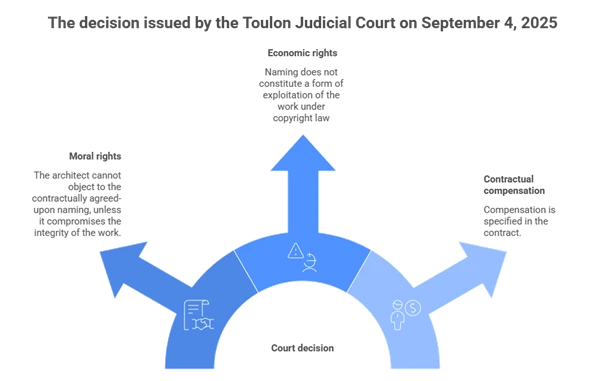
A limitation of moral rights when naming has been accepted
The court first examined the issue of the architect’s moral rights.
It recalled a fundamental principle of copyright law: moral rights allow the author to oppose any infringement of the integrity of the work.
However, the court noted that the architect had expressly accepted in the original contract the principle of a future naming agreement.
In these circumstances, the court held that the architect could not rely on his moral rights to oppose the naming operation itself, unless it affected the integrity or spirit of the work.
No exploitation of the work under copyright law
The court then addressed the issue of economic rights.
It held that naming does not in itself constitute an exploitation of the architectural work within the meaning of copyright law.
Indeed, the naming operation primarily relates to:
- A sponsorship agreement
- A commercial communication strategy
- The promotion of the name of a place
Naming concerns the association between a trademark and a location rather than the reproduction or representation of the architectural work itself.
As a result, copyright law does not automatically entitle the architect to compensation derived from naming revenues.
The determination of contractual compensation
Ultimately, the court fixed the architect’s compensation at €25,000 per year, based on the contractual provisions binding the parties.
The decision thus emphasizes that financial compensation linked to naming primarily depends on the contractual agreement concluded between the parties.
The implications of the decision for naming agreements
This decision provides two important clarifications for naming practices:
- First, moral rights protect the integrity of the work but do not allow the author to oppose a naming operation that has been contractually accepted.
- Second, naming is not considered an exploitation of the work under copyright law, meaning that the author does not automatically benefit from financial participation in naming revenues.
Practical lessons for industry stakeholders
For public authorities, sports clubs, and investors, this decision highlights the importance of anticipating naming operations from a legal perspective at the earliest stage of a project.
Several best practices can be identified:
- Explicitly provide for the possibility of naming in the original contract
- Regulate potential visual modifications to the building or infrastructure
- Clarify the conditions of compensation, if any
The essential point is that these issues should be addressed contractually from the outset.
To learn more about the importance of contractual anticipation, we invite you to consult our dedicated page.
Conclusion
The decision of the Judicial Court of Toulon of September 4, 2025 represents an important reference regarding the interaction between naming practices and copyright law in architecture.
For public and private stakeholders, this case law highlights the need to anticipate legal issues related to naming in architectural and operational contracts.
A well-structured naming agreement helps prevent disputes between authors and operators, secure commercial investments, and preserve the integrity of architectural works.
Dreyfus & Associés assists its clients in managing complex intellectual property cases, offering personalized advice and comprehensive operational support for the complete protection of intellectual property.
Nathalie Dreyfus with the support of the entire Dreyfus team
FAQ
1. Is naming a public building compatible with the architect’s copyright?
Yes. Naming can be compatible with copyright provided it does not affect the integrity of the architectural work and the author’s rights are respected, particularly when these issues have been anticipated contractually.
2. Can a naming agreement affect the image or reputation of the architect?
Potentially. If the association between the building and a commercial trademark alters the spirit or perception of the work, questions relating to the author’s moral rights may arise.
3. Can naming be challenged several years after the construction of a building?
Yes, if the naming operation infringes the author’s rights or breaches the original contractual commitments. However, the possibility of bringing an action will depend on the circumstances and contractual arrangements.
4. Can naming have consequences for the protection of the sponsor’s trademark?
Yes. The sponsor must ensure that its trademark is properly protected and registered and that its use within the naming arrangement is contractually regulated. The long-term association of a trademark with a place may also require increased monitoring against uses that could harm the trademark’s image or trademark rights.
5. How can a naming agreement be legally secured?
It is advisable to provide for:
- A specific clause dealing with naming
- Provisions addressing moral rights
- Conditions governing visual modifications
- The terms of compensation, where applicable.
This publication is intended to provide general guidance and highlight certain issues. It is not intended to apply to specific situations or to constitute legal advice.