

Introduction
Blockchain technology is gradually establishing itself within intellectual property litigation strategies. Tamper-proof timestamping, transaction traceability, immutable recording of a creation or prior use: the promises are compelling. Yet the probative value of such records remains conditional and subject to strict procedural requirements that neither technology nor enthusiasm can circumvent.
Blockchain: what the case law says
Under French law, civil evidence is unrestricted in principle: any means of proof is admissible, subject to the judge’s sovereign assessment of its probative weight. Blockchain is no exception: it is neither presumed reliable nor automatically disregarded.
1.1 Progressive recognition by the courts
The evidentiary value of blockchain is beginning to be recognised by French courts, particularly where the timestamp is corroborated by other evidence in the case file. The Marseille Judicial Court (1st Civil Chamber, case no. 23/00046) recently confirmed this in a judgment dated March 20, 2025, while stopping short of granting blockchain automatic evidentiary force.
For a detailed analysis of this decision, see our dedicated article: Is blockchain evidence recognised in copyright matters?
1.2 The applicable legal framework
French law has progressively recognised blockchain technology through the mechanism of the shared electronic recording device. Following an initial recognition of minibons by Ordinance no. 2016-520 of April 28, 2016, Ordinance no. 2017-1674 of December 8, 2017 admitted the inscription and transfer of certain financial securities on blockchain, a solution subsequently consolidated by the PACTE Act of May 22, 2019.
In the field of intellectual property, however, no specific legislative provision recognises autonomous probative value or constitutive effect for blockchain records. Blockchain essentially constitutes a timestamping and traceability tool whose probative value remains subject to the sovereign assessment of the judge.
Structural limitations
2.1 The oracle problem
This limitation, commonly referred to as the “oracle problem”, it admits that the immutability of blockchain does not, in itself, guarantee the reliability of the data recorded on it. If the information stored is inaccurate, falsified or misleading at source, its indelible nature confers no additional probative weight.
Accordingly, the registration of a hash at a given date establishes only that a file existed in that form at that precise moment. It does not demonstrate the originality of the content, the absence of prior rights, or that the person presenting themselves as author or rightholder is in fact the legitimate party. In other words, blockchain primarily demonstrates that content existed at a given date, without establishing, on its own, the ownership of the corresponding rights.
2.2 Enforceability against third parties
A prior right is enforceable against third parties only under the conditions provided for by the applicable legal provisions. However, blockchain does not replace official intellectual property registers. For rights that require registration, such as trademarks, designs or patents, only a formality completed with the INPI, the EUIPO or the competent office can give rise to the right or make it fully enforceable against third parties.
Accordingly, an on-chain record may demonstrate the existence of content at a given date but is insufficient, on its own, to establish an exclusive right enforceable against third parties. In litigation, the absence of a formal title or corroborating evidence may therefore substantially undermine the claimant’s case.
2.3 GDPR and blockchain
The use of blockchain raises significant compliance issues under the GDPR. The CNIL notes in particular that the immutability of data recorded on a blockchain may conflict with certain rights enshrined in the Regulation, most notably the right to erasure under Article 17 GDPR.
The recording of personal data on a public blockchain therefore carries significant risks, since the information stored cannot, in principle, be modified or deleted. Companies using blockchain in the management of their intangible assets must anticipate these constraints by adopting anonymisation mechanisms, data minimisation, or architectural solutions that limit the direct on-chain storage of personal data.
Blockchain and intellectual property: concrete use cases
3.1 Proving the anteriority of a creation
An author, designer or developer may record the hash of their source file on a blockchain prior to any public disclosure. This record, when combined for example with a bailiff’s report, provides a strong body of evidence to demonstrate prior creation in copyright litigation. It supplements, without replacing, the classical tools recommended by the INPI.
Practical example
« A graphic design studio records the digital fingerprint of its mock-ups on blockchain before presenting them to a client. Two years later, the client markets a product incorporating those elements. The blockchain record, submitted to the court together with an expert’s report, contributes to establishing anteriority and facilitates the infringement action »
3.2 NFTs and copyright: do not confuse token transfer with assignment
The transfer of a NFT does not automatically carry with it the assignment of the economic rights in the underlying work. The WIPO states this explicitly: the token evidences a transaction, not an assignment within the meaning of the French Intellectual Property Code. Under French law, any assignment must be express and delimited as to its subject matter, duration and territory (Art. L. 131-3 IPC). The valuation of digital assets must therefore be based on formally executed assignment agreements, not on blockchain records alone.
3.3 Commercial use of a trade mark: documenting through the chain
In revocation proceedings for non-use, the trade mark owner must demonstrate genuine use of their mark during the five years preceding the application. Authenticated screenshots, commercial transactions or licence agreements recorded on-chain may enrich the body of evidence required by the courts. This mechanism is usefully complemented by active portfolio surveillance to detect infringements.
How to strengthen the probative value of a blockchain record?
In practice, a blockchain record has real litigation value only if it forms part of a broader evidentiary strategy. Courts assess the reliability of this type of evidence in light of the circumstances of the case and the corroborating elements produced.
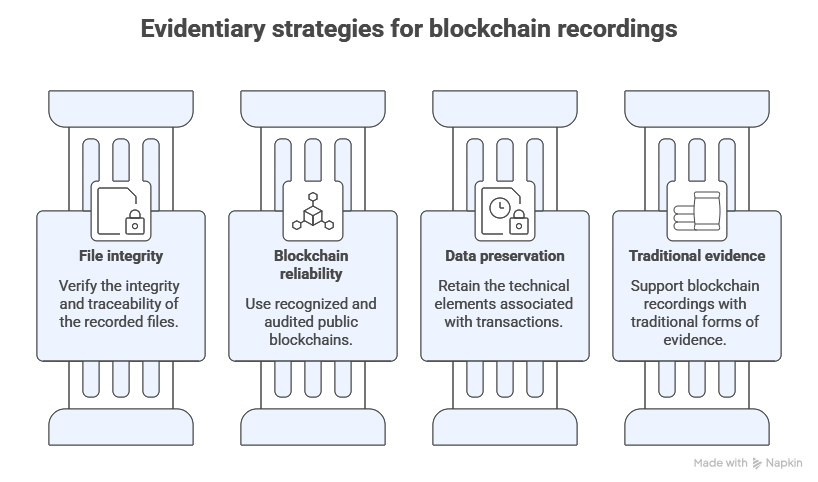
Several precautions can strengthen the credibility of an on-chain record:
- verify the integrity and traceability of the file whose digital fingerprint is recorded;
- prefer widely recognised and audited public blockchains;
- retain the technical elements associated with the transaction (hash, transaction identifier, timestamp certificate);
- supplement the blockchain record with traditional means of proof such as a judicial officer’s report, a deposit with an accredited trusted third party, or evidence of commercial exploitation.
Blockchain should therefore be viewed not as autonomous or self-sufficient proof, but as a tool that consolidates a body of circumstantial evidence.
Conclusion
Blockchain represents a genuine advance in the constitution of evidence in intellectual property matters. Its timestamping, traceability and immutability capabilities usefully reinforce litigation strategies and portfolio management. Nevertheless, its structural limitations serve as a reminder that legal rigour remains irreplaceable. Blockchain is an instrument in the service of proof: it must be designed, built and validated with the same care as any formal legal act.
Dreyfus law firm assists its clients in managing complex intellectual property cases, offering personalized advice and comprehensive operational support for the complete protection of intellectual property.
Nathalie Dreyfus with the support of the entire Dreyfus team.
FAQ
1. What is a hash in blockchain?
A hash is a unique digital fingerprint generated from a file or piece of data. If the content is modified, even slightly, the hash changes automatically. It therefore makes it possible to verify the integrity of a document without revealing its content.
2. Why is blockchain described as “immutable”?
Once a transaction has been validated and recorded in the chain of blocks, it can no longer be modified without altering the entire chain, making it extremely difficult to falsify.
3. How is a transaction validated on a blockchain?
Transactions are validated through consensus mechanisms among network participants, such as Proof of Work or Proof of Stake, before being added to the chain.
4. Why is blockchain used as a timestamping tool?
Because it enables data to be recorded at a precise date in a durable and publicly verifiable manner, which may be useful for proving the existence of content at a given point in time.
5. Does a hash allow the content of the recorded file to be read?
No, the hash is a string of characters that represents the file in mathematical form, without making it possible to reconstruct or consult its content.
The purpose of this publication is to provide general guidance to the public and to highlight certain issues. It is not intended to apply to particular situations or to constitute legal advice.