

Introduction
The judgment in Case T-159/24 of September 24, 2025, delivered by the General Court of the European Union in relation to the ‘Cripps Pink’ and ‘Cripps Red’ varieties, constitutes an important decision in the field of plant variety rights (PVRs). While it does not rule on the nullity of the rights at issue, it validates a decisive step : the opening of nullity proceedings based on the existence of serious doubts as to novelty within the meaning of Regulation (EC) No 2100/94.
Situated at the intersection of plant breeding and the international circulation of plant material, this decision highlights a central issue in plant variety law : reconciling early-stage dissemination practices, often necessary for agronomic development, with the requirement to preserve commercial novelty.
The ruling recalls that insufficiently controlled dissemination of a variety, or of its plant material, may, where it occurs in a context of economic exploitation, be regarded as novelty-destroying.
Legal framework applicable to plant varieties in the European Union
The European plant variety rights regime is based on Council Regulation (EC) No 2100/94 of July 27, 1994 , which establishes a Community protection title producing uniform effects throughout the territory of the European Union. This system is administered by the Community Plant Variety Office (CPVO), which is responsible for examining applications and managing rights. The Regulation thus establishes an autonomous regime for the protection of plant varieties, distinct from patent law both in terms of its conditions and its subject matter, even though these two systems coexist in practice in the field of agronomic and biotechnological innovation.
This autonomy of plant variety rights is particularly important where the variety has already circulated before the filing of the application for protection. In practice, trials, transfers of plant material or exchanges with partners may take place before the title is granted. At what point can such prior dissemination, apparently preparatory or experimental in nature, be regarded as a making available capable of destroying the novelty of the variety ?
To answer this question, it is necessary to return to the conditions governing the validity of the title. As a matter of substance, the validity of a protection title requires, in particular, that the variety be :
- distinct (Article 7),
- uniform (Article 8),
- stable (Article 9),
- and new (Article 10).
These four criteria are known by the acronym DUS + N.
As regards novelty, Article 10 of the Regulation does not adopt a logic of absolute novelty comparable to that of patent law. It follows a logic of commercial novelty : a variety is deemed to be new if, at the filing date, its variety constituents or harvested material have not been sold or otherwise disposed of to others, by the breeder or with his consent, for the purposes of exploitation of the variety, more than one year before that date within the European Union, or more than four years outside the Union, this period being extended to six years for trees and vines. This framework reflects the structure of the 1991 UPOV Convention , which remains the international matrix of plant variety rights.
This approach explains why the analysis does not focus solely on the existence of prior circulation of the plant material, but also on the concrete circumstances in which it took place : the purpose of the transfer, the contractual framework, the degree of control retained by the breeder and the economic context of the dissemination.
In the case of apple varieties protected in the late 1990s, the economic stakes of a potential challenge to the title therefore remain real, even where the protection is approaching the end of its term.
Nullity procedure before the CPVO
The application for a declaration of nullity is first examined by the CPVO, acting as the competent administrative authority at first instance. The Office assesses the evidence submitted by the applicant and may, depending on the stage of the procedure, either refuse to open an examination on the merits or initiate such an examination in order to determine whether the conditions for the validity of the right were in fact satisfied at the time it was granted.
The CPVO’s decision may then be appealed before the Board of Appeal of the CPVO. This Board, which is the Office’s internal administrative appeal body, reviews the legality and merits of the contested decision. It may uphold the CPVO’s decision, annul it, exercise the powers of the Office itself, or remit the case to the competent body of the CPVO for further action.
Finally, the decision of the Board of Appeal may be challenged before the General Court of the European Union. The General Court then carries out judicial review of the decision of the Board of Appeal.
Facts and procedure in case T-159/24
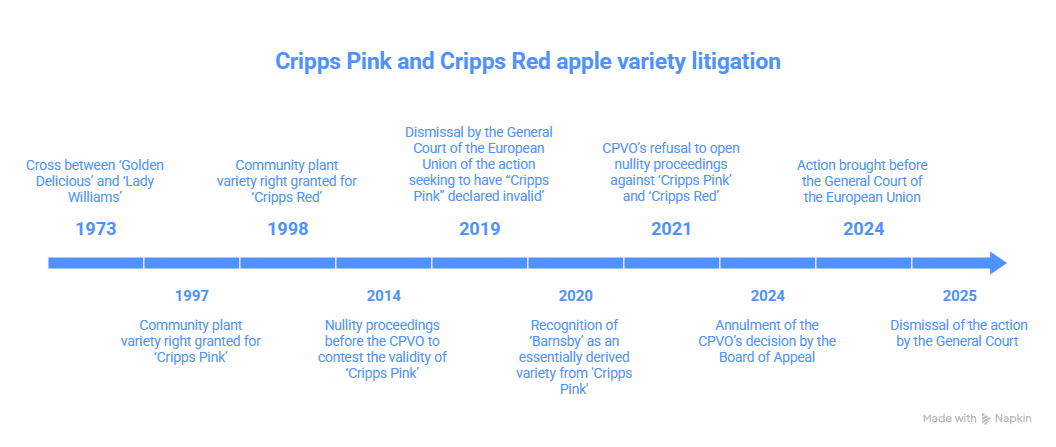
‘Cripps Pink’, marketed under the Pink Lady® brand, and ‘Cripps Red’, marketed under the Sundowner® brand, were developed by John Cripps from a cross between ‘Golden Delicious’ and ‘Lady Williams’ made in 1973. Community plant variety rights were subsequently granted by the CPVO in 1997 for ‘Cripps Pink’ and in 1998 for ‘Cripps Red’.
The difficulty lies in the circumstances in which those varieties circulated before they were protected in Europe. At the time, Australia did not yet have a regime comparable to the European system for the protection of plant varieties. The debate therefore concerned the characterisation of the transfers of plant material that had taken place before the critical date : were they merely for testing or commercial evaluation, or did they amount to making the varieties available for exploitation, capable of destroying their novelty ?
This issue was not new : it had already given rise to an initial nullity procedure, which had, however, been unsuccessful. In 2014, Pink Lady America LLC sought a declaration of nullity of the Community plant variety right relating to ‘Cripps Pink’, arguing that the variety was not new. By judgment of 24 September 2019 in Case T-112/18, the General Court dismissed the action brought against the decision of the Board of Appeal of the CPVO of 14 September 2017 in Case A 007/2016. The evidence produced at that time had led to the conclusion that the earlier transfers of plant material had taken place within a framework of testing or commercial evaluation, without amounting to commercial exploitation capable of destroying novelty.
Case T-159/24 follows on from that first dispute. In the new proceedings, Teak Enterprises Pty Ltd was the holder of a variety known under the denominations ‘Barnsby’ or ‘PLBAR B1’, presented as a mutation of ‘Cripps Pink’ and recognised as an essentially derived variety, meaning that its commercialisation depended on the authorisation of the holder of the initial variety.
In May 2021, the CPVO refused to open nullity proceedings against ‘Cripps Pink’ and ‘Cripps Red’, taking the view that the evidence produced did not give rise to serious doubts as to their novelty. That decision was, however, annulled by the CPVO Board of Appeal on 12 January 2024 in Joined Cases A 019/2021 and A 020/2021. The Western Australian Agriculture Authority, holder of the rights at issue, then brought an action before the General Court of the European Union.
By its judgment of 24 September 2025 in Case T-159/24, the General Court dismissed that action. It did not, however, declare the Community plant variety rights invalid. The scope of the judgment is more limited, but essential : the General Court confirms that the new evidence produced by Teak Enterprises was capable of giving rise to serious doubts as to the novelty of the varieties, thereby justifying the opening of nullity proceedings.
The issue therefore focuses on the condition of novelty. For apple trees, the grace period applicable to acts carried out outside the European Union is six years, meaning that the critical date was set at 29 August 1989. Any sale or making available to third parties, by the breeder or with his consent, for purposes of exploitation before that date was therefore capable of affecting the validity of the rights.
The General Court’s reasoning : novelty, implied consent and “serious doubts”
The Court first rejected the argument that the CPVO was bound by the judgment in case T-112/18. That earlier case was not based on the same evidence and concerned only ‘Cripps Pink’, whereas the new application also concerned ‘Cripps Red’.
The Court then recalled that nullity proceedings involve two distinct stages. At this stage, the issue was not yet to declare the rights null and void, but only to determine whether the evidence submitted gave rise to “serious doubts” as to their validity.
As regards the burden of proof, the Court confirmed that it lies with the applicant for a declaration of nullity. However, at the stage of “serious doubts”, the applicant is not required to fully establish the invalidity of the right : it must only produce evidence that is sufficiently clear, specific and substantiated to justify an examination of the merits by the CPVO. According to the Court, the new evidence relied on by Teak Enterprises met that requirement.
The judgment also provides an important clarification regarding the breeder’s consent. Such consent may be inferred from the circumstances : the absence of a written licence is therefore not sufficient to rule out consent where the conditions under which the plant material was supplied reveal a genuine absence of restrictions.
Finally, the Court endorsed the analysis that certain supplies could go beyond the framework of mere trials and form part of a process of dissemination for economic purposes. It was precisely this uncertainty that justified the continuation of the nullity proceedings.
Implications for breeders, right holders and licensees
For breeders, this decision highlights the importance of a rigorous legal framework governing the dissemination of plant material from the earliest stages of development. The conditions of trials, transfers of material and usage restrictions must be clearly defined and documented.
For existing right holders and licensees, the judgment underscores that a right is not definitively secure where new evidence emerges. A favourable prior decision does not preclude a new challenge if it is based on a different evidentiary record.
In a sector where proof often relies on historical practices and fragmented documentation, traceability and proper record-keeping are essential.
Conclusion
The judgment in Case T-159/24 does not declare the plant variety rights relating to the ‘Cripps Pink’ and ‘Cripps Red’ varieties null and void. It does, however, confirm that the validity of those rights may be re-examined where new evidence gives rise to serious doubts as to compliance with the novelty requirement.
The main contribution of the decision lies in the analytical method adopted by the General Court. Novelty is not assessed in the abstract, but by reference to the specific circumstances in which the plant material was disseminated before the application was filed. In particular, the Court takes into account the purpose of the transfer, the existence or absence of restrictions on use, the degree of control retained by the breeder, and the economic context of the dissemination.
Dreyfus & Associés assists its clients in addressing complex issues relating to plant variety rights, providing tailored advice and comprehensive support in implementing and optimising protection strategies across all areas of intellectual property (plant variety rights, patents, trademarks and know-how).
Nathalie Dreyfus with the support of the entire Dreyfus team.
Q&A
1. Is my plant variety right at risk after this judgment, even if it has already been upheld once ?
Potentially, yes. The central contribution of the judgment in Case T-159/24 is precisely that a favourable prior ruling does not prevent a new challenge, provided it is based on a distinct case file : new witnesses, new instances of dissemination, broader scope. ‘Cripps Pink’ was successfully defended in 2019 (Case T-112/18); six years later, it faces a substantive nullity examination. No right is definitively shielded as long as new evidence may emerge.
2. What is the concrete difference between “experimental trials” and “commercial exploitation” ?
The distinction does not depend on the label attached to the operation but on the concrete conditions under which the material is made available. An experimental trial requires strict framing : limited geographical scope, restricted audience, written prohibition of replanting and marketing, and documented traceability of transfers. Conversely, transfers made without restriction to growers oriented towards commercialisation amount to economic dissemination, even if the parties label them as trials. In the ‘Cripps Pink’ case, it is precisely these factual conditions that tipped the analysis in 2025.
3. The breeder’s implied consent : what does it change in practice ?
Everything. Before this judgment, one could reasonably assume that the absence of a formal licence was sufficient to exclude the breeder’s consent. The General Court now accepts that consent may be inferred from the circumstances : unrestricted transfers, lack of patent or other intellectual property protection, broader context oriented towards economic exploitation. For breeders, this means that contractual silence is no longer protective : what is not expressly prohibited may be interpreted as tacitly authorised.
4. What are the concrete risks for licensees and operators if nullity is ultimately granted ?
For Community plant variety rights, nullity has retroactive effect (Article 20 of Regulation No. 2100/94 ) : the right is retroactively deprived of its effects. The practical consequences are significant : loss of the exclusive exploitation monopoly, weakening of ongoing licence agreements, possible challenge to royalties already collected, and exposure of operators to actions from third parties who had been subject to the monopoly. Anticipating the risk of nullity when drafting contracts, through warranty clauses, risk-sharing mechanisms or royalty adjustment provisions, has become an operational necessity, not a sophistication.
5. How to secure a variety breeding programme effectively, starting today ?
Four structuring reflexes: (i) formalise in writing any transfer of plant material, even to trusted partners, expressly prohibiting replanting and marketing; (ii) maintain a dated and exhaustive register of transfers (recipient, volume, purpose, restrictions); (iii) anticipate the protection strategy, CPVO filing, possible articulation with a patent, before any economically oriented dissemination; (iv) periodically audit the existing portfolio to identify documentary weaknesses before a third party does it for you.
This publication is intended for general public guidance and to highlight issues. It is not intended to apply to specific circumstances or to constitute legal advice.