

Introduction
In a notable judgment handed down on 12 March 2026 (Nador Cott Protection SAS v Asda Stores Ltd, [2026] EWHC 553 (Pat)), the UK Patents Court provided important clarification on the concept of an essentially derived variety (EDV) as applied to citrus fruit.
The decision concerns the mandarin variety “Tang Gold”, which the holder of the protected variety “Nadorcott” claimed was an essentially derived variety of Nadorcott. The dispute therefore required the UK court to examine the criteria for establishing the existence of an EDV and, more specifically, the method for identifying the essential characteristics of the initial variety.
The main lesson from this decision is clear : EDV status cannot be inferred from mere genetic or phenotypic similarity. It requires a rigorous analysis of the essential characteristics of the protected variety and of their expression in the allegedly derived variety.
The Nadorcott / Tang Gold dispute : background and issues
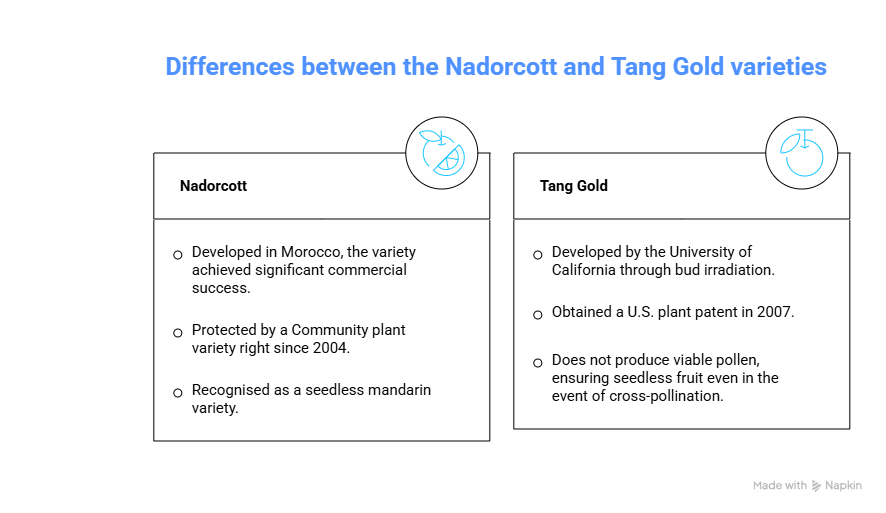
The “Nadorcott” variety is a late, seedless mandarin created in Morocco and protected since 2004 by a Community plant variety right. Following Brexit, this protection was converted into a UK national right as from 1 January 2021.
Given its international commercial success, this variety has already given rise to several major disputes, notably before the Court of Justice of the European Union in Case C-176/18. The UK dispute between Nador Cott Protection SAS and Asda Stores Limited falls within this broader context of exploiting and actively defending the rights attached to this plant variety.
Tang Gold, a variety derived by irradiation
The “Tang Gold” variety, marketed under the name “Tango” in certain countries, was developed by the University of California, Riverside from irradiated buds of the “W. Murcott” variety, which was alleged during the proceedings to correspond to the Nadorcott variety.
This variety has a particular characteristic : it does not produce viable pollen. As a result, its fruit remains seedless even in the presence of cross-pollination with other nearby varieties. This agronomic advantage enables growers to avoid certain cultivation constraints designed to preserve seedlessness.
Taking the view that Tang Gold was an essentially derived variety of Nadorcott, Nador Cott Protection SAS brought infringement proceedings against Asda, a distributor of these mandarins in the United Kingdom.
The proceedings : from the application for a stay to the trial on the merits
In response to the infringement action brought against it, Asda applied to the UK Plant Variety Rights Office (PVRO) for the revocation of the plant breeder’s right relating to the “Nadorcott” variety. This application was based on several grounds, including lack of novelty, lack of distinctness and a challenge to entitlement to the right.
At the same time, Asda asked the Patents Court to stay the proceedings pending the PVRO’s decision on the validity of the title. This application for a stay was rejected. The UK court therefore held that the infringement action could continue without waiting for the outcome of the revocation proceedings.
The trial on the merits was accordingly held in November 2025 before the Patents Court. At that stage, no decision had yet been issued by the PVRO on the validity of the “Nadorcott” plant breeder’s right.
The concept of an essentially derived variety (EDV) under UK law
Legal definition : the three cumulative conditions under section 7 of the Plant Varieties Act 1997
UK law defines EDVs autonomously from EU Regulation No. 2100/94 of 27 July 1994 on Community plant variety rights. Section 7(3) of the Plant Varieties Act 1997 requires three cumulative conditions to be met for a variety to be regarded as essentially derived from an initial variety :
- it must be predominantly derived from the initial variety, while retaining the expression of the essential characteristics that result from the genotype or combination of genotypes of that initial variety ;
• it must be clearly distinguishable from the initial variety by one or more characteristics capable of precise description ;
• except for the differences resulting from the act of derivation, it must conform to the initial variety in the expression of the essential characteristics that result from the genotype or combination of genotypes of that initial variety.
The Nadorcott/Tang Gold case is one of the first judicial decisions to examine in depth the application of these criteria to a commercially strategic fruit variety.
Essential characteristics at the heart of the debate
The issue of pollen fertility and seed formation
The debate focused mainly on the consequences of Tang Gold’s failure to produce viable pollen.
Unlike Tang Gold, the Nadorcott variety produces fertile pollen capable of fertilising nearby varieties and causing seeds to appear in the fruit.
To preserve the variety’s commercial qualities, growers must therefore implement various preventive measures, such as isolating plantations or installing insect-proof nets.
Tang Gold removes this constraint, since its fruit remains seedless regardless of growing conditions.
The method for identifying essential characteristics
Relying in particular on the UPOV Explanatory Notes, the judge recalled that an essential characteristic must be assessed by reference to its importance for the economic actors concerned, whether growers, distributors or consumers.
The reasoning adopted is particularly instructive. The court did not regard the absence of viable pollen as a mere ancillary improvement to Nadorcott. It considered that this property provided growers with a substantial agronomic and economic advantage, to the extent that it constituted an essential characteristic in its own right.
Accordingly, Tang Gold does not merely reproduce the essential characteristics of Nadorcott. It introduces an additional essential characteristic that substantially alters the profile of the variety.
This analysis led the Patents Court to conclude that Tang Gold does not meet the definition of an essentially derived variety within the meaning of the Plant Varieties Act 1997.
The judge nevertheless noted that a different conclusion might have been reached under Regulation (EC) No. 2100/94 on Community plant variety rights, the wording of which differs significantly from the UK legislation.
Finally, the court expressly rejected any consideration of the cost or importance of the investments made to develop Tang Gold, as such factors have no bearing on the legal classification of an EDV.
The cascade principle and the protection of harvested material
Mechanism and purpose of the cascade principle
The judgment also provides important clarification on the application of the so-called “cascade” principle set out in section 6(3) of the Plant Varieties Act 1997.
This mechanism allows the holder of a plant breeder’s right to act in respect of harvested material where the holder has not had a reasonable opportunity to exercise its rights upstream in relation to propagating material.
Historically designed to combat the importation of cut flowers from countries that did not recognise plant breeders’ rights, this mechanism now plays a major role in the international trade in fruit and vegetables.
Imports from countries without protection
Some of the Tang Gold mandarins marketed by Asda came from Peru, Chile and Egypt, territories in which the Nadorcott variety did not benefit from any protection.
The judge adopted a restrictive interpretation of the concept of “unauthorised use”. In the judge’s view, a use can only be characterised as unauthorised in a territory where the plant breeder’s right is actually in force.
As a result, the production and marketing of fruit in a country where there is no protection cannot be regarded as infringing, even where that fruit is subsequently imported into the United Kingdom.
This analysis is based on the UPOV Explanatory Notes published in 2013, although those notes are not binding.
Divergences between UK law, EU Regulation and UPOV
Beyond the dispute between Nadorcott and Tang Gold, the decision highlights the growing risk of fragmentation in plant variety rights law.
The judge himself acknowledged that the outcome of the dispute might have been different under Regulation (EC) No. 2100/94, which applies within the European Union. This divergence is particularly significant both in relation to the definition of essentially derived varieties and the scope of protection granted to harvested material.
This issue is all the more topical because an expert study published by UPOV in January 2026 adopts an interpretation that differs substantially from that adopted by the Patents Court regarding the concept of “unauthorised use” and the interpretation of the cascade principle.
The decision therefore illustrates the growing importance of an international plant variety protection strategy. In a legal environment marked by divergences of interpretation between different protection systems, the geographical scope of rights and the way in which they interact have become decisive factors in securing and exploiting varietal innovations.
Conclusion
The judgment in Nador Cott Protection SAS v Asda Stores Ltd is a major decision in the field of plant variety rights. For the first time, a UK court carried out an in-depth analysis of the concept of an essentially derived variety as applied to a high-value commercial fruit variety.
Beyond the specific case of the Nadorcott and Tang Gold varieties, the decision recalls that EDV status cannot result from mere genetic similarity or common origin. It requires the precise identification of the essential characteristics of the initial variety and an assessment of whether those characteristics remain effectively expressed in the allegedly derived variety. The introduction of a new essential characteristic with its own agronomic or economic value may therefore prevent classification as an EDV.
The judgment also provides important clarification on the application of the cascade principle and on the territorial scope of plant breeders’ rights, while highlighting the divergences of interpretation that may exist between UK law, EU law and recent UPOV work.
In a context of increasing internationalisation of agricultural and horticultural supply chains, this decision underlines the importance for breeders of implementing a coherent global protection strategy, taking into account both the choice of territories in which protection is sought and the need to anticipate differences of interpretation between legal systems.
Dreyfus & Associés assists its clients with complex issues relating to plant variety rights, providing tailored advice and comprehensive operational support for the implementation and optimisation of protection strategies that incorporate all intellectual property tools.
Dreyfus & Associés is partnered with a global network of Intellectual Property attorneys.
Nathalie Dreyfus, with the support of the entire Dreyfus team.
Q&A
1. What methods are used to determine if a variety is essentially derived ?
Experts combine genetic analysis, morphological tests, and agronomic trials, comparing genotype, fidelity of essential characteristics, and distinctiveness of observable traits, in line with UPOV criteria and local laws.
2. Could the absence of viable pollen in Tang Gold be a standalone commercial advantage ?
Yes. The lack of viable pollen reduces contamination risk for neighboring crops and simplifies the production of seedless fruits, providing a distinctive advantage for producers and distributors, independently of legal disputes.
3. Why do some countries like Peru, Chile, and Egypt not protect Nadorcott ?
Protection of plant varieties varies by national legislation and UPOV membership. Some countries have not implemented variety rights for certain species or prioritize free access to varieties to support local agriculture and exports.
4. What international strategies do breeders use to protect a variety like Nadorcott ?
Breeders file rights on the variety in multiple countries, monitor imports and sales, enter into licenses or commercial agreements, and use genetic analysis to detect potential derived varieties.
5. What is the difference between UK plant variety rights and EU law post-Brexit ?
Since 1 January 2021, the UK has an autonomous plant variety rights regime, administered by the PVRO. The wording of the Plant Varieties Act 1997 differs from Regulation (EC) No 2100/94, notably regarding the EDV definition. CPVO decisions are not binding on UK courts, and vice versa, creating a tangible risk of divergent interpretations.
This publication is intended to provide general guidance to the public and to highlight certain issues. It is not intended to apply to specific situations nor to constitute legal advice.