

Introduction
A fictional universe cannot be protected as one indivisible asset. The strongest strategy combines copyright, trademarks, contracts and evidence measures, selecting the appropriate tool for each component of the fictional world and each intended form of exploitation.
A successful saga may encompass stories, characters, maps, invented languages, symbols, audiovisual adaptations, music, software, video games and merchandise. Each element raises a separate issue of protection, ownership and licensing. The first task is therefore to map the assets before deciding how they should be defended.
Why must the protection of a fictional universe be cumulative?
A fictional universe combines assets of different kinds No single right protects them all in the same way. The strategy should therefore begin with a map of the creative elements, ownership and planned uses, before matching each asset with the appropriate legal instrument.
Copyright protects original expression, not ideas
Under Article L. 111-1 of the French Intellectual Property Code, the author of a work of the mind enjoys, by the mere fact of its creation, an exclusive intangible property right enforceable against all persons. Within a fictional universe, copyright may cover texts, illustrations, maps, dialogue, music, emblematic objects and sufficiently individualised characters, provided that they reflect creative choices. It does not create a monopoly over a genre, archetype or broad narrative idea. Successive versions, source files, correspondence and reliable timestamping should therefore be retained to establish priority and each contributor’s creative input.
Trademarks secure signs used in trade
Saga and character names, logos, emblems and recurring expressions may be registered where they are distinctive for the relevant goods and services. A trademark does not protect the story; it indicates commercial origin. The portfolio should reflect genuine or planned activities, including publishing, audiovisual content, gaming, events and merchandise. Under Article L. 714-5 of the French Intellectual Property Code, a trademark may be revoked if it is not put to genuine use for an uninterrupted period of five years.
For a broader overview of genuine use in trademark law, we invite you to read our article: ” Genuine use and trademark litigation: burden, nature and scope of proof ? ”
How do licensing agreements govern the development of a fictional universe?
As the universe develops, rights may be divided among authors, illustrators, studios, publishers, developers, platforms and manufacturers. Its value then depends on the ability to demonstrate a clear, continuous and enforceable chain of title and then to define precisely the forms of exploitation granted to partners
Securing the chain of title before any adaptation
Before granting a licence or authorising an adaptation, the right holder in a fictional universe must be able to demonstrate that it effectively owns the necessary rights in each of its components.
Agreements entered into with the various creators must therefore identify their respective contributions and specify the rights assigned, the media, territories, duration, languages and forms of exploitation concerned. Article L. 131-3 of the French Intellectual Property Code requires the scope of any assignment of rights to be precisely defined.
An incomplete chain of title may undermine an adaptation project, a commercial partnership or the development of derivative products.
For more information on the assignment of intellectual property rights, we invite you to consult our dedicated page: ” Assignment Agreement “.
Precisely define the rights granted to each licensee
Once ownership of the rights has been secured, licence agreements allow third parties to exploit certain elements of the fictional universe without transferring ownership of those elements to them.
Each licence must precisely define its scope and govern the conditions under which derivative works may be developed, in accordance with Article L. 131-3 of the French Intellectual Property Code cited above. This helps prevent an adaptation from distorting the fictional universe, creating inconsistencies between different forms of exploitation, or generating uncertainty as to the ownership of any new characters, storylines or graphic elements developed by a commercial partner.
Managing fan works without weakening enforcement
Fan fiction, fan art, mods and wikis can strengthen a community, but may also reproduce protected elements or create commercial confusion. The right holder may publish guidelines specifying the uses it authorises or chooses to tolerate, particularly depending on whether they are commercial or non-commercial. Projects falling outside this framework may require individual authorisation or a licence.
The rules should be public, consistent and compatible with applicable exceptions, including parody and pastiche (Article L. 122-5, 4° of the French Intellectual Property Code).
How is artificial intelligence changing the protection of fictional universes?
Artificial intelligence raises two key issues for right holders in a fictional universe. First, texts, images, characters and other elements of that universe may be used to train AI models. Second, these tools may generate new content that reproduces or imitates certain characteristics of the universe.
Right holders must therefore act on two fronts: regulating the use of their content by AI providers and documenting the human contribution to creations produced with the assistance of AI.
For further information on how to prove that works have been used by AI, we invite you to read our article on this subject : “How could the presumption of use of cultural content by AI providers rebalance the burden of proof ?”
Reserving rights and monitoring training data
Article 4 of Directive (EU) 2019/790 of April 17, 2019 permits text and data mining under certain conditions while allowing an appropriate reservation of rights. The EU Artificial Intelligence Act of June 13, 2024, also imposes transparency and copyright-compliance duties on certain providers of general-purpose AI models. Effective governance combines an inventory of online content, technical reservations, evidence of publication, monitoring and the relevant CNIL guidance.
Documenting human-led AI-assisted creation
The CSPLA report published on July 16, 16, 2026 confirms that copyright protection remains dependent on free and creative human choices that are perceptible in the resulting work. Accordingly, where an AI tool is used to develop a character, illustration or narrative, copyright protection will depend on whether such free and creative human choices can be identified in the final result.
We therefore recommend retaining the prompts, selections, iterations, edits and editorial decisions. This traceability facilitates the assertion of rights, licence negotiations and the assessment of the risk that pre-existing elements may have been reproduced.
Which practical measures provide lasting protection for a fictional universe?
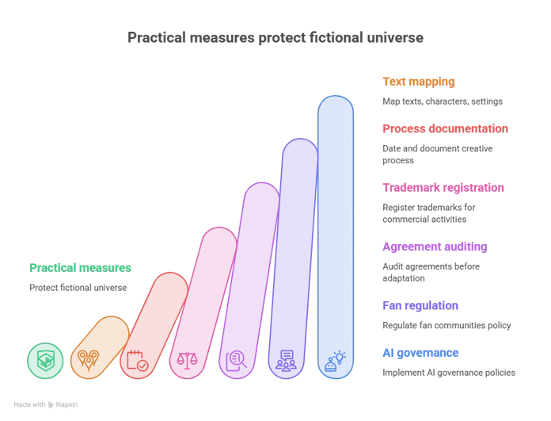
- Map texts, characters, settings, signs, software and individual contributions.
- Date and document the creative process and each author’s participation.
- Register trademarks that correspond to genuine commercial activities.
- Audit agreements before any adaptation, licence or expansion into a new medium.
- Regulate fan communities through a clear and proportionate policy.
- Implement AI governance covering training, generated output and evidence of human input.
Conclusion
The protection of a fictional universe through intellectual property rights does not depend on a single exclusive right. It requires a coherent strategy combining copyright, trademarks, contracts, evidence and digital monitoring. The objective is not to lock away an imaginary world, but to identify the elements that are legally protectable, secure their exploitation and anticipate new forms of creation and distribution.
Dreyfus Law Firm assists its clients in managing complex intellectual property cases, offering personalized advice and comprehensive operational support for the complete protection of intellectual property.
Dreyfus Law Firm works in partnership with a global network of attorneys specializing in Intellectual Property.
Q&A
How should the partial reproduction of elements from a fictional universe be addressed?
The assessment should focus on the specific similarities between the works rather than merely on their general themes. The reproduction of an individualised character, specific visual features, dialogue, settings or an original combination of elements may be unlawful even where the work as a whole has not been copied. A case-by-case analysis is required to determine whether an action based on copyright infringement, trademark infringement or unfair competition may be available.
Do all creators contributing to the same fictional universe automatically own the same rights?
No. Ownership depends on the nature of each contribution, the status of the contributors and the contracts entered into between them. Financing, commissioning or supervising a creation does not necessarily result in an automatic transfer of copyright. Agreements should therefore clearly identify the relevant works, the rights assigned, the territories, the forms of exploitation and the duration of the assignment.
Can the title of a saga or game be registered as a trademark?
Yes, provided that it is distinctive in relation to the relevant goods and services. A title that is overly descriptive, commonplace or perceived solely as identifying the content of the work may, however, encounter difficulties during registration. A clearance search should also be conducted to identify any earlier rights that could prevent the registration or use of the sign.
How can the date of creation of a character or fictional universe be proved?
Copyright protection arises automatically, without any registration requirement. However, the rights holder must be able to prove the date and content of the creation. It is therefore advisable to retain source files, drafts, correspondence and successive versions, and to use a dated means of evidence, such as a deposit with a specialised body, an e-Soleau filing or another official timestamping system or a bailiff’s report.
Can a fictional universe be protected as a whole?
As a general rule, there is no exclusive right covering an entire fictional universe as such. Protection usually results from a combination of rights applying to its individual components, including copyright in texts, illustrations, characters and settings, trademark rights in distinctive signs, design rights in certain visual elements, and potentially unfair competition law where the reproduction creates a likelihood of confusion.
This publication is intended for general public guidance and to highlight issues. It is not intended to apply to specific circumstances or to constitute legal advice.