

Introduction
The grass used on a tennis court may include varieties protected by plant breeders’ rights. The distinction, however, is essential: intellectual property does not protect the lawn as a sporting surface, nor its colour, density or playing characteristics in the abstract. Protection attaches to an identified plant variety, provided that the legal requirements are satisfied and a valid right exists in the relevant territory.
Wimbledon makes that distinction particularly tangible. In its 2026 sports edition, WIPO Magazine explains that the exact varieties used at Wimbledon are not publicly disclosed, while noting that high-performance turfgrass of this kind is typically protected by plant breeders’ rights. Perennial ryegrass is selected for characteristics such as wear tolerance, rapid recovery, density and visual consistency. WIPO also notes that developing a sports-turf variety can require more than a decade of breeding and testing.
Why sports turf can be protected by plant variety rights
Plant variety rights are a specific industrial property regime designed to protect new plant varieties.
The applicable legal framework is based on several instruments that follow a broadly comparable approach:
- the 1991 Act of the UPOV Convention;
- Council Regulation (EC) No 2100/94, applicable at European Union level;
- Articles L. 623-1 et seq. of the French Intellectual Property Code.
These instruments are based on a common principle: it is not the grass species as such that is subject to protection, but rather a sufficiently individualized plant variety capable of constituting a distinct subject matter of rights.
The protection criteria for a turfgrass variety
To qualify for protection, a variety must in particular be new, distinct, uniform and stable. It must therefore be clearly distinguishable from known varieties, sufficiently uniform in the expression of its relevant characteristics and capable of retaining those characteristics through successive propagation. A compliant variety denomination is also required.
These criteria are particularly relevant to sports turf because breeders are selecting reproducible performance traits:
- wear tolerance,
- recovery after heavy use,
- disease resistance,
- heat or drought resilience,
- visual uniformity.
WIPO Magazine reports that almost 7,000 varieties suitable for turfgrass use are protected across UPOV members, including varieties intended for tennis courts, football pitches, golf courses and multi-use sports surfaces.
What a plant variety right actually protects: the variety, not the tennis court
A plant variety certificate grants an exclusive right over certain acts concerning propagating or reproductive material. In France, Article L. 623-4 of the French Intellectual Property Code covers, in particular, production, reproduction, conditioning for the purpose of propagation, offering for sale, sale, import, export and stocking for those purposes. Article 13 of Regulation No 2100/94 provides for comparable protection at European Union level.
The practical consequence is important: playing tennis on a court established with a protected variety is not, by itself, an act reserved to the breeder. By contrast, reproducing or multiplying protected plant material without authorization in order to seed other courts, produce seed or place that material on the market may fall within the holder’s exclusive rights.
For more information on the protection, filing strategies and commercialization of plant varieties, we invite you to read our article: “Complete Guide to Plant Variety Rights 2025: Protection, Strategies and Commercialization”.
Wimbledon: protected genetics, seed mixtures and turf-management know-how
The Wimbledon example also shows that intellectual property protection is not limited to plant variety rights. WIPO notes that the exact varieties used are not publicly disclosed and that genetics account for only part of the performance: specialized turf management is crucial to maintaining a consistent playing surface from one year to the next.
The precise composition of a seed mixture, maintenance protocols, and parameters relating to mowing, irrigation, regeneration or seasonal preparation may therefore qualify as trade secrets where they are secret, have commercial value because of their secrecy and are subject to reasonable measures to keep them secret, in accordance with Article L. 151-1 of the French Commercial Code. Plant variety rights protect the variety itself, while trade secret protection may protect part of the technical “recipe” used to achieve a particular level of sporting performance.
For a broader analysis of this interaction, see our previously published article: “Why do plant innovations require a multidimensional intellectual property strategy?”.
How can the legal use of sports turf be secured?
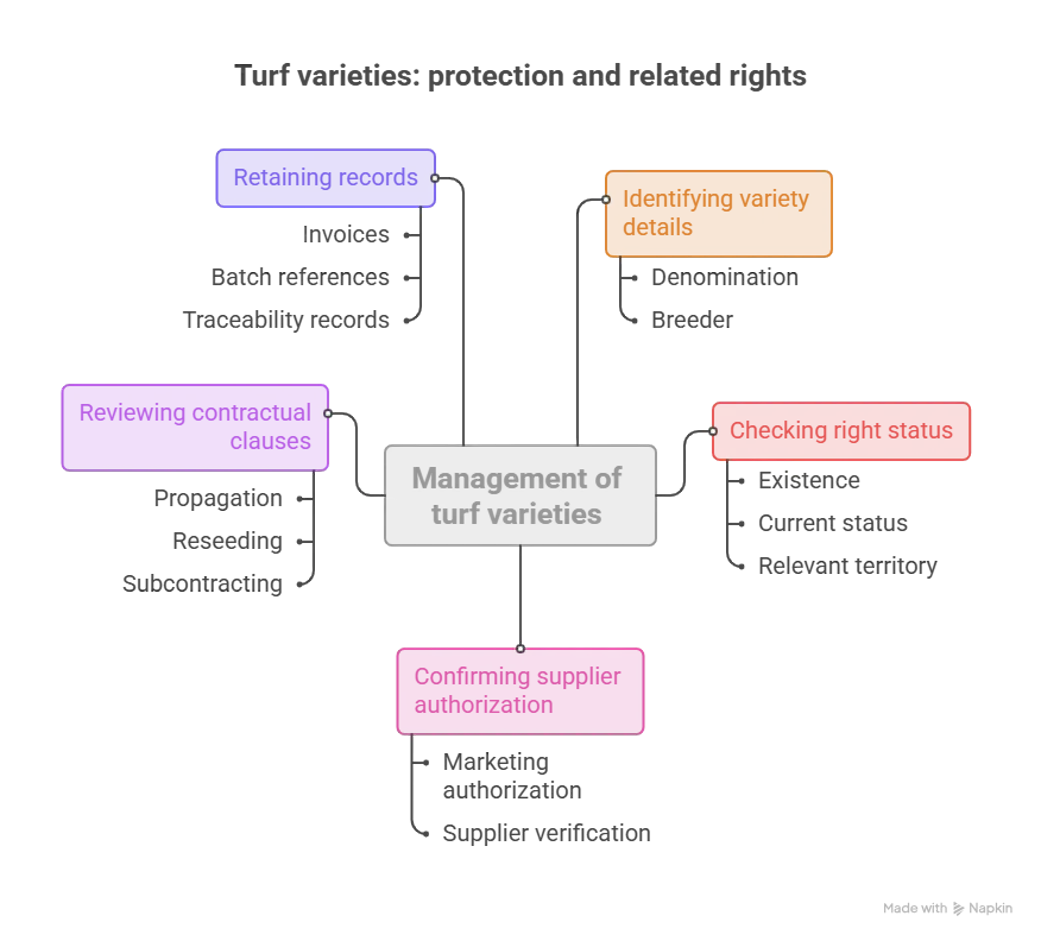
For a club, stadium operator, tournament organizer or sports-surface supplier, the key question is not simply whether “the grass” is protected. It is whether the specific varieties being purchased, propagated or reseeded are subject to enforceable rights. Before procurement or a propagation programme, we recommend:
- • identifying the denomination of each variety and the breeder or right holder;
- • checking the existence and current status of the right in the relevant territory;
- • confirming that the supplier is authorized to market the material;
- • reviewing contractual clauses on propagation, reseeding and subcontracting; and
- • retaining invoices, batch references and traceability records.
UPOV’s PLUTO database is a valuable search tool, but UPOV expressly states that it does not replace the official publication of the competent authority.
For a European project, the filing and verification strategy can also be explored in greater detail in our article dedicated to filing a plant variety right in the European Union: “Filing a plant variety right in the European Union: what complete legal and administrative checklist should be followed to secure your rights?”
Conclusion
The grass on a tennis court can therefore sit at the centre of a genuine intellectual property strategy. The protected asset is not the court itself, but the plant varieties used to create it, while confidential know-how, seed mixtures and contractual arrangements may provide additional layers of protection. At elite level, the performance of a playing surface reflects the interaction between plant breeding, plant variety rights, agronomic expertise and disciplined contractual management.
Dreyfus Law Firm assists its clients in managing complex intellectual property cases, offering personalized advice and comprehensive operational support for the complete protection of intellectual property.
Dreyfus Law Firm works in partnership with a global network of attorneys specializing in Intellectual Property.
Nathalie Dreyfus, with the assistance of the entire Dreyfus team.
Q&A
Can artificial turf be protected by plant variety rights?
No. Plant variety rights protect plant varieties, not artificial playing surfaces. Synthetic turf may instead fall within other intellectual property regimes, for example patents for technical innovations, designs for certain visual features or trademarks for commercial signs.
Can a protected turfgrass variety be used to breed a new variety?
Under EU law, breeding and developing other varieties fall within the exemption in Article 15 of Regulation No 2100/94. The exemption does not eliminate rights over an essentially derived variety, whose commercial exploitation may still require the authorization of the initial variety’s holder.
How long can a turfgrass variety remain protected?
The duration of protection depends on the relevant right and territory. In the European Union, protection generally runs until the end of the twenty-fifth calendar year following the year in which the right was granted, and until the end of the thirtieth year for varieties of vine and tree species. In France, Article L. 623-13 of the French Intellectual Property Code likewise provides for a general term of twenty-five years from the grant of the certificate, while certain categories, including perennial fodder grasses and legumes, benefit from a thirty-year term. The botanical classification of the variety and the applicable protection title should therefore be assessed on a case-by-case basis.
Can a turfgrass variety be protected by both plant variety rights and a patent?
A plant variety as such is excluded from patentability. However, Article L. 611-19 of the French Intellectual Property Code allows an invention relating to plants to be patented where its technical feasibility is not limited to a particular plant variety and the other patentability requirements are met.
Can the name of a protected turfgrass variety be registered as a trademark?
The variety denomination must remain available to identify the variety. A separate trademark may accompany commercialization, but cannot prevent required use of the denomination. In practice, the varietal denomination and commercial brand are therefore often kept distinct.
This publication is intended for general public guidance and to highlight issues. It is not intended to apply to specific circumstances or to constitute legal advice.