Intellectual property (IP) litigation is a process used to resolve a dispute over the ownership or use of IP. It is a legal process that can be used to protect and enforce the rights of IP owners. IP litigation is an important tool for businesses, as it enables them to protect their valuable IP assets and to prevent infringement.
The most common form of IP litigation is patent litigation. Patent litigation is used to resolve disputes over the ownership of inventions and the rights associated with them. Patent litigation can help to protect businesses from infringement and can help to ensure that they have exclusive rights to their inventions. Copyright litigation is another form of IP litigation. Copyright litigation is used to resolve disputes over the ownership of creative works, such as artwork, literature, music, and software. Copyright litigation can help to protect businesses from infringement and can help to ensure that they have exclusive rights to their works. Trademark litigation is another form of IP litigation. Trademark litigation is used to resolve disputes over the ownership of trademarks and the rights associated with them. Trademark litigation can help to protect businesses from infringement and can help to ensure that they have exclusive rights to their trademarks. The benefits of IP litigation for businesses are numerous. IP litigation can help to protect a business from infringement and can help to ensure that they have exclusive rights to their IP assets. IP litigation can also protect a business from competitors by preventing them from misusing or copying a business’s IP assets. In addition, IP litigation can help to protect a business’s reputation and to ensure that their products are not associated with competitors. IP litigation can also help to protect a business’s investments. IP litigation can help to ensure that a business’s investments are not wasted by competitors who are infringing on their IP rights. IP litigation can also help to secure a business’s investments by preventing competitors from misusing or copying their IP assets. IP litigation can also help to protect a business’s revenues. IP litigation can help to ensure that a business’s revenues are not lost due to infringement or misappropriation of their IP assets. IP litigation can also help to protect a business’s revenues by preventing competitors from copying or misusing their IP assets. Finally, IP litigation can help to protect a business’s future. IP litigation can help to ensure that a business’s IP assets remain valuable and can help to prevent competitors from taking advantage of them. IP litigation can also help to protect a business’s future by preventing competitors from misusing or copying their IP assets.
In conclusion, IP litigation is a valuable tool for businesses. IP litigation can help to protect a business’s valuable IP assets, can help to protect a business’s investments, can help to protect a business’s revenues, and can help to protect a business’s future. IP litigation can help to ensure that a business’s IP assets remain valuable and can help to prevent competitors from taking advantage of them.
We offer our clients a dedicated and unique experience of expertise that is necessary for the exploitation of intangible assets. We will also endeavor to keep you informed and up-to-date about intellectual property and digital economic issues through our articles and newsletters written by the Dreyfus Legal Team.
The European Union (EU) is one of the most technologically advanced areas in the world, and as such, it is important that businesses remain compliant with all applicable IT laws. This article provides an overview of some of the key regulations that all companies should be aware of to ensure they remain compliant with the latest IT laws in the EU.
The EU General Data Protection Regulation (GDPR) is one of the most important pieces of legislation in the EU. It sets out the rules that companies must follow when processing and storing the personal data of EU citizens. Key elements of the GDPR include the right for people to access the data that companies hold on them, the right to be forgotten and the right to data portability. Companies must also ensure that they are transparent about how they are using personal data and must have appropriate measures in place to protect it. The EU Network and Information Security (NIS) Directive is another key piece of legislation. It sets out the requirements for organizations that operate “essential services” such as energy, transport, healthcare and banking. The Directive requires these organizations to take appropriate measures to protect their networks and information systems from cyber-attacks. This includes ensuring that they have appropriate security policies and procedures in place, as well as measures to detect, report and respond to cyber-attacks. The EU Digital Single Market Strategy is a set of rules designed to ensure that businesses can operate freely and fairly in the digital world. It includes measures to make sure that digital services are not subject to unreasonable restrictions, that businesses can compete on a level playing field, and that consumers have access to a wide range of digital content and services. This includes ensuring that copyright laws are respected and that online content is not blocked or filtered unnecessarily.
Finally, the EU e-Privacy Directive sets out rules for the use of cookies and other tracking technologies. Companies must inform users about how they are using cookies and must obtain the user’s consent before using them. Companies must also ensure that any information collected through cookies is kept secure and is only used for the purposes for which it was collected.
We offer our clients a dedicated and unique experience of expertise that is necessary for the exploitation of intangible assets. We will also endeavor to keep you informed and up-to-date about intellectual property and digital economic issues through our articles and newsletters written by the Dreyfus Legal Team.
Contract law is an area of law that governs the enforcement of contracts and the related legal implications. It is a complex and multifaceted field of law that is applicable in many different scenarios. The European Union (EU) has its own set of contract law regulations that are specifically tailored to the needs of the EU. It is important for businesses, lawyers, and individuals to understand the basics of contract law in the EU in order to effectively navigate the legal landscape.
At its core, contract law in the EU is based on the principle of freedom of contract. This means that parties are free to enter into contracts as long as they do not violate public policy or any other applicable laws. The terms and conditions of the contract must be clearly defined in order to be enforceable. This includes the rights and obligations of each party, the duration of the agreement, and any other relevant details.
The EU also has a number of specific laws and regulations that apply to contracts. These include the European Union Consumer Rights Directive, which provides a set of minimum standards for consumer rights in contracts, and the General Data Protection Regulation (GDPR), which regulates the processing and handling of personal data.
In addition to specific laws, the EU also has a number of general principles that apply to contracts. These include the principle of good faith, which requires that parties act in a fair and reasonable manner. The principle of reasonableness also applies, which states that the terms of the contract must be reasonable and not impose an undue burden on either party.
Finally, the EU also has a number of rules that regulate the formation and execution of contracts. These include the requirements for a valid offer and acceptance, the capacity of each party to enter into the contract, and the rules of consideration. Consideration is a term that refers to the exchange of something of value between the parties, such as money or goods.
Contract law in the EU is an important and complex area of law that requires an in-depth understanding of the laws and regulations. It is important for businesses, lawyers, and individuals to understand the basics of contract law in order to effectively navigate the legal landscape.
We offer our clients a dedicated and unique experience of expertise that is necessary for the exploitation of intangible assets. We will also endeavor to keep you informed and up-to-date about intellectual property and digital economic issues through our articles and newsletters written by the Dreyfus Legal Team.
In the digital age, intellectual property litigation risk no longer arises only from obvious copying. It often develops much earlier: a trademark launched without clearance searches, third-party software or images used under misunderstood licences, work commissioned without an adequate IP assignment, uncontrolled use of generative AI, or confidential know-how uploaded to an external tool.
Clear intellectual property rights before launching a product or service
Conduct availability and clearance searches
A company can itself create litigation risk by adopting a sign, technology or content that conflicts with an earlier right.
Before selecting a new brand, businesses should therefore investigate not only earlier trademarks but also relevant company names, trade names, domain names and other potentially conflicting rights. A search limited to identical signs may provide false comfort: the INPI specifically highlights the relevance of visual, phonetic and conceptual similarities when assessing earlier marks.
Technology projects may similarly require patent and freedom-to-operate analysis. Websites, applications and marketing campaigns should be reviewed for third-party photographs, music, fonts, software, databases, interfaces and other licensed assets.
The relevant question is therefore not merely “What does the company own?”, but also “What is the company actually entitled to use?”
Do not confuse copyright protection with registration
Under French law, an eligible work is protected by copyright, provided the legal requirements for protection are satisfied, as a consequence of its creation. There is no general requirement imposed by the French Intellectual Property Code to register a work with a copyright office in order for French copyright to arise.
Secure the contractual chain with employees, contractors and partners
Establish exactly who owns each asset
Paying for a creation does not necessarily mean acquiring the underlying intellectual property rights.
This issue frequently arises where a business commissions a developer, agency, photographer or designer. Under French copyright rules, an assignment must identify the rights assigned and define the permitted scope of exploitation, including its extent, purpose, geographical scope and duration.
Employment also does not automatically transfer every copyright work created by an employee. Specific statutory regimes exist, however. In particular, subject to the applicable statutory conditions, economic rights in software created by an employee in the performance of their duties or following their employer's instructions vest in the employer.
Every significant project should therefore document the author, the owner, the contractual or statutory basis for ownership, and the exact uses that have been authorised.
Treat confidentiality as an operational requirement
An NDA is important, but confidentiality should not exist only on paper.
French trade-secret legislation requires, among other conditions, that protected information have actual or potential commercial value because it is secret and be subject to reasonable protective measures.
NDA clauses should therefore be supported by restricted access rights, document classifications, controlled external sharing, logging where appropriate, employee exit procedures and clear rules governing the use of external digital tools.
Control generative AI, open-source software and third-party digital content
Generative AI has added a new layer to IP risk. An employee may upload confidential source code to an external service, reproduce a client's protected document in a prompt, or commercially publish generated material without checking whether protected elements have been reproduced.
The French CNIL recommends that organisations adopt internal policies defining permitted and prohibited uses of generative AI, control the disclosure of confidential information and train users to review both inputs and outputs.
The EU AI Act also imposes copyright-related obligations on providers of general-purpose AI models, including the requirement to maintain a policy aimed at complying with EU copyright law. Those provider obligations do not replace the user company's own review of the way AI-generated output will ultimately be exploited.
The same discipline applies to open-source software. Open source does not mean free of legal conditions. Businesses should maintain an inventory of dependencies, versions and licences and assess the obligations attached to them before commercial deployment.
Build evidence and monitoring mechanisms before a dispute occurs
Effective IP management does not end when a trademark, patent or design is registered.
Businesses should maintain a reliable repository containing contracts, licences, successive versions of creative works, internal approvals, evidence of use, invoices and project documentation. Such records can be decisive when the provenance of an asset or the scope of an authorisation must be demonstrated quickly.
Monitoring trademarks, online marketplaces, platforms and domain-name registrations can also identify infringements before they become entrenched. The appropriate response can then be proportionate: preserve evidence, conduct a legal assessment, contact the operator, send a cease-and-desist letter, initiate an alternative dispute mechanism or commence court proceedings where necessary.
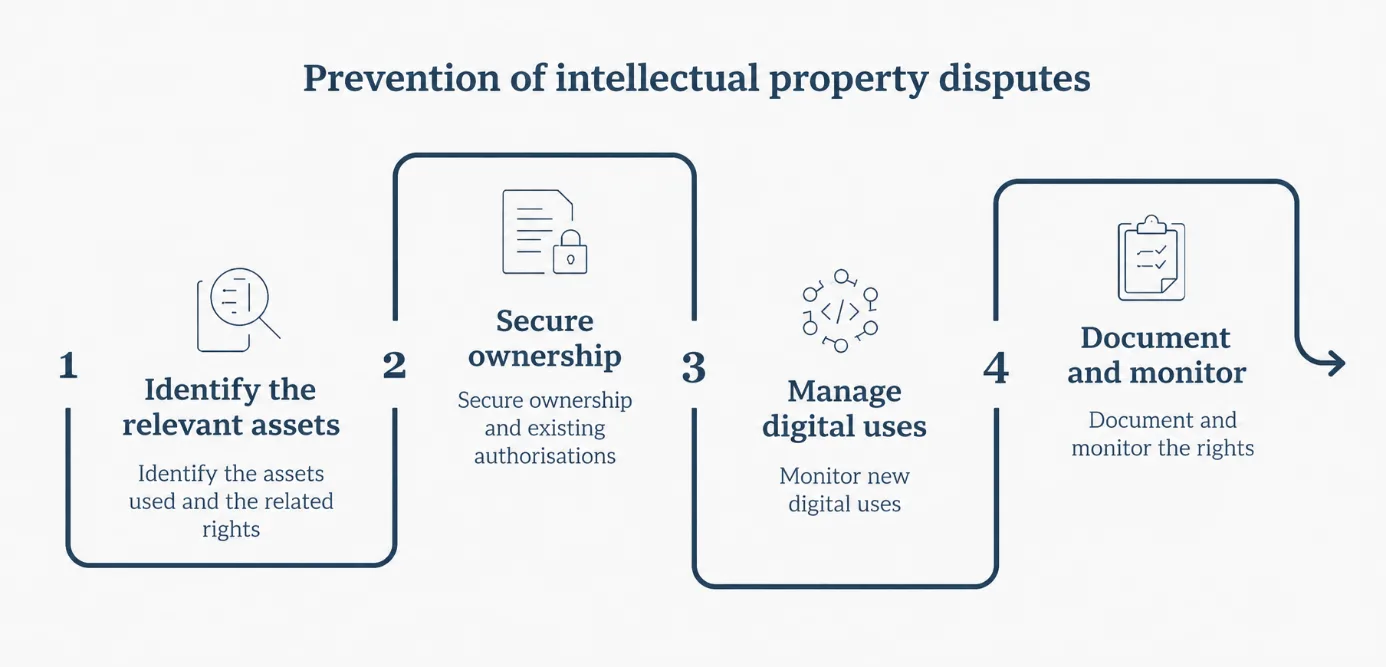
What are the four essential steps for preventing IP disputes?
An effective IP risk-management framework should:
identify both company assets and third-party rights before products, services or campaigns are launched;
secure ownership and licences contractually, including with employees, developers, agencies, designers and independent contractors;
govern digital uses, particularly generative AI, open-source components, databases and licensed content;
document and monitor rights, so that ownership, authorisation and earlier creation or use can be established efficiently.
The objective is to make IP compliance a normal business process rather than an emergency response.
Conclusion
Reducing the risk of intellectual property litigation in the digital age requires moving legal review upstream: before a trademark is selected, before an external developer is retained, before third-party code is integrated and before AI-generated or AI-assisted material is released publicly.
Dreyfus Law Firm assists its clients in managing complex intellectual property cases, offering personalized advice and comprehensive operational support for the complete protection of intellectual property.
Can an idea or concept be protected before it is commercialised?
An abstract idea is not protected as such. Once materialised, however, different forms of protection may become relevant: copyright for an original expression, patents for qualifying inventions, trademarks for distinctive signs and designs for product appearance. Before materialisation, confidentiality, contractual safeguards and reliable evidence of the project's development can be particularly important.
Does registering a domain name automatically protect the name as a trademark?
A domain-name registration does not, by itself, create an industrial property title. Domain names and trademarks are legally distinct. A domain name may, however, constitute a prior right under certain circumstances.
How long does a company have to bring an infringement action in France?
A five-year limitation period applies to a number of French IP infringement actions, including trademark, patent and design claims, generally by reference to when the right holder knew or should have known the relevant last fact enabling the action to be brought. The precise calculation remains dependent on the right and factual chronology concerned.
Is French intellectual property protection sufficient when a company expands internationally?
Industrial property rights are territorial. Businesses entering foreign markets should determine where their trademarks, patents or designs require protection. Trademark owners, for example, may use national, regional or international filing routes depending on their target markets.
What should a business do after receiving an IP infringement cease-and-desist letter?
The first priority is to preserve evidence and verify the rights relied upon, their ownership and validity, the allegedly infringing conduct and any applicable contracts or licences. An immediate admission or an unplanned alteration of evidence may complicate the response. The legal assessment should determine whether the appropriate strategy is to contest the claim, remedy the position, negotiate, enter into a licence or coexistence agreement, or defend formal proceedings.
This publication is intended for general public guidance and to highlight issues. It is not intended to apply to specific circumstances or to constitute legal advice.
Industrial property law is the specialized legal field that governs the protection and use of intellectual property (IP). It covers the laws related to copyrights, patents, trademarks, designs, trade secrets, and other IP. Industrial property law is complex, but for businesses and individuals looking to protect their interests, the benefits of understanding it are clear.
First, industrial property law provides businesses with a way to protect their work and investments. By obtaining patents, copyrights, and trademarks, companies can ensure that their investments of time and money are protected. This has the added benefit of giving businesses an edge over competitors since their IP is protected and cannot be copied or used without permission. Second, industrial property law is a way for businesses to make money. By obtaining patents, businesses can license their IP to other companies, meaning they can make money by granting companies the right to use their IP. This is an important source of income for many companies and can be a great way to expand a business’s reach. Third, industrial property law can help companies avoid litigation. By understanding and adhering to the laws governing IP, companies can avoid costly legal battles with competitors. This is especially important for small companies who may not have the resources to defend themselves in court. Fourth, industrial property law helps companies protect their reputation. A company’s reputation is one of its most valuable assets, and by understanding the laws surrounding IP, companies can ensure that their reputation remains intact. This is especially important in industries where reputation is key, such as technology and healthcare, since IP can easily be stolen or misused. Finally, industrial property law can help companies stay compliant with local and international laws. Companies operating on an international scale must understand the laws governing IP in each jurisdiction they operate in. This is essential for companies looking to do business overseas and protect their IP from infringement.
Overall, industrial property law is an essential part of any business’s operations. It provides companies with a way to protect their investments, make money, avoid litigation, protect their reputation, and stay compliant with local and international laws. Understanding and adhering to industrial property law is key for any business looking to protect their IP.
We offer our clients a dedicated and unique experience of expertise that is necessary for the exploitation of intangible assets. We will also endeavor to keep you informed and up-to-date about intellectual property and digital economic issues through our articles and newsletters written by the Dreyfus Legal Team.
The world of technology is ever-evolving, and the same applies to the law that governs it. The latest development is Web 3.0 law, which is the legal framework created to govern the newest generation of technology and the internet. This article will explain what Web 3.0 law is and how it can affect businesses.
Web 3.0 law is a broad term that refers to the legal framework that has been created to govern the future of the internet. It is a legal framework that will provide protection for both companies and consumers in the digital age. It is designed to ensure that digital assets, such as data and content, are protected from unauthorized access or misuse. It also ensures that companies are held accountable for their actions and that consumers are given the tools to protect themselves from potential harm.
Web 3.0 law covers a number of different areas, including intellectual property (IP) rights, privacy, data protection, and cybersecurity. It also includes regulations on the use of artificial intelligence (AI) and other emerging technologies. It is important for businesses to understand these regulations, as they can have a significant impact on how they do business.
One of the key components of Web 3.0 law is the protection of IP rights. This includes copyright, trademark, and patent laws. These laws are designed to ensure that businesses are able to protect their intellectual property, such as inventions, designs, logos, and other creative works. This ensures that businesses are able to benefit from the products they create and that they are not unfairly taken advantage of by others.
Furthermore, Web 3.0 law also includes regulations on privacy and data protection. This is important for businesses, as they need to ensure that they are protecting their customers’ data and are not sharing it with third parties without their consent. Additionally, businesses need to comply with regulations on data retention and disposal, as well as data protection laws, such as the General Data Protection Regulation (GDPR).
Lastly, Web 3.0 law also covers cybersecurity. This is important for businesses, as it helps to protect them from cyberattacks, such as data breaches and ransomware. Additionally, it provides guidance on how to secure networks and how to respond to cyberattacks.
Overall, Web 3.0 law is an important development in the legal framework governing the future of the Internet. It is designed to ensure that companies can protect their digital assets and that consumers have the tools to protect themselves from potential harm. It is important for companies to understand these regulations, as they can have a significant impact on their operations.
We offer our clients a dedicated and unique experience of expertise that is necessary for the exploitation of intangible assets. We will also endeavor to keep you informed and up-to-date about intellectual property and digital economic issues through our articles and newsletters written by the Dreyfus Legal Team.
Intellectual property (IP) is a valuable asset for businesses, and it is important for companies to understand the legal implications of IP contracts in the EU. Companies that operate in the EU should be aware of the various legal requirements that need to be considered when drafting an IP contract. This article will discuss some of the important considerations to be taken into account when drafting an IP contract in the EU.
The first consideration is the type of IP contract being drafted. There are several different types of IP contracts in the EU, such as patent licenses, trademark licenses, copyright licenses, and trade secrets contracts. It is important to determine which type of contract best suits the needs of the company and to determine the scope of the agreement. The second consideration is the jurisdiction of the contract. The jurisdiction of the contract determines which laws will apply to the contract and the parties involved. It is important to select a jurisdiction that is most appropriate for the company and the type of IP being protected. The third consideration is the language of the contract. The language of the contract should be clear and concise and should be tailored to the needs of the company. It is important to include all relevant terms and conditions in the contract, and to ensure that they are clearly understood by all parties involved. The fourth consideration is the enforcement of the contract. It is important to consider how the contract will be enforced in the event of a dispute. It is important to include provisions for dispute resolution and to ensure that the contract is enforceable in the event of a breach of the agreement. The fifth consideration is the duration of the contract. It is important to determine the length of the contract and to include provisions for renewal or termination. Companies should also consider the possibility of amendment or termination of the contract in the event of unforeseen circumstances. Finally, it is important to consider any additional clauses or provisions that may be included in the contract. This could include confidentiality provisions, warranties, and indemnities. It is important to ensure that these provisions are in line with the company’s legal requirements and are clearly understood by all parties involved.
In conclusion, when drafting an IP contract in the EU, it is important to consider the various legal requirements and to ensure that the contract is tailored to the needs of the company. Companies should ensure that the contract is clear and concise and that all relevant terms and conditions are included.
We offer our clients a dedicated and unique experience of expertise that is necessary for the exploitation of intangible assets. We will also endeavor to keep you informed and up-to-date about intellectual property and digital economic issues through our articles and newsletters written by the Dreyfus Legal Team.
Technology is more integral to our lives and businesses than ever before. With this shift, the need for sound legal protection of technology-related assets has grown as well. This is where IT law comes into play. IT law, or information technology law, is a branch of law that covers the use, development, and implementation of technology. It’s a complex and ever-evolving area of law, and it can be the difference between success and failure for many businesses.
IT law covers a wide range of topics, including intellectual property, data protection and privacy, cyber security, and technology contracts. Each of these areas of law can play a key role in protecting a business’s assets, products, and services. The following is a brief overview of how IT law can help protect businesses in each of these areas. Intellectual Property Intellectual property (IP) law is the cornerstone of IT law. It deals with protecting intangible assets such as copyrights, trademarks, and patents. Copyrights protect an individual’s or business’s creative works, such as books, music, and software, from being copied or used without permission. Trademarks protect a business’s brand identity by ensuring that their logo, name, and other identifying marks can’t be used by another business. Patents protect inventions from being copied or used without permission. Data Protection and Privacy Data protection and privacy law is the set of laws that govern how businesses collect, use, store, and protect personal data. This includes data from customers, clients, and employees. Data protection and privacy laws are designed to ensure that businesses are transparent about how they are collecting and using data, and that they are taking steps to protect the data from unauthorized access. Cyber Security Cyber security law is the set of laws that govern how businesses protect their networks and data from cyberattacks. This includes everything from developing a secure network architecture to implementing effective cyber security measures, such as firewalls and encryption. Cyber security laws also require businesses to have a plan in place to respond to and recover from cyberattacks. Technology Contracts Technology contracts are the agreements that govern a business’s relationship with its vendors and other technology providers. These contracts cover everything from the services being provided to the terms of payment. It’s important that businesses have sound technology contracts in place to ensure they are getting the best value from their technology providers and that they are protected from potential legal issues.
Overall, IT law provides a number of important protections for businesses. It is a complex and ever-evolving area of law, which is why it’s important for businesses to have an experienced IT lawyer on their side. An experienced IT lawyer can help businesses stay up to date on the latest developments in IT law and ensure they have the legal protections in place that they need to succeed.
We offer our clients a dedicated and unique experience of expertise that is necessary for the exploitation of intangible assets. We will also endeavor to keep you informed and up-to-date about intellectual property and digital economic issues through our articles and newsletters written by the Dreyfus Legal Team.
Copyright is an important form of intellectual property protection that authors, artists, and other creators of works can register in the European Union (EU). The EU has a harmonised copyright system that applies to all of its member states, making it easier to protect your work across the entire EU. Here are the steps for registering a copyright in the EU.
First, you must determine whether your work is eligible for copyright protection. Copyright protection is available for both published and unpublished works, including literary, dramatic, musical, and artistic works. As long as your work is original and has not been copied from someone else, then it is eligible for copyright protection. Second, you must decide where you want to register your copyright. You can register your copyright in the EU through the European Intellectual Property Office (EUIPO). This is the main office where all EU copyright registrations are processed. Third, you must prepare the documents required for registration. These include a completed application form, a copy of the work itself, and a fee for registration. You may also need to include a power of attorney or a statement of legal representation if you are registering your copyright through an agent. Fourth, you must submit your application and documents to the EUIPO. The EUIPO will review your application and documents to make sure they meet the requirements for registration. If the EUIPO approves your application, you will be issued a certificate of registration and a registration number. Finally, you must keep your registration up to date. Copyright registrations are valid for the life of the author, plus an additional 70 years. You must renew your registration every 10 years in order to keep it valid.
These are the steps for registering a copyright in the EU. Copyright registration is an important form of intellectual property protection that can help you protect your work and your rights.
We offer our clients a dedicated and unique experience of expertise that is necessary for the exploitation of intangible assets. We will also endeavor to keep you informed and up-to-date about intellectual property and digital economic issues through our articles and newsletters written by the Dreyfus Legal Team.
Filing a patent application is the first step towards protecting your intellectual property. A patent grants its owner the right to exclude others from making, using, offering for sale, or selling the invention throughout the country in which the patent is granted and, in some cases, importing the invention. Patents are governed by the laws of each country, so it is important to understand the laws of the country or countries in which you wish to file a patent application.
Before you file a patent application, you must first determine whether the invention is eligible to be patented. Patents are typically granted for inventions that are new and useful. To be considered “new,” the invention must not have been previously known or used by others. To be considered “useful,” the invention must provide some kind of benefit or utility, such as a machine that can be used to perform a task. After determining that your invention is eligible for a patent, you must then decide what type of patent you would like to file for. There are three main types of patents: utility patents, design patents, and plant patents. Utility patents cover inventions that are functional, such as machines, processes, and chemical compositions. Design patents cover the ornamental design of a functional item. Plant patents cover newly developed varieties of plants. Once you have decided on the type of patent you would like to file for, you must then prepare the necessary documents. To apply for a patent, you must submit a written application, which includes a description of the invention, drawings of the invention, and any other relevant information. You must also include a claim, which is a statement that describes the scope of the invention. After you have gathered the necessary documents, you must then decide how you would like to file the application. You can file a patent application in person at a patent office, or you can file an application electronically. If you choose to file electronically, you must have a valid email address and a digital signature to complete the application. Once the patent application has been filed, the patent office will review it and determine if the invention qualifies as patentable. If the patent office approves the application, it will then issue a patent. The patent will give you exclusive rights to the invention, which can be used to prevent others from using or selling the invention without your permission.
Filing a patent application is a complex process, so it is important to understand the laws and procedures involved. If you are unsure of how to proceed, it is best to consult a lawyer or patent agent. A lawyer or patent agent can help you navigate the legal process and ensure that your application is complete and accurate.
We offer our clients a dedicated and unique experience of expertise that is necessary for the exploitation of intangible assets. We will also endeavor to keep you informed and up-to-date about intellectual property and digital economic issues through our articles and newsletters written by the Dreyfus Legal Team.
Our site uses cookies to offer you the best service and to produce statistics, and measure the website's audience. You can change your preferences at any time by clicking on the "Customise my choices" section.
When browsing the Website, Internet users leave digital traces. This information is collected by a connection indicator called "cookie".
Dreyfus uses cookies for statistical analysis purposes to offer you the best experience on its Website.
In compliance with the applicable regulations and with your prior consent, Dreyfus may collect information relating to your terminal or the networks from which you access the Website.
The cookies associated with our Website are intended to store only information relating to your navigation on the Website. This information can be directly read or modified during your subsequent visits and searches on the Website.
Necessary cookies are absolutely essential for the website to function properly. These cookies ensure basic functionalities and security features of the website, anonymously.
Dreyfus is concerned about protecting your privacy and the Personal Data ("Data"; "Personal Data") it collects and processes for you.
Hence, Dreyfus complies every day with the European Union legislation regarding Data protection and particularly the European General Data Protection Regulation Number 2016/679 of 27 April 2016 (GDPR).
This Privacy Policy is aimed at informing you clearly and comprehensively about how Dreyfus, as Data Controller, collects and uses your Personal Data. In addition, the purpose of this Policy is to inform you about the means at your disposal to control this use and exercise your rights related to the said processing, collection and use of your Personal Data.
This Privacy Policy describes how Dreyfus collects and processes your Personal Data. The collection happens when you visit our Website, when you exchange with Dreyfus by e-mail or post, when exercising our Intellectual Property Attorney and representative roles, when we interact with our clients and fellow practitioners, or on any other occasion when you provide your Personal Data to Dreyfus, in particular when you register for our professional events.


 Written by Dreyfus10/03/2023
  Intellectual property (IP) litigation is a process used to resolve a dispute over the ownership or use of IP. It is a legal process that can be used to protect and enforce the rights of IP owners. IP litigation is an important tool for businesses, as it enables them to protect their valuable IP assets and to prevent infringement.


 Contract law is an area of law that governs the enforcement of contracts and the related legal implications. It is a complex and multifaceted field of law that is applicable in many different scenarios. The European Union (EU) has its own set of contract law regulations that are specifically tailored to the needs of the EU. It is important for businesses, lawyers, and individuals to understand the basics of contract law in the EU in order to effectively navigate the legal landscape.



 The world of technology is ever-evolving, and the same applies to the law that governs it. The latest development is Web 3.0 law, which is the legal framework created to govern the newest generation of technology and the internet. This article will explain what Web 3.0 law is and how it can affect businesses.
 Intellectual property (IP) is a valuable asset for businesses, and it is important for companies to understand the legal implications of IP contracts in the EU. Companies that operate in the EU should be aware of the various legal requirements that need to be considered when drafting an IP contract. This article will discuss some of the important considerations to be taken into account when drafting an IP contract in the EU.
 Technology is more integral to our lives and businesses than ever before. With this shift, the need for sound legal protection of technology-related assets has grown as well. This is where IT law comes into play. IT law, or information technology law, is a branch of law that covers the use, development, and implementation of technology. It’s a complex and ever-evolving area of law, and it can be the difference between success and failure for many businesses.
 Copyright is an important form of intellectual property protection that authors, artists, and other creators of works can register in the European Union (EU). The EU has a harmonised copyright system that applies to all of its member states, making it easier to protect your work across the entire EU. Here are the steps for registering a copyright in the EU.