


Introduction
The valuation of intangible assets consists in identifying, organising and assessing the non-physical elements that contribute to the economic value of a business. The issue is straightforward: what has not been identified, protected and documented is difficult to value.
A serious valuation exercise therefore does not consist in arbitrarily assigning an attractive figure to an asset. It requires demonstrating that the asset exists, that it is duly owned by the company, that it is enforceable against third parties, that it has economic relevance, and that it is capable of generating or securing revenue.
Identifying intangible assets that can truly be valued
The first step consists in drawing up an inventory of the company’s intangible assets. Not all such assets are based on the same legal foundation, and not all are valued in the same manner.
Certain assets are protected by industrial property titles. This is the case for trademarks, patents and designs rights.
- A trademark may embody the company’s reputation, customer trust and commercial distinctiveness. Its value depends, in particular, on its distinctiveness, the territory in which it is protected, its reputation, its effective use and its ability to support a commercial strategy.
- A patent, for its part, may constitute a strategic asset where it protects a key technology, limits competitors’ market entry or enables revenue to be generated through licensing.
- Designs rights, in turn, may also constitute valuable assets where they protect the appearance of a product, its design, lines or aesthetic features, thereby contributing to its commercial appeal and differentiation on the market.
Other assets fall more within the scope of copyright, contract law or internal documentation. Software, applications, algorithms, interfaces, databases, graphic content and original creations may represent significant value, particularly in the technology and digital sectors. Their valuation nevertheless requires verification of ownership of the rights, especially where the creations have been produced by employees, freelancers, service providers or partners.
Finally, certain assets are not necessarily registered but may nevertheless be essential to the company’s business. Know-how and trade secrets, including internal methods, commercial data, protocols, formulas, pricing strategies and customer information, may constitute a decisive competitive advantage. Their value then depends on their confidential nature, their economic usefulness and the measures implemented to preserve their confidentiality.
Legally securing rights prior to any valuation
Prior to any valuation, intellectual property due diligence is essential. An investor, acquirer or partner does not merely value an idea, a technology or a trademark: they value an asset that the company can effectively exploit, defend and transfer.
This review must make it possible to answer several key questions. Is the company indeed the holder of the rights? Are the trademarks, patents, designs registered in the relevant territories? Do the employment, service provision or assignment agreements contain appropriate clauses? Do licences granted to third parties restrict the freedom to operate? Are trade secrets subject to sufficient protection measures?
This step is decisive. High-performing software developed without a valid agreement, a trademark used but not registered in the appropriate territories, or strategic know-how insufficiently protected may lose a substantial part of its value during due diligence.
Conversely, clear and comprehensive documentation strengthens the credibility of the valuation. It demonstrates that the company has control over its intangible assets and is able to derive a secure economic advantage from them.
Choosing an appropriate valuation method
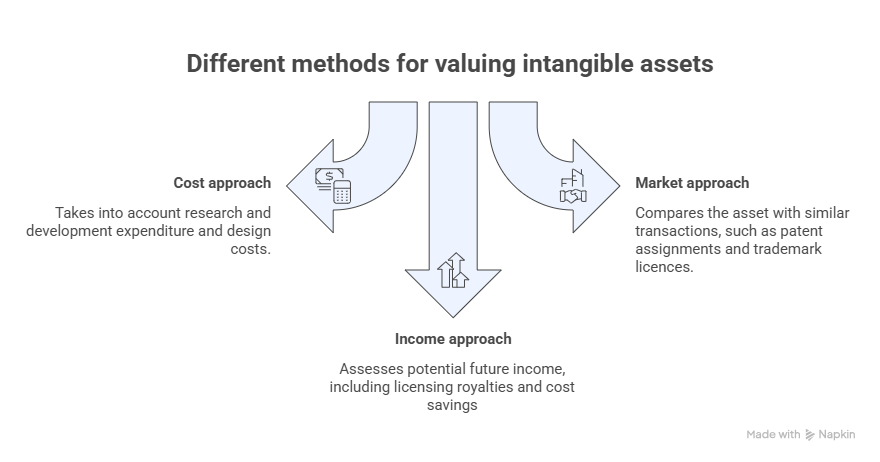
Once the assets have been identified and secured, their valuation may be considered. There is no single method: the approach adopted depends on the nature of the asset, its stage of development, its exploitation, its market and the company’s strategy.
-
The cost approach
This method consists in assessing the investments required to create, develop or replace the asset. It may take into account research and development expenditure, design costs, filing fees, professional fees, technical development costs and market launch costs.
This method is useful for recent assets or assets that are still only marginally exploited, but it has one limitation: the cost of creation does not always reflect the asset’s actual economic value. A costly patent may prove difficult to exploit, whereas a trademark created with limited resources may become highly profitable.
-
The market approach
This method consists in valuing an intellectual property asset by comparing it with transactions involving similar assets, such as patent assignments, trademark licences, software valuations, franchise agreements or comparable transactions in the same sector. This method is based on the idea that the financial terms observed for a comparable asset may serve as a reference for assessing the value of the asset being valued.
The comparison must, however, be carried out with caution. The assets used as references must have similar characteristics, particularly with regard to the business sector, the territory concerned, the duration of the rights, the degree of exclusivity granted, the reputation of the asset, its stage of development and its commercial potential.
In practice, however, its application may be difficult, as the financial terms of licence or assignment agreements are often confidential.
-
The income approach
This method consists in assessing the future income that the asset may generate or secure. It may include licensing royalties, cost savings, additional margins or commercial exclusivity. This method is often the most meaningful for investors, as it directly links the intangible asset to future economic performance. It nevertheless requires robust, documented and prudent assumptions.
In practice, these methods may be combined. The valuation must remain consistent with the legal, economic and commercial reality of the asset concerned.
Turning intangible assets into revenue
The valuation of intangible assets is not solely an accounting or financial exercise. It also makes it possible to structure their exploitation and turn them into sources of revenue.
-
Licensing
A licence enables the company to retain ownership of the asset while authorising a third party to exploit it. It may be exclusive or non-exclusive, and may be limited to a territory, a duration, a sector or a category of products. Remuneration may take the form of a lump sum, royalties proportional to turnover, guaranteed minimums or a combination of these mechanisms.
-
Assignment
An assignment, by contrast, enables the ownership of the asset to be transferred to a third party. It may generate immediate revenue but entails a loss of control. It should therefore be considered with caution, particularly where the asset concerned is central to the company’s strategy.
Other mechanisms may also be used to exploit the value of intangible assets. Co-branding may bring together two trademarks in order to create a joint offering. Franchising, for its part, is based on the structured provision of a set of intangible assets enabling the franchisee to reproduce a commercial concept, such as trademarks, know-how, commercial methods or distinctive signs, for example.
In all cases, valuation requires a rigorous contractual framework. An intangible asset creates lasting value only if the conditions governing its exploitation are clearly defined and legally secured.
Conclusion
The valuation of intangible assets is based on a progressive approach. It is first necessary to identify the assets that may be valued, then to secure their ownership and enforceability, before selecting an appropriate valuation method and considering their monetisation.
For an innovative company, this approach can make the difference between an asset that is difficult to defend and a genuine lever for growth, financing and negotiation.
Dreyfus law firm assists its clients in managing complex intellectual property cases, offering personalized advice and comprehensive operational support for the complete protection of intellectual property.
Nathalie Dreyfus with the support of the entire Dreyfus team.
Q&A
1. Can open-source components reduce the value of software?
They may do so depending on the licences used. Certain open-source licences impose specific obligations, particularly with respect to redistribution, attribution of authorship or making the source code available. Poor management of these licences may create legal risk and reduce the value of the software during due diligence.
2. Can the departure of an employee affect the value of an intangible asset?
Yes, particularly where key know-how or knowledge is not sufficiently documented or protected. If the asset depends solely on one individual, its value is more fragile. The company must therefore organise internal knowledge transfer, confidentiality and the preservation of essential elements.
3. How can an intangible asset be prevented from losing value over time?
Rights must be kept in force, titles renewed where necessary, unauthorised uses monitored, documentation updated, contracts adapted and the asset continuously exploited. An intangible asset that is not properly maintained may gradually lose both its legal and economic value.
4. Can an overvaluation be risky?
An excessive or insufficiently documented valuation may result in a loss of credibility with investors, acquirers or partners. It may also be challenged in the context of a financial transaction. The valuation must therefore remain prudent, justified and consistent with the available data.
5. Can intangible assets be used as collateral or as a financing lever?
In certain circumstances, yes. Some intangible assets may be taken into account in financing transactions, pledges or asset-structuring arrangements. However, their acceptance depends on their demonstrable value, legal certainty and potential liquidity.
The purpose of this publication is to provide general guidance to the public and to highlight certain issues. It is not intended to apply to particular situations or to constitute legal advice.