Nathalie Dreyfus

Trademark law: an effective tool to protect one’s voice and image in the age of generative AI?

Introduction

With the rapid development of generative AI systems capable of simulating voices and faces with striking realism, the legal protection of digital identity remains fragile. In this context, American actor Matthew McConaughey recently filed several trademark applications with the United States Patent and Trademark Office (USPTO), including movement trademarks depicting him.

Such an initiative has surprised many legal practitioners, as it challenges the traditional boundaries of trademark law and raises novel questions regarding the legal protection of digital identity.

The limits of personality rights in the face of generative AI

Under French law, a person’s image and voice are protected as personality rights, primarily pursuant to Article 9 of the French Civil Code related to the right to privacy. This provision protects any unauthorized use of elements enabling the identification of a person, irrespective of whether a pre-existing material medium exists. An infringement may therefore be established whenever the public is capable of recognizing the individual concerned.

Although protective, this regime relies on demanding evidentiary requirements. The claimant must demonstrate the existence of an infringement, fault, identification of the responsible party, and, where applicable, the extent of the damage suffered.

The emergence of generative AI complicates each of these elements. AI systems may produce “resembling” voices or faces without directly reproducing an identifiable recording or photograph. The legal issue lies less in the distinction between reproduction and simulation than in the assessment of identifiability: at what level of resemblance can a person be deemed legally recognizable?

Further uncertainty arises from issues of attribution. The generation of AI content may involve multiple actors, developers, infrastructure providers, end users, and distribution platforms, thereby rendering the allocation of liability more complex. Existing mechanisms remain primarily corrective and intervene only after the dissemination of the contested content.

The evolution of filing requirements for distinctive signs

Since the entry into force of French Ordinance No. 2019-1169 of November 13, 2019 implementing the EU Trademark Package (Directive (EU) 2015/2436), French trademark law has undergone significant modernization.

The abolition of the requirement of graphic representation replaced by the obligation to represent the sign in a manner that is clear, precise, self-contained, easily accessible, intelligible, durable and objective in the register, has considerably broadened the range of registrable signs. This reform follows the criteria established by the Court of Justice of the European Union in the Sieckmann judgment (CJEU, December 12, 2002, Case C-273/00), which are now fully integrated into the practice of trademark offices.

evolution trademark law

Within this updated framework, French and EU law expressly permit the registration of sound trademarks, movement trademarks and multimedia trademarks, provided that they are represented in an appropriate technological format, such as an audio file (MP3) or video file (MP4). A sound trademark may therefore consist of a precisely fixed sequence, such as a jingle, a distinctive intonation or a recurring expression used in a commercial context, provided that the relevant public perceives it as an indication of commercial origin.

The protection of voice and image through trademark law under French and EU Law

Pursuant to Article L.711-2 of the French Intellectual Property Code, a sign may be registered only if it is linked to designated goods or services and used as a trademark to distinguish the goods or services of one undertaking from those of others. When applied to a sound or audiovisual sequence, this principle requires that the relevant public perceive the sequence as an indication of commercial origin.

It is essential to emphasize the precise scope of the monopoly conferred. Protection extends exclusively to the sign as filed and exploited, namely, the specific sound or audiovisual sequence recorded in the register. Trademark law does not grant a general appropriation of a person’s identity; rather, it secures a defined expression integrated into commercial activity.

The primary advantage of relying on trademark law lies in its litigation framework. The proprietor of a registered trademark holds a constitutive right benefiting from a presumption of validity and may initiate counterfeiting proceedings where a third party reproduces or imitates the sign in the course of trade for identical or similar goods or services.

Such action is based on the infringement of the registered sign itself, independently of the need to demonstrate personal moral damage, and allows for effective injunctive relief, including through internal procedures implemented by digital platforms.

Nonetheless, a measured approach remains necessary. Registering a sound or audiovisual excerpt as a trademark is legally demanding. Trademark law is not intended to protect an individual’s personality but to identify the commercial origin of goods or services.

Attempting to secure a voice or image through trademark law may therefore conflict with its economic rationale. It must be demonstrated that the sign genuinely fulfills the essential function of a trademark and is not merely perceived as a representation of the individual. Failing genuine use within the meaning of trademark law, the registration risks being challenged or revoked for non-use.

Conclusion

Trademark law protects only a specific sign exploited as an indication of origin in the course of trade. Its effectiveness will therefore depend, in practice, on the proprietor’s ability to demonstrate genuine, distinctive use as a trademark.

In the context of generative AI, trademark law does not constitute a universal solution. Nevertheless, it offers a more structured legal framework than personality rights alone, allowing certain uses to be anticipated and supported by an enforceable registered title. Such a strategy must, however, be embedded in a coherent and sustained commercial exploitation.

Dreyfus & Associés assists its clients in managing complex intellectual property cases, offering personalized advice and comprehensive operational support for the complete protection of intellectual property.

Dreyfus & Associés works in partnership with a global network of attorneys specializing in Intellectual Property.

Nathalie Dreyfus with the support of the entire Dreyfus team

Q&A

1.Does trademark law protect against non-commercial deepfakes?
No. Trademark law requires use in the course of trade. Deepfakes disseminated for parody or private purposes are more likely to fall under image rights or other legal mechanisms.

2.Does celebrity status provide an advantage when registering a voice excerpt?
Not automatically. While notoriety may facilitate the acquisition of distinctiveness through use, it does not exempt the applicant from satisfying the statutory conditions.

3.Does parody limit trademark protection?
In certain circumstances, freedom of expression may be invoked, particularly where the use does not undermine the essential function of the trademark.

4.Does a multimedia trademark offer broader protection?
It may provide more precise protection where the combination of sound and image constitutes the core element of commercial identification.

5.Why does registering a trademark simplify judicial proceedings in cases involving voice or image misuse?
Because infringement proceedings are based on the existence of a registered and presumed valid right, shifting the debate from the subjective assessment of personal harm to the more objective issue of infringement of a protected sign. This may render the evidentiary analysis clearer and more structured before court.

The purpose of this publication is to provide general guidance to the public and to highlight certain issues. It is not intended to apply to particular situations or to constitute legal advice.

Read More

Trademark filing: How to effectively secure its legal and commercial identity?

Introduction

Commercial identity encompasses all signs through which the public identifies a company, such as its corporate name, trade name, business sign, visual identity, or digital presence. The protection of these elements is governed by distinct legal regimes that are often less structured and less predictable than trademark law.

In a context where a company’s name and image circulate across borders instantaneously, securing distinctive signs has become a non-negotiable requirement. Trademark registration does not encompass the entirety of a company’s commercial identity; however, it constitutes its most solid legal foundation. It grants an exclusive right over a specific sign (name, logo, slogan) in relation to precisely designated goods and services. In the absence of registration, a third party may file and appropriate an identical sign. Conversely, a registered trademark enables its owner to initiate opposition proceedings, bring counterfeiting actions, and consolidate a legally controlled intangible asset.

Why is trademark filing essential to preserve its legal identity?

Under French law, a trademark constitutes an industrial property title governed by Articles L.711-1 et seq. of the French Intellectual Property Code. Registration confers upon its holder an exclusive right of use for the designated goods and services, subject to the principles of specialty and territoriality.

This exclusive right produces immediate and structured legal effects. In particular, it allows the holder to:

  • Prohibit the use of an identical or similar sign for identical or similar goods or services;
  • Take action against the use of a similar sign creating a likelihood of confusion;
  • File opposition against a subsequent trademark application within statutory deadlines;
  • Initiate infringement proceedings before specialized courts;
  • Challenge domain name registrations reproducing or imitating the trademark;
  • Exploit the sign through licensing, franchising, or assignment.

A registered trademark therefore constitutes a right enforceable erga omnes. By contrast, in the absence of registration, protection relies on unfair competition or parasitism claims under Article 1240 of the French Civil Code. Such actions require proof of fault, damage, and causation, an evidentiary burden considerably more uncertain than in trademark infringement proceedings. Registration thus transforms commercial use into a legally consolidated property right.

This protection nevertheless requires consistency between the registered sign and the actual business activity. The selection of classes under the Nice Classification and the drafting of specifications must correspond to a genuine, documented, and coherent business project. Recent case law confirms that trademark filing may not be diverted from its economic purpose. The decision of the French Intellectual Property Office (INPI) dated September 13, 2024 (NL 23-0183) concerning bad faith filing confirms that a speculative filing intended solely to block a third party, without genuine intent to use, is liable to cancellation.

A detailed analysis of this decision is available here:

https://www.dreyfus.fr/en/2025/02/10/french-trademark-office-inpi-decision-of-september-13-2024-bad-faith-trademark-filing-and-its-implications/

error compromising filing

How to integrate trademark filing into a comprehensive protection strategy?

Trademark registration is not an end in itself. To achieve full effectiveness, it must form part of a coordinated strategy encompassing all means of identification and exploitation of the sign.

Consistency between trademarks and domain names is essential. Filing a trademark without securing the corresponding strategic domain names (.fr, .com, or relevant country-code extensions) exposes the company to opportunistic registrations capable of generating confusion, traffic diversion, or fraud. An effective protection strategy therefore requires proactive domain name registration and ongoing monitoring of competing filings.

This protection must also be aligned with digital compliance. The exploitation of a trademark on a website or digital platform requires compliance with legal obligations relating to mandatory disclosures, personal data protection, and commercial communication rules. Deficiencies in this area may weaken the reputation attached to the sign and compromise its economic value.

A trademark is a territorial right whose scope depends on the chosen title. A filing with the INPI provides protection limited to France. A filing with the European Union Intellectual Property Office (EUIPO) produces unitary effect throughout the European Union. The Madrid International Registration System enables protection to be extended to specifically designated States.

The choice of territorial scope must not be dictated solely by the company’s present situation; it should reflect its foreseeable business development. A trademark protected only in France will not prevent identical use in Germany or Spain. Conversely, a European Union trademark may be vulnerable if an earlier right exists in a single Member State. Legal security therefore requires a forward-looking assessment of target markets, competitive risk areas, and planned expansion.

We invite you to read a previously published article outlining best practices in trademark filing and portfolio management strategy:

https://www.dreyfus.fr/en/2026/02/11/how-to-build-in-2026-a-trademark-filing-and-management-strategy-to-secure-structure-and-anticipate-risks/

Finally, a registered trademark must be viewed as a structured intangible asset. It may be licensed, assigned, contributed in kind, or valued in the context of financing or restructuring operations. Integrating trademark filing into a comprehensive strategy therefore means securing not only a distinctive sign but also a central component of the company’s intangible assets, controlled geographically and economically exploitable.

Conclusion

Ultimately, trademark filing constitutes the foundational act in securing your commercial identity from a legal standpoint. When properly prepared, it transforms a mere distinctive sign into an exclusive right that is enforceable, exploitable, and economically valuable. Poorly anticipated, it exposes the business to opposition proceedings, invalidity actions, or loss of rights. Effective trademark protection therefore requires a methodical, forward-looking, and economically coherent approach. Securing your trademark today means strengthening the long-term legal and financial value of your business.

Dreyfus & Associés assists its clients in managing complex intellectual property cases, offering personalized advice and comprehensive operational support for the complete protection of intellectual property.

Dreyfus & Associés works in partnership with a global network of attorneys specializing in Intellectual Property.

Nathalie Dreyfus with the support of the entire Dreyfus team

FAQ

1. Can a trademark be filed before the company is incorporated?
Yes. An individual may file a trademark prior to company incorporation. The trademark must subsequently be assigned or contributed to the company to avoid any uncertainty regarding ownership.

2. Should the name or the logo be filed first?
A word trademark generally provides broader protection, independently of graphic stylization. A figurative trademark protects a specific visual representation. Both filings may be complementary depending on the protection strategy.

3. Does a trademark automatically protect the corresponding domain name?
No. A trademark grants a right to prohibit use, but it does not automatically reserve the corresponding domain name, which must be registered separately.

4. Can a trademark be modified after registration?
No. A registered trademark cannot be substantially modified. Any material alteration requires a new filing.

5. Can a trademark be cancelled several years after registration?
Yes. An invalidity action may be brought at any time if an absolute or relative ground for refusal existed at the time of filing.

The purpose of this publication is to provide general guidance to the public and to highlight certain issues. It is not intended to apply to particular situations or to constitute legal advice.
Read More

Opposition in France and the European Union: How to effectively respond to a trademark opposition?

Introduction

When an applicant receives a notice of opposition against a recently filed trademark, the stakes go far beyond a mere procedural formality. The issue concerns the protection of the company’s commercial identity, strategic positioning, and the economic value of its intangible assets. In trademark law, opposition is a specific administrative procedure allowing a third party to request the refusal of a trademark application on the grounds that it allegedly infringes earlier rights.

In this article, we will examine how an applicant can build a structured, persuasive response that complies with procedural requirements, both before the French National Institute of Industrial Property (INPI) and the European Union Intellectual Property Office (EUIPO).

The legal framework of opposition in France and the European Union

Under French law, opposition is governed by Articles L.712-4 et seq. of the French Intellectual Property Code (IPC). It allows the holder of an earlier right to oppose the registration of a new trademark. The time limit for filing an opposition is two months from the publication of the trademark in the Official Bulletin of Industrial Property (BOPI).

At the European level, opposition is regulated by Articles 46 and seq. of Regulation (EU) 2017/1001 on the European Union trade mark. The deadline to file opposition is three months from publication of the EU trademark application.

These time limits are non-extendable and determine the admissibility of the opposition. Any action filed out of time is automatically declared inadmissible.

Opposition is primarily based on the existence of a likelihood of confusion, a key concept defined in Article L.713-3 of the French IPC and Article 8(1)(b) of Regulation (EU) 2017/1001. This mechanism does not seek to sanction infringement but to prevent the registration of a sign that could mislead the public or dilute earlier rights.

Notification of the opposition: the starting point of the defense strategy

From the date of publication in the BOPI, any person who believes that the trademark infringes on their prior rights (already registered trademark, trade name, company name, etc.) has two months to file an opposition. This period cannot be extended. If no opposition is filed within this time frame, the trademark will continue through the registration process as normal.

Within that period, it is possible to file a so-called notice of opposition and to pay the official fee, without immediately setting out the full substantive arguments: the statement of grounds (written submissions) and certain supporting documents may therefore be filed within an additional one-month period running from the expiry of the opposition time limit.

This additional period serves a practical purpose: it allows the opponent to draft and substantiate the statement of grounds (likelihood of confusion / infringement of earlier rights, etc.) after having secured the opposition deadline. That said, this subsequent filing is strictly framed: the opponent may not broaden the scope of the opposition, nor rely on new earlier rights, nor target additional goods/services beyond those identified within the initial time limit.

The notice of opposition must in any event include (Article R.712-14 of the French Intellectual Property Code):

  1. The opponent’s identity, together with information establishing the existence, nature, origin and scope of the earlier rights relied upon;
  2. Identification of the contested application, together with specification of the goods/services targeted by the opposition; and
  3. Evidence that the official fee has been paid.

For more information on this French opposition procedure, please see our specific article published on the subject .

Once the opposition has been declared admissible, the competent office proceeds notifies the applicant.Before the EUIPO, the procedure includes a specific feature: a “cooling-off” period, initially set at two months and extendable by mutual agreement between the parties. If no settlement is reached, the formal adversarial phase begins. For more information, please see our dedicated article on our blog page.

At this stage, the key issue is to determine the most appropriate strategy among several legally available options.

Strategic analysis of the notice of opposition

The first step for the applicant is to carefully analyze the opposition, which is based on three essential criteria:

  • The comparison of the signs requires assessing the overall impression produced by the trademarks at issue. The analysis is conducted from visual, phonetic, and conceptual perspectives.
  • The comparison of the goods and services focuses on their nature, purpose, function, potential complementarity, and distribution channels. Mere inclusion in the same Nice Classification class is insufficient, in itself, to establish similarity..
  • The global assessment of the risk of confusion must take into account the interdependence of these factors. A low degree of similarity between the signs may be offset by a high degree of similarity between the goods and services, and vice versa.

An effective argument does not isolate a single criterion but methodically dismantles the opponent’s reasoning as a whole.

strategic analysis opposition notice

Drafting the response brief and supporting evidence

Following the analysis phase, drafting the response brief becomes a decisive strategic moment. It is not a simple formal reply but a structured legal argument aimed at clearly and convincingly demonstrating the absence of infringement of the earlier rights invoked.

The brief must first accurately recall the procedural elements: the office involved, the opposition number, the contested application reference, and the earlier rights relied upon. This contextual framework ensures that the argument is grounded in the precise legal setting.

The applicant must then set out the opponent’s arguments in order to analyze and challenge them point by point. This demonstrates a thorough understanding of the claims raised and helps identify weaknesses in the opposing reasoning. The argumentation must place the signs and goods or services within their actual economic context in order to establish the absence of confusion for the relevant public.

Finally, the brief must be supported by relevant and properly explained evidence. Proof of use, commercial documents, or market-related materials should be incorporated in a structured and reasoned manner. Overall coherence is essential: each development must serve a single objective, namely to convince the examiner that the contested mark may be registered without infringing the rights invoked.

Proof of use and alternative negotiation strategies

  • Requesting proof of use: a decisive procedural lever

Where the earlier trademark relied upon has been registered for more than five years, the applicant may request that the opponent provide proof of genuine use for the goods or services invoked. This option exists before both the INPI and the EUIPO.

The burden of proof lies with the opponent, who must demonstrate real, public, and commercially justified use during the previous five years in the relevant territory.

Accepted evidence includes invoices, catalogues, advertisements, promotional materials, sales data, and contractual documents.

Use must be genuine and not merely token. In the absence of sufficient evidence, the opposition may be rejected in respect of the goods or services not properly substantiated.

This stage often represents a strategic turning point in the proceedings.

  • Limiting the specification

The applicant may choose to voluntarily restrict the list of goods or services covered by the trademark application. This limitation can eliminate areas of conflict with the earlier right invoked and may lead to partial withdrawal or rejection of the opposition.

However, such limitation is definitive. It reduces the scope of protection of the trademark and must be assessed in light of future commercial exploitation plans.

In practice, this option frequently serves as a negotiation tool, particularly during the cooling-off phase before the EUIPO.

Conclusion

Responding to a trademark opposition requires technical mastery of trademark law, thorough factual analysis, and a drafting strategy aligned with the expectations of the competent offices. A response built on a solid demonstration of the absence of likelihood of confusion, supported by carefully substantiated evidence, not only neutralizes the opposition but also strengthens the legal security of your trademark.

Mastering this procedural stage is a major strategic issue for protecting your commercial identity and enhancing the value of your intangible assets.


Dreyfus & Associés assists its clients in managing complex intellectual property cases, offering personalized advice and comprehensive operational support for the complete protection of intellectual property.

Dreyfus & Associés works in partnership with a global network of attorneys specializing in Intellectual Property.

Nathalie Dreyfus with the support of the entire Dreyfus team


Q&A


1. What happens if the applicant does not respond to the opposition?

Failure to respond leads to the closure of the adversarial phase and generally results in a total or partial refusal of the application for the goods or services targeted by the opposition. Silence is treated as a waiver of the right to present arguments.

2. Can additional time be requested to prepare the response?

As a matter of principle, an extension of the time limit for filing a response is not available. Before both the INPI and the EUIPO, the time limits set for submitting observations are strictly regulated and cannot be extended upon simple request. Only specific grounds for suspension of the proceedings may be contemplated, in particular where the parties are engaged in settlement negotiations, and subject to strict compliance with the applicable procedural requirements.

3. Can an opposition be withdrawn during the proceedings?

Yes. The opponent may withdraw the opposition at any time, either as part of a settlement agreement or unilaterally. Withdrawal terminates the proceedings for the goods or services concerned. However, the opponent’s incurred costs are not automatically reimbursed. Any agreement should therefore be properly documented in writing.

4. Can new evidence be submitted after filing the response brief?

In principle, the offices set strict deadlines for the submission of evidence. Additional materials may sometimes be accepted, but their admissibility depends on the procedural stage and proper justification. Anticipating evidentiary strategy is therefore essential.

5. Can the applicant rely on good faith to overcome the opposition?

Good faith is not a decisive factor in assessing likelihood of confusion. The examination primarily focuses on an objective comparison of the signs and the goods or services. Nevertheless, evidence of prior peaceful coexistence or independent use may serve as contextual support in certain defense strategies.


This publication is intended to provide general guidance and to highlight certain issues. It is not intended to address specific situations nor to constitute legal advice.

Read More

How to protect an AI-trained model?

Introduction

In the field of artificial intelligence (AI), trained models represent a major technological advancement derived from extensive training datasets. Unlike the raw data forming the original datasets, an AI model captures the relationships and patterns learned during the training process. Once trained, it becomes an autonomous intangible asset, embodying technical knowledge extracted from the underlying data.

The legal protection of such models has therefore become an increasingly significant issue. While the question of protection of AI-generated works, authorship, and liability for infringement have already been extensively analyzed, the legal qualification and protection regime applicable to the trained model itself raise distinct and specific challenges requiring separate examination.

The sui generis database right: an ill-suited regime for AI models

The training of an AI system relies on a database serving as an informational reservoir. However, the resulting model is not equivalent to the original database. Unlike a mere aggregation of structured data, an AI model incorporates relationships, weightings, and patterns learned during the training process. It constitutes an abstract representation enabling prediction, classification, or analysis of new data.

This specificity raises a qualification issue. The sui generis database right, established by Directive 96/9/EC and transposed into Article L.341-1 of the French Intellectual Property Code, protects substantial investment in the acquisition, verification, or presentation of systematically organized data. By contrast, an AI model does not consist of individually accessible structured data, but rather a dynamic configuration resulting from algorithmic learning. It does not reproduce the original database, nor does it allow extraction of the initial data as such.

Accordingly, although it relies on a potentially protected training dataset, the AI model itself generally falls outside the scope of the sui generis database right. Its algorithmic and relational nature fundamentally differs from the static and organizational logic inherent in databases.

Copyright: partial protection focused on code expression

In theory, copyright protection may apply to certain elements of an AI model if they reflect free and creative choices constituting the author’s own intellectual creation, as established in the Pachot decision (French Court of Cassation, Plenary Assembly, March 7, 1986, No. 83-10.477).

In practice, such protection primarily concerns the source code or software architecture implementing the model, insofar as these fall within the legal regime applicable to software (Article L.112-2, 13° of the French Intellectual Property Code). To date, however, no judicial decision has recognized autonomous copyright protection for a trained AI model as such.

In case SAS Institute (CJEU, May 2, 2012, C-406/10), the Court held that while a software is protected by copyright, its functionalities and the ideas and principles underlying it are not. Transposed to AI models, this reasoning requires distinguishing between the code implementing the model, which may be protected, and its functionalities (text generation, classification, prediction) as well as its underlying statistical or architectural principles, which remain unprotectable ideas.

The most complex issue concerns the weights and parameters of a trained neural network: can they be regarded as “expression” for copyright purposes? The restrictive approach adopted in the SAS Institute case excludes ideas, principles, and underlying mathematical methods from protection. The qualification of weights and parameters, materializing the outcome of algorithmic learning, remains uncertain in the absence of specific case law.

copyright protection software

Patent law: the requirement of a further technical effect

Patent law does not permit protection of an AI model as an abstract mathematical construct. Algorithms, mathematical methods, and computer programs are excluded from patentability “as such” pursuant to Article L.611-10 of the French Intellectual Property Code.

However, an invention implementing an AI model may be patentable if it provides a technical solution to a technical problem and produces a further technical effect, as clarified by the EPO Technical Board of Appeal (T 1173/97 – Computer program product, July 1, 1998).

In other words, it is not the model itself that may be protected, but its integration into a concrete technical application, such as improving computer performance, optimizing an industrial process, processing technical signals or images, or managing a physical device.

Patentability therefore requires that the model effectively contributes to the technical character of the invention beyond the mere execution of calculations or statistical learning. In practice, direct protection of an isolated AI model appears unlikely; only its incorporation into a system or process producing an identifiable technical effect may justify patent protection.

Trade secrets: a pragmatic protection for trained parameters

In practice, trade secret protection constitutes the most appropriate mechanism for safeguarding trained AI models. Under Articles L.151-1 et seq. of the French Commercial Code, information is protected where it is not generally known or readily accessible, has commercial value because of its secrecy, and is subject to reasonable protective measures.

The weights, parameters, and internal configurations of an AI model frequently satisfy these criteria: they are non-public, result from substantial investments in data and computation, and confer a decisive competitive advantage. Protection requires an effective security policy, including technical access controls, contractual confidentiality limitations, and appropriate organizational measures.

From this perspective, trade secret law appears to be the most coherent legal tool for preserving the economic value of proprietary AI models.

Conclusion

A trained AI model does not fully fit within any traditional intellectual property regime. It is neither a database within the meaning of the sui generis right, nor a work protected as such under copyright, nor an independently patentable invention absent a further technical effect.

Its protection therefore relies on a combined approach: copyright for the code, patent protection for certain technical applications, and, above all, trade secret protection to safeguard trained weights and parameters. Rather than a single exclusive right, it is a coherent and anticipatory legal strategy that ensures effective protection of this strategic intangible asset.

Dreyfus & Associés assists its clients in managing complex intellectual property cases, offering personalized advice and comprehensive operational support for the complete protection of intellectual property.

Dreyfus & Associés works in partnership with a global network of attorneys specializing in Intellectual Property.

Nathalie Dreyfus with the support of the entire Dreyfus team

FAQ

1. Are models derived from an open-source model legally independent?
It depends on the applicable license terms. Certain licenses impose obligations to share modifications or derivative works.

2. Are non-compete clauses relevant for protecting a model?
They may complement contractual protection strategies, particularly to prevent the reuse of equivalent know-how by employees or partners.

3. Can training a model on protected data legally contaminate the model?
In principle, no, since the model does not reproduce the data. However, if protected data remain identifiable or retrievable, infringement risks may arise.

4. Does the protection of AI models require legislative reform?
The doctrinal debate is ongoing. Some advocate for a sui generis protection regime for AI systems, but no specific reform has yet been planned.

5. Can an AI model constitute a strategic asset for valuation or investment purposes?
Yes. It may be subject to specific due diligence in M&A transactions or fundraising operations.

The purpose of this publication is to provide general guidance to the public and to highlight certain issues. It is not intended to apply to particular situations or to constitute legal advice.

Read More

Does the legal framework established by the LCEN still effectively address contemporary digital challenges, or does it reveal the limits of a system designed for a bygone Internet?

Introduction

Adopted in 2004, the French “Loi pour la confiance dans l’économie numérique” (LCEN) laid the foundations for the regulation of the Internet in France. Nearly seven years later, the implementing decree of Article 6 II, published in 2011 (Decree No. 2011-219 of February 25, 2011), clarified the obligations relating to the retention of identification data imposed on technical intermediaries.

More than fifteen years after the entry into force of this decree, and in a profoundly transformed digital environment, the practical effects of this framework now call for renewed assessment.

The issue is no longer the long-awaited adoption of an implementing text, but rather its current relevance. In an era characterized by the massification of data, the consolidation of major digital platforms, and the expansion of European regulation, does the LCEN framework still provide an effective response to contemporary digital challenges, or does it expose the limits of a system conceived for an Internet that no longer exists?

limited responsability

The evolution of article 6 II of the LCEN in a transformed digital environment

The legal framework of Article 6 II of the LCEN establishes one of the pillars of French Internet law. Asserted as early as 2004, in a technological context predating the development of large platforms, this obligation was designed for an Internet with largely linear and centralized uses. However, it has been implemented in a constantly evolving digital environment, characterized by the diversification of services, the emergence of global intermediaries, and the exponential growth of data volumes processed.

By requiring access providers and hosting service providers to retain data enabling the identification of content authors, the legislator established a key counterpart to the limited liability regime applicable to technical intermediaries. This regime is based on a conditional exemption from liability, grounded in the absence of prior knowledge of the content and the obligation to act promptly upon notification, excluding any general obligation to monitor. The retention of data thus serves as the procedural counterpart to this neutrality, allowing for the subsequent identification of those responsible for infringements without transforming intermediaries into oversight actors.

This obligation is a prerequisite for the ex post identification of authors of unlawful content, without imposing any form of generalized monitoring.

However, from the outset, this framework was structurally incomplete. The legislator expressly deferred to an implementing decree the task of defining the categories of data to be retained and the applicable modalities, in order to ensure proportionality and legal certainty. The prolonged absence of this decree generated lasting legal uncertainty.

In practice, operators relied on fragmented case law and heterogeneous recommendations, resulting in uneven retention practices, sometimes excessive, sometimes insufficient. The decree was therefore expected to serve as an instrument of normative clarification and alignment with European requirements, particularly in the field of personal data protection.

An assessment of the implementing decree in light of changes in the digital ecosystem

The implementing decree of Article 6 II of the LCEN was adopted in a context radically different from that prevailing in 2004. At the time, the legislator primarily sought to regulate the first generation of hosting and access providers, within a relatively stable technical environment dominated by identifiable operators.

Twenty years later, the digital ecosystem has undergone profound transformation. Platforms have proliferated, uses have become more complex, and data volumes have reached unprecedented levels.

Against this backdrop, the detailed list of identification data categories imposed by the decree appears, with hindsight, both necessary and structurally outdated. While it initially provided much-needed formal clarification, it soon encountered the limits of a retention model designed for the early 2000s Internet.

Transposed to a 2026 environment marked by service fragmentation, automated exchanges, and the widespread use of distributed architectures, this approach has proven only partially suitable. Retention periods and modalities have been repeatedly challenged, particularly in light of contemporary principles of proportionality and data minimization.

Far from settling the debate, the decree has thus contributed over time to the emergence of structural litigation concerning the compatibility between identification requirements, personal data protection, and technical realities.

Operational impacts on digital stakeholders

Following its entry into force, the decree resulted in significant operational requirements for hosting providers, publishers  and platforms including a legal obligation to retain and secure identification data. This obligation, which conditions the limited liability regime provided by the LCEN, has required operators to implement substantial technical and organizational measures. These measures particularly focus on the traceability of connections, the integrity of retained data, and its security, in accordance with Article 32 of the GDPR.

With hindsight, these obligations have formed part of a broader movement toward the standardization of compliance functions within digital actors. They have progressively been integrated into comprehensive frameworks combining requirements arising from the LCEN, the GDPR, and, more recently, European regulations governing digital services.

By 2026, this accumulation of regulatory obligations represents one of the sector’s principal operational challenges, in terms of both costs and internal legal governance particularly regarding the allocation of responsibilities, management of litigation risk, and traceability of compliance decisions.

From the perspective of intellectual property rights holders, the decree has strengthened the procedural tools allowing, under judicial oversight, the identification of perpetrators of online infringements.. The clarification regarding the categories of data retained, such as IP addresses, connection timestamps, and subscription data held by the host or registrar has improved, in several disputes, the effectiveness of actions for infringement and unfair competition.

Nevertheless, litigation experience since 2011 demonstrates that this mechanism remains largely dependent on the effective cooperation of intermediaries and judicial interpretation of their obligations. The decree has therefore not created an automatic right to identification, but rather a procedural framework whose scope varies according to circumstances.

Anticipated legal and litigation risks

The main legal risks associated with the decree implementing the LCEN relate to the delicate balance between the legitimate objective of identifying the authors of illegal content and the protection of fundamental freedoms, foremost among which are the right to privacy and the protection of personal data. In practice, these tensions have crystallized around the requirements of proportionality, which stipulate that data retention and disclosure obligations must be strictly necessary, limited in scope, and subject to effective procedural safeguards. Over time, they have given rise to extensive litigation before national and European courts, concerning both retention periods and conditions of access to data.

This is the case, for example, in this ruling dated March 25, 2021 (Cass. civ. 2e, March 25, 2021, No. 18-18.824), in which the French Cour de Cassation clarified the conditions for accessing identification data. In this case, the High Court was asked to rule on a request for disclosure of data made by a private party in a civil dispute, based on the obligations arising from Article 6 II of the LCEN. The Court ruled that the retention obligation established by the LCEN does not confer on individuals an automatic right of access to data, but is subject to a strict procedural framework, subject to judicial review. It thus reiterates that the disclosure of identification data must comply with the principles of proportionality, purpose and necessity, in accordance with the requirements of both domestic and European law. This decision illustrates the Cour de Cassation’s desire to maintain a balance between the effectiveness of the fight against illegal content and the protection of personal data. In practice, it limits the possibilities for direct identification by rights holders and strengthens the role of the judge as the guarantor of this balance.

Conclusion

Long awaited, the implementing decree of Article 6 II of the LCEN has undeniably contributed to structuring obligations relating to the retention of identification data in France. With more than fifteen years of application, however, it appears that it has constituted neither a definitive solution nor an instrument fully adapted to digital transformations.

While it has strengthened the traceability of online activities, it has also intensified tensions with data protection law and multiplied areas of litigation, particularly in relation to proportionality, liability, and data governance.

In an environment increasingly shaped by European regulation and global platform dynamics, this framework reveals the limits of an essentially national approach. It calls upon digital stakeholders to adopt an integrated legal strategy combining compliance, risk management, and anticipation of regulatory developments.


Dreyfus & Associés  assists its clients in managing complex intellectual property cases, offering personalized advice and comprehensive operational support for the complete protection of intellectual property.

Dreyfus & Associés works in partnership with a global network of attorneys specializing in Intellectual Property.

Nathalie Dreyfus with the support of the entire Dreyfus team


Q&A


1. Are all platforms subject to the obligations of Article 6 II of the LCEN?

No. The applicable regime depends on the qualification of the actor: hosting provider, publisher, access provider, or hybrid operator. In practice, many services combine multiple functions, making classification more complex. Each service must be assessed individually, taking into account its actual role in content publication and control.

2. Are LCEN retention obligations compatible with the GDPR?

In principle, yes, subject to strict conditions. Retention must be based on a legal ground, be necessary and proportionate, and comply with the principles of minimization and storage limitation. The main risk lies in excessive precautionary retention, which may expose operators to GDPR litigation and proportionality challenges.

3. Under what conditions may a judge order the disclosure of identification data?

In practice, courts require targeted requests justified by a legitimate purpose (e.g., identifying the author of unlawful conduct) and subject them to strict necessity and proportionality review.

4. Do LCEN obligations apply to actors established outside France?

Potentially, depending on connecting factors such as targeting of the French public, activities directed toward France, or the presence of infrastructure or establishments. Enforcement may be more complex, reinforcing the relevance of European mechanisms such as the DSA and cross-border cooperation tools.

5. Do artificial intelligence and automation affect identification obligations?

They primarily affect scale and speed, through automated moderation, abnormal behavior detection, and event correlation. However, they do not reduce legal obligations. On the contrary, they require enhanced governance, including minimum explainability, human oversight, and decision traceability.


This publication is intended to provide general guidance and highlight certain issues. It is not intended to address specific situations and does not constitute legal advice.

Read More

How to build in 2026 a trademark filing and management strategy to secure, structure, and anticipate risks

Introduction

In 2026, filing a trademark is no longer merely about “reserving a name.” The filing has become a fully-fledged legal and strategic act, directly engaging the applicant’s responsibility and determining the future strength of the portfolio. This evolution results from a now-structuring triptych : the continuous increase in trademark filings, the tightening of office practices (INPI, EUIPO, and foreign offices), and the rise of opportunistic behaviour.

A poorly anticipated strategy exposes applicants to refusals at the examination stage, multiple opposition proceedings, and subsequent invalidity or revocation actions. Above all, registration only confers a presumption of ownership. A trademark may be registered without opposition due to the absence of monitoring, and later challenged once the project is already established, thereby jeopardising substantial marketing investments.

In 2026, the objective is therefore clear : to file more effectively and manage rights proactively. This requires securing registration, structuring the portfolio, anticipating evidence, and organising enforcement within a sustainable framework.

Distinctiveness, descriptiveness, and bad faith : securing the validity of the filing

The tightening of practices relating to distinctiveness and descriptiveness has become a fundamental parameter. Offices and courts now require more strictly that a sign fulfil its essential function of indicating commercial origin. This severity is directly linked to the progressive saturation of registers, with filings having tripled over the past twenty years.

Signs closely related to professional jargon, evoking product characteristics, or bearing strong sector-specific connotations are now subject to heightened scrutiny. Assessment is carried out exclusively as of the filing date, based on the perception of the relevant public, without any binding precedent drawn from earlier registrations.

This requirement fully extends to descriptive signs. In this respect, the cancellation by the EUIPO of OpenAI’s “GPT,” “GPT-3,” “GPT-4,” and “GPT-5” trademarks provides a particularly significant illustration. The Office held that the term “GPT,” meaning “Generative Pre-Trained Transformer,” refers to a language model architecture based on machine learning commonly used in artificial intelligence. Due to its widespread use to describe a technology rather than a commercial origin, the term was deemed generic and devoid of distinctive character.

At the same time, bad faith has become a central ground in trademark litigation. Authorities examine, in particular, knowledge of prior rights, lack of intent to use, refiling strategies, and the appropriation of abandoned trademarks. Attempts to revive “zombie” trademarks are assessed in light of the economic context and the effective reputation at the filing date.

Securing the validity of a filing therefore requires thorough preliminary analysis, addressing both the inherent distinctiveness of the sign and the risk of challenges based on bad faith.

Use and proof of use : anticipating enforcement from the outset

Consistency between the specification and actual or foreseeable use has become a major vulnerability in 2026. From the filing stage, the owner must anticipate the creation of a structured evidentiary file.

This file should include tangible materials : commercial documents, packaging, labels, invoices, catalogues, marketing content, affidavits, studies, and quantitative data. Their probative value is enhanced when they clearly indicate the trademark, date, relevant products, and territory.

Such anticipation is strategic. In certain jurisdictions, use directly conditions the validity or maintenance of rights. Moreover, once a trademark is more than five years old, adversaries may request proof of use in various procedural contexts.

The concept of sub-categories reinforces this requirement. Where a specification covers a broad category, use may need to be demonstrated for each relevant autonomous sub-segment. Exploitation of a single product does not necessarily preserve rights for the entire scope.

Evidentiary anticipation thus becomes a core pillar of portfolio governance.

Specifications and foreign office practices : focus on the United States and Canada

In the United States and Canada, drafting the specification represents a major procedural issue. Compliance with administrative standards directly affects costs, timelines, and objection risks.

Since 2025, the USPTO has imposed a structural choice : reliance on pre-approved terms from the Trademark ID Manual or use of customised wording. The former facilitates processing and reduces fees, while the latter entails stricter examination and increased risk of provisional refusals.

Canada applies a comparable approach, with heightened scrutiny of goods and services within an increasingly automated examination framework.

In this context, a specification drafted solely in accordance with European standards may prove inadequate. Integrating North American constraints from the outset often avoids fragmented and costly internationalisation.

american drafting clauses

Clearance searches and territorial strategy

Clearance searches have become an indispensable preventive investment. Filing without a serious search, or based on informal checks, exposes applicants to disproportionate risks.

In a saturated environment, thorough searches help identify potential obstacles, adapt the sign, strengthen distinctiveness, or adjust the specification before significant financial commitments are made.

Territorial strategy must be developed concurrently. Limiting protection to the country of headquarters is no longer sufficient. Production countries, distribution markets, and structurally high-risk regions must be considered.

Cumulative protection and portfolio structuring

Protection based solely on a word trademark is not always optimal. Depending on the sector, cumulative rights significantly enhance overall defensibility.

Trademarks protect distinctive signs. Designs protect appearance. Figurative or semi-figurative trademarks secure visual elements. Each title has its own criteria and provides complementary enforcement tools.

In creative industries, particularly fashion and cosmetics, this combination enables more effective responses to duplication and parasitic practices.

The European design law reform, gradually applicable from 2026, further reinforces the value of an integrated and anticipatory approach.

Rationalisation and optimisation : audit and article 4bis of the Madrid Protocol

In 2026, portfolio management requires strategic oversight. Audits enable assessment of alignment between actual activities and registered rights, identification of vulnerabilities, and elimination of unnecessary costs.

Duplication situations, particularly resulting from Brexit, illustrate the importance of this approach. Without audits, redundant rights continue generating expenses without added value.

Article 4bis of the Madrid Protocol offers an additional rationalisation tool. Under strict conditions, it allows an international registration to replace national rights while preserving priority.

Use assimilation strengthens continuity. However, dependency periods and varying office practices require cautious and well-documented implementation.

Conclusion

In 2026, trademark strategy rests on a demanding balance between legal security, risk anticipation, and cost control. Filing represents a structuring investment requiring rigour, territorial coherence, drafting precision, and evidentiary organisation.

Protection does not end with registration. It requires active management, regular audits, and continuous monitoring policies to preserve the long-term distinctiveness and economic value of signs.

Dreyfus & Associés supports its clients in managing complex intellectual property matters by providing tailored advice and comprehensive operational support for the full protection of intellectual property rights.

Dreyfus & Associés works in partnership with a global network of specialised intellectual property lawyers.

Nathalie Dreyfus, with the support of the entire Dreyfus team.


Q&A


1. What checks should be carried out before investing in a “short” sign to limit cascading oppositions ?

Beyond identity searches, phonetic and visual proximity, registry density in relevant classes, and the descriptive load of the sign must be analysed to assess real multi-front risk.

2. How can a specification be calibrated when offerings evolve rapidly ?

It is preferable to reason in terms of foreseeable commercial uses and sub-categories, covering core activities and realistic extensions while avoiding generic formulations likely to trigger objections or bad faith claims.

3. What warning signs indicate a risk of invalidity for bad faith before filing ?

Disproportionate specifications, lack of a credible exploitation project, a history of defensive filings without use, or conflict contexts (former partners, employees, distributors) are major red flags.

4. When should trademark monitoring be implemented, and with what minimum scope ?

From filing, ideally at launch, as lack of monitoring may allow oppositions to lapse. A baseline covering trademarks, company names, and domain names in key territories limits unexpected challenges.

5. When is a figurative or position trademark more wise than a word trademark alone ?

When the verbal element is weak or overcrowded, protection of a distinctive visual configuration or position may provide a stronger enforcement angle.


This publication aims to provide general guidance to the public and highlight certain issues. It is not intended to apply to specific situations or constitute legal advice.

Read More

How to conduct intellectual property due diligence?

Introduction

An intellectual property due diligence is conducted prior to major corporate transactions, such as acquisitions, mergers, fundraising operations, or asset disposals. Its purpose is to assess the legal and financial status of a company’s intellectual property assets before any strategic decision is made, thereby serving a fundamentally transactional function.

Too often perceived as a mere documentary audit, intellectual property due diligence in fact directly determines the valuation of intangible assets, the stability of transferred rights, and the control of future legal and financial risks.

Why is intellectual property due diligence a strategic asset?

Intellectual property represents a key component in the valuation of innovative companies, particularly in technology-driven and creative industries. An intellectual property due diligence goes far beyond the mere verification of registered rights. It secures investments by assessing the impact of legal risks on the contemplated transaction.

This process includes the review of claimed rights (trademarks, patents, licenses, and related assets), verification of their  enforceability, and the identification of vulnerabilities that may affect asset valuation or transaction terms.

From a litigation risk perspective, IP due diligence also evaluates the potential impact of ongoing or foreseeable disputes, including counterfeiting actions, opposition proceedings, and collective actions, on the purchase price, the stability of transferred rights, and the management of warranties and indemnities. For instance, unresolved disputes may justify price reductions or the implementation of compensation mechanisms.

By anticipating financial exposure, due diligence enables the parties to adjust their negotiation strategy, minimize risks, and secure the transaction. It further facilitates the implementation of appropriate safeguards, such as indemnification clauses, limitation of liability provisions, and price adjustment mechanisms.

How to structure an effective intellectual property due diligence process?

An effective intellectual property due diligence relies on a clearly defined scope to ensure strategic relevance. Prior to starting the review, it is essential to determine the transactional context, taking into account the parties’ objectives, the relevant jurisdictions, and the strategic technologies or trademarks involved.

Competitive dynamics and regulatory constraints must also be assessed, as they may affect the management and enforceability of IP rights. This preliminary framework allows the analysis to focus on the most critical assets for the transaction.

The success of the process further depends on the quality and reliability of the collected information. A structured data repository is essential to centralize key documentation, including registration certificates, assignment and license agreements, confidentiality provisions, and invention disclosure records.

Access to such documentation enables a comprehensive understanding of ownership, exploitation modalities, and associated legal risks.

essential aspects

Which assets and risks should be prioritized?

The review of trademarks and domain names generally forms the cornerstone of the analysis. It involves verifying actual ownership, registration validity, territorial scope, exposure to opposition proceedings, and ongoing disputes. A strategically important trademark that has not been renewed may expose the acquirer to an immediate loss of rights.

Patent and innovation audits require both technical and legal expertise. They involve reviewing chains of title, employee inventions, joint ownership arrangements, cross-licensing agreements, and freedom-to-operate assessments. A patent that is formally valid but easily circumvented may suffer a significant loss of value.

With regard to copyrights, software, and databases, it is essential to review development agreements, assignments, open-source licenses, and compliance with data protection regulations, including GDPR requirements. Regulatory non-compliance may constitute a major transactional obstacle.

A comprehensive due diligence must also include an analysis of past, ongoing, and potential disputes, including court proceedings, cease-and-desist letters, administrative oppositions, arbitration proceedings, and settlement agreements. All latent risks must be carefully identified, quantified, and documented in order to assess their potential impact on the transaction.

How to leverage the results from a legal and financial perspective?

To ensure effective legal and financial use of due diligence findings, a structured and operational report must be prepared. This report should not be limited to an inventory of rights and risks, but must include risk prioritization, criticality assessments, practical recommendations, and impact scenarios.

Each issue should be presented in a manner that enables decision-makers to take informed and timely action.

The conclusions of the due diligence must then be incorporated into the negotiation process. They serve as the basis for drafting representations and warranties, indemnification clauses, conditions precedent, price adjustment mechanisms, and post-closing commitments.

Finally, due diligence should lead to the implementation of a remediation plan, including title regularization, contractual restructuring, supplementary filings, targeted enforcement actions, and strengthened internal compliance policies. In this way, intellectual property due diligence becomes a strategic tool for correcting, securing, and optimizing intangible assets within a transactional framework.

Conclusion

Mastering intellectual property due diligence has become an essential strategic competence for any company involved in a major corporate transaction.

A rigorous, cross-disciplinary, and well-documented approach not only reduces legal risks, but also enhances asset valuation, strengthens negotiation positions, and secures investments.

Dreyfus & Associés assists its clients in managing complex intellectual property cases, offering personalized advice and comprehensive operational support for the complete protection of intellectual property.

Dreyfus & Associés works in partnership with a global network of attorneys specializing in Intellectual Property.

Nathalie Dreyfus with the support of the entire Dreyfus team

FAQ

1. Is intellectual property due diligence legally mandatory?
No. Intellectual property due diligence is not legally mandatory. However, it constitutes a fundamental duty of care for any acquirer or investor seeking to limit liability and secure their investment.

2. Can an incomplete due diligence engage directors’ liability?
Yes. Where demonstrable harm is established, insufficient due diligence may be characterized as a breach of directors’ duties or a failure in corporate governance.

3. Can unregistered intellectual property rights be transferred?
Yes, subject to precise and duly formalized contractual arrangements. Nevertheless, the absence of registration significantly weakens enforceability against third parties.

4. Should a due diligence include social media assets?
Yes. Official accounts, usernames, content, and online communities now constitute strategic assets in their own right and must be duly assessed.

5. Should trademark coexistence agreements be reviewed?
Absolutely. Such agreements may restrict future exploitation and materially affect post-acquisition commercial strategy.

The purpose of this publication is to provide general guidance to the public and to highlight certain issues. It is not intended to apply to particular situations or to constitute legal advice.
Read More

How to ensure the validity of a figurative trademark ?

Introduction

When considering filing a figurative trademark (logo, image, or graphical sign without words), a fundamental question arises: Are they automatically valid? The answer, under French and European trademark law, is negative. The validity of a figurative trademark depends on specific legal criteria related to its ability to identify the commercial origin of a product or service, as demonstrated in the French Intellectual Property Code, European Union law, recent case law such as the decision in Mercedes-Benz Group AG v. EUIPO (Case T 400/24) of March 19, 2025, and the practices of trademark offices (INPI, EUIPO, etc.).

What is a figurative trademark?

A figurative trademark consists exclusively of graphical elements, designs, logos, symbols, colors, without any independent verbal element (text). It aims to visually protect a sign that distinguishes the products or services of one company from those of its competitors.

Alongside the figurative trademark, we distinguish:

• The verbal trademark: composed solely of words or letters.
• The semi-figurative trademark: a combination of text and visual elements.

This distinction is important because while the validity requirements are generally common under substantive law, they are applied differently depending on the type of sign being filed.

Legal conditions for the validity of a figurative trademark

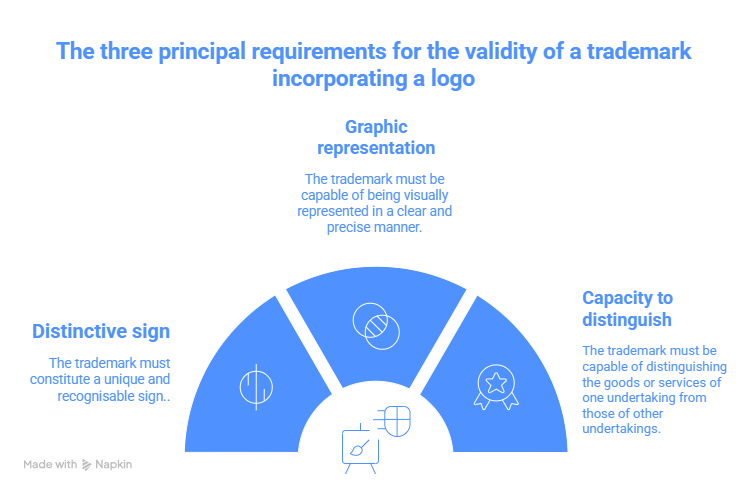
For a figurative trademark to be considered valid and registered, it must meet several cumulative conditions.

Distinctiveness

Distinctiveness is the primary requirement; the trademark must allow consumers to identify the commercial origin of a product or service. It should not be descriptive, generic, or purely functional.
An arbitrary or stylized logo, unrelated to the products/services, generally presents strong distinctiveness. However, a graphic representing the product itself or an expected feature of the product is rarely considered distinctive.

Legality and public order

As shown in Article L711-3 of the French Intellectual Property Code, the trademark must not be contrary to public order or morals. It must also be lawful and not infringe on existing rights (e.g., personality rights, state arms, international agreements).

Availability

A figurative trademark cannot be registered if identical or similar prior trademarks already exist in the same product or service classes. Thorough searches for prior rights are essential before filing.

conditions validity trademark

Jurisdictional illustrations of refusals or acceptances: the Mercedes-Benz Group AG v. EUIPO Case (Case T 400/24) of March 19, 2025

Facts

In this case, Mercedes-Benz sought to register Image1as an EU trademark (EUTM no. 018805110) representing an off-road vehicle driving up a slope, for products in Class 12 (vehicles, spare parts, tires) and Class 18.

However, the EUIPO partially refused the application due to a lack of distinctiveness for products in Class 12. The Board of Appeal upheld this refusal on the grounds that the sign represented a typical image of an off-road vehicle in a situation and did not contain any distinctive elements to indicate commercial origin to consumers.

EUIPO Tribunal decision

In its decision of March 19, 2025 (Case T 400/24), the EUIPO Tribunal rejected Mercedes-Benz’s appeal, confirming that the sign lacked distinctiveness under the EU Trademark Regulation 2017/1001.
In its reasoning, the Tribunal recalled case law stating that a sign closely inspired by usual representations of the product itself can only be considered distinctive if it deviates significantly from the visual norms of the sector. The drawing in question was not sufficiently different from the usual representations of an off-road vehicle for the relevant public to associate it with a particular commercial origin.

The simplicity and generic nature of the image reinforced the absence of distinctiveness, even though the target public pays attention to the concerned products.

Scope of the decision

This decision illustrates the high level of distinctiveness required for figurative trademarks representing the product or its expected performance.

A drawing that merely represents the product in a conventional or generic manner, without sufficiently unique or unusual elements, is likely to be deemed devoid of distinctiveness and thus ineligible for registration as a trademark.

Strategies to Maximize the Validity of Your Figurative Trademark

Here are some best practices based on practical experience and case law:

Design an original visual sign: A drawing or logo that deviates from usual product/service representations makes registration easier.

Combine distinctiveness and creativity: Unusual stylization, distinctive graphic elements, or a unique composition enhance distinctiveness.

Conduct a prior search: Before filing, an exhaustive search of existing trademarks (both verbal and visual) reduces the risks of opposition or refusal.

Consider multiple filings: Filing both a verbal trademark and a semi-figurative trademark can strengthen protection, especially for trademarks that rely on both a logo and a name.

Conclusion

Not all figurative trademarks are automatically valid. Their legal validity primarily depends on their distinctiveness, compliance with public order, and availability relative to prior rights. A generic or overly descriptive logo will often be refused registration, while an original and distinctive design will result in solid protection.

To ensure successful registration and safeguard your rights, it is essential to create a strong visual sign and conduct the necessary checks before filing.

Dreyfus & Associés assists its clients in managing complex intellectual property cases, offering personalized advice and comprehensive operational support for the complete protection of intellectual property.

Dreyfus & Associés works in partnership with a global network of attorneys specializing in Intellectual Property.

Nathalie Dreyfus with the support of the entire Dreyfus team

Q&A

1. Is a simple logo always valid as a figurative trademark?
No, it must also be distinctive and non-descriptive to be registrable.

2. Can a figurative trademark be refused for reasons other than lack of distinctiveness?
Yes, it can be refused if it contravenes public order, is already used by another party, or does not meet the conditions of representability or legality required by law.

3. Can I modify a figurative logo already filed?
Any significant change generally requires a new filing.

4. Is a drawing very similar to an existing one valid?
No, if it creates similarity with a prior trademark, registration may be refused or the act annulled.

5. Can a color alone constitute a figurative trademark?
Yes, but the color must be specifically claimed and presented with international codes (e.g., Pantone).

This publication is intended to provide general guidance to the public and highlight certain issues. It is not intended to apply to specific situations or constitute legal advice.

Read More

Court-appointed expert witness and IP: the strategic asset for asset security

In an economic landscape where corporate value is increasingly derived from intangible assets, intellectual property (IP) litigation is becoming significantly more complex. The increasing judicialization of business, coupled with the technical intricacies of emerging digital challenges (Web3, AI, Data), imposes a requirement for absolute rigor upon legal practitioners. For international lawyers, General Counsels, and decision-makers, relying on standard technical support is no longer sufficient; it has become imperative to collaborate with professionals whose competence is recognized and validated by the highest jurisdictions.

It is in this context that the dual status of Court-Appointed Expert to the Cour de cassation (French Supreme Court – Specialization: Trademarks) and Expert to the Paris Court of Appeal (Specialization: Trademarks, Designs & Models) assumes its full strategic dimension. Beyond the honorific title, it represents a probative methodology and an anticipatory vision of judicial risk that are placed at the service of corporate strategy. This qualification offers reinforced legal certainty, which is essential for preserving the professional liability of legal counsel and ensuring the enforceability of rights holders’ assets.

expert judiciaire et propriete intellectuelle

The status of court-appointed expert: a guarantee of technical excellence and ethics

Inclusion on the lists of judicial experts is not a mere administrative formality. It is the culmination of a drastic selection process, validating indisputable technical competence and absolute moral probity.

Being a Court-Appointed Expert to the Cour de cassation constitutes the highest level of recognition for a legal technician in France. This implies that the highest court in the French judicial order recognizes the expert as an authority in their specialization. Similarly, accreditation by the Paris Court of Appeal, the central jurisdiction handling the vast majority of IP litigation in France, attests to a proven practice in complex cases.

For the lawyer or the final client, collaborating with a Court-Appointed Expert offers three major guarantees, indispensable to the solidity of a file:

  1. Independence: The expert is bound to total objectivity, a pledge of credibility when establishing reports or audits.
  2. Technical Competence: Mastery of the most specific aspects of the matter (distinctiveness, likelihood of confusion, revocation, materiality of infringement).
  3. Ethics: Strict adherence to the guiding principles of the trial, notably the adversarial principle (due process), which permeates their entire practice, even in advisory roles.

You may verify these official registrations via the justice directories:

The added value of the judicial expert in the lifecycle of IP rights

A common misconception is that the Court-Appointed Expert only intervenes once litigation has arisen. On the contrary, it is precisely upstream, in the daily management of portfolios, that the judicial expert’s mindset provides superior legal certainty. Each act is performed with the perspective of its future enforceability before a tribunal.

Audit and availability searches: the judge’s eye before the trial

A standard availability search lists potential obstacles. A search conducted with “the eye of the Court-Appointed Expert” qualifies the risk with the perspective of the magistrate. The expert, accustomed to enlightening tribunals, understands how trial judges appreciate in concreto the similarity of signs or goods and services.

When analyzing your trademark availability searches, we do not merely apply theoretical criteria. We evaluate the probability that a judge would retain a likelihood of confusion, integrating the most recent jurisprudential trends. This allows for the elimination of false positives (theoretical risks that are judicially weak) and the identification of genuine litigation risks, thus protecting the company against future nullity actions.

Filings and procedures: procedural rigor at the service of protection

The solidity of an industrial property title is determined at the moment of its filing. A poorly drafted specification or imprecise classification constitutes a breach into which the opposing party will step during a nullity or revocation action.

The practice of pathological litigation teaches us a contrario how to draft robust wordings. We anticipate arguments of non-use or lack of distinctiveness. This preventive approach is at the heart of our trademark law practice, where each class is weighed to withstand the “fire” of judicial proceedings, guaranteeing maximum enforceability of the title. This is essentially legal engineering designed to preclude future vulnerability.

Management and valuation: credibility in audits (M&A)

In the context of Mergers & Acquisitions (M&A) or fundraising, the valuation of IP assets is critical. The intervention of an Expert appointed to the Cour de cassation to audit a portfolio provides a major “trust signal” to investors and auditors.

The financial valuation of trademarks requires rigorous methodology (relief from royalty method, excess earnings method, etc.) which the judicial expert masters perfectly for regular presentation before the courts. This rigor secures the valuation and strategy and minimizes the risks of liability warranties, thereby protecting the professional liability of the business lawyers managing the transaction.

Surveillance and defense: qualifying infringement with precision

Online brand enforcement often generates significant “noise.” Distinguishing between a minor infringement and a substantiated counterfeiting case requiring immediate action is crucial for cost control and defense strategy.

The Court-Appointed Expert possesses the necessary acuity to detect the constitutive elements of infringement (identical reproduction, imitation, risk of association) and to compile a body of probative evidence. This precise qualification allows for advising on the most adapted gradual response, from the cease-and-desist letter to the seizure (saisie-contrefaçon), avoiding reckless threats that could lead to liability for disparagement.

The synergy between lawyers and IP attorneys in complex litigation

The success of intellectual property litigation often rests on the alliance between the procedural strategy of the lawyer and the technical analysis of the Trademark Attorney (CPI). When a specialized lawyer collaborates with a CPI holding the status of Court-Appointed Expert, they significantly reinforce the probative value of their file.

This technical collaboration materializes at several levels:

  • Expert Consultation (Party-Appointed Expertise): Even before the introduction of proceedings, we can draft an independent technical consultation. Although produced at the request of a party, the signature of an Expert appointed to the Cour de cassation confers major technical weight upon the document. This report serves to objectify technical facts and provides the lawyer with robust arguments for their pleadings, which can be pivotal in IP litigation advice.
  • Assistance during Saisie-Contrefaçon (Seizure): The preparation of the motion and assistance to the Bailiff during operations require surgical precision to avoid the nullity of the official report. Judicial expertise ensures scrupulous respect for the limits of the court order and the accurate description of material facts.
  • Validity Analysis and Counterclaims: In a defense strategy, we assist the lawyer in identifying technical flaws in the opposing party’s patent or trademark (prior art, lack of novelty, descriptiveness) to construct a solid counterclaim for nullity.

This synergy allows for the delivery of a “turnkey” file to the judge, where law and technique articulate perfectly, maximizing the chances of success.

FAQ: The judicial expertise in practice

What is the difference between a Party-Appointed Expert and a Court-Appointed Expert?
The Court-Appointed expert is designated by the judge to enlighten the tribunal on a technical question with total impartiality. The Party-Appointed expert is retained by one of the parties. However, when the party expert also holds accreditation from the Cour de cassation or Court of Appeal, their private consultation benefits from superior moral and technical authority. They remain bound by their ethics and duty of rigor, which confers greater probative force to their analysis than a simple technical note.

How does judicial expertise secure a trademark financial valuation in an M&A context?
The financial valuation of intangible assets is often contested by tax authorities or during shareholder disputes. The judicial expert applies standardized methodologies recognized by the courts. Their valuation report is argued, documented, and justified point by point. In the event of an audit or post-acquisition litigation, this report constitutes a master piece of evidence to justify the transfer price, thus protecting executives and their legal counsel.

Can we retain a Court-Appointed Expert for a private consultation before litigation starts?
Yes, and it is highly recommended. Retaining a Court-Appointed Expert for a pre-litigation consultation allows for an objective assessment of the chances of success of an action (analysis of the materiality of infringement, validity of the title). This enables the lawyer and client to define the best strategy: settle, attack, or withdraw. It is an indispensable risk management tool to avoid long, costly, and uncertain proceedings.

What is the role of the expert during a saisie-contrefaçon?
During a seizure, the Bailiff describes what they see, but they do not always possess the technical competence to identify specific elements of infringement, particularly in complex fields (software, designs). The expert assisting the Bailiff guides them to ensure that the seized evidence corresponds exactly to the judge’s order, thus avoiding out-of-scope seizures that could lead to the nullity of the report.

Why trust Dreyfus Law Firm

Dreyfus Law Firm is not merely a firm of Trademark Attorneys; it is a reference in Intellectual Property and Digital Law.

Founded by Nathalie Dreyfus, Expert to the Cour de cassation and Expert to the Paris Court of Appeal, the firm combines the agility of a dedicated team with the power of a global network. Our transversal approach allows us to accompany lawyers and legal departments across the entire value chain: from filing strategy to aggressive defense of rights on the Internet (Domain names, UDRP, Phishing) and in the physical world.

Choosing Dreyfus means choosing the security of technical expertise recognized by the highest French jurisdictions to protect your most valuable assets and secure your litigation strategies.

Are you a lawyer or General Counsel looking to secure the technical aspect of a complex file?

Contact us for a confidential analysis of your issues.

Dreyfus & Associés is a partner of a global network of lawyers specializing in Intellectual Property.

Read More

Filing a plant variety right in the European Union: what comprehensive legal and administrative checklist should be followed to secure your rights?

Introduction

The protection of plant varieties is a major strategic issue for breeders, seed companies, research institutes and investors. Within the European Union, the plant variety right (PVR) provides a harmonised, demanding and highly technical legal framework. Certain mistakes—often made prior to filing—may result in the definitive loss of rights.

It was Regulation (EC) No. 2100/94 of 27 July 1994, known as the Basic Regulation, which established at EU level a specific system for the protection of plant varieties, referred to as the Community Plant Variety Protection system (CPVP).
This system provides for the grant of a single intellectual property title: the Community Plant Variety Right (Community PVR), issued by the Community Plant Variety Office (CPVO), the sole authority competent at EU level for implementing this protection system.

Unlike national plant variety rights, which are granted by national offices and are strictly limited in territorial scope to the State concerned, the Community plant variety right allows, through a single filing, the securing of exclusive rights covering the entire European market.

The purpose of this article is to provide a comprehensive, structured and chronological checklist designed to anticipate risks and to effectively secure an application for plant variety protection within the European Union.

Ensuring, at an early stage, that the variety is eligible for protection

Before taking any steps, it is essential to verify that the variety in question actually meets the conditions for protection under EU law. Above all, the variety must result from a characterised breeding activity, excluding any mere discovery.

Beyond this initial assessment, attention must focus on compliance with the fundamental criteria for protection: novelty, distinctness, uniformity and stability.
Novelty requires that the variety has not been commercialised, with the breeder’s consent, beyond the authorised time limits prior to filing. Even limited or indirect marketing may be sufficient to destroy novelty.
Distinctness means that the variety must be clearly distinguishable from any other known variety at the filing date, by at least one relevant and observable characteristic.
Uniformity requires that the plants constituting the variety show sufficient consistency in the expression of their characteristics, taking into account the mode of reproduction.
Stability, finally, means that the essential characteristics of the variety remain unchanged after repeated propagation or at the end of each cycle of reproduction.

These criteria are assessed globally as part of the technical examination conducted by the CPVO. The absence of any one of them is sufficient to justify rejection of the application.

In practice, novelty is very often the main point of concern. Any marketing activity, even on a limited scale, occurring prior to filing may lead to an irreversible loss of rights. Field trials, exchanges of plant material or inadequately controlled technical communications are frequently at the origin of subsequent difficulties.

conditions plant variety certificate

Securing ownership of the plant variety right from the outset

Ownership of rights is a central issue in the plant variety protection procedure. It is essential to identify precisely the breeder in the legal sense, whether a natural person or a legal entity.

Where the variety results from collective work involving employees, industrial partners or research institutes, an in-depth analysis of the contractual relationships is required. Employment contracts, collaboration agreements or research conventions may contain decisive clauses regarding ownership of results. In the absence of prior clarification, the applicant exposes itself to subsequent claims likely to seriously weaken the protection.

Formal requirements for filing

The preparation of the filing dossier should not be treated as a mere administrative formality. It requires the collection of precise and consistent technical information relating to the variety, its origin and its breeding method.

The filing dossier notably includes:
the full identity of the breeder and, where applicable, its representative,
the exact botanical designation of the variety,
the proposed variety denomination, compliant with European rules,
a detailed technical questionnaire specific to the species concerned.

Particular care must be taken with the variety denomination. This is subject to specific rules, distinct from trademark law, and must allow clear, stable and non-misleading identification of the variety. A poorly chosen denomination may give rise to objections, delay the procedure or result in refusal.

Applications before the CPVO may be filed in several official EU languages; however, English remains the preferred working language.
Representation by a specialised advisor helps to avoid formal irregularities likely to delay the procedure.

Filing the application and conduct of the procedure before the CPVO

Once the application has been filed and the fees paid, a formal examination is carried out before the technical examination phase is opened. This phase involves the designation of a competent examination office for the species concerned, responsible for carrying out the distinctness, uniformity and stability tests.

The choice of this office may have a significant impact on the duration of the procedure and on subsequent technical exchanges. In addition, the timely submission of plant material in accordance with the required conditions is a critical step. Any failure in this respect may result in rejection of the application or a substantial extension of time limits.

The DUS Examination: a lengthy and decisive phase

The DUS examination lies at the heart of the plant variety protection procedure. It is based on in-depth comparative tests, generally spread over several growing cycles.
In practice, this examination is entrusted to an authorised examination office competent for the species concerned, in accordance with Article 55 of the Regulation.

The examination generally involves:
• the supply of compliant plant material,
• trials conducted over one or more growing cycles,
• strict adherence to a timetable, which varies depending on the species and the filing period.

The duration of the examination depends in particular on the growing season applicable to the variety. In practice, the full procedure most often extends over two to three years, or even longer for certain perennial species.

At this stage, objections may be raised if the variety appears insufficiently distinct from existing varieties or if difficulties are identified in terms of uniformity or stability.

This phase requires rigorous technical preparation and anticipation of the examination office’s expectations. An incorrect assessment of the criteria or insufficient documentation may lead to failure, sometimes after several years of proceedings.


Applicants outside the European Union: key regulatory points of attention

Where the applicant is established outside the European Union, additional regulatory constraints must be taken into account at an early stage of the project. The transfer of plant material into the EU may be subject to strict phytosanitary rules, specific customs formalities and, depending on the country of origin and the species concerned, prior authorisations.

Furthermore, certain States apply particular restrictions on the export of biological resources or specific tax regimes likely to affect the circulation of plant material or the structuring of financial flows.
Failure to anticipate these aspects may result in delays, unforeseen costs or even prevent continuation of the procedure. A prior analysis of the applicable regulatory, customs and tax constraints is therefore essential.

Anticipating common errors and international coordination

Among the most frequent errors are:
premature disclosure of the variety; strict traceability of the first uses of the variety is therefore essential,
• a non-compliant or conflicting denomination, making it necessary to conduct a thorough availability search prior to filing, not only in respect of existing variety denominations but also relevant prior rights,
• poor coordination between national, European and international filings.

The filing of a community plant variety right is only one component of an international protection strategy. It must be coordinated with systems in place in third countries that are members of the International Union for the Protection of New Varieties of Plants (UPOV), which, although based on common principles, present significant national specificities.

Poorly managed timing between initial commercialisation, Community filing and filings in third countries (United States, Latin America, Asia, Africa) may lead to irreversible loss of protection in strategic territories.

Conclusion

Filing a plant variety right in the European Union requires a rigorous approach, combining law, agronomic expertise and economic strategy. A comprehensive legal and administrative checklist is the most effective tool to secure the breeder’s rights and optimise the long-term valorisation of the variety.

Dreyfus & Associés is in partnership with a global network of lawyers specialising in Intellectual Property.

Nathalie Dreyfus with the assistance of the entire Dreyfus team

Q&A

1.What is a Community plant variety right (CPVR)?
A Community plant variety right is a unitary intellectual property title granted by the Community Plant Variety Office (CPVO). It confers on its holder an exclusive right to exploit a new, distinct, uniform and stable plant variety throughout the entire territory of the European Union.

2.What is the difference between a national plant variety right and a Community plant variety right?
A national plant variety right has effect only within the territory of the State that granted it. By contrast, a Community plant variety right provides uniform protection in all EU Member States through a single filing, making it the preferred option for breeders targeting the European market as a whole.

3.What do the DUS tests carried out as part of the procedure involve?
DUS tests are designed to verify that the variety is distinct, uniform and stable. They are conducted by authorised examination offices and focus on specific technical characteristics. These tests may extend over several growing cycles and represent the longest and most technical stage of the CPVR procedure.

4.When should an application for plant variety protection be filed?
Ideally, before any commercialisation or public disclosure likely to affect the novelty of the variety.

5.Can a variety be protected both by a plant variety right and a trademark?
Yes, but these protections serve different purposes. The variety denomination is subject to specific rules and must not be confused with a commercial trademark.

6.How long does the plant variety protection procedure take?
The duration varies depending on the species, but the DUS examination generally extends over several years.

7.What happens in the event of an error regarding ownership of rights?
An ownership error may lead to claims, disputes or, in some cases, invalidation of the plant variety right.

8.Can an applicant outside the EU apply for a European plant variety right?
Yes, but the applicant must anticipate the phytosanitary, customs and regulatory rules applicable to the export of plant material into the European Union.

This publication is intended to provide general guidance to the public and to highlight certain issues. It is not intended to apply to specific situations nor to constitute legal advice.
Read More