Data

What strategies should you use to secure your intellectual property rights in the digital age?


As the world becomes increasingly digital, it is important to understand how to protect your intellectual property rights. Intellectual property is an asset that can be protected and controlled, but it requires the right strategies to do so. In the digital age, there are various strategies you can use to protect your intellectual property rights.


The first, and most important, strategy to secure your intellectual property rights is to register your intellectual property with the appropriate government body. Depending on the country, this may be a copyright registration, patent registration, or trademark registration. By registering your intellectual property, you are ensuring that your rights are legally binding and can be enforced in the event of infringement. Another strategy to protect your intellectual property rights is to use effective contracts.


If you are working with someone else on a project, it is important to have a contract in place that outlines each party’s rights and responsibilities in regards to the intellectual property. This will help ensure that each party is aware of and respects the other’s rights. In addition, you can also use technological tools to protect your intellectual property rights. For example, you can use digital rights management (DRM) software to help prevent unauthorized use of your intellectual property. DRM software can help protect your intellectual property from unauthorized access and copying, as well as from piracy.


Finally, you should be aware of the laws that apply to intellectual property in your jurisdiction. There are various laws and regulations that apply to intellectual property, such as copyright laws and trademark laws. By understanding these laws, you can ensure that you are taking the necessary steps to protect your intellectual property rights.


By following these strategies, you can help ensure that your intellectual property rights are protected in the digital age. It is important to understand the laws that apply to intellectual property and to use effective contracts and technological tools to protect your rights. Additionally, registering your intellectual property is essential to legally enforce your rights. By taking the necessary steps to protect your intellectual property, you can help ensure that your rights are respected and protected in the digital age.


We offer our clients a dedicated and unique experience of expertise that is necessary for the exploitation of intangible assets.  We will also endeavor to keep you informed and up-to-date about intellectual property and digital economic issues through our articles and newsletters written by the Dreyfus Legal Team.

Read More

What Are the Pitfalls of Not Having IP Protection?

Intellectual property (IP) is a valuable asset that can help businesses grow and protect their investments. Without adequate IP protection, businesses are vulnerable to having their ideas and inventions stolen or copied without any legal recourse. This article will discuss the pitfalls of not having IP protection in place and the importance of having it.


The first major pitfall of not having IP protection is that your ideas and inventions are open to theft or copying by someone else. Without a registered trademark or patent, anyone can use your ideas or inventions and claim them as their own. This could mean that someone else is profiting off of your hard work and creativity, while you receive nothing in return.


Additionally, if your ideas or inventions are widely stolen or copied, it can hurt your reputation as an innovator and make it difficult to differentiate yourself from the competition. Another pitfall of not having IP protection is that you may be unable to stop others from using your ideas or inventions. If you don’t have a registered trademark or patent, you can’t legally stop others from using your ideas or inventions without your permission.


This means that anyone can take your ideas and sell them, or use them as part of their own product or service, without your consent. Finally, not having IP protection can also lead to costly legal disputes. If someone does use your ideas or inventions without your permission, you may need to take legal action in order to stop them. This can be a costly and time-consuming process, and you may be unable to recoup any of the money or effort you lost due to the infringement.


In conclusion, it’s important to have IP protection in place in order to protect your ideas and inventions. Without IP protection, you may be vulnerable to theft or copying of your ideas or inventions, unable to legally stop others from using them, and may have to take legal action in order to protect your rights.


We offer our clients a dedicated and unique experience of expertise that is necessary for the exploitation of intangible assets.  We will also endeavor to keep you informed and up-to-date about intellectual property and digital economic issues through our articles and newsletters written by the Dreyfus Legal Team.

Read More

What Are the Pros and Cons of Web 3.0 Law?

Metaverse, virtual world, Web 3.0The advent of Web 3.0 has ushered in a new era of digital law, and it has become important for businesses and individuals to understand the implications of this new legal landscape. Web 3.0 law, also referred to as “smart contract” law, is a type of technology-based law that governs the use of digital assets and transactions. It is an incredibly important development in the world of intellectual property law, as it presents both opportunities and risks for businesses and individuals.


The primary benefit of Web 3.0 law is that it allows for the secure and seamless transfer of digital assets. Smart contracts are self-executing contracts that use blockchain technology to securely and anonymously store and transfer data. This increases the security and reliability of digital transactions, and makes them more efficient and cost-effective.


Furthermore, Web 3.0 law can help to protect intellectual property rights, as it allows for the secure tracking and control of digital assets. However, there are some potential drawbacks to Web 3.0 law. For one, it can be difficult to enforce, as the technology is still relatively new and there is not yet a unified legal framework.


Additionally, smart contracts are not always legally enforceable, meaning that parties may have difficulty obtaining legal recourse should a dispute arise. Furthermore, Web 3.0 law can be quite complex, and it is essential that businesses and individuals have a clear understanding of how it works in order to ensure that their legal rights are protected.


Overall, Web 3.0 law presents both opportunities and risks for businesses and individuals. It is an important development in the world of intellectual property law, and it is essential that businesses and individuals have a clear understanding of its implications. With the right knowledge and guidance, businesses and individuals can take advantage of the opportunities offered by Web 3.0 law while mitigating the risks.


We offer our clients a dedicated and unique experience of expertise that is necessary for the exploitation of intangible assets.  We will also endeavor to keep you informed and up-to-date about intellectual property and digital economic issues through our articles and newsletters written by the Dreyfus Legal Team.

Read More

Legal Watch : THE UDRP PROCEDURE

CYBERSQUATTINGThe UDRP PROCEDURE is designed to deal with cases of abusive cybersquatting.

Since the implementation of the General Data Protection Regulation and, more generally, when domain names are registered anonymously, it is often difficult to identify the enemy that we intend to strike.

The issue can be solved through filing a UDRP complaint. This is what happened to the US company Capital Distribution Consulting Inc. As the owner of the semi-figurative trademark Royal dragon superior vodka 5X distilled, the company filed a complaint against the anonymously registered domain name <royaldragonvodka.com>.

Once the procedure was initiated, the identity of the registrant was revealed. The latter was a certain Mr. X, who was an officer of Horizons Group (London) in the United Kingdom and the owner of the UK trademark Royal dragon vodka.


In fact, it turned out that both parties obtained their trademarks through a transfer carried out by Dragon Spirits Limited in Hong Kong, of which Mr. Bharwani was one of the shareholders.
This information gave rise to further exchanges between the parties, each accusing the other of having obtained the trademark unlawfully. In particular, the complainant argued that the transfer to the defendant had taken place after the liquidation of the transferee.

The facts reported in this decision are particularly complex and all-encompassing, which indicates that the UDRP is not the appropriate forum for this kind of litigation.
The expert reported that the complainant filed an additional response, which is not provided for in the Regulation, after the defendant’s response and then a second response 9 days later. This response contained 15 annexes, including a sales agreement, court orders, share transfers, a declaration relating to the liquidation procedure, etc.

The expert decided not to accept this response and consequently not to consider the defendant’s request to reply in case these submissions were accepted.
The expert pointed out that this case does not concern a simple case of cybersquatting but rather a competition matter, involving trademarks being registered around the world.

He noted that trademark rectification proceedings based on competition grounds have been granted or are still pending in different jurisdictions. Therefore, the domain name in question is fully in line with this broader dispute. The expert recalled that the Guiding Principles of the UDRP are not designed to settle all kinds of disputes that would have any link with domain names. On the contrary, the Guidelines establish an inexpensive and streamlined administrative procedure being limited to ‘abusive cybersquatting’ cases.
This decision serves as a reminder that it is essential to obtain as much information as possible about the disputed domain name that forms the subject of a procedure. For relatively old names such as <royaldragonvodka.com> being registered in 2011, valuable information can be found through consulting the Whois history of the domain name.


WIPO, Arbitration and Mediation Center, Case No. D2021-2871, Nov. 24, 2021, Capital Distribution Holding Inc. v. Hiro Bharwani, Horizons Group (London) Ltd.

Read More

The Public Interest Registry creates an institute specialized in the fight against DNS abuse

lutte anti DNSThe Public Interest Registry (PIR), registry for the .org top-level domain, launched the domain name system Abuse Institute on February 17, 2020. The purpose is to help protect Internet users from the threat of domain name system abuse.

The institute’s mission includes helping to identify and report DNS abuse, establishing best practices in the area of domain name system abuse and funding domain name system research.

The Institute’s activities cover three main areas:

Innovation: Developing best practices for registries and registrars and funding research on cyber security and domain name system abuse;

Education: Through the development of a library of available information and practices;

Collaboration: The Institute will operate as a networking forum and sharing centre for stakeholders interested in these issues.


A hotline has also been created to assist registries and registrars with questions about DNS abuse.


Sources :

https://dnsabuseinstitute.org/about-the-dns-abuse-institute/

Read More

What are the suggested modifications to the UDRP?

UDRP principlesFollowing the UDRP ‘s new gTLD program, new Rights Protection Review Mechanisms (RPM) have been implemented to protect trademark holders, such as the Uniform Rapid Suspension System (URS) procedure.


ICANN has now decided to address changes suggested by trademark holders and intellectual property experts regarding the UDRP. For instance, one of these suggestions is that a domain name should be considered abusive if it is registered OR if it is used in bad faith, instead of requiring that both these conditions are met. The idea is to lighten the burden of proof on the rights owner to take into account a more up-to-date reality. Another suggestion is to provide for an accelerated procedure in case of abusive conduct and to get a decision more rapidly if the defendant fails to respond to the complaint.


It has also been proposed to provide for a presumption of bad faith if the registrant has lost three UDRP complaints and to require any repeat offender to pay a response fee to defend the case. The central issue at this stage of the study is to understand the extent to which the UDRP principles should be changed in favour of trademark owners, while knowingt hat it may weaken the UDRP principles.


Sources:

Overview: The Rights Protection Mechanisms (RPM) Review https://newgtlds.icann.org/en/reviews/cct/rpm

Phase: 1 Initial Report of the Review of All Rights Protection Mechanisms in All gTLDs Policy Development Process :

https://www.icann.org/public-comments/rpm-initial-report-2020-03-18-en

Read More

Why does the willingness to sell a domain name is not conditioned on an active approach? 

Télévision netflix (OMPI, Centre d’arbitrage et de médiation, 23 février 2021, affaire n° D2020-3322, Netflix Inc. c. WhoisGuard, Inc. / Siddharth Sethi)


Avons-nous encore besoin d’introduire Netflix ? Cette plateforme proposant des services de streaming vidéo compte 195 millions de membres dans plus de 190 pays et semble être connue dans le monde entier. Pourtant, certaines personnes tentent de se soustraire à cette notoriété pour tenter de se construire une légitimité artificielle et justifier l’enregistrement d’un nom de domaine .


En effet, alors que la société Netflix détient de nombreux enregistrements dans le monde pour le signe « NETFLIX » en tant que marque , la société a détecté l’enregistrement du nom de domaine <netflix.store> . En conséquence, elle a déposé une plainte auprès du Centre d’arbitrage et de médiation de l’OMPI pour obtenir son transfert.

Le nom de domaine, enregistré le 3 septembre 2017, pointe vers une page qui présente une animation composée d’un effet d’éclatement de couleur et se termine par un écran de couleur vierge.
Le titulaire soutient que le nom de domaine ne reproduit pas la marque NETFLIX mais est plutôt composé de deux termes , “net” et “flix”. Or, comme prévu, l’expert considère que la marque NETFLIX est reproduite à l’identique dans le nom de domaine.
L’expert considère que si l’utilisation du nom de domaine n’est pas commerciale, son enregistrement ne serait pas non plus considéré comme légitime. En effet, le site mis en place vise à légitimer l’enregistrement afin de dissimuler l’intention de vendre le nom de domaine au Plaignant. Ni la reproduction de la marque NETFLIX dans le nom de domaine litigieux, ni l’extension <.store> n’ont de sens si le projet devait effectivement être non commercial.


En conséquence, il estime que l’intimé n’a aucun droit ou intérêt légitime sur le nom de domaine .
Par ailleurs, l’expert constate que le Défendeur connaissait le Plaignant et son activité et prévoyait qu’en achetant le nom de domaine, il serait en mesure de le revendre au Plaignant avec un bénéfice significatif. Cette stratégie a été partiellement couronnée de succès, car Netflix a fait une offre que l’intimée a refusée, essayant d’obtenir une somme considérablement plus élevée.

Or, l’enregistrement d’un nom de domaine qui correspond à la marque d’un Plaignant avec l’intention de le vendre au Plaignant lui-même , établit la mauvaise foi. L’expert précise que le titulaire « [n’aurait pu] raisonnablement penser qu’un tiers serait en mesure d’utiliser commercialement le Nom de domaine litigieux ». Il convient également de noter que l’intimé a tenté de faire croire à la personne qui l’a contacté qu’il avait reçu d’autres offres plus élevées. En effet, le représentant de Netflix, qui n’avait pas indiqué qu’il agissait pour Netflix, ce qui était un secret de polichinelle, avait proposé la somme de 2 000 USD, que le déclarant jugeait trop faible.

L’expert commente ce comportement récurrent de certains cybersquatteurs : « Peu importe que le Défendeur n’ait pas proposé activement à la vente le Nom de domaine litigieux. Il n’est pas rare que des déclarants opportunistes de noms de domaine incluant une marque tierce attendent d’être approchés, réalisant qu’une offre active de vente du nom de domaine peut faciliter un procès UDRP à leur encontre ».

En conséquence, l’expert conclut que le nom de domaine litigieux a été enregistré et est utilisé de mauvaise foi et ordonne ainsi son transfert au Plaignant.

Sauf dans les cas où un nom de domaine reproduisant une marque notoire telle que NETFLIX est utilisé à des fins de critique sans usage commercial, ou pour un usage commercial minimal, il est quasiment inconcevable d’imaginer qu’un tel nom de domaine ait pu être enregistré de bonne foi . Netflix savait évidemment qu’elle gagnerait le procès, mais a visiblement choisi d’essayer de négocier un rachat à l’amiable pour un budget légèrement inférieur à celui d’une procédure UDRP, si l’on compte les 1 500 USD d’honoraires et les honoraires d’avocat. Cette approche, si elle réussissait, aurait permis d’économiser du temps et de l’argent, mais la simple offre de rachat a pour effet d’encourager le cybersquattage.

Read More

What are the new cookies regulations?

The Regulation (EU) 2016/679 of the European Parliament and of the Council of 27 April 2016 on the protection of natural persons with regard to the processing of personal data and on the free movement of such data, and repealing Directive 95/46/EC (General Data Protection Regulation) affects how you, as a website owner, can use cookies and online tracking of visitors from the European Union.

Wednesday March 31, 2021 was the very last limit set by the National Commission for Informatics and Freedoms (Cnil), for French advertisers to comply with European rules relating to cookies.

From Thursday, April 1, 2021, the banner on websites is required to enable much more explicitly Internet users to “refuse” these computer tracers much more explicitly.

This is one of the measures voted in 2016 by the European Union in the General Data Protection Regulation (GDPR) and entered into force in May 2018 in all 28 (now 27) member states.

When they browse the web or use mobile applications, Internet users are increasingly followed by various actors (service editors, advertising agencies, social networks, etc.) who analyze their browsing, their movements and their consultation or consumption habits, in particular in order to provide them with targeted advertising or personalized services.

This tracing is carried out by means of various technical tools, tracers, of which cookies are a part.

Cookies are small pieces of text inserted into your browser while you are browsing the web.

There are various types of cookies and have multiple uses: they can be used to remember your customer ID with a merchant site, the current content of your shopping cart, the language of the web page, an identifier allowing to track your navigation for statistical or advertising purposes, etc.

They are a source of concern for many users, while others are not even aware of their existence apart from the mandatory pop-ups on all websites that ask you to Accept cookies“.

If you are a website owner, it is important that you make sure that the management of cookies and consent on your site complies with the very strict requirements of the GDPR.

In France, the National Commission for Informatics and Liberties (CNIL) carries out numerous checks and issues sanctions for non-compliance with the GDPR and French legislation.

Your website is required under the EU’s General Data Protection Regulation (GDPR) to allow European users to control the activation of cookies and trackers that collect their personal data.

This is the essential point of consent to the use of cookies according to the GDPR – and the future of our digital infrastructures.

The CNIL reminds that the consent requirement provided for by these provisions refers to the definition and the conditions provided for in Articles 4 and 7 of the GDPR.

It must therefore be free, specific, enlightened, unambiguous and the user must be able to withdraw it, at any time, with the same simplicity with which he has granted it.

In order to remind and clarify the law applicable to the deposit and reading of tracers in the user’s terminal, the CNIL adopted guidelines on September 17, 2020, supplemented by a recommendation aimed in particular at proposing examples of modalities consent collection practices.

Consent must be manifested by a positive action of the user, informed beforehand, in particular, of the consequences of his or her choice and having the means to accept, refuse and withdraw his or her consent. Appropriate systems must therefore be put in place to collect consent in practical ways that allow Internet users to benefit from easy-to-use solutions.

Acceptance of general conditions of use cannot be a valid method of obtaining consent.

The CNIL will therefore now carry out checks to assess compliance with the rules relating to tracers, in application of article 82 of the Data Protection Act and articles 4 and 7 of the RGPD on consent, as summarized in its guidelines.

Through this action, the CNIL intends to meet the expectations of Internet users who are increasingly sensitive to Internet tracking issues, as evidenced by the constant complaints it receives on this subject.

If breaches are noted following checks or complaints, the CNIL may use all the means made available to it in its repressive chain and issue, if necessary, formal notices or public sanctions.


The evolution of the applicable rules, clarified by the guidelines and the recommendation of the CNIL, marks a turning point and progress for Internet users, who will now be able to exercise better control over online tracers.

Dreyfus can assist you in the management of your trademarks portfolios in all countries of the world. Do not hesitate to contact us.

Read More

How does the bad faith duplicate between registration and bad faith use?

UDRPWhile one generally refers to the “three criteria” of the UDRP (a trademark similar to the domain name; the absence of rights or legitimate interests of the defendant in the disputed domain name; and the bad faith of the registrant), it should be kept in mind that bad faith in UDRP matters has two aspects: the first is bad faith registration and the second is bad faith usage. Therefore, proving only one of these elements is insufficient even though it may be considered “fair” that a name used in bad faith should be transferred to the applicant.
In the present case, Great American Hotel Group, Inc. complained that its former vice-president retained the domain name <greatamericanhg.com> and changed the password of the account used to manage this name with the registrar.

It all started in 2011 when the applicant decided to adopt the name Great American Hotel Group. Its president at the time asked Mr. Greene, then vice-president of the company, to reserve the domain name <greatamericanhg.group>.
The latter did so, but – apparently without notifying his superior – reserved the domain name in his name instead of that of the company. He did, however, record the company’s postal address, and pay with the company card. In 2012, he hired an anonymity service to hide his data.

Since its registration, the name had been used for the company and Mr. Greene had always treated the domain name as part of the company’s assets.

However, following disagreements, Mr. Greene was suspended from office in 2015 and dismissed in 2016. In 2017, the name was renewed by the company’s technical teams even though Mr. Greene was no longer present. However, the latter subsequently changed the password so that the name could no longer be renewed by the company. The applicant’s counsel proceeded to send Mr. Greene a letter of formal notice, which remained unanswered, leading to the filing of a UDRP complaint.

The panellist acknowledged that the applicant had common law trademark rights through the use of the sign “Great American” and that the registrant did not have any legitimate rights or interest in the name as it was created for the applicant company.
He also acknowledged that the domain name was used by Mr. Greene in bad faith.

Nevertheless, the panellist was more sceptical regarding the issue of bad faith registration. Indeed, the name had been reserved by Mr. Greene at the request of the president of the applicant company, which, in principle, had, in fact, been a registration in good faith.

In order for registration by an employee to qualify as having been done in bad faith, the panellist specified that the employee must have, from the beginning, had “an intention to cause harm”. Therefore, the evaluation must be factual and done on a case-by-case basis.

In this case, Mr. Greene had registered the domain name in his own name. The panellist found that “this may be subject to questioning, and the fact that he did not mention the company does not constitute a good domain name management practice”, however, the president and the company seemed to be equally as uninterested in formalizing the reservation of the name.

For four years, until he was suspended from his functions, the registrant had always displayed conduct that demonstrated that he understood that the name belonged to the company. Thus, there is no reason to suppose that by reserving the name four years earlier, he had intended to compete with the applicant or to benefit from some type of tactical advantage against him.

Consequently, the plaintiff’s complaint was dismissed as the registration in bad faith had not been established. Nevertheless, the panellist specified that the applicant could turn to other avenues to try to obtain relief.

The significance of this decision, in addition to highlighting the dual condition of bad faith, is that it reiterates the need to set up an internal naming charter to avoid any dispersion of assets, both in terms of trademarks and domain names.

Read More

How to protect your brands in the digital era?

brand protectionIntellectual property was viewed with passion – and in a style steeped in pre-Romanticism! – as “the most sacred, the most legitimate, the most unassailable […], the most personal of properties”; “The least likely to be contested, the one whose increase can neither hurt republican equality, nor overshadow freedom,” said Patrick Tafforeau in his book Intellectual Property Law published in 2017.

It should be borne in mind that intellectual property is protected by law. This protection is notably achieved through patents, copyright and trademark registrations. These intellectual property rights allow creators to obtain a certain form of recognition or even a financial advantage from their inventions, plant varieties or creations.

In this sense, paragraph 1 of article L111-1 of the Intellectual Property Code provides that: “The author of a work of the mind enjoys on this work, by the sole fact of his creation, of an exclusive and  intangible property right enforceable against all”.

In fact, the Internet has created tremendous opportunities for companies in terms of communicating their brand message. However, its global reach, openness, versatility and the fact that it is largely unregulated are all elements that have created fertile ground for trademark infringement such as counterfeiting.


For a long time, real world activity and Internet activity were separated. Today, the two worlds undeniably tend to come together. Trademark law is therefore very useful in defending yourself in the digital era. By appropriately balancing the interests of innovators with those of the general public, the intellectual property system aims to foster an environment conducive to the flourishing of creativity and innovation.

When you create a company or launch a product, know that it is recommended to protect your trademark (which can be the name of your company, a logo, numbers, letters, etc. …). This registration will protect your company from counterfeiting.

Once registered, the trademark is an industrial property title which gives you a monopoly of exploitation for a period of ten years, renewable indefinitely.

Registering your trademark gives you an exclusive right to a sign that distinguishes the products or services you offer from those of your competitors, which is a significant competitive advantage ! As such, your sign is protected for the categories of goods and services referred to in your trademark registration and in the territory for which said registration is accepted.

In this perspective, it is necessary to put in place a strategy for the protection of your brand as soon as possible. Before filing a trademark, it is important to make sure that it is available and that there is no owner of an earlier right to that trademark. You must therefore be the first to register this mark.

The reasons why trademark registration is becoming a necessity are multiplying in the face of the phenomenon of cybersquatting. Thus, owners of registered trademarks benefit from new advantages in the defense of their rights on the Internet.


First, it has become increasingly important to protect your brand on social media. Since 2009, Facebook has allowed its members to create usernames, easily accessible, but which can include brands. Prior to 2009, Facebook allowed registered trademark owners to identify their trademarks and prevent their use by other members.

Most social networks register user names on a “first come, first served” basis. In order to defend your rights, it is preferable to have a registered trademark in order to report a violation of trademark rights, according to the general conditions of use of social networks.


Secondly, the presence of a mark on the Internet also imposes its protection in referencing on search engines and in particular paid referencing. Through the AdWords system, Google allows advertisers to select keywords so that their ads will appear to Internet users after entering those words into a search. Conflicts arise when advertisers buy keywords that contain brands, but do not have rights to them.

Owning a trademark right then also becomes extremely useful in the fight against unfair practices.


Thirdly, the proliferation of new gTLD domain name extensions must also attract the attention of trademark owners. To date, more than 300 new gTLDs have been delegated, and gradually hundreds more will follow. Faced with the risk of conflicts with protected trademarks, a new tool is made available to trademark rights holders: The Trademark Clearinghouse. It is a centralized declarative database of registered trademarks. Once the trademark is registered, the holder benefits from the priority registration period for new gTLDs – Sunrise Period – and is notified when a third party wishes to register a domain name identical or similar to its trademark. The registrant of the disputed domain name is also informed that he may infringe trademark rights.


Finally, if a domain name reproducing or containing a trademark is registered, the trademark rights holder has the possibility of taking action against cybersquatters using dedicated extrajudicial procedures such as the Uniform Rapid Suspension (URS) and the Uniform Domain Resolution Policy (UDRP). These dedicated procedures are only open to trademark holders.

It should be remembered that the business landscape has changed with the rise of the Internet and, in order to thwart the risks of intellectual property infringements on online markets, it is important that companies adapt their management of industrial property rights portfolio accordingly.


Nathalie Dreyfus – Industrial Property Attorney, Expert at the Paris Court of Appeal, Founder & Director of Cabinet Dreyfus in Paris – Dreyfus.fr

Dreyfus can assist you in the management of your trademarks portfolios in all countries of the world. Do not hesitate to contact us.

Read More

Can ICANN provide a solution for IT security problems?

website securityThe DNS NEWS report No. 271 highlights the overall criticism of ICANN solution for not intervening as much as its powers allow in Internet security issues, even though the DNS breaches do not decrease the number of hits. A sort of criticism derives from this observation: should ICANN become a kind of Internet welfare state or should it remain in the background, which would be recommended by the defenders of Internet neutrality.


It should be noted that in 2018, ICANN solution had already undertaken measures to make the Internet a little more secure, by changing the cryptographic key used to protect the Internet’s address book, the DNS (Domain Name System). However, further efforts are expected.
Domain Name System. – V. ICANN, 16 sept. 2018, Approved Board Resolutions [ R]egular Meeting of the ICANN Board).


Source: Dns-news.fr, date, rapp. n° 271, 


To discover…

♦ ICANN Summit: the fight against DNS abuse, a GAC priority


Read More

The creation of a data access system Whois by ICANN

Since the advent of the General Data Protection Regulations (GDPR), it has become really difficult to obtain information about the registrant of a domain name. This obviously complicates the dialogue between trademark and domain name holders.


ICANN has proposed a project to create a System for Standardized Access/Disclosure (SSAD), which would allow standardized access to non-public data on domain name registrations.
The objective of the SSAD is to provide a predictable, transparent, efficient and accountable framework for access to non-public registration data. It must also be consistent with the GDPR.
However, the decision whether or not to grant requests would still belong to the registrars, as legal constraints on personal data may vary from country to country.


This project accelerated in August during Stage 2 of the policy development process, during which a final report was presented that provides 22 recommendations for the system.
The creation of this SSAD could, in the coming years, facilitate the fight against cybersquatting, which has been strongly impacted by the GDPR and WhoIs anonymization processes. It should be remembered that the next round of requests for domain name extensions should take place in 2023, bringing a whole new set of challenges in the fight against Internet attacks.


Source: LexisNexis, N°1 (January 2021)

Read More

Domain names in <.suck> : between attack to brand image and freedom of expression

Sources: Domain Incite, Free speech, or bad faith? UDRP panels split on Everything.sucks domains, Oct. 22, 2020:

Free speech, or bad faith? UDRP panels split on Everything.sucks domains


Mirapex.sucks, Case n° 103141, 2020-06-29 : https ://udrp.adr.eu/adr/decisions/decision.php ?dispute_id=103141
Bioderma.sucks, Case n° 103142, 2020-07-01 : https ://udrp.adr.eu/adr/decisions/decision.php ?dispute_id=103142DNS News No. 270, Oct. 2020

The top-level domain name extension <.sucks> was open for registration by ICANN in 2015. At the time, some brands were already concerned about the risk of cybersquatting on these extensions, and the possible damage to the brand image that this could generate. In fact, many domain names that use trademarks known and ending in <.sucks> were born. Very often, these domain names refer to pages where Internet users can complain about the brand in question, whether they are consumers or former employees.

During the past months, the phenomenon has intensified with a lot of reservation numbers, clearly done by the same registrar of the domain name in <.sucks>. Suddenly, new online pages have emerged, with the same structure and bad comments about renowned brands. A system of resale at prices between $199 and $599 is also in place.
The question of the dispute resolution about the <.suck> is complex, since the situation raises issues relating to freedom of expression.

Two recent cases with two opposite outcomes illustrate this complexity. The domain names <mirapex.sucks> and <bioderma.sucks> were both registered by the same registrar and are both the subject of UDRP complaints. In response to these two complaints, the defendant based his argument on freedom of expression. For <mirapex.sucks>, the complaint was unsuccessful, on the contrary, for <bioderma.sucks>, the name transfer was ordered.

In the case of <bioderma.sucks>, the expert had taken into consideration the fact that the registrar didn’t use the domain name for bad comments on the trademark in question but was simply a third party who registered the domain name seeking to resell it. The reseller was a company located in the Turks and Caicos Islands whose activity is the purchase and resale of names in <.sucks>. The latter had no way of verifying if the bad comments were authentic. Especially because those comments seemed to have been added only after the complaint was filed.

On the other hand, in the decision on <mirapex.sucks>, reserved by the same company, the transfer was refused. The expert gave special attention to the nature of the <.sucks> and to the freedom of expression, while underlining the insufficiency of the argumentation of the applicant.
One thing is sure: prevention is better than cure, therefore it would preferable to register a brand in the extension <.sucks>, on a purely defensive basis.

Read More

The opportunity to add a registered domain name to the complaint after the filing

domain nameIf Virgin Enterprises Limited (“Virgin”) was notably known by the French public as a megastore on the Champs Elysées, now permanently shut down; the company, on the contrary, is still very active in many different sectors such as travel, under the Virgin Voyages brand, or even in the mobile sector under the Virgin Mobile brand. As we all know, success is often followed by harm. Having detected the registration of domain names by a third party taking over its brands, namely <virgincruisevoyages.com>, <virginmediabiz.com>, <virginmobilewifi.com>, Virgin has filed an UDRP complaint against these names, July 23, 2020.

On the day the complaint was notified, July 27, the name <govirginvoyages.com> was registered and the applicant added it to his complaint. The expert reminds that a complaint can indeed cover several names, if they are registered by the same person or under the same name or under a common control.

In order to accept the request for consolidation, the expert takes in consideration the following elements:
* the names <govirginvoyages.com> and <virgincruisevoyages.com> that refer to identical sites and the same email contact;

* the registrant of the name <govirginvoyages.com> has the same first name as the registrant of of <virgincruisevoyages.com>, <virginmovilewifi.com> and <virginmediabiz.com>.

Thus, it seems possible to add a reserved name to a complaint after the filing.

Subsequently, the expert was able to conclude without difficulty that there was no legitimate interest of the defendant and bad faith. The defendant did not respond to the complaint.

All names resolved to sites copying those of Virgin and two of them, in particular, <virgincruisevoyages.com> and virginmobilewifi.com> were used in the context of fraud, aimed at “obtaining public information for commercial gain”. In addition, the registrar already used, in the past, other domain names related to Virgin’s brands. The expert said that “the use of some of the domain names involved in conducting an e-mail phishing scam is the type of illegal activity that is clearly considered to be the proof of bad faith”. This decision also highlights the need to be vigilant when mail servers – also known as “servers MX” – are set on a domain name. When such servers are set up, the reservee can send to anyb0ody e-mails from an address that includes the domain name, and endanger the company and its consumers; just checking if a website is in place on the names cybersquatted is not enough.

In this case, each single name was associated with a fake site and two of them had in addition a mail server that was carrying an e-mail fraud campaign. Thus, would be preferable to set up adequate surveillance on the company’s brands and to carefully analyze those, which are closest to the brand in order to take the right actions once the registration is detected.


Source: WIPO, Arbitration and Mediation Center, Oct. 23, 2020, aff. D2020-1921, Virgin Enterprises Limited v. Aladin Chidi, NA / Aladin Tg.

Read More

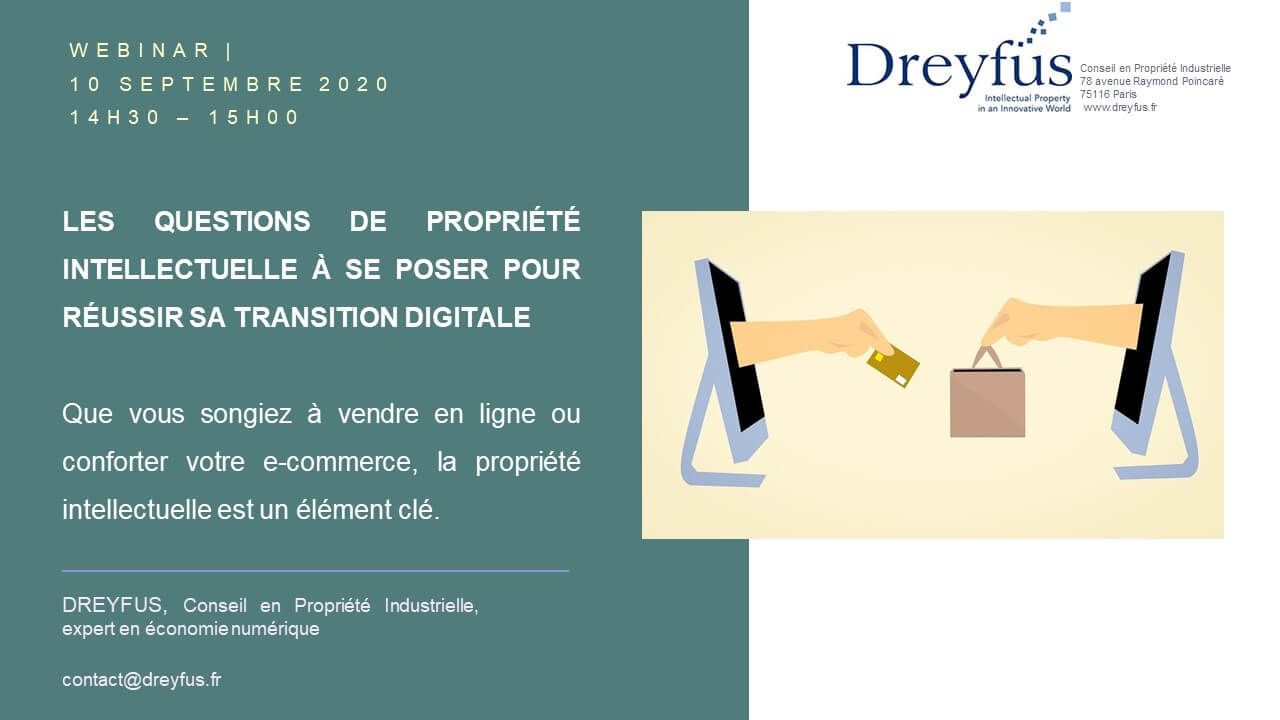
Webinar – Intellectual property questions for a successful digital transition

Webinar September 10, 2020 :

Intellectual property questions for a successful digital transition


How to secure and optimize your website? What precautions to take? How to defend your intellectual property rights on the Internet?

When you want to succeed in your digital transition, you have to ask yourself certain questions.

Whether you are thinking of selling online or strengthening your e-commerce, intellectual property is a key element.


Webinar replay


Read More

Data protection : what are today’s real issues?


Consumers are now demanding more privacy and security in t he processing of their personal data.

What are the challenges for the data controller?

There are several challenges for the data controll

er – i.e. the legal or natural person who determines the purposes and means of a processing operation – to overcome at different scales:

information management: reducing the data collected by establishing a precise commercial context, and reducing the risks by taking care of the contracts;

communication with suppliers: being able to find solutions and evaluate each other;

monitoring of data processing: setting up mechanisms for reporting data breaches or threats concerning suppliers (for example, if Easyjet has had a data breach, the data controller, operating in the same business sector as the airline, if notified, can redirect its decisions.


What are the risk management methods?

A more effective risk management includes precise identification of suppliers, prior audits when integrating new suppliers, automation of evaluation and control processes, and risk prevention to protect data.

What about cookies?

They are used to collect data. Their presence is materialized by the banners you find on websites that ask for your consent to collect certain data.

In summary, there are 3 types of cookies:

– cookies strictly necessary for the operation of the site;

– cookies intended to improve the performance and functionality of the site;

– advertising cookies (which will soon disappear, Firefox has already put an end to them, and Google has announced that Chrome will no longer use them in 2021).

How do I collect online consent?

Remember that in France, consent must be free, specific, informed and unambiguous (GDPR).

Nevertheless, in order to collect consent, the user must understand what he is consenting to. He must receive clear information (purpose and duration of the use of cookies, list of third parties with whom the information is shared etc…) and the data controller must be particularly attentive to the layout of his banner.

What should be the role of the DPO (Data Protection Officer) in a modern company?

If the company promotes ethics, innovation, data, then the DPO has a key role: they shed light on data collection, and bring their vision on risks from an individual’s point of view.

In the past, their role was purely administrative, but today it is different, the DPO accompanies the company on a permanent basis, but they cannot guarantee compliance on their own: they have to expand a web within the organization (with the digital or marketing departments in particular) in order to promote the essential principles.

What changes are taking place within companies, in terms of GDPR awareness?

When GDPR came into force, programs were launc

hed to raise awareness of it, , and it was necessary to mobilize the entities and ensure they had good skills (setting up e-learning internally, for example).

Despite the existing similarities in legislation, what differences persist and what are the challenges that companies have to face in this respect?

There are technical differences (in terms of data retention time, each country has its obligations) and very important cultural differences, the way in which people in different countries deal with these subjects depends on their history. Consequently, it is difficult to find “golden rules” (= harmonized rules).

How can organizations benefit from their compliance efforts?

One way to recognize that companies have done their job properly is through certifications, such as HDS certification.


Dreyfus helps you to comply with these new legislations.


Read More