Marques

How trademarks can make or break your M&A transaction

Corporate value increasingly resides in intangible assets. Trademarks, which concentrate brand identity, market recognition and consumer trust, are often among the most poorly documented assets in a transaction. Fragmented portfolios, outdated ownership records, incomplete chains of title, undisclosed disputes: the pitfalls are numerous and can, at best, weigh on valuation, and at worst, block the deal or trigger costly post-closing litigation.

Dreyfus & Associates regularly advises on IP due diligence in M&A transactions, fundraising rounds, and carve-outs. This article sets out the key risk areas and best practices to ensure trademarks become a transaction enabler rather than an obstacle.

1. Trademarks as high-stakes assets in M&A

More than a logo: what a trademark actually represents in a deal

A trademark is not a graphic element. It is the legal foundation that makes brand value transferable, enforceable against third parties, and defensible in court. In a transaction, trademarks perform three simultaneous functions: they secure market access (the registered owner can enforce its rights), they underpin financial valuation (royalty and excess profits methods apply to registered rights), and they condition operational continuity after closing, particularly for access to e-commerce platforms.

A well-structured trademark portfolio can transform a standard investment into a high-value strategic asset. Conversely, the absence of protection or undisclosed conflicts can trigger a significant price reduction or cause the transaction to collapse entirely.

Further reading: Should an Investment Fund Hold Trademark Rights?.

Portfolios carry history, and all its imperfections

Even well-known brands accumulate administrative inconsistencies over time. Years of renewals, entity restructures, and local agent practices create divergence between what internal teams believe they own and what official registers actually show. The most common issues are:

  • registrations in the name of dissolved or absorbed entities, without formal assignment
  • outdated addresses or company names on national registers
  • marks appearing active on internal schedules that have in fact lapsed
  • filings made by previous teams no longer aligned with the current structure
  • incomplete chains of title, leaving the enforceability of certain rights uncertain with respect to third parties

These anomalies slow due diligence, complicate recordal execution, and can block access to online marketplaces, which require up-to-date certificates matching the current legal owner.

2. Trademark due diligence: what to actually check

Verify the official register, not just the seller’s schedule

Standard practice is to rely on trademark schedules provided by the seller. This is not enough. Rigorous IP due diligence requires direct verification against official registers (INPI, EUIPO, WIPO, USPTO, and national offices in priority markets) to cross-reference data and identify discrepancies.

Ten areas to verify systematically:

  • Portfolio completeness, covering word marks, device marks, transliterations and product- or market-specific filings. See: Trademark Prior Art Searches
  • Ownership, confirming the correct legal entity is on record in every jurisdiction and identifying any legacy or dissolved entities. See: IP Rights on Business Closure
  • Registration status, confirming each registration is active and not subject to cancellation proceedings for non-use, which may be initiated after five years of lack of genuine use following the date of registration.
  • Renewal deadlines, checking expiry dates, payment status and any imminent deadlines
  • Oppositions and disputes, mapping open oppositions, cancellation actions and pending litigation
  • Key market coverage, coverage in current priority markets and those targeted for future expansion
  • Coexistence and licensing agreements, reviewing restrictions, territorial limits and obligations that may constrain post-closing strategy
  • Digital asset alignment, ensuring domain names, marketplace accounts and social handles match the legal trademark owner. See: Domain Name Portfolio Audit
  • Specification and Nice classes, verifying goods and services descriptions are aligned with actual and planned business activities
  • Similarity and dilution risks, identifying crowded spaces, third-party marks and risks for future enforcement

Further reading: How to Conduct IP Due Diligence | IP Asset Valuation and Strategy.

Align diligence with the business plan, not just the asset inventory

The central question is not “which trademarks exist?” but “do these trademarks allow the business plan to be executed?”. A target market without coverage, a product extension blocked by a coexistence agreement, or a mark exposed to cancellation risk: each of these factors can materially affect strategy and valuation.

The analysis must incorporate: planned expansion markets, post-closing product categories, potential rebranding plans, and platform distribution constraints.

3. Timeline management: two clocks that never synchronise themselves

Legal closing ≠ commercial operability

Legal teams optimise for signing and closing. Commercial teams optimise for launch. Trademark work sits between the two, and the gap is rarely managed proactively.

A portfolio may transfer legally yet be operationally unusable if ownership is not updated on registers, coexistence constraints are not mapped, or key markets lack enforceable rights. It is common for M&A teams to request a “quick trademark check” late in the process. Work that normally requires weeks of careful analysis is then compressed into hours, dramatically heightening the risk that material issues go undetected.

Recordals: sequence for speed

Once the transaction closes, ownership recordals must be filed across all relevant jurisdictions. Some require notarisation or apostille; others impose sequential multi-step chains where several historic entities are involved. Each step must be prioritised based on commercial urgency.

Best practices:

  • identify priority jurisdictions early based on the commercial launch schedule
  • combine recordal steps (assignment + address change in a single filing) to reduce cost and delay
  • budget for multi-step chains in portfolios spread across historic entities
  • flag dependencies to cross-functional teams before timelines are fixed

4. Post-closing governance: turning a fragmented portfolio into an operational asset

An M&A transaction is also an opportunity to reset IP governance. Trademarks are cross-functional assets: they concern legal, marketing, R&D, e-commerce, and finance. Without clear ownership and rules, fragmentation quickly returns.

Key governance steps after closing:

  • establish a clear IP policy defining filing, use, and approval rules for trademarks across the combined entity
  • centralise portfolio management in a single system with renewal alerts and dispute tracking
  • train commercial, marketing, and e-commerce teams on proper trademark use and infringement risks
  • implement continuous monitoring to detect infringements against the post-acquisition brand
  • align digital assets (domain names, marketplace accounts, social handles) to the new legal owner without delay

On the financial valuation of intangible assets in a transaction context: The Role of AI in IP Asset Valuation Strategy.

Conclusion: Put trademarks on the critical path

In every M&A transaction, trademark rights deserve to sit on the critical path, not to be treated as a trailing administrative task. The risks are real: delays, unplanned costs, blocked markets, post-closing disputes. So are the opportunities: a well-audited and properly structured portfolio strengthens valuation, secures the closing, and accelerates operational launch.

Dreyfus & Associates advises legal departments, investment funds, and M&A teams on comprehensive IP due diligence, assignment structuring, recordal management, and post-closing IP governance. With a network of over 500 partner firms across 50+ countries, we provide international coverage commensurate with the scale of your transaction.

Q&A

Why are trademarks so often overlooked in due diligence?

Because they are perceived as secondary assets compared to financial or operational ones. In reality, a poorly documented mark (incomplete chain of title, lapsed registration, undisclosed dispute) can block a closing, generate significant additional cost, or restrict post-acquisition commercial freedom.

What is a chain of title in trademark law?

A chain of title traces all successive transfers of a trademark from its original filing to the current owner. Each assignment must have been formally documented and recorded on official registers to be enforceable against third parties. An incomplete chain can invalidate enforcement actions in a number of jurisdictions.

Can a trademark be transferred separately from the business?

Yes. Under French and European law, a trademark can be assigned independently of the business to which it is attached. This flexibility is particularly valuable in carve-out or partial business disposals. The assignment must be formalised in writing and registered with the relevant offices (INPI, EUIPO) to be enforceable against third parties.

How long do recordals take?

Timelines vary considerably by country: a few weeks in well-equipped jurisdictions (US, EU), several months in more complex jurisdictions (parts of Asia or Latin America). Some require notarisation or apostille, extending the process further. This is why recordals must be anticipated before closing, not queued as a post-closing task.

What is a trademark vulnerable to cancellation for non-use?

Under French and EU law (Article L. 714-5 of the CPI; Article 58 of the EUTMR), a trademark may be cancelled if it has not been put to genuine use for an uninterrupted period of five years. In an M&A context, an acquirer may discover that certain portfolio marks are exposed to this risk, materially affecting the scope of the rights being transferred. See: IP Expert and Strategic Asset Security.

Read More

Understanding the Declaration of Use in Argentine Trademark Law: A Comprehensive Guide

In Argentina, the robust protection of intellectual property rights, particularly trademarks, hinges significantly on procedural compliance. One such critical procedural requirement is the filing of a Declaration of Use, which plays a pivotal role in the lifecycle of a trademark.


This guide delves into the nuances of this requirement, its implications for trademark holders, and the associated legal and administrative processes.

The Legal Imperative of the Declaration of Use

Under Argentine trademark law, every trademark holder is obliged to file a mid-term affidavit of use, known as the Declaration of Use, between the fifth and sixth anniversaries of the trademark’s registration. This declaration serves as a key checkpoint to ensure that trademarks registered in the country are actively utilized in commerce.


The failure to comply with this requirement has significant repercussions. Primarily, the Trademark Office (TMO) will not approve any renewal applications for the trademark until the Declaration of Use has been appropriately filed for the registration period in question. This mechanism ensures that only those trademarks that are actively used continue to enjoy the legal protections afforded by registration.


Contents and Submission of the Declaration

The Declaration of Use involves submitting a written statement that lists the goods and/or services for which the trademark has been actively used over the past five years. This list should encompass all products or services that fall within the trademark’s scope of protection, potentially extending to related goods or services even in different classes or those used as a commercial designation.


It is crucial to note that at the time of this filing, the Patent and Trademark Office (PTO) does not require evidence of actual use. The primary goal is to receive a formal declaration from the trademark holder. However, should the declaration not be submitted timely, it triggers a rebuttable presumption of non-use. This does not automatically lead to the expungement of the registration but makes the trademark vulnerable to cancellation actions. Such actions can be initiated by third parties demonstrating a legitimate interest or by the PTO itself.

Concurrency with Renewal and Potential Penalties

The Declaration can also be filed concurrently with the trademark’s renewal application. In such cases, it must be submitted immediately before the renewal application and through a specific process tailored for each class involved. If the declaration accompanies a renewal, additional annual official fees are imposed.


Be aware that submitting a false declaration, whether due to error or fraud, can precipitate cancellation proceedings. These proceedings can be initiated by any third party with a legitimate interest and are adjudicated through a judicial process, underscoring the importance of accuracy and honesty in the filing.

Fees and Administrative Details

The cost of filing the Declaration of Use is relatively modest. There is a fee per trademark, per class and a late filing during the grace period.

Documentation Requirements

To file the Declaration of Use, certain documents are essential:


  • Power of Attorney (PoA): A notarized and legalized PoA, signed by an authorized representative, must be submitted. This can be legalized via an Apostille or directly at the Argentine Consulate. Although a scanned copy of the PoA suffices for initial deadlines, the original should be available upon request by the TMO.
  • List of Goods/Services: A detailed list of the goods and/or services associated with the trademark usage over the last five years must be provided. This documentation should comprehensively cover the trademark’s scope of protection and related commercial uses.


Conclusion

The Declaration of Use is a fundamental element of trademark law in Argentina, ensuring that trademarks are not merely registered but actively employed in commerce. By adhering to these requirements, trademark holders can safeguard their rights and maintain the integrity of their brands in the Argentine market.

At Dreyfus Law Firm, we understand the complexities of trademark law in Argentina. Our experienced team provides comprehensive legal support to ensure that your Declaration of Use is filed accurately and on time, protecting your valuable trademark rights. Trust us to navigate the intricacies of Argentine trademark law, ensuring your intellectual property remains secure and enforced.


Join us on social media !

LinkedIn  

Instagram

FAQ

1. What is a declaration of use in Argentine trademark law?

A declaration of use in Argentina is a formal statement filed by the trademark owner confirming that the registered mark is being used in the country. This declaration is required to maintain the validity of the trademark after the fifth year of registration.

2. When must a declaration of use be filed for a trademark in Argentina?

Trademark holders must submit the declaration of use between the 5th and 6th year after registration. Failing to file on time may result in fines or the cancellation of the trademark.

3. What are the consequences of not filing a declaration of use in Argentina?

If the declaration of use is not submitted within the required time frame, the trademark may be subject to cancellation or other administrative penalties, potentially compromising the owner's rights.

Read More

Outsmarting Dupes: Essential Strategies to Protect and Enhance Your Trademarks


In an increasingly globalised world, companies are faced with a growing problem: dupes. Dupes have become an increasingly prevalent phenomenon in the field of intellectual property, especially in trademark and design enforcement.

A dupe is a product inspired by an original product that attempts to capture the look, style and even the packaging of the original product, without being an exact reproduction. Duplicate” is neither a reproduction nor an imitation or copy. Unlike counterfeiting, which illegally reproduces a protected brand, dupes often play in legal grey areas. They use names, logos or packaging that evoke the original without copying them directly. In fact, the aim of the dupe manufacturer is not to make people believe that his articles are those of the brand from which he takes his inspiration, but to capture the attention of consumers by following in the footsteps of the trademark owner, without however copying exactly the distinctive elements of that brand.


How can companies effectively protect their trademarks and innovations in an environment where dupes exploit legal grey areas without explicitly breaking intellectual property laws?


Dupes can seriously compromise companies’ revenues by offering low-cost alternatives. While some consumers knowingly buy an imitation, many others are fooled by the striking resemblance into believing they are buying a genuine product for less.


However, the quality of these ‘inspired products’ is often much lower than that of the originals, which can seriously damage the reputation of the original trademark. When consumers associate the poor quality of dupes with the genuine trademark, this can lead to a decline in trust and loyalty.


Pursuing legal action against dupe manufacturers is often a complex and expensive process. It requires considerable resources, both in terms of time and money, but it is essential to protect trademarks and maintain their integrity in the marketplace.

A few strategies to counter the harmful effects of dupes


In order to secure your trademark rights, it is essential to set up active market surveillance in order to quickly detect dupes. To do this, it is advisable to use online monitoring tools that can identify imitations on e-commerce platforms, social networks and other distribution channels. These sophisticated monitoring systems can provide immediate alerts if suspicious products are detected, enabling a rapid and appropriate response.


It is also essential to ensure that your trademarks and designs are properly registered and protected in all the territories in which you operate. This protection must include not only trademarks, but also copyrights and patents, where applicable. This may involve registering and protecting your packaging as a trademark. Distinctive and unique packaging can be legally protected, strengthening the defence against dupes. Well-designed and protected packaging can deter imitators and facilitate legal action against them. Protecting packaging also helps to maintain brand integrity and image.


Working with other companies to fight counterfeiters can also be very effective. Partnerships can include sharing information about counterfeiters and taking joint action to put pressure on online sales platforms to remove adverts for counterfeit products. Cross-sector cooperation can enhance the effectiveness of anti-counterfeiting measures.


Finally, it is advisable to implement traceability technologies such as QR codes or RFID (radio frequency identification) chips to enable consumers to check the authenticity of your products. These technologies can also help track and identify dupe distribution points. Increased traceability improves product transparency and safety, while making it easier to take action against counterfeiters.

Conclusion

Dupes represent a major challenge for businesses, but with a proactive strategy and concrete actions, it is possible to protect your trademarks and minimise their negative impacts. By combining market surveillance, legal protection, consumer education and the use of advanced technologies, you can strengthen the defence of your intellectual property.

Join us on social media!

LinkedIn  

Instagram


Read More

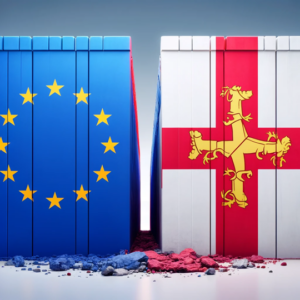
The Changing Landscape of EU Trademarks and Their Coverage of Jersey


EU trademarks (EUTMs) serve as a cornerstone for businesses within the European Union, allowing for a unified approach to trademark protection across diverse jurisdictions. This harmonized system not only simplifies procedures but also ensures consistent legal safeguards against infringement, essential for brand integrity across the EU’s expansive market.


Jersey’s Unique Position

Jersey, while geographically close to Europe, maintains a distinct legal and economic relationship with the EU. This unique position affects various aspects, including intellectual property rights and specifically, the applicability and enforcement of EU trademarks on the island. Understanding this unique relationship is critical for businesses and legal practitioners navigating the realm of trademark protection in Jersey.


Key Changes Affecting EU Trademark Protection in Jersey

In a declaration of March 2024, as part of the consultation on primary trademark legislation, the Government of Jersey set out the position regarding the protection of European Union Trademarks (EUTMs) under the Trademarks (Jersey) Law 2000 (TMJL).

The protection of EU trademarks in Jersey has undergone significant changes, particularly highlighted by the legal landscape shift post-April 2009. Initially, Jersey’s Trademarks (Jersey) Law 2000 facilitated automatic protection for European Union Trademarks (EUTMs) on the island. However, with the repeal of the Community Trademark Regulation in 2009 and subsequent lack of amendments to Jersey’s law to align with new EU regulations, the automatic protection for EUTMs was discontinued. This change marks a critical juncture, emphasizing the need for businesses to actively seek protection within Jersey’s jurisdiction.

In its declaration, the Government of Jersey also set out its position on the protection of international trademarks through the Madrid Protocol under the Trademarks (Jersey) Law 2000 (TMJL), stating that while international trademark registrations protected in the UK under the Madrid Protocol are “automatically protected in Jersey without the need for re-registration locally by virtue of Article 13 of the TMJL and the definition of a protected international trademark in Article 1 of the TMJL”; international (EU) trademark designations, on the other hand, “are not (and have never been) automatically protected in Jersey because they do not fall within the scope of the definition of protected international trademark in Article 1 of the TMJL and, therefore, do not benefit from the protection afforded by Article 13 of the TMJL”.


Consequences for Holders of EU Trademarks

The Government of Jersey set out that holders of an EUTM could obtain trademark protection in Jersey by re-registration of a trademark first obtained in the United Kingdom (this includes so-called ‘comparable UK trademarks’).


This pivotal shift from automatic to non-automatic protection for European Union Trademarks (EUTMs) underscores the evolving nature of trademark law in response to broader regulatory changes. It requires businesses and legal practitioners to be more vigilant and proactive in their intellectual property strategies.

The cessation of automatic EU trademark protection in Jersey poses new challenges and necessitates European businesses to adopt new adaptation strategies, including a thorough reassessment of current trademark portfolios with an eye towards securing or extending protection through the UK re-registration process. This proactive approach ensures continued safeguarding of intellectual property rights within Jersey’s unique legal framework.


The Importance of Legal Advice

Now more than ever, specialized legal advice is crucial. Intellectual property lawyers and industrial property attorneys with expertise spanning Jersey and EU jurisdictions offer invaluable guidance, helping businesses navigate the complexities of the new trademark landscape effectively. This legal support is essential for aligning trademark strategies with current regulations, ensuring ongoing compliance and protection.


Conclusion: Looking Forward in Trademark Protection for Jersey

The future of trademark protection in Jersey will be shaped by ongoing legal developments and the strategic responses of businesses and legal practitioners. Staying informed, adaptable, and proactive is key to navigating these changes successfully. As the legal framework continues to evolve, fostering a deep understanding of both Jersey-specific and broader EU trademark regulations will be indispensable for securing and maintaining robust trademark protection.


Dreyfus & associés partner with an international network of Intellectual Property attorneys

Have your say: Follow us on social networks!

LinkedIn

Instagram 

Read More

Plagiarism of art by fashion: inspiration or violation of intellectual property?

In a world where the lines between different artistic disciplines are becoming increasingly blurred, fashion designers often draw inspiration from art to bring their collections to life or to promote their brands.


This issue echoes the recent dispute between the brand Zadig&Voltaire and artist Julian Charriere over a promotional video for the brand that features a flaming fountain, similar to the one captured by the artist in his “And Beneath it all Flows Liquid Fire” video in 2019.


Many fashion designers are inspired by works of art to create their collections and advertising campaigns. However, some of them cross the line and copy the work of established artists almost exactly, without giving them the credit they deserve. This practice is not only ethically questionable, but can can also be harmful to the original artists in terms of violating their intellectual property (“IP”) rights.


  1. Legal issues of intellectual property in fashion and art


Copyrighting protects original works of the mind, whether they are literary, musical, graphic, plastic or photographic creations. Fashion designers may be tempted to take inspiration from a work of art to design a new piece or an advertising campaign, but it is essential to consider the legal issues related to IP.


Plagiarism, or mindless copying of a work, is a violation of copyright. In the case of fashion, it can mean using a work of art without permission to create prints, patterns or even the shape of a garment. If the copying is obvious, the original artist can sue for damages.


The fine line between fashion and art is even more blurred as many luxury brands have launched their own art foundations such as the Cartier Foundation or the Louis Vuitton Foundation.


However, it is important to note that copyright does not protect ideas, only their expression. Thus, taking inspiration from a work of art in order to create a fashion piece is not necessarily illegal, so long as the creation is suitably original and does not directly copy the work in question. Additionally, some artists occasionally can collaborate with fashion designers, such as Louis Vuitton, who recently worked with Japanese artist Yakoi Kusuma to produce a new collection as well as to transform the Louis Vuitton store in Paris, now decorated with a monumental silhouette of the artist.


  1. Consequences of intellectual property infringement


IP infringement can have negative consequences for artists and the fashion industry.


Plagiarism robs original artists of recognition and fair compensation for their work. When a piece of work is copied without permission, the original artist is not credited or paid for their work. This can lead to a loss of income for artists, causing them to abandon their creative work or settle for less than their talent.


In addition, intellectual property infringement hinders innovation in the creative industry. When artists are not rewarded for their work, it can discourage innovation and the creation of new works. Companies that copy original works do not need to devote resources to research and development of new ideas, as they can simply copy those of others.


Finally, intellectual property infringement can have a negative impact on the brand image of companies that engage in this practice. Consumers are increasingly aware of the importance of ethics and corporate social responsibility. When a company is accused of plagiarism or intellectual property infringement, it can damage its brand image and consumer confidence in the company.


In summation, the phenomenon of plagiarism of art by fashion raises complex questions and considerable stakes, both artistically and legally. The line between inspiration and copying can sometimes be unclear, and the fashion industry seems to navigate these murky waters in search of creativity and innovation.


While some see this appropriation as a democratization of art and a way to enrich fashion, others see them as a threat to the value and integrity of original works. At a time when legislation is struggling to adapt to these issues, it is the responsibility of fashion designers and consumers to commit to ethical fashion that respects art and its creators.


It is critical to continue the dialogue between the different actors involved and to rethink the mechanisms of intellectual property protection to ensure a fair balance between creative freedom and respect for copyright. Creators, as well as artists, can call upon professionals such as Industrial Property Attorneys, with their networks of lawyers specialized in intellectual property, to ensure that no IP rights are infringed upon.


We offer our clients a dedicated and unique experience of expertise that is necessary for the exploitation of intangible assets.  We will also endeavor to keep you informed and up-to-date about intellectual property and digital economic issues through our articles and newsletters written by the Dreyfus Legal Team.

This article is current as of the date of its publication and does not necessarily reflect the present state of the law or relevant regulation.

Read More

What are the benefits of IP litigation and how can you make the most of it?

litigation, Lady of Justice, Justitia, statueIntellectual property (IP) litigation is an important tool for protecting and enforcing rights in IP assets, such as patents, trademarks, and copyrights. When an IP owner’s rights are infringed or someone else is using their IP without permission, the owner may have the right to take legal action against the offender. IP litigation can help the owner to protect their valuable IP assets, as well as their reputation and market position.


The benefits of IP litigation include:


1. Protection of IP Rights IP litigation is an effective way to protect your IP assets from infringement. It allows you to enforce your IP rights and stop unauthorized use of your IP, while also deterring future infringers. By filing a lawsuit, you can also seek damages or other relief to make up for any losses caused by the infringement.


2. Strengthening of IP Rights Through the process of IP litigation, you can also strengthen your IP rights. This is because the court may issue an injunction that requires the infringing party to stop using your IP or to pay you for any profits they made from using your IP. This can help to bolster your IP rights and make it more difficult for others to infringe on them in the future.


3. Deterrence of Unlawful Use The threat of IP litigation can also act as a deterrent to others who may be considering using your IP without permission. By demonstrating that you are willing to take legal action to protect your IP rights, you can create a deterrent effect that can help to discourage others from infringing on your IP.


4. Valuable Legal Remedies IP litigation can also provide you with valuable legal remedies that can help you to recover the costs of defending your IP rights. In some cases, you may be able to recover damages or other relief to compensate you for any losses caused by the infringement.


In addition to these benefits, IP litigation can also provide you with a sense of satisfaction that you are protecting your IP rights and standing up for what is right. It can be a powerful way to make sure that your IP is respected and protected. So how can you make the most of IP litigation? Here are a few tips:


1. Understand Your IP Rights The first step to making the most of IP litigation is to understand your IP rights. You should be familiar with the different types of IP protection and what rights they provide, as well as any related laws or regulations. This will help you to identify potential infringements and determine whether or not you have the right to take legal action.


2. Seek Professional Advice It is also important to seek professional advice when it comes to IP litigation. An experienced IP lawyer can provide you with guidance on your legal rights and remedies, as well as help you to pursue a successful legal action.


3. Take Action Quickly Acting quickly is key when it comes to IP litigation. You should take action as soon as you become aware of a potential infringement, as the longer you wait, the more difficult it may be to prove your case.


4. Gather Evidence The more evidence you have to support your case, the stronger it will be. This means gathering evidence such as documents, emails, and other records that show the infringement occurred.


By following these tips, you can make the most of IP litigation and protect your valuable IP rights.


We offer our clients a dedicated and unique experience of expertise that is necessary for the exploitation of intangible assets.  We will also endeavor to keep you informed and up-to-date about intellectual property and digital economic issues through our articles and newsletters written by the Dreyfus Legal Team.

Read More

What Are the Pros and Cons of Web 3.0 Law?

Metaverse, virtual world, Web 3.0The advent of Web 3.0 has ushered in a new era of digital law, and it has become important for businesses and individuals to understand the implications of this new legal landscape. Web 3.0 law, also referred to as “smart contract” law, is a type of technology-based law that governs the use of digital assets and transactions. It is an incredibly important development in the world of intellectual property law, as it presents both opportunities and risks for businesses and individuals.


The primary benefit of Web 3.0 law is that it allows for the secure and seamless transfer of digital assets. Smart contracts are self-executing contracts that use blockchain technology to securely and anonymously store and transfer data. This increases the security and reliability of digital transactions, and makes them more efficient and cost-effective.


Furthermore, Web 3.0 law can help to protect intellectual property rights, as it allows for the secure tracking and control of digital assets. However, there are some potential drawbacks to Web 3.0 law. For one, it can be difficult to enforce, as the technology is still relatively new and there is not yet a unified legal framework.


Additionally, smart contracts are not always legally enforceable, meaning that parties may have difficulty obtaining legal recourse should a dispute arise. Furthermore, Web 3.0 law can be quite complex, and it is essential that businesses and individuals have a clear understanding of how it works in order to ensure that their legal rights are protected.


Overall, Web 3.0 law presents both opportunities and risks for businesses and individuals. It is an important development in the world of intellectual property law, and it is essential that businesses and individuals have a clear understanding of its implications. With the right knowledge and guidance, businesses and individuals can take advantage of the opportunities offered by Web 3.0 law while mitigating the risks.


We offer our clients a dedicated and unique experience of expertise that is necessary for the exploitation of intangible assets.  We will also endeavor to keep you informed and up-to-date about intellectual property and digital economic issues through our articles and newsletters written by the Dreyfus Legal Team.

Read More

Fragrance and intellectual property: how can a perfume be legally protected?

Introduction

Fragrance represents a major economic asset for perfume, cosmetics and luxury companies. Yet its legal protection remains paradoxical: although a perfume formula may embody years of research, investment and expertise, the scent itself is currently neither satisfactorily protected by copyright nor, in practice, registrable as an olfactory trademark in France or before the EUIPO.

Why is a perfume fragrance difficult to protect by copyright?

French courts do not recognise fragrance itself as a copyright work

French copyright law protects original works of authorship regardless of their genre, merit or intended purpose. The principal difficulty with fragrance is therefore not its ephemeral nature, but whether the protected subject matter can be identified with sufficient legal certainty.

In 2006, the French Cour de cassation held that the fragrance of a perfume resulted from the implementation of know-how and did not constitute a form of expression eligible for copyright protection (Cass. 1re civ., June 13, 2006, No. 02-44.718).

The Court confirmed its position in 2013, in the case Lancôme Parfums et Beauté & Cie, GA Modefine and Prestige et Collections International (Cass. com.,December 10, 2013, No. 11-19.872), holding that copyright protects creations in a perceptible form only where that form can be identified with sufficient precision to permit its communication. A fragrance did not meet that requirement.

This reasoning is consistent with the broader European requirement that copyright subject matter must be identifiable with sufficient precision and objectivity. The CJEU adopted a comparable approach concerning the taste of a food product in Levola Hengelo ((CJEU, November 13, 2018 , C-310/17).

Accordingly, a fragrance in itself remains outside French copyright protection, although many elements surrounding a perfume may benefit from separate intellectual property rights.

Can a fragrance be registered as an olfactory trademark?

Removing the graphical representation requirement did not solve the problem

European and French trade mark law no longer require a sign to be represented graphically since the EU Trademark Law reform. However, the sign must still be represented on the register in a manner that allows the subject matter of protection to be determined clearly and precisely. Under French law, the representation must notably be clear, precise, self-contained, easily accessible, intelligible, durable and objective.

This reform initially appeared capable of opening the door to olfactory trademarks. In practice, it has not done so.

The French INPI expressly states that the technical requirements for representing smell and taste signs cannot currently be satisfied and that an odour or taste is therefore not protectable as a trade mark at present. The EUIPO takes the same position: chemical formulae, written descriptions and physical samples do not provide a sufficiently clear, precise and objective representation of a smell.

The previous version of this article therefore requires an important update: abolishing graphical representation did not make olfactory marks effectively registrable in France or at EU level.

Protect the signs through which consumers identify the perfume

Trademark law nevertheless remains central to a fragrance protection strategy. Businesses can protect the perfume name, range name, logos and visual identifiers, and, subject to the relevant requirements, certain distinctive product or bottle shapes.

The filing strategy should be coordinated with monitoring of prior rights and commercial uses.

The bottle and packaging may also qualify for design protection. French Intellectual Property Code expressly provides that the appearance of a product, including packaging, may be protected as a design where the applicable requirements are satisfied.

How can a perfume formula and manufacturing process be protected?

Trade secrets are often the most commercially valuable form of protection

For perfume houses, the principal confidential asset is frequently the formula itself, the proportions of ingredients, manufacturing processes, testing data and research information.

Under Article L.151-1 of the French Commercial Code, information may qualify for trade secret protection where it is not generally known or readily accessible, has commercial value because it is secret, and is subject to reasonable measures designed to preserve its secrecy.

Access to formulas should therefore be restricted, confidential information securely stored and appropriate non-disclosure obligations imposed on perfumers, laboratories, manufacturers, suppliers and commercial partners. WIPO itself identifies the process of making a perfume as information potentially capable of trade secret protection.

Patent or trade secret: a strategic choice

Perfume-related innovation may also qualify for patent protection where it constitutes a new technical invention involving an inventive step and capable of industrial application. Purely aesthetic creations, by contrast, are not patentable as such.

Patents may therefore be relevant to new fragrance molecules, compositions producing a specific technical effect or innovative manufacturing or delivery processes. Patent applications relating to fragrance compositions continue to be filed and published internationally.

The choice between patent and secrecy requires careful assessment: a patent involves disclosure of the invention, whereas a trade secret may potentially remain confidential indefinitely but cannot prevent independent development or certain lawful methods of obtaining the underlying information.

What remedies are available against perfume imitations?

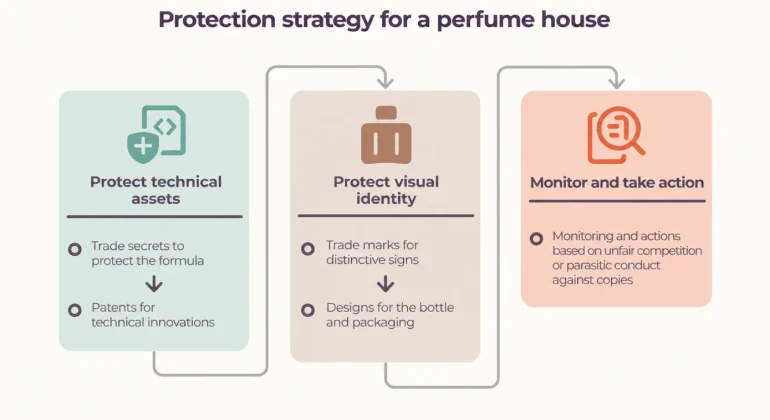
For a perfume house, an effective strategy relies on several complementary tools:

  • trade secrets to protect the formula;
  • patents for technical innovations;
  • trade marks for distinctive signs;
  • design rights for the bottle and packaging;
  • monitoring and actions based on unfair competition or parasitic conduct to address copies.

This combined approach helps protect all the assets that contribute to the perfume’s value.

Conclusion

Fragrance and intellectual property protection therefore require a nuanced strategy. While the scent itself remains difficult to monopolise, the formula, manufacturing process, name, bottle, packaging and commercial investments surrounding it can each benefit from effective legal protection.

Protection should be organised before disclosure and commercial launch and supported by ongoing monitoring to identify copies, counterfeiting and parasitic practices as early as possible.

Dreyfus Law Firm assists its clients in managing complex intellectual property cases, offering personalized advice and comprehensive operational support for the complete protection of intellectual property.

Dreyfus Law Firm works in partnership with a global network of attorneys specializing in Intellectual Property.

Nathalie Dreyfus with the support of the entire Dreyfus team

Q&A

1. Is it lawful to chemically analyse a competitor's perfume in order to identify its formula?

It may be. French trade secret law expressly recognises observation, study, disassembly or testing of a product made available to the public or lawfully possessed as lawful means of obtaining information, subject in particular to applicable contractual restrictions. Chemical analysis of a commercially available perfume does not therefore automatically constitute unlawful acquisition of a trade secret.

2. Who owns a formula developed by an independent perfumer for a perfume house?

Payment for the development work should not be assumed to resolve every issue concerning ownership, confidentiality and further use. The agreement should identify the results of the assignment, confidential information, any rights relating to technical inventions and the conditions under which the formula or underlying know-how may subsequently be reused.

3. Can a “dupe” brand state that its fragrance is equivalent to a famous perfume?

As a matter of principle, a “dupe” brand may not present its fragrance as the “equivalent”, “imitation” or “reproduction” of a fragrance marketed under a protected trademark. Such a presentation is liable to go beyond the limits of lawful comparative advertising, even in the absence of any likelihood of confusion. The comparison must also remain objective and non-misleading and must not take unfair advantage of the reputation of the competing trademark.

4. Does the trade mark of a discontinued perfume remain protected indefinitely?

Not necessarily. Under French law, a trade mark proprietor may face revocation where the mark has not been put to genuine use for the relevant goods or services for an uninterrupted period of five years, without proper reasons for non-use. Discontinuing a fragrance should therefore be accompanied by a review of the relevant trade mark portfolio and available evidence of use.

5. Can an e-Soleau filing protect a perfume formula?

An e-Soleau filing may be useful for establishing a certain date and preserving evidence that a formula, R&D development or related documentation existed at a particular time. It does not, however, create an exclusive intellectual property right and cannot replace either patent protection or an appropriate trade secret strategy.

This publication is intended for general public guidance and to highlight issues. It is not intended to apply to specific circumstances or to constitute legal advice.

Read More

What are the challenges of zombie trademarks?

Propriété intellectuelle, marques The protection of intangible assets as well as the efficient management of zombie trademarks or patents  portfolio contribute to the proper development of a company and its business.

Building a reputation is the very goal of any brand. This reputation is normally attached in law to the sign and to the company that filed and operates it. However, in the context of zombie trademarks, the mark does not symbolize the reputation of the current owner but that of the original owner.

Indeed, these zombie trademarks are signs that have been abandoned but still have marketing potential, a reputation.

A zombie trademark presupposes an indisputable relinquishment, that is to say an abandonment both in fact and legally. It then falls into the public domain.

As long as a brand continues to be used and is renewed every ten years, it can exist perpetually, contrary to patents and the author’s economic rights. However, sometimes a company discontinues the use of some of these signs.

This abandonment can occur any time, whether while the filing is still under review or even when the sign has been in use for a long time. In terms of non-use, a sign is abandoned when a holder stops using it without the intention of resuming its operation, for five consecutive years according to Article L 714-5 of the French Code of Intellectual Property.

Although perpetually renewable, in practice the vast majority of brands have a limited lifespan. They are born and they die. However, it happens that some experience a different fate. They are resurrected.


As we can see with the zombie trademarks, abandonment doesn’t have to be permanent.

A company that has given up its rights to a trademark cannot normally prevent a newcomer from bringing a trademark “back from the dead”. Indeed, the disputed sign has returned to the public domain, which theoretically allows anyone to be able to dispose of it freely.

An abandoned trademark is in principle available to everyone.

In France, it is possible to take action against a so-called deceptive brand. Article L. 711-3 c) of the French Intellectual Property Code provides that signs “likely to deceive the public, in particular as to the nature, quality or geographical origin of the product or service” cannot be adopted as a trademark. The former owner also sometimes has the opportunity to initiate ​​unfair and parasitic competition claims.

Resurrecting a brand can thus be of major asset for a company wishing to take advantage of the notoriety of a distinctive sign that has returned to the public domain. However, some of these marks are not legally neither quite dead, nor quite alive, and it is advisable to be very careful, given that the case law is still rare and uncertain on this subject.

Dreyfus is experienced in anticipating, securing and optimizing IP portfolios, which ultimately adds value to our clients’ businesses.


In order to offer our clients a unique expertise, necessary for the exploitation of intangible assets, we keep you informed about intellectual property and digital economy issues with our articles written by  Dreyfus’ legal team.

Read More

How to develop a reliable and flexible compliance strategy for intellectual property professionals?

With the rise of the digital age, setting up a reliable and effective compliance strategy as well as mobilizing the skills of professionals have become key factors in the company’s performance, particularly in the field of intellectual property. With the rise of the digital age, setting up a reliable and effective compliance strategy as well as mobilizing the skills of professionals have become key factors in the company’s performance, particularly in the field of ​​intellectual property.

From the outset, it seems important to remember that compliance includes all the processes intended to ensure that a company, its managers and its employees comply with the legal and ethical standards applicable to them.

FromLAW No. 2016-1691 of 9 December 2016 on transparency, the fight against corruption and the modernization of economic life.  on anti-corruption measures to the implementation of the Regulation (EU) 2016/679 of the European Parliament and of the Council of 27 April 2016 on the protection of natural persons with regard to the processing of personal data and on the free movement of such data, and repealing Directive 95/46/EC (GDPR) of April 27, 2016, and including the duty of vigilance of parent companies and ordering companies (law of March 27, 2017) or the prevention of cyber risk (implementing decree of May 25, 2018 of the NIS directive), an undeniable operational impact on companies and their managers can be observed.

Likewise, the challenges and risks of intellectual property have increased in the virtual world. Domain names as well as social networks are likely to be the targets of multiple attacks.

The key challenges of compliance with regards to intellectual property risks (I) raise questions both about the practical consequences of compliance in all aspects of intellectual property the role of the “compliance officer” in this framework (II) and the role of the “compliance officer” in this framework (III).

The challenges of intellectual property compliance

The environment as well as legal decisions revolve around the long-term development of the company and justify the establishment of real legal engineering within companies whose intellectual property is decisive. This is the key challenge of compliance, which is both a framework for thinking and a method of solving problems, involving a large number of tools and components oriented by company strategy.

Legal, regulatory and fiscal constraints are increasingly stringent and make companies bear increased responsibility in case of negligence, or even simple inaction. In particular, the regulatory framework sets out increased requirements regarding the protection of consumers and personal data.

In the field of intellectual property, domain names are key assets to contemplate when analyzing the risks and drafting compliance plans. While they are a major asset, essential to the very functioning of the business (for example, for e-mail servers, they are also risk vectors: phishing, fraud, identity theft, forged e-mail …

Online fraud can lead to loss of turnover, endangerment of consumers, and if so, risks of civil or criminal liabilities of directors for non-compliance with enforceable laws and regulations. impact the stock market price, thus causing loss of customers.

It is therefore very important to put in place the appropriate strategies to anticipate dangers, react effectively in the event of a breach and ultimately protect the company.

The practical consequences of compliance in all aspects of intellectual and digital property

Compliance has an immediate impact on all aspects of intellectual property. Also, while the legislation is more and more restrictive for companies and intellectual property professionals, compliance requirements are reinforced. How to bring your company into compliance with the laws? What are the risks of not including the Internet in your compliance plan?

Beyond its legal meaning of compliance with the requirements of laws, regulations, Codes or even directives, compliance aims to protect the company and intellectual property professionals against any non-compliance with internal and external standards and its values. Intellectual property frauds are growing and becoming increasingly complex in the digital era, which requires taking action to mitigate risks for the company business, including in terms of compliance. Its objective is to avoid adverse consequences for the company and its managers, both financial and civil or criminal liability, or damage to image and reputation. It is ultimately part of a desire for lasting growth in all aspects of intellectual property, both in France and internationally.

To cope with these new standards, companies must put in place a governance policy capable of minimizing their exposure to risk vis-à-vis their customers, their shareholders, but also regulatory authorities.

To begin with, it is essential to identify the risks through the relevant audits.

Then, it is important to assess those risks and map them. The risk management policy shall be defined accordingly.

In particular, a policy for the management of Intellectual Property related risks calls for a virtually systematic surveillance system of trademarks among domain names.


The role of the “compliance officer”

The compliance officer must protect the company from any risk of non-compliance, and therefore ensure that the organization adopts good conduct in business practice, respects the rules of ethics and finally, complies with the various laws, regulations, or even European directives. It must therefore undertake a proactive approach, organize and implement the means necessary to comply with the regulations.

Likewise, it is important to anticipate risks: once they have been defined and supervised, the mission of the compliance officer being to protect the group and its reputation, he will have to analyze the rules and standards according to the context, the activity, and the business sector.

According to a study “Who are compliance professionals?” published on March 27, 2019 and carried out by the firm Fed Legal, 92% of compliance officers have a legal background. They are operational professionals who have a strategic vision as well as a multiplicity of soft skills, in particular an ability to persuade and an interest for teaching. In addition, 60% of compliance officers belong to legal services in which there are many recruitments, both in large and small companies.

When a company is questioned, the consequences are at the same time financial, commercial and human: the company reputation will suffer greatly. The compliance officer thus takes care of protecting his company from the financial, legal and reputational risks that it  incurs in the event that it does not comply with laws, regulations, conventions, or quite simply a certain code of ethics or professional conduct.

Dreyfus can assist you in the management of your trademarks portfolios in all countries of the world.  Please feel free to contact us.


Read More