Directive (EU) No. 2018/1808 of the European Parliament and of the Council, adopted on November 14, 2018 and amending Directive 2010/13/EU (AVMS Directive), has (finally) been transposed into French law, via the Order of December 21, 2020. This directive is part of a context of international competition on the one hand and profound transformation of the audio-visual and the evolution of demand on the other hand.
Redefinition of the essential concepts of the 2010 European Directive
The Order deals with essential concepts that one needs to fathom to understand the issues at stake. First of all, what are audio-visual media services (AVMS)? There are two types:
Linear television services (traditional services);
Non-linear services, e.audio-visual content-on-demand services or media-on-demand services (MOS). These SMAD services allow the customer to choose both when and what they wish to watch.
The Order also calls into question certain principles, such as the old principle of media chronology resulting from a 1960 legislation. This legislation coordinated the diffusion of films, after their release in cinemas, to optimise their profitability.
Modernisation and adaptation of the rules to the transformation of audiovisual services
The Order transposing the Directive has implemented several measures aiming to ensure the effective contribution by market players and to protect both the minors and the public.
While this principle is a leading point of the reform, the AVMS Directive also acknowledges the profound changes in multimedia by extending audio-visual regulation to video-sharing platforms, social networks and live video platforms. This way, Brussels wishes to protect minors against certain harmful content and harmonise the legal framework of the European audio-visual sector.
Reform of the 1986 Act and safeguarding the French cultural exception
France wanted to implement the directive and collaborate in the European project while defending the French cultural exception. The Order is mainly concerned with reinforcing the rules of transparency for service publishers and with establishing more complete objectives, such as the inclusion of the system of funding for production (particularly independent production) over time, but also the guarantee that French broadcasters and global platforms are on an equal footing.
Article 19 of the Order, therefore, now requires “publishers of television services and on-demand audio-visual media services aimed at French territory” “when they are not established in France and do not fall under the jurisdiction of France”, to financially contribute in the same way as French publishers do.
Article 28 substantially reforms the principle of media chronology and now allows the industry players to negotiate an agreement with the professional organisations within six months to reduce broadcasting delays.
Extension of the powers of the CSA and protection of minors
As platforms are now part of the regulatory landscape, the CSA has seen its competencies and powers broadened and, in particular, has been assigned two new essential missions: the accessibility of AVMS programmes, and the protection, in particular of minors, against content that is violent, incites hatred or constitutes a criminal offence. The CSA will then have jurisdiction if the head office or a subsidiary of the platform is established in France.
Furthermore, the CSA is also in charge of ensuring that publishers have issued guidelines of best practice (particularly regarding food advertising to which minors could be exposed) and highlighting audio-visual services of general interest on new audio-visual platforms.
In addition, the Order completes Article 15 of the 1986 Act by prohibiting in programmes not only incitement to hatred and violence but also a provocation to commit acts of terrorism, while entrusting the CSA with the task of ensuring that these provisions are respected.
If the Oder is already a significant step forward, the implementing decrees are just as important. In particular, on June 23, 2021, the audio-visual media services on-demand decree (or SMAD decree n°2010-1379 of November 12, 2010) was published in the French Journal Officiel, which probably represents the most valuable step in the project to modernise the financing of French and European audio-visual services. Among other things, SMADs will have to devote at least 20% of their turnover in France to finance the production of European or original French cinematographic and audio-visual works.
We are a law firm with a unique expertise in the exploitation of intangible assets. We keep you updated on issues related to intellectual property and the digital economy through articles written by the Dreyfus legal team.
A perfume involves several assets, rather than a single right covering every aspect of its scent.
A perfume combines a composition, a name, a bottle and a commercial presentation. These four elements do not fall under the same legal rules. Under French Court of Cassation case law, the fragrance itself does not qualify for copyright protection. This does not exclude protection of the other assets (name, bottle, formula) or prevent action against certain forms of imitation. It requires the business to identify exactly what it wishes to protect and the evidence supporting its position.
For a perfume brand, risks arise during the first exchanges with the laboratory, manufacturer or distributor. Who owns the formula? Which information remains confidential? Were the name and packaging protected before public disclosure? A trademark protection strategy must work alongside contracts and other available rights. For lawyers and in-house legal teams, the priority is a substantiated case, not a promise of exclusivity over every similar scent. The response to imitation will depend on the rights held, the signs used and the documented circumstances of production and sale.
An intellectual property assessment identifies, for a perfume, the rights that can be relied on (trademark, design, trade secret, patent) and the evidence available before any action against a copy. Nathalie Dreyfus’s qualifications can be checked through the official directories: the Paris Court of Appeal 2026 directory (PDF), under trademarks and designs, the Court of Cassation directory, 2025 edition (PDF), and the CNCEJ directory. Listings relate to defined specialisms. A private opinion is distinct from a court-ordered investigation. The engagement is defined according to the matter and the skills required.
Separate the scent from the other creative elements
In its decision of 10 December 2013, appeal no. 11-19.872, the commercial chamber of the French Court of Cassation rejected copyright protection for a perfume fragrance because its perceptible form could not be identified with sufficient precision to be protected as a work. This does not mean that everything associated with a perfume is available for unrestricted use.
A bottle design, campaign photograph or advertising text may, by contrast, be protected by copyright if it is original. The file should distinguish the scent, its technical formulation and the creative elements of the presentation. This prevents a broad claim being built on a right that does not protect the subject matter actually copied. French conclusions should not be presented as a universal statement about every jurisdiction.
Protect the name, bottle and commercial presentation
A trademark protects a sign for specified goods and services. Clearance searches, the specification and territorial choices should precede launch. The owner must also define the uses permitted to manufacturers and distributors. Registering a name does not protect a formula or scent. Trademark rights need renewal and genuine commercial use in accordance with the applicable rules.
The bottle and certain packaging features may warrant an assessment under design law, if they meet the requirements of novelty and individual character. An ordinary shape or a feature dictated solely by its technical function does not qualify for this protection. The date of each public presentation of the bottle should be recorded: in the European Union, a filing remains possible within twelve months of the designer’s first disclosure (grace period), but this period does not exist in every country. Photographs of prototypes and launch materials help establish the sequence of events.
The chain of ownership also requires attention. Paying the designer is not enough: under French law, copyright is transferred only by a written assignment specifying the rights assigned. Agreements should identify the deliverables, rights transferred, authorised uses and contributors to the project. Dated files, approvals and contracts are useful evidence when entitlement or copying is disputed. The assessment should cover both the registered rights and the supporting contractual records.
Registering a scent trademark remains difficult
Removing the graphical representation requirement for EU trademarks did not make every smell registrable. The representation must enable the authorities and the public to determine clearly and precisely what is protected. The EUIPO guidelines concerning smell marks explain the representation difficulties associated with the means currently available.
A chemical formula describes a substance without necessarily representing its smell. A verbal description or sample does not satisfy clarity, durability and objectivity requirements. In practice, a scent trademark application therefore has very little chance of being accepted. The available options need checking with the relevant office against the criteria applicable when filing. A distinctive fragrance and an acceptable representation are different questions.
information that is not generally known or readily accessible,
commercial value because it is secret,
reasonable steps to keep it secret.
Calling a formula confidential in a document is insufficient if it circulates without meaningful controls.
Safeguards can include restricted access, confidentiality commitments, separation of the information shared and version tracking. Teams should identify who receives the complete formula, who may amend it and what must be returned or deleted when the relationship ends. Contractual obligations need to reflect the actual practices of laboratories and service providers. Evidence that safeguards were applied is important, not merely evidence that a template agreement existed.
Secrecy does not provide a monopoly equivalent to a registered right. A competitor that rediscovers the formula by its own means (independent development, analysis of a lawfully purchased product) does not, in principle, infringe the secret, unless it is bound by a contractual undertaking. The file should establish the source of the information and the conduct alleged. A similar smell is not, without more, proof that the formula was unlawfully obtained or used.
Choose between patent protection and confidentiality
A composition or manufacturing process may justify an assessment under patent law if the patentability requirements are satisfied. Development costs or commercial novelty alone are insufficient. The assessment should address technical novelty, inventive step, existing rights and the territories where protection would be valuable. It should distinguish patentability from freedom to operate.
A patent requires the invention to be published, generally eighteen months after filing, in exchange for a monopoly of up to twenty years. Secrecy instead depends on controlling access to information. The choice between these options should precede public communications that could affect novelty. Relevant factors include how easily the formula can be reconstructed, the expected useful life of the advantage and whether unauthorised exploitation could be detected. These approaches are not interchangeable, and their costs and limitations should be explained before choosing.
Assess imitation and comparison lists separately
A similar smell does not, by itself, establish infringement. The signs, goods, packaging and commercial uses need examination. A list describing one perfume as equivalent to a well-known product raises a separate issue. References to another party’s mark and the way its reputation is used should be assessed independently from the fragrance composition.
The L’Oréal v Bellure judgment of 18 June 2009, case C-487/07, held that a list presenting a product as an imitation of a branded perfume is unlawful comparative advertising and may amount to taking unfair advantage of that mark’s reputation. It does not justify treating every product described as a “dupe” identically. The wording, public perception and marketing context remain material. Evidence should record the complete presentation rather than an isolated statement removed from its context.
Unfair competition and parasitism claims may also be considered under French law. They require proof of specific wrongful conduct (for example, deliberately creating confusion or free-riding on another’s investment) and of harm. Resemblance or the success of the original product does not remove that burden. Screenshots, purchases and records should be preserved before the disputed offers change, with collection methods proportionate to the intended proceedings.
The role of the IP adviser
The IP adviser defines the legal grounds, remedies and strategy. It also contributes to the analysis of registered rights, comparison of assets and organisation of evidence. The technical engagement must state its limits: recording a similarity, identifying a sign and examining a formula answer different questions. The weight of evidence also depends on how it was collected (bailiff’s report, infringement seizure) and on respect for adversarial proceedings.
Illustrative case
A fictional brand supplies its composition to a laboratory and develops a bottle with a designer. After launch, it discovers a product referring to its perfume in a comparison list. It wants all sales stopped immediately, without distinguishing the formula, name and packaging. Its agreements with the different contributors have not been collected into one file.
The firm would first assemble registrations, contracts, disclosure records and marketing evidence. It would compare the signs and packaging features, then assess possible grounds, confidentiality obligations and suitable evidence-preservation measures. A technical analysis of the composition would be commissioned only if it answered a relevant question, rather than being treated as an automatic first step.
The aim would be a focused claim and improved agreements for future products. This fictional educational example does not describe a client matter, successful judgment or guaranteed outcome.
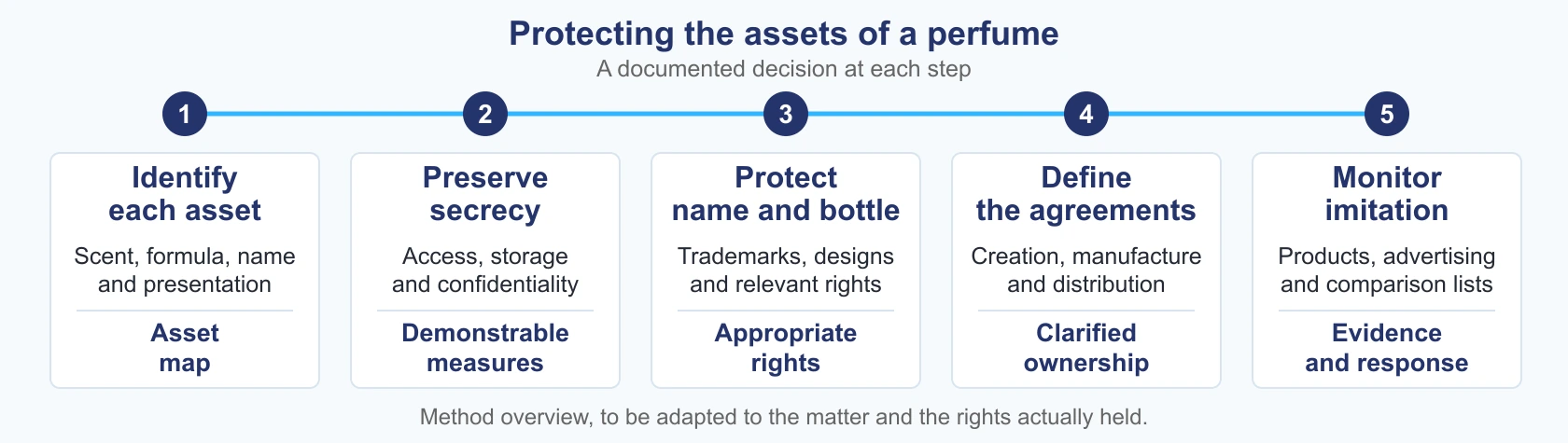
A five-stage protection process
The strategy brings rights, confidentiality and evidence together during development.
Identify assets. Separate scent, formula, name and bottle.
Preserve secrecy. Define access and commitments before disclosure.
Protect signs and shapes. File before relevant disclosures.
Define contracts. Clarify ownership and exploitation.
Monitor and document. Preserve evidence before taking action.
FAQ on perfume protection
Does copying a smell establish infringement?
Not by itself. A scent is protected neither by copyright nor, in practice, by trademark law. The claim must rely on another right (sign, bottle, secrecy of the formula) or on wrongful conduct such as parasitism. The legal basis depends on the proven facts.
Does a confidentiality agreement protect the entire formula?
It can contribute, but its scope and implementation require checking. Public information and uncontrolled access raise separate issues. Effective safeguards matter alongside contractual wording and the persons bound by it.
Should a patent be filed before presenting the perfume?
Novelty and disclosure timing should be examined beforehand. The decision depends on the composition or process, patentability requirements and other protections. Assess the consequences before making public disclosures.
Can a comparison list be challenged?
Potentially, depending on wording and context. Trademark uses, comparison rules and any advantage taken of reputation require assessment. Similar smells alone do not determine the claim.
Why work with Dreyfus
Dreyfus assists businesses and their advisers with protection strategy and alleged infringement, coordinating rights, contracts and evidence to define a proportionate response.
The Third Session of the 13th National People’s Congress (NPC) voted and passed the “Civil Code of the People’s Republic of China” on May 28, 2020. This law came into force on January 1, 2021.
The fundamental objective of this Civil Code is to facilitate the protection of people’s extensive civil rights and provide sufficient remedies for right holders whenever their IP rights are infringed upon especially when it comes to counterfeiting.
Apart from serving as a policy instrument for stimulating innovation, intellectual property (IP) rights have always been considered a significant category of private rights. The intellectual property regime, thus, is deeply rooted in and closely related to the civil law system.
While referred to by the Chinese press as the Encyclopedia of Social Life, the new Civil Law includes many provisions related to intellectual property (IP). At first read, the most striking IP provision is for punitive damages for intentional infringement, which will be potentially most valuable in patent infringement cases and especially in cases related to counterfeiting.
Article 1185 (out of 1260 articles) states, with reference to IP, “if the circumstances are serious, the infringed person shall have the right to request corresponding punitive damages”. This actually aligns with the newly amended trademark law that provides for increased punitive damages.
Article 63 of the trademark law, as amended in November 2019, increased punitive damages from three times to five times the amount of assessed damages when infringement is “committed in bad faith and the circumstance is serious.”
The United States has called China the “world’s principal IP infringer”. In a 2017 report, the US bipartisan Commission on the Theft of American Intellectual Property estimated that counterfeit goods, pirated software and the theft of trade secrets cost the US economy between US$225 billion and US$600 billion annually, not including the full cost of patent infringement.
China, meanwhile, has signaled that IP protection is a priority in its 14th five-year plan for 2021 to 2025, as part of its strategy to move towards self-reliance in critical technology.
Government economic planners detailed how they intended to strengthen the protection of IP and raise high-value patent ownership over the next five years, and Beijing is this year set to reveal its strategic plan to make China a global IP power by 2035.
In both the Chinese Patent Law and the Copyright Law, which will come into effect on June 1 2021, the applicable elements of punitive damages are “intentional infringement” and “aggravated circumstances“ according to the China Civil Code.
Therefore, punitive damages will be more actively applied by the Chinese courtswhen handling IP cases in the future.
The introduction of punitive damages into IP infringement disputes will help improve the protection of intellectual property rights, promote technology progress and innovation, and build a healthier market for investment.
The new Civil Code is demonstrating China’s resolute attitude toward malicious IP infringement, concrete articles and complementary civil principles could enhance the protection of IP rights in China.
In order to provide our clients with a unique expertise, necessary for the exploitation of intangible assets, we keep you informed about intellectual property and digital economy issues with our articles written by the Dreyfus legal team.
Reverse domain name hijacking constitutes an abuse of procedure. On this topic, the WIPOissued on April 4, 2021 a decision reminding Complainants of their failings: it was their duty to proceed to relevant checks before initiating the complaint and to build their case properly. The examiner was all the more severe given that Complainants were represented by counsel.
The complaint in question was filed by three applicants.
First Complainant is an Indian company notably specializing in the manufacture and sale of sanitary products and kitchen appliances. First Complainant was originally known as Hindustan Twyfords, but later changed its name to HSILLtd. in 2009. Second Complainant, Somany Home Innovation Limited, was incorporated in 2017. It manufactures and sells, among other goods, air and water purifiers, water heaters, air coolers. Like Second Complainant, Third Complainant, Brilloca Ltd, results from the split of First Complainant.
Having detected the registration of the domain names <hsil.com> registered on November 16, 1999 and <shil.com> on December 9, 1999, Complainants filed a complaint with the WIPO Arbitration and Mediation Center to request the transfer of the domain names.
Respondent is a UK registered company, established on October 7, 1998, which provides web development services to help small businesses gain visibility on the Internet, initially focusing on the health club and leisure equipment market. In addition to the main site « health-club.net », Respondent has registered a number of short acronymic domain names.
First Complainant owns trademarks for the sign « HSIL », the first of which dates from 2004. Complainants further argue that Somany Home Innovation is widely known by the sign « SHIL », the acronym that corresponds to its corporate name.
First and foremost, the panelist notes that the applicants have not submitted any evidence showing the use of the sign « SHIL » to the point of making it a distinctive identifier for their benefit. Therefore, the latter considers that they are in default concerning the proof of likelihood of confusion between the <shil.com> domain name and an earlier trademark in which they potentially have rights. On the other hand, the likelihood of confusion was recognized for the name <hsil.com>.
Then, regarding the issue of legitimate interest and/or rights in the domain names, the panelist takes into account the fact that Respondent registered the disputed domain names in 1999, before the alleged filing and use of Complainants’ « HSIL » and « SHIL » marks. As opposed to Complainants, Respondent has provided evidence to support its claims that the names were used as acronyms for « Sports / Health in London » and « Health / Sports in London ».
Besides, the disputed domain names were registered in 1999, many years before the filing of the HSIL marks and the registration of domain names containing « HSIL ». In addition, the Complainants have no trademark rights for the sign « SHIL ».
Also, Respondent has demonstrated a use of the disputed domain names in connection to a bona fide offering of goods and services.
The complaint is therefore dismissed.
In addition, the panelist found that the complaint constituted reverse domain name hijacking, an attempt to obtain a domain name by artificially proving infringement.
Complainants, who are represented by counsel, should have anticipated the weakness of their argument and the fact that the acronyms « Hsil » and « Shil » could not refer exclusively to them, as alleged in the complaint without any evidence.
The panelist also notes that Complainants tried to make it look like trademarks were rejected in India because of the « well-known status and enormous goodwill » acquired by their earlier marks. This, despite the fact that the defendant has proven that third parties have been able to obtain registration of trademarks for the sign « SHIL » in India.
The panelist also targets Complainants’ representative and denounces an « unfamiliarity with the UDRP » and raises the fact that the latter has listed the registrar as respondent simply because it had allowed the registration of an available domain name, even though it is not in its power to decide whether or not to allow a registration.
Source: WIPO, Arbitration and Mediation Center, April 4, 2021, Case No. D2020-3416, HSIL Limited, Somany Home Innovation Limited v. SHIL Ltd, Brilloca Limited v. GOTW Hostmaster, Get on The Web Limited, India
The Public Interest Registry (PIR), registry for the .org top-level domain, launched the domain name system Abuse Institute on February 17, 2020. The purpose is to help protect Internet users from the threat of domain name system abuse.
The institute’s mission includes helping to identify and report DNS abuse, establishing best practices in the area of domain name system abuse and funding domain name system research.
The Institute’s activities cover three main areas:
– Innovation: Developing best practices for registries and registrars and funding research on cyber security and domain name system abuse;
– Education: Through the development of a library of available information and practices;
– Collaboration: The Institute will operate as a networking forum and sharing centre for stakeholders interested in these issues.
A hotline has also been created to assist registries and registrars with questions about DNS abuse.
Following the UDRP ‘s new gTLD program, new Rights Protection Review Mechanisms (RPM) have been implemented to protect trademark holders, such as the Uniform Rapid Suspension System (URS) procedure.
ICANN has now decided to address changes suggested by trademark holders and intellectual property experts regarding the UDRP. For instance, one of these suggestions is that a domain name should be considered abusive if it is registered OR if it is used in bad faith, instead of requiring that both these conditions are met. The idea is to lighten the burden of proof on the rights owner to take into account a more up-to-date reality. Another suggestion is to provide for an accelerated procedure in case of abusive conduct and to get a decision more rapidly if the defendant fails to respond to the complaint.
It has also been proposed to provide for a presumption of bad faith if the registrant has lost three UDRP complaints and to require any repeat offender to pay a response fee to defend the case. The central issue at this stage of the study is to understand the extent to which the UDRP principles should be changed in favour of trademark owners, while knowingt hat it may weaken the UDRP principles.
On November 22, 2016, at 4:05 p.m. sharp, the Vinci group is the victim of identity theft. Several media receive a false press release reporting a review of Vinci’s consolidated accounts for fiscal year 2015 and the first half of 2016 following alleged accounting embezzlement.
In 2019, the US news agency Bloomberg appealed a decision of the AMF’s sanctions commission. The hearing before the court of appeal will be held this Thursday. Bloomberg was sentenced to 5 million euros for relaying information from a false Vinci press release.
A fake press release from Bloomberg
The American news agency Bloomberg is accused of having disseminated, in 2016, false information about Vinci without having verified it.
On November 22, 2016, at 4:05 p.m. sharp, the Vinci group is the victim of identity theft. Several media receivea false press release reporting a review of Vinci’s consolidated accounts for fiscal year 2015 and the first half of 2016 following alleged accounting embezzlement.
The false statement also indicates that the chief financial officer was fired. Less than a minute later, between 4:06 p.m. and 4:07 p.m., Bloomberg picked up the information and disclosed it on his terminal.
This press release had even been signed with the name of the real person in charge of Vinci’s press relations, while referring to a false cell phone number.
In defense, the defendants point out before the commission that the tone, the absence of spelling errors, the careful layout, the exact references to certain directors of Vinci or to its auditors, the mention of the real spokesperson for Vinci as well as the plausibility of the foot of the press release, which contained a link to unsubscribe from the Vinci mailing list and alerted the recipient to the automated processing of data, mentioning the contact details of the real correspondent Cnil de Vinci , did not differentiate this press release from a real press release established by Vinci.
The domain name issue in the false press release
The only inaccuracies in the false press release: the domain name of the false Vinci site to which the press release referred and the false mobile phone number of the “media contact”.
The fraudulent press release was also received by AFP, which did not follow up after realizing that this document had been posted on a mirror website, very similar to the real site but with a separate address (vinci.group and not vinci.com).
How to protect your domain name?
Domain names represent an essential intangible asset for companies since they allow access to websites related to their activity. Now, protecting the domain names associated with the trademark or the business of the company has become almost as important to the company as the protection of its brands.
In addition, domain names are the preferred medium for cyber-attacks which calls for increased vigilance on the part of owners and Internet users.
Phishing, fake president fraud, identity theft, fake job offers, theft of personal or banking data, whaling… frauds are numerous and are constantly adapting to technological progress;
Fraud is facilitated by the very protective provisions of the GDPR, which prevent the direct identification of the domain name registrant; technical service providers tend to rely upon the provisions of the GDPR and the LCEN to justify their inaction and allow fraud to continue;
There is a great risk of damage to the company’s image and reputation. Such fraud also has a significant financial impact, given the risk of embezzlement and money laundering.
The AMF’s Guide to Periodic Disclosure for Listed Companies (dated June
To protect your domain name from cybersquatters or competitors, it is recommended to also register the domain name as a trademark in addition to the reservation of the domain name.
It is possible, before making a domain name reservation and trademark registration, to check its availability, to avoid conflicts between domain names, trademarks or corporate names.
Domain names are now an integral part of the international economic landscape. Like industrial property rights and traditional distinctive signs, they are instruments of competition and intangible assets of companies. It is of course essential to have it for anyone who wants to exist in a market.
But care must be taken not to come into conflict with one’s competitors by using, even in good faith, distinctive signs close to theirs. Conversely, it is also necessary to enforce its own distinctive signs by not allowing third parties to appropriate signs close to its own in order to offer the same or similar services.
How to mitigate the risks regarding domain names ?
– Proceed to an audit of the corporate trademark and the company’s flagship trademarks among domain names, in order to map the risks;
– Set up a 7/7 watch of the corporate trademark among domain names, and a 7/7 or at least weekly watch on the company’s trademarks dedicated to goods or services;
– Set up watches on social networks such as Facebook, Instagram, Twitter and LinkedIn;
– Proceed with the preventive registration of domain names in risky extensions (such as .COM, .CO, .CM, .GROUP);
– Take preventive action(s) against potentially dangerous domain names;
– Define procedures and set up a crisis management unit to quickly react to infringements in case of emergency;
– Draft or update the company’s domain name policy (registration procedures, compliance with legal obligations, best practices) to be shared internally and with the company’s service providers and suppliers.
Cyber threats are more numerous and more complex and it has also become increasingly difficult to take action against registrants of disputed domains. More than ever, monitoring is required with the implementation of risk mapping and a defense strategy.
Dreyfus advise you in setting up the appropriate strategy to limit the risks related to domain names and to integrate industrial property assets in your compliance plans.
A right or legitimate interest in a domain name may be demonstrated by its use in the context of a bona fide offer of goods or services. This assessment requires to take into account how the domain name has been used, but also the space-time framework: When was the domain name registered? By whom? In which country?
Founded in 2003, Ba & sh is a French company operating in the field of design, manufacturing and distribution of women’s ready-to-wear clothing and fashion accessories.
Having detected the registration of the domain names <bashshitever.com> registered in 2014 and <bashclothing.co> in 2020, Ba & sh filed a complaint with the WIPO Arbitration and Mediation Center in order to obtain the transfer of these domain names.
While the construction of the <bashshitever.com> domain name is somewhat intriguing, the fact that the <bashclothing.co> name contains the term “clothing” may have led Ba & sh to consider that its rights were being infringed.
In any event, since the domain names include the sign “BASH” except for the ampersand, the panellist acknowledges a likelihood of confusion.
Nevertheless, the panellist deems that Respondent has chosen these domain names independently of Complainant’s trademark and has used them in the context of a bona fide offer of its goods on the corresponding websites.
Indeed, Respondent is from Malaysia, where the company was founded in 2015, while Ba & sh has provided no evidence of actual use of its BA & SH mark in that territory. Khor Xin Yu, Respondent, explains that he co-founded “BASH CLOTHING” in 2013 when he was 18 years old and that the mark was also used in Singapore in 2017. Initially, the sign used was “Bash Shit Ever”, later changed in 2020 to “Bash Clothing” as part of a branding update.
Similarly, Respondent provided an explanation and documentation justifying the selection of the sign BASH because of the meaning of the dictionary term “bash”. Finally, Respondent used a logo that differs from that of Complainant.
Complainant has not shown that Respondent registered and used the disputed domain names in bad faith.
Indeed, when the first disputed domain name <bashshitever.com> was acquired by Respondent, Complainant had been operating in France and worldwide for about 11 years and had owned an international trademark for about 7 years, designating Malaysia. However, Complainant has not presented any evidence of actual use of its BA & SH trademark in Malaysia at the time of registration of the first disputed domain name.
In addition, a Google search for “bash” shows several results unrelated to Complainant or its trademark. Respondent has also provided a plausible explanation as to why he chose the term “bash”, an English dictionary term related to the idea of a party insofar as its initial target was female students.
Finally, although the parties operate in the same market segment (i.e. ready-to-wear and accessories), Respondent’s use of the disputed domain names does not show an intention to compete with Complainant and its trademark, given the different logos/layouts, the significantly lower prices at which the Respondent’s clothing is offered for sale, and the absence of any information on Respondent’s website that would lead users to believe that the website is operated by Complainant or any of its affiliated entities.
The complaint is, therefore, dismissed.
Ba & sh should have investigated Respondent’s motives before initiating a UDRP proceeding, including whether its trademark was known in Respondent’s country when the first domain name was registered. It should also have determined for how long Respondent had been using the “Bash” sign for fashion activities. An investigation could have revealed these elements. Respondent explains that he first marketed the Bash clothing on social networks. And, depending on the answers to these two questions, write a proper letter to the defendant
Building a reputation is the very goal of any brand. This reputation is normally attached in law to the sign and to the company that filed and operates it. However, in the context of zombie trademarks, the mark does not symbolize the reputation of the current owner but that of the original owner.
Indeed, these zombie trademarks are signs that have been abandoned but still have marketing potential, a reputation.
A zombie trademark presupposes an indisputable relinquishment, that is to say an abandonment both in fact and legally. It then falls into the public domain.
As long as a brand continues to be used and is renewed every ten years, it can exist perpetually, contrary to patents and the author’s economic rights. However, sometimes a company discontinues the use of some of these signs.
This abandonment can occur any time, whether while the filing is still under review or even when the sign has been in use for a long time. In terms of non-use, a sign is abandoned when a holder stops using it without the intention of resuming its operation, for five consecutive years according to Article L 714-5 of the French Code of Intellectual Property.
Although perpetually renewable, in practice the vast majority of brandshave a limited lifespan. They are born and they die. However, it happens that some experience a different fate. They are resurrected.
As we can see with the zombie trademarks, abandonment doesn’t have to be permanent.
A company that has given up its rights to a trademark cannot normally prevent a newcomer from bringing a trademark “back from the dead”. Indeed, the disputed sign has returned to the public domain, which theoretically allows anyone to be able to dispose of it freely.
An abandoned trademark is in principle available to everyone.
In France, it is possible to take action against a so-called deceptive brand. Article L. 711-3 c) of the French Intellectual Property Code provides that signs “likely to deceive the public, in particular as to the nature, quality or geographical origin of the product or service” cannot be adopted as a trademark. The former owner also sometimes has the opportunity to initiate unfair and parasitic competition claims.
Resurrecting a brand can thus be of major asset for a company wishing to take advantage of the notoriety of a distinctive sign that has returned to the public domain. However, some of these marks are not legally neither quite dead, nor quite alive, and it is advisable to be very careful, given that the case law is still rare and uncertain on this subject.
Dreyfus is experienced in anticipating, securing and optimizing IP portfolios, which ultimately adds value to our clients’ businesses.
In order to offer our clients a unique expertise, necessary for the exploitation of intangible assets, we keep you informed about intellectual property and digital economy issues with our articles written by Dreyfus’ legal team.
La notoriété d’une marque ne suffit pas à garantir le transfert d’un nom de domaine similaire
Rémy Martin & C fait partie du groupe Rémy Cointreau, une grande entreprise de cognac. Fondée en 1724, cette maison est l’un des principaux acteurs de la production et de la fabrication du cognac en France.
Le groupe détient un large portefeuille de la notoriété d’une marque comprenant les éléments verbaux « louis » et « louis xiii » en lien avec son cognac Louis XIII le plus célèbre et le plus cher.
Suite à la détection du nom de domaine < louisthirteen.com >, E. Remy Martin & C a déposé une plainte auprès du Centre d’Arbitrage et de Médiation de l’OMPI, afin d’obtenir le transfert de ce nom de domaine.
Le nom de domaine est composé de « louis » qui est identique à la première partie de la marque et est suivi de « treize ». Un nom de domaine qui consiste en une traduction d’une marque est généralement considéré comme identique ou similaire à cette marque . « Treize » est la traduction littérale en anglais du chiffre romain « xiii », comme l’a reconnu l’expert.
Or, en examinant les différentes pages du site Internet de l’intimé, le panéliste constate que le nom est utilisé pour une véritable offre de produits en marque blanche, notamment des masques de protection contre les bactéries et les virus dans le cadre de la lutte contre le Covid-19. Bien que le Défendeur n’ait pas répondu à la plainte, des mentions légales sont présentes sur le site et une recherche rapide sur Internet des sociétés britanniques montre un enregistrement de la société Louis Thirteen Group Limited en juin 2019, soit 18 mois avant le dépôt de la plainte.
Même si la marque antérieure bénéficie d’une large protection, l’expert précise qu’il n’est pas évident que le Plaignant puisse s’opposer à l’utilisation d’un nom commercial « louis thirtheen » pour des activités aussi différentes des siennes.
La lourde charge de la preuve incombant au Plaignant pour s’opposer à l’usage de la notoriété d’une marque.
Dans l’Union européenne et au Royaume-Uni, le titulaire d’une marque notoirement connue ne peut s’opposer à l’utilisation d’une marque similaire/identique que si l’utilisation par le tiers tire indûment profit de ladite marque ou porte atteinte au caractère distinctif ou à la renommée. de cette marque.
L’expert constate que le Plaignant a manqué à sa charge de la preuve dans la mesure où il existe une possibilité réelle que le nom correspondant au nom de domaine ait été utilisé dans le cadre d’une offre de bonne foi de biens et de services antérieure à la notification du litige.
Dès lors, l’expert considère qu’il n’est pas prouvé que l’intimé n’ait aucun droit ou intérêt légitime sur le nom de domaine. Ainsi, il n’a pas à établir que le nom de domaine a été enregistré et utilisé de mauvaise foi.
La possibilité de saisir la justice reste ouverte
Pour les motifs qui précèdent, la plainte est rejetée. Cependant, l’expert déclare que cette décision n’affecte pas le droit du Plaignant d’intenter une action en contrefaçon de marque contre le Défendeur devant les tribunaux.
Une recherche rapide sur Internet aurait dû permettre au Plaignant d’identifier l’existence de Louis Thirteen Group Limited et de conclure que l’UDRP n’était pas un for approprié pour ce litige, qui devait être abordé de manière globale et non limité au seul nom de domaine. .
Par ailleurs, Louis XIII est le nom d’un roi de France et la marque antérieure n’est donc pas fantaisiste , élément que le panéliste a pu prendre en compte dans son analyse, même s’il ne l’a pas mentionné explicitement.
Our site uses cookies to offer you the best service and to produce statistics, and measure the website's audience. You can change your preferences at any time by clicking on the "Customise my choices" section.
When browsing the Website, Internet users leave digital traces. This information is collected by a connection indicator called "cookie".
Dreyfus uses cookies for statistical analysis purposes to offer you the best experience on its Website.
In compliance with the applicable regulations and with your prior consent, Dreyfus may collect information relating to your terminal or the networks from which you access the Website.
The cookies associated with our Website are intended to store only information relating to your navigation on the Website. This information can be directly read or modified during your subsequent visits and searches on the Website.
Necessary cookies are absolutely essential for the website to function properly. These cookies ensure basic functionalities and security features of the website, anonymously.
Dreyfus is concerned about protecting your privacy and the Personal Data ("Data"; "Personal Data") it collects and processes for you.
Hence, Dreyfus complies every day with the European Union legislation regarding Data protection and particularly the European General Data Protection Regulation Number 2016/679 of 27 April 2016 (GDPR).
This Privacy Policy is aimed at informing you clearly and comprehensively about how Dreyfus, as Data Controller, collects and uses your Personal Data. In addition, the purpose of this Policy is to inform you about the means at your disposal to control this use and exercise your rights related to the said processing, collection and use of your Personal Data.
This Privacy Policy describes how Dreyfus collects and processes your Personal Data. The collection happens when you visit our Website, when you exchange with Dreyfus by e-mail or post, when exercising our Intellectual Property Attorney and representative roles, when we interact with our clients and fellow practitioners, or on any other occasion when you provide your Personal Data to Dreyfus, in particular when you register for our professional events.

 Written by Nathalie Dreyfus29/07/2021
 Directive (EU) No. 2018/1808 of the European Parliament and of the Council, adopted on November 14, 2018 and amending Directive 2010/13/EU (AVMS Directive), has (finally) been transposed into French law, via the Order of December 21, 2020. This directive is part of a context of international competition on the one hand and profound transformation of the audio-visual and the evolution of demand on the other hand.