In April 2013, the Government of the British Virgin Islands adopted a new law to revamp its trademark regime established in the 19th century.
A year later, the draft Trademark Rules has finally been released. The passage of the new Rules is expected later this year.
The draft Rules aims to implement the following changes:
– Electronic filing at the Registrar’s discretion will be possible;
– The Registrar will be required to provide a notice of irregularities for each application, should there be any.
The applicant will have to respond within 2 months of the receipt of the notice, failing which his application will be deemed abandoned;
– An immediate opposition period of three months. If the applicant does not respond, the application will be deemed canceled. The Registrar may require security for costs from the opponent, however this could be done only if the latter does not reside or carry on business in the British Virgin Islands;
– The Registrar may, at its sole discretion, reclassify the specification of a registered mark if it is not in accordance with the Nice Classification. The applicant must then submit any objections he may have within 2 months; after that period the Registrar will proceed with executing the changes it considers appropriate. Third parties may object to the filing of the trademark within one month in the case of a new application, or within 2 months if the trademark was already registered.
Once again, the Registrar may require security for costs if they do not reside or carry on business in the British Virgin Islands;
– The Registrar may order extensions of time up to two months for opposition procedures;
– The Registrar may restore non-renewed trademarks within 6 months of their expiration date upon payment of penalty fees;
– In addition to all that, the draft Rules provides instructions on the procedure for approval as a trademark agent.
These provisions are likely to be amended before the final Trade Mark Rules are passed in the British Virgin Islands.
“You may create what you wish as long as you respect the trends…”
It is expected from stylists to make dramatic changes to the fashion world through evermore extravagant clothing lines, yet it is common for their inspiration to be restrained by the commercial pressure of ongoing trends. And by doing so, this can blur the line between imitation and original creations. A conference will take place to discuss the legal issues regarding this paradox on Friday 7th of November at the Library of the Paris Bar Association.
The conference will be chaired by the JosephLtd legal director Catherine Palmer, as well as many participants.
Most notably, Nicolas Martin Director of Intellectual Property Hermès, Fabrizio Jacobacci, Attorney-at-law and founder of the firm Jacobacci & Associati as well as an expert on issues relative to the protection of fashion products. But also Nathalie Dreyfus, Founder of the firm Dreyfus & Associés, and expert of the Arbitration and Mediation Centre , WIPO and the National Arbitration Forum (NAF), Alexander Rozycki, Barrister specializing intellectual property law, 4-5 Gray’s Inn Square and finally Annabelle Gauberti, Founder of Crefovi law firm, specializing in fashion and luxury law (Paris and London), and president of the International Association of Lawyers for Creative Industries (ialci).
It is safe to say that the future of fashion, on the intellectual property perspective but also its creativity may become a serious concern…
Competition for new generic top-level domains has reopened, but the auctions have not yet begun. ICANN’s 2026 application window—the first since 2012— closed on August 12, 2026.
Operating a new gTLD, particularly a .brand, involves administering a registry, controlling a namespace and complying with technical, financial, contractual and abuse-mitigation obligations. An application should therefore be treated as a long-term intellectual property and digital governance project.
The 2026 round revives competition for new gTLDs
Following the 2012 application round, which generated 1,930 applications, ICANN opened a new application window for generic top-level domains in 2026. This window closed on August 12, 2026, with more than 1,600 primary applications submitted. The next milestone will be “Reveal Day”, scheduled for mid-October, when the applied-for strings, the identities of the applicants and any potential contention situations between applications will notably be made public.
This new round therefore brings back to the forefront the question of whether companies should consider having their own extension. Beyond trademark protection, a “.brand” can indeed constitute a genuine tool for controlling and managing a company’s digital identity.
A .brand can create a closed namespace in which the company alone determines which second-level domains may be registered. It may strengthen the authenticity of official websites and reduce dependence on open extensions. It does not, however, provide an automatic Google ranking advantage: new gTLDs are generally treated in the same manner as other generic extensions.
Occurrence of string contention
String contention occurs when separate applicants seek identical gTLDs, variants of one another or strings that are visually, aurally or semantically similar. Contention may be direct, where applications immediately conflict, or indirect, where one application connects several otherwise separate applications within a broader contention set.
Initial contention sets involving identical strings will be published on Reveal Day. They may subsequently change following singular-plural notifications, String Similarity Evaluation or a likehood of confusion. A proper clearance exercise must therefore cover translations, transliterations, linguistic variants and phonetic similarities – not merely exact textual matches.
New mechanisms for avoiding contention
Applicants may designate a replacement string when submitting their application. During the 14-day period following Reveal Day, an applicant may permanently replace its initial string with that alternative. The change is irreversible and does not guarantee that the replacement will avoid later contention.
Subject to specific requirements, a .brand applicant may also amend its string by adding a term appearing in the goods or services covered by its registered trademark. This mechanism makes an early audit of the applicant’s trademark portfolio essential: an unduly narrow specification may restrict the alternatives available if contention arises.
Concerning the resolution of new contention, an eligible community application, that is, an application submitted on behalf of a clearly identified and structured community, may participate in Community Priority Evaluation. If it meets the applicable criteria, it may receive priority over competing applications. Where several community applicants prevail, or no application obtains priority, an ICANN auction may still be required.
Private contention resolution is now prohibited
The most significant departure from the practices that followed the 2012 round is the prohibition of private resolution arrangements. The 2026 Applicant Guidebook prohibits private auctions, joint ventures and other arrangements designed to resolve contention outside ICANN’s procedures.
From Reveal Day, applicants within the same contention set are generally prohibited from communicating about their applications, strategies, compensated withdrawals or any proposed sharing of the string. A voluntary withdrawal remains possible, but it must not result from a prohibited negotiation.
This rule fundamentally changes financial planning. An applicant can no longer rely on a confidential settlement under which it receives compensation for withdrawing or agrees to share the future operation of the string. Its economic ceiling, fallback options and operational rationale must be determined before the application is filed.
How will an ICANN auction work?
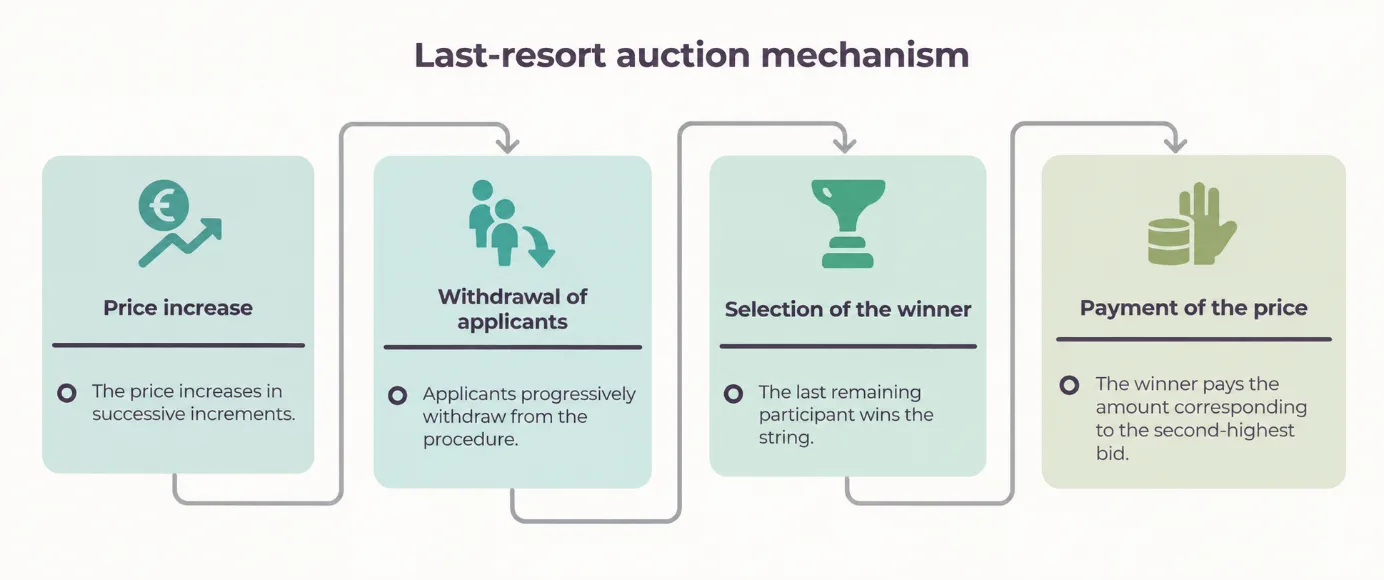
The auction of last resort will use an ascending-clock, second-price method:
the price increases through successive rounds;
applicants progressively leave the auction;
the final remaining participant wins the string;
the successful applicant pays the second-highest bid.
An indirect contention auction may leave more than one application able to proceed towards delegation.
Applicants qualifying for the Applicant Support Program may receive a bid credit of up to 35%, capped at USD 1.75 million per application. The credit is progressively reduced when the winning price exceeds USD 5 million and falls to zero above USD 9 million.
The outcome and use of the proceeds from the 2012 auctions
Sixteen auctions of last resort generated approximately USD 225 million.
ICANN has established a global Grant Program funded by the net proceeds of the 2012 auctions. Its first cycle made USD 10 million available. In 2026, the ICANN Board also authorized aggregate funding of up to USD 9.9 million from those proceeds to support as many as 75 eligible applicants participating in the new round.
The experience of the previous round also demonstrates that the winning bid is only one part of the total investment. Registry operation, contractual compliance, cybersecurity, abuse prevention and user adoption must all be incorporated into the business case.
How should trademark owners prepare for Reveal Day?
Reveal Day will make it possible to identify the applied-for strings, the applicants and the first contention situations. Trademark owners should therefore implement targeted monitoring covering not only identical trademarks, but also variants, translations, transliterations and similar signs.
For companies that have filed an application, a rapid response will be essential: where a replacement string has been designated, they will have fourteen days after Reveal Day to decide whether to activate it.
It is therefore advisable to anticipate now which strings should be monitored, the potential risks involved and the internal decision-making process, so as to be able to react immediately once the applications are published.
Conclusion
The new gTLD application round opened by ICANN in 2026 marks the return of global competition for scarce digital assets. Effective decision-making requires coordination between intellectual property, brand strategy, finance, cybersecurity and registry operations.
Dreyfus Law Firm assists its clients in managing complex intellectual property cases, offering personalized advice and comprehensive operational support for the complete protection of intellectual property.
How much does a new gTLD application cost in 2026?
The standard evaluation fee is USD 227,000 per application. Applicants must also budget for technical, legal, operational and possible auction costs.
Can a trademark owner object to a new gTLD that infringes its rights?
Yes. A Legal Rights Objection may be filed where a rights holder considers that an applied-for string infringes its existing legal rights. This procedure is separate from application comments.
What are the main grounds for objecting to a new gTLD application?
The Applicant Guidebook provides four grounds: String Confusion, Legal Rights, Limited Public Interest and Community objections.Can applicants reach a private settlement?
No. Private auctions, compensated withdrawal agreements and other private contention-resolution arrangements are prohibited under the 2026 Applicant Guidebook.
Does a .brand automatically improve search rankings?
No. Google treats new gTLDs in broadly the same manner as other generic extensions. Their principal value lies in control of the namespace, brand consistency and the identification of official services.
This publication is intended for general public guidance and to highlight issues. It is not intended to apply to specific circumstances or to constitute legal advice.
Following the separation of Sudan and South Sudan in 2011, a trademark must be subject to dual protection so as to be safeguarded throughout the territory of the two countries. Trademarks registered in Sudan are no longer protected in South Sudan. Thus, it is advisable to have two distinct registrations.
The Ministry of Justice of South Sudan is responsible for the completion of formalities under the 1969 Sudanese law. The existing system is expeditious (2 to 3 months to secure a registration certificate) but requires that an application to be filed for each proposed class (mono class system).
Once registered, the trademark will be protected for a renewable period of 10 years in the territory of South Sudan.
Any application filed today will only be legally enforceable once the new law, which is currently being debated in Parliament, shall come into force. However, protection will run retroactively from the filing date.
With the rapid proliferation of social networks and the increased access to virtual currencies, it was inevitable that the two would merge at some point. Indeed, virtual currencies are being increasingly used in networks, particularly for the payment of premium services.
Virtual currencies are characterized by their digital nature. They are stored on electronic media and used by electronic devices. They serve the same purpose as real money, that is, to purchase goods and services. However, they are private currencies and are thus not controlled or regulated by the state. They may be used either for profit or for charity.
These new currencies, which work in parallel with real money, are often network-specific. Facebook Credits and Twitter’s Twollars are amongst the most popular. They have also established themselves in other media, particularly in video games.
There are two systems of virtual currencies:
– open systems where real money can be converted into virtual currency and vice versa;
– closed systems where virtual currency cannot be reconverted back into real money.
In connection with these currencies, new payment methods can be found which are specifically designed for social networks like, for instance, Dwolla. At the same time, “likes”, followers and tweets are being monetized. This concept was used in Marc Jacobs’ pop-up store during the Fashion Week in New York where customers could pay through tweets by using the hashtag #MJDaisychain.
Currently, these currencies are not regulated. However, their evolution and the stakes involved make it very important for a related legal framework to be established. Given their lack of territoriality, an international solution should be found for these currencies to be effectively monitored. This makes the issue a complex one.
Dorothy M. Hartman, a retired science teacher and the CEO of the ABFY SELLERS group, claims that her contributions towards The Internet 2 were stolen by the federal government through its Small Business Innovation Programs and the National Science Foundation. According to Hartman, after her patent application was fraudulently prosecuted by the United States Patent and Trademark Office, she responded by filing writs in the United States Supreme Court. The Internet 2, which has brought enormous change around the globe in terms of how people do business, and has turned into to a trillion dollar industry, is certainly worth fighting for, especially considering Hartman’s current business ventures are struggling.
As a background, if you are unaware of the drastic differences between the Internet 1 and the Internet 2, and don’t want to delve in-depth into technical details, imagine the difference between a line and a circle. Before the invention of the Internet 2, the internet was more or less seen as a tool for business and utility. Websites, created by webmasters could be visited by online users. However, communication remained fixed between these two actors in a linear relationship. If we compare this to the advent of The Internet 2, which has become more about social media, commercial transactions, and online interactions, amongst various parties together, the complexities of these differences become evident. It is now circular, with webmasters, online users and other online users all in a circle of communication together. In linking her ideas to the success of The Internet 2, Hartman says it took her insight of the web to realize these interactive transformations.
It has now been 24 years that Hartman’s voice has been ignored. At the time, Hartman was 46 years old when she submitted a business plan to the government with the goal of obtaining funding for a telecommunications services prototype company. Her plan, which was dismissed by the government, was apparently stolen to enrich the Internet 1 and those already in the internet industry. The battle for her intellectual property has felt like an up-hill battle to the now senior Hartman, who no longer feels she has the strength to fight against the power of the government and massive multinational companies.
Hartman rejects the reasoning of the U.S. Court of Appeals for the Federal Circuit in the 2013 case on the following grounds:
She claims that the Court did not distinguish between the Internet 1 and the Internet 2 and that the difference is definite;
the Court did not acknowledge the, what she claims to be, fraudulent behavior of the United States Patent and Trademark Office;
the Patent Office argument was invalid in its assertion of “indefiniteness.”
Despite her age, Hartman claims she will continue to fight for justice and for what she deserves for producing an invention which has without doubt changed the world. Numerous media outlets have begun describing this case and the injustice to which Hartman is being subjected to in relation to Hartman’s status as a black female operating in a male dominated industry. Regardless of this, it can surely be said that whoever the inventor of the Internet 2 is, they deserve credit for what could be said to be the 20th century’s greatest invention.
Three post-delegation dispute resolution procedures (PDDRP)for the new extensions have been implemented :
The TM-PDDRP on trademark infringement;
The RRDRP which comes into play when the registry of a new community extension goes beyond the restrictions contained in its registry agreement;
The PICDRP.
The Public Interest Commitments Dispute Resolution Procedure (PICDRP) was developed to ensure the compliance of the registries with the commitments undertaken in their registry agreement with ICANN.
What does the procedure sanction?
By signing the registry agreement with ICANN, companies applying for new domain name extensions subjected themselves to numerous technical, financial and legal obligations. The duty to comply with public interest commitments (PICs) as well as the duty to comply with Specification 11 of the registry agreement (see below) form part of these obligations. The PICDRP therefore sanctions the registries’ non-compliance with their commitments in this respect.
Like all post-delegation dispute resolution procedures, the PICDRP sanctions the very behavior of the extension registry. It thus differs significantly from the UDRP procedure, for instance, which targets domain names registrants.
What are PICs?
As from March 5, 2013, applicants for new gTLDs were given twenty-eight days to make public interest commitments. They were thus afforded the opportunity to specifically define the commitments they intended to take (or not), either by referring to their application file, or by undertaking completely new obligations.
For example, Donuts Inc, the applicant with the largest number of filed applications, undertook that the domain name .lawyer be only open to legal professionals, with a view to protecting consumers. Donuts may thus be liable if it decides to make the .lawyer extension accessible to all internet users.
“These are commitments made to the community, to governments, and to all those who could oppose applications – they are not commitments to ICANN,” said the President of the Global Domains Division at ICANN, Akram Atallah, at the time. And of course, it is these same commitments that the PICRDP will sanction in the event of non-compliance.
What is Specification 11?
Inserted in the registry agreements entered into with ICANN, Specification 11 requires registry operators of new gTLDs inter alia not to impose eligibility criteria for the registration of domain names which would limit the registrations to a single person/entity or affiliated persons/entities.
Specification 11 results from the opinions emanating from the GAC, the ICANN body representing governments. The GAC had identified gTLDs reflecting regulated or restricted industries, as well as generic extensions which applicants wish to make exclusive use of (known as “closed generic TLDs”). The GAC thus made several proposals in an effort to protect public interest in relation to these extensions which took the form of Specification 11. This document is attached to the registry agreement.
The obligation of registries to sign the RAA 2013 (the latest version of the Registrar Accreditation Agreement) with the registrars or that to publish and comply with the registration rules are also included in Specification 11.
What is the procedure?
The PICDRP is the mechanism through which ICANN intends to enforce public interest commitments. Any person who deems that PICs or provisions of Specification 11 have not been complied with by an extension registry can lodge a complaint with ICANN stating:
– The basis of the complaint;
– The way in which the registry did not comply with its commitments;
– The resulting loss.
After a preliminary assessment, ICANN forwards the complaint to the relevant extension registry. The latter then has 30 days to liaise with the complainant and try to find a solution. Beyond this deadline, the registry will have to explain to ICANN how it complies with public interest commitments. ICANN will have investigation powers and, at its sole discretion, will have the power to appoint three experts who will investigate and assess whether the registry has breached its commitments. If the behavior of the registry does not comply with the PICs or Specification 11, ICANN may require it to take corrective measures within 30 days and could thereafter adopt measures culminating in the termination of the registry agreement.
Which TLDs does the procedure apply to?
The PICDRP is solely intended for new domain name extensions. Therefore, neither national extensions known as ccTLDs (such as .fr or .uk) nor traditional gTLDs (such as .com, .info, .net or .org) are covered.
Dreyfus specializes in the resolution of Internet disputes, particularly in relation to new domain name extensions. Please do not hesitate to contact us for any queries.
On June 9, 2014, a federal district court in California refused to dismiss the complaint lodged by Parts.com against U.S company, Yahoo for the second time in less than six months.
Parts.com is a company specializing in the online sales of car parts. It alleged that the keyword “parts” on the Yahoo search engine refereds to a direct competitor. The trademark Parts.com would thus allegedly be used as a keyword, which entails an infringement of its rights. Parts.com sued Yahoo and its competitor which avails itself of the keyword for referencing purposes.
Last December, Yahoo contended that the term “parts” was descriptive and could thus not be registered as a trademark. Yet the federal court had cast aside the issue, holding that Yahoo’s argument was premature. The proceedings had been allowed to continue in this respect.
The gist of the argument put forth by Part.com centers on the sponsored links of the search engine. The company states that these links which steer towards competing sites divert internet users and the profits of Parts.com to other companies. According to the plaintiff, this results in a drop in sales, returns on investment, trademark dilution as well as additional losses.
In its reply, Yahoo did not depart from its argument and asked for the proceedings to be dismissed in the absence of any trademark right on the words “parts.com”. The US giant also requested the court to sentence Parts.com for abuse of process. It cited the Communication Decency Act, which provides that the provider of an interactive service cannot be treated as the publisher of any information provided by a third party.
The court therefore did not grant the second request of Yahoo, stating that the submissions of Parts.com were serious enough for the case to be reviewed on its merits. It remains for the court to review the generic nature of the words “parts.com” and Yahoo’s liability for trademark infringement.
Several federal courts have already ruled as regards the lack of distinctive features in the names and , which, accordingly, have not been afforded the protection granted to trademarks.
This matter is reminiscent of the case-law relating to Google’s Adwords, where the company was repeatedly sentenced for having played an active role in selecting keywords and writing down advertisements. It remains to be seen whether the Californian court will adhere to this well established case-law.
Dreyfus can assist you if your trademark is infringed through keywords. Please contact us for any information you may require.
The issue of net neutrality, and particularly that of leading players such as Google, Apple or Amazon, is currently of interest to the French Government.
The Digital Council, an advisory body for all matters relating to digital development, presented a report on “platform neutrality” on Friday, June 13. This report aims at initiating discussions with Internet stakeholders for the development of a set of the best practices in order to ensure a free and open Internet that can reconcile innovation, freedom of trade and industry as well as respect for individual freedoms.
The objective of net neutrality is achieved through the fairness and transparency of the platforms. The major recommendations of the report are as follows:
impose a certain degree of fairness in the overall process of collecting and processing personal data;
acknowledge the principle of neutrality as a “fundamental principle which is necessary for the exercise of the freedom of communication and freedom of expression” and provide for its inclusion in the law “at the highest level in the hierarchy of norms”;
set up rating agencies to evaluate and grade platforms. The rationale seems to rest upon staking the reputation of businesses so that the latter rectify their behavior on their own accord out of their apprehension of reputational damage.
Despite the regrettable lack of recommendations with regard to Internet access providers in this report, the proposals of the National Digital Council shall, in France, pave the way for the informed preparation of an effective draft legislation in respect of the French digital technology and the country’s digital strategy in Europe.
It remains to be seen, however, whether major Net players will be compelled to adhere to the French rules.
On April 9, 2014, the Paris Court of Appeals[1] ruled on Google’s status regarding its AdWords services. It found that Google is a passive host provider for these specific services, which awards it limited liability destined for passive hosts provided by the E-commerce Directive.[2]
Google’s AdWords service is frequently the cause of legal disputes. This decision follows, inter alia, a decision of the Court of Justice of the European Union (CJEU), which ruled that hosting keywords corresponding to trademarks does not amount to a “use in the course of trade” that the right owner can prevent.[3]
A decision was rendered in lower court in January 2009, which found Google liable for unfair competition and misleading advertising. On appeal, the Court excluded the misleading character of the ads, stating that the display allowed any average internet user to perceive the difference between the advertising and the natural results.
The Court then focused on Google’s role in the keywords selection for its AdWords service. Google’s intervention was qualified by the judges as “merely technical, automatic and passive […], consequently lacking control and knowledge of the hosted information”. The Court also pointed out that the hosting provider had no monitoring obligation regarding illegal content.
Indeed, European law distinguishes active service providers from passive hosts to whom it offers partial immunity. This immunity exempts the hosting providers from liability for third-party content hosted on its platform. However, if there is actual knowledge of information, facts or circumstances of an illegal nature and no action was taken expeditiously to remove or disable access to the illegal content, the host may be held liable.
The Paris Court of Appeals’ decision confirms the trend set by previous French case law as well as the Spanish Court in the Telecinco v Youtube case[4] whereby automatic services do not contravene to the neutral nature of the services provided. Therefore, the Courts recognize that there is no reason to exclude such passive service providers from liability immunity according to the E-commerce Directive.
As part of its monitoring activities, Dreyfus offers watch services covering AdWords campaigns as well as domain names and social networks.
[1] CA Paris, April 9, 2014, Google France, Inc. et Ireland / Voyageurs du monde, Terres d’aventures
[2] Directive 2000/31/CE on E-commerce
[3] CJEU, March 23, 2010, Google France v Louis Vuitton Malletier, joined cases C-236/08 to C-238/08
[4] CA Madrid, January 14, 2014, Telecinco v Youtube, N° 11/2014
Our site uses cookies to offer you the best service and to produce statistics, and measure the website's audience. You can change your preferences at any time by clicking on the "Customise my choices" section.
When browsing the Website, Internet users leave digital traces. This information is collected by a connection indicator called "cookie".
Dreyfus uses cookies for statistical analysis purposes to offer you the best experience on its Website.
In compliance with the applicable regulations and with your prior consent, Dreyfus may collect information relating to your terminal or the networks from which you access the Website.
The cookies associated with our Website are intended to store only information relating to your navigation on the Website. This information can be directly read or modified during your subsequent visits and searches on the Website.
Necessary cookies are absolutely essential for the website to function properly. These cookies ensure basic functionalities and security features of the website, anonymously.
Dreyfus is concerned about protecting your privacy and the Personal Data ("Data"; "Personal Data") it collects and processes for you.
Hence, Dreyfus complies every day with the European Union legislation regarding Data protection and particularly the European General Data Protection Regulation Number 2016/679 of 27 April 2016 (GDPR).
This Privacy Policy is aimed at informing you clearly and comprehensively about how Dreyfus, as Data Controller, collects and uses your Personal Data. In addition, the purpose of this Policy is to inform you about the means at your disposal to control this use and exercise your rights related to the said processing, collection and use of your Personal Data.
This Privacy Policy describes how Dreyfus collects and processes your Personal Data. The collection happens when you visit our Website, when you exchange with Dreyfus by e-mail or post, when exercising our Intellectual Property Attorney and representative roles, when we interact with our clients and fellow practitioners, or on any other occasion when you provide your Personal Data to Dreyfus, in particular when you register for our professional events.


 Written by Nathalie Dreyfus24/10/2014
  n April 2013, the Government of the British Virgin Islands adopted a new law to revamp its trademark regime established in the 19th century.