Nathalie Dreyfus

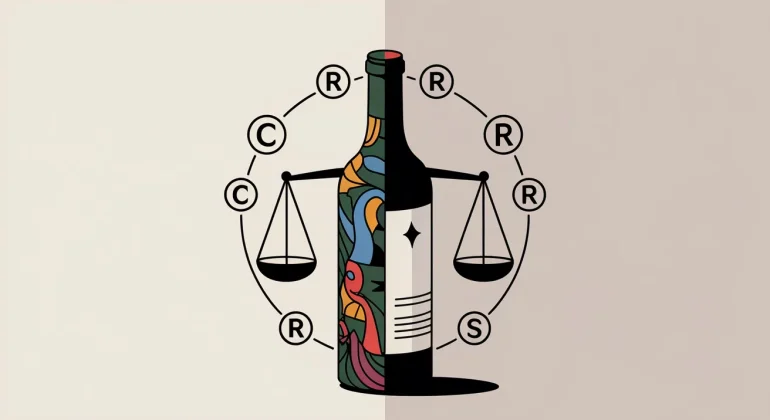
Professional accounts available on Instagram: how to prevent “username squatting”?

Introduction

The launch of professional accounts on Instagram marked a decisive step in the evolution of corporate communication. Social media platforms are no longer merely channels for institutional expression; they are now fully integrated into business development strategies, customer relations, and the enhancement of intangible assets.

However, this evolution entails a specific and often underestimated legal risk : “username squatting”, namely the appropriation by a third party of a username corresponding to a trademark or distinctive sign. In a digital environment where control over identity determines credibility and visibility, securing identifiers has become a major strategic issue.

Instagram and professional accounts : a strategic asset at risk

The shift to professional accounts has significantly transformed the nature of Instagram profiles. Access to audience analytics, promotional tools and commercial features has turned the account into a genuine business asset.

In this context, the username is no longer a secondary choice. It concentrates trademark visibility on the platform and determines how easily consumers can identify and find the company. It also contributes to consistency across digital channels, including domain names and other social media platforms.

When a third party registers or exploits this identifier, the consequences go beyond mere technical inconvenience: public confusion, loss of traffic, trademark dilution and a weakening of the overall digital strategy may result.

Username squatting : definition, mechanisms and legal risks

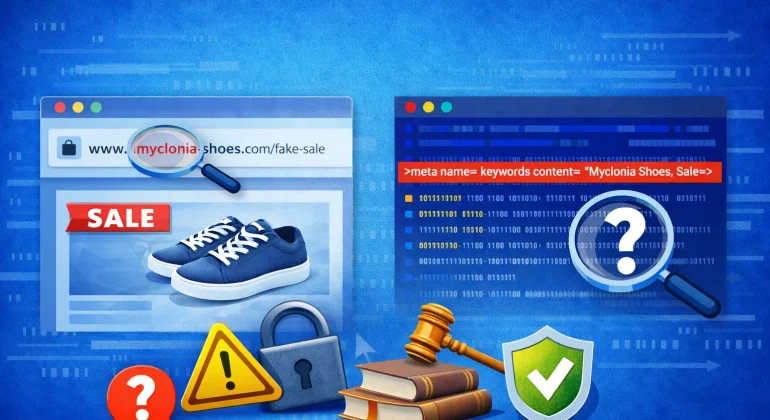
Username squatting refers to the registration of a username identical or similar to a trademark, generally with speculative or harmful intent. This practice follows the logic of cybersquatting observed in domain names, now transposed to social networks.

Motivations may vary : resale at a high price, traffic diversion, exploitation of a trademark’s reputation, and more generally, of a company, or even identity impersonation intended to mislead consumers.

From a legal perspective, the risks are significant. Where a trademark is registered, the use of a username incorporating the protected sign may constitute trademark infringement if it amounts to use in the course of trade likely to create a likelihood of confusion. Case law acknowledges that a digital identifier may qualify as trademark use where it seeks to attract public attention in a commercial context.

In the absence of a sign being filed, action may be brought on the grounds of unfair competition or parasitism. In such cases, fault, damage and a causal link must be demonstrated, requiring a detailed analysis and solid evidentiary support.

Beyond litigation, damage to online reputation may occur rapidly and have lasting consequences, particularly where the disputed account disseminates misleading or harmful content.

Legal grounds for taking action against the misappropriation of a username

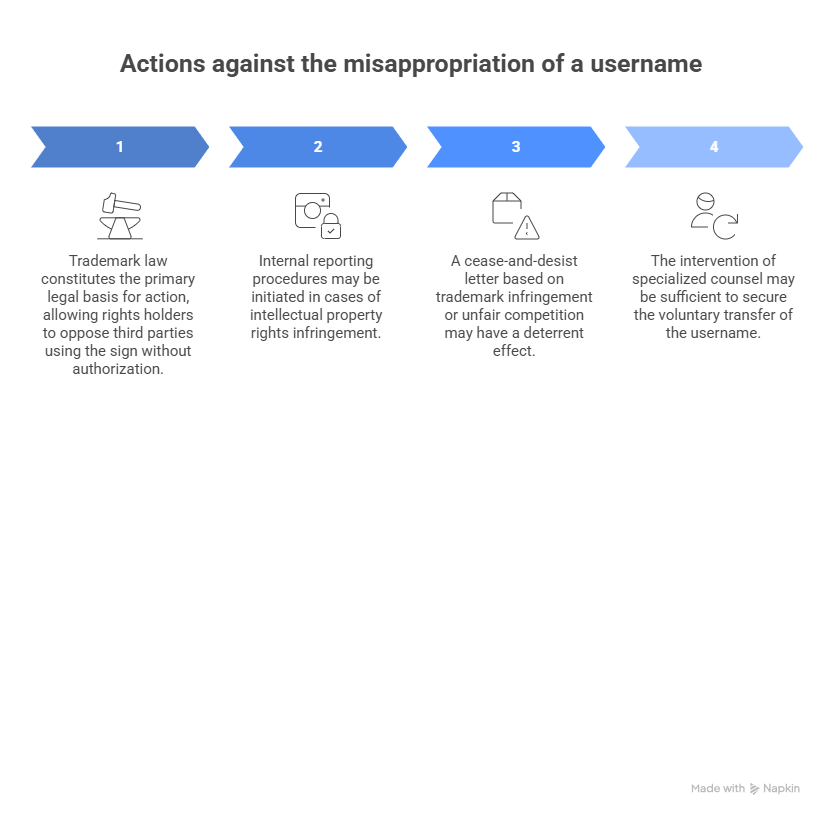
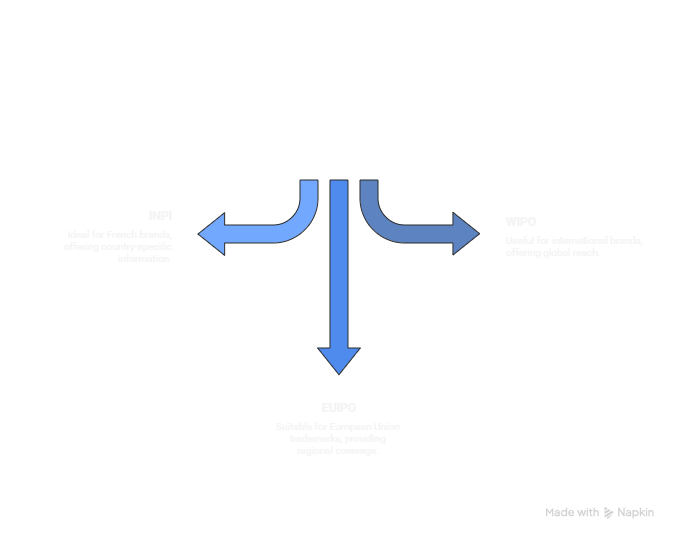
Trademark law constitutes the primary legal tool. Registration with the INPI, EUIPO, or through an international filing provides an exclusive right that may be enforced against unauthorized third-party use.

In parallel, Instagram, and more generally the Meta group, provides internal reporting procedures in cases of intellectual property infringement. These mechanisms require evidence of ownership and proof of the alleged infringement. The strength of the file and the rights holder’s responsiveness are decisive factors.

Where necessary, a formal cease-and-desist letter based on trademark infringement or unfair competition may have a strong deterrent effect. In certain cases, the intervention of specialized counsel is sufficient to secure voluntary transfer of the username.

actions misappropriation username

Prevention : protecting your trademark before opening a professional account

Prevention remains the most effective strategy. Reserving usernames should be integrated into any trademark launch or development strategy, alongside trademark filing and domain name registration.

Implementing digital monitoring enables early detection of abusive registrations and allows prompt action. Such monitoring forms part of a broader policy for managing intangible assets and governing digital identity.

To learn more about the importance of monitoring your trademark on social media, we invite you to read our previously published article.

A global strategic approach : digital consistency and trademark protection

Username squatting should not be viewed in isolation. It forms part of a broader reflection on the consistency and security of a company’s digital presence.

Alignment between the registered trademark, domain names and social media identifiers strengthens commercial credibility and limits the risk of impersonation. Rigorous digital identity governance helps prevent fraud, reputational damage and traffic loss.

Today, digital identity constitutes a fully-fledged intangible asset. Its protection should be approached with the same level of rigor as other intellectual property rights.

Conclusion

The launch of professional accounts on Instagram offers considerable commercial opportunities and plays a key role in corporate visibility strategies.

However, the risk of username squatting requires increased vigilance. Effective protection relies on a combination of prior trademark registration, strategic reservation of identifiers and swift action in the event of infringement.

In a competitive digital environment, securing a username is not a minor operational detail; it is a major legal and strategic issue.

Dreyfus & Associés assists its clients in managing complex intellectual property matters by providing tailored advice and comprehensive operational support for the full protection of intellectual property rights.

Dreyfus & Associés works in partnership with a global network of specialized intellectual property lawyers.

Nathalie Dreyfus with the support of the entire Dreyfus team.

Q&A

1. Can a company reserve a username without immediately using the account ?
Yes. Preventive reservation of a username is recommended even if the account is not immediately active. It prevents third-party appropriation and secures future digital strategy.

2. Does the inactivity of a squatted account make transfer easier ?
Not automatically. Inactivity alone is insufficient; infringement of prior rights or violation of platform rules must be demonstrated.

3. Can a slightly different username still create legal issues ?
Yes, if the similarity creates a likelihood of confusion in the public’s mind. Assessment is case-specific and depends on the trademark’s reputation and the context of use.

4. Is a username considered a company asset ?
Indirectly yes. As part of digital identity, it contributes to trademark recognition and coherence, potentially impacting the overall valuation of intangible assets.

5. Is social media monitoring truly necessary for SMEs ?
Yes. The risk of impersonation does not only affect large corporations. Appropriate monitoring enables early detection of infringements and limits their impact.

This publication is intended to provide general guidance and highlight certain issues. It is not intended to apply to specific situations nor to constitute legal advice.

Read More

Are designs an effective weapon against fast fashion?

Introduction

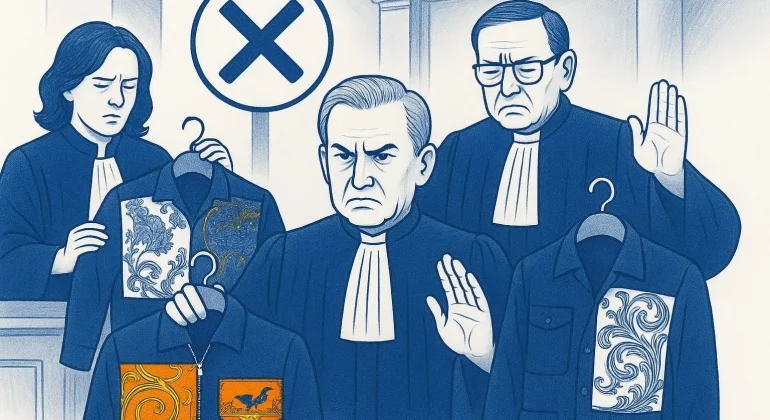
In its Deity Shoes case of December 18, 2025, the Court of Justice of the European Union (CJEU) clarified with remarkable precision the conditions for protection of community designs.

Through this decision, the Court reaffirmed two fundamental principles: first, that protection under Regulation (EC) No 6/2002 is subject solely to novelty and individual character. Second, that the existence of fashion trends cannot lower the threshold required to establish individual character.

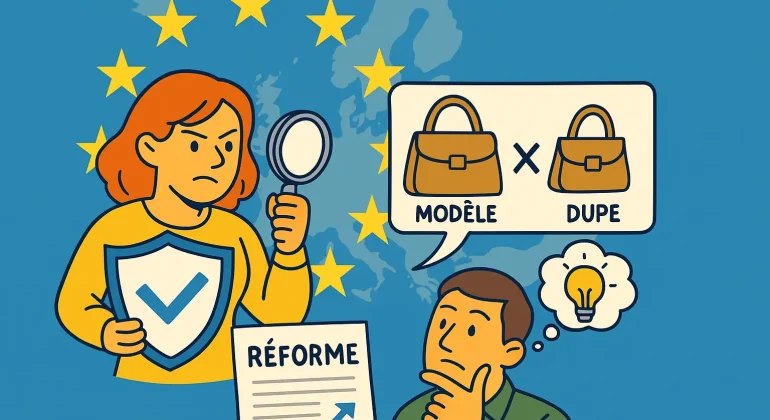
In recent years, fast fashion has profoundly transformed the fashion industry. Within weeks sometimes days a trend spotted on a runway or social media platform is reproduced on a large scale. The phenomenon of “dupes” products openly marketed as near-identical alternatives at lower prices further intensifies this pressure. We invite you to read our article previously published on this issue.

This judgment arises in a context marked by increasing litigation related to fashion, product customization and rapid reproduction practices. It now stands as a key reference for design right holders throughout the European Union.

The background of the case: A revealing illustration of contemporary creative practices

Deity Shoes marketed footwear protected by community design registrations. Its creative process relied on selecting and combining components sourced from catalogues of Asian suppliers. Colors, materials, decorative elements and accessories were chosen from pre-defined options and assembled into a final product intended for the European market.

When sued for counterfeiting, the defendant companies challenged the validity of the asserted rights. In their view, the designs merely resulted from the juxtaposition of pre-existing elements, without genuine creative contribution, and therefore could not meet the statutory requirements.

The CJEU was asked to clarify two sensitive issues:

  • Whether a minimum threshold of creativity exists under EU design law;
  • Whether fashion trends affect the assessment of individual character.

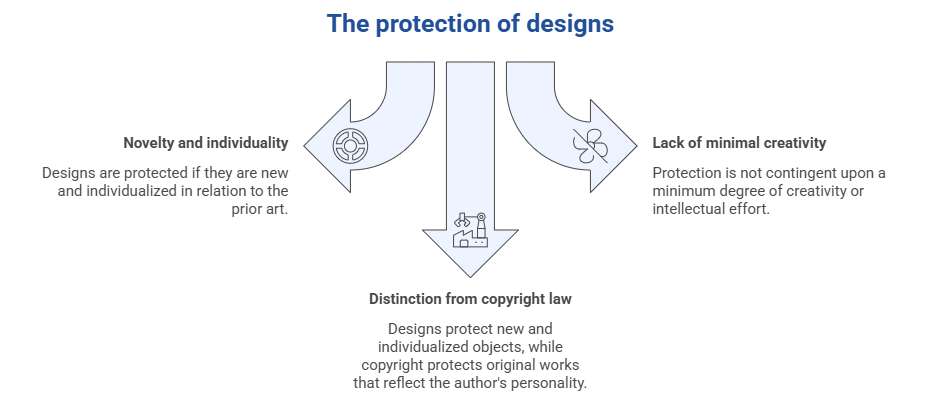
Fundamental reminder: no “minimum degree of creativity” required for design protection

One of the central questions referred to the Court concerned the possible existence of a minimum creativity threshold. The defendants argued that the contested designs reflected nothing more than combinations of existing elements and did not demonstrate any particular intellectual effort.

The Court rejected this reasoning unequivocally. Protection under Regulation No 6/2002 cannot be made conditional upon a “minimum degree of creativity” or a “particular intellectual effort.”

The Court clearly distinguished design law from copyright law. While copyright protects original “works” reflecting the author’s personality, design law protects new and individualized objects, often of an utilitarian nature and intended for mass production.

Accordingly, the assessment does not focus on the intensity of the creative process but on the final product. Novelty and individual character must be evaluated through an objective comparison with prior designs. The concept of “designer,” referred to in Article 14 of the Regulation, is relevant only for determining ownership and does not introduce any additional substantive condition for protection.

Design law: is the customization of a pre-existing design sufficient to establish individual character?The Court further clarified that “the fact that a design results from the personalization of a basic model […] is not, in itself, an obstacle to recognizing its individual character.”

The decisive factor remains the overall impression produced on the informed user. Even when composed of known elements, a design may be protectable if the specific combination creates an overall impression that differs from that produced by any individual prior design.

This clarification is crucial for the fashion industry, where creativity often operates through selection, adaptation and recombination rather than radical invention.

protection of designs

The informed user and the requirement of a global comparison

The Court adopted a rigorous approach to the assessment of individual character. The analysis must be conducted from the perspective of the informed user, defined as a person possessing a high degree of attention and extensive knowledge of the sector concerned.

This informed user is familiar with prevailing fashion trends. However, such knowledge does not reduce the level of scrutiny. On the contrary, it makes the user more attentive to differences in detail.

The Court emphasized that the assessment must be based on a global comparison, independent of aesthetic considerations, commercial positioning or the popularity of certain elements. The reasoning cannot rely on the notoriety of a trend or market saturation.

Practical implications of the case for fashion stakeholders

The judgment comes at a time of modernization of EU design law. The ongoing reform seeks to adapt the system to digital environments, clarify key concepts and enhance legal certainty.

In this context, the Deity Shoes ruling consolidates the theoretical foundations of the regime. It reassures right holders by confirming that protection is not dependent on fluctuating subjective criteria. At the same time, it prevents an excessive dilution of the individual character requirement in a sector heavily influenced by trends.

For businesses, this case law calls for a structured filing strategy. It is essential to:

  • Clearly define the scope of claimed protection;
  • Identify the visually dominant features of the design;
  • Anticipate potential comparisons with prior art.

A proactive and strategic approach significantly enhances enforceability against fast fashion operators.

Conclusion

Design rights constitute an effective legal weapon against fast fashion, provided they are deployed within a coherent strategy. The Deity Shoes ruling clarifies that protection does not depend on subjective creative effort or the existence of fashion trends, but rather on the overall perception of the product by the informed user.

This strengthens business models based on adaptation and combination while maintaining a high and objective threshold for individual character. For fashion creators who invest in structured intellectual property protection, the legal framework offers robust and predictable safeguards.


Dreyfus & Associés assists its clients in managing complex intellectual property matters by providing tailored advice and comprehensive operational support for the full protection of their intellectual assets.

Dreyfus & Associés works in partnership with a global network of Intellectual Property attorneys.

Nathalie Dreyfus with the support of the entire Dreyfus team


Q&A


1. Can fast fashion reduce the effectiveness of design protection?

Fast fashion does not alter the legal validity criteria. However, rapid production cycles and widespread copying may complicate enforcement. Effectiveness therefore largely depends on the filing, monitoring and enforcement strategy implemented by the right holder.

2. Can a design inspired by a supplier’s catalogue be protected?

Yes. The CJEU confirmed that a design resulting from the personalization or combination of pre-existing elements may be protected, provided that the chosen combination produces a distinct overall impression. The originality of each component taken individually is irrelevant.

3. Does commercial success influence the assessment of individual character?

No. The analysis is strictly legal and objective. Market popularity, aesthetic appeal or branding strategy do not affect validity. Only the overall impression on the informed user is decisive.

4. How long does protection of a community design last?

A registered community design is protected for an initial period of five years, renewable in five-year increments up to a maximum of 25 years. An unregistered community design benefits from three years of protection from the date of disclosure within the European Union.

5. Is it necessary to demonstrate significant creative effort to obtain protection?

No. Unlike copyright law, EU design law does not require a minimum degree of creativity or particular intellectual effort. Novelty and individual character are the only substantive requirements.

Read More

Trademark invalidity in France and the European Union : when and how can a registration be challenged ?

Introduction

Trademark invalidity in France and in the European Union has become a major strategic tool for securing a portfolio of rights, defending a competitive position, or neutralizing an opportunistic filing. Since the reform introduced by the Ordinance of  November 13, 2019 and the transfer of jurisdiction to the French National Institute of Industrial Property (INPI) for a large portion of intellectual property administrative disputes, invalidity actions have become more structured, professionalized, and significantly faster.

When can an invalidity action be brought ? On what legal grounds ? What procedure should be followed before the INPI or the EUIPO ? And above all, how can the chances of obtaining cancellation of a registered trademark be maximized ?

We provide here a structured, practical analysis grounded in experience.

What is trademark invalidity under French and EU law ?

Trademark invalidity consists of establishing that a sign registered as a trademark should never have benefited from the protection granted under trademark law. It is not a matter of sanctioning conduct occurring after registration, but rather of identifying a legal defect that existed at the filing date. In other words, invalidity is based on the principle that the trademark was irregular ab initio.

Since the reform that entered into force in 2020, the INPI has jurisdiction over  administrative invalidity actions. This development has profoundly transformed practice by making proceedings more accessible and considerably faster.

At EU level, Regulation (EU) 2017/1001 governs invalidity proceedings before the EUIPO. Although principles are harmonized, the analysis remains demanding, particularly with regard to evidence and the assessment of likelihood of confusion.

The effect of an invalidity decision is particularly powerful : the trademark is deemed never to have existed. This retroactive effect may weaken license agreements, coexistence agreements, or infringement actions based on the cancelled title. In strategic litigation, invalidity can therefore neutralize a competitor’s legal weapon.

Absolute and relative grounds for trademark invalidity

The distinction between absolute and relative grounds structures the entire invalidity framework. The former protect the public interest; the latter safeguard earlier private rights.

  • Absolute grounds for invalidity :

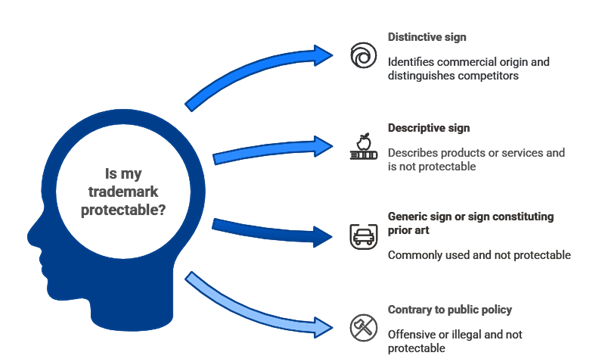
A trademark is liable to invalidity if, at the time of filing, it did not meet the essential validity requirements. This is the case where it lacks distinctive character, merely describes the goods or services concerned, has become customary in everyday language, or is misleading as to the nature, quality, or origin of the goods.

Contrary to public policy or morality may also constitute an independent ground, although its application remains rare and strictly interpreted.

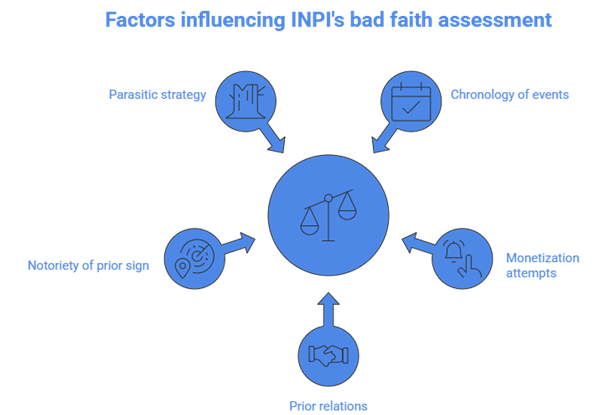
Bad faith of the applicant has become central in contemporary case law. French and European courts carefully scrutinize massive, defensive, or speculative filing strategies. A filing made solely to prevent a competitor from accessing the market, without any genuine intention to use the sign, may constitute abusive conduct justifying cancellation.

In technological sectors, we frequently observe filings anticipating emerging trends, such as artificial intelligence, blockchain, or the metaverse, made by entities with no actual development project. In such situations, the chronology of events, the relationship between the parties, and the competitive context become decisive.

  • Relative grounds for invalidity :

Invalidity may also be based on the existence of an earlier right. This may include a French trademark, an EU trademark, or an international trademark designating the relevant territory. Other rights may also be invoked, such as a prior company name, trade name, domain name effectively used in the course of trade, copyright, or personality rights.

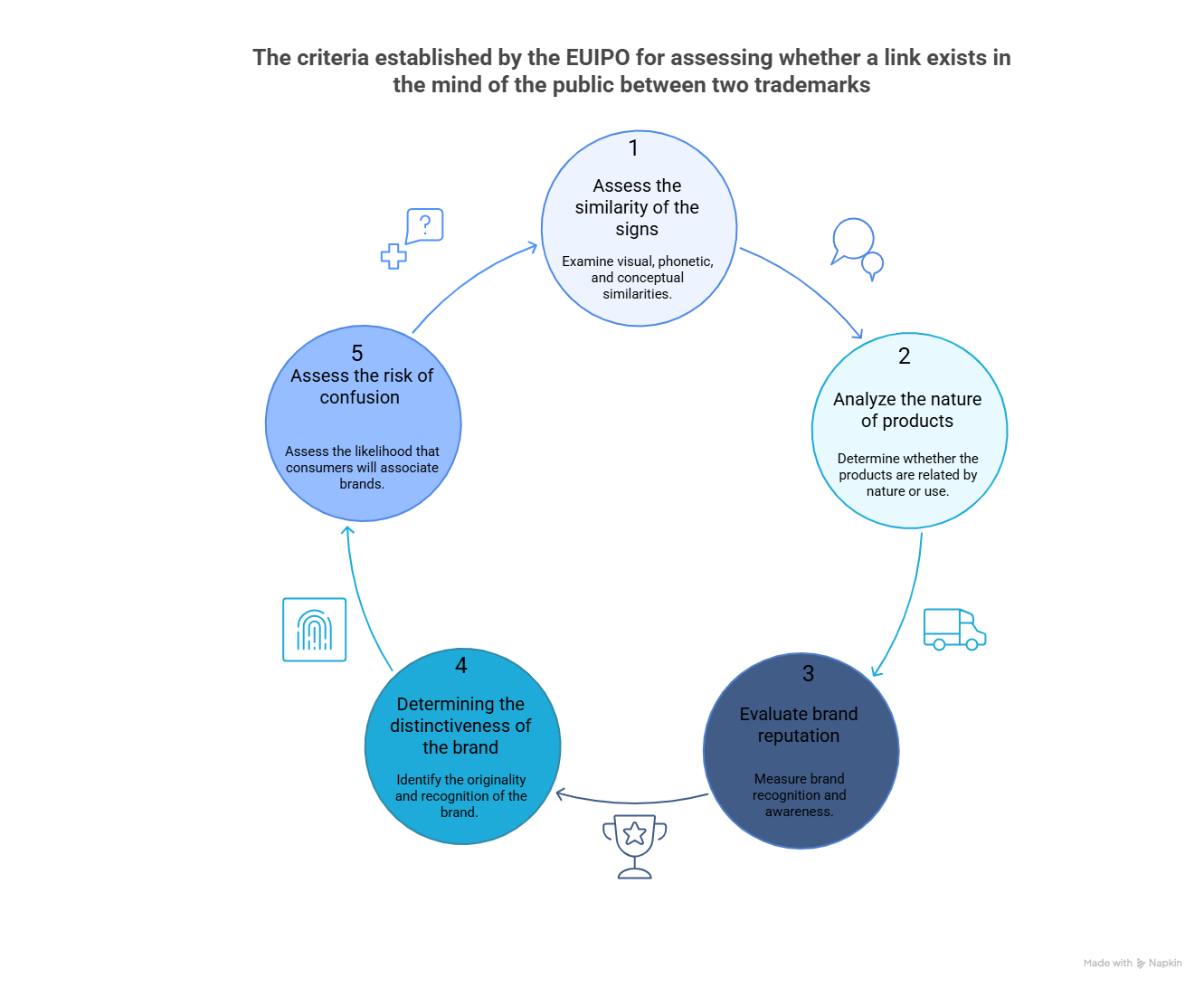
The analysis is based on the concept of likelihood of confusion, assessed globally. Authorities examine the visual, phonetic, and conceptual similarity of the signs, the proximity of the goods or services, and the distinctiveness of the earlier right. This assessment is contextualized: the relevant public, the level of consumer attention, and the possible reputation of the earlier right all play a determining role.

Practice shows that mere chronological priority is insufficient. It is also necessary to demonstrate effective use and real economic impact. Evidentiary strategy therefore lies at the heart of a successful action.

Invalidity proceedings before the INPI and the EUIPO

Since the reform, proceedings before the INPI have become a particularly effective tool. The procedure is fully digital and based on a strictly regulated timetable. Exchanges are written and adversarial. Each party must present all arguments and evidence within the prescribed deadlines, failing which submissions may be declared inadmissible.

A decision is generally issued within six to ten months, which represents a significant gain in time compared to traditional judicial proceedings. This speed allows invalidity actions to be integrated into broader commercial strategies, including fundraising operations or portfolio restructuring.

Certain complex situations, particularly where invalidity is based on copyright or contractual issues, remain within the jurisdiction of judicial courts.

For further information on the invalidity procedure before the INPI, we invite you to refer to our  article, previously published on this subject.

Before the EUIPO, proceedings follow a similar logic within a harmonized European framework. The application must be precisely reasoned and accompanied by all relevant evidence. The trademark holder has the right to respond, and the decision may be appealed before the Boards of Appeal.

The evidentiary requirement is particularly high. Applications that are insufficiently substantiated are systematically rejected. Drafting rigor and strategic coherence are therefore essential.

What evidence is required to obtain trademark invalidity ?

The success of an invalidity action largely depends on the quality of the evidence produced. For absolute grounds, it may be necessary to demonstrate the descriptive nature of a term through linguistic analyses, specialized dictionary extracts, sector publications, or examples of common market usage.

In cases involving bad faith, email exchanges, the chronology of business relationships, competing initiatives, or a manifest absence of intent to use may constitute decisive indicators.

Where invalidity is based on an earlier right, registration certificates alone are not always sufficient. If the earlier trademark is more than five years old, its holder must demonstrate genuine use. Invoices, catalogs, advertising campaigns, dated screenshots, and sector-specific turnover figures then become essential.

Recent case law strictly regulates the late submission of evidence. Methodical anticipation is therefore indispensable from the outset of the action.

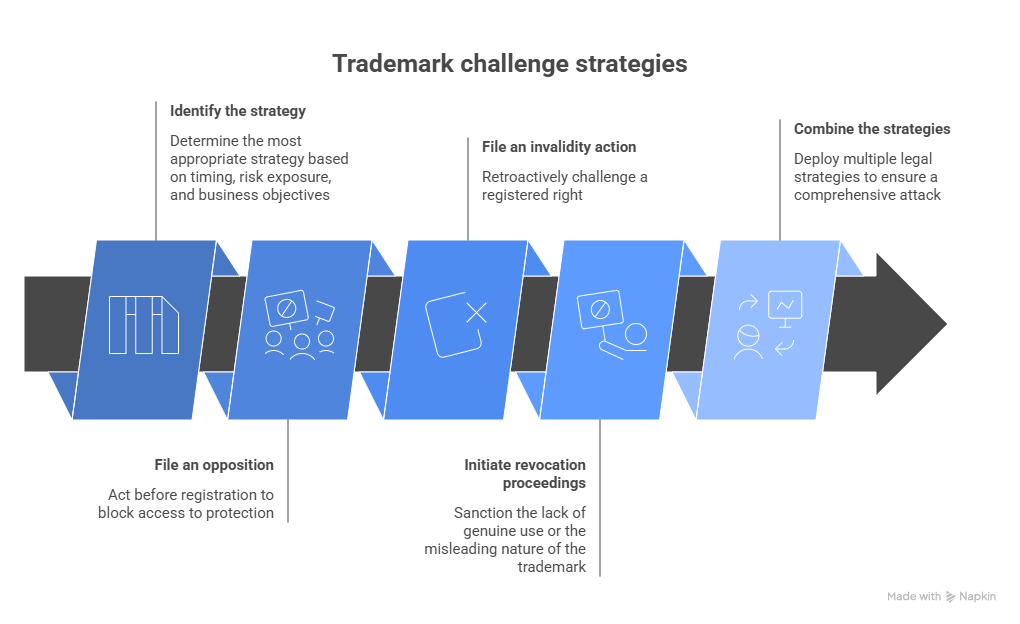
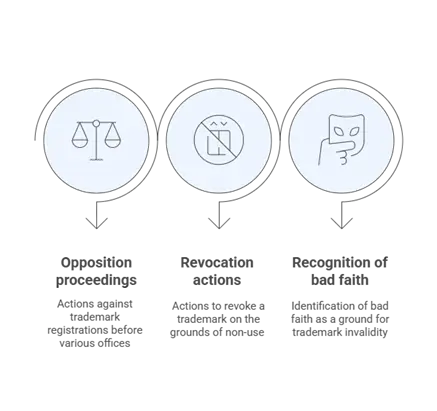
Invalidity, opposition or revocation : which strategy should be chosen ?

The choice between opposition, invalidity and revocation is not merely a procedural preference ; it forms part of a broader strategic approach that takes into account timing, legal risk exposure and underlying business objectives.

Opposition is the preventive tool by excellence. It allows action to be taken upstream, before the contested trademark is registered. In France, opposition must be filed within two months from the publication of the application in the official bulletin (BOPI). At European Union level, the time limit is three months from the publication of the European Union trademark application by the EUIPO. The decisive advantage of opposition lies in its ability to block registration and prevent the trademark from producing legal effects. However, it requires active monitoring of trademark filings and immediate responsiveness.

Invalidity, by contrast, operates after registration. It enables a party to challenge retroactively a right that has already been entered on the register. Invalidity becomes a central strategic instrument when the opposition deadline has expired or when the dispute arises within broader litigation, particularly as a defense in infringement proceedings. In such cases, invalidity can neutralize the very foundation of the opposing party’s claim by eliminating the invoked trademark altogether.

Revocation follows a different logic. It sanctions the absence of genuine use of a trademark over an uninterrupted five-year period, or circumstances where the mark has become misleading or generic. Revocation is rooted in post-registration conduct and relies on a factual assessment of the effective commercial exploitation of the sign. In complex matters, revocation may be strategically combined with an invalidity action, allowing the claimant to articulate multiple lines of attack, one based on the initial irregularity of the filing, the other on the lack of subsequent use.

Ultimately, opposition protects proactively, invalidity corrects retroactively, and revocation penalizes inactivity. The appropriate choice depends less on the nature of the right itself than on procedural positioning and the competitive strategy pursued.

invalidity opposition revocation

Conclusion

Trademark invalidity in France and in the European Union is a powerful strategic instrument for the protection of intangible assets. Early analysis and rigorous structuring of the case significantly increase the likelihood of success.

Dreyfus & Associés assists its clients in managing complex intellectual property matters by providing tailored advice and comprehensive operational support for the full protection of intellectual property rights.

Dreyfus & Associés works in partnership with a global network of specialized intellectual property lawyers.

Nathalie Dreyfus with the support of the entire Dreyfus team.


FAQ


1. Can a trademark be invalidated for lack of genuine intention to use at the time of filing ?

Yes. If the filing was made without a serious intention to use the mark, in a blocking or speculative strategy, this may constitute bad faith and justify cancellation, provided consistent and objective evidence is produced.

2. Can a prior domain name be relied upon to obtain trademark invalidity ?

Yes, provided that effective prior use of the domain name in the course of trade and a likelihood of confusion are demonstrated. Mere registration is insufficient; commercial exploitation is decisive.

3. Can a weakly distinctive trademark be invalidated several years after registration ?

Yes, if the lack of distinctiveness existed from the outset and has not been remedied by intensive use conferring acquired distinctiveness. The burden of proving such acquired distinctiveness lies with the trademark holder.

4. Can an invalidity action be brought defensively in infringement proceedings ?

Absolutely. Invalidity is frequently used as a strategic defense. If the invoked trademark is cancelled, the infringement action becomes legally unfounded.

5. Does peaceful coexistence between two trademarks prevent an invalidity action ?

Not necessarily. However, conscious and prolonged tolerance of more than five years may, in certain circumstances, deprive the earlier right holder of the ability to act, except in cases of bad faith.


This publication is intended for general public guidance and to highlight issues. It is not intended to apply to specific circumstances or to constitute legal advice.

Read More

Trademark law: an effective tool to protect one’s voice and image in the age of generative AI?

Introduction

With the rapid development of generative AI systems capable of simulating voices and faces with striking realism, the legal protection of digital identity remains fragile. In this context, American actor Matthew McConaughey recently filed several trademark applications with the United States Patent and Trademark Office (USPTO), including movement trademarks depicting him.

Such an initiative has surprised many legal practitioners, as it challenges the traditional boundaries of trademark law and raises novel questions regarding the legal protection of digital identity.

The limits of personality rights in the face of generative AI

Under French law, a person’s image and voice are protected as personality rights, primarily pursuant to Article 9 of the French Civil Code related to the right to privacy. This provision protects any unauthorized use of elements enabling the identification of a person, irrespective of whether a pre-existing material medium exists. An infringement may therefore be established whenever the public is capable of recognizing the individual concerned.

Although protective, this regime relies on demanding evidentiary requirements. The claimant must demonstrate the existence of an infringement, fault, identification of the responsible party, and, where applicable, the extent of the damage suffered.

The emergence of generative AI complicates each of these elements. AI systems may produce “resembling” voices or faces without directly reproducing an identifiable recording or photograph. The legal issue lies less in the distinction between reproduction and simulation than in the assessment of identifiability: at what level of resemblance can a person be deemed legally recognizable?

Further uncertainty arises from issues of attribution. The generation of AI content may involve multiple actors, developers, infrastructure providers, end users, and distribution platforms, thereby rendering the allocation of liability more complex. Existing mechanisms remain primarily corrective and intervene only after the dissemination of the contested content.

The evolution of filing requirements for distinctive signs

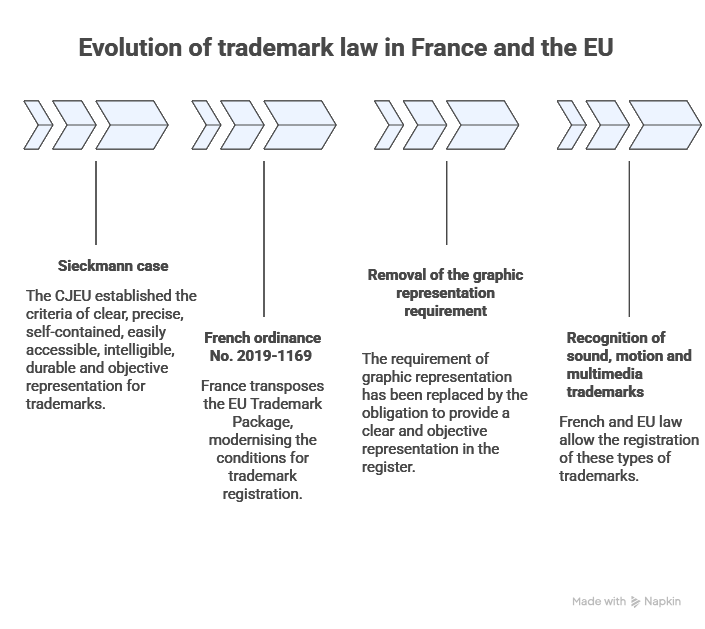
Since the entry into force of French Ordinance No. 2019-1169 of November 13, 2019 implementing the EU Trademark Package (Directive (EU) 2015/2436), French trademark law has undergone significant modernization.

The abolition of the requirement of graphic representation replaced by the obligation to represent the sign in a manner that is clear, precise, self-contained, easily accessible, intelligible, durable and objective in the register, has considerably broadened the range of registrable signs. This reform follows the criteria established by the Court of Justice of the European Union in the Sieckmann judgment (CJEU, December 12, 2002, Case C-273/00), which are now fully integrated into the practice of trademark offices.

evolution trademark law

Within this updated framework, French and EU law expressly permit the registration of sound trademarks, movement trademarks and multimedia trademarks, provided that they are represented in an appropriate technological format, such as an audio file (MP3) or video file (MP4). A sound trademark may therefore consist of a precisely fixed sequence, such as a jingle, a distinctive intonation or a recurring expression used in a commercial context, provided that the relevant public perceives it as an indication of commercial origin.

The protection of voice and image through trademark law under French and EU Law

Pursuant to Article L.711-2 of the French Intellectual Property Code, a sign may be registered only if it is linked to designated goods or services and used as a trademark to distinguish the goods or services of one undertaking from those of others. When applied to a sound or audiovisual sequence, this principle requires that the relevant public perceive the sequence as an indication of commercial origin.

It is essential to emphasize the precise scope of the monopoly conferred. Protection extends exclusively to the sign as filed and exploited, namely, the specific sound or audiovisual sequence recorded in the register. Trademark law does not grant a general appropriation of a person’s identity; rather, it secures a defined expression integrated into commercial activity.

The primary advantage of relying on trademark law lies in its litigation framework. The proprietor of a registered trademark holds a constitutive right benefiting from a presumption of validity and may initiate counterfeiting proceedings where a third party reproduces or imitates the sign in the course of trade for identical or similar goods or services.

Such action is based on the infringement of the registered sign itself, independently of the need to demonstrate personal moral damage, and allows for effective injunctive relief, including through internal procedures implemented by digital platforms.

Nonetheless, a measured approach remains necessary. Registering a sound or audiovisual excerpt as a trademark is legally demanding. Trademark law is not intended to protect an individual’s personality but to identify the commercial origin of goods or services.

Attempting to secure a voice or image through trademark law may therefore conflict with its economic rationale. It must be demonstrated that the sign genuinely fulfills the essential function of a trademark and is not merely perceived as a representation of the individual. Failing genuine use within the meaning of trademark law, the registration risks being challenged or revoked for non-use.

Conclusion

Trademark law protects only a specific sign exploited as an indication of origin in the course of trade. Its effectiveness will therefore depend, in practice, on the proprietor’s ability to demonstrate genuine, distinctive use as a trademark.

In the context of generative AI, trademark law does not constitute a universal solution. Nevertheless, it offers a more structured legal framework than personality rights alone, allowing certain uses to be anticipated and supported by an enforceable registered title. Such a strategy must, however, be embedded in a coherent and sustained commercial exploitation.

Dreyfus & Associés assists its clients in managing complex intellectual property cases, offering personalized advice and comprehensive operational support for the complete protection of intellectual property.

Dreyfus & Associés works in partnership with a global network of attorneys specializing in Intellectual Property.

Nathalie Dreyfus with the support of the entire Dreyfus team

Q&A

1.Does trademark law protect against non-commercial deepfakes?
No. Trademark law requires use in the course of trade. Deepfakes disseminated for parody or private purposes are more likely to fall under image rights or other legal mechanisms.

2.Does celebrity status provide an advantage when registering a voice excerpt?
Not automatically. While notoriety may facilitate the acquisition of distinctiveness through use, it does not exempt the applicant from satisfying the statutory conditions.

3.Does parody limit trademark protection?
In certain circumstances, freedom of expression may be invoked, particularly where the use does not undermine the essential function of the trademark.

4.Does a multimedia trademark offer broader protection?
It may provide more precise protection where the combination of sound and image constitutes the core element of commercial identification.

5.Why does registering a trademark simplify judicial proceedings in cases involving voice or image misuse?
Because infringement proceedings are based on the existence of a registered and presumed valid right, shifting the debate from the subjective assessment of personal harm to the more objective issue of infringement of a protected sign. This may render the evidentiary analysis clearer and more structured before court.

The purpose of this publication is to provide general guidance to the public and to highlight certain issues. It is not intended to apply to particular situations or to constitute legal advice.

Read More

Trademark filing: How to effectively secure its legal and commercial identity?

Introduction

Commercial identity encompasses all signs through which the public identifies a company, such as its corporate name, trade name, business sign, visual identity, or digital presence. The protection of these elements is governed by distinct legal regimes that are often less structured and less predictable than trademark law.

In a context where a company’s name and image circulate across borders instantaneously, securing distinctive signs has become a non-negotiable requirement. Trademark registration does not encompass the entirety of a company’s commercial identity; however, it constitutes its most solid legal foundation. It grants an exclusive right over a specific sign (name, logo, slogan) in relation to precisely designated goods and services. In the absence of registration, a third party may file and appropriate an identical sign. Conversely, a registered trademark enables its owner to initiate opposition proceedings, bring counterfeiting actions, and consolidate a legally controlled intangible asset.

Why is trademark filing essential to preserve its legal identity?

Under French law, a trademark constitutes an industrial property title governed by Articles L.711-1 et seq. of the French Intellectual Property Code. Registration confers upon its holder an exclusive right of use for the designated goods and services, subject to the principles of specialty and territoriality.

This exclusive right produces immediate and structured legal effects. In particular, it allows the holder to:

  • Prohibit the use of an identical or similar sign for identical or similar goods or services;
  • Take action against the use of a similar sign creating a likelihood of confusion;
  • File opposition against a subsequent trademark application within statutory deadlines;
  • Initiate infringement proceedings before specialized courts;
  • Challenge domain name registrations reproducing or imitating the trademark;
  • Exploit the sign through licensing, franchising, or assignment.

A registered trademark therefore constitutes a right enforceable erga omnes. By contrast, in the absence of registration, protection relies on unfair competition or parasitism claims under Article 1240 of the French Civil Code. Such actions require proof of fault, damage, and causation, an evidentiary burden considerably more uncertain than in trademark infringement proceedings. Registration thus transforms commercial use into a legally consolidated property right.

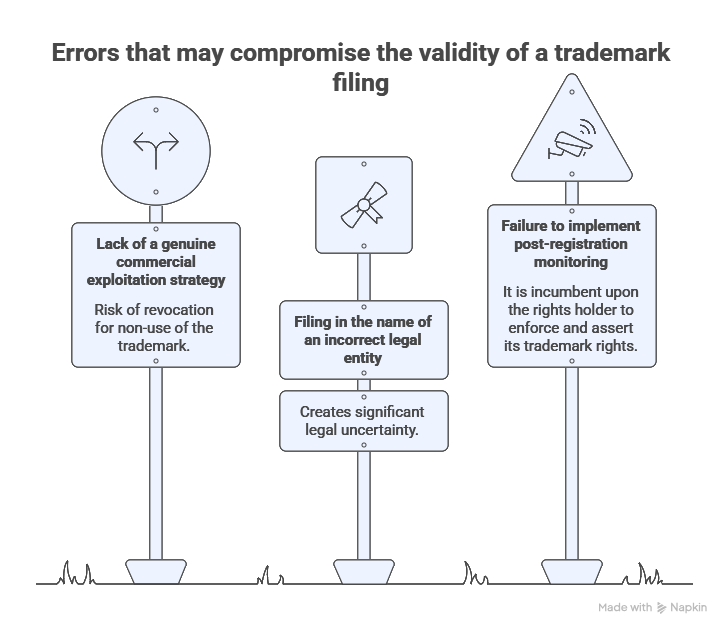
This protection nevertheless requires consistency between the registered sign and the actual business activity. The selection of classes under the Nice Classification and the drafting of specifications must correspond to a genuine, documented, and coherent business project. Recent case law confirms that trademark filing may not be diverted from its economic purpose. The decision of the French Intellectual Property Office (INPI) dated September 13, 2024 (NL 23-0183) concerning bad faith filing confirms that a speculative filing intended solely to block a third party, without genuine intent to use, is liable to cancellation.

A detailed analysis of this decision is available here:

https://www.dreyfus.fr/en/2025/02/10/french-trademark-office-inpi-decision-of-september-13-2024-bad-faith-trademark-filing-and-its-implications/

error compromising filing

How to integrate trademark filing into a comprehensive protection strategy?

Trademark registration is not an end in itself. To achieve full effectiveness, it must form part of a coordinated strategy encompassing all means of identification and exploitation of the sign.

Consistency between trademarks and domain names is essential. Filing a trademark without securing the corresponding strategic domain names (.fr, .com, or relevant country-code extensions) exposes the company to opportunistic registrations capable of generating confusion, traffic diversion, or fraud. An effective protection strategy therefore requires proactive domain name registration and ongoing monitoring of competing filings.

This protection must also be aligned with digital compliance. The exploitation of a trademark on a website or digital platform requires compliance with legal obligations relating to mandatory disclosures, personal data protection, and commercial communication rules. Deficiencies in this area may weaken the reputation attached to the sign and compromise its economic value.

A trademark is a territorial right whose scope depends on the chosen title. A filing with the INPI provides protection limited to France. A filing with the European Union Intellectual Property Office (EUIPO) produces unitary effect throughout the European Union. The Madrid International Registration System enables protection to be extended to specifically designated States.

The choice of territorial scope must not be dictated solely by the company’s present situation; it should reflect its foreseeable business development. A trademark protected only in France will not prevent identical use in Germany or Spain. Conversely, a European Union trademark may be vulnerable if an earlier right exists in a single Member State. Legal security therefore requires a forward-looking assessment of target markets, competitive risk areas, and planned expansion.

We invite you to read a previously published article outlining best practices in trademark filing and portfolio management strategy:

https://www.dreyfus.fr/en/2026/02/11/how-to-build-in-2026-a-trademark-filing-and-management-strategy-to-secure-structure-and-anticipate-risks/

Finally, a registered trademark must be viewed as a structured intangible asset. It may be licensed, assigned, contributed in kind, or valued in the context of financing or restructuring operations. Integrating trademark filing into a comprehensive strategy therefore means securing not only a distinctive sign but also a central component of the company’s intangible assets, controlled geographically and economically exploitable.

Conclusion

Ultimately, trademark filing constitutes the foundational act in securing your commercial identity from a legal standpoint. When properly prepared, it transforms a mere distinctive sign into an exclusive right that is enforceable, exploitable, and economically valuable. Poorly anticipated, it exposes the business to opposition proceedings, invalidity actions, or loss of rights. Effective trademark protection therefore requires a methodical, forward-looking, and economically coherent approach. Securing your trademark today means strengthening the long-term legal and financial value of your business.

Dreyfus & Associés assists its clients in managing complex intellectual property cases, offering personalized advice and comprehensive operational support for the complete protection of intellectual property.

Dreyfus & Associés works in partnership with a global network of attorneys specializing in Intellectual Property.

Nathalie Dreyfus with the support of the entire Dreyfus team

FAQ

1. Can a trademark be filed before the company is incorporated?
Yes. An individual may file a trademark prior to company incorporation. The trademark must subsequently be assigned or contributed to the company to avoid any uncertainty regarding ownership.

2. Should the name or the logo be filed first?
A word trademark generally provides broader protection, independently of graphic stylization. A figurative trademark protects a specific visual representation. Both filings may be complementary depending on the protection strategy.

3. Does a trademark automatically protect the corresponding domain name?
No. A trademark grants a right to prohibit use, but it does not automatically reserve the corresponding domain name, which must be registered separately.

4. Can a trademark be modified after registration?
No. A registered trademark cannot be substantially modified. Any material alteration requires a new filing.

5. Can a trademark be cancelled several years after registration?
Yes. An invalidity action may be brought at any time if an absolute or relative ground for refusal existed at the time of filing.

The purpose of this publication is to provide general guidance to the public and to highlight certain issues. It is not intended to apply to particular situations or to constitute legal advice.

Read More

Opposition in France and the European Union: How to effectively respond to a trademark opposition?

Introduction

When an applicant receives a notice of opposition against a recently filed trademark, the stakes go far beyond a mere procedural formality. The issue concerns the protection of the company’s commercial identity, strategic positioning, and the economic value of its intangible assets. In trademark law, opposition is a specific administrative procedure allowing a third party to request the refusal of a trademark application on the grounds that it allegedly infringes earlier rights.

In this article, we will examine how an applicant can build a structured, persuasive response that complies with procedural requirements, both before the French National Institute of Industrial Property (INPI) and the European Union Intellectual Property Office (EUIPO).

The legal framework of opposition in France and the European Union

Under French law, opposition is governed by Articles L.712-4 et seq. of the French Intellectual Property Code (IPC). It allows the holder of an earlier right to oppose the registration of a new trademark. The time limit for filing an opposition is two months from the publication of the trademark in the Official Bulletin of Industrial Property (BOPI).

At the European level, opposition is regulated by Articles 46 and seq. of Regulation (EU) 2017/1001 on the European Union trade mark. The deadline to file opposition is three months from publication of the EU trademark application.

These time limits are non-extendable and determine the admissibility of the opposition. Any action filed out of time is automatically declared inadmissible.

Opposition is primarily based on the existence of a likelihood of confusion, a key concept defined in Article L.713-3 of the French IPC and Article 8(1)(b) of Regulation (EU) 2017/1001. This mechanism does not seek to sanction infringement but to prevent the registration of a sign that could mislead the public or dilute earlier rights.

Notification of the opposition: the starting point of the defense strategy

From the date of publication in the BOPI, any person who believes that the trademark infringes on their prior rights (already registered trademark, trade name, company name, etc.) has two months to file an opposition. This period cannot be extended. If no opposition is filed within this time frame, the trademark will continue through the registration process as normal.

Within that period, it is possible to file a so-called notice of opposition and to pay the official fee, without immediately setting out the full substantive arguments: the statement of grounds (written submissions) and certain supporting documents may therefore be filed within an additional one-month period running from the expiry of the opposition time limit.

This additional period serves a practical purpose: it allows the opponent to draft and substantiate the statement of grounds (likelihood of confusion / infringement of earlier rights, etc.) after having secured the opposition deadline. That said, this subsequent filing is strictly framed: the opponent may not broaden the scope of the opposition, nor rely on new earlier rights, nor target additional goods/services beyond those identified within the initial time limit.

The notice of opposition must in any event include (Article R.712-14 of the French Intellectual Property Code):

  1. The opponent’s identity, together with information establishing the existence, nature, origin and scope of the earlier rights relied upon;
  2. Identification of the contested application, together with specification of the goods/services targeted by the opposition; and
  3. Evidence that the official fee has been paid.

For more information on this French opposition procedure, please see our specific article published on the subject .

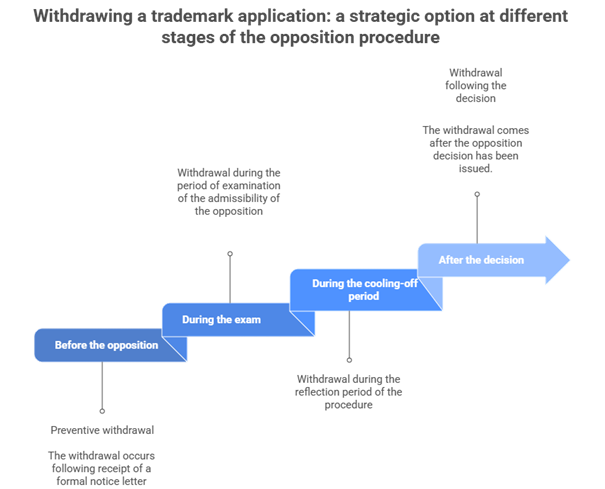
Once the opposition has been declared admissible, the competent office proceeds notifies the applicant.Before the EUIPO, the procedure includes a specific feature: a “cooling-off” period, initially set at two months and extendable by mutual agreement between the parties. If no settlement is reached, the formal adversarial phase begins. For more information, please see our dedicated article on our blog page.

At this stage, the key issue is to determine the most appropriate strategy among several legally available options.

Strategic analysis of the notice of opposition

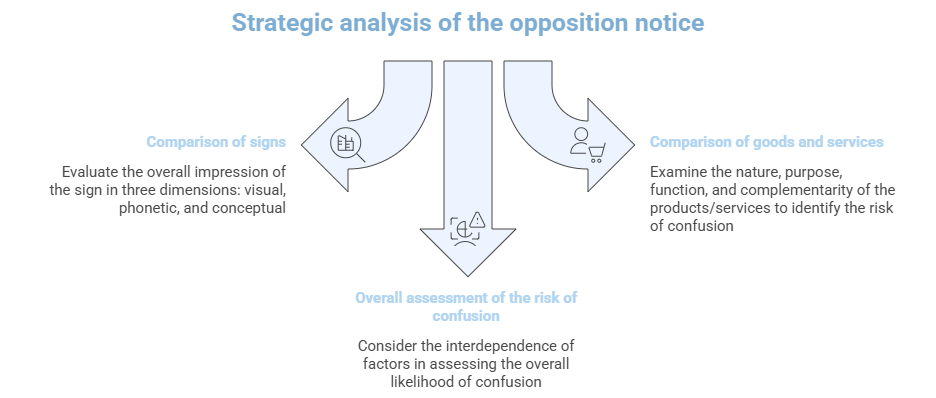
The first step for the applicant is to carefully analyze the opposition, which is based on three essential criteria:

  • The comparison of the signs requires assessing the overall impression produced by the trademarks at issue. The analysis is conducted from visual, phonetic, and conceptual perspectives.
  • The comparison of the goods and services focuses on their nature, purpose, function, potential complementarity, and distribution channels. Mere inclusion in the same Nice Classification class is insufficient, in itself, to establish similarity..
  • The global assessment of the risk of confusion must take into account the interdependence of these factors. A low degree of similarity between the signs may be offset by a high degree of similarity between the goods and services, and vice versa.

An effective argument does not isolate a single criterion but methodically dismantles the opponent’s reasoning as a whole.

strategic analysis opposition notice

Drafting the response brief and supporting evidence

Following the analysis phase, drafting the response brief becomes a decisive strategic moment. It is not a simple formal reply but a structured legal argument aimed at clearly and convincingly demonstrating the absence of infringement of the earlier rights invoked.

The brief must first accurately recall the procedural elements: the office involved, the opposition number, the contested application reference, and the earlier rights relied upon. This contextual framework ensures that the argument is grounded in the precise legal setting.

The applicant must then set out the opponent’s arguments in order to analyze and challenge them point by point. This demonstrates a thorough understanding of the claims raised and helps identify weaknesses in the opposing reasoning. The argumentation must place the signs and goods or services within their actual economic context in order to establish the absence of confusion for the relevant public.

Finally, the brief must be supported by relevant and properly explained evidence. Proof of use, commercial documents, or market-related materials should be incorporated in a structured and reasoned manner. Overall coherence is essential: each development must serve a single objective, namely to convince the examiner that the contested mark may be registered without infringing the rights invoked.

Proof of use and alternative negotiation strategies

  • Requesting proof of use: a decisive procedural lever

Where the earlier trademark relied upon has been registered for more than five years, the applicant may request that the opponent provide proof of genuine use for the goods or services invoked. This option exists before both the INPI and the EUIPO.

The burden of proof lies with the opponent, who must demonstrate real, public, and commercially justified use during the previous five years in the relevant territory.

Accepted evidence includes invoices, catalogues, advertisements, promotional materials, sales data, and contractual documents.

Use must be genuine and not merely token. In the absence of sufficient evidence, the opposition may be rejected in respect of the goods or services not properly substantiated.

This stage often represents a strategic turning point in the proceedings.

  • Limiting the specification

The applicant may choose to voluntarily restrict the list of goods or services covered by the trademark application. This limitation can eliminate areas of conflict with the earlier right invoked and may lead to partial withdrawal or rejection of the opposition.

However, such limitation is definitive. It reduces the scope of protection of the trademark and must be assessed in light of future commercial exploitation plans.

In practice, this option frequently serves as a negotiation tool, particularly during the cooling-off phase before the EUIPO.

Conclusion

Responding to a trademark opposition requires technical mastery of trademark law, thorough factual analysis, and a drafting strategy aligned with the expectations of the competent offices. A response built on a solid demonstration of the absence of likelihood of confusion, supported by carefully substantiated evidence, not only neutralizes the opposition but also strengthens the legal security of your trademark.

Mastering this procedural stage is a major strategic issue for protecting your commercial identity and enhancing the value of your intangible assets.


Dreyfus & Associés assists its clients in managing complex intellectual property cases, offering personalized advice and comprehensive operational support for the complete protection of intellectual property.

Dreyfus & Associés works in partnership with a global network of attorneys specializing in Intellectual Property.

Nathalie Dreyfus with the support of the entire Dreyfus team


Q&A


1. What happens if the applicant does not respond to the opposition?

Failure to respond leads to the closure of the adversarial phase and generally results in a total or partial refusal of the application for the goods or services targeted by the opposition. Silence is treated as a waiver of the right to present arguments.

2. Can additional time be requested to prepare the response?

As a matter of principle, an extension of the time limit for filing a response is not available. Before both the INPI and the EUIPO, the time limits set for submitting observations are strictly regulated and cannot be extended upon simple request. Only specific grounds for suspension of the proceedings may be contemplated, in particular where the parties are engaged in settlement negotiations, and subject to strict compliance with the applicable procedural requirements.

3. Can an opposition be withdrawn during the proceedings?

Yes. The opponent may withdraw the opposition at any time, either as part of a settlement agreement or unilaterally. Withdrawal terminates the proceedings for the goods or services concerned. However, the opponent’s incurred costs are not automatically reimbursed. Any agreement should therefore be properly documented in writing.

4. Can new evidence be submitted after filing the response brief?

In principle, the offices set strict deadlines for the submission of evidence. Additional materials may sometimes be accepted, but their admissibility depends on the procedural stage and proper justification. Anticipating evidentiary strategy is therefore essential.

5. Can the applicant rely on good faith to overcome the opposition?

Good faith is not a decisive factor in assessing likelihood of confusion. The examination primarily focuses on an objective comparison of the signs and the goods or services. Nevertheless, evidence of prior peaceful coexistence or independent use may serve as contextual support in certain defense strategies.


This publication is intended to provide general guidance and to highlight certain issues. It is not intended to address specific situations nor to constitute legal advice.

Read More

How to protect an AI-trained model?

Introduction

In the field of artificial intelligence (AI), trained models represent a major technological advancement derived from extensive training datasets. Unlike the raw data forming the original datasets, an AI model captures the relationships and patterns learned during the training process. Once trained, it becomes an autonomous intangible asset, embodying technical knowledge extracted from the underlying data.

The legal protection of such models has therefore become an increasingly significant issue. While the question of protection of AI-generated works, authorship, and liability for infringement have already been extensively analyzed, the legal qualification and protection regime applicable to the trained model itself raise distinct and specific challenges requiring separate examination.

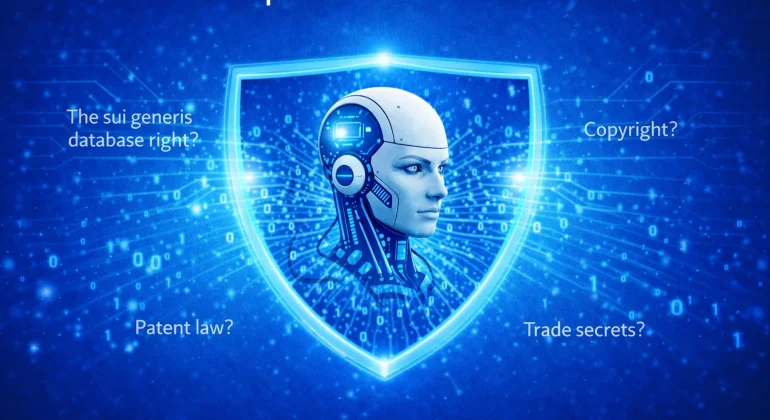
The sui generis database right: an ill-suited regime for AI models

The training of an AI system relies on a database serving as an informational reservoir. However, the resulting model is not equivalent to the original database. Unlike a mere aggregation of structured data, an AI model incorporates relationships, weightings, and patterns learned during the training process. It constitutes an abstract representation enabling prediction, classification, or analysis of new data.

This specificity raises a qualification issue. The sui generis database right, established by Directive 96/9/EC and transposed into Article L.341-1 of the French Intellectual Property Code, protects substantial investment in the acquisition, verification, or presentation of systematically organized data. By contrast, an AI model does not consist of individually accessible structured data, but rather a dynamic configuration resulting from algorithmic learning. It does not reproduce the original database, nor does it allow extraction of the initial data as such.

Accordingly, although it relies on a potentially protected training dataset, the AI model itself generally falls outside the scope of the sui generis database right. Its algorithmic and relational nature fundamentally differs from the static and organizational logic inherent in databases.

Copyright: partial protection focused on code expression

In theory, copyright protection may apply to certain elements of an AI model if they reflect free and creative choices constituting the author’s own intellectual creation, as established in the Pachot decision (French Court of Cassation, Plenary Assembly, March 7, 1986, No. 83-10.477).

In practice, such protection primarily concerns the source code or software architecture implementing the model, insofar as these fall within the legal regime applicable to software (Article L.112-2, 13° of the French Intellectual Property Code). To date, however, no judicial decision has recognized autonomous copyright protection for a trained AI model as such.

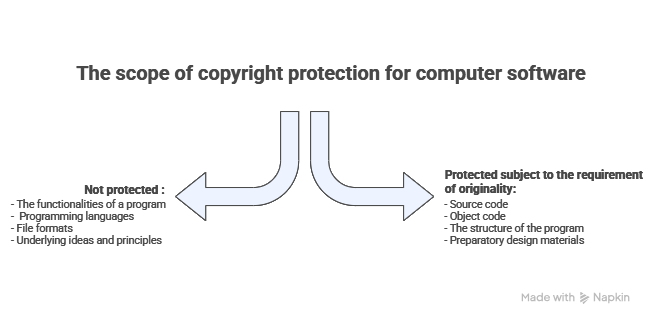
In case SAS Institute (CJEU, May 2, 2012, C-406/10), the Court held that while a software is protected by copyright, its functionalities and the ideas and principles underlying it are not. Transposed to AI models, this reasoning requires distinguishing between the code implementing the model, which may be protected, and its functionalities (text generation, classification, prediction) as well as its underlying statistical or architectural principles, which remain unprotectable ideas.

The most complex issue concerns the weights and parameters of a trained neural network: can they be regarded as “expression” for copyright purposes? The restrictive approach adopted in the SAS Institute case excludes ideas, principles, and underlying mathematical methods from protection. The qualification of weights and parameters, materializing the outcome of algorithmic learning, remains uncertain in the absence of specific case law.

copyright protection software

Patent law: the requirement of a further technical effect

Patent law does not permit protection of an AI model as an abstract mathematical construct. Algorithms, mathematical methods, and computer programs are excluded from patentability “as such” pursuant to Article L.611-10 of the French Intellectual Property Code.

However, an invention implementing an AI model may be patentable if it provides a technical solution to a technical problem and produces a further technical effect, as clarified by the EPO Technical Board of Appeal (T 1173/97 – Computer program product, July 1, 1998).

In other words, it is not the model itself that may be protected, but its integration into a concrete technical application, such as improving computer performance, optimizing an industrial process, processing technical signals or images, or managing a physical device.

Patentability therefore requires that the model effectively contributes to the technical character of the invention beyond the mere execution of calculations or statistical learning. In practice, direct protection of an isolated AI model appears unlikely; only its incorporation into a system or process producing an identifiable technical effect may justify patent protection.

Trade secrets: a pragmatic protection for trained parameters

In practice, trade secret protection constitutes the most appropriate mechanism for safeguarding trained AI models. Under Articles L.151-1 et seq. of the French Commercial Code, information is protected where it is not generally known or readily accessible, has commercial value because of its secrecy, and is subject to reasonable protective measures.

The weights, parameters, and internal configurations of an AI model frequently satisfy these criteria: they are non-public, result from substantial investments in data and computation, and confer a decisive competitive advantage. Protection requires an effective security policy, including technical access controls, contractual confidentiality limitations, and appropriate organizational measures.

From this perspective, trade secret law appears to be the most coherent legal tool for preserving the economic value of proprietary AI models.

Conclusion

A trained AI model does not fully fit within any traditional intellectual property regime. It is neither a database within the meaning of the sui generis right, nor a work protected as such under copyright, nor an independently patentable invention absent a further technical effect.

Its protection therefore relies on a combined approach: copyright for the code, patent protection for certain technical applications, and, above all, trade secret protection to safeguard trained weights and parameters. Rather than a single exclusive right, it is a coherent and anticipatory legal strategy that ensures effective protection of this strategic intangible asset.

Dreyfus & Associés assists its clients in managing complex intellectual property cases, offering personalized advice and comprehensive operational support for the complete protection of intellectual property.

Dreyfus & Associés works in partnership with a global network of attorneys specializing in Intellectual Property.

Nathalie Dreyfus with the support of the entire Dreyfus team

FAQ

1. Are models derived from an open-source model legally independent?
It depends on the applicable license terms. Certain licenses impose obligations to share modifications or derivative works.

2. Are non-compete clauses relevant for protecting a model?
They may complement contractual protection strategies, particularly to prevent the reuse of equivalent know-how by employees or partners.

3. Can training a model on protected data legally contaminate the model?
In principle, no, since the model does not reproduce the data. However, if protected data remain identifiable or retrievable, infringement risks may arise.

4. Does the protection of AI models require legislative reform?
The doctrinal debate is ongoing. Some advocate for a sui generis protection regime for AI systems, but no specific reform has yet been planned.

5. Can an AI model constitute a strategic asset for valuation or investment purposes?
Yes. It may be subject to specific due diligence in M&A transactions or fundraising operations.

The purpose of this publication is to provide general guidance to the public and to highlight certain issues. It is not intended to apply to particular situations or to constitute legal advice.

Read More

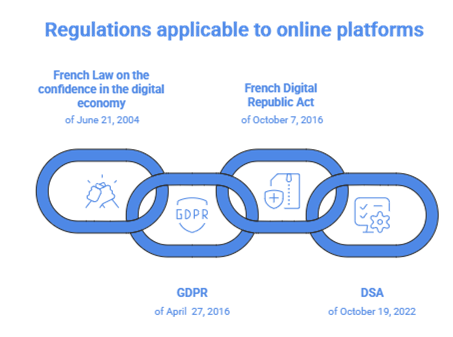
Does the legal framework established by the LCEN still effectively address contemporary digital challenges, or does it reveal the limits of a system designed for a bygone Internet?

Introduction

Adopted in 2004, the French “Loi pour la confiance dans l’économie numérique” (LCEN) laid the foundations for the regulation of the Internet in France. Nearly seven years later, the implementing decree of Article 6 II, published in 2011 (Decree No. 2011-219 of February 25, 2011), clarified the obligations relating to the retention of identification data imposed on technical intermediaries.

More than fifteen years after the entry into force of this decree, and in a profoundly transformed digital environment, the practical effects of this framework now call for renewed assessment.

The issue is no longer the long-awaited adoption of an implementing text, but rather its current relevance. In an era characterized by the massification of data, the consolidation of major digital platforms, and the expansion of European regulation, does the LCEN framework still provide an effective response to contemporary digital challenges, or does it expose the limits of a system conceived for an Internet that no longer exists?

limited responsability

The evolution of article 6 II of the LCEN in a transformed digital environment

The legal framework of Article 6 II of the LCEN establishes one of the pillars of French Internet law. Asserted as early as 2004, in a technological context predating the development of large platforms, this obligation was designed for an Internet with largely linear and centralized uses. However, it has been implemented in a constantly evolving digital environment, characterized by the diversification of services, the emergence of global intermediaries, and the exponential growth of data volumes processed.

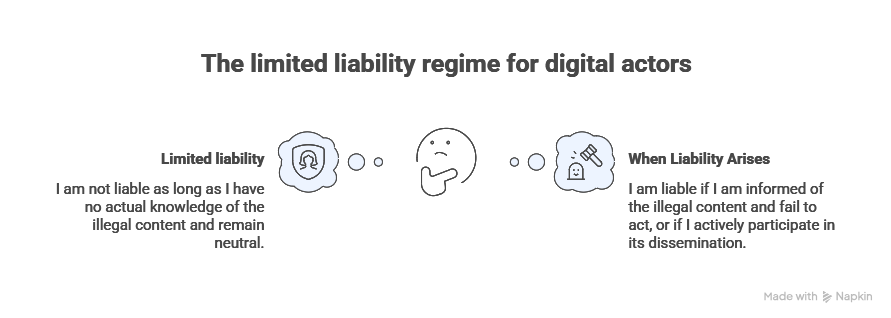
By requiring access providers and hosting service providers to retain data enabling the identification of content authors, the legislator established a key counterpart to the limited liability regime applicable to technical intermediaries. This regime is based on a conditional exemption from liability, grounded in the absence of prior knowledge of the content and the obligation to act promptly upon notification, excluding any general obligation to monitor. The retention of data thus serves as the procedural counterpart to this neutrality, allowing for the subsequent identification of those responsible for infringements without transforming intermediaries into oversight actors.

This obligation is a prerequisite for the ex post identification of authors of unlawful content, without imposing any form of generalized monitoring.

However, from the outset, this framework was structurally incomplete. The legislator expressly deferred to an implementing decree the task of defining the categories of data to be retained and the applicable modalities, in order to ensure proportionality and legal certainty. The prolonged absence of this decree generated lasting legal uncertainty.

In practice, operators relied on fragmented case law and heterogeneous recommendations, resulting in uneven retention practices, sometimes excessive, sometimes insufficient. The decree was therefore expected to serve as an instrument of normative clarification and alignment with European requirements, particularly in the field of personal data protection.

An assessment of the implementing decree in light of changes in the digital ecosystem

The implementing decree of Article 6 II of the LCEN was adopted in a context radically different from that prevailing in 2004. At the time, the legislator primarily sought to regulate the first generation of hosting and access providers, within a relatively stable technical environment dominated by identifiable operators.

Twenty years later, the digital ecosystem has undergone profound transformation. Platforms have proliferated, uses have become more complex, and data volumes have reached unprecedented levels.

Against this backdrop, the detailed list of identification data categories imposed by the decree appears, with hindsight, both necessary and structurally outdated. While it initially provided much-needed formal clarification, it soon encountered the limits of a retention model designed for the early 2000s Internet.

Transposed to a 2026 environment marked by service fragmentation, automated exchanges, and the widespread use of distributed architectures, this approach has proven only partially suitable. Retention periods and modalities have been repeatedly challenged, particularly in light of contemporary principles of proportionality and data minimization.

Far from settling the debate, the decree has thus contributed over time to the emergence of structural litigation concerning the compatibility between identification requirements, personal data protection, and technical realities.

Operational impacts on digital stakeholders

Following its entry into force, the decree resulted in significant operational requirements for hosting providers, publishers  and platforms including a legal obligation to retain and secure identification data. This obligation, which conditions the limited liability regime provided by the LCEN, has required operators to implement substantial technical and organizational measures. These measures particularly focus on the traceability of connections, the integrity of retained data, and its security, in accordance with Article 32 of the GDPR.

With hindsight, these obligations have formed part of a broader movement toward the standardization of compliance functions within digital actors. They have progressively been integrated into comprehensive frameworks combining requirements arising from the LCEN, the GDPR, and, more recently, European regulations governing digital services.

By 2026, this accumulation of regulatory obligations represents one of the sector’s principal operational challenges, in terms of both costs and internal legal governance particularly regarding the allocation of responsibilities, management of litigation risk, and traceability of compliance decisions.

From the perspective of intellectual property rights holders, the decree has strengthened the procedural tools allowing, under judicial oversight, the identification of perpetrators of online infringements.. The clarification regarding the categories of data retained, such as IP addresses, connection timestamps, and subscription data held by the host or registrar has improved, in several disputes, the effectiveness of actions for infringement and unfair competition.

Nevertheless, litigation experience since 2011 demonstrates that this mechanism remains largely dependent on the effective cooperation of intermediaries and judicial interpretation of their obligations. The decree has therefore not created an automatic right to identification, but rather a procedural framework whose scope varies according to circumstances.

Anticipated legal and litigation risks

The main legal risks associated with the decree implementing the LCEN relate to the delicate balance between the legitimate objective of identifying the authors of illegal content and the protection of fundamental freedoms, foremost among which are the right to privacy and the protection of personal data. In practice, these tensions have crystallized around the requirements of proportionality, which stipulate that data retention and disclosure obligations must be strictly necessary, limited in scope, and subject to effective procedural safeguards. Over time, they have given rise to extensive litigation before national and European courts, concerning both retention periods and conditions of access to data.

This is the case, for example, in this ruling dated March 25, 2021 (Cass. civ. 2e, March 25, 2021, No. 18-18.824), in which the French Cour de Cassation clarified the conditions for accessing identification data. In this case, the High Court was asked to rule on a request for disclosure of data made by a private party in a civil dispute, based on the obligations arising from Article 6 II of the LCEN. The Court ruled that the retention obligation established by the LCEN does not confer on individuals an automatic right of access to data, but is subject to a strict procedural framework, subject to judicial review. It thus reiterates that the disclosure of identification data must comply with the principles of proportionality, purpose and necessity, in accordance with the requirements of both domestic and European law. This decision illustrates the Cour de Cassation’s desire to maintain a balance between the effectiveness of the fight against illegal content and the protection of personal data. In practice, it limits the possibilities for direct identification by rights holders and strengthens the role of the judge as the guarantor of this balance.

Conclusion

Long awaited, the implementing decree of Article 6 II of the LCEN has undeniably contributed to structuring obligations relating to the retention of identification data in France. With more than fifteen years of application, however, it appears that it has constituted neither a definitive solution nor an instrument fully adapted to digital transformations.

While it has strengthened the traceability of online activities, it has also intensified tensions with data protection law and multiplied areas of litigation, particularly in relation to proportionality, liability, and data governance.

In an environment increasingly shaped by European regulation and global platform dynamics, this framework reveals the limits of an essentially national approach. It calls upon digital stakeholders to adopt an integrated legal strategy combining compliance, risk management, and anticipation of regulatory developments.


Dreyfus & Associés  assists its clients in managing complex intellectual property cases, offering personalized advice and comprehensive operational support for the complete protection of intellectual property.

Dreyfus & Associés works in partnership with a global network of attorneys specializing in Intellectual Property.

Nathalie Dreyfus with the support of the entire Dreyfus team


Q&A


1. Are all platforms subject to the obligations of Article 6 II of the LCEN?

No. The applicable regime depends on the qualification of the actor: hosting provider, publisher, access provider, or hybrid operator. In practice, many services combine multiple functions, making classification more complex. Each service must be assessed individually, taking into account its actual role in content publication and control.

2. Are LCEN retention obligations compatible with the GDPR?

In principle, yes, subject to strict conditions. Retention must be based on a legal ground, be necessary and proportionate, and comply with the principles of minimization and storage limitation. The main risk lies in excessive precautionary retention, which may expose operators to GDPR litigation and proportionality challenges.

3. Under what conditions may a judge order the disclosure of identification data?

In practice, courts require targeted requests justified by a legitimate purpose (e.g., identifying the author of unlawful conduct) and subject them to strict necessity and proportionality review.

4. Do LCEN obligations apply to actors established outside France?

Potentially, depending on connecting factors such as targeting of the French public, activities directed toward France, or the presence of infrastructure or establishments. Enforcement may be more complex, reinforcing the relevance of European mechanisms such as the DSA and cross-border cooperation tools.

5. Do artificial intelligence and automation affect identification obligations?

They primarily affect scale and speed, through automated moderation, abnormal behavior detection, and event correlation. However, they do not reduce legal obligations. On the contrary, they require enhanced governance, including minimum explainability, human oversight, and decision traceability.


This publication is intended to provide general guidance and highlight certain issues. It is not intended to address specific situations and does not constitute legal advice.

Read More

How to build in 2026 a trademark filing and management strategy to secure, structure, and anticipate risks

Introduction

In 2026, filing a trademark is no longer merely about “reserving a name.” The filing has become a fully-fledged legal and strategic act, directly engaging the applicant’s responsibility and determining the future strength of the portfolio. This evolution results from a now-structuring triptych : the continuous increase in trademark filings, the tightening of office practices (INPI, EUIPO, and foreign offices), and the rise of opportunistic behaviour.

A poorly anticipated strategy exposes applicants to refusals at the examination stage, multiple opposition proceedings, and subsequent invalidity or revocation actions. Above all, registration only confers a presumption of ownership. A trademark may be registered without opposition due to the absence of monitoring, and later challenged once the project is already established, thereby jeopardising substantial marketing investments.

In 2026, the objective is therefore clear : to file more effectively and manage rights proactively. This requires securing registration, structuring the portfolio, anticipating evidence, and organising enforcement within a sustainable framework.

Distinctiveness, descriptiveness, and bad faith : securing the validity of the filing

The tightening of practices relating to distinctiveness and descriptiveness has become a fundamental parameter. Offices and courts now require more strictly that a sign fulfil its essential function of indicating commercial origin. This severity is directly linked to the progressive saturation of registers, with filings having tripled over the past twenty years.

Signs closely related to professional jargon, evoking product characteristics, or bearing strong sector-specific connotations are now subject to heightened scrutiny. Assessment is carried out exclusively as of the filing date, based on the perception of the relevant public, without any binding precedent drawn from earlier registrations.

This requirement fully extends to descriptive signs. In this respect, the cancellation by the EUIPO of OpenAI’s “GPT,” “GPT-3,” “GPT-4,” and “GPT-5” trademarks provides a particularly significant illustration. The Office held that the term “GPT,” meaning “Generative Pre-Trained Transformer,” refers to a language model architecture based on machine learning commonly used in artificial intelligence. Due to its widespread use to describe a technology rather than a commercial origin, the term was deemed generic and devoid of distinctive character.

At the same time, bad faith has become a central ground in trademark litigation. Authorities examine, in particular, knowledge of prior rights, lack of intent to use, refiling strategies, and the appropriation of abandoned trademarks. Attempts to revive “zombie” trademarks are assessed in light of the economic context and the effective reputation at the filing date.

Securing the validity of a filing therefore requires thorough preliminary analysis, addressing both the inherent distinctiveness of the sign and the risk of challenges based on bad faith.

Use and proof of use : anticipating enforcement from the outset

Consistency between the specification and actual or foreseeable use has become a major vulnerability in 2026. From the filing stage, the owner must anticipate the creation of a structured evidentiary file.

This file should include tangible materials : commercial documents, packaging, labels, invoices, catalogues, marketing content, affidavits, studies, and quantitative data. Their probative value is enhanced when they clearly indicate the trademark, date, relevant products, and territory.

Such anticipation is strategic. In certain jurisdictions, use directly conditions the validity or maintenance of rights. Moreover, once a trademark is more than five years old, adversaries may request proof of use in various procedural contexts.

The concept of sub-categories reinforces this requirement. Where a specification covers a broad category, use may need to be demonstrated for each relevant autonomous sub-segment. Exploitation of a single product does not necessarily preserve rights for the entire scope.

Evidentiary anticipation thus becomes a core pillar of portfolio governance.

Specifications and foreign office practices : focus on the United States and Canada

In the United States and Canada, drafting the specification represents a major procedural issue. Compliance with administrative standards directly affects costs, timelines, and objection risks.

Since 2025, the USPTO has imposed a structural choice : reliance on pre-approved terms from the Trademark ID Manual or use of customised wording. The former facilitates processing and reduces fees, while the latter entails stricter examination and increased risk of provisional refusals.

Canada applies a comparable approach, with heightened scrutiny of goods and services within an increasingly automated examination framework.

In this context, a specification drafted solely in accordance with European standards may prove inadequate. Integrating North American constraints from the outset often avoids fragmented and costly internationalisation.

american drafting clauses

Clearance searches and territorial strategy

Clearance searches have become an indispensable preventive investment. Filing without a serious search, or based on informal checks, exposes applicants to disproportionate risks.

In a saturated environment, thorough searches help identify potential obstacles, adapt the sign, strengthen distinctiveness, or adjust the specification before significant financial commitments are made.

Territorial strategy must be developed concurrently. Limiting protection to the country of headquarters is no longer sufficient. Production countries, distribution markets, and structurally high-risk regions must be considered.

Cumulative protection and portfolio structuring

Protection based solely on a word trademark is not always optimal. Depending on the sector, cumulative rights significantly enhance overall defensibility.

Trademarks protect distinctive signs. Designs protect appearance. Figurative or semi-figurative trademarks secure visual elements. Each title has its own criteria and provides complementary enforcement tools.

In creative industries, particularly fashion and cosmetics, this combination enables more effective responses to duplication and parasitic practices.

The European design law reform, gradually applicable from 2026, further reinforces the value of an integrated and anticipatory approach.

Rationalisation and optimisation : audit and article 4bis of the Madrid Protocol

In 2026, portfolio management requires strategic oversight. Audits enable assessment of alignment between actual activities and registered rights, identification of vulnerabilities, and elimination of unnecessary costs.

Duplication situations, particularly resulting from Brexit, illustrate the importance of this approach. Without audits, redundant rights continue generating expenses without added value.

Article 4bis of the Madrid Protocol offers an additional rationalisation tool. Under strict conditions, it allows an international registration to replace national rights while preserving priority.

Use assimilation strengthens continuity. However, dependency periods and varying office practices require cautious and well-documented implementation.

Conclusion

In 2026, trademark strategy rests on a demanding balance between legal security, risk anticipation, and cost control. Filing represents a structuring investment requiring rigour, territorial coherence, drafting precision, and evidentiary organisation.

Protection does not end with registration. It requires active management, regular audits, and continuous monitoring policies to preserve the long-term distinctiveness and economic value of signs.

Dreyfus & Associés supports its clients in managing complex intellectual property matters by providing tailored advice and comprehensive operational support for the full protection of intellectual property rights.

Dreyfus & Associés works in partnership with a global network of specialised intellectual property lawyers.

Nathalie Dreyfus, with the support of the entire Dreyfus team.


Q&A


1. What checks should be carried out before investing in a “short” sign to limit cascading oppositions ?

Beyond identity searches, phonetic and visual proximity, registry density in relevant classes, and the descriptive load of the sign must be analysed to assess real multi-front risk.

2. How can a specification be calibrated when offerings evolve rapidly ?

It is preferable to reason in terms of foreseeable commercial uses and sub-categories, covering core activities and realistic extensions while avoiding generic formulations likely to trigger objections or bad faith claims.

3. What warning signs indicate a risk of invalidity for bad faith before filing ?

Disproportionate specifications, lack of a credible exploitation project, a history of defensive filings without use, or conflict contexts (former partners, employees, distributors) are major red flags.

4. When should trademark monitoring be implemented, and with what minimum scope ?

From filing, ideally at launch, as lack of monitoring may allow oppositions to lapse. A baseline covering trademarks, company names, and domain names in key territories limits unexpected challenges.

5. When is a figurative or position trademark more wise than a word trademark alone ?

When the verbal element is weak or overcrowded, protection of a distinctive visual configuration or position may provide a stronger enforcement angle.


This publication aims to provide general guidance to the public and highlight certain issues. It is not intended to apply to specific situations or constitute legal advice.

Read More

How to conduct intellectual property due diligence?

Introduction

An intellectual property due diligence is conducted prior to major corporate transactions, such as acquisitions, mergers, fundraising operations, or asset disposals. Its purpose is to assess the legal and financial status of a company’s intellectual property assets before any strategic decision is made, thereby serving a fundamentally transactional function.

Too often perceived as a mere documentary audit, intellectual property due diligence in fact directly determines the valuation of intangible assets, the stability of transferred rights, and the control of future legal and financial risks.

Why is intellectual property due diligence a strategic asset?

Intellectual property represents a key component in the valuation of innovative companies, particularly in technology-driven and creative industries. An intellectual property due diligence goes far beyond the mere verification of registered rights. It secures investments by assessing the impact of legal risks on the contemplated transaction.

This process includes the review of claimed rights (trademarks, patents, licenses, and related assets), verification of their  enforceability, and the identification of vulnerabilities that may affect asset valuation or transaction terms.

From a litigation risk perspective, IP due diligence also evaluates the potential impact of ongoing or foreseeable disputes, including counterfeiting actions, opposition proceedings, and collective actions, on the purchase price, the stability of transferred rights, and the management of warranties and indemnities. For instance, unresolved disputes may justify price reductions or the implementation of compensation mechanisms.

By anticipating financial exposure, due diligence enables the parties to adjust their negotiation strategy, minimize risks, and secure the transaction. It further facilitates the implementation of appropriate safeguards, such as indemnification clauses, limitation of liability provisions, and price adjustment mechanisms.

How to structure an effective intellectual property due diligence process?

An effective intellectual property due diligence relies on a clearly defined scope to ensure strategic relevance. Prior to starting the review, it is essential to determine the transactional context, taking into account the parties’ objectives, the relevant jurisdictions, and the strategic technologies or trademarks involved.

Competitive dynamics and regulatory constraints must also be assessed, as they may affect the management and enforceability of IP rights. This preliminary framework allows the analysis to focus on the most critical assets for the transaction.

The success of the process further depends on the quality and reliability of the collected information. A structured data repository is essential to centralize key documentation, including registration certificates, assignment and license agreements, confidentiality provisions, and invention disclosure records.

Access to such documentation enables a comprehensive understanding of ownership, exploitation modalities, and associated legal risks.

essential aspects

Which assets and risks should be prioritized?

The review of trademarks and domain names generally forms the cornerstone of the analysis. It involves verifying actual ownership, registration validity, territorial scope, exposure to opposition proceedings, and ongoing disputes. A strategically important trademark that has not been renewed may expose the acquirer to an immediate loss of rights.

Patent and innovation audits require both technical and legal expertise. They involve reviewing chains of title, employee inventions, joint ownership arrangements, cross-licensing agreements, and freedom-to-operate assessments. A patent that is formally valid but easily circumvented may suffer a significant loss of value.

With regard to copyrights, software, and databases, it is essential to review development agreements, assignments, open-source licenses, and compliance with data protection regulations, including GDPR requirements. Regulatory non-compliance may constitute a major transactional obstacle.

A comprehensive due diligence must also include an analysis of past, ongoing, and potential disputes, including court proceedings, cease-and-desist letters, administrative oppositions, arbitration proceedings, and settlement agreements. All latent risks must be carefully identified, quantified, and documented in order to assess their potential impact on the transaction.

How to leverage the results from a legal and financial perspective?

To ensure effective legal and financial use of due diligence findings, a structured and operational report must be prepared. This report should not be limited to an inventory of rights and risks, but must include risk prioritization, criticality assessments, practical recommendations, and impact scenarios.

Each issue should be presented in a manner that enables decision-makers to take informed and timely action.

The conclusions of the due diligence must then be incorporated into the negotiation process. They serve as the basis for drafting representations and warranties, indemnification clauses, conditions precedent, price adjustment mechanisms, and post-closing commitments.

Finally, due diligence should lead to the implementation of a remediation plan, including title regularization, contractual restructuring, supplementary filings, targeted enforcement actions, and strengthened internal compliance policies. In this way, intellectual property due diligence becomes a strategic tool for correcting, securing, and optimizing intangible assets within a transactional framework.

Conclusion

Mastering intellectual property due diligence has become an essential strategic competence for any company involved in a major corporate transaction.

A rigorous, cross-disciplinary, and well-documented approach not only reduces legal risks, but also enhances asset valuation, strengthens negotiation positions, and secures investments.

Dreyfus & Associés assists its clients in managing complex intellectual property cases, offering personalized advice and comprehensive operational support for the complete protection of intellectual property.

Dreyfus & Associés works in partnership with a global network of attorneys specializing in Intellectual Property.

Nathalie Dreyfus with the support of the entire Dreyfus team

FAQ

1. Is intellectual property due diligence legally mandatory?
No. Intellectual property due diligence is not legally mandatory. However, it constitutes a fundamental duty of care for any acquirer or investor seeking to limit liability and secure their investment.

2. Can an incomplete due diligence engage directors’ liability?
Yes. Where demonstrable harm is established, insufficient due diligence may be characterized as a breach of directors’ duties or a failure in corporate governance.

3. Can unregistered intellectual property rights be transferred?
Yes, subject to precise and duly formalized contractual arrangements. Nevertheless, the absence of registration significantly weakens enforceability against third parties.

4. Should a due diligence include social media assets?
Yes. Official accounts, usernames, content, and online communities now constitute strategic assets in their own right and must be duly assessed.

5. Should trademark coexistence agreements be reviewed?
Absolutely. Such agreements may restrict future exploitation and materially affect post-acquisition commercial strategy.

The purpose of this publication is to provide general guidance to the public and to highlight certain issues. It is not intended to apply to particular situations or to constitute legal advice.

Read More

How to ensure the validity of a figurative trademark ?

Introduction

When considering filing a figurative trademark (logo, image, or graphical sign without words), a fundamental question arises: Are they automatically valid? The answer, under French and European trademark law, is negative. The validity of a figurative trademark depends on specific legal criteria related to its ability to identify the commercial origin of a product or service, as demonstrated in the French Intellectual Property Code, European Union law, recent case law such as the decision in Mercedes-Benz Group AG v. EUIPO (Case T 400/24) of March 19, 2025, and the practices of trademark offices (INPI, EUIPO, etc.).

What is a figurative trademark?

A figurative trademark consists exclusively of graphical elements, designs, logos, symbols, colors, without any independent verbal element (text). It aims to visually protect a sign that distinguishes the products or services of one company from those of its competitors.

Alongside the figurative trademark, we distinguish:

• The verbal trademark: composed solely of words or letters.
• The semi-figurative trademark: a combination of text and visual elements.

This distinction is important because while the validity requirements are generally common under substantive law, they are applied differently depending on the type of sign being filed.

Legal conditions for the validity of a figurative trademark

For a figurative trademark to be considered valid and registered, it must meet several cumulative conditions.

Distinctiveness

Distinctiveness is the primary requirement; the trademark must allow consumers to identify the commercial origin of a product or service. It should not be descriptive, generic, or purely functional.
An arbitrary or stylized logo, unrelated to the products/services, generally presents strong distinctiveness. However, a graphic representing the product itself or an expected feature of the product is rarely considered distinctive.

Legality and public order

As shown in Article L711-3 of the French Intellectual Property Code, the trademark must not be contrary to public order or morals. It must also be lawful and not infringe on existing rights (e.g., personality rights, state arms, international agreements).

Availability

A figurative trademark cannot be registered if identical or similar prior trademarks already exist in the same product or service classes. Thorough searches for prior rights are essential before filing.

conditions validity trademark

Jurisdictional illustrations of refusals or acceptances: the Mercedes-Benz Group AG v. EUIPO Case (Case T 400/24) of March 19, 2025

Facts

In this case, Mercedes-Benz sought to register Image1as an EU trademark (EUTM no. 018805110) representing an off-road vehicle driving up a slope, for products in Class 12 (vehicles, spare parts, tires) and Class 18.

However, the EUIPO partially refused the application due to a lack of distinctiveness for products in Class 12. The Board of Appeal upheld this refusal on the grounds that the sign represented a typical image of an off-road vehicle in a situation and did not contain any distinctive elements to indicate commercial origin to consumers.

EUIPO Tribunal decision

In its decision of March 19, 2025 (Case T 400/24), the EUIPO Tribunal rejected Mercedes-Benz’s appeal, confirming that the sign lacked distinctiveness under the EU Trademark Regulation 2017/1001.
In its reasoning, the Tribunal recalled case law stating that a sign closely inspired by usual representations of the product itself can only be considered distinctive if it deviates significantly from the visual norms of the sector. The drawing in question was not sufficiently different from the usual representations of an off-road vehicle for the relevant public to associate it with a particular commercial origin.

The simplicity and generic nature of the image reinforced the absence of distinctiveness, even though the target public pays attention to the concerned products.

Scope of the decision

This decision illustrates the high level of distinctiveness required for figurative trademarks representing the product or its expected performance.

A drawing that merely represents the product in a conventional or generic manner, without sufficiently unique or unusual elements, is likely to be deemed devoid of distinctiveness and thus ineligible for registration as a trademark.

Strategies to Maximize the Validity of Your Figurative Trademark

Here are some best practices based on practical experience and case law:

Design an original visual sign: A drawing or logo that deviates from usual product/service representations makes registration easier.

Combine distinctiveness and creativity: Unusual stylization, distinctive graphic elements, or a unique composition enhance distinctiveness.

Conduct a prior search: Before filing, an exhaustive search of existing trademarks (both verbal and visual) reduces the risks of opposition or refusal.

Consider multiple filings: Filing both a verbal trademark and a semi-figurative trademark can strengthen protection, especially for trademarks that rely on both a logo and a name.

Conclusion

Not all figurative trademarks are automatically valid. Their legal validity primarily depends on their distinctiveness, compliance with public order, and availability relative to prior rights. A generic or overly descriptive logo will often be refused registration, while an original and distinctive design will result in solid protection.

To ensure successful registration and safeguard your rights, it is essential to create a strong visual sign and conduct the necessary checks before filing.

Dreyfus & Associés assists its clients in managing complex intellectual property cases, offering personalized advice and comprehensive operational support for the complete protection of intellectual property.

Dreyfus & Associés works in partnership with a global network of attorneys specializing in Intellectual Property.

Nathalie Dreyfus with the support of the entire Dreyfus team

Q&A

1. Is a simple logo always valid as a figurative trademark?
No, it must also be distinctive and non-descriptive to be registrable.

2. Can a figurative trademark be refused for reasons other than lack of distinctiveness?
Yes, it can be refused if it contravenes public order, is already used by another party, or does not meet the conditions of representability or legality required by law.

3. Can I modify a figurative logo already filed?
Any significant change generally requires a new filing.

4. Is a drawing very similar to an existing one valid?
No, if it creates similarity with a prior trademark, registration may be refused or the act annulled.

5. Can a color alone constitute a figurative trademark?
Yes, but the color must be specifically claimed and presented with international codes (e.g., Pantone).

This publication is intended to provide general guidance to the public and highlight certain issues. It is not intended to apply to specific situations or constitute legal advice.

Read More

Court-appointed expert witness and IP: the strategic asset for asset security

In an economic landscape where corporate value is increasingly derived from intangible assets, intellectual property (IP) litigation is becoming significantly more complex. The increasing judicialization of business, coupled with the technical intricacies of emerging digital challenges (Web3, AI, Data), imposes a requirement for absolute rigor upon legal practitioners. For international lawyers, General Counsels, and decision-makers, relying on standard technical support is no longer sufficient; it has become imperative to collaborate with professionals whose competence is recognized and validated by the highest jurisdictions.

It is in this context that the dual status of Court-Appointed Expert to the Cour de cassation (French Supreme Court – Specialization: Trademarks) and Expert to the Paris Court of Appeal (Specialization: Trademarks, Designs & Models) assumes its full strategic dimension. Beyond the honorific title, it represents a probative methodology and an anticipatory vision of judicial risk that are placed at the service of corporate strategy. This qualification offers reinforced legal certainty, which is essential for preserving the professional liability of legal counsel and ensuring the enforceability of rights holders’ assets.

expert judiciaire et propriete intellectuelle

The status of court-appointed expert: a guarantee of technical excellence and ethics

Inclusion on the lists of judicial experts is not a mere administrative formality. It is the culmination of a drastic selection process, validating indisputable technical competence and absolute moral probity.

Being a Court-Appointed Expert to the Cour de cassation constitutes the highest level of recognition for a legal technician in France. This implies that the highest court in the French judicial order recognizes the expert as an authority in their specialization. Similarly, accreditation by the Paris Court of Appeal, the central jurisdiction handling the vast majority of IP litigation in France, attests to a proven practice in complex cases.

For the lawyer or the final client, collaborating with a Court-Appointed Expert offers three major guarantees, indispensable to the solidity of a file:

  1. Independence: The expert is bound to total objectivity, a pledge of credibility when establishing reports or audits.
  2. Technical Competence: Mastery of the most specific aspects of the matter (distinctiveness, likelihood of confusion, revocation, materiality of infringement).
  3. Ethics: Strict adherence to the guiding principles of the trial, notably the adversarial principle (due process), which permeates their entire practice, even in advisory roles.

You may verify these official registrations via the justice directories:

The added value of the judicial expert in the lifecycle of IP rights

A common misconception is that the Court-Appointed Expert only intervenes once litigation has arisen. On the contrary, it is precisely upstream, in the daily management of portfolios, that the judicial expert’s mindset provides superior legal certainty. Each act is performed with the perspective of its future enforceability before a tribunal.

Audit and availability searches: the judge’s eye before the trial

A standard availability search lists potential obstacles. A search conducted with “the eye of the Court-Appointed Expert” qualifies the risk with the perspective of the magistrate. The expert, accustomed to enlightening tribunals, understands how trial judges appreciate in concreto the similarity of signs or goods and services.

When analyzing your trademark availability searches, we do not merely apply theoretical criteria. We evaluate the probability that a judge would retain a likelihood of confusion, integrating the most recent jurisprudential trends. This allows for the elimination of false positives (theoretical risks that are judicially weak) and the identification of genuine litigation risks, thus protecting the company against future nullity actions.

Filings and procedures: procedural rigor at the service of protection

The solidity of an industrial property title is determined at the moment of its filing. A poorly drafted specification or imprecise classification constitutes a breach into which the opposing party will step during a nullity or revocation action.

The practice of pathological litigation teaches us a contrario how to draft robust wordings. We anticipate arguments of non-use or lack of distinctiveness. This preventive approach is at the heart of our trademark law practice, where each class is weighed to withstand the “fire” of judicial proceedings, guaranteeing maximum enforceability of the title. This is essentially legal engineering designed to preclude future vulnerability.

Management and valuation: credibility in audits (M&A)

In the context of Mergers & Acquisitions (M&A) or fundraising, the valuation of IP assets is critical. The intervention of an Expert appointed to the Cour de cassation to audit a portfolio provides a major “trust signal” to investors and auditors.

The financial valuation of trademarks requires rigorous methodology (relief from royalty method, excess earnings method, etc.) which the judicial expert masters perfectly for regular presentation before the courts. This rigor secures the valuation and strategy and minimizes the risks of liability warranties, thereby protecting the professional liability of the business lawyers managing the transaction.

Surveillance and defense: qualifying infringement with precision

Online brand enforcement often generates significant “noise.” Distinguishing between a minor infringement and a substantiated counterfeiting case requiring immediate action is crucial for cost control and defense strategy.

The Court-Appointed Expert possesses the necessary acuity to detect the constitutive elements of infringement (identical reproduction, imitation, risk of association) and to compile a body of probative evidence. This precise qualification allows for advising on the most adapted gradual response, from the cease-and-desist letter to the seizure (saisie-contrefaçon), avoiding reckless threats that could lead to liability for disparagement.

The synergy between lawyers and IP attorneys in complex litigation

The success of intellectual property litigation often rests on the alliance between the procedural strategy of the lawyer and the technical analysis of the Trademark Attorney (CPI). When a specialized lawyer collaborates with a CPI holding the status of Court-Appointed Expert, they significantly reinforce the probative value of their file.

This technical collaboration materializes at several levels:

  • Expert Consultation (Party-Appointed Expertise): Even before the introduction of proceedings, we can draft an independent technical consultation. Although produced at the request of a party, the signature of an Expert appointed to the Cour de cassation confers major technical weight upon the document. This report serves to objectify technical facts and provides the lawyer with robust arguments for their pleadings, which can be pivotal in IP litigation advice.
  • Assistance during Saisie-Contrefaçon (Seizure): The preparation of the motion and assistance to the Bailiff during operations require surgical precision to avoid the nullity of the official report. Judicial expertise ensures scrupulous respect for the limits of the court order and the accurate description of material facts.
  • Validity Analysis and Counterclaims: In a defense strategy, we assist the lawyer in identifying technical flaws in the opposing party’s patent or trademark (prior art, lack of novelty, descriptiveness) to construct a solid counterclaim for nullity.

This synergy allows for the delivery of a “turnkey” file to the judge, where law and technique articulate perfectly, maximizing the chances of success.

FAQ: The judicial expertise in practice

What is the difference between a Party-Appointed Expert and a Court-Appointed Expert?
The Court-Appointed expert is designated by the judge to enlighten the tribunal on a technical question with total impartiality. The Party-Appointed expert is retained by one of the parties. However, when the party expert also holds accreditation from the Cour de cassation or Court of Appeal, their private consultation benefits from superior moral and technical authority. They remain bound by their ethics and duty of rigor, which confers greater probative force to their analysis than a simple technical note.

How does judicial expertise secure a trademark financial valuation in an M&A context?
The financial valuation of intangible assets is often contested by tax authorities or during shareholder disputes. The judicial expert applies standardized methodologies recognized by the courts. Their valuation report is argued, documented, and justified point by point. In the event of an audit or post-acquisition litigation, this report constitutes a master piece of evidence to justify the transfer price, thus protecting executives and their legal counsel.

Can we retain a Court-Appointed Expert for a private consultation before litigation starts?
Yes, and it is highly recommended. Retaining a Court-Appointed Expert for a pre-litigation consultation allows for an objective assessment of the chances of success of an action (analysis of the materiality of infringement, validity of the title). This enables the lawyer and client to define the best strategy: settle, attack, or withdraw. It is an indispensable risk management tool to avoid long, costly, and uncertain proceedings.

What is the role of the expert during a saisie-contrefaçon?
During a seizure, the Bailiff describes what they see, but they do not always possess the technical competence to identify specific elements of infringement, particularly in complex fields (software, designs). The expert assisting the Bailiff guides them to ensure that the seized evidence corresponds exactly to the judge’s order, thus avoiding out-of-scope seizures that could lead to the nullity of the report.

Why trust Dreyfus Law Firm

Dreyfus Law Firm is not merely a firm of Trademark Attorneys; it is a reference in Intellectual Property and Digital Law.

Founded by Nathalie Dreyfus, Expert to the Cour de cassation and Expert to the Paris Court of Appeal, the firm combines the agility of a dedicated team with the power of a global network. Our transversal approach allows us to accompany lawyers and legal departments across the entire value chain: from filing strategy to aggressive defense of rights on the Internet (Domain names, UDRP, Phishing) and in the physical world.

Choosing Dreyfus means choosing the security of technical expertise recognized by the highest French jurisdictions to protect your most valuable assets and secure your litigation strategies.

Are you a lawyer or General Counsel looking to secure the technical aspect of a complex file?

Contact us for a confidential analysis of your issues.

Dreyfus & Associés is a partner of a global network of lawyers specializing in Intellectual Property.

Read More

Filing a plant variety right in the European Union: what comprehensive legal and administrative checklist should be followed to secure your rights?

Introduction

The protection of plant varieties is a major strategic issue for breeders, seed companies, research institutes and investors. Within the European Union, the plant variety right (PVR) provides a harmonised, demanding and highly technical legal framework. Certain mistakes—often made prior to filing—may result in the definitive loss of rights.

It was Regulation (EC) No. 2100/94 of 27 July 1994, known as the Basic Regulation, which established at EU level a specific system for the protection of plant varieties, referred to as the Community Plant Variety Protection system (CPVP).
This system provides for the grant of a single intellectual property title: the Community Plant Variety Right (Community PVR), issued by the Community Plant Variety Office (CPVO), the sole authority competent at EU level for implementing this protection system.

Unlike national plant variety rights, which are granted by national offices and are strictly limited in territorial scope to the State concerned, the Community plant variety right allows, through a single filing, the securing of exclusive rights covering the entire European market.

The purpose of this article is to provide a comprehensive, structured and chronological checklist designed to anticipate risks and to effectively secure an application for plant variety protection within the European Union.

Ensuring, at an early stage, that the variety is eligible for protection

Before taking any steps, it is essential to verify that the variety in question actually meets the conditions for protection under EU law. Above all, the variety must result from a characterised breeding activity, excluding any mere discovery.

Beyond this initial assessment, attention must focus on compliance with the fundamental criteria for protection: novelty, distinctness, uniformity and stability.
Novelty requires that the variety has not been commercialised, with the breeder’s consent, beyond the authorised time limits prior to filing. Even limited or indirect marketing may be sufficient to destroy novelty.
Distinctness means that the variety must be clearly distinguishable from any other known variety at the filing date, by at least one relevant and observable characteristic.
Uniformity requires that the plants constituting the variety show sufficient consistency in the expression of their characteristics, taking into account the mode of reproduction.
Stability, finally, means that the essential characteristics of the variety remain unchanged after repeated propagation or at the end of each cycle of reproduction.

These criteria are assessed globally as part of the technical examination conducted by the CPVO. The absence of any one of them is sufficient to justify rejection of the application.

In practice, novelty is very often the main point of concern. Any marketing activity, even on a limited scale, occurring prior to filing may lead to an irreversible loss of rights. Field trials, exchanges of plant material or inadequately controlled technical communications are frequently at the origin of subsequent difficulties.

conditions plant variety certificate

Securing ownership of the plant variety right from the outset

Ownership of rights is a central issue in the plant variety protection procedure. It is essential to identify precisely the breeder in the legal sense, whether a natural person or a legal entity.

Where the variety results from collective work involving employees, industrial partners or research institutes, an in-depth analysis of the contractual relationships is required. Employment contracts, collaboration agreements or research conventions may contain decisive clauses regarding ownership of results. In the absence of prior clarification, the applicant exposes itself to subsequent claims likely to seriously weaken the protection.

Formal requirements for filing

The preparation of the filing dossier should not be treated as a mere administrative formality. It requires the collection of precise and consistent technical information relating to the variety, its origin and its breeding method.

The filing dossier notably includes:
the full identity of the breeder and, where applicable, its representative,
the exact botanical designation of the variety,
the proposed variety denomination, compliant with European rules,
a detailed technical questionnaire specific to the species concerned.

Particular care must be taken with the variety denomination. This is subject to specific rules, distinct from trademark law, and must allow clear, stable and non-misleading identification of the variety. A poorly chosen denomination may give rise to objections, delay the procedure or result in refusal.

Applications before the CPVO may be filed in several official EU languages; however, English remains the preferred working language.
Representation by a specialised advisor helps to avoid formal irregularities likely to delay the procedure.

Filing the application and conduct of the procedure before the CPVO

Once the application has been filed and the fees paid, a formal examination is carried out before the technical examination phase is opened. This phase involves the designation of a competent examination office for the species concerned, responsible for carrying out the distinctness, uniformity and stability tests.

The choice of this office may have a significant impact on the duration of the procedure and on subsequent technical exchanges. In addition, the timely submission of plant material in accordance with the required conditions is a critical step. Any failure in this respect may result in rejection of the application or a substantial extension of time limits.

The DUS Examination: a lengthy and decisive phase

The DUS examination lies at the heart of the plant variety protection procedure. It is based on in-depth comparative tests, generally spread over several growing cycles.
In practice, this examination is entrusted to an authorised examination office competent for the species concerned, in accordance with Article 55 of the Regulation.

The examination generally involves:
• the supply of compliant plant material,
• trials conducted over one or more growing cycles,
• strict adherence to a timetable, which varies depending on the species and the filing period.

The duration of the examination depends in particular on the growing season applicable to the variety. In practice, the full procedure most often extends over two to three years, or even longer for certain perennial species.

At this stage, objections may be raised if the variety appears insufficiently distinct from existing varieties or if difficulties are identified in terms of uniformity or stability.

This phase requires rigorous technical preparation and anticipation of the examination office’s expectations. An incorrect assessment of the criteria or insufficient documentation may lead to failure, sometimes after several years of proceedings.


Applicants outside the European Union: key regulatory points of attention

Where the applicant is established outside the European Union, additional regulatory constraints must be taken into account at an early stage of the project. The transfer of plant material into the EU may be subject to strict phytosanitary rules, specific customs formalities and, depending on the country of origin and the species concerned, prior authorisations.

Furthermore, certain States apply particular restrictions on the export of biological resources or specific tax regimes likely to affect the circulation of plant material or the structuring of financial flows.
Failure to anticipate these aspects may result in delays, unforeseen costs or even prevent continuation of the procedure. A prior analysis of the applicable regulatory, customs and tax constraints is therefore essential.

Anticipating common errors and international coordination

Among the most frequent errors are:
premature disclosure of the variety; strict traceability of the first uses of the variety is therefore essential,
• a non-compliant or conflicting denomination, making it necessary to conduct a thorough availability search prior to filing, not only in respect of existing variety denominations but also relevant prior rights,
• poor coordination between national, European and international filings.

The filing of a community plant variety right is only one component of an international protection strategy. It must be coordinated with systems in place in third countries that are members of the International Union for the Protection of New Varieties of Plants (UPOV), which, although based on common principles, present significant national specificities.

Poorly managed timing between initial commercialisation, Community filing and filings in third countries (United States, Latin America, Asia, Africa) may lead to irreversible loss of protection in strategic territories.

Conclusion

Filing a plant variety right in the European Union requires a rigorous approach, combining law, agronomic expertise and economic strategy. A comprehensive legal and administrative checklist is the most effective tool to secure the breeder’s rights and optimise the long-term valorisation of the variety.

Dreyfus & Associés is in partnership with a global network of lawyers specialising in Intellectual Property.

Nathalie Dreyfus with the assistance of the entire Dreyfus team

Q&A

1.What is a Community plant variety right (CPVR)?
A Community plant variety right is a unitary intellectual property title granted by the Community Plant Variety Office (CPVO). It confers on its holder an exclusive right to exploit a new, distinct, uniform and stable plant variety throughout the entire territory of the European Union.

2.What is the difference between a national plant variety right and a Community plant variety right?
A national plant variety right has effect only within the territory of the State that granted it. By contrast, a Community plant variety right provides uniform protection in all EU Member States through a single filing, making it the preferred option for breeders targeting the European market as a whole.

3.What do the DUS tests carried out as part of the procedure involve?
DUS tests are designed to verify that the variety is distinct, uniform and stable. They are conducted by authorised examination offices and focus on specific technical characteristics. These tests may extend over several growing cycles and represent the longest and most technical stage of the CPVR procedure.

4.When should an application for plant variety protection be filed?
Ideally, before any commercialisation or public disclosure likely to affect the novelty of the variety.

5.Can a variety be protected both by a plant variety right and a trademark?
Yes, but these protections serve different purposes. The variety denomination is subject to specific rules and must not be confused with a commercial trademark.

6.How long does the plant variety protection procedure take?
The duration varies depending on the species, but the DUS examination generally extends over several years.

7.What happens in the event of an error regarding ownership of rights?
An ownership error may lead to claims, disputes or, in some cases, invalidation of the plant variety right.

8.Can an applicant outside the EU apply for a European plant variety right?
Yes, but the applicant must anticipate the phytosanitary, customs and regulatory rules applicable to the export of plant material into the European Union.

This publication is intended to provide general guidance to the public and to highlight certain issues. It is not intended to apply to specific situations nor to constitute legal advice.

Read More

How does the registry service provider evaluation program shape the future of gTLD strategies for domain name stakeholders?

Introduction

As the next round of new generic top-level domain (gTLD) applications approaches in 2026, the Registry Service Provider (RSP) Evaluation Program introduced by ICANN is redefining the technical and legal foundations of the domain name ecosystem.

This program marks a structural shift in how registry operators are assessed, certified, and integrated into the global DNS infrastructure. For trademark owners, intellectual property professionals, registries, understanding this framework is now a strategic imperative.

Understanding the registry service provider evaluation program

A new model for technical qualification

The RSP Evaluation Program introduces a decoupled assessment model, separating technical validation from individual gTLD applications.

Under the former framework, each applicant had to demonstrate independently its operational capabilities. This approach generated:

  • Redundant technical audits
  • Increased compliance costs
  • Extended review timelines
  • Inconsistent quality benchmarks

The RSP model replaces this with a centralized pre-qualification mechanism, whereby providers are evaluated once and recognized across multiple applications.

Core services covered by the RSP framework

Certified RSPs must demonstrate robust capacity in:

  • Domain Name System (DNS) operations
  • DNSSEC key management and cryptographic security
  • Registry data publication and RDAP compliance
  • Registry system continuity and disaster recovery
  • Escrow and data integrity mechanisms

These functions are no longer treated as ancillary. They now constitute the technical backbone of gTLD governance.

Evaluation phases and operational framework

Pre-evaluation phase (2024–2025)

The initial pre-evaluation phase enabled early applicants to undergo technical assessment ahead of the main round.

Its objectives included:

  • Establishing a pool of vetted operators
  • Enhancing transparency for applicants
  • Facilitating early contractual negotiations

Successful candidates are listed publicly, creating a reference market for future applicants.

Concurrent evaluation phase (From 2026)

A second evaluation window will operate alongside the 2026 gTLD application round.

This phase targets:

  • New entrants
  • Late technical providers
  • Applicants developing in-house registry systems

phase evaluation providers

Testing infrastructure: OT&E and RST v2.0

ICANN’s Operational Test and Evaluation (OT&E) and Registry System Testing (RST) v2.0 environments are mandatory validation platforms established to verify that a registry operator or RSP provider is genuinely capable of managing a top-level domain in a reliable, secure, and continuous manner.

They assess:

  • Load resilience
  • Incident response capacity
  • Data recovery procedures
  • System interoperability

This reinforces operational reliability at the root of DNS governance.

Legal and technical implications for stakeholders

Technical reliability as a legal safeguard

From an IP enforcement perspective, registry stability directly conditions the effectiveness of:

Without a qualified RSP, these instruments lose practical effectiveness.

Impact on enforcement and dispute resolution

Procedures administered in coordination with institutions such as the WIPO depend on accurate registry data and operational continuity.

A certified RSP ensures:

  • Reliable registrant identification
  • Traceable abuse reporting
  • Preservation of evidentiary records

These elements are decisive in litigation and administrative proceedings.

Strategic opportunities for trademark owners and rights holders

Cost rationalization and budget predictability

The pre-certification model significantly reduces:

  • Technical audit expenses
  • Legal contingency reserves
  • Emergency remediation costs

Applicants can reallocate resources toward:

  • Trademark architecture
  • Defensive registration programs
  • Digital compliance policies

Enhancing .trademark governance models

For corporate applicants pursuing .trademark strategies, RSP certification enables:

  • Centralized trademark ecosystems
  • Controlled distribution channels
  • Unified cybersecurity governance
  • Integrated compliance frameworks

Practical recommendations for 2026 applicants

We recommend that applicants integrate RSP considerations into early strategic planning.

Key action points

  • Identify pre-evaluated RSPs at least 18 months in advance
  • Integrate RSP timelines into trademark filing strategies
  • Conduct legal audits of registry agreements
  • Align DNS governance with trademark protection policies
  • Establish internal oversight committees

Internal and external resource integration

Applicants should coordinate:

  • Legal teams
  • IT governance units
  • Cybersecurity departments
  • External IP counsel
  • Registry operators

This transversal approach reduces operational fragmentation.

Conclusion

The Registry Service Provider Evaluation Program represents a structural evolution in DNS governance. It transforms technical qualification into a strategic legal instrument and places infrastructure reliability at the center of trademark protection.

For domain name stakeholders, this program is no longer optional. It is a prerequisite for sustainable digital positioning.

The Registry Service Provider Evaluation Program must now be understood as a cornerstone of modern domain name strategy.

Dreyfus & Associés assists its clients in managing complex intellectual property cases, offering personalized advice and comprehensive operational support for the complete protection of intellectual property.

Dreyfus & Associés works in partnership with a global network of attorneys specializing in Intellectual Property.

Nathalie Dreyfus with the support of the entire Dreyfus team

FAQ

1. Does RSP certification guarantee application approval?
No. It only validates technical capacity. Legal, financial, and policy reviews remain applicable.

2. How long does RSP evaluation usually take?
Between 6 and 12 months, depending on system complexity and remediation requirements.

3. Should trademark owners prioritize pre-evaluated providers?
Yes. Early engagement reduces regulatory and operational uncertainty.

4. What are the main legal risks of using a non-certified provider?
Application rejection, enforcement failures, compliance breaches, and reputational damage.

5. When should applicants begin RSP negotiations?
Ideally 24 months before the application window.

This publication is intended for general public guidance and to highlight issues. It is not intended to apply to specific circumstances or to constitute legal advice.

Read More

How has the double proxy become the ultimate weapon of the cybersquatter?

Introduction

Over the past few years, the double proxy has established itself as one of the most formidable technical mechanisms used by professional cybersquatters. Behind an apparent technical sophistication hides a very concrete legal reality: an organized opacity, intended to slow down the identification of those responsible, to neutralize in practice the actions of withdrawal and to amplify infringements of trademarks, domain names and corporate reputation.

In a context of growing organized crime, the double proxy is no longer a simple tool for anonymization. It now allows the deployment of industrial phishing, employment fraud, digital counterfeiting or identity theft campaigns, designed to resist traditional legal reaction mechanisms.

Understanding the double proxy: a cascade opacity mechanism

The double proxy is based on the successive interposition of several distinct technical intermediaries between the end user and the server effectively controlled by the attacker. In practice, the disputed domain name points to a first proxy, often operated by a CDN or reverse proxy provider, which then redirects to a second intermediary before reaching the final infrastructure.

These actors generally present themselves as mere technical providers and claim, in practice, the benefit of the hosting providers’ liability regime, subject to the legal qualification of their actual functions.. The objective is clear: to sever both the legal and technical link between the unlawful content and its true operator. Each layer acts as an additional screen, making the identification of the true hostng provider and the data controller particularly complex.

second proxy mechanism

Fragmentation of responsibilities and enforcement actions

Unlike a simple proxy, the double proxy is based on a voluntary segmentation of technical and legal roles, which fragments the chain of responsibility and complicates any swift and coordinated action.

In practice, the chain of intermediation follows a well-established pattern. The registrar identifies a technical point of contact and refers to a CDN provider, whose official mission is to optimize the availability and performance of content. This provider then redirects to an intermediate hosting service, which is not necessarily the actual site operator. Finally, this host relies on a hidden origin server, sometimes located outside the European Union.

Each actor then presents himself as a passive intermediary and shifts responsibility to the next link in the chain. This cascading architecture exploits the grey areas of technical intermediaries’ liability law: without formally neutralizing notice-and-takedown mechanisms, it largely deprives them of  effectiveness by diluting the actual knowledge of unlawful content and the capacity for immediate action.

Why the double proxy has become the cybersquatter’s ultimate weapon

The first effect of the double proxy is a systemic neutralization, in practice, of takedown procedures. Each service provider invokes their status as an intermediary, requires local court orders or redirects the complainant to another actor in the chain. A withdrawal request, although well-founded, then turns into a fragmented procedural journey, incompatible with the urgency of ongoing fraud.

The second effect is an accelerator of large-scale fraudulent campaigns. The dual proxy allows for near-instant infrastructure recycling: when a website is suspended, content is replicated elsewhere, the domain name redirected, and the proxy chain reconfigured in minutes.

Finally, this architecture leads to a dilution of legal responsibilities. Each intermediary invokes its local compliance, or lack of actual knowledge, complicating the demonstration of bad faith, which is central to cybersquatting and domain name disputes.

Impact on rights holders

The double proxy weakens the effectiveness of trademark rights and extrajudicial mechanisms. UDRP-type procedures or blocking actions carried out with registrars lose effectiveness when fraudulent content remains accessible despite the suspension or blocking of the disputed domain name.

Each additional day during which a fraudulent website remains online generates immediate economic and reputational damage, marked by a loss of customer trust and an increased risk of personal data being misappropriated.

From an evidentiary standpoint, the double proxy greatly complicates evidence gathering. The rotation of IP addresses, limited log retention and the deliberate instability of intermediation chains make the identification of the real operator particularly challenging.

What solutions are available against double proxying?

Faced with the double proxy, the effectiveness of the response relies on a multi-level legal approach. This combines coordinated notifications with the registrars, CDN providers and hosting providers, legally qualified formal notices and, where justified , targeted extrajudicial or judicial actions. The objective is to identify, within the technical chain, the actors with a concrete capacity for intervention and to avoid the dilution of responsibilities.

Anticipation through technical evidence is decisive. The precise documentation of proxy chains, time-stamped captures of redirects, dynamic DNS analysis and rapid conservation of technical elements make it possible to establish the actual role of each intermediary and to contest usefully the classification as a purely passive intermediary.

In this respect, recent case law confirms the relevance of this approach. In a judgment of October 2nd, 2025 (RG n° 24/10705) relating to a streaming fraud case, the Paris Judicial Court admitted that an infrastructure provider could be held liable as an indirect host provider, when the latter is duly notified of the illegal content and this qualification remains proportionate to its technical functions and its capacity to act.

Conclusion

The double proxy is today one of the most sophisticated and destabilizing tools of modern cybersquatting. Its impact goes well beyond technical considerations: it undermines the effectiveness of rights, the speed of remedies and user protection.

within response to this weapon, only a global strategy, combining legal expertise, technical mastery and anticipatory evidence gathering, can restore a balanced enforcement framework.

Dreyfus & Associés assists its clients in managing complex intellectual property cases, offering personalized advice and comprehensive operational support for the complete protection of intellectual property.

Dreyfus & Associés works in partnership with a global network of attorneys specializing in Intellectual Property.

Nathalie Dreyfus with the support of the entire Dreyfus team


Q&A


1. Is the use of double proxying illegal?

No. The use of a proxy, including multiple, is legally neutral in itself. It is not the technology that is unlawful, but its use. On the other hand, when double proxy is used to conceal manifestly unlawful activities, it constitutes a strong indicator of bad faith in the overall legal analysis.

2. Can an intermediary be forced to keep their logs?

In principle, not without judicial intervention. Data retention obligations are strictly regulated. On the other hand, rapid precautionary measures may be requested in order to avoid the automatic deletion of essential technical data.

3. Does the use of non-EU servers prevent any legal action?

No, but it complicates enforcement. It often requires combined actions (administrative, judicial) and more frequent reliance on international assistance or actors located upstream in the technical chain.

4. Are automated detection tools effective against double proxy?

They are useful but insufficient alone. They must be combined with legal and technical analysis, capable to interpret redirections, infrastructure structures and weak signals.

5. Is a website protected by a CDN necessarily suspicious?

No. CDNs are widely used for legitimate purposes. It is the combined use of several layers of proxy, associated with unlawful content, that may become problematic.

6. Are the hosting providers always able to act quickly?

Not necessarily. Some intermediaries have only partial control over the infrastructure and must themselves turn to other providers before they can intervene.


The purpose of this publication is to provide general guidance to the public and to highlight certain issues. It is not intended to apply to particular situations or to constitute legal advice.

Read More

The Data Protection Act: Key Changes Since the Adoption of the GDPR

Introduction

The Data Protection Act (Loi Informatique et Libertés), of January 6, 1978, has since then evolved to meet the new challenges posed by digital technologies and the management of personal data.

The successive reforms, particularly with the implementation of the General Data Protection Regulation (GDPR), the EU Directive 2016/680’s transposal, and recent amendments, have allowed the law to adapt to contemporary issues.

This article explores the major changes to this legislation and analyzes their impact on personal data protection in France.


The origin and evolution of the data protection Act

The Data Protection Act was initially adopted in 1978 to protect citizens’ privacy in the context of personal data management. This law established the Commission Nationale Informatique & Libertés (CNIL), French independent administrative authority, to ensure that data processing practices comply with the law’s fundamental principles. The original law aimed to regulate the collection and processing of personal data by both public and private sectors and has been amended twice:

• In 2004, with the introduction of new provisions to strengthen data protection, notably through the transposal of the European Directive 95/46/EC, which implemented adjustments to the law.

• In 2016, with the adoption of the General Data Protection Regulation (GDPR) in May, which came into effect in 2018, marking a significant evolution in both French and European legislation.

modification adoption data protection Act

Major changes brought by the GDPR

The GDPR had a significant impact on the Data Protection Act by strengthening personal data protection and harmonizing rules at the European level. While it is not directly a modification of French law, its application forced national legislation to integrate its core principles.

The GDPR has enabled to guarantee :
The right to clear and accessible information when collecting data.
The right to access, rectify, and erase (right to be forgotten).
Data portability from one service to another.

The GDPR also expanded the CNIL’s powers in terms of enforcement, allowing fines up to 4% of a company’s global turnover for non-compliance. The CNIL now plays a more proactive role in monitoring corporate compliance.

Relationship between national law and the GDPR

The Data Protection Act continues to play a complementary role to the GDPR on issues where the European regulation allows for national discretion.

For example:
• The processing of health data, offense-related data, or journalistic data.
• Criminal law files, governed by specific rules derived from the European directive introduced alongside the GDPR.

These provisions allow the legal framework to adapt to areas where security and protection concerns are particularly high.

The evolution of the Data Protection Act remains dynamic, with regular amendments, notably decrees published since 2018, specifying the operational modalities of the new rules.

New obligations for businesses

The Data Protection Act, as amended by the GDPR, now imposes additional obligations on businesses regarding the management of personal data:

• Appointment of a Data Protection Officer (DPO):
Certain businesses must appoint a DPO to ensure that data processing practices comply with the legislation.

• Explicit and Documented Consent:

Businesses must obtain explicit consent from users before collecting their data, and this consent must be documented and easily accessible.

• Privacy Impact Assessment (PIA):

Businesses must conduct PIAs when data processing presents a high risk to individuals’ rights and freedoms, especially in the case of automated processing.

Challenges of data protection in the digital Age

1) The rise of Big Data and AI

The massive processing of data (Big Data) and the growing use of artificial intelligence (AI) in personal data processing pose new challenges. Businesses must now justify the necessity of collecting data and can no longer rely on a lax approach.

2) The risks of data breaches

Despite efforts to strengthen security, data breaches remain frequent. Companies must not only take preventive measures but also be prepared to notify competent authorities and affected individuals in case of a data breach.

3) International Data Transfers
The transfer of data outside the European Union is strictly regulated. Businesses must implement appropriate mechanisms, such as standard contractual clauses or comply with adequacy regulations (e.g., the Privacy Shield for transfers to the United States), to ensure the security of personal data.

Conclusion

The Data Protection Act, as amended by the GDPR, represents a strengthened legal framework for personal data protection, particularly in the context of rapid technological advancements. Businesses must comply with these new rules, not only to avoid penalties but also to ensure the trust of their users.

Dreyfus & Associés assists its clients in managing complex intellectual property cases, offering personalized advice and comprehensive operational support for the complete protection of intellectual property.

Dreyfus & Associés works in partnership with a global network of specialized intellectual property lawyers.

Nathalie Dreyfus with the support of the entire Dreyfus team.


Q&A

1.How does the GDPR affect companies that process sensitive data?
Companies that process sensitive data must implement enhanced security measures and obtain explicit consent from the individuals concerned. They must also conduct a Data Protection Impact Assessment (DPIA) to assess the risks associated with these processing activities.

2.Which companies must appoint a DPO?
Companies that process personal data on a large scale or sensitive data must appoint a Data Protection Officer (DPO). It is also mandatory for public organizations and those involved in regular monitoring of individuals.

3.What are the risks for companies in case of non-compliance?
In case of non-compliance, companies risk financial penalties of up to 4% of their global turnover or €20 million, depending on the severity of the violation. They may also face legal action and damage to their reputation.

4.How can companies ensure the security of personal data?
Companies must implement technical and organizational security measures, such as data encryption, strict access controls, and continuous training for employees on security best practices.

5.What is a Data Protection Impact Assessment (DPIA)?
A Data Protection Impact Assessment (DPIA) allows companies to analyze the risks to data protection before launching processing activities that may affect individuals’ privacy. It is mandatory for high-risk processing, particularly in cases of large-scale surveillance.

6.Is user consent always necessary for the processing of their data?
Explicit consent is required when data is processed based on this consent. However, in certain cases (e.g., for contract execution or legal obligations), other legal bases, such as legitimate interest, can be used without the need for prior consent.

This publication is intended for general public guidance and to highlight issues. It is not intended to apply to specific circumstances or to constitute legal advice.

Read More

Why is it beneficial for companies to register ccTLD domain names?

Introduction

ICANN (Internet Corporation for Assigned Names and Numbers) established the system of national top-level domains, known as ccTLDs (country code Top-Level Domains), the management of which is entrusted to each country. Specific rules govern the registration and use of these extensions, depending on local legal and regulatory requirements.

Choosing an appropriate ccTLD makes it possible to clearly indicate to search engines and users the intended target audience, thereby strengthening the relevance of content at a national or regional level. As such, the ccTLD constitutes an essential legal, technical, and strategic lever for any company developing an online activity, whether domestic or international.

Definition: what is a ccTLD?

A ccTLD (Country Code Top-Level Domain) is a domain name extension composed of two letters, assigned to a State or territory on the basis of the international ISO 3166-1 standard.

Each ccTLD corresponds to a clearly identified geographical area, for example .fr for France, .de for Germany, .it for Italy, .es for Spain, or .cn for China.

In addition, certain territories have been assigned specific codes under the ISO standard, in particular overseas territories, in order to reflect their particular geographical situation. Accordingly, alongside the French .fr extension, there are also .gf (French Guiana), .mq (Martinique), .re (Réunion), .nc (New Caledonia), .yt (Mayotte), and .gp (Guadeloupe).

Certain exceptions also exist. The United Kingdom, for instance, does not use the standard ISO code .gb, but rather the ccTLD .uk. Likewise, although the European Union is not a State, the ccTLD .eu is widely used by institutions and organisations in order to strengthen their visibility and identification at the European level.

The role of governance authorities

From an institutional perspective, the allocation of all ccTLDs is coordinated by ICANN. However, the management and registration of national domain names are carried out by the respective national registries, commonly referred to as NICs (Network Information Centers).

In France, for example, the .fr extension is administered by AFNIC (Association française pour le nommage Internet en coopération), which sets specific rules relating to eligibility, dispute resolution mechanisms, and the protection of prior rights.

Accordingly, a ccTLD is not merely a technical extension. It is the expression of national digital sovereignty, governed by specific rules that are often firmly rooted in local law.

What are the conditions for registering a ccTLD?

Each ccTLD is subject to its own registration rules, which are often stricter than those applicable to generic top-level domains (gTLDs) such as .com, .net, or .org. Certain extensions require a local presence, a national registration, or the appointment of a legal representative within the relevant territory.

By way of example, the registration of a .fr domain name is limited to holders established within the European Union, as well as in Iceland, Liechtenstein, Norway, or Switzerland.

Registration conditions vary depending on the policy adopted by the relevant registry. For more information about the eligibility rules for the .fr extension, please refer to our previously published article.

Similarly, the Canadian ccTLD .ca is strictly reserved for companies and individuals having their registered office or residence in Canada.

As a result, ccTLDs are not subject to a uniform regime.

What are the advantages of ccTLDs for businesses?

A lever of credibility and local trust

A ccTLD sends a strong signal of geographical proximity to users. It enhances trust, improves the clarity of the offer, and reinforces commercial credibility, particularly in markets where local presence is decisive. For many consumers, a national extension is naturally associated with a company established locally and subject to the applicable national law.

A strategic advantage for search engine optimisation

From an SEO perspective, a ccTLD clearly indicates the geographical target to search engines. It improves rankings for local searches and enables the implementation of a more precise international SEO strategy than reliance on a generic domain name alone.

A tool for protecting trademarks and digital assets

ccTLDs play a key role in the fight against cybersquatting, phishing, and other fraudulent uses. The defensive registration of strategic country-code extensions helps reduce the risk of trademark infringement, traffic diversion, and online impersonation, while facilitating recovery actions based on local law.

advantages registering ccTLD

Conclusion

The ccTLD (Country Code Top-Level Domain) has become a structuring tool at the heart of corporate digital strategies. Far beyond a simple geographical extension, it serves as a vector of credibility, a lever for local visibility, and an essential legal instrument for protecting trademarks and online intangible assets.


The firm Dreyfus & Associés works in partnership with a global network of intellectual property lawyers.

Nathalie Dreyfus with the support of the entire Dreyfus firm team


Q&A


Does registering a domain name under a ccTLD automatically protect a trademark?
No, but it is an effective tool for preventing and combating online infringements.

Are all ccTLD extensions subject to the same registration requirements?
No. There is no uniform regime applicable to ccTLDs. Registration requirements vary depending on the policy of the relevant registry. Some extensions are open without specific conditions, while others require a local presence, national incorporation, or the appointment of a local representative.

Can a ccTLD be used as an indicator of territorial targeting in a dispute?
Yes. Courts and IP offices frequently take the national extension into account when assessing the intended audience, particularly in cases involving trademark infringement or unfair competition.

Can a ccTLD domain name be deleted if the eligibility requirements are no longer met?
Yes. Many registries provide for the suspension or deletion of a domain name if the holder no longer satisfies the required criteria, in particular where local presence is lost.

Are dispute resolution procedures identical for all ccTLDs?
No. Each ccTLD applies its own mechanisms, which may be based on the UDRP, local alternative dispute resolution procedures, or national courts.

Read More

Does the introduction of arbitration for .me domain names, alongside the UDRP procedure in Montenegro, represent a turning point ?

Introduction

In December 2009, the new Montenegrin regulation applicable to .me domain names entered into force, entitled Regulation on Procedures for the Registration and Use of Domain Names under the National .ME Domain. This regulation paved the way for the introduction of an arbitration mechanism in addition to theUDRP (Uniform Domain-Name Dispute Resolution Policy), which had until then been the preferred means of resolving disputes relating to this extension.

This arbitration mechanism represents a structural development in the domain name dispute resolution framework, as it now makes it possible to address more complex situations that go beyond the strict scope of cybersquatting, and to integrate contractual, commercial, or strategic issues closely linked to contemporary domain name use.

The legal and institutional framework of the .me domain

From its launch in 2007, the .me extension enjoyed immediate and unparalleled success. Although formally attached to Montenegro, it quickly established itself as an extension with a clear international vocation, with more than 320,000 domain names registered within just a few months, an unprecedented pace for a ccTLD and a clear indication of its attractiveness to economic players and trademark owners worldwide.

The .me is a ccTLD operated in accordance with international standards, while remaining subject to Montenegrin law. This hybrid nature explains the early integration of the UDRP and the gradual opening to complementary national mechanisms.

The UDRP procedure as applied to .me domain names

The UDRP and arbitration are not mutually exclusive. They serve distinct yet complementary purposes, offering rights holders a broader strategic range. While the UDRP is often described as a form of arbitration, it is in fact a specific extrajudicial administrative procedure.

The UDRP is characterized by a deliberately narrow scope, limited to situations of manifest abuse, based on strictly defined criteria, and leading exclusively to technical remedies, namely the transfer or cancellation of the disputed domain name. It does not produce res judicata effects, as state courts remain competent in all circumstances. The procedure remains particularly well suited to cases of clear bad faith, but it shows its limits when confronted with complex contractual or commercial disputes.

For further information on the UDRP framework, readers are invited to consult our previously published guide.

The arbitration procedure applicable to .me domain names

The Montenegrin regulation governing .me domain names provides for the implementation of an autonomous arbitration mechanism, distinct from the UDRP procedure. The coexistence of these two dispute resolution avenues requires prior strategic reflection, based on the nature of the dispute, the economic interests at stake, and the legal effect sought.

Fully falling within the scope of arbitration law, this mechanism is based on the existence of an arbitration agreement, whether express or implied. It is distinguished by its ability to address complex disputes involving contractual, commercial, or competitive elements, whereas the UDRP remains confined to cases of abusive registration and use of domain names, in particular cybersquatting. The procedure allows for in-depth examination, extensive administration of evidence, and results in an arbitral award capable of recognition and enforcement at the international level, notably under the New York Convention.

For trademark owners, arbitration therefore constitutes a complementary tool with significant strategic value. It offers a more flexible and structured dispute resolution framework when the domain name forms part of an existing business relationship, while ensuring a comprehensive assessment of the dispute and a decision with enhanced legal force.

me advantages arbitration

Conclusion

The introduction of arbitration for .me domain names, alongside the UDRP procedure in Montenegro, significantly strengthens the enforcement tools available to rights holders. It allows the legal response to be tailored to the increasing complexity of domain name uses.


Dreyfus & Associés law firm assists its clients in designing bespoke strategies that integrate all available mechanisms for resolving digital disputes.

Dreyfus & Associés works in partnership with a global network of specialized intellectual property lawyers.

Nathalie Dreyfus, with the support of the entire Dreyfus team.


Q&A


1. Does arbitration allow remedies other than the transfer or cancellation of the domain name ?

Yes. Unlike the UDRP, arbitration may, depending on the applicable framework, address broader claims, such as contractual obligations, corrective measures, or future commitments between the parties.

2. Is arbitration riskier for a trademark owner than the UDRP procedure ?

Arbitration is not riskier, but it is more demanding. It requires thorough legal preparation, strong factual arguments, and a clear strategic vision, whereas the UDRP is based on strict and limited criteria.

3. Can one freely choose between the UDRP procedure and arbitration for a .me dispute ?

Yes, in most cases. The choice depends on the nature of the dispute, the objectives pursued, and the respondent’s profile. Prior analysis is essential to avoid an inappropriate or ineffective procedure.

4. Is arbitration confidential, unlike the UDRP procedure ?

Yes. Confidentiality is one of the major advantages of arbitration, particularly valued by companies seeking to avoid public exposure of sensitive or strategic disputes.

5. Is arbitration suitable for disputes involving international groups ?

Absolutely. Arbitration offers procedural, linguistic, and legal flexibility, making it particularly well suited to international groups operating across multiple markets and facing cross-border issues.


This publication is intended for general public guidance and to highlight issues. It is not intended to apply to specific circumstances or to constitute legal advice. 

Read More

What is a fraudulent invoice, and how can intellectual property rights holders protect themselves effectively?

Introduction

The receipt of fraudulent invoices has become one of the most recurrent and costly risks for intellectual property rights holders. The scheme is now well known : fraudsters exploit public data from official registers, reproduce visual codes and institutional language, and then request payments for services that are either non-existent or devoid of any legal value. Beyond the financial loss, these practices undermine trust in the intellectual property ecosystem and compel companies to adopt genuine risk governance mechanisms.

When invoicing becomes a tool for fraud : heightened vigilance for intellectual property rights holders

A fraudulent invoice is a payment request designed to resemble an official communication, referring to a trademark filing, a publication, an opposition period, or a renewal. It frequently proposes registration in so-called “private registers” presented as mandatory, even though they have no official status whatsoever.

The fraud relies on ambiguity between official fees and optional services lacking any legal relevance, while insinuating that failure to pay could jeopardize rights. Intellectual property offices, including the EUIPO, publish warnings and examples of misleading communications on their websites, identifying companies involved in such scams.

By way of example, in 2023 a series of fraudulent emails was reported. These messages originated from email accounts using domain names closely resembling those of the EUIPO. Such phishing emails falsely claimed to come from the Office’s Deputy Executive Director and requested payment of an alleged registration fee to a foreign bank account that in no way belonged to the Office.

This constitutes identity theft fraud, evidenced in particular by a fake registration certificate imitating the name, acronym, and logo of the Office.

The vulnerability of rights holders

The exposure of rights holders begins as soon as an application is published and continues through to renewal. Publication acts as a trigger, as it makes visible the applicant’s identity, the filing date, and the procedural status. A second critical phase arises during opposition periods, when internal organizations may hesitate as to the appropriate steps to take in response to earlier rights holders. Finally, the approach of renewal deadlines offers fertile ground for fraudsters, especially when teams receive purported “final reminders” even before the office has issued any official communication. The risk is heightened when intellectual property management is spread across several subsidiaries or brands, and when payment processes prioritize speed over verification.

Identifying warning signs

The most reliable method is to verify structural elements rather than debating the tone or style of the message. Authenticity depends on the identity of the sender, the payment channel, and the beneficiary bank account. Where an office provides a secure online portal, legitimate payments and notifications should be checked primarily through that channel, not through unsolicited emails.

Fraudsters typically use domain names very close to official ones, with minor typographical variations, and attach documents imitating certificates or decisions. Within companies, the decisive reflex is procedural : no payment relating to intellectual property should be approved without verification of the file in the official portal or internal records, and without formal confirmation of the beneficiary’s legitimacy.

The accelerating effect of artificial intelligence (AI)

Generative AI increases both credibility and scalability. It facilitates multilingual drafting of messages with a convincing legal tone, removes obvious errors, and enables mass personalization based on public data. It also allows optimization of timing : by observing corporate processing habits, fraudsters can target periods when the likelihood of payment is highest. Observations by European authorities and anti-fraud cooperation bodies describe a structured phenomenon, fueled by significant gains reinvested in tools, front entities, and international logistics. The practical consequence is clear : awareness alone is no longer sufficient, and security increasingly depends on robust internal controls.

Best practices in combating fraud

When faced with a suspicious request, the appropriate response is not simply to delete the fraudulent email. Internally, legal teams and the person responsible for intellectual property must be informed to verify whether an official fee is genuinely due, and accounting departments should be alerted to block payment execution.

If a payment has already been made, the bank should be contacted immediately to explore cancellation or recovery options, as speed is often decisive. Externally, reporting is not incidental: it feeds investigations, enables offices to issue alerts, and contributes to dismantling fraudulent campaigns. From an evidentiary standpoint, it is essential to preserve the message in its original form in order to retain headers and technical data, as simple forwarding may erase useful information.

fight against fraud

Conclusion

Fraudulent invoices exploit the transparency of official registers, which calls for a structured response : validation procedures, secure channels, training, and an internal culture in which urgency never overrides verification.

Dreyfus & Associés law firm assists its clients in implementing preventive measures, managing incidents, liaising with offices and authorities, and analyzing phishing and identity theft components when they overlap.

Dreyfus & Associés works in partnership with a global network of lawyers specialised in intellectual property.

Nathalie Dreyfus, with the support of the entire Dreyfus firm team.

Q&A

1. What types of fraudulent invoices most commonly circulate in the field of intellectual property ?
The most common involve registrations in private registers with no legal value, fake renewal or opposition notices, and purportedly mandatory service offers. Some directly imitate communications from offices or advisors to create confusion as to the official nature of the request.
2. At which key stages in the life of an intellectual property right is the risk of fraud highest ?
The risk is particularly high at the time of publication, during opposition periods, and as renewal deadlines approach. These stages make information public and create time pressure conducive to unchecked payments.
3. How can a legitimate request be distinguished from an attempted fraud ?
Any payment request must be verified through the offices’ official secure channels; unsolicited, urgent emails or those featuring unusual bank accounts should raise immediate concern.
4. How can an effective internal validation process for intellectual property payments be organized ?
All payments should be validated by the legal function or the person responsible for the portfolio, based on official portals or pre-verified banking references. No payment should be made solely on the basis of an unsolicited or purportedly urgent email.
5. Should an attempted fraud be reported even if no payment has been made ?
Yes. Reporting helps fuel investigations, warn other users, and strengthen the effectiveness of collective anti-fraud mechanisms.

This publication is intended to provide general guidance and to highlight certain issues. It is not intended to apply to specific circumstances or to constitute legal advice.

Read More

Can artificial intelligence be freely used in the workplace?

Introduction

Artificial intelligence (AI) is rapidly spreading within companies. Task automation, decision-support tools, content generation and the optimisation of internal processes are becoming increasingly common, often driven by employees themselves in a context where AI tools are widely accessible.

This rapid adoption may create the illusion of freedom of use. In reality, the use of AI in the workplace is subject to a dense and now clearly structured legal framework, resulting from the combined application of labour law, the General Data Protection Regulation (GDPR), collective bargaining agreements (CBAs) and, more recently, the European regulation on artificial intelligence (the AI Act).

AI is therefore neither a neutral tool nor a purely technical instrument. It cannot be freely used in the workplace whenever it affects work organisation, employees’ rights or the processing of data.

The general legal framework governing the use of AI in companies: a multi-level approach

The use of AI in the workplace is governed by an intricate set of national and European rules, which fully apply whenever an algorithmic tool influences work organisation, decision-making processes or the processing of personal data.

The AI Act: a new pillar, but not a standalone one

Regulation (EU) 2024/1689 on artificial intelligence (the AI Act), adopted in June 2024, is the first European legal framework specifically dedicated to AI. It introduces a risk-based approach to AI systems.

In particular, AI systems are classified as high-risk when they are used for:

  • recruitment and candidate selection,
  • employee evaluation or scoring,
  • performance management,
  • monitoring or control of professional behaviour.

The Regulation already imposes, for certain provisions, key obligations on employers, including:

  • the prohibition of certain AI practices considered incompatible with fundamental rights;
  • the obligation to ensure appropriate training for persons using AI systems in a professional context.

However, practical experience shows that the AI Act cannot be considered in isolation. It forms part of a pre-existing legal framework that continues to produce its full effects.

The GDPR: the central legal foundation of AI in the workplace

In almost all cases, AI used in companies involves the processing of personal data. The GDPR therefore constitutes the unavoidable legal entry point.

As a general rule, the employer remains the data controller, even where the AI tool is provided by a third-party service provider. In this capacity, the employer must in particular:

  • define a specific, explicit and legitimate purpose;
  • identify a valid legal basis;
  • comply with the principles of data minimisation, proportionality and security;
  • provide clear and transparent information to employees.

The French Data Protection Authority (CNIL) regularly recalls that algorithmic systems cannot escape the fundamental requirements for the protection of individuals’ rights.

The GDPR also strictly regulates decisions based solely on automated processing that produce legal or similarly significant effects. In practice, human intervention remains mandatory, particularly in recruitment, evaluation or disciplinary processes.

Labour law and collective bargaining agreements: a decisive social framework

Beyond European regulations, labour law and collective bargaining agreements (CBAs) play a central role in governing the use of AI in companies.

From a legal perspective, AI is treated as a new workplace technology. As such, its introduction triggers, in many sectors, specific obligations to inform and consult employee representative bodies.

Collective bargaining agreements frequently regulate:

  • the introduction of new technologies affecting work organisation or working conditions;
  • employee monitoring, surveillance or evaluation systems;
  • measures likely to have an impact on employment, skills or management methods.

artificial intelligence work

As a result, an AI project may comply with the GDPR and the AI Act while still being legally weakened if it fails to comply with applicable collective bargaining obligations. This level of regulation remains too often underestimated by companies.

What obligations do employers face when using AI in the workplace?

Employers may use AI to organise work, improve performance or secure internal processes, provided that they respect a fundamental principle: decision-making responsibility remains human.

AI may assist, inform or automate certain tasks, but it can never replace the employer’s responsibility, whether towards employees or supervisory authorities.

The growing use of generative AI tools also raises a specific risk: the unintentional disclosure of personal or confidential data through prompts. Such data may be processed outside the European Union or reused for model training purposes.

Employers must therefore:

  • strictly regulate authorised uses;
  • train employees on legal and compliance risks;
  • select service providers offering strong guarantees in terms of confidentiality and security.

AI deployer or AI provider: a particularly fragile legal boundary

One of the key structural contributions of the AI Act lies in the distinction between AI deployers and AI providers.

At first glance, the distinction appears straightforward:

  • the provider designs or places an AI system on the market;
  • the deployer uses that system in the course of its professional activity.

In practice, the AI Act adopts a functional approach. An employer may be classified as a provider when it goes beyond a passive use of the tool, in particular when it:

  • trains or retrains a model using its own internal data;
  • modifies operating parameters;
  • integrates the AI system into an internal decision-making process;
  • combines several tools to create a proprietary algorithmic solution.

These situations are common in HR, compliance or performance-management projects and result in enhanced obligations in terms of governance, documentation and risk management.

What measures should companies take to properly govern the use of AI?

To secure the use of AI in the workplace, companies must implement clear legal and organisational governance, including in particular:

  • an internal AI use policy or charter;
  • precise rules governing data and prompt management;
  • training programmes addressing legal and compliance risks;
  • robust contractual oversight of AI service providers.

Such an approach significantly reduces litigation risks, strengthens regulatory compliance and fosters trust with employees.

Conclusion

Artificial intelligence is a powerful tool, but it cannot be used freely or without control in the workplace. Its use directly engages the employer’s liability and requires legal mastery that is as rigorous as technical expertise.

A clear strategy, combined with appropriate internal rules, is essential to reconcile innovation, performance and legal certainty. Governing AI in the workplace requires a comprehensive approach, integrating the GDPR, labour law, collective bargaining agreements, intellectual property law and the European regulation on artificial intelligence.

Dreyfus & Associés works in partnership with a global network of lawyers specialised in Intellectual Property.
Nathalie Dreyfus with the support of the entire Dreyfus firm team

FAQ

1. Is the employer responsible for decisions made by an AI system?
Yes. The employer remains fully responsible for decisions taken within the company, even where such decisions are assisted or prepared by an AI system. AI may serve as a decision-support tool, but it can never replace human responsibility, in particular in matters relating to recruitment, employee evaluation or disciplinary measures.

2. Does the AI Act replace the GDPR and labour law?
No. The AI Act does not replace either the GDPR or labour law. It supplements an existing legal framework. A single AI tool may be subject simultaneously to the AI Act, the GDPR, labour law rules and collective bargaining agreements, which requires a combined reading and a comprehensive compliance approach.

3. Can an employee refuse to use an AI tool imposed by the employer?
In principle, employees are required to comply with the employer’s instructions issued under its managerial authority. However, a refusal may be legitimate if the AI tool has not been properly disclosed to employees, if it infringes their fundamental rights, or if it has not been subject to the mandatory consultation of employee representatives. A lack of training or use contrary to data protection rules may also undermine the legitimacy of the tool.

4. What happens if an employee uses an unauthorised AI tool in the course of their work?
The use of an unauthorised AI tool may constitute a breach of professional obligations, particularly with regard to confidentiality and data security. However, any disciplinary measure requires that the applicable rules have been clearly defined, communicated to employees and remain proportionate. In the absence of an internal policy or AI charter, the employer’s disciplinary leeway is reduced.

5. Can an employee claim intellectual property rights over content generated with the assistance of AI?
Yes, but only in very limited circumstances. An employee may claim intellectual property rights over AI-assisted content only where their human contribution is creative, decisive and identifiable. In the absence of a personal intellectual contribution (creative choices, structuring, or substantial modification of the content), the output generated by AI is not protected by copyright. Furthermore, where the content is created in the course of the employee’s duties, the exploitation rights generally belong to the employer or are contractually governed.

This publication is intended to provide general guidance to the public and to highlight certain issues. It is not intended to apply to specific situations nor to constitute legal advice.

Read More

Can intellectual property rights be effectively enforced without going before a court, while avoiding the risk of abusive actions?

Introduction

This issue is central for companies facing alleged infringements of their trademarks, patents, designs and models, or copyrights. In a context of intensified competition and rapid circulation of information, the temptation to act quickly, sometimes too quickly, is strong. Recent case law, however, firmly reiterates that the enforcement of intellectual property rights is subject to strict limits, particularly when exercised outside judicial proceedings and when it involves third parties.

Enforcing intellectual property rights without a court decision: an accepted but regulated principle

Extrajudicial action as a legitimate tool for rights protection

French law does not systematically require a prior court decision to enforce intellectual property rights.
In practice, numerous mechanisms allow for a swift response to an alleged infringement, including the sending of a cease-and-desist letter, notice-and-takedown requests addressed to online platforms, removal procedures involving technical intermediaries, or customs actions.

These measures pursue a clear economic objective: to promptly bring an allegedly unlawful practice to an end, limit damage to the value of the right, and preserve the right holder’s competitive position.

Freedom of action subject to loyalty and caution

This freedom, however, is neither absolute nor discretionary.

Case law requires that any extrajudicial action be based on a solid factual foundation, conducted with restraint, and comply with the principle of fair dealing in commercial relations. Failing this, the enforcement of rights may amount to a civil fault engaging the author’s liability.

Legal limits to the extrajudicial enforcement of intellectual property rights

The principle: prohibition of discrediting a competitor

On the basis of Article 1240 of the French Civil Code, disparagement is established whenever a company disseminates information to third parties that is likely to discredit a competitor’s products, services, or activities.

Case law is consistent: the tone used or the absence of malicious intent is irrelevant where the information disseminated has not been judicially established.

The boundary between legitimate information and abusive action

Directly informing the alleged infringer of the existence of prior rights and requesting the cessation of the disputed acts is generally accepted.

By contrast, alerting third parties—such as distributors, customers, or commercial partners—to an alleged infringement places the action in a zone of significant legal risk.

Allegations of infringement and abusive actions: key lessons from recent case law

Clear confirmation by the Court of Cassation

In a decision dated October 15, 2025 (No. 24-11.150), the Court of Cassation firmly reiterated that notifying third parties of an alleged infringement, in the absence of a court decision, constitutes an act of disparagement.

In this case, a company holding copyright in wooden wind chimes had been authorised to carry out a copyright seizure (“saisie-contrefaçon”) against a competing company and its subcontractor. Following this seizure, it sent cease-and-desist letters to several distributors of the targeted competitors, requesting that they cease marketing the allegedly infringing products.

The competing companies, considering that they had been unfairly implicated while no infringement had yet been legally established, brought an action for disparagement against the copyright holder.

At first instance, the lower courts considered that the wording of the letters sent to the resellers was measured and did not, as such, constitute disparagement. However, the Court of Cassation overturned the appellate decision, holding that “in the absence of a court decision recognising the existence of copyright infringement, the mere fact of informing third parties of a possible infringement of such rights constitutes disparagement of the products alleged to be infringing.”

Principles derived from case law

The Court thus reaffirmed three key principles governing any extrajudicial intellectual property enforcement strategy:

  • The defence of rights does not justify everything: invoking an intellectual property right does not confer any entitlement to publicly disseminate unproven accusations.
  • Pre-litigation communications must remain targeted: they must be strictly limited to the person suspected of infringement and must not extend to economic third parties.
  • Good faith is irrelevant: even if measured, cautious and devoid of animosity, the dissemination of an unadjudicated allegation of infringement constitutes a civil fault.

lessons decision caution

Best practices for protecting rights without incurring liability

Structuring a legally secure extrajudicial action

An effective strategy is based on a graduated sequence of actions that complies with judicial requirements:

  • Objectively assess the risk: evaluate the strength of the asserted rights and the reality of the alleged infringement.
  • Limit exchanges to the alleged infringer: any cease-and-desist letter must be addressed exclusively to the presumed author of the acts.
  • Adopt factual and proportionate wording: avoid definitive characterisations of “infringement” until recognised by a court.
  • Preserve evidence: bailiff reports, seizures, and technical or comparative analyses should precede any communication.

When turning to the courts becomes essential

Where the economic risk is high or the infringement spreads through a distribution network, promptly seising a court often becomes the only secure course of action.

A judicial decision offers a dual benefit: it legitimises subsequent communications and protects the right holder against any allegation of disparagement.

Conclusion

Can intellectual property rights be enforced without a court decision? Yes, but only subject to strict limits. Case law reiterates that the defence of rights cannot justify communications liable to harm a competitor’s reputation in the absence of prior judicial recognition.

In this context, a controlled, legally framed and proportionate strategy remains essential. Anticipation and support from specialists help secure rights enforcement while preserving fair competition.

Dreyfus & Associés assists its clients in managing complex intellectual property cases, offering personalized advice and comprehensive operational support for the complete protection of intellectual property.

Dreyfus & Associés works in partnership with a global network of attorneys specializing in Intellectual Property.

Nathalie Dreyfus with the support of the entire Dreyfus team

FAQ

1. Is legal risk limited to litigation exposure?
No. It also includes reputational, commercial and sometimes structural risks for the company.

2. Is extrajudicial action always less risky than court proceedings?
No. If poorly handled, it may expose its author to civil liability that can be more costly than initially contemplated litigation.

3. Does good faith protect against an action for disparagement?
No. Case law considers good faith to be irrelevant.

4. Is a seizure for infringement sufficient to communicate with third parties?
No. It is an evidentiary tool, not a judicial recognition of infringement.

5. Can freedom of expression be relied upon?
It is limited by the principles of loyalty and protection against disparagement.

This publication is intended for general public guidance and to highlight issues. It is not intended to apply to specific circumstances or to constitute legal advice.

Read More

Getty Images v. Stability AI: Does the use of trademarks in the AI creation process constitute an infringement of intellectual property rights?

On November 4, 2025, the case Getty Images (US) Inc. v. Stability AI Limited gave rise to a highly anticipated decision of the High Court of Justice in London, stating that the use of trademarks in the context of artificial intelligence is not, in itself, unlawful. This judgment is of considerable importance for defining the scope of liability in the field of generative AI and intellectual property law.

Introduction

On November 4, 2025, the High Court of Justice in London delivered a long-awaited decision in Getty Images (US) Inc. v. Stability AI Limited, providing key clarifications on the interaction between generative artificial intelligence and intellectual property rights.

In particular, the Court held that the use of trademarks in the context of AI is not unlawful per se, while emphasizing that specific infringements may nevertheless be established in concrete circumstances. This ruling constitutes a significant reference point in defining the liability of generative AI stakeholders.

Background and facts of the case

Getty Images, a leading provider of licensed images, brought legal proceedings against Stability AI, alleging that the latter had used its images to “train” its generative AI system, Stable Diffusion, a deep learning model capable of generating images from textual descriptions.

Getty Images claimed that Stability AI had used, without authorization, images from its databases to train its model and had generated synthetic images reproducing its “Getty Images” or “iStock” watermarks.

These allegations were based on three main legal grounds:

  • infringement of copyright and database rights;
  • infringement of the “Getty” and “iStock” trademarks, on the basis that certain generated images appeared to reproduce or evoke watermarks associated with those marks;
  • acts of passing off, namely the misleading appropriation of Getty Images’ commercial reputation.

getty images accusations

Arguments raised by the parties

Getty Images argued that Stability AI had reproduced copyright-protected works without authorization. In its view, the training process should be regarded both as an indirect reproduction of those works and as an unlawful extraction from its databases.

From a trademark law perspective, Getty Images primarily alleged infringement of its trademarks, asserting that the reproduction of its distinctive signs in AI-generated images constituted unauthorized use, likely to give rise to unfair competition, in particular by creating confusion in the public’s mind as to the existence of a license or a partnership.

Stability AI,  contended under copyright law that the Stable Diffusion model neither stores nor reproduces source images, but relies on statistical learning that cannot be equated with copying protected works. It further argued that the training operations had been carried out outside the United Kingdom, thereby excluding the application of UK copyright law.

Stability AI also denied any liability, asserting that any potential infringement resulted from prompts provided by end users rather than from its own conduct.

The Court’s legal analysis

An approach based on the reality of the infringement

The Court recalled that trademark law does not sanction abstract risks, but rather actual and perceptible uses. Accordingly, the analysis focused on the images generated and disseminated, rather than on the technical training process alone.

Some images had been generated from content identifiable as originating from Getty Images, while others stemmed from broader and non-identifiable datasets. This distinction played a decisive role in the Court’s assessment.

Rejection of the copyright counterfeiting claims

With regard to copyright, the Court carried out a precise legal characterization of the disputed subject matter. It clearly distinguished between:

  • the model training process, which falls within the scope of statistical learning; and
  • the reproduction of protected works, which alone is capable of constituting infringement.

The Court found that Stable Diffusion does not store or contain source images in a recognizable form. The model could therefore not be treated as a medium incorporating copies of protected works within the meaning of the Copyright, Designs and Patents Act 1988.

This conclusion was reinforced by a strict territorial analysis: as the training had been carried out outside the United Kingdom, UK copyright law was in any event inapplicable.

The Court thus drew a clear line between algorithmic learning and legally relevant reproduction, rejecting any principle-based liability of the AI provider on this ground.

Recognition of a limited trademark counterfeiting

For trademark matters, the Court adopted a more nuanced approach. It acknowledged the existence of counterfeiting, but characterized its scope as “extremely limited”.

The trademarks at issue were found to be identical or quasi-identical, and the services concerned fell within the same economic field as those covered by Getty Images’ registrations.

The judge specified that the lack of extensive evidence of actual confusion was not decisive, insofar as the likelihood of confusion could be inferred from the overall context.

Use of trademarks at the stage of generated content: consumer perception

It is at the stage of content generation and dissemination that legal risk crystallizes. The Court therefore examined the perception of the average consumer, a central concept in trademark law.

In the Getty case, several user profiles were considered:

  • members of the general public using cloud-based services;
  • developer users;
  • users of downloadable models.

The Court held that a significant number of these users could believe that a partnership or license existed, a factor which weighed heavily in the recognition of trademark infringement.

Conclusion

The Getty Images v. Stability AI decision confirms that the use of trademarks in the AI creation process is not unlawful by nature, but may constitute an infringement of intellectual property rights where the traditional conditions of infringement are met and concretely demonstrated.

It represents an important milestone for both rights holders and AI developers, by clarifying the analytical criteria and evidentiary requirements applicable, while rejecting any blanket condemnation of generative AI.

In a context of rapidly expanding AI uses, specialized legal expertise remains essential to secure projects and anticipate litigation risks.

Dreyfus & Associés assists its clients in anticipating and managing these emerging risks related to generative AI, integrating trademark law, data protection and emerging technologies.

Dreyfus & Associés  is in partnership with a global network of intellectual property law specialists.

Nathalie Dreyfus, with the support of the entire Dreyfus firm team

FAQ

1. Can an AI system infringe a trademark without intent?
Yes. Intent is not a necessary condition in trademark law where there is use in the course of trade.

2. Is the appearance of a trademark in an AI-generated output always unlawful?
No, but it becomes problematic in cases of likelihood of confusion, damage to reputation, or parasitism.

3. Are AI developers responsible for generated images?
Case law trends towards increased accountability where outputs are commercially exploited.

4. How can trademark use by AI systems be monitored?
Through a combination of technological monitoring, legal analysis, and audits of generative platforms.

5. Can the removal of a trademark from AI outputs be requested?
Yes, through appropriate amicable or judicial proceedings, depending on the context and jurisdiction.

This publication is intended to provide general guidance and to highlight certain issues. It is not intended to address specific situations nor to constitute legal advice.

Read More

How is DNS abuse addressed today through legal and contractual mechanisms?

Introduction

Understanding DNS abuse has become a strategic priority for companies operating online, well beyond the technical community. The Domain Name System (DNS) underpins global digital commerce, trademark visibility, and trust. Yet, it is also one of the most exploited layers of the Internet infrastructure, routinely leveraged for phishing, malware distribution, botnet coordination, and large-scale fraud.

Over the past two years, and particularly since April 2024, the regulatory and contractual landscape governing DNS abuse has undergone a structural transformation. Through reinforced contractual obligations imposed by ICANN, enhanced compliance oversight, and the launch of new policy initiatives within the GNSO, DNS abuse mitigation has shifted from best-effort cooperation to binding, enforceable responsibility.

What is DNS abuse under ICANN rules?

At the highest level, DNS abuse refers to a limited and deliberately narrow category of online harms that rely on the DNS itself to function. This scope is essential: ICANN does not regulate online content, but rather the technical coordination of the DNS.

A precise and enforceable definition

For contractual and compliance purposes, DNS abuse exists when a domain name is used to enable or materially support:

  • Malware, meaning malicious software designed to compromise systems or data
  • Botnets, consisting of remotely controlled networks of infected devices
  • Phishing, involving deception to obtain credentials or sensitive information
  • Pharming, redirecting users to fraudulent destinations through DNS manipulation
  • Spam, but only when it serves as a delivery mechanism for one of the above threats

This definition draws a strict line between DNS-level abuse and content-based illegality (such as trademark infringement), which falls outside ICANN’s mandate.

DNS abuse examples

DNS abuse beyond technical enforcement

Historically, DNS abuse mitigation relied heavily on voluntary cooperation and informal best practices. That model has proven insufficient against industrialized cybercrime, where abusive domains are registered in volume, activated within minutes, and rotated rapidly.

From a legal and business perspective, DNS abuse now represents:

  • A direct risk to trademark integrity and consumer trust
  • A source of contractual exposure for registrars and registries
  • A compliance risk with measurable enforcement consequences
  • A governance issue, requiring documented decision-making and accountability

In practice, DNS abuse has become a cross-disciplinary risk, sitting at the intersection of cybersecurity, contract law, regulatory compliance, and digital governance.

How did the 2024 contractual amendments change registrar and registry obligations?

ICANN’s contractual amendments, effective 5 April 2024, mark a clear shift in DNS abuse mitigation. What had long been framed as cooperative best practice is now established as a binding contractual obligation, subject to compliance review and enforcement.

Registrars: clearer duties and an obligation to act

Under the revised Registrar Accreditation Agreement, registrars must maintain accessible abuse reporting mechanisms and ensure that reports are effectively processed. Beyond accessibility, the core change lies in the explicit duty to act when presented with actionable evidence of DNS abuse involving a domain name they sponsor.

This standard does not require absolute certainty. It requires a reasonable assessment based on available information. Once met, registrars must take timely and appropriate measures to disrupt the abuse.

Registries: complementary responsibilities at the TLD level

Registry operators are subject to parallel obligations under the Base gTLD Registry Agreement. They must publish abuse contact points and, upon receiving actionable evidence of DNS abuse, either escalate the matter to the sponsoring registrar or take direct mitigation measures where appropriate.

How is DNS abuse enforced today?

Since April 2024, enforcement activity has intensified significantly. ICANN relies on:

  • Third-party complaints, filed by rights holders, security researchers, or affected users
  • Proactive audits and monitoring, initiated internally
  • Public compliance reporting, increasing transparency and reputational pressure

Failure to comply can lead to formal breach notices and escalating contractual consequences.

Strategic implications for professional stakeholders

For legal advisers, compliance officers, and technical teams, several priorities emerge.

  • Structured governance and audit-ready procedure: clear internal procedures for intake, assessment, escalation, and response are now essential. Documentation is no longer optional.
  • Operational capability and staff readiness: teams handling abuse reports must understand both technical indicators of DNS abuse and the contractual standards governing mitigation.
  • Proportionality and exposure to legal liability: over-reaction can be as damaging as inaction. Unjustified suspensions may expose operators to contractual disputes or liability toward registrants.
  • Integrated cross-functional coordination: effective DNS abuse mitigation increasingly depends on coordination between legal, technical and compliance teams.

Conclusion

DNS abuse remains one of the most persistent threats to Internet stability and user trust. Through its 2024 contractual amendments and strengthened compliance framework, ICANN has fundamentally reshaped the expectations placed on registrars and registry operators.

For professional stakeholders, DNS abuse mitigation is now a legal and contractual obligation with tangible enforcement consequences. Mastery of this framework is essential to managing risk, ensuring compliance, and protecting digital assets in an increasingly hostile online environment.

Dreyfus & Associés assists its clients in managing complex intellectual property cases, offering personalized advice and comprehensive operational support for the complete protection of intellectual property.

Dreyfus & Associés works in partnership with a global network of attorneys specializing in Intellectual Property.

Nathalie Dreyfus with the support of the entire Dreyfus team


Q&A


What is the difference between DNS abuse and online content infringement?

DNS abuse concerns technical misuse of the DNS itself, whereas content infringement relates to what is published on a website and falls outside ICANN’s mandate.

Is spam always considered DNS abuse?

No. Spam qualifies only when it is used to deliver malware, phishing, or similar DNS-enabled threats.

Are registrars required to suspend domains automatically?

No. They must take proportionate and appropriate measures, which may vary depending on context.

Can registry operators act directly against abusive domains?

Yes, where appropriate, or they may escalate the matter to the sponsoring registrar.

Does DNS abuse mitigation create legal risk for registrars?

Yes. Both failure to act and disproportionate action can carry contractual and legal consequences.


This publication is intended for general public guidance and to highlight issues. It is not intended to apply to specific circumstances or to constitute legal advice.

Read More

What do WIPO’s record 2025 statistics reveal about the surge in domain name disputes?

Introduction

The sharp increase in demand for out-of-court dispute resolution services in the field of domain names constitutes one of the most significant indicators of recent developments in digital law. According to official data published by WIPO, more than 6,200 UDRP complaints were filed in 2025, representing the highest volume ever recorded, and a slight increase compared to 2024 (6,168 cases).

This growth is not a short-term or cyclical phenomenon. It reflects a structural transformation in the way intellectual property disputes are resolved, driven directly by the digitalization of intangible assets.

An analysis of the 2025 statistics provides key legal, economic, and strategic insights for businesses, particularly regarding the now central role of WIPO procedures in the protection of intangible assets.

Statistical analysis of domain name disputes

UDRP: a new all-time record

In 2025, more than 6,200 UDRP complaints were filed, a level never reached since the creation of the UDRP mechanism.

These figures confirm a continued intensification of cybersquatting, phishing, and identity theft practices, involving domain names that imitate well-known trademarks or distinctive corporate signs. Such practices are frequently accompanied by:

  • deceptive websites,
  • mail server (MX) configurations,
  • targeted fraud campaigns aimed at employees, partners, or customers.

At the same time, these infringements have become increasingly professionalized, involving mass registrations, multiple extensions, and fraudulent uses combining websites and email services.

fraud cybersquatting phishing

An industrialized form of litigation

Cumulative data show that WIPO has now administered more than 80,000 domain name disputes since the inception of its dispute resolution mechanisms.

From a statistical perspective, this critical mass produces two major effects:

  • a highly structured and predictable case-law,
  • a growing deterrent effect on the most visible fraudulent operators.

Geographical distribution and sectors of activity

Complaints originate from rights holders established in numerous countries, with a strong concentration of filings from the United States, France, and the United Kingdom.

The disputes span a wide range of economic sectors, including retail and distribution, digital technologies, healthcare, finance, and consumer goods.

WIPO mechanisms: scope and operational effectiveness

UDRP and related procedures: an international standard

The procedures administered by WIPO, foremost among them the UDRP, make it possible to obtain the transfer or cancellation of a domain name when three cumulative conditions are met:

  • identity or confusing similarity with a prior right,
  • absence of rights or legitimate interests on the part of the respondent,
  • registration and use in bad faith.

A pragmatic and predictable procedural framework

The average duration of a procedure remains limited, generally a matter of weeks, with reasoned decisions that are widely published, thereby contributing to legal certainty and jurisprudential consistency.

Strategic impacts for companies and legal departments

Integrating WIPO procedures into a global protection strategy

The statistics invite companies to rethink their internal organization, including:

  • anticipation of infringements,
  • structured international monitoring,
  • the ability to initiate WIPO proceedings rapidly.

A complementary lever to judicial litigation

Recourse to WIPO does not systematically replace court actions, but rather forms part of a complementary approach.

It allows companies to reserve judicial proceedings for matters with high strategic value, while effectively addressing large-scale or repetitive infringements. In practice, WIPO procedures often make it possible to:

  • Act quickly,
  • Reduce costs,
  • Secure digital assets upstream of more complex litigation.

Conclusion

WIPO’s record 2025 statistics reflect a clear reality: out-of-court resolution of intellectual property disputes has become a central pillar of digital law.

For businesses, these mechanisms now constitute an essential strategic tool, provided they are integrated into a comprehensive and forward-looking approach to the protection of intangible assets.

Dreyfus & Associés assists its clients in managing complex intellectual property cases, offering personalized advice and comprehensive operational support for the complete protection of intellectual property.

Dreyfus & Associés works in partnership with a global network of attorneys specializing in Intellectual Property.

Nathalie Dreyfus with the support of the entire Dreyfus team

FAQ

1. How can a WIPO procedure be prepared effectively?
By gathering solid technical evidence, conducting a precise legal analysis, and clearly demonstrating bad faith.

2. Are WIPO decisions binding?
They are enforceable at the registrar level, subject to the absence of judicial proceedings initiated within the prescribed deadlines.

3. Are WIPO procedures truly effective?
The growing volume of cases and their recurrence demonstrate an effectiveness recognized by companies of all sizes.

4. Does a WIPO procedure prevent subsequent judicial action?
No. It does not preclude complementary actions before the competent courts.

5. Why is there such a sharp increase in WIPO procedures?
The statistics reflect the multiplication of digital infringements and the search for rapid, international, and specialized solutions.

6. Will domain name disputes continue to increase?
Current statistical trends indicate a likely continuation of growth, driven by fraudulent practices and the expansion of domain name extensions.

This publication is intended to provide general guidance to the public and to highlight certain issues. It is not intended to apply to specific circumstances or to constitute legal advice.

Read More

What is the opportunity to hold trademarks for athletes?

Introduction

In the contemporary sports economy, performance alone is no longer enough to create sustainable value. Media visibility, presence on social networks, the ability to unite a community and attract business partners are now essential levers. In this context, the possession of trademarks by athletes is an essential legal and strategic tool. It allows to transform a notoriety, by nature volatile, into a structured intangible asset, secure and exploitable, in the service of a long-term patrimonial and entrepreneurial strategy.

The trademark, a key asset for athletes

The trademark confers on its owner an exclusive right of use over a distinctive sign for specific goods and services. For an athlete, this right presents a major interest: it allows to legally appropriate its commercial value, regardless of its sporty performances.

In a highly competitive and globalized environment, the trademark plays a structuring role. It provides a clear legal framework, enforceable against third parties, and facilitates the defense actions against unauthorized uses such as counterfeiting or parasitism. In the absence of a deposit, an athlete exposes himself to significant risks, particularly in systems based on the principle of “first to file”, where third parties can legally appropriate a name, a pseudonym or a sign that has become famous. This is notably the case of Neymar, whose name was registered as a trademark by a third party (TEU, 14 May 2019; T 795/17). The athlete had the possibility to contest the validity of the trademark, subject to the assessment of the INPI or the judges, in particular by invoking the bad faith of the registrant who exploits the name of a third party for his personal benefit. On the other hand, this means having to initiate trademark cancellation proceedings, which in turn has a financial and temporal cost.

The variety of signs eligible for trademark protection

Contrary to a generally accepted idea, the trademark of an athlete is not limited to their patronymic name. Depending on the case, can be protected:

• The civil noun, when it has distinctive character;
• A sports pseudonym or nickname recognized by the public;
• A logo or stylized signature;
• A slogan, motto or phrase associated with the athlete;

The deposit must however be carefully prepared. Not all signs are automatically protectable, and a prior legal analysis is essential to assess the distinctiveness, the possible presence of earlier trademarks and consistency with the commercial objectives of the athlete.

The trademark as a monetization and negotiation lever

The holding of trademarks considerably strengthens the position of the athlete in his contractual relations. In sponsorship, equipment or partnership agreements, the question of ownership of the used signs is central. An athlete who masters its trademarks retains increased bargaining power and avoids permanent transfers or excessive dependencies towards economic partners.

Trademarks are also the foundation of diversified monetisation strategies. They allow for the development of licensing, merchandising, co-branding, or even the creation of product and service ranges. In a structured framework, the trademark becomes an asset that generates recurring revenues, regardless of the duration of the sports career.

In terms of heritage, trademarks can be valued, brought to a company, licensed or transmitted. They are thus fully integrated into a logic of management and optimization of intangible assets.

Trademarks, image and legal risk management

Athletes are among the prime targets of Internet rights violations: counterfeits, fake products, fraudulent accounts on social networks, misleading sites or parasitic uses. In this context, the trademark is a particularly effective protection tool.

It allows to act quickly with platforms, registrars, hosts or customs authorities, often without having to demonstrate a complex fault. It also provides a sound legal basis to combat reputational damage and risks of confusion in the public mind.

Moreover, the trademark facilitates articulation with other rights, such as image rights or copyright. It provides additional legal certainty, particularly in a digital environment where the boundaries between business operations and personal communication are increasingly blurred.

trademark benefits athletes

Anticipate the post-career thanks to trademarks

The sports career is, in essence, limited in time. Injuries, performance drop or personal choices can end it abruptly. The trademark, on the other hand, is long-term, offering stable valuation support, likely to fit into a long-term heritage logic. It allows the athlete to perpetuate their notoriety beyond the competition.

Many reconversion projects today rely on pre-existing trademarks: academies, consulting activities, media, product lines, foundations or philanthropic commitments. By anticipating these developments, the trademark strategy becomes a tool for securing the professional and financial future of the athlete.
It also participates in the construction of a heritage, by permanently associating a name or a sign with values, an expertise or a specific universe.

Conclusion

The opportunity to own trademarks for athletes relies on a proactive and structured approach to intellectual property. By transforming sports awareness into a legal asset, the trademark becomes a real tool for economic and strategic management. Experience shows that athletes who have anticipated these challenges have a real freedom of action, much greater than those who would have neglected them.
Dreyfus & Associates assists its clients in managing complex intellectual property cases, offering personalized advice and comprehensive operational support for the complete protection of intellectual property.

Dreyfus & Associates is partnered with a global network of intellectual property law firms.

Nathalie Dreyfus with the help of the entire team at Dreyfus & Associates

Q&A

1.Can a trademark be filed personally or must it be through a company?
Both options are possible. The deposit can be made on a personal basis, which may offer more flexibility in operation, or through a company, which may have tax or patrimonial advantages. The choice depends on the overall strategy for managing the athlete’s rights.

2.Do trademarks protect against fake accounts on social networks?
Yes, they are an effective legal basis for requesting the removal of fraudulent accounts.

3.When should an athlete consider a branding strategy?
Ideally as soon as possible, before any significant media exposure or signing of commercial contracts.

4.What happens if a third party files a trademark with the name of an athlete?
If a third party files a trademark with the name of an athlete without his consent, the latter may initiate opposition or cancellation proceedings, especially if the trademark was filed in bad faith or if it creates confusion in the mind of the public. It is also possible to request the cancellation of the trademark if the filing infringes the image rights of the athlete.

5.Can an athlete file a trademark in several countries?
Yes, an athlete can register their trademark in several countries depending on their commercial ambitions. He can choose to file his trademark at the national level or use systems like the Madrid system (WIPO) for a simplified international registration, covering several countries in a single application

6.How can an athlete use their trademark to enter sectors other than sports?
An athlete can use their trademark to diversify into sectors such as fashion, wellness products, technologies, or media. By using his name or image, he can create partnerships with trademarks in these sectors, relying on his reputation and network to expand his activities beyond the sports field.

The purpose of this publication is to provide general guidance to the public and to highlight certain issues. It is not intended to apply to particular situations or to constitute legal advice

Read More

Why conduct an audit of trademarks and patents?

Introduction

Trademarks and patents are intangible assets of value for a company. Thus, both their maximization and their protection are essential to preserve innovation, differentiation, and competitiveness in the market. However, effectively managing these rights requires much more than their simple registration: a thorough audit allows to analyze and evaluate all the industrial property rights held by a company to ensure that they are well protected, operated and in accordance with legal and contractual requirements. An audit of trademarks and patents is therefore a crucial lever to avoid risks and optimize innovation and growth strategies.

The need for an audit of trademarks and patents

There are multiple situations in which a trademark or patent audit is required. Among these, three major reasons justify, in themselves, making this approach an essential strategic reflex for the company..

The protection of intellectual property assets

Trademarks and patents are essential tools for securing a company’s activity. Indeed, the audit allows verifying that all intellectual property rights are properly registered and protected. Many intellectual property assets can be neglected, such as unpaid annuities or a title not renewed on time or not used. The audit also makes it possible to verify that the rights are properly used and that the company does not face risks of infringement, revocation or nullity. By identifying rights at risk or geographical areas that are insufficiently covered, the audit makes it possible to adopt a proactive strategy to strengthen legal protection.

The optimization of business strategies and transactions

An audit of trademarks and patents is particularly important in the context of commercial transactions such as mergers, acquisitions or fundraising. During these events, an investor or a purchaser will conduct a due diligence review, including the audit of intellectual property rights. This ensures the legal soundness of the company and avoids setbacks during the transaction. In addition, the audit allows to identify patents or trademarks that can be , transferred or assigned, which optimizes the commercial potential of the company.

The reduction of legal risks

An audit helps limit the legal risks and helps to identify industrial property rights that could be contentious or invalid and to anticipate possible conflicts. By verifying the compliance of contracts, licenses and transfers of rights, the audit helps to avoid potential violations of third-party rights. In addition, it allows for the assessment of the scope of existing patents and trademarks, as well as their potential to be exploited in new markets or areas.

benefits audit

The essential steps of trademark and patent audit

An audit of trademarks and patents is not limited to a simple inventory of rights. It includes several fundamental steps to assess the situation of intellectual property assets and propose appropriate recommendations.

The inventory of intellectual property assets

The first step of the audit is to draw up a complete inventory of the company’s intangible assets. This includes intellectual property titles stricto sensu, such as trademarks, patentsdesigns, as well as copyright-protected works, but the trade secret.

Each asset must be listed with its essential information:

  • Registration dates
  • Renewal dates
  • Geographical scope
  • Etc…

This step also allows identifying unused or abandoned rights that can be removed from the portfolio.

Assessment of the validity and strength of rights

The next step is to assess the validity and scope of the rights held. This includes verification of their legal status (for example patents reaching an expiry date or trademarks that will need to be renewed). The audit also assesses the strength of rights in the face of potential challenges. We also study the strength of the right in case of infringements by third parties such as counterfeiting.

Management of contracts and licenses

The audit also includes the analysis of contracts related to intellectual property rights: license, assignment, co-ownership agreements, as well as agreements with employees and business partners. These contracts must be reviewed to ensure that they are up-to-date and comply with current legislation. The audit verifies that the company meets all its contractual obligations and identifies areas for improvement for better management of intellectual property.

Anticipating an action against a trademark or a patent: auditing as a tool for litigation preparation

In the context of an opposition, a cancellation action, revocation for non-use or infringement, the ability to quickly produce legally relevant proof of use is decisive. In practice, many cases fail not on the substance of the law, but due to insufficient, inadequate or non-aligned evidentiary elements with procedural requirements.

A trademark audit allows for the upstream identification of the portfolio’s evidentiary strengths and weaknesses, by verifying the existence of usable proof of use in relation to the labels, territories and periods concerned. It also highlights securities exposed to a risk of lapse or challenge, thus avoiding the company from placing itself in a situation of procedural vulnerability vis-à-vis a prepared opponent.

In patent matters, auditing is an essential tool for litigation preparation. It enables the legal and technical soundness of the titles invoked, the consistency between the claims and the invention actually exploited, as well as their ability to withstand a nullity action, to be assessed.

This anticipation reduces reaction times, secures the contentious strategy and refocuses the debate on the substance of the law, rather than on avoidable evidentiary weaknesses, while offering a realistic vision of the chances of success and the associated financial stakes.

Conclusion

The audit of trades and patents is an essential step for a proactive management of intellectual property tools. It allows a company to maximize the value of its assets while protecting against legal risks. To ensure the sustainability of rights and effectively exploit assets, a regular audit is essential.

Dreyfus & Associates helps its clients identify, secure, and monetize their rights, both in France and internationally.

Dreyfus & Associates is partnered with a global network of intellectual property law firms.

Nathalie Dreyfus with the help of the entire team at Dreyfus & Associates

FAQ

1. Does the industrial property rights audit include the analysis of third party?
Yes, the audit of patents includes the analysis of freedom to operate, that is to say the study of third-party patents likely to prevent the exploitation of the invention. This allows the company to identify potential patent conflicts before launching a product on the market.

2. How often should a trademark and patent audit be conducted?
It is advisable to carry out an annual or biannual audit, or on the occasion of strategic events such as an acquisition or a change in strategy.

3. What is the difference between an internal industrial property audit and an audit carried out by an external firm?
An internal audit can be conducted by the company’s legal team, but it often lacks the necessary hindsight and objectivity to identify all gaps. An external audit, conducted by lawyers specialized in intellectual property, provides a more complete, impartial and expert view of industrial property rights and the strategies to adopt.

4. What are the advantages of an industrial property audit as part of fundraising?
An industrial property audit can reassure investors that the company has properly protected its industrial property assets and is in compliance with regulations. This increases the company’s perceived value and improves its position in negotiations, proving that its assets are well managed.

5. What are the costs associated with a trademark and patent audit?
Costs vary depending on the size and complexity of a company’s industrial property portfolio. A comprehensive audit may include additional research, legal advice, and analysis of contracts and documents related to the industrial property. It is important to consider these costs as an investment in the security and valuation of company assets.

6. Is the audit of trademarks and patents mandatory?
Auditing trademarks and patents is not a legal requirement, but it is highly recommended to optimize industrial property asset management, avoid legal risks, and maximize business value. Some companies choose to carry out one in strategic periods (before a transaction, a change of strategy, etc.).

The purpose of this publication is to provide general guidance to the public and to highlight certain issues. It is not intended to apply to particular situations or to constitute legal advice.

Read More

How to protect your wines and spirits?

Introduction

Wines and spirits, emblematic products of French and European heritage, are highly exposed to counterfeiting and misappropriation of reputation, particularly due to their strong territorial identity and the rise of online commerce. How can producers protect goods whose value depends as much on origin as on visual identity and reputation? An integrated approach combining wine and spirits regulations, intellectual property rights and digital enforcement is essential.

Legal framework applicable to wines and spirits

A sector governed by strict and specific regulations

The protection of wines and spirits relies on a combination of French laws (Rural Code, Consumer Code, Évin Law) and European regulations (EU Regulation 2024/1143 on geographical indications, Regulation 2019/787 on spirit drinks). These texts impose:

• Strict labelling requirements,
• Restrictive rules on advertising,
• Transparency obligations to prevent consumers from being misled.

While these obligations protect the public, they also limit the freedom of communication for operators. As a result, robust intellectual property protection becomes the only way to secure a product’s name, packaging and reputation over time.

Protecting origin: PDO, PGI and geographical indications

SIQO (official signs of identification of origine and quality): the cornerstone of territorial protection

Geographical indications (PDO and PGI) are the most powerful mechanisms, amongst SIQO, for safeguarding the link between a product and its territory. They rely on a detailed and enforceable specification document, binding on all producers.

PDO: the highest level of protection

Under Article L.721-1 of the French Intellectual Property Code :

“A protected designation of origin is the name of a country, region or locality used to designate a product originating therein, the quality or characteristics of which are due to the geographical environment, including natural and human factors.”

Obtaining a PDO is subject to strict requirements:

– Precisely identifying the natural and human factors that characterise the terroir,
– Demonstrating that the proposed area shows genuine geographical and qualitative coherence,
– Establishing long-standing, stable and recognised use reflecting historical continuity,
– Showing that the product enjoys sufficient reputation, which influences the scope of protection.

requirement obtaining PDO

The geographical delimitation often proves to be the most sensitive element, particularly near borders where certain producers may be excluded from the designated perimeter.

PGI: a more flexible but solid link

A PGI identifies a product originating in a specific place whose quality, reputation or other characteristics are essentially attributable to its geographical origin. For a protected geographical indication (PGI), only one stage of production must occur within the geographical area, but the European legislator is clear: no misleading use of a territorial name should deceive consumers.
Wines benefit from enhanced requirements: both the grapes and vinification must originate from the designated area.

Protecting commercial identity: trademarks, designs and copyright

The essential complement to geographical protection

Even if reputation is tied to terroir, the economic value of wines and spirits is embodied by their trademarks, packaging and visual identity.

Trademarks: a central but regulated tool

A trademark may include a geographical name, but only if:
• It does not describe the actual origin of the goods,
• It is not misleading,
• It does not monopolise a place name required by other producers.

A viticultural village name cannot be appropriated by a single producer unless distinctiveness through use can be demonstrated.

Figurative and semi-figurative trademarks (crests, château silhouettes, stylised labels) often provide stronger protection.

Designs: protecting shape and appearance

Iconic bottles, capsules, gift boxes or label designs may be protected through design rights.

Filing with the INPI, EUIPO or with the WIPO (through the Hague System) prevents others from reproducing or imitating a distinctive appearance.

Unregistered Community Designs (UCD), valid for three years, are valuable for seasonal packaging or limited editions.

Copyright: protecting originality

Subject to originality, the following can be protected by copyright:
• Graphic labels,
• Illustrations,
• Photographs,
• Original visual creations.

By contrast, flavours, aromas and recipes cannot be protected due to the absence of objective identification criteria.

Securing the digital presence and combating fraud

Cybersurveillance: now indispensable

Wine and spirits counterfeiting is no longer limited to falsified labels. It now expands through:

• Fake online shops,
• Marketplaces offering counterfeit goods,
• Typographic or phonetic domain name squatting,
• Impersonation on social networks,
• Deepfakes used in fraudulent promotions.

Tools such as DNS monitoring, marketplace surveillance and DSA-based notifications to major platforms ensure rapid response.

Building a comprehensive protection strategy

A coherent, proactive and evolving approach

An effective strategy requires a global and structured methodology. It begins with a precise mapping of the company’s intangible assets (domain names, cuvées, labels, packaging, graphic signatures and digital positioning) to identify what must be protected.

This is followed by the implementation of a multi-layered legal protection system combining a coherent portfolio of trademarks, designs and copyright, appropriate distribution agreements, licensing frameworks defining usage of distinctive signs and strict governance of know-how.

This architecture must be reinforced by continuous monitoring of geographical indications, competitor filings, e-commerce platforms, social networks and domain names, enabling rapid detection of infringements.

Responses should then be graduated from cease-and-desist letters and online takedown notices to customs seizures, and, if necessary, civil or criminal proceedings.

Finally, rigorous internal organization is a must: documented procedures, systematic archiving, staff training and coordinated communication between legal, marketing and commercial teams all help preserve the long-term value of intangible assets.

This integrated strategy becomes a true competitive advantage: it protects, enhances and sustains a producer’s identity.

Conclusion

Protecting wines and spirits requires the articulation of geographical indication law, intellectual property tools and modern digital surveillance mechanisms. A comprehensive approach enables producers to defend origin, identity and reputation effectively, while anticipating the risks of an increasingly globalised and digital marketplace.

Operators who structure their protection strategy around these pillars gain a decisive and lasting advantage in this highly competitive sector.

Dreyfus & Associés assists its clients in managing complex intellectual property cases, offering personalized advice and comprehensive operational support for the complete protection of intellectual property.

Dreyfus & Associés works in partnership with a global network of attorneys specializing in Intellectual Property.

Nathalie Dreyfus with the support of the entire Dreyfus team

Q&A

1. Can a designation of origin be registered as a trademark?
No. PDOs and PGIs are collective, regulated rights and cannot be privatised.
2. Can a municipality oppose a trademark that reproduces its name?
Yes. Article L.712-3 IPC allows public authorities to challenge trademarks that harm their reputation or image.
3. Do small producers have the means to protect themselves effectively?
Yes. Affordable legal tools exist (PGIs, figurative trademarks, design registrations, targeted monitoring), and collective structures such as unions and inter-professional bodies play a key role in shared protection.
4. What should a global protection strategy include in this sector?
A solid strategy combines an inventory of intangible assets, a structured IP portfolio, appropriate contracts, digital and legal monitoring systems, tiered enforcement mechanisms and internal workflows capable of responding quickly.
5. Can a producer’s know-how be legally protected?
Yes. Although it cannot be registered as a trademark or design, know-how may be protected as a trade secret if it is identified, documented, not publicly known and preserved through reasonable confidentiality measures. Techniques such as vinification protocols, blending methods and selection processes may therefore be safeguarded.

This publication is intended to provide general guidance to the public and to highlight certain issues. It is not intended to apply to specific situations or to constitute legal advice.

Read More

Dreyfus named “Trademark Law Firm Of The Year In France 2026”

2026 is off to a brilliant start for the Dreyfus law firm. We are proud to announce that our firm has been recognized as the “Trademark Law Firm Of The Year In France” by the prestigious Global 100 awards. This international recognition highlights our team’s expertise and our clients’ continued trust.

recompense global 100 dreyfus

Recognizing excellence on a global scale

The Global 100 program is dedicated to identifying and honoring firms and companies that demonstrate outstanding performance, innovation, and strategic leadership worldwide.

Receiving this distinction confirms Dreyfus’ position as a key player in Intellectual Property (IP), both in France and on the international stage.

Why Dreyfus? A Winning strategy

This award reflects the dedication of our team of over 20 experts. Based in Paris but operating with a global mindset, we assist clients daily with the full spectrum of their intangible assets: trademarks, designs, copyrights, and digital brand issues.

Under the leadership of Nathalie Dreyfus, renowned for her strategic vision, the firm has established itself through a pragmatic and results-oriented approach.

“This award highlights not only our technical expertise but also our concrete efficiency, reflected by a success rate of over 90% in our IP cases.”

Thank you to our clients and partners

Above all, this victory belongs to you. It testifies to the trust you place in us to protect, enhance, and defend your innovations in an increasingly complex legal environment.

In 2026, we will continue to innovate to provide you with optimal legal security in the face of new digital challenges and globalization.

View the full list of winners on the official website: Global 100 – 2026 Winners

Read More

How are trademarks protected in ChatGPT?

Introduction

In a world where artificial intelligence is reshaping the digital commercial landscape, ChatGPT is opening up new opportunities by becoming a genuine player in e-commerce, no longer limited to the role of a conversational assistant. The issue of trademark protection within ChatGPT therefore becomes a central concern for companies seeking to safeguard their intangible assets.

Contrary to a sometimes-widespread belief, the digital environment does not constitute a lawless space. A structured legal framework has gradually emerged, particularly at the European level, foremost among which is Directive 2000/31/EC of the European Parliament and of the Council of 8 June 2000, known as the “e-Commerce Directive”.

Trademark law in the face of AI technologies

Trademark law is based on the right of the trademark owner to prohibit the use, in the course of trade, of a sign that is identical or similar to its trademark for identical or similar goods or services, where such use is likely to create a likelihood of confusion in the mind of the public, including the likelihood of association.

Applied to ChatGPT, this principle requires a contextual analysis. AI, as a technology, does not itself hold rights or obligations. However, the uses made of the content it generates, particularly in a commercial context, may fall squarely within the scope of trademark law.

Instant Checkout and conversational commerce: a new area of vulnerability for trademarks

The Instant Checkout service, launched in 2025 by OpenAI, allows users to purchase products directly from ChatGPT. This technology, currently available in the United States, could be rapidly deployed in Europe.

The immediate visibility offered by this platform represents a powerful commercial lever, as it enables trademarks to reach a wide audience through purchase offers. At the same time, it also facilitates infringements of intellectual property rights, particularly trademarks.

The AI system aggregates product feeds from various platforms, enabling counterfeiters to offer infringing products using images and registered trademarks without authorization. This process is particularly risky, as ChatGPT does not automatically certify that the seller is official, preventing consumers from knowing whether they are purchasing from an authorized reseller.

It is therefore imperative for trademark owners to take measures to secure their products and prevent the abusive use of their distinctive signs.

Best practices for protecting trademarks on commerce platforms

Trademark protection on commerce platforms incorporating generative AI engines now relies on the proactive structuring of information, aimed at guiding algorithmic interpretation toward authentic products and legitimate sources.

Generative Engine Optimization (GEO) is a key lever in this respect. GEO follows in the footsteps of SEO and encompasses all techniques designed to improve the visibility of certain information in outputs generated by generative AI systems such as ChatGPT. When applied to trademark protection, GEO enables rights holders to enhance the clarity, credibility, and visibility of legitimate product listings for AI systems.

Clear identification of authorized sellers, product origin, and rights holders, combined with technical measures such as the integration of metadata and distinctive elements in visuals, helps limit fraudulent uses.

Finally, securing trademarks within the ChatGPT ecosystem requires an active and ongoing approach. This includes continuous monitoring of generated results to quickly identify suspicious offers, systematic enrichment of product catalogs, and the use of verification badges designed to reassure consumers.

Trademark enforcement and legal actions

Where counterfeit products are identified, trademark owners must follow a rigorous enforcement process to protect their rights:

  • Securing evidence: retaining screenshots and metadata in order to build a robust evidentiary file.
  • Taking action with sales platforms: directly contacting platforms to obtain the removal of counterfeit product listings and the deactivation of the sellers’ accounts involved.
  • De-indexing : obtaining the removal of counterfeit product listings from ChatGPT’s results.
  • Implementing targeted monitoring: in order to rapidly identify new high-risk occurrences and intervene at an early stage.

In this complex technological environment, recourse to an intellectual property specialist remains decisive to define an appropriate and legally secure enforcement strategy.

defending trademarks counterfeiting

Conclusion

In this new era of digital commerce, the integration of tools such as ChatGPT and Instant Checkout creates significant opportunities for trademarks, while also introducing risks of counterfeiting and identity misappropriation. By adopting protection strategies such as GEO, the use of metadata, and authenticity labels, trademarks can secure their position in this dynamic environment and effectively protect their intellectual property rights.

Dreyfus & Associés law firm assists its clients in managing complex intellectual property matters, providing tailored advice and comprehensive operational support for the full protection of intellectual property.

Dreyfus & Associés works in partnership with a global network of specialized intellectual property lawyers.

Nathalie Dreyfus, with the support of the entire Dreyfus team.

FAQ

1. What are the main threats to trademarks in the ChatGPT ecosystem?
The risk of association with inaccurate content, unauthorized sellers, or counterfeit products, as well as the dilution of the official source in favor of third-party content.

2. Why is GEO (Generative Engine Optimization) important for trademarks?
It aims to optimize the understanding and accurate citation of a trademark by generative AI systems, in order to prevent confusion and uncontrolled uses. Conversational engines no longer merely reference existing content; they synthesize, rephrase, and prioritize information, becoming powerful intermediaries between trademarks and the public. In this context, a lack of GEO control exposes trademarks to heightened risks of confusion, approximation, and potential infringement of their rights.

3. What legal and operational levers can trademarks activate to regain control over their image in responses generated by ChatGPT?
Trademarks can combine several complementary levers, including monitoring the use of their trademarks in conversational environments, as well as notification, takedown, or legal actions in the event of misleading or unlawful associations. This hybrid approach, both preventive and reactive, helps reduce the risk of confusion, protect trademark reputation, and strengthen the consistency of information relayed by generative AI systems.

4. Is ChatGPT liable for the counterfeit products it displays?
Legal liability depends on the contractual arrangements between ChatGPT and the sales platforms and remains unclear at this stage.

5. How can metadata be used to protect a trademark in ChatGPT?
By integrating explicit, standardized, and consistent metadata enabling the identification of the trademark, its legitimate rights holder, and its official channels. Such metadata may include the exact trademark name as registered, registration references (INPI, EUIPO, WIPO), protected territories, and links to official websites and verified social media accounts.

This publication is intended for general public guidance and to highlight issues. It is not intended to apply to specific circumstances or to constitute legal advice.

Read More

What technical recommendations should be followed when filing a design in order to ensure effective legal protection?

Introduction

The protection of a design relies less on creative intuition than on the rigorous mastery of the technical requirements applicable to filing. In practice, many rights that are nevertheless strategic prove to be fragile, or even unenforceable, due to errors made at the stage of graphical formalisation. In a context of increased competition and frequent litigation, the technical quality of the filing directly determines the scope and effectiveness of legal protection.

We set out below the essential technical recommendations to be followed in order to secure a design filing, both under French and European law, adopting a pragmatic approach focused on evidence and enforceability of rights.

Understanding the central role of graphical representation in the protection of designs

Graphical representation as the sole scope of protection

In design law, only what is represented is protected. Neither creative intent, nor function, nor textual description can compensate for a deficient representation. Design offices, whether the INPI or the EUIPO, assess novelty and individual character exclusively on the basis of the filed visuals.

An imprecise, overloaded or ambiguous representation mechanically results in a reduction of the scope of protection, or even increased vulnerability in the event of cancellation action.

Fundamental technical requirements to be respected

The visuals must comply with strict standards, both in substance and in form. In particular, we recommend:

  • Clear images, without parasitic shading or reflections;
  • A neutral, uniform or white background, without any decorative elements;
  • A complete absence of textual elements, logos or measurements;
  • Perfect consistency between the different views.

In addition, where the design comprises several elements, each element must be represented separately, while also being shown as part of the overall product, in order to allow a clear understanding of the global appearance as well as of each component taken individually.

Structuring views and variants to control the scope of protection

Multiplying views without diluting protection

An effective filing is based on a balance between exhaustiveness and readability. The views must make it possible to fully understand the appearance of the product, without introducing contradictions. In practice, the following views are generally recommended:

  • Front and rear views;
  • Right profile and left profile views,
  • Top and bottom views;
  • A perspective view.

views recommended filing

Any inconsistency between these views may be exploited by a third party to challenge the scope of the right, particularly in infringement proceedings.

Managing variants and options strategically

Where the product includes variants (alternative shapes, interchangeable patterns, removable elements), several strategies may be considered.

Either the variants may be included in a coherent multiple filing, or separate design filings may be made. Poor management of variants exposes the right holder to a double risk: overly narrow protection, or conversely, partial cancellation for lack of novelty.

Anticipating office technical requirements and litigation risks

Neutralising non-claimed elements

In order to precisely delimit the scope of protection and exclude visible but non-claimed elements, offices allow the use of several graphical neutralisation techniques, provided they are applied clearly, consistently and without ambiguity.

  • Broken lines: the reference technique for explicitly excluding visible but non-claimed elements, in particular functional or standardised parts.
  • Dotted lines: an accepted alternative for clearly indicating excluded elements, provided they are applied uniformly across all views.
  • Distinct colour treatment: a technique used to visually differentiate claimed elements from neutral elements, provided that the protected scope remains immediately identifiable.
  • Voluntary blurring effect: a method enabling the neutralisation of secondary elements without removing them entirely from the representation.
  • With boundaries: a technique aimed at precisely delineating the claimed parts by contrast with the surrounding visual environment.

The use of these techniques must form part of a homogeneous and anticipated graphical strategy, as imprecise or inconsistent neutralisation may weaken the validity of the design and its effectiveness in litigation.

Avoiding any confusion with technical function

A design must never give the impression of protecting a technical solution. Shapes dictated exclusively by function are excluded from protection. An inappropriate representation may lead the office or the court to consider that the appearance is dictated by technical constraints, resulting in invalidity.

We therefore recommend a prior cross-analysis between design law, patent law and competition law, in order to properly guide the filing strategy.

Conclusion

A legally effective design filing is based on a technical, strategic and anticipatory approach. The quality of the representations determines the strength of the right, its economic value and its ability to withstand litigation.

Mastering the technical recommendations applicable to design filings makes it possible to transform an aesthetic creation into a robust and enforceable legal asset. Such rigour is now essential to secure innovation, enhance portfolio value and prevent disputes.

Dreyfus & Associés assists its clients in managing complex intellectual property cases, offering personalized advice and comprehensive operational support for the complete protection of intellectual property.

Dreyfus & Associés works in partnership with a global network of attorneys specializing in Intellectual Property.

Nathalie Dreyfus with the support of the entire Dreyfus team

FAQ

1. How many views are recommended when filing a design?
As many as necessary to understand the complete appearance, without unnecessary redundancy, within a limit of ten views per filing. In this respect, seven views are taken into account for protection, while up to three additional views may be included without extending the scope of protection.

2. What is the purpose of filing ten views if only seven are taken into account for protection?
Additional views facilitate a global understanding of the design by illustrating certain angles, details or specific configurations that cannot be fully perceived through the protected views alone. These supplementary views play a pedagogical and interpretative role, assisting the office or the judge in assessing the overall appearance.

3. Must colours be filed?
Only where they contribute to the claimed overall impression.

4. Can a poor representation invalidate a design?
Yes, in particular where there is ambiguity or contradiction between the views.

5. Should the filing be adapted depending on the country?
Yes, certain formal and practical requirements vary between offices.

6. Is a technical drawing sufficient?
No, it must reflect appearance, not function.

This publication is intended to provide general guidance to the public and to highlight certain issues. It is not intended to apply to specific situations or to constitute legal advice.

Read More

Withdrawal or renunciation of a trademark: what are the legal and strategic consequences?

Introduction

At first glance, the withdrawal or renunciation of a trademark may appear to be a simple and pragmatic way to defuse a trademark dispute. Behind this apparent simplicity, however, lie far-reaching legal consequences, sometimes irreversible, which may durably affect the value of a strategic asset, the coherence of a trademark portfolio and the rights holder’s position in contentious proceedings.

In the context of administrative disputes, whether before the INPI or the EUIPO, these mechanisms must be handled with caution. Poorly anticipated, they may turn an amicable solution into a structural weakening of rights. When properly mastered, on the other hand, they become an effective, swift and economically rational negotiation tool.

Understanding the withdrawal and renunciation of a trademark: key concepts and fundamental distinctions

Renunciation consists of a partial or total abandonment of rights by the trademark owner. When total, the trademark simply disappears from the register. When partial, it results in a reduction of the scope of protection, by limiting the list of goods and services  designated. This reduction may take several forms, including:

  • the removal of certain goods or services;
  • the explicit exclusion of sensitive or disputed segments.

Renunciation is often used to neutralise an identified risk of confusion.

One fundamental point must be emphasised:

  • when the owner acts before the trademark is registered, this is referred to as a withdrawal (total or partial);
  • when the owner acts after the trademark has been registered, this is referred to as a renunciation (total or partial).

This terminological distinction entails major legal consequences, particularly where proceedings are already pending.

Trademark withdrawal and opposition: a fast and regulated conflict-resolution tool

The rationale behind opposition proceedings: prevention rather than cureOnce a trademark application has been examined by the competent office and found to meet the legal requirements, it is published to allow third parties holding earlier rights to file an opposition if necessary. This enables early intervention and the resolution of disputes before the contested trademark is definitively registered.

Opposition is based on the argument that the registration of the new trademark would infringe existing rights, in particular due to a likelihood of confusion, or the reputation or renown of the earlier trademark. In this context, the total or partial withdrawal of the contested application is often regarded by trademark offices as a priority solution, as it directly alters the subject matter of the dispute.

Procedural effects of a withdrawal in opposition proceedings

The withdrawal of a trademark application may occur at various stages of the opposition procedure. First, it may take place before an opposition is even filed, typically following the receipt of a cease-and-desist letter from the holder of earlier rights.

Withdrawal may also occur during the admissibility review of the opposition or during the cooling-off period provided for by the procedure. Finally, withdrawal may also take place after the opposition decision has been issued.

It is essential to distinguish between the effects of partial withdrawal and total withdrawal. Partial withdrawal results in an amendment of the specification of the trademark application, which then continues with this revised wording. Where the application is totally withdrawn, or where all goods or services targeted by the opposition are withdrawn, the opposition proceedings are automatically closed, as they become devoid of purpose.

withdrawal trademark application

This solution is highly valued by companies and practitioners, as it allows disputes to be resolved swiftly, without the need to await a decision on the merits.

Renunciation of a trademark in the context of invalidity and revocation actions: radically different legal effects

Effects and strategic implications of renunciation

Renunciation, although it does not remove the trademark from the register, results in a reduction of its scope of protection. Where renunciation is total, its effects are similar to those of a withdrawal, as the trademark is no longer protected. Where renunciation is partial, certain ownership rights are maintained, but subject to restrictions. This may create management risks, as the trademark may lose visibility or be used in a non-strategic manner.

Renunciation must be integrated into a global trademark portfolio strategy. It may help rationalise a portfolio, avoid unnecessary renewal costs and eliminate rights over trademarks that are no longer relevant. However, such decisions must be taken with caution, carefully assessing the long-term impact on the value of the trademark and the legal protection it affords.

Renunciation may also be proven necessary in a contentious context, particularly where a trademark is exposed to an invalidity or revocation action, in order to anticipate legal risk or manage the effects of ongoing proceedings.

Why renunciation does not put an end to litigation

In invalidity or revocation actions, the claimant’s objectives do not always align with the effects of renunciation:

  • Invalidity or cancellation action seeks recognition that the contested trademark never met the legal conditions for valid registration and produces its effects as from the filing date.
  • Revocation seeks recognition that the trademark no longer meets the legal requirements for use or that an event justifies the loss of rights, and produces its effects as from the date of non-use or the date of the request.
  • Renunciation allows the owner to abandon all or part of its rights but produces effects only from the date it is recorded.

As a result, the claimant often retains a legitimate interest in pursuing the proceedings, even in cases of total renunciation.

Conclusion

Withdrawal and renunciation of a trademark are neither mere administrative formalities nor universal solutions. They are structuring legal acts, whose effects vary significantly depending on the type of proceedings involved.

While limitation of a trademark may prove an effective tool in opposition proceedings, it largely loses its relevance in the face of invalidity or revocation actions, where renunciation does not deprive the claimant of the right to obtain a decision.

A strategic, integrated and legally sound approach remains essential to preserve the value and security of trademark rights.

Dreyfus & Associés assists its clients in managing complex intellectual property cases, offering personalized advice and comprehensive operational support for the complete protection of intellectual property.

Dreyfus & Associés works in partnership with a global network of attorneys specializing in Intellectual Property.

Nathalie Dreyfus with the support of the entire Dreyfus team


Q&A


Is renunciation of a trademark definitive?

Yes. Once recorded on the register, renunciation is irreversible for the goods or services abandoned.

Can partial renunciation of a trademark affect its reputation?

Yes. Partial renunciation may give the impression that the trademark is losing relevance or use in certain sectors, potentially affecting its visibility and market perception.

Does partial or total renunciation of a trademark affect licence or partnership agreements?

Yes. Renunciation may partially or fully terminate trademark protection and therefore impact existing licence or partnership agreements, requiring stakeholders to be informed and arrangements to be adjusted.

Can a trademark that has been withdrawn or totally renounced be reused by third parties?

Yes. Once protection has been abandoned, the sign generally becomes available again, subject to any existing identical or similar earlier rights.

Is withdrawal always preferable to opposition?

No. Withdrawal is an effective and sometimes necessary tool, but it must be weighed against other strategic options, including a defence on the merits, depending on the legal and commercial stakes.


This publication is intended to provide general guidance to the public and to highlight certain issues. It is not intended to address specific situations or to constitute legal advice.

Read More

Ownership of a design and model: who really holds the rights?

Introduction

Determining the ownership of a design and model is one of the most sensitive issues in industrial creation law. In practice, disputes rarely focus on the validity of the design or model itself but rather on the identity of the person authorized to exploit, oppose, or transfer the rights. Employment, subcontracting, collective creation, lack of a contract, or poorly anticipated registration are all sources of risk. In this article, we analyze how the ownership of a design and model is obtained and proven, under both French and European law.

Principle and criteria of ownership in design and model

Criteria for ownership of designs and models

A design and model protect the appearance of a product or a part of a product, independently of its technical function. Ownership must be distinguished from material creation. The creator must be a natural person, while the holder may be a legal entity.

Under both French and European law, the logic is pragmatic: ownership is attributed to the person legally entitled to exploit the design, taking into account the context of its creation. The law sets out a principle, with presumptions and corrective mechanisms.

Principle of ownership: the central role of the creator

As a general rule, the design and model belong to its creator. This rule applies whether or not the design is registered. Creation confers an original right, provided that the design is new and has an individualized form.

In the event of a dispute, the courts examine the concrete elements proving the creative contribution: sketches, prototypes, digital files, email exchanges, annotated specifications. A mere idea or aesthetic directive is insufficient. Ownership is based on a personal creative contribution identifiable in the final form of the product.

info distinction creator holder


Ownership disputes

1. Designs and models created by employees

The creation of a design by an employee in the performance of his duties is not regulated by law. In fact, the case law uses a slightly different reasoning than that used in copyright. Indeed, if copyright is inextricably personalist, the right of designs and models responds to a more economic logic. Thus, when the design is created by an employee in the performance of his duties or according to his employer’s instructions, the law provides a presumption of ownership in favour of the employer when the latter is at the origin of the application for registration. This rule aims to secure the economic exploitation of creations made in an organized and remunerated framework.

However, this presumption is not irrebuttable and assumes that the creation is indeed part of the tasks entrusted to the employee. If the design was designed outside the functions, without any link with the company’s activity, the ownership thus remains attached to the employee.

In fact, the absence of a precise contractual clause constitutes a major source of litigation. It is recommended that employment contracts should systematically include explicit clauses relating to the creation of designs and models, covering both ownership and operating terms.

2. Designs and models created by independent contractors or partners

The situation is radically different when dealing with an independent contractor, freelance designer, or industrial partner. Unlike employment, no legal presumption favors the client.

In the absence of a contract specifying the assignment or transfer of ownership, the contractor retains ownership of the rights, even if the creation was fully financed by the client. This situation is common in industries such as luxury, product design, or fashion, and constitutes a major legal risk.

The transfer of ownership must be explicit, written, and clearly defined, especially regarding territorial scope, duration, and modes of exploitation. A simple invoice or mention of “custom work” is legally insufficient.

Ownership presumptions and the value of registration

The registration of a design and model, whether national or European, creates a simple presumption of ownership in favor of the registrant. This presumption facilitates actions for infringement and defense of rights, but it can be overturned by contrary evidence.
Thus, a registrant may lose their ownership status if it is demonstrated that the registration was made without rights, particularly by a former employee, contractor, or partner acting in bad faith. European courts are particularly attentive to the circumstances of creation and prior contractual relationships.

The registration should, therefore, be viewed as a tool for securing rights, not as an absolute guarantee.

Securing ownership: best practices and legal strategies

To avoid future disputes, several levers should be combined:

• First, systematically contractually secure ownership at the outset of creative projects.
• Then, maintain dated evidence of creation and the design process.
• Finally, align the registration strategy with the legal reality of creation.

For example, an industrial company that registers a model created by an external studio without a written transfer may lose its rights during a nullity action. In contrast, a prior contractual audit would have secured the chain of rights at a lower cost.

Conclusion

Knowing how to determine the ownership of a design and model is essential for effectively protecting a strategic asset. Ownership is not presumed solely from funding or registration. It relies on a thorough analysis of the creation context, contractual relationships, and available evidence. Rigorous legal foresight remains the best safeguard against disputes.

Dreyfus & Associates assists its clients in managing complex intellectual property cases, offering personalized advice and comprehensive operational support for the complete protection of intellectual property.

Dreyfus & Associés works in partnership with a global network of attorneys specializing in Intellectual Property.

Nathalie Dreyfus with the support of the entire Dreyfus team

Q&A

1) What is the difference between creator and holder?
The creator is the material author of the design; the owner is the one who legally holds the exploitation rights. In some cases, the creator and the owner may be the same person, particularly when the creator retains all rights over his work.

2) Can ownership of a design or model be transferred without a written contract?
In principle, no. The transfer of ownership must be explicit, written, and recorded. The law requires that any transfer of rights (including ownership) be clearly documented to avoid disputes. In practice, this means that a simple invoice or verbal agreement is insufficient. A detailed contract defining the scope of the transferred rights (territory, duration, exclusivity, etc.) is always preferable.

3) What is the procedure to recover a design or model if a contractor refuses to transfer the rights?
In this case, it is recommended to act quickly by asserting ownership of the design or model based on contractual elements. If no transfer contract was signed, jurisprudence may, however, consider tacit agreement or contextual elements showing the intention to transfer ownership, which can be crucial.
4) What evidence can be used to challenge the ownership of a registered design in Europe?
In order to challenge the ownership of a registered design, relevant evidence may be :
• Communications
• Original sketches
• Testimony about prior discussions
• Proof of prior authorship
• A preliminary version of the design
• Exchanges between the creator and the company
• Proof of funding, may also be essential to contest a design registration.
Additionally, the question of bad faith during registration may be decisive.

5) Does a creation carried out during a notice period or a period of suspension of the employment contract belong to the employer?
Not necessarily. The period of notice or suspension (leave without pay, sick leave, layoff) does not automatically eliminate the contractual relationship, nor does it imply an automatic devolution of rights.
The analysis will focus on the concrete circumstances of creation, the use of the company’s resources, the link with previous missions and the possible existence of a transfer clause. In practice, these situations are particularly conducive to subsequent disputes.

The purpose of this publication is to provide general guidance to the public and to highlight certain issues. It is not intended to apply to particular situations or to constitute legal advice.

Read More

Zombie Trademarks / Revival of Brands: How to manage the reactivation of old and abandoned trademarks while respecting legal imperatives?

Introduction

In an environment where competition is growing increasingly fierce, the idea of resurrecting abandoned trademarks, known as zombie trademarks , has become a major strategic shift. Far from being a mere trend, trademarks revival has become a true economic lever. This article explores the assessment criteria, differences in treatment between jurisdictions, and the often underestimated legal risks associated with the reactivation of dormant trademarks.

What is a Zombie Trademark?

Zombie trademarks are those that have been registered  but are no longer actively used, either because they have expired or because they have not been put to genuine use. These brands are often considered “dead” in the sense that they are not exploited commercially. However, under certain circumstances, they can be reactivated or “resurrected.”

What motivates the resurrection of old Trademark ? Nostalgia is a key factor: consumers are drawn to the nostalgic aspect of these trademarks, especially when they evoke cultural memories. Furthermore, reviving trademarks can provide a competitive advantage by reducing the need to build a new brand identity while capitalizing on some residual reputation.

An emblematic example of this strategy is Old Spice, a men’s grooming brand, which was relaunched in the 2010s with a modern marketing approach and saw its sales double.

Legal risks associated with the revival of an abandoned trademark

Reactivating a trademark after revocation for non-use

Trademark law is based, inter alia, on the concept of use, the effective absence of which may lead to the revocation of the trademark registration. Failing serious use over an uninterrupted period of five years, a trademark is exposed to revocation, in accordance with Regulation (EU) 2017/1001 on the European Union trade mark. Once revocation is declared, the exclusive rights on the trademark cease to exist. From a strictly legal standpoint, the sign then becomes available again and may, in principle, be the subject of a new filing by a third party.

For a new applicant, the disappearance of the earlier right may appear to create an opportunity. Nevertheless, this opportunity remains fragile, particularly where the sign continues to enjoy a lasting presence in the public’s mind.

The role of residual reputation

Certain historical trademarks, although legally revoked, continue to benefit from persistent public recognition. This phenomenon is commonly referred to as residual reputation.

When a third party files a trademark that was previously well known, it may be exposed to the risk that the new filing is characterised as an opportunistic appropriation of pre-existing goodwill. In such circumstances, the challenge no longer concerns the existence of an earlier trademark right, but rather the legitimacy of the new applicant’s conduct.

The Question of Good Faith According to the European Approach

Reactivating a trademark must be done carefully. If a third party attempts to re-register an abandoned trademark and uses it in a way that could create a misleading impression of continuity, it could be interpreted as bad faith.

In the Nehera case (T-250/21, judgment of July 6, 2022), the European Court ruled that the lack of use and protection of the “Nehera” trademark for several decades, combined with the absence of any surviving reputation and exploitation, excluded any bad faith on the part of the applicant. Mere knowledge of past use was not sufficient to establish bad faith.

In the present case, the applicant had undertaken its own commercial efforts to relaunch the mark without creating a misleading impression of continuity, such that bad faith could not be established.”

In contrast, in the Simca case (T-327/12, judgment of May 8, 2014), the European Court confirmed that the Simca brand still enjoyed a residual reputation in 2007 despite its historical use. The applicant, fully aware of this reputation and the absence of serious prior use, filed the application intending to exploit that reputation, which constituted parasitism.

Therefore, the existence of a surviving reputation, combined with positive knowledge and the intent to take advantage of that reputation, led to the determination of bad faith, resulting in the invalidation of the European Union trademark.

Diverging National Approaches in Europe on the Good Faith Issue

An analysis of national case law reveals a marked divergence among EU Member States in the assessment of good faith in the context of the re-filing of abandoned trademarks. This heterogeneity highlights the absence of a unified approach as regards the weight given to a sign’s past notoriety and to the applicant’s intention at the time of filing.

In Germany, in the Testarossa case involving Ferrari (29 W (pat) 14/21), the court adopts a restrictive conception of bad faith. It holds that the residual reputation of a sign, taken in isolation, is not sufficient to preclude a new filing. In the absence of a current likelihood of confusion or a clearly established infringement of an existing protected trademark, the re-filing is not considered unlawful.

By contrast, the Court of Appeal of Paris, in the VOGICA case (May 16, 2025, RG No. 23/17886), adopts a significantly more protective approach. Although the trademark had not been subject to any genuine use since 1991, the court acknowledged the existence of a substantial residual reputation on the French market. Noting, moreover, the applicant’s inability to substantiate an autonomous and credible economic project, the court inferred an intention to unduly appropriate the economic value attached to the sign’s past notoriety. This strategy was characterised as parasitic behaviour, leading to the invalidation of the filing.

More generally, national courts do not assess good faith in a uniform manner when it comes to the re-filing of trademarks that have been abandoned or revoked for non-use.

What are the major legal risks identified in reviving a trademark?

Reviving a brand becomes legally risky when the following conditions are met:

  • A current residual reputation, a proven knowledge of this reputation,
  • And the absence of an independent economic project,

which exposes the applicant to:

  • Invalidity for bad faith,
  • Parasitic actions,
  • And the lasting blockage of any revival strategy.

visuel marques renaissance risques en

Conclusion

The revival of brands is a powerful strategy, but it must be approached with caution. A zombie brand can offer a significant competitive advantage, but the legal risks are also substantial. A successful resurrection relies on good faith, genuine use, and a thorough understanding of European case law. Therefore, a detailed analysis of the brand’s history, its prior use, and its residual reputation is essential.

Dreyfus & Associés works in partnership with a global network of specialized intellectual property lawyers.


Nathalie Dreyfus with the support of the entire Dreyfus team.


Q&A


1. What is a parasitic act in the context of brand revival?
A parasitic act involves exploiting the reputation of a historical brand without bringing any real innovation or added value, with the aim of unduly benefiting from its image.

2. What are the legal risks associated with reviving a dormant trademark?
Reviving a brand involves several legal risks, including cancellation for non-use if the brand has not been used for an extended period, bad faith, or a risk of confusion with other brands.

3. Can a dormant trademark be revived if it has been cancelled for non-use?
Reviving a dormant brand cancelled for non-use is possible, but it is subject to strict conditions. If a brand has been cancelled for non-use, it is necessary to prove that it has been used again in a serious and continuous manner in commerce.

4. Does residual good faith protect a trademark?
It depends on the assessment of the courts, based on whether the brand’s notoriety is still active in the public’s mind.

This publication is intended for general public guidance and to highlight issues. It is not intended to apply to specific circumstances or to constitute legal advice.

Read More

Sound trademarks: what protection opportunities?

Introduction

In the field of intellectual property, sound trademarks have become a powerful differentiating tool for businesses. Protecting a sound as a trademark offers many unique opportunities for businesses seeking to secure their identity. This article explores the strategic advantages, legal considerations, and best practices related to the protection of sound trademarks.

What is a sound trademark?

Since December 15, 2019, it’s possible to register an MP3 file as a trademark with the INPI. A sound trademark is a trademark consisting of a sound or a combination of sounds. To be registered, the sound trademark must comply with the existing validity requirements in trademark law. IP Offices often emphasize the importance of distinctiveness when registering a sound trademark.

According to the European Union Intellectual Property Office (EUIPO), in order for a sound to be protected as a trademark, it must be distinctive and capable of distinguishing the products or services of one company from those of others

This criterion implies that the sound must be unique, non-functional, and directly associated with the brand’s identity. For example, a jingle or a specific sound effect used in advertisements can be registered as a trademark.

The benefits of protecting a sound trademark

Sound trademarks help create a distinct identity for a company, thereby differentiating it from its competitors.

Examples of registered sound trademarks:

These sounds are closely associated with the undertaking from which they originate, representing a powerful lever for fostering brand loyalty and public recognition.

By registering a sound trademark, companies can license it for use in various media, advertisements, and products, generating new revenue streams while protecting their intellectual property from unauthorized use (legal action for infringement could then be pursued). Therefore, the sound trademark represents a significant and valuable asset for a company.

The legal framework for sound trademarks

Several landmark cases have established the legal precedent for sound trademarks. A notable example is the EUIPO’s refusal to register the jingle of Netflix after several attempts

As the sound is too short and too simple, it would not be sufficiently distinctive in the mind of the relevant public. In other words, consumers would not automatically perceive this sound as a distinctive sign linked to Netflix. However, the company succeeded in registering its jingle as a multimedia trademark, combining both its logo and jingle, as well as the term “TUDUM” as a word trademark.

However, a decision handed down by the General Court of Justice of the European Union on September 10, 2025, appears to point towards a more favourable assessment of the registrability of sound marks.

In this case, a Berlin public transport company sought the registration, as a European Union sound trademark, of a two-second jingle composed of four notes.

The application was rejected by the EUIPO, and then by its Board of Appeal, on the grounds that the sign was too short and too simple to be perceived as a trademark by the relevant public.

In its ruling, the Court annulled the decision of the Board of Appeal and held that the disputed jingle was eligible for registration as a European Union trademark.

He first considers that the requirement for a sign to “differ from the norms and practices of the sector,” often applied to figurative marks, does not apply to sound marks, which constitutes a favorable decision.

The Court further highlighted that only a minimal degree of distinctiveness is required. In this case, several factors favored the registrability of the jingle: its brevity, which aids in memorization, its structure composed of successively distinct sounds, its originality, and, most importantly, the fact that it does not reproduce a sound directly related to the execution of the transport service.

It also appears that the fact a sound serves a practical function, such as attracting the attention of passengers, does not prevent it from simultaneously functioning as a trademark. The Court thus recognizes that a sound sign can be both functional and distinctive, as long as it is perceived by the public as an indicator of commercial origin.

This ruling represents a notable relaxation in the assessment of the distinctiveness of sound marks. Unless overturned in the future, it serves as a favorable signal for trademark holders wishing to protect sound identities within the European Union.

benefits sound trademarks

Best practices for protecting your sound trademark

When choosing a sound to protect as a trademark, it is essential to select a sound that is memorable, distinctive, and consistent with the brand’s image. It is advisable to consult intellectual property experts to ensure that the sound is both effective and protectable.
The registration process involves selecting the appropriate intellectual property office (INPI, EUIPO, USPTO) depending on the desired scope of protection, submitting the sound file, and verifying that it meets all the necessary legal criteria for registration. Seeking advice from experts throughout this process can significantly enhance the likelihood of a successful registration.

Conclusion

In conclusion, protecting a sound as a trademark offers numerous strategic advantages in today’s competitive market. By securing the legal protection of a distinctive sound, businesses can enhance the visibility, recognition, and profitability of their brand.

Dreyfus & Associés works in partnership with a global network of specialized intellectual property lawyers.

Nathalie Dreyfus with the support of the entire Dreyfus team.

FAQ

1. What types of sounds can be registered as a trademark?
Any type of sound can be registered as a trademark if it is distinctive and non-functional.

2. How long does it take to register a sound trademark?
The registration process for a sound trademark can take several months, depending on the IP office and whether objections are raised.

3. Can I use a sound trademark in different countries?
Yes, it is possible to protect a sound trademark internationally through systems like the Madrid Protocol, which allows for global trademark protection.

4. What are the costs of registering a sound trademark?
Costs vary depending on the jurisdiction, and may be substantially higher if you opt for additional services such as legal consultation.

5. How can the evidence of unauthorized use of a sound trademark be proven?
To prove the unauthorized use of a sound trademark, it is necessary to gather concrete elements showing that the sound is being used without authorization: audio recordings, screenshots of advertisements, websites, or products using the sound trademark. It is also possible to use media monitoring tools or online platforms to detect unauthorized use.

This publication is intended for general public guidance and to highlight issues. It is not intended to apply to specific circumstances or to constitute legal advice.

Read More

When is URS a strategic option for trademark owners?

Introduction

The Uniform Rapid Suspension (URS) procedure is particularly effective when the primary goal is to stop a clear trademark infringement quickly through a domain name, without initiating a heavier procedure aimed at transferring the domain. It complements the UDRP by offering a faster and generally less expensive route, but with a deliberately limited remedy: suspension (not recovery) of the domain name.

URS: what the procedure can do (and what it cannot)

The promise: fast suspension, no transfer

URS allows a trademark owner to file a complaint for infringement of its rights, leading to the temporary suspension of the disputed domain name without any transfer of ownership. The suspension remains in place until the end of the registration period, after which the domain name is expected to become available again.

Strategic implication: URS is ideal when the priority is to stop a fraud or abusive use, rather than to recover a digital asset.

The standard: a procedure reserved for “clear-cut” cases

URS is designed for the most obvious infringements. It is not comfortable territory where the file involves a serious factual or legal dispute (plausible competing rights, potentially descriptive use, broader commercial dispute). This approach is expressly supported by ICANN: URS is intended as a fast-track mechanism for clear cases.

The three elements to prove (the “three-part test”)

To succeed in an URS complaint, the complainant must establish three cumulative elements:

  • The domain name is identical or confusingly similar to a word trademark or figurative trademark owned by the complainant (a valid national/regional registration in current use, or judicially validated), and the complainant must be able to prove both the registration and the use;
  • The domain name holder has no legitimate right or interest;
  • The domain name was registered and is being used in bad faith.

condition urs complaint

Which Top-Level Domains (TLDs) are eligible for URS?

Before recommending URS, it is essential to verify the eligibility of the relevant extension, as URS is not intended to apply indiscriminately to all TLDs. As a rule, URS was designed for the new gTLDs introduced under the ICANN program, meaning it primarily applies to domain names registered under those new extensions. Conversely, for legacy gTLDs (for example, .com, .net, or .org), URS is not automatically available and the “standard” route generally remains the UDRP.

There are, however, specific cases: certain so-called “legacy” extensions have incorporated URS following amendments or renewals of their Registry Agreement, so that an extension historically “outside URS” may become eligible depending on the applicable framework. In practice, the most robust approach is therefore to confirm, on a TLD-by-TLD basis, whether URS is available, and then to choose between URS and UDRP depending on the objective pursued (rapid neutralization or transfer).

When URS is strategically better than the UDRP

1) Phishing, fake shop, impersonation: neutralization comes first

When the domain name is used for fraud (phishing, payment pages, a fake store replicating the trademark, misleading redirects), the economic priority is often to stop the abuse before anything else. In this context, URS is strategic because it specifically targets obvious abuse and can lead to rapid suspension.

2) Short-window campaigns: sales, launches, events

Where infringement is opportunistic (Black Friday, holiday season, product launches, influencer-driven campaigns), the key issue is not the ownership of the domain name but the loss of revenue and consumer confusion over a short time frame. URS is then a proportionate response: fast, tailored to obvious cases, and compatible with a multi-channel enforcement strategy.

3) Volume: “cloned” series of registrations (same pattern, same actor)

URS is also relevant where multiple domains follow the same abusive pattern: trademark + generic term, typos, geographic variants, or multiple extensions. Providers offer fee schedules adapted to volume, which can make URS economically rational in “anti-raid” operations.

4) When transfer offers no immediate value

If the domain name has no real portfolio value (no marketing value, no “clean” traffic, no portfolio coherence), pursuing a transfer under the UDRP may be disproportionate. URS allows us to cut the abuse and let the domain expire, with a possible one-year extension if needed.

Limitations: when URS is not the right tool

1) Where recovering the domain name is a business issue

URS does not transfer ownership. If the domain name is strategic (trademark + core business term, product name, recurring campaign name), the UDRP (or a national procedure) is more suitable, as it can result in a transfer.

2) Where there is a serious dispute

URS is designed to exclude “debatable” situations. If a potentially legitimate use exists (criticism site, parody, descriptive use, plausible prior rights, contractual dispute), the URS complaint may be denied, as the examiner must reject the complaint whenever a substantial factual dispute arises.

3) Where evidence of trademark use is weak

URS requires a clean file (rights, use, bad faith, lack of legitimate interest). Operationally, the procedure is strict and leaves little room to “fix” weaknesses afterwards: an incomplete or poorly structured filing can significantly undermine the case.

Conclusion

URS is a strategic route when a rapid response is required, focused on neutralizing a clear infringement, on an eligible TLD, with an evidentiary record capable of meeting the clear and convincing evidence standard. Conversely, as soon as the goal is to recover the domain name, or where a serious dispute is foreseeable, the UDRP (or a targeted court action) becomes the natural option again.

It is also advisable to strengthen your upstream framework through an integrated strategy combining targeted filings for key signs, continuous monitoring of risky registrations and content, and a graduated response depending on urgency (notice, takedown requests to intermediaries, then URS or UDRP where suspension or transfer is required).

Dreyfus & Associés assists its clients in managing complex intellectual property cases, offering personalized advice and comprehensive operational support for the complete protection of intellectual property.

Dreyfus & Associés works in partnership with a global network of attorneys specializing in Intellectual Property.

Nathalie Dreyfus with the support of the entire Dreyfus team


Q&A


1. What is the deadline to respond to an URS complaint?

In principle, the respondent has 14 calendar days to file a response.

2. What level of proof does URS require?

The complainant must prove its case by clear and convincing evidence and show that there is no substantial factual dispute.

3. How much does an URS proceeding cost?

Costs depend on the provider and the number of domain names involved. By way of indication, centers such as Forum, ADNDRC, and MFSD publish fee schedules: for a straightforward case (1 domain), fees usually start at a few hundred, then increase by tiers or with an additional per-domain fee.

4. Is there an appeal mechanism under URS?

Review/appeal mechanisms exist under the URS rules and the provider’s supplemental rules (deadlines, fees, conditions).

5. In which cases is URS not recommended?

Where the objective is transfer, or where the case raises serious factual or legal issues (potentially legitimate use, credible competing rights).

This publication is intended for general public guidance and to highlight issues. It is not intended to apply to specific circumstances or to constitute legal advice.

Read More

How will ICANN’s Registration Data Request Service (RDRS) reshape access to non-public WHOIS data through 2027?

Introduction

ICANN’s Board decision of 30 October 2025 keeps the Registration Data Request Service (RDRS) running until December 2027, while the community debates whether RDRS should evolve into a long-term, standardised access model (such as SSAD or a successor). The practical consequence is immediate: for the next two years, stakeholders must operate in a “hybrid” environment where disclosure requests are increasingly standardised in format, but still uneven in coverage, timelines, and authentication.

RDRS: what it is (and what it is not)

The Registration Data Request Service (RDRS) is a pilot service launched on 28 November 2023 to standardise the submission format of requests to obtain non-public gTLD registration data from ICANN-accredited registrars. It is intentionally not a final policy framework: it is a “real-world instrument” to measure demand, collect operational metrics, and identify policy gaps, so the community can decide what a durable system (e.g., SSAD) should look like.
What this means concretely: RDRS standardises the front door, not the outcome. Each registrar still applies its own legal assessment and decision-making, within applicable law and ICANN policy.

What ICANN’s 30 October 2025 resolution changes in practice?

ICANN’s Board confirmed that RDRS will continue operating for up to two years beyond the pilot, i.e., until December 2027, while the community works through next steps and policy alignment.
From an operational perspective, three points matter most:
• Continuity: rights-holders and investigators can keep using RDRS as a live channel rather than losing it at the end of the pilot.
• Pressure to expand uptake: the Board explicitly encouraged comprehensive usage by requestors and registrars, without (yet) converting it into a mandatory regime.
• Policy alignment is now the battlefield: ICANN opened a public comment process on the “RDRS Policy Alignment Analysis”, positioning it as the roadmap for addressing gaps (privacy/proxy underlying data, urgent timelines, authentication, etc.).

effect rdrs icann

What ICANN84 in Dublin revealed: the real friction points

ICANN84 (Dublin, 25–30 October 2025) made one reality unavoidable: RDRS is useful, but incomplete, and its weakest points sit exactly where brand protection and law enforcement most need predictability.

Voluntary participation creates structural blind spots

A recurring concern is that participation is not universal. The Governmental Advisory Committee (GAC) highlighted that optional registrar participation translated into about 60% of gTLD domains under management being reachable via RDRS, which inevitably depresses requestor adoption and undermines “single-channel” expectations.

Authentication (especially for law enforcement) is a gating item

Community discussions repeatedly return to one practical question: who is the requestor, and can the registrar rely on that identity fast enough for urgent cases? ICANN’s own communications refer to ongoing work on an authentication protocol for law enforcement users during the extension period.

Integration and workflow efficiency are decisive

Registrars with mature disclosure processes are reluctant to “duplicate” work. The direction of travel is therefore technical: API-based integration that lets registrars map RDRS inputs into their internal tooling, reduce manual handling, and improve turnaround consistency, without forcing a single UI on everyone.

RDRS vs SSAD: why the distinction matters for strategy and compliance

SSAD (System for Standardised Access/Disclosure) is not a synonym for RDRS. SSAD is a policy construct developed through the EPDP Phase 2 process, with 18 interdependent recommendations covering accreditation, request criteria, response requirements, logging, auditing, and service levels.
ICANN’s Operational Design Assessment work illustrates why SSAD has remained complex and resource-intensive to implement, and why the community is now testing what can be improved incrementally via RDRS while policy deliberations continue.
Practical takeaway: RDRS is the operational “bridge” through 2027; SSAD (or a successor) is the potential “highway.” Planning must therefore assume evolution, not stability.

European data protection: how GDPR logic shapes disclosure decisions

For European stakeholders, the disclosure decision is rarely “policy-only.” It is a legal risk assessment structured around GDPR principles: lawful basis, necessity, proportionality, transparency, minimisation, retention, and accountability.

Lawful basis and the “legitimate interest” test

In most rights-holder scenarios, disclosure requests are framed around legitimate interest (Article 6(1)(f) GDPR logic), which requires (i) a legitimate interest, (ii) necessity, and (iii) balancing against the data subject’s rights and reasonable expectations. The CNIL and French legal materials frequently reflect this three-step logic.

Cross-border reality: one DNS, many legal regimes

A single domain name can involve a registrar in one jurisdiction, a registrant in another, and harm occurring across markets. RDRS helps standardise inputs, but it does not harmonise legal thresholds. As a result, outcomes will continue to vary unless and until enforceable service standards and authentication mechanisms mature.

A useful comparison point for France: AFNIC’s disclosure logic

While RDRS targets gTLDs, French operators and rights-holders are already familiar with structured disclosure models at the ccTLD level. AFNIC, for example, provides a formal route to request disclosure (lift of anonymisation) for .fr-type namespaces, illustrating that “structured request + evidence + legitimate interest” is operationally feasible, yet still fact-dependent.

Operational implications by stakeholder type

Registrars and registries: prepare for “standardisation pressure”

If you are not participating, you risk being operationally and reputationally out of step with ICANN’s “comprehensive usage” direction, even before any mandatory shift occurs.
If you are participating, the competitive differentiator becomes process maturity: intake quality, documented decision criteria, escalation paths for urgent cases, and technical integration capacity.
For further reading, we invite you to consult our analysis of ICANN registration data policy measures and their impacts.

Rights-holders and investigators: treat RDRS as one channel in a layered toolkit

RDRS remains a valuable path, but not a complete one. We recommend positioning it as:
• a first-line standardised intake for gTLD non-public data; and
• a case-building instrument that strengthens follow-on actions (takedown, registrar escalation, UDRP/URS, court measures) when disclosure is denied or delayed.
For further reading, we invite you to consult our complete guide to UDRP, Syreli, and international alternatives.

Privacy/proxy services: expect policy alignment to narrow discretion

One of the most sensitive gaps concerns access to underlying data behind privacy/proxy services, and how such requests should be handled in a standardised architecture. The policy alignment track explicitly connects RDRS evolution with privacy/proxy workstreams.

Corporate stakeholders: anticipate governance questions, not only “legal” questions

Large organisations operating globally should expect internal questions such as:
• Who is authorised to submit RDRS requests?
• What evidence threshold is required (fraud indicators, brand rights, consumer harm, phishing signals)?
• How do we log, retain, and audit outgoing requests and incoming data to meet internal compliance expectations?

Conclusion

The Registration Data Request Service (RDRS) is no longer a short experiment: with operations maintained through December 2027, it becomes the reference bridge for non-public gTLD registration-data requests, while the community debates whether to harden it into mandatory, authenticated, SLA-driven infrastructure. For European organisations, success will depend on combining high-quality evidence, disciplined disclosure theories, and well-sequenced enforcement paths that remain robust even when disclosure is refused.

Dreyfus & Associés assists its clients in managing complex intellectual property cases, offering personalized advice and comprehensive operational support for the complete protection of intellectual property.

Dreyfus & Associés works in partnership with a global network of attorneys specializing in Intellectual Property.

Nathalie Dreyfus with the support of the entire Dreyfus team

Q&A

1) Does RDRS replace WHOIS/RDDS?

No. WHOIS/RDDS remains the system for accessing registration data (often partially redacted), while RDRS is a separate channel for submitting disclosure requests.

2) Does RDRS provide automatic access to non-public WHOIS data?

No. There is no automatic disclosure: each request is assessed by the registrar on a case-by-case basis, based on the applicable legal framework and the supporting evidence provided.

3) What is SSAD and how is it different from RDRS?

SSAD is the policy framework proposed by the EPDP Phase 2 process, including recommendations on accreditation, request criteria, response requirements, auditing, and SLAs. RDRS is a pilot operational service collecting data and experience while those policy questions remain unresolved.

4) Why is “law enforcement authentication” such a central issue?

Because urgent, cross-border cases require reliable requestor identity verification. ICANN has identified authentication work as a priority improvement track during the extension period.

5) How should EU rights-holders frame RDRS requests under GDPR constraints?

Requests should be tightly scoped, evidence-driven, and aligned with lawful-basis logic (often legitimate interest), necessity, proportionality, and documented balancing, consistent with CNILstyle reasoning around Article 6(1)(f).

6) If RDRS fails, what are the fastest alternatives to stop abuse?

Depending on the facts: registrar/hosting takedown routes, platform abuse channels, and, when transfer or suspension is needed, UDRP/URS or ccTLD-specific procedures.

This publication is intended for general public guidance and to highlight issues. It is not intended to apply to specific circumstances or to constitute legal advice.

Read More

Is the filing of a trademark or a domain name in the name of a company president fraudulent?

Introduction

In corporate life, the issue of ownership of intangible assets is far from secondary. The filing of a trademark or the registration of a domain name in the personal name of a company director, even though such signs identify the company’s business, regularly gives rise to disputes. This practice is not automatically unlawful. However, it may become fraudulent where the filing is carried out with knowledge of the company’s prior rights or use, or as part of a strategy aimed at the personal appropriation of a strategic asset. This issue was recently illustrated by a noteworthy decision of the Douai Court of Appeal dated June 12, 2025.

The stakes are significant: judicial transfer of the trademark, loss of the domain name, civil liability, and potentially unfair competition claims.

When may a director file a trademark or register a domain name in their own name?

The principle: freedom to file

Under French law, the right to file belongs to the first applicant. As a matter of principle, no provision prohibits a director from filing a trademark or registering a domain name in their personal name, including where a company is still in the process of being formed. This formal freedom explains many “anticipatory” filings, particularly prior to incorporation.

The limit: corporate interest and loyalty

This freedom nevertheless reaches its limit where the filing takes place in the context of a joint project, a company in formation, or collective exploitation of the sign. A director may not divert to their own benefit an asset intended to identify the company.

To learn more about recent case law developments relating to trademarks filed on behalf of companies in formation, we invite you to consult our previously published article.

The criteria applied by French courts

Prior use for the benefit of the company

Use of the sign prior to filing, even informal, for the benefit of the future company or its associates constitutes a strong indication of fraud where the filing is made in a personal capacity.

The context of a company in formation

Where the filing takes place while the company is in the process of being formed, and the sign has been chosen collectively, courts frequently consider that the applicant acted in the corporate interest, even if the company had not yet acquired legal personality.

The director’s subsequent conduct

Fraud is not presumed. It is based on an intentional element: the applicant’s knowledge of existing rights or prior use that they seek to neutralise or appropriate. Case law consistently recalls that fraudulent intent must be assessed in light of all the circumstances, including those arising after the filing. Fraud is often revealed by subsequent conduct, such as:

  • Proposing a licence agreement to the company,
  • Threatening to prohibit use of the sign,
  • Retaining control of the domain name or professional email addresses.

In a recent case, the Douai Court of Appeal ruled on this issue.

application fraud condition

The decision of the Douai Court of Appeal, June 12, 2025, No.22/05989

Facts of the case

A founding associate, who later became president of a company in formation, personally filed several trademarks and registered a domain name corresponding to the sign intended to identify the company’s business. After his dismissal, he claimed ownership of these rights and proposed a licence agreement to the company, while retaining control over the domain name and the professional email addresses.

Decision of the Douai Court of Appeal

In its decision of 12 June 2025, the Douai Court of Appeal held that these filings constituted fraudulent filings, as they had been carried out with full knowledge of the circumstances, within the framework of a collective business creation project, and exclusively in the interest of the company in formation. The Court ordered the transfer of the trademarks and the domain name to the company, finding that the director had sought to appropriate a strategic intangible asset for personal purposes.

The Court also found the existence of acts of unfair competition and parasitism, as the former president, following his dismissal, pursued a competing activity through a newly created company while improperly exploiting the signs and identifying elements of the original company.

Scope of the decision

This decision confirms settled case law: the filing of a trademark or the registration of a domain name by a director is not unlawful per se, but becomes fraudulent where it diverts a sign intended to identify and develop the company’s business, in disregard of the collective interest and the duty of loyalty.

Trademarks and domain names: a converging legal approach

Courts apply a similar line of reasoning to domain names. Personal registration of a domain name corresponding to the corporate name or an exploited trademark may be characterised as fraud or unfair competition where it disrupts the company’s operations or diverts an element of its intangible assets.

Issues relating to identification data and access retention are also assessed in light of loyalty requirements and, where applicable, the principles recalled by the CNIL regarding the use of professional data.

Best practices to secure ownership of rights

  • Anticipate ownership issues from the creation phase.
  • Include an asset transfer clause in the articles of association or shareholders’ agreements.
  • File trademarks directly in the name of the company once incorporated.
  • Centralise domain name management at company level.
  • Document collective decisions relating to the choice and exploitation of distinctive signs.

Conclusion

The filing of a trademark or the registration of a domain name in the name of a director is not, in itself, fraudulent. It becomes so when the facts demonstrate a disloyal appropriation of a sign intended to identify the company’s business, to the detriment of the company and its associates.

Dreyfus & Associés assists its clients in managing complex intellectual property cases, offering personalized advice and comprehensive operational support for the complete protection of intellectual property.

Dreyfus & Associés works in partnership with a global network of attorneys specializing in Intellectual Property.

Nathalie Dreyfus with the support of the entire Dreyfus team

FAQ

1. Can a company recover a trademark filed by its director?
Yes, through an action for ownership claim where fraud is established.

2. What if the articles of association do not provide for the transfer of trademarks?
The absence of a transfer clause does not prevent legal action, but it weakens the company’s position and makes proof of fraudulent intent more complex.

3. Is an oral agreement between associates sufficient?
It is risky. A written agreement is strongly recommended.

4. Is payment of filing fees by the company decisive?
It is a strong indication, but not an exclusive one.

5. Is the registration of a domain name treated in the same way as a trademark?
The legal reasoning is largely similar, particularly where company operations are disrupted.

This publication is intended to provide general public guidance and to highlight certain issues. It is not intended to apply to specific circumstances or to constitute legal advice.

Read More

How can trademarks make or break your next M&A deal?

Introduction

An M&A deal is often decided on an element that is mistakenly viewed as “technical” until the documentation is scrutinized: the trademark. Where ownership is clear, registers are properly updated and use is consistent, the trademark supports a significant portion of the valuation, reduces legal uncertainty and facilitates post-acquisition implementation.
Conversely, an unclear chain of title, rights scattered across territories, or a trademark that is challenged or vulnerable (cancellation or revocation) may lead to price renegotiation, reinforced protections, or even the termination of the transaction.

Why trademarks are a decisive asset in M&A?

A trademark is not merely a graphic sign: it is an enforceable right…or a fragile advantage

A trademark is an asset because it grants an exclusive right to use a sign for designated goods and services. It enables the owner to prevent confusing uses, structure a distribution policy, support international expansion and protect marketing investment. However, its value depends on verifiable facts: who owns the trademark, in which territories, for which goods/services, and subject to which contractual constraints?

Common situations in which trademarks weaken the transaction

Uncertain ownership: the seller uses the sign but is not (or is no longer) the recorded proprietor. This undermines enforcement against third parties and complicates transfer. Under French law, recording transfers and changes is a key condition for opposability.
Territorial fragmentation: the same sign is owned by different entities depending on the country, complicating a global strategy (communications, social media, distribution, parallel imports). This is common in older portfolios or those built through successive acquisitions.
Risk of invalidity or revocation: descriptive trademark, serious prior rights, insufficient use for certain classes, overly broad specifications disconnected from actual activity, a portfolio that is “theoretical” rather than defensible.
Contracts that dilute value: exclusive licenses, imbalanced coexistence agreements, security interests, non-challenge commitments, transfer restrictions or change-of-control clauses.

factors weakening ma

Trademark audit: the checks that protect price and completion

1) Start from the business strategy

First, identify the portfolio’s strategic marks: the main trademark, sub-trademarks, slogans, logos, country-specific marks, flagship product names, and their role in the company’s growth (line extensions, new markets, new channels). The goal is not merely to take stock, but to confirm that the portfolio truly supports the post-acquisition plan (roll-out, expansion, diversification, internationalisation).

2) Secure the chain of title and opposability

Next, the asset must be regularised before being transferred. In France, INPI sets out the recording of events affecting a trademark’s life (assignment, change of name, merger, etc.), which contributes to publicity and opposability.
Key points of attention: in France and in the European Union, an up-to-date register is a condition for a transfer that is fully opposable and practically usable; for international trademarks, changes of ownership are handled through WIPO procedures.

3) Verify the validity of the sign

A portfolio can be extensive and yet fragile. It is therefore necessary to assess the likelihood that a third party could obtain invalidation of the trademark in contentious proceedings, by examining distinctiveness, relevant prior rights and the market context. This assessment is decisive: it determines the ability to defend the trademark, to invest, and to expand the commercial strategy without paralysing disputes.

4) Verify use and the administrative regularity of the titles

A trademark must remain “alive”. This requires checking renewals, the consistency of recorded data (owner, address, goods/services) and the existence of strong evidence of use (packaging, invoices, campaigns, dated screenshots, commercial documents). Portfolios that have undergone multiple restructurings can become difficult to operate if evidence and documentation have not been centralised.

5) Review the contracts

The buyer acquires a right to use and exploit. Change-of-control provisions, exclusivity clauses, territorial limits, quality-approval obligations, or sub-licensing restrictions can reduce value, constrain strategy or trigger renegotiation. A licence misaligned with the post-acquisition strategy may, in practice, neutralise a portion of the valuation.

6) Integrate the digital perimeter

A trademark’s digital footprint is inseparable from the trademark: domain names, marketplaces, social media, content and accounts. On certain platforms, access to trademark-protection tools requires proof of ownership and consistency between the recorded proprietor and the operating entity. Any inconsistency in the register can delay critical actions (content removal, seller blocking, internal trademark-protection processes).

7) Do not overlook data

Where valuation relies on customer relationships, marketing performance and customer files, compliance becomes an economic parameter. CNIL recalls the rules applicable to the sale/transfer of customer databases (information, rights, proportionality, security, etc.).

From the audit report to transaction clauses: securing the transaction without unnecessary over-negotiation

Match each identified risk with an appropriate measure

A weakness in title or a latent dispute does not automatically require abandoning the transaction. However, it must be translated into a clear mechanism: price adjustment, price holdback, escrow, capped indemnity, or a targeted condition precedent (recording an assignment, releasing a security interest, contractual regularisation). The logic is straightforward: a specific risk calls for a specific, proportionate and verifiable response.
Organise pre- and post-completion regularisation while protecting the timetable
Regularisation takes time: recordals, multi-territory signatures, supporting documents and historical corrections. For sellers, putting IP assets “in order” ahead of time reduces negotiation fatigue and strengthens the file’s credibility. For buyers, the audit should be approached as a structuring decision: what must be resolved before completion and what can be treated afterwards, with appropriate protections and a controlled timetable.

Conclusion

In M&A, trademarks can make or break the transaction: they concentrate value, but also potentially decisive weaknesses (opposability, territorial scope, use, contracts, disputes, digital issues). A structured audit and rigorous contractual implementation turn trademarks into a tool for security and negotiation, rather than a late-stage source of uncertainty.

Dreyfus & Associés assists its clients in managing complex intellectual property cases, offering personalized advice and comprehensive operational support for the complete protection of intellectual property.

Dreyfus & Associés works in partnership with a global network of attorneys specializing in Intellectual Property.

Nathalie Dreyfus with the support of the entire Dreyfus team

Q&A

1) What does a trademark audit cover in an M&A transaction?
It involves reviewing ownership, validity, use, contracts and disputes relating to trademarks in order to secure price and completion.

2) What documents should the seller prepare to avoid delays?Up-to-date certificates and register extracts, assignment deeds and evidence of recordal, renewal schedules, evidence of use (invoices, catalogues, packaging, campaigns), contracts (licences, distribution, coexistence, security interests) and any litigation history.

3) What are the most frequent chain-of-title issues?
Trademarks filed in a founder’s name and used by the company without recorded transfer; intra-group transfers not recorded after restructuring; errors in corporate name or address; partially executed assignments; assignments unclear as to scope (territories/classes).

4) How should a trademark owned by different entities across territories be handled?
Through a rights map and a strategy combining additional filings, coexistence agreements, licences, intra-group reorganisation, or a trademark adjustment aligned with commercial priorities.

5) What if the audit reveals a missing recordal or a missing deed?
Implement a regularisation plan (reconstituted deeds, signatures, recordals), typically through a condition precedent or a specific covenant, supplemented where necessary by a holdback or escrow.

This publication is intended to provide general guidance to the public and to highlight certain issues. It is not intended to apply to specific circumstances or to constitute legal advice.

Read More

How to comply with French and European regulations on product labelling, packaging and sorting?

Introduction

French and European regulations on labelling, packaging and sorting are undergoing a major transformation with the entry into force of Regulation (EU) 2025/40, also known as the PPWR (Packaging and Packaging Waste Regulation). Published on January 22, 2025, this regulation replaces Directive 94/62/EC and establishes a harmonised and binding framework for all packaging placed on the European market, with clear objectives aimed at reducing waste and promoting the circular economy.

This represents a structural legal turning point, engaging not only environmental law, but also consumer law and trademark law, for both food and non-food packaging. Companies must now integrate these obligations into their compliance strategies and legal governance frameworks.

What is the legal framework governing labelling, packaging and sorting?

A directly applicable and strengthened European framework

Regulation (EU) 2025/40, adopted on December 19, 2024 and published on January 22, 2025, now constitutes the core European legal instrument governing packaging and packaging waste. It replaces Directive 94/62/EC and introduces binding rules on the design, durability, recyclability, labelling and management of packaging waste across all Member States.

This harmonisation aims to:

  • Reduce packaging waste,
  • Promote reuse and recycling,
  • Foster the circular economy throughout the internal market.

At national level, these provisions interact with the existing French regulatory framework, in particular the AGEC Law, which already imposes obligations relating to the reduction and recycling of packaging.

When do the main measures enter into force?

A progressive yet legally binding timetable

The PPWR entered into force on January 22, 2025. Its main milestones are structured as follows:

  • August 12, 2026: mandatory application of the new rules on packaging design, harmonised labelling and consumer information for companies and Member States.
  • 2028: introduction of a minimum recycled content requirement for certain categories of plastic packaging, for example at least 30% recycled plastic in PET packaging.
  • 2030: more ambitious reuse and recycling targets must be met.
  • 2035: extension of recycling obligations to additional types of packaging, with a goal of large-scale recyclability.

reglementation ppwr deadline

What obligations apply to food and non-food packaging?

Challenges specific to food packaging

Food packaging combines environmental constraints with strict health and safety requirements.
Packaging must ensure product safety while avoiding any misleading information regarding the nature, composition or preservation of the product.

From 2026, new rules will apply, reinforcing in particular:

  • the clarity and legibility of sorting instructions,
  • consistency between the packaging and the environmental message conveyed,
  • traceability of the materials used.

Constraints for non-food packaging

For non-food products (cosmetics, household products, electronics, textiles, etc.), obligations will also apply from 2026, covering new standards of design and labelling. Companies will need to anticipate reuse requirements and the reduction of unnecessary packaging in product design, relying on technical data and documented evidence of compliance.

Why are sorting and recycling at the heart of the new rules?

Persistent complexity for consumers

Despite the widespread use of the Triman logo logo triman in France, studies show that consumers still have difficulty understanding sorting instructions.

The European regulation now requires a clear hierarchy of information, combined with standardised pictograms.

Companies must explain:

  • what can be recycled,
  • how to dismantle the packaging where applicable,
  • what must not be disposed of in recycling bins.

The central role of environmental instructions for use

Instructions for use will no longer concern solely the use of the product, but also its end of life.
This obligation directly extends the consumer law duty to provide clear and accurate information.

What impact do these rules have on trademarks and environmental claims?

The PPWR has a direct impact on the use of environmental claims on packaging. From 2026, statements such as “recyclable”, “eco-friendly” or “biodegradable” may only be used if they are based on objective and verifiable criteria. The new regulatory framework requires absolute consistency between the trademark message and the technical reality of the packaging.

The absence of technical substantiation for such claims may be considered a misleading commercial practice, engaging the company’s liability regardless of its status as a trademark owner. From 2028, enforcement is expected to intensify, particularly in the context of market surveillance and product compliance checks.

To learn more about green brands and greenwashing, we invite you to read our previously published article.

Conclusion

French and European regulations on labelling, packaging and sorting now form a structuring legal framework, with obligations progressively applicable between 2026 and 2035, aimed at strengthening recyclability, reducing waste and harmonising practices across the internal market.

Integrating these constraints into companies’ legal and operational strategies is essential to ensure compliance and to mitigate significant legal risks.

Dreyfus & Associés assists its clients in managing complex intellectual property cases, offering personalized advice and comprehensive operational support for the complete protection of intellectual property.

Dreyfus & Associés works in partnership with a global network of attorneys specializing in Intellectual Property.

Nathalie Dreyfus with the support of the entire Dreyfus team

FAQ

1. How can regulatory developments be anticipated?
To anticipate these developments and minimise legal risks, it is recommended to:

  • conduct packaging audits incorporating the new European obligations;
  • document evidence of recyclability and recycled content;
  • align environmental claims with certified technical data;
  • involve legal, CSR and marketing teams from the product design stage.

2. What sanctions apply in the event of non-compliance?
Administrative penalties, unfair competition actions, consumer litigation and reputational damage.

3. Does the Triman logo remain mandatory?
Yes, the Triman logo remains mandatory in France, but it will gradually have to be coordinated with the harmonised European pictograms provided for under the PPWR. In the medium term, companies will have to manage the coexistence of different systems, requiring particular vigilance in terms of clarity and hierarchy of information.

4. Does the regulation require a complete redesign of existing packaging?
Not systematically, but in many cases adaptation will be unavoidable, particularly for:

  • packaging that is not recyclable by design,
  • packaging using complex composite materials,
  • packaging containing non-compliant environmental claims.

5. Why anticipate obligations that only apply in 2028 or 2030?
Because current decisions relating to design, supplier contracts and trademark strategy commit the company for several years. Anticipation helps secure investments legally, avoid rushed redesign costs and transform regulatory compliance into a controlled competitive advantage.

This publication is intended to provide general guidance to the public and to highlight certain issues. It is not intended to apply to specific circumstances or to constitute legal advice.

Read More

Losing a plant variety right for an unpaid fee: a risk confirmed by the CJEU?

Introduction

The decision delivered by the Court of Justice of the European Union on September 2, 2025 (Case C-426/24 P) marks a decisive turning point in the management of Community Plant Variety Rights (CPVRs). By confirming the definitive cancellation of a right for non-payment of an annual fee, the CJEU forcefully reiterates that the protection of plant innovations depends as much on the legal robustness of the title as on the administrative discipline of its holder.

This ruling, with major practical implications for breeders, seed companies, and agri-industrial groups, calls for a strategic and operational reading of plant variety protection law in the era of dematerialisation.

The legal framework governing the payment of fees in plant variety protection

The fundamental principle of maintaining the right

Regulation (EC) No 2100/94, which establishes the Community system for the protection of plant varieties, is based on a clear balance: in return for an exclusive right of exploitation, the holder must pay an annual maintenance fee.

In principle, failure to pay this annual fee within the prescribed time limits results in the definitive forfeiture of the plant variety right, save for limited circumstances in which the holder demonstrates, pursuant to Article 80 of Regulation (EC) No 2100/94, that an involuntary, exceptional, and duly justified impediment prevented compliance with the deadline.

A logic comparable to other intellectual property rights

Like patents or trademarks, a plant variety right is a living right, dependent on continuous vigilance. However, the specific feature of the CPVO system lies in its European centralisation and the growing use of digital tools dedicated to relations with right holders, in particular the MyPVR electronic platform, used for the notification of official acts, deadline management, payment of annual fees, and procedural exchanges with holders.

The Melrose case: a landmark dispute before the CJEU

The facts giving rise to the dispute

Romagnoli Fratelli SpA, the holder of a Community plant variety right for the potato variety Melrose, failed to pay the annual fee within the prescribed time limits.

The CPVO (Community Plant Variety Office) had nevertheless issued a debit note and several reminders, all made available via the MyPVR platform, with notifications sent by email.

The attempted restitutio in integrum

The holder applied for restitutio in integrum under Article 80 of Regulation (EC) No 2100/94, arguing that it had been prevented from meeting the payment deadline due to the lack of effective receipt of the notifications and contesting the validity of MyPVR as an official means of communication.

These arguments were rejected successively by the CPVO, the General Court of the European Union, and ultimately by the Court of Justice of the European Union, which held that failure to consult electronic notifications does not constitute an involuntary impediment within the meaning of Article 80.

Validation of electronic communications via MyPVR

An explicitly recognised legal basis

The CJEU confirms that the President of the CPVO is empowered, under Regulation 2100/94, to determine the modalities of electronic notification. Accordingly, the MyPVR system is recognised as an official and legally valid channel for the service of acts.

The importance of the holder’s consent

A decisive factor lies in the fact that the holder had opted for electronic communication. This choice entails clear legal consequences: failure to consult the platform cannot invalidate the notification.

legal recognition plateform

Burden of proof and the holder’s heightened responsibility

A firm position of the CJEU

The Court unequivocally states that the burden of proof lies with the holder. It was for the holder to demonstrate that the documents had not been made available in its MyPVR space or that the notification emails had not been sent. Failing such proof, the notification is presumed valid.

A heightened duty of diligence

This approach enshrines a logic of proactive responsibility: not seeing a notification does not mean it does not exist.

The CJEU thus elevates the administrative management of a CPVR portfolio to a strategic obligation, inseparable from legal protection.

Essential best practices for holders of plant variety rights

To avoid irreversible losses, we notably recommend:

  • Regular monitoring of MyPVR;
  • Continuous updating of electronic contact details;
  • The implementation of redundant internal alerts;
  • The use of a professional representative for portfolio management.

Conclusion

The CJEU decision of September 2, 2025 starkly illustrates the cost of administrative negligence in plant variety protection law. Failure to pay an annual fee, even in the absence of bad faith, may result in the definitive loss of a right of significant economic value. In a digital environment fully embraced by European institutions, vigilance is no longer optional; it is the very condition for the sustainability of rights.

Dreyfus & Associés assists its clients in managing complex intellectual property cases, offering personalized advice and comprehensive operational support for the complete protection of intellectual property.

Dreyfus & Associés works in partnership with a global network of attorneys specializing in Intellectual Property.

Nathalie Dreyfus with the support of the entire Dreyfus team


Q&A


1. Can a cancelled plant variety right be refiled at a later stage?

In practice, refiling a plant variety right is very limited, as any new protection remains subject to novelty within the meaning of Regulation (EC) No 2100/94, as well as the DUS criteria, conditions that are rarely met after prior exploitation of the variety.

2. Is appointing a professional representative mandatory?

No, but it is strongly recommended to secure effective portfolio management.

3. Can the loss of a plant variety right affect a company’s valuation?

Absolutely. Plant variety rights are often strategic intangible assets. Their cancellation may impact financial valuation, acquisition audits, fundraising operations, or mergers and acquisitions.

4. Can failure to pay a CPVO fee trigger internal liability within a company?

Yes. In structured groups, forfeiture resulting from non-payment may give rise to contractual or disciplinary liability of the department or service provider responsible for portfolio management, particularly where economic harm can be demonstrated.

5. Does forfeiture of a plant variety right affect ongoing licence agreements?

Yes. Cancellation of the right generally removes the legal basis for licences, with potentially significant contractual consequences, particularly regarding royalties, warranties, and liability vis-à-vis licensees.


This publication is intended to provide general guidance to the public and to highlight certain issues. It is not intended to apply to specific situations nor to constitute legal advice.

Read More

Comprehensive guide: Strategic protection of the 4 pillars of a perfume

In the luxury industry, perfume is far more than just a fragrance: it is a complex intangible asset composed of multiple layers of creation. For effective protection, it is imperative to dissect the product into its four major components: the scent (the juice), the formula (the recipe), the packaging (the bottle/box), and the name (the trademark).

Each of these elements falls under a distinct legal regime. Dreyfus Law Firm offers this expert guide to navigating between Copyright, Trademark Law, Designs & Models, and Trade Secrets.


The scent (The Fragrance): The challenge of the intangible

This is the soul of the perfume, yet it remains the most difficult element to protect legally in France today. This is a subject we monitor closely, and one we have already addressed particularly in our article entitled Fragrance and Intellectual Property: which protection?.

Why copyright does not (yet) apply to scent

Unlike music or literature, current French case law refuses to consider the fragrance (the perceived scent) as a “work of the mind” (œuvre de l’esprit) protected by copyright.

  • The Judicial Position: The French Cour de cassation considers that a fragrance proceeds from the implementation of technical know-how, rather than from a purely creative artistic endeavor identifiable with sufficient precision.
  • The Consequence: One cannot sue for “copyright infringement” for the reproduction of a scent alone.

The solution: Acting on grounds of unfair competition

While the scent is not a “work,” servile imitation remains punishable. To protect a scent against “dupes” or copies, we take action based on unfair competition (concurrence déloyale) or free-riding (parasitisme).

  • The Legal Argument: The goal is to prove that the competitor sought to appropriate the wake (sillage) of your perfume to benefit from your investments without cost, creating a risk of confusion or undue value capture.

The formula (the recipe): The realm of secrecy

If the scent is the result, the formula is the technical process (the list of chemical ingredients and their dosage) used to achieve it.

Trade secrets rather than patents

Patent filing is rare in perfumery because it requires disclosing the formula to the public (which enters the public domain after 20 years). The preferred strategy is that of Trade Secrets (Secret des affaires).

  • The Principle: The formula must remain confidential information, known only to a very restricted number of people (the “nose,” the laboratory).
  • Legal Protection: This relies on the implementation of reasonable protection measures (physical and digital) to prevent the theft of the formula.

Contractualization as a shield

For the secret to hold, it must be legally secured by contracts:

  • Non-Disclosure Agreements (NDAs): Essential with laboratories, raw material suppliers, and employees.
  • Non-Compete Clauses: To prevent a perfumer from joining a competitor with your formulas in mind.

Packaging (bottle and box): The alliance of design and trademark

The bottle is the first visual point of contact with the consumer. It is an industrial art object that benefits from powerful cumulative protections.

Designs & models and copyright

  • Designs & Models: This is the premier protection for the aesthetic appearance of the bottle (its shape, lines). Filing must be done before the product is disclosed to guarantee its novelty.
  • Copyright: If the bottle is original and bears the imprint of its author’s personality, it is protected by copyright from the moment of its creation, without formal registration (although a probatory deposit is recommended).

The three-dimensional trademark

In exceptional cases, the shape of the bottle itself can be registered as a trademark (3D trademark) if it is sufficiently distinctive for the consumer to recognize the origin of the product by its shape alone (e.g., the iconic Jean Paul Gaultier torso bottle).

The name: The trademark monopoly

The name is the most valuable asset in the long term. Once the scent has evaporated, the name remains.

Word mark registration

The perfume name (e.g., “N°5”) and the House name must be registered as word marks.

  • Filing Classes: It is crucial to target Class 3 (cosmetics, perfumes) but also Class 35 (advertising, business management) for retail and distribution.
  • Availability: An in-depth clearance search is indispensable to ensure the name is not already taken.

Protection against cybersquatting

The name must also be protected online. Reserving domain names (.com, .fr, and new extensions like .luxury) must be synchronized with trademark filing, as we explain in our article on Domain Names and New gTLDs.

Litigation expertise of Nathalie Dreyfus

Protecting these four elements requires a global strategy, but also the ability to defend one’s rights in court when counterfeiting occurs.

Dreyfus Law Firm stands out through the specialized expertise of its founder, Nathalie Dreyfus. As a French and European Trademark Attorney, she possesses recognized experience not only in strategic consulting but also in handling complex litigation.

Her expertise is regularly sought in high-stakes cases, requiring perfect mastery of case law from the French Cour de Cassation and Courts of Appeal regarding intellectual property. This fine-tuned knowledge of judicial decisions allows for the anticipation of legal risks linked to scent or shape protection and the construction of solid defense cases for perfume houses.

You can view our founder’s full profile here: Nathalie Dreyfus.

FAQ: Frequently asked questions

  1. Can you patent a scent?
    No. A scent cannot be patented. Only the technical manufacturing process (the chemical formula) could theoretically be patented, but this requires publication, which contradicts the industry’s secrecy strategy.
  1. How do I prove my scent was copied?
    Proof is generally established via chromatography analysis (chemical analysis) comparing the original juice and the copy, combined with olfactory tests by experts, to demonstrate economic parasitism.
  1. Should my perfume name be descriptive?
    Absolutely not. A trademark must be distinctive. Naming a perfume “Rose Scent” may be refused registration because the term describes the product. It is recommended to choose an arbitrary or fanciful name.
  1. What is the difference between a “dupe” and a counterfeit?
    Counterfeiting copies a registered right (the name, the logo, the bottle shape). A “dupe” often imitates the scent (not protected by copyright) and the vibe, while changing the name. Against a dupe, we act on grounds of unfair competition; against a counterfeit, we act for trademark or design infringement.

Dreyfus Law Firm is your strategic partner for securing your intangible assets. Contact us to audit the protection of your olfactory creations.

Read More

When should you seek the assistance of a trademark law expert: distinctive signs, infringement and defence strategies?

Introduction

In an economic environment characterised by intensified competition, the digitalisation of exchanges and the rapid circulation of content, trademarks have become a key strategic asset. They embody economic value, reputation and consumer trust. Yet many companies still underestimate the technical complexity of trademark law and intervene too late, when the legal risk has already materialised.
Knowing when to seek the assistance of a trademark law expert is not a matter of legal comfort, but a strategic decision. Whether it involves creating a distinctive sign, preventing an infringement action or deploying an effective defence strategy, the involvement of a specialist makes it possible to anticipate, secure and, above all, arbitrate risks.

Understanding distinctive signs and the challenges of their protection

What is a distinctive sign under trademark law?

A distinctive sign is a sign capable of identifying the commercial origin of goods or services and distinguishing them from those of competitors. It may take various forms: a word trademark, logo, slogan, shape, colour, or even a sound or animation in certain cases.
However, not all signs are eligible for protection. Trademark law excludes, in particular, descriptive, generic or customary signs, as well as those contrary to public policy. Assessing distinctiveness requires a refined legal analysis, which is often underestimated at the filing stage. Independently of these absolute grounds for refusal, a sign may also be legally unavailable due to prior rights held by third parties, such as registered trademarks, company names, trade names or domain names, even if it is distinctive in itself.

protection sign trademark


Why is distinctiveness a critical point of attention?

A trademark that is weakened from the outset exposes its owner to significant risks: refusal of registration, third-party oppositions, or subsequent invalidity or revocation. A trademark law expert plays a key role in securing the choice of the sign, taking into account the relevant sector of activity, the target public and applicable case law.
Example: the French Supreme Court (Cour de cassation) set aside an appellate decision that had considered the trademark “Silhouette” to be distinctive on the grounds that the goods concerned were slimming-related substances, from which it followed that the sign could designate a characteristic of those goods (Cass. Com., July 12, 2005, No. 04-12.146).

When does trademark law expertise become essential?

Upstream: creation, filing and protection strategy

The first reflex must be anticipation. Before any commercial launch, the expert conducts in-depth prior rights searches and designs a coherent filing strategy, both at national and international levels. This approach helps avoid marketing investments in a sign that is legally unavailable.
Companies can file their trademarks with INPI for protection in France, with the EUIPO for a European Union trademark, or use the Madrid System managed by WIPO for streamlined international protection.

During use: monitoring and risk management

A registered trademark is not automatically protected in practice. Monitoring trademark registers, domain names, marketplaces and social networks is essential. The expert identifies potential infringements and recommends proportionate actions, ranging from cease-and-desist letters to litigation.

In crisis situations: opposition, disputes or litigation

Once a conflict has arisen, the intervention of a specialist becomes decisive. Opposition proceedings before the INPI or the EUIPO, infringement actions, settlement negotiations: each decision is based on a precise legal and strategic assessment, taking into account evidence, deadlines and economic stakes.

Trademark infringement: identifying, qualifying and acting effectively

How can a situation of infringement be identified?

Trademark infringement involves the unauthorised use of an identical or similar sign for identical or similar goods or services, creating a likelihood of confusion. The analysis is not limited to a visual comparison; it also incorporates phonetic, conceptual and contextual criteria.

Why is acting quickly essential?

Inaction weakens the trademark owner’s position and may be interpreted as acquiescence. A trademark law expert assesses the urgency, the seriousness of the infringement and the most appropriate course of action, whether judicial or extrajudicial.

Example: a company discovers the exploitation of its trademark through a fraudulent domain name used for online sales. A strategy combining a cease-and-desist letter, a UDRP procedure and platform takedown notices allows the risk to be neutralised swiftly. The firm has recognised expertise in domain name matters.

Building a defence and trademark valorisation strategy

Legal defence and overall consistency

Defending a trademark is not limited to reacting to infringements. It forms part of a broader strategy, aligned with the company’s commercial objectives and communication policy. The expert supports decision-making by assessing the cost/risk/opportunity balance.

Valorisation and securing intangible assets

Beyond litigation, trademark law is a powerful tool for valorisation: licensing, assignments, partnerships and fundraising. A legally robust trademark strengthens a company’s credibility with investors and business partners.

Conclusion

Seeking the assistance of a trademark law expert is a structuring step at every stage of a trademark’s life cycle: creation, use, defence and valorisation. In a context where infringements are multiplying and becoming increasingly complex, legal expertise makes it possible to turn risk into a competitive advantage.
Dreyfus & Associés assists its clients in managing complex intellectual property cases, offering personalized advice and comprehensive operational support for the complete protection of intellectual property.
Dreyfus & Associés works in partnership with a global network of attorneys specializing in Intellectual Property.
Nathalie Dreyfus with the support of the entire Dreyfus team

Q&A

1. When should a trademark law expert be consulted?
As early as the reflection phase on the choice of a name or logo, and before any filing or commercial launch.
2. Is an expert indispensable to file a trademark?
Filing is possible without an expert, but professional support significantly reduces legal risks.
3. What are the risks of a poorly drafted trademark filing?
An imprecise or overly broad specification may weaken the trademark, limit its enforcement or expose it to invalidity or revocation actions.
4. Is an unused trademark protected?
The absence of genuine use may lead to revocation of trademark rights.
5. Is trademark monitoring mandatory?
It is not legally mandatory, but it is essential in practice to preserve trademark rights.
6. What is the difference between opposition and infringement?
Opposition arises during the trademark application phase, whereas infringement sanctions the unauthorised use of a protected sign.
7. Can a company defend itself alone against an infringement claim?
In practice, this entails significant risks. Incorrect legal qualification or an inappropriate response may aggravate the situation. Expert support helps structure a coherent and proportionate defence.

This publication is intended for general public guidance and to highlight issues. It is not intended to apply to specific circumstances or to constitute legal advice.

Read More

Franchise law in the European Union and the United Kingdom: 2026 complete guide

Brexit has profoundly changed the legal landscape for international franchises. Since  June 1st, 2022, the European Union and the United Kingdom have applied separate exemption regimes for vertical agreements, creating new complexity for franchisors operating on both sides of the Channel. This guide details the applicable rules, the key differences between the two systems and the compliance strategies to secure your international development.


The legal framework for franchises in Europe

A franchise agreement constitutes a vertical agreement under competition law: it links two undertakings operating at different levels of the production or distribution chain. The franchisor grants the franchisee the right to exploit its brand, know-how and business methods, in return for a royalty and compliance with defined standards.

This contractual relationship is governed by competition rules that prohibit agreements likely to restrict competition. In the European Union, Article 101 of the Treaty on the Functioning of the European Union (TFEU) sets out this principle. In the United Kingdom, Chapter I of the Competition Act 1998 serves an equivalent function.

However, certain vertical agreements may benefit from a block exemption when they generate efficiency gains from which consumers benefit. This is precisely the purpose of block exemption regulations, which create a “safe harbour” for agreements meeting certain conditions.

The legacy of the Pronuptia ruling

European franchise law has its roots in the Pronuptia de Paris v Schillgalis ruling delivered by the Court of Justice of the European Communities in 1986. This landmark decision recognized that certain contractual restrictions are inherent to the very nature of franchising and do not constitute restrictions of competition. These include clauses aimed at protecting the identity and reputation of the network, as well as the confidentiality of the know-how transferred.

This “Pronuptia test” remains relevant today: restrictions genuinely necessary to protect know-how and brand image fall outside the scope of the prohibition on anti-competitive agreements.

Regulation 2022/720: the EU exemption regime

Regulation (EU) 2022/720 on the application of Article 101(3) TFEU to categories of vertical agreements entered into force on  June 1st, 2022. It replaces the 2010 Regulation and will be in force  until May 31st, 2034.

This Regulation is accompanied by the Vertical Guidelines, which provide a detailed interpretation of its provisions. Together, they constitute the reference framework for assessing the compliance of franchise agreements with EU competition law.

Conditions for applying the exemption

To benefit from the block exemption, a franchise agreement must meet several cumulative conditions:

Market share threshold: both the franchisor and the franchisee must each hold a market share not exceeding 30% on their respective relevant markets. For the franchisor, this is the market on which it sells the contract goods or services. For the franchisee, it is the purchasing market that is considered.

Absence of hardcore restrictions: the agreement must not contain any of the “hardcore” restrictions listed in Article 4 of the Regulation, which cause the entire agreement to lose the benefit of the exemption.

Absence of excluded restrictions: certain clauses, although not hardcore restrictions, are excluded from the benefit of the exemption without contaminating the rest of the agreement. They must be assessed individually.

Key changes in the Regulation 2022

The 2022 Regulation provides important clarifications on several points that had been debated under the previous text:

Dual distribution: the exemption now expressly covers situations where the franchisor also sells at the same levels as its franchisees (retail, wholesale, import), provided that the agreement is non-reciprocal and the parties do not compete at the upstream level.

Information exchange: in the context of dual distribution, the exchange of information between franchisor and franchisee is subject to specific rules to avoid the risks of horizontal coordination.

Shared exclusivity: the franchisor may now designate up to five exclusive distributors per territory, compared to only one previously.

Online sales: the Regulation clarifies the permissible restrictions regarding the use of the Internet and online sales platforms.

VABEO: the UK post-Brexit regime

The United Kingdom adopted its own exemption regime with the Competition Act 1998 (Vertical Agreements Block Exemption) Order 2022, commonly known as the VABEO. Entering into force on June 1st, 2022, it will expire on June 1st, 2028, six years before the EU Regulation.

The Competition and Markets Authority (CMA), the UK competition authority, has published guidance accompanying the VABEO. This guidance diverges from the European Commission’s guidelines on certain points.

Structure of the VABEO

The VABEO broadly follows the structure of the Regulation with the same 30% market share threshold and a similar list of hardcore restrictions. However, several notable differences reflect UK competition law enforcement priorities and CMA experience.

Shorter duration: expiry in 2028 will allow the UK to adapt its regulations more quickly to market developments, but also creates uncertainty for long-term agreements.

Investigation powers: the VABEO gives the CMA a statutory power to request information from parties about their vertical agreements, strengthening its monitoring capabilities.

Key differences between the Regulation and the VABEO

Although the two regimes share a common basis, several significant divergences require separate analysis for networks operating on both sides of the Channel.

Parity clauses (MFN)

This is probably the most important difference between the two regimes.

In the UK: all wide retail parity clauses (“wide retail MFN”) constitute hardcore restrictions. A wide parity clause prohibits the franchisee from offering its products or services on better terms through any other sales channel, whether online or offline. The inclusion of such a clause causes the entire agreement to lose the benefit of the exemption.

In the EU: only wide parity clauses imposed by online intermediation services providers are excluded from the exemption, and this is an exclusion (affecting only the clause concerned) rather than a hardcore restriction (which would affect the entire agreement).

Dual distribution and information exchange

In the EU: the Regulation imposes specific conditions for information exchange between parties in a dual distribution situation to benefit from the exemption. The exchange must be directly related to the implementation of the vertical agreement and necessary to improve the production or distribution of the contract goods.

In the UK: the VABEO does not impose these formal conditions. Information exchange is exempt if it does not restrict competition by object and is “genuinely vertical”, i.e. necessary for the implementation of the vertical agreement.

Shared territorial exclusivity

In the EU: the maximum number of exclusive distributors per territory is set at five.

In the UK: the VABEO does not prescribe a maximum number but requires the number to be “determined in proportion to the territory/customer group in such a way as to secure a certain volume of business that preserves the investment efforts” of the distributors.

Post-term non-compete

Both regimes allow post-term non-compete clauses of a maximum duration of one year, limited to the premises where the franchisee operated. However:

In the EU: an additional condition requires that the clause be “indispensable for the protection of know-how”.

In the UK: the VABEO adds that the clause must “relate to goods or services which compete with the contract goods or services”.

Summary table of differences

Criterion Regulation (EU) VABEO (UK)
Expiry date 31 May 2034 1 June 2028
Wide retail MFN clauses Excluded only for online intermediation platforms Hardcore restrictions for all
Information exchange (dual distribution) Formal conditions required More flexible approach
Shared exclusivity Maximum 5 distributors Number proportionate to territory
Post-term non-compete Indispensable for know-how protection Must relate to competing goods/services

Essential franchise agreement clauses

An international franchise agreement must be carefully drafted to benefit from the exemption in both jurisdictions. Here are the main clauses to consider.

Protection of know-how

Both regimes recognize the legitimacy of clauses aimed at protecting the franchisor’s know-how. The guidelines list the types of restrictions generally considered inherent to franchising:

  • Confidentiality obligation regarding the know-how transferred
  • Obligation not to acquire financial interests in a competitor
  • .
  • Obligation to communicate improvements to the system to the franchisor
  • Obligation to use the know-how solely for the purpose of operating the franchise

Non-compete clauses

Non-compete clauses are permitted under certain conditions:

During the term of the contract: the maximum duration is 5 years. Clauses that are tacitly renewable beyond this period are deemed to be concluded for an indefinite duration and do not benefit from the exemption.

After termination of the contract: the maximum duration is 1 year, and the clause must be geographically limited to the premises and land from which the franchisee operated during the term of the contract.

Territorial and customer restrictions

The franchisor may impose certain restrictions on the franchisee’s sales, including:

  • Restrictions on active sales into territories or to customer groups reserved exclusively to other network members
  • Obligation to operate only from an authorized place of establishment
  • Restrictions on active sales into territories reserved to the franchisor

However, restrictions on passive sales (responses to unsolicited customer enquiries) are generally considered hardcore restrictions.

Exclusive sourcing

The franchisor may impose an exclusive sourcing obligation (purchasing more than 80% of requirements from the franchisor or designated suppliers) provided that this obligation does not exceed 5 years.

Hardcore restrictions to avoid

Certain clauses constitute hardcore restrictions which cause the entire agreement to lose the benefit of the block exemption. These restrictions are presumed to restrict competition by object.

Resale price maintenance (RPM)

The imposition of a fixed or minimum resale price is the most serious restriction. This includes indirect mechanisms such as:

  • Fixed or maximum margins
  • Discounts or reimbursements conditional on compliance with a price level
  • Threats, intimidation or penalties related to pricing policy
  • Minimum advertised prices (MAP) that function in practice as fixed prices

However, recommended resale prices and maximum prices are permitted, provided they do not function in practice as fixed prices.

Absolute territorial restrictions

Restrictions that completely prevent a franchisee from selling in certain territories or to certain categories of customers are prohibited. This particularly targets the partitioning of the EU internal market.

Passive sales restrictions

Restrictions on passive sales, i.e. sales resulting from unsolicited customer enquiries, constitute hardcore restrictions, with limited exceptions (notably in selective distribution systems).

Prohibition of online sales

A complete ban on the use of the Internet as a sales channel is a hardcore restriction. The franchisee must be able to sell online, even if qualitative restrictions may be imposed.

UK-specific restrictions

In the UK only, wide retail parity clauses also constitute hardcore restrictions. This stricter treatment than in the EU requires particular care when drafting contracts covering the UK market.

E-commerce and online sales

The rise of e-commerce was one of the main drivers of the revision of the exemption regulations. The new rules provide important clarifications for franchise networks.

Principle of free access to the Internet

The franchisee must be free to use the Internet to promote and sell the contract products or services. Any restriction aimed at preventing the effective use of the Internet as a sales channel constitutes a hardcore restriction.

Permitted restrictions

Certain restrictions on online sales are nevertheless permitted:

Dual pricing: the franchisor may set different wholesale prices for products intended to be sold online and those intended for in-store sales, provided that this difference is related to the different costs of each channel.

Qualitative criteria: in a selective distribution system, the franchisor may impose different criteria for online and offline sales, provided they pursue the same objectives and achieve comparable results.

Marketplace restrictions: the franchisor may prohibit the franchisee from selling via third-party marketplaces (Amazon, eBay, etc.), provided that all online presence is not prohibited.

Online intermediation platforms

The rules on online intermediation services have been strengthened. In the EU, wide parity clauses imposed by these platforms are excluded from the exemption. In the UK, the treatment is even stricter as all wide retail parity clauses are hardcore restrictions.

International compliance strategies

Franchisors operating in both the EU and the UK face an increased compliance challenge since Brexit. Several strategies may be considered.

Option 1: single contract aligned with the strictest regime

This approach involves adopting a single template contract that simultaneously meets the requirements of both the Regulation and the VABEO. Clauses are drafted according to the most restrictive standard, generally that of the UK for MFN clauses.

Advantages: simplicity of management, network consistency, reduced administrative costs.

Disadvantages: potential loss of flexibility in the EU where certain clauses would be permitted.

Option 2: separate contracts by jurisdiction

This approach involves using different contracts for franchisees established in the EU and those established in the UK, each optimized for its applicable regime.

Advantages: optimal use of the possibilities offered by each regime.

Disadvantages: management complexity, higher drafting and monitoring costs, risk of inconsistency within the network.

Option 3: modular approach

An intermediate solution involves using a common framework agreement with annexes or addenda specific to each jurisdiction. Sensitive clauses (MFN, information exchange, etc.) are addressed in these ancillary documents.

Compliance audit

Whatever option is chosen, a regular contract audit is essential. Key checkpoints include:

  • Verification of market share thresholds (to be updated regularly)
  • Review of non-compete clauses and their duration
  • Analysis of clauses relating to online sales
  • Examination of pricing mechanisms
  • Review of parity and MFN clauses
  • Verification of territorial restrictions

Dreyfus support for your franchise network

Dreyfus & Associés supports franchisors and franchisees in securing the legal foundations of their networks in France, the European Union and the United Kingdom.

Our expertise

Our team assists at all stages of your network development:

Audit and compliance: analysis of your existing contracts against Regulation and VABEO rules, identification of risk clauses, modification recommendations.

Contract drafting: preparation of franchise agreements compliant with both regimes, with necessary adaptations for each market. Our contracts incorporate best practices in know-how protection, intellectual property rights and competition compliance.

Brand protection: registration and monitoring of your trademarks in the EU and UK, management of opposition proceedings, anti-counterfeiting actions. The opposition procedure effectively protects your network’s identity.

Litigation: defense of your interests in disputes with franchisees, competitors or competition authorities.

Why choose Dreyfus?

Our firm stands out through:

  • Recognized expertise in intellectual property law and competition law
  • In-depth knowledge of the specific features of the franchise sector
  • International practice with a network of correspondents in key European markets
  • Nathalie Dreyfus’s accreditation as a judicial expert with the French Supreme Court and WIPO

Contact us to secure your franchise network


Frequently asked questions

What is the difference between the EU Regulation and the UK VABEO?
The VBER (Regulation 2022/720) applies in the EU until 2034, while the UK VABEO expires in 2028. The main differences concern MFN (Most Favoured Nation) clauses, the treatment of dual distribution and certain hardcore restrictions. In the UK, all wide retail parity clauses are hardcore restrictions, whereas the EU only treats those imposed by online intermediation services as such.

What clauses are prohibited in an EU/UK franchise agreement?
Hardcore restrictions common to both regimes include resale price maintenance (RPM), absolute territorial restrictions, restrictions on passive sales and a complete ban on online sales. In the UK only, wide retail parity clauses are also hardcore restrictions, requiring particular care.

What is the maximum duration of a non-compete clause?
The maximum duration of an in-term non-compete clause is 5 years. Clauses that are tacitly renewable beyond 5 years are deemed to be concluded for an indefinite duration and do not benefit from the exemption. Post-term clauses are limited to 1 year and must be geographically restricted to the franchisee’s premises.

What is the market share threshold to benefit from the exemption?
To benefit from the Regulation or VABEO exemption, both the franchisor and the franchisee must each hold a market share of 30% or less on their respective relevant markets. If this threshold is exceeded, the agreement must be individually assessed under competition law.

How to manage a franchise network covering the EU and the UK?
International franchisors must now carry out a dual compliance analysis. Two main options are available: adopting a single contract that complies with the stricter rules of both regimes, or using separate contracts adapted to each jurisdiction. A modular approach with jurisdiction-specific annexes often provides a good compromise. Regular audits and guidance from a specialised law firm are strongly recommended.

Can I prohibit my franchisees from selling on Amazon or other marketplaces?
Yes, under certain conditions. The franchisor may prohibit the franchisee from selling via third-party marketplaces (Amazon, eBay, etc.), provided that all online presence is not prohibited. The franchisee must retain the ability to sell through their own website. This restriction is permitted under both the EU and UK regimes.

What happens if my contract contains a hardcore restriction?
If your contract contains a hardcore restriction, it loses the benefit of the block exemption as a whole. The agreement must then be individually assessed to determine whether it infringes competition law. In the event of a proven infringement, the clause concerned is void and you face sanctions from competition authorities as well as damages claims from injured parties.

Can I impose resale prices on my franchisees?
No, fixing minimum or fixed resale prices (RPM – Resale Price Maintenance) constitutes a hardcore restriction under both regimes. However, you may communicate recommended prices or set maximum prices, provided they do not function in practice as fixed or minimum prices. Pressure, threats or monitoring systems aimed at enforcing compliance with these prices are also prohibited.

How long are the Regulation and VABEO exemptions valid?
The EU VBER is valid until May 31st 2034, while the UK VABEO expires on June 1st  2028. This six-year difference creates uncertainty for long-term contracts covering the UK. It is advisable to anticipate UK regulatory developments and include adaptation clauses in your contracts.

How do I calculate my market share to know if I benefit from the exemption?
For the franchisor, market share is calculated on the market where it sells the contract goods or services. For the franchisee, it is the purchasing market that is considered. The calculation must be performed annually based on turnover or, failing that, volumes. If the market share exceeds 30% but remains below 35%, the exemption may continue to apply for two additional years (only one year if it exceeds 35%).

Are online sales restrictions permitted?
A complete ban on online sales is a hardcore restriction. However, certain qualitative restrictions are permitted: website quality requirements, prohibition on selling through third-party marketplaces (while allowing a website of one’s own), or price differentiation between online and offline channels if it reflects different costs. The franchisee must always retain an effective ability to sell online.

What is dual distribution and what are its implications?
Dual distribution refers to the situation where the franchisor also sells directly to the same customers as its franchisees. This configuration is common in franchise networks. Since 2022, it has explicitly benefited from the exemption, but requires particular precautions regarding information exchange between franchisor and franchisees to avoid any risk of horizontal anti-competitive coordination.

Are post-term non-compete clauses valid?
Yes, but under strict conditions. The maximum duration is 1 year after termination of the contract. The clause must be geographically limited to the premises and land from which the franchisee operated. It must be indispensable for the protection of know-how (EU) and relate to competing goods/services (UK). A broader or longer clause does not benefit from the exemption.

Does my franchise agreement need to be notified to competition authorities?
No, there is no prior notification system. The block exemption applies automatically if the conditions are met. However, competition authorities (European Commission, CMA, national authorities) may at any time investigate an agreement and withdraw the benefit of the exemption if they find anti-competitive effects. A preventive audit by a specialized law firm is therefore recommended.


Key takeaways

  • Dual regime: since Brexit, two separate systems apply (Regulation in the EU, VABEO in the UK)
  • 30% threshold: the market shares of both franchisor and franchisee must not exceed this level
  • Non-compete: maximum 5 years during the contract, 1 year after termination
  • MFN clauses: stricter treatment in the UK (hardcore restriction)
  • Online sales: cannot be completely prohibited
  • Different expiry dates: VABEO expires in 2028, Regulation in 2034

Legal references

Read More

Filing a trademark in the United States without proof of use: how does the Intent-to-Use system work?

Introduction

Filing a trademark in the United States is an essential step for any business seeking to secure its growth in the world’s largest market. However, the U.S. system differs significantly from the French or European model: in the United States, trademark rights are fundamentally based on actual use in commerce. Unlike in the European Union, where registration alone creates a right, U.S. law requires that the trademark be genuinely used in interstate commercial activity.

For a foreign entrepreneur who has not yet launched products or services in the United States, this requirement may constitute a major obstacle. It is precisely to address this need that the USPTO created the Intent-to-Use (ITU) mechanism. This system allows a trademark to be filed even before it is used, provided that the applicant has a bona fide intention to use it in the near future. It is a particularly strategic tool, offering the ability to secure a sign, obtain a priority date, and prepare for an orderly entry into the U.S. market.

In this article, we present a rigorous and detailed explanation of the mechanics, steps, advantages and risks associated with this framework. Our aim is to support French and European companies in building a robust trademark strategy that complies with U.S. requirements.

Understanding the “intent-to-use” basis in the United States

The Intent-to-Use system is built on a simple yet decisive principle: allowing an applicant to reserve a trademark that has not yet been used, while maintaining the historical connection between use and protection. Unlike filings made in France before the INPI or before the EUIPO, the USPTO does not immediately register a trademark filed under an ITU basis. It will only be registered once use is demonstrated.

This approach aims to prevent speculative filings while allowing foreign companies to anticipate their market entry. In other words, the U.S. legislator seeks to encourage genuine, well-founded projects and discourage filings made for convenience. For this reason, the declaration of intent must be specific, sincere, and well-founded: a purely theoretical intention is insufficient.

The filing bases available before the USPTO include use in commerce (Section 1(a)), intent to use (Section 1(b)), and filings based on foreign rights. For foreign companies preparing entry into the U.S. market, the ITU basis remains the most commonly used mechanism.

The full process of an Intent-to-Use application

Initial filing

The applicant submits its trademark application to the USPTO under Section 1(b). At this stage, no proof of use is required, but the applicant must declare under oath that it has a real and bona fide intention to launch its products or services in the United States in the short or medium term. This declaration carries legal consequences.

Examination and publication

Once filed, the application undergoes the standard examination process: assessment of distinctiveness, analysis of potential conflicts, and review of the goods and services description. If no objections are raised, the application is published in the USPTO’s Official Gazette. Third parties then have an opposition period during which they may challenge the registration on the basis of prior rights or likelihood of confusion.

Notice of Allowance (NOA)

After publication and in the absence of opposition, the USPTO issues a Notice of Allowance. This step confirms that the trademark may proceed to registration once proof of use is provided. The trademark is therefore not yet registered, but it is accepted in principle.

Statement of Use (SOU)

The applicant has an initial six-month period to file a Statement of Use, accompanied by a specimen demonstrating commercial use. This proof may take the form of a photograph of the product, a screenshot of an online sales page, packaging, invoices, or any document showing actual use in interstate commerce.

If use began before issuance of the NOA, it is possible to submit an Amendment to Allege Use, allowing the registration process to be accelerated.


process intent usa

Extensions of time

If the company has not yet begun use, it may request up to five successive six-month extensions. In total, the applicant has a maximum of three years from the NOA to submit proof of use. Otherwise, the application will be abandoned and the priority date lost.

Strategic considerations for French and European companies

The Intent-to-Use mechanism is a major strategic tool. It allows applicants to secure a crucial priority date in sectors where filings proliferate, such as cosmetics, fashion, technology or wellness. For a European company in an expansion phase, an ITU filing provides the necessary time to plan a commercial launch without risking being overtaken by a local competitor.

However, this flexibility requires strict discipline. An undocumented intention to use may be challenged, particularly in the context of an opposition or a cancellation action. Likewise, insufficient or weakly substantiated use may result in invalidation of the registration.

We strongly recommend retaining documents that demonstrate preparation for use: market studies, exchanges with U.S. distributors, prototypes, pre-orders, or advertising developments. These elements reinforce the credibility of the original intention.

Finally, once the trademark is registered, the obligation to use it continues. The owner must file periodic maintenance declarations to preserve its rights, failing which the registration may be cancelled.

Conclusion

The Intent-to-Use system offers a particularly valuable strategic framework for foreign companies, provided it is used with rigor and caution. This mechanism enables applicants to secure priority, anticipate entry into the U.S. market, and prepare for a commercial launch in optimal conditions. However, it also imposes strict deadlines, close monitoring of use, and ongoing vigilance.

Dreyfus & Associés assists its clients in managing complex intellectual property cases, offering personalized advice and comprehensive operational support for the complete protection of intellectual property.

Dreyfus & Associés works in partnership with a global network of attorneys specializing in Intellectual Property.

Nathalie Dreyfus with the support of the entire Dreyfus team


Q&A


1. Does an Intent-to-Use filing provide immediate protection against counterfeiting?

It grants a priority date, but full protection arises only upon registration.

2. Is the U.S. system compatible with a European filing?

Yes. Coordinating both strategies is recommended to harmonise priority claims and use requirements.

3. What types of documents constitute valid proof of use?

Product photographs, packaging, sales pages, invoices, screenshots, or labels.

4. Is a simple publication on a website sufficient?

No. Use must occur in interstate or international commerce.

5. Can the goods and services be amended after filing?

Substantive modifications are prohibited; only clarifications of the wording are allowed.


This publication is intended to provide general guidance to the public and to highlight certain issues. It is not intended to apply to specific situations nor to constitute legal advice.

Read More

Complete Reference Guide: Trade Secrets in 2026

Legal definition, recent case law, litigation procedures, evidence methods and protection strategies — everything you need to know to protect your confidential information.


In an economy built on intangibles, a company’s value often lies in what it doesn’t disclose. Customer databases, algorithms, business strategies or technical know-how: these critical assets are not always patentable, and this is where trade secret protection comes into play.

Since the French law of July 30, 2018, transposing EU Directive 2016/943, France has had a powerful but demanding protective framework. The 2024-2025 case law has significantly clarified the relationship between trade secrets, the right to evidence and GDPR. This reference guide provides everything you need to understand, protect and defend your confidential information.

This guide covers:

  • The legal definition and 3 cumulative protection criteria
  • The 2024-2025 case law review and its practical implications
  • Litigation procedures: taking legal action, timelines, costs
  • Methods for proving the prior existence of your secret
  • Industry case studies (pharma, tech, food & beverage)
  • Coordination with other intellectual property rights
  • The international dimension of protection

Evolution of the Legal Framework

June 8, 2016 Adoption of EU Directive 2016/943 on trade secret protection
July 30, 2018 Transposition into French law (Law No. 2018-670)
December 22, 2023 Cass.Ass: admission of unfairly obtained evidence under conditions (No. 20-20.648)
June 5, 2024 Cass. Com.: first articulation between right to evidence / trade secrets (No. 23-10.954)
February 5, 2025 Cass. Com.: confirmation of the “indispensable” requirement (No. 23-10.953)
February 27, 2025 CJEU: GDPR prevails over trade secrets for automated decisions (C-203/22)

1. Fundamentals: What is a Trade Secret?

Unlike traditional intellectual property (patents, trademarks) which relies on a public title, trade secret law protects information by virtue of it remaining secret. This protection arose from a simple observation: some strategic information cannot or should not be patented.

The Legal Definition (Article L.151-1 of the French Commercial Code)

To be protected by law, information must cumulatively meet three strict criteria:

The 3 Cumulative Conditions

  1. Secrecy
    The information is not generally known or readily accessible to persons within circles that normally deal with this type of information. This is the “non-obviousness” criterion: the information must not be commonplace in the relevant sector.
  2. Commercial Value
    The information has commercial value (actual or potential) precisely because it is secret. This value can be direct (competitive advantage) or indirect (cost avoidance).
  3. Reasonable Protection Measures
    The information is subject to concrete protection measures by its holder to maintain its secrecy. This is often the determining criterion in litigation.

Essential Point

If you don’t actively protect your information (confidentiality clauses, passwords, document classification), courts will consider there is no trade secret. This is the criterion most often neglected by companies.


What Does Trade Secret Law Cover?

The scope is very broad. The concept of “information” is interpreted extensively and includes:

Technical know-how: manufacturing processes, recipes, chemical formulas, production methods, optimization parameters, technical drawings.

Commercial information: customer and prospect lists, pricing policies, supplier terms, product margins, internal market shares.

Strategic data: M&A projects, development plans, proprietary market studies, business plans, financial projections.

Organizational information: strategic organization charts, management methods, optimized internal processes.

Algorithms and data: source code, scoring models, proprietary databases, software architectures.

What Trade Secret Law Does NOT Protect

Understanding the limits of this protection is essential:

Independent discovery: if a competitor independently develops the same information, you cannot sue them.

Lawful reverse engineering: analyzing a product placed on the market to understand how it works is legal (unless contractually prohibited).

Information becoming public: once a secret is disclosed (voluntarily or not), protection is lost definitively.

General employee skills: the know-how acquired by an employee (their “experience”) belongs to them and can be used with a new employer.

2. 2024-2025 Case Law Review

Recent judicial developments have been marked by an ongoing tension between two imperatives: protecting business secrets and the right to evidence (a party’s need to obtain documents to assert their rights in court).

The Landmark Ruling: Cass. Com., February 5, 2025 (No. 23-10.953)

This was the major turning point. In a case between the franchise networks Speed Rabbit Pizza and Domino’s Pizza, the French Cour de Cassation established a structuring principle for balancing these rights.

The Legal Principle

“The right to evidence may justify the production of elements covered by trade secrets, provided that such production is indispensable to its exercise and that the infringement is strictly proportionate to the aim pursued.”


Practical implications:

For a judge to order production of a document covered by trade secrets, it must be indispensable to resolve the dispute, not merely “necessary” or “useful”. The term “indispensable” is intentionally restrictive: it excludes “fishing expedition” requests (exploratory evidence gathering).

The judge must conduct a proportionality assessment between the competing rights. This involves verifying that no less intrusive means of proof exists, and that the requested document is truly decisive for the outcome of the case.

Managing Seizures (Seizure-Infringement and Article 145 CPC)

When a company is subject to an ex parte seizure on its premises, how can it prevent its secrets from ending up with a competitor?

Case law requires strict application of provisional sequestration:

Documents seized that may violate trade secrets are placed in escrow with a third party (usually the bailiff). A period of one month is granted to the seized party to contest disclosure. The judge rules on whether documents can be communicated before any transmission to the seizing party, applying the proportionality test.

The Preparatory Ruling: Cass. Com., June 5, 2024 (No. 23-10.954)

This decision laid the groundwork for the balance, recognizing for the first time that the right to evidence could justify an infringement of trade secrets, while requiring strict judicial oversight.

Unfairly Obtained Evidence: Cass.Ass, December 22, 2023 (No. 20-20.648)

The French Cour de cassation ruled that evidence obtained unfairly (secret recordings, stolen documents) may be admitted in court if two conditions are met: production is indispensable to exercising the right to evidence, and the infringement of the opposing party’s rights is proportionate to the aim pursued.

3. Trade Secrets vs GDPR: The CJEU Ruling of February 27, 2025

At the European level, the Court of Justice (CJEU, C-203/22, Dun & Bradstreet Austria) issued a major decision on the relationship between trade secrets and individual rights.

The Facts

An Austrian consumer was denied a mobile phone contract on the grounds of insufficient creditworthiness. This refusal was based on an automated assessment (credit scoring) conducted by Dun & Bradstreet. She requested an explanation of the “underlying logic” of this decision, invoking Article 15 of the GDPR (right of access). The company refused, citing trade secret protection of its algorithm.

The CJEU Decision

Principle Established by the CJEU

GDPR prevails over trade secrets regarding the right of access to personal data and information about automated decisions. The data controller must provide “meaningful information about the logic involved” in a manner that is “concise, transparent, intelligible and easily accessible”.

What this means for businesses:

Simply providing an algorithm or complex mathematical formula is not sufficient to fulfill the information obligation. The explanation must be understandable to a non-specialist.

The company must enable the individual to understand what data was used and how it influenced the decision. This doesn’t mean disclosing the complete algorithm, but explaining the determining criteria.

In case of dispute, allegedly protected information must be communicated to the judge who will balance the competing rights.

Sector Impact

This decision directly affects sectors using automated scoring: banks and credit institutions, insurance (personalized pricing), recruitment (automated CV screening), real estate rental (tenant creditworthiness), and more generally any automated decision-making process with significant effects on individuals.

4. Protection Strategies: “Reasonable Measures”

To benefit from legal protection, a company must prove it has implemented concrete measures. The term “reasonable” means appropriate to the nature of the information, the size of the company and the economic context. A SME doesn’t have the same resources as a Fortune 500 company, and courts take this into account.

Protection Measures Checklist

Legal Measures

  • Non-disclosure agreements (NDAs): systematic before any discussion with a partner, service provider or investor
  • Enhanced confidentiality clauses: in employment contracts and commercial agreements
  • Non-compete clauses: for strategic positions, within legal limits
  • IT charter: explicitly mentioning confidentiality duties and signed by all employees
  • Internal regulations: incorporating confidentiality obligations

Technical Measures

  • Access management: “need-to-know” principle
  • Traceability: access logs for sensitive documents
  • Encryption: of sensitive data at rest and in transit
  • Strong authentication: MFA for access to critical systems
  • DLP (Data Loss Prevention): data leak prevention tools

Organizational Measures

  • Document marking: “CONFIDENTIAL — TRADE SECRET” label on sensitive documents
  • Information classification: confidentiality level system (C1, C2, C3…)
  • Staff training: awareness of social engineering risks and information leaks
  • Exit procedures: reminder interview about obligations, retrieval of access and documents
  • Physical security: secured premises for sensitive paper documents
  • Secret inventory: regular mapping of the company’s confidential information

Practical Tip

“CONFIDENTIAL” marking of documents is the simplest and most effective measure to prove in court. An unmarked document will be difficult to consider as a trade secret. Also invest in traceability: being able to demonstrate who accessed what information and when is invaluable in litigation.

5. Proving Your Secret: Timestamping Methods

In case of dispute, you will need to prove that you held the information before the alleged infringement. A computer file’s creation date is not sufficient proof (it can be modified). You need to establish a certain date.

The Soleau Envelope (INPI)

The best-known and most economical solution for SMEs and individual inventors.

Principle: You send a document in two identical copies to INPI (French Patent Office). One copy is kept by INPI, the other is returned to you with an official stamp certifying the date.

Cost: €15 for 5-year protection, renewable once (10 years maximum).

Advantages: Simplicity, low cost, established judicial recognition.

Limitations: Limited size (7 pages maximum per compartment), not suitable for frequent updates, no direct international validity.

Website: INPI – Soleau Envelope

Deposit with a Bailiff or Notary

Traditional solution offering maximum evidentiary weight under French law.

Principle: A ministerial officer certifies the content of a document on a given date and stores it.

Cost: Variable depending on volume, generally €100 to €500 for a simple deposit.

Advantages: Uncontestable evidentiary weight, universal acceptance by French courts, ability to deposit digital media.

Limitations: Higher cost, less agile procedure for frequent updates.

Blockchain Timestamping

Modern solution, particularly suited for tech companies and frequent updates.

Principle: A digital fingerprint (hash) of your document is recorded in a public blockchain (usually Bitcoin or Ethereum). This record is immutable and timestamped.

Cost: A few euros per timestamp via specialized services, or integratable into your internal processes.

Advantages: Automatable, suitable for software development pipelines (CI/CD), low marginal cost, traceability of each version.

Limitations: Judicial recognition still emerging in France (but growing), need to keep the original document corresponding to the hash.

Providers: Woleet, OriginStamp, KeeSign, or solutions integrated into document management platforms.

APP Deposit (Software)

For source code and software, the French Agency for Program Protection offers a specialized deposit service.

Principle: Secure deposit of source code with certain date, recognized as proof of prior possession.

Cost: From €120 excluding VAT for 5 years.

Website: APP – Agency for Program Protection

Evidence Methods Comparison Table

Method Cost Evidentiary Weight Ideal for
Soleau Envelope €15 / 5 years ★★★★☆ SMEs, inventors, stable documents
Bailiff / Notary €100-500 ★★★★★ Strategic deposits, foreseeable disputes
Blockchain €1-10 / hash ★★★☆☆ Tech, source code, multiple versions
APP Deposit €120 / 5 years ★★★★☆ Software, source code

6. Taking Legal Action: Procedures, Timelines and Costs

When a trade secret infringement is identified, several courses of action are available to the secret holder. The choice depends on urgency, severity of the infringement and objectives pursued.

Competent Jurisdiction

Civil Court (Tribunal judiciaire): competent for civil actions in trade secret matters. This is the general jurisdiction court.

Commercial Court (Tribunal de commerce): competent if the dispute is between two merchants or commercial companies and relates to commercial acts.

Labor Court (Conseil de prud’hommes): competent if the infringement is committed by an employee within the employment relationship (but action may be brought before the civil court for non-employment aspects).

Available Procedures

Interim Relief (Référé)

Fast-track procedure for obtaining provisional measures. Conditions: urgency and absence of serious dispute, or existence of imminent harm. Hearing timeline: generally 2 to 4 weeks after service. The judge can order provisional prohibition on use or disclosure of the secret, protective seizure of disputed products or documents, and penalty payments to ensure compliance.

Proceedings on the Merits

Full procedure for obtaining a definitive decision. Average duration: 12 to 24 months at first instance depending on complexity. Allows for final damages, permanent injunction and publication of the judgment.

Adapted Seizure-Infringement (Article L.152-3 of the Commercial Code)

Ex parte procedure (without the opposing party being notified) to establish an infringement and seize evidence. Application to the president of the civil court. Execution by bailiff at the presumed infringer’s premises. Sequestration of sensitive documents pending decision on their disclosure.

Limitation Period

Limitation Period: 5 Years

Civil action in trade secret matters is time-barred after 5 years from the day the trade secret holder knew or should have known the last fact enabling them to exercise their action (Article L.152-2 of the Commercial Code). This period can be interrupted by a formal notice or legal proceedings.

Cost Estimates

Procedure Attorney Fees (estimate) Ancillary Costs
Formal Notice €500 – €1,500
Simple Interim Relief €3,000 – €8,000 Bailiff: €200-500
Seizure-Infringement €5,000 – €15,000 Bailiff: €1,000-3,000
Proceedings on Merits (1st instance) €10,000 – €50,000+ Court expert: variable

These estimates are indicative and vary according to case complexity, firm reputation and geographic area.

Elements to Gather Before Taking Action

Before initiating proceedings, ensure you have the following elements:

Proof of prior possession: Soleau envelope, notarial deposit, blockchain timestamp.

Proof of protection measures: signed NDAs, IT charters, access logs, document classification.

Proof of infringement: disclosed documents, infringing products, witness statements, correspondence.

Damage assessment: loss of revenue, lost R&D investments, reputational harm.

7. Remedies and Sanctions

In case of theft, misappropriation or unlawful disclosure, the law provides for extensive civil sanctions. Criminal liability remains limited to related offenses such as theft, breach of trust or receiving stolen goods.

What the Court Can Order

Prohibition orders: prohibition on using, manufacturing, marketing or disclosing the protected information. This prohibition may be accompanied by penalty payments for non-compliance.

Recall and destruction measures: product recall from the market, destruction of documents, files or products incorporating the secret (“infringing goods”).

Publication of the decision: at the infringer’s expense, in newspapers or on websites, to repair reputational harm.

Damages: calculated taking into account negative economic consequences (loss of earnings, lost opportunity), moral damage, and profits made by the infringer through the infringement.

Legal Exceptions (Article L.151-8 of the Commercial Code)

Trade secrets cannot be invoked in certain situations of overriding interest:

Exercise of the right to information: freedom of expression and freedom of the press, particularly to reveal information in the public interest.

Whistleblowers: disclosure of illegal activity or wrongdoing to protect the public interest (enhanced protection under the 2022 Waserman law).

Protection of a legitimate interest: particularly the right to evidence, subject to proportionality conditions established by 2025 case law.

Employee representatives: in the exercise of their functions (works council, union delegates).

8. Industry Case Studies

Trade secret protection is implemented differently across industries. Here are concrete examples illustrating the stakes and best practices.

Pharmaceutical and Biotechnology Industry

Typical Case: Protection of Development Data

A laboratory develops a new molecule. Before filing a patent (which requires disclosure), all R&D data constitutes critical trade secrets: preclinical trial results, tested formulations, observed side effects, synthesis processes.

Issue: A leak could allow a competitor to file a “blocking” patent or develop a similar molecule.

Recommended specific measures:

Strict compartmentalization of R&D teams (each team only has access to their part of the project). Laboratory notebooks timestamped and signed daily. Enhanced NDAs with CROs (Contract Research Organizations). Clean room procedures for license negotiations.

Technology Sector (Startups, Software Publishers)

Typical Case: Protection of Algorithms and Source Code

A startup develops a recommendation algorithm that constitutes its competitive advantage. The source code and model training parameters are trade secrets.

Issue: A developer leaving for a competitor could recreate a similar solution.

Recommended specific measures:

Technical architecture limiting access to complete code (microservices, module-based access). Systematic blockchain timestamping of commits. Specific confidentiality clauses in developer employment contracts. Monitoring of code repositories (GitHub, GitLab) to detect leaks. Formalized exit interviews with reminder of obligations.

Food and Beverage Industry

Typical Case: Protection of Recipes and Processes

A food manufacturer holds a unique recipe (sauce, beverage, processed product) whose secrecy is key to its market positioning. The most famous example is Coca-Cola, whose formula has been kept secret since 1886.

Issue: Disclosure would allow immediate copying by competitors or private labels.

Recommended specific measures:

Fragmentation of the recipe (different people know different parts). Coding of ingredients (internal codes instead of actual names). Restricted physical access to sensitive production areas. Regular audits of key ingredient suppliers.

Consulting and Professional Services

Typical Case: Protection of Methodologies and Client Data

A consulting firm develops proprietary methodologies and holds strategic data about its clients. These elements constitute major intangible assets.

Issue: A consultant leaving for a competitor takes their “address book” and methods.

Recommended specific measures:

Formal documentation of methodologies marked “trade secret”. Strict policy on use of client data (no export, anonymization). Client non-solicitation clauses. Team training on the distinction between personal skills and company assets.

9. Coordination with Other IP Rights

Trade secrets are not intellectual property rights in the strict sense, but they interact with other available protections. An effective protection strategy often combines several regimes.

Trade Secrets and Copyright

Cumulation possible: Software source code can simultaneously benefit from copyright (which protects the original form of expression) and trade secret protection (which protects the underlying algorithms and business logic).

Key differences:

Criterion Copyright Trade Secret
Formality None (automatic protection) Protection measures required
What is protected The original form The information itself
Duration 70 years post mortem As long as secrecy is maintained

Trade Secrets and Patents

Strategic choice: To patent or keep secret? This choice is fundamental and irreversible.

Patenting is preferable when: The invention is easily identifiable through reverse engineering. You want to monetize the invention (licenses, assignments). The commercial lifespan is less than 20 years. You need a title enforceable against all (including independent discoverers).

Secrecy is preferable when: The information doesn’t meet patentability criteria. The secret can be maintained long-term (no reverse engineering possible). The commercial lifespan exceeds 20 years. You want to avoid patent costs and disclosure.

Warning: Patents Destroy Secrecy

Filing a patent requires publication of the invention (18 months after filing). This disclosure is definitive: if the patent is invalidated or expires, the information remains in the public domain. The secret is lost forever.

Trade Secrets and Trademarks

Coordination: Trademarks protect a distinctive sign (public by nature), while trade secrets can protect brand strategy, positioning studies, launch projects before public announcement.

Trade Secrets and Designs

Coordination: Before launching a new design, plans and prototypes are trade secrets. Once the product is marketed, protection shifts to design rights (registered or unregistered for the EU).

Trade Secrets and Know-How in Contracts

In know-how license agreements or franchises, trade secrets are often the basis of the transferred value. Confidentiality clauses must be particularly carefully drafted, with a precise definition of the know-how scope, protection obligations for the licensee, and control mechanisms.

10. International Dimension

In a globalized economy, your trade secrets cross borders. Understanding the international protection framework is essential.

The Harmonized European Framework

EU Directive 2016/943 has harmonized protection across the 27 member states. This means the definition of trade secrets and available remedies are similar throughout the European Union, facilitating cross-border protection.

The TRIPS Agreement (WTO)

Article 39 of the Agreement on Trade-Related Aspects of Intellectual Property Rights (TRIPS) requires the 164 WTO members to protect “undisclosed information”. This is the minimum ground of international protection.

International Comparison

Jurisdiction Protection Level Particularities
United States ★★★★★ Defend Trade Secrets Act (DTSA, 2016). Federal action available. Punitive damages up to 2x. Ex parte seizures.
European Union ★★★★☆ Harmonized Directive 2016/943. Civil protection. No harmonized criminal component.
United Kingdom ★★★★☆ Common law + directive transposition (retained post-Brexit). Breach of confidence.
China ★★★☆☆ Revised Anti-Unfair Competition Law (2019). Improved protection but variable enforcement.
Japan ★★★★☆ Unfair Competition Prevention Act. Criminal provisions. Effective protection.

Best Practices for International Protection

Adapt your NDAs to applicable law: An NDA governed by French law won’t have the same effectiveness before an American or Chinese court. Include choice of law and jurisdiction clauses.

Map your information flows: Identify where your secrets transit (subsidiaries, subcontractors, cloud). Each jurisdiction crossed requires a protection analysis.

Strengthen clauses with foreign partners: In some countries with weaker protection, stricter contractual clauses (penalties, bank guarantees) can compensate.

Consider international arbitration: For cross-border disputes, arbitration (ICC, LCIA) can offer faster proceedings and facilitated enforcement in many countries (New York Convention).

11. Patent vs Trade Secret: Comparison Table

Criterion Patent Trade Secret
Nature Public industrial property title Protection through confidentiality
Duration 20 years maximum (with annuity payments) Unlimited as long as secrecy is maintained
Condition Public disclosure required Maintenance of secrecy required
Protection against All exploitation, including independent creation Unlawful acquisition only (not lawful reverse engineering)
Initial cost High (drafting, filing, examination: €5,000-15,000) Low (internal organizational measures)
Recurring cost Increasing annuities + international extensions Security measure maintenance
Main risk Design-around by different conception Leak or independent discovery
Monetization Easily monetizable (license, assignment, collateral) More complex monetization (due diligence required)
Ideal for Patentable technical inventions, monetization/licensing Know-how, commercial data, non-patentable information

Combined Strategy

The two protections are not mutually exclusive. An optimal strategy can combine: patenting key innovations (strong, monetizable protection) and keeping complementary information secret (manufacturing processes, optimization parameters, implementation know-how).


12. Q&A: Your Questions About Trade Secrets

What is the difference between a patent and a trade secret?
A patent grants a 20-year monopoly in exchange for public disclosure of the invention. A trade secret protects information as long as it remains secret (unlimited duration), but does not protect against independent discovery by a competitor (lawful reverse engineering). A patent is enforceable against everyone; a trade secret only protects against unlawful acquisition.

Can an employee use their knowledge with a new employer?
Yes, acquired know-how (“experience”) belongs to the employee. The line is crossed if they take documents, client files or use specific technical secrets identified as confidential by their former employer. The distinction lies in the nature of the information: general skills (usable) vs. protected information (prohibited).

What constitutes a “reasonable protection measure”?
There is no official list, but case law recognizes: “Confidential” marking of documents, restricted computer access, signed confidentiality clauses, physical security of premises and staff training. Complete absence of such measures prevents legal protection. “Reasonable” is assessed according to company size and nature of the information.

Do trade secrets override whistleblower protections?
No. The law provides clear exceptions (Article L.151-8 of the Commercial Code). Trade secrets cannot be invoked to prevent disclosure of illegal activity or wrongdoing aimed at protecting the public interest (right to alert). The 2022 Waserman law strengthened this protection.

How long does protection last?
It is potentially perpetual. It lasts as long as the three conditions (secrecy, value, protection) are met. If the information becomes public — through disclosure, leak or independent discovery — protection is immediately and definitively lost. The example of Coca-Cola’s formula (kept secret since 1886) illustrates this potentially unlimited duration.

Can trade secrets yield to the right to evidence?
Yes, since the French Cour de cassation’s ruling of February 5, 2025 (No. 23-10.953). The judge must verify whether production of the document is “indispensable” to prove the alleged facts and whether the infringement of secrecy is “strictly proportionate” to the aim pursued. This is a case-by-case assessment that excludes exploratory requests.

Must I explain my algorithms to affected individuals?
Since the CJEU ruling of February 27, 2025 (C-203/22), yes for automated decisions with significant effects (scoring, profiling). You must provide “meaningful information about the logic involved” in an understandable manner. This doesn’t mean disclosing the complete algorithm, but explaining the criteria used and their influence on the decision.

What is the limitation period for legal action?
Civil action is time-barred after 5 years from the day the trade secret holder knew or should have known the last fact enabling them to exercise their action (Article L.152-2 of the Commercial Code). This period can be interrupted by a formal notice or legal proceedings.

How can I prove I held the information before the infringement?
Several methods establish a certain date: the Soleau envelope (INPI, €15 for 5 years), deposit with a bailiff or notary, blockchain timestamping, or APP deposit for software. A computer file’s creation date is not sufficient proof as it can be modified.

Can source code be protected by both copyright and trade secrets?
Yes, these two protections can be combined. Copyright protects the original form of the code (automatically, without formalities), while trade secret law protects the underlying algorithms and business logic (provided the 3 legal criteria are met and confidentiality is maintained).


Legal References


Need to Audit Your Protection or Take Legal Action?

Dreyfus assists you in implementing your protection measures, drafting your NDAs, timestamping your secrets and defending your interests in case of infringement.

Contact Our Experts

Read More

Return fraud: How counterfeits infiltrate the e-commerce supply chain

Introduction

With the rise of online shopping, not only are buying habits changing, but so are methods of fraud. Return fraud, which involves sending back a counterfeit item instead of an authentic product, is now one of the most serious types of fraud.

This mechanism introduces counterfeits directly into legal distribution channels and undermines the integrity of inventories. As a result, companies can no longer rely on simple visual checks: sustainable trademark protection requires enhanced traceability and authentication tools, in line with best practices recommended by French and European authorities.

How return fraud works?

Return fraud is based on a simple but discreet strategy. The fraudster orders a genuine product, keeps the original, and returns a carefully reproduced imitation. This type of fraud thrives due to several factors:

  • Very permissive return policies on e-commerce platforms,
  • Increasing sophistication of counterfeits,
  • Logistical pressure linked to large volumes,
  • Lack of thorough checks upon receipt.

In warehouses, processing times are short and teams do not always have the expertise to identify high-quality fakes.

Why is return fraud rising in e-commerce?

Historically, counterfeit goods entered the market through parallel channels. Today, return fraud creates an internal entry point: counterfeit goods enter directly through the trademark‘s official channel. As a result:

  • Warehouses receive counterfeits without their knowledge;
  • Some counterfeits perfectly imitate the characteristics of the authentic product;
  • Counterfeits may be mistakenly shipped to other consumers.

This confusion blurs the lines between authentic and counterfeit, complicating overall control of the supply chain.

cycle return fraud

Legal, financial, and reputational impacts

Return fraud has three major consequences:

  1. An immediate financial cost

The company loses the original item and is left with a counterfeit that cannot be sold. On a large scale, the losses add up.

  1. Significant reputational risk

If a counterfeit item is accidentally returned to a customer, trust is eroded, which can lead to complaints, doubts about quality, and damage to the company’s image.

  1. Significant legal consequences

The presence of counterfeits in the supply chain complicates infringement actions, as the break in traceability alters the evidence. This raises questions about civil liability, as well as the company’s ability to enforce its intellectual property rights.

Strengthening authentication and traceability

To limit this risk, companies must adopt enhanced technical mechanisms:

  • Unique digital identifiers for each item,
  • Discreet markings applied during manufacturing,
  • Authentication technologies integrated into the product,
  • Digital tracking of the item’s life cycle until its eventual return.

Internal procedures must allow for rapid and confidential verification of authenticity upon receipt.

A sustainable protection strategy

Return fraud evolves with online commerce practices. Companies must therefore secure the entire chain:

  • Production,
  • Transport,
  • Distribution,
  • Returns.

But the strategy must also be based on:

  • Robust internal procedures,
  • Regular updates to the legal framework,
  • Ongoing training for teams,
  • Constant risk analysis to anticipate new methods.

Conclusion

Return fraud is now a major challenge for businesses. It is essential to implement robust authentication systems and strengthen return controls. Companies that invest in these measures protect their reputation, the value of their assets, and public trust in the long term.

Dreyfus & Associés assists its clients in managing complex intellectual property cases, offering personalized advice and comprehensive operational support for the complete protection of intellectual property.

Dreyfus & Associés works in partnership with a global network of attorneys specializing in Intellectual Property.

Nathalie Dreyfus with the support of the entire Dreyfus team

FAQ

1. What is return fraud?
The purchase of an authentic product followed by the return of a counterfeit or different product.

2. Why is this phenomenon rising?
Due to flexible return policies, the increasing quality of counterfeits, and the rise in return volumes.

3. What are the risks for businesses?
Risk of financial loss, damage to reputation, and legal difficulties related to the presence of counterfeits in the supply chain.

4. How can you protect yourself?
Through unique identifiers, authentication technologies, digital tracking, and strict internal procedures.

5. Is it possible to completely eliminate return fraud?
No, but consistent measures can greatly reduce the risk.

Read More

Why is a prior art search essential before filing a trademark?

Introduction

Creating a trademark, whether a name and/or a logo, is often a pivotal moment in the development of a business. However, before initiating a formal filing with the French IP Office (INPI) or any comparable authority, it is essential to verify that the proposed sign is available and does not conflict with earlier rights. This is precisely the purpose of a prior art search: an essential step to anticipate legal risks, safeguard your investments, and build a sustainable trademark strategy.

What Is a trademark prior art search?

Filing a trademark grants, under trademark law, an exclusive right to use the sign for specific goods and services.

However, such registration requires that the chosen sign be distinctive and available: it must not infringe any pre-existing rights (trademarks, company names, trade names, business names, domain names, etc.).

A prior art search is therefore the preliminary verification used to identify such earlier rights before filing.

Several types of searches may be necessary:

  • Exact-match search: identifies signs that are strictly identical (same spelling, same logo, same classes of goods/services) to the one you intend to file.
  • Similarity search (phonetic, visual, conceptual): a deeper examination to detect signs that are close enough to trigger a likelihood of confusion. This level is particularly critical for assessing risks of opposition, invalidity, or infringement.

Thus, the absence of identical trademarks is not sufficient: similarity must also be assessed to identify potential risks.

How to conduct an effective prior art search?

Recommended tools and databases

To perform a thorough search, it is advisable to use:

Relying solely on a general-purpose search engine is strongly discouraged.

database search trademark

Legal analysis: beyond simple automated searches

A truly useful prior art search requires professional legal analysis:

  • Assessment of the likelihood of confusion based on phonetic, visual or conceptual criteria, and the perception of the relevant public.
  • Examination of the goods and services covered, in accordance with the principle of specialty.
  • Consideration of other rights beyond trademarks: company names, trade names, domain names, business names, etc.
  • Verification of the actual use of the earlier sign (reputation, age, geographical scope), which may affect the assessment of the risk.

This work demands legal expertise, making the involvement of an IP attorney or trademark attorney highly advisable.

When and by whom should the search be conducted?

  • When?: Before any filing. It should be carried out as soon as the name, trade name, domain name, or logo is being conceived.
  • By whom?: The applicant may perform preliminary checks, but a professional (IP attorney or specialist lawyer) is strongly recommended for a reliable, risk-based interpretation.

Legal and strategic implications of a prior art search

Securing registration and avoiding opposition or invalidation

Without a prior search, filing a trademark may lead to:

For instance, in the Huella case of May 7, 2025, the application for a trademark covering leather goods (Class 18) was refused due to the presence of an earlier trademark protected for cosmetics (Class 3). More details can be found on this case in our previously published article.

Thus, a prior art search is the first line of defence in securing the validity and long-term enforceability of your trademark.

Protecting investments and trademark reputation

Trademark development often involves substantial investments: branding, marketing, packaging, communication, digital presence, etc.

A conflict arising after launch may result in refusal of registration, forced withdrawal, or a complete rebrand, each carrying significant financial, logistical and reputational consequences.

A prior art search protects the business against these risks by providing a stable and secure framework from the outset.

Structuring a strategic trademark portfolio

Beyond a simple verification exercise, a prior art search helps to build a smart filing strategy. The applicant is advised to:

  • Identify priority or defensive classes based on current or future activities,
  • Adjust the sign (spelling, logo, wording) to maximise distinctiveness,
  • Consider complementary filings (domain names, trade names, company names) to strengthen market presence,
  • Prepare for future monitoring to detect potentially conflicting new filings.

A comprehensive search is therefore not merely a compliance measure but a genuine strategic tool for managing intangible assets.

Conclusion

A prior art search is the cornerstone of any effective trademark protection strategy. It allows businesses to anticipate legal risks (opposition, invalidity, infringement), safeguard investments, establish a strong trademark reputation, and develop a coherent trademark portfolio. Neglecting this step exposes the company to significant financial and reputational consequences that can be difficult to remedy.

We strongly encourage every entrepreneur, start-up, and established company to incorporate this process into their trademark development strategy, ideally with the support of an experienced professional.

Dreyfus & Associés assists its clients in managing complex intellectual property cases, offering personalized advice and comprehensive operational support for the complete protection of intellectual property.

Dreyfus & Associés works in partnership with a global network of attorneys specializing in Intellectual Property.

Nathalie Dreyfus with the support of the entire Dreyfus team


Q&A

1. Is a prior art search legally required before filing a trademark?

No. It is not a statutory requirement, but it is essential in practice because it determines whether earlier rights could block registration or restrict the use of your trademark.

2. Why is a simple Google search insufficient to verify availability?

Many earlier rights are not visible through search engines. Only official databases (INPI, EUIPO, WIPO, domain name registries) reveal registered rights, and only legal analysis can assess the likelihood of confusion.

3. Should I check only trademarks, or also domain names and company names?

A complete search should include domain names, company names, trade names and business names, as these rights can also be invoked, especially when they are well-known.

4. Does a prior art search guarantee the absence of future conflicts?

It significantly reduces the risk but cannot provide absolute certainty. New filings may still arise after the search, which is why ongoing monitoring is recommended.

5. Does a prior art search guarantee that my trademark will be registered?

No search can guarantee registration. The outcome depends on the applicant’s strategic choices, the behaviour of holders of earlier rights and subsequent filings. A combined strategy (search + filing + monitoring) provides the highest level of security.


This publication is intended for general public guidance and to highlight issues. It is not intended to apply to specific circumstances or to constitute legal advice.

Read More

Protection of figurative trademarks in the European Union: how to ensure distinctiveness and prevent registration refusals?

Introduction

The protection of figurative trademarks occupies a central place in intellectual property strategies, particularly in an environment where imagery, form, and graphic codes are decisive vectors for identifying products and services. Yet the registration of such signs remains complex due to the strict requirements set by European Union law and recent case law. Companies seeking robust protection must anticipate obstacles relating to distinctiveness, graphic originality, and consumer perception.

This article outlines the key legal criteria, the risk of refusal, and practical strategies to optimize the protection of figurative trademarks.

Legal foundations of figurative trademark protection

A figurative trademark encompasses any non-verbal sign composed of graphic elements: logos, icons, stylized drawings, shapes, lines, or visual combinations. Under both French law and European Union law, such signs must be distinctive, non-descriptive, and capable of identifying the commercial origin of the goods or services.

Legislation requires that the sign be perceived immediately by the consumer as an indication of origin, and not as a simple decorative motif or ordinary shape. This requirement is set out in Article L.711-2 of the French Intellectual Property Code and Article 7(1)(b) EUTMR.

Industrial property offices consistently refuse signs considered banal, even when applicants rely on actual commercial use or marketing strategy. The logic remains constant: a trademark does not protect a graphic idea but a form that is immediately perceived as distinctive.

condition protection trademark

Distinctiveness criteria applicable to shapes and graphic elements

The central question is whether the figurative sign contains sufficiently marked characteristics to allow the consumer to memorise it without particular effort. This does not require a high level of artistic creativity, but the sign must be capable of standing apart from the common stock of shapes.

Where the graphic element approaches a simple geometric shape (circle, square, rectangle, line, pentagon), there is a high risk of refusal. Case law adds that minor variations (slight waviness, tilt, rounding) are not sufficient to compensate for a lack of distinctiveness.

For example, in a decision dated November 13, 2024 (TUE, November 13, 2024, case 426/23 Chiquita Brands v. EUIPO), the General Court of the European Union ruled that a simple yellow and blue oval was comparable to a basic geometric shape and therefore not eligible for trademark protection. This approach is particularly strict, as the offices and courts consider that these signs do not convey any identifiable commercial message.

This requirement applies irrespective of the relevant public. Even if that public has a higher level of attention, as in technological or professional sectors, case law reiterates that the degree of attention has no impact on the threshold of distinctiveness.

Key lessons from recent case law: the Rigo Trading decision

The judgment delivered by the General Court of the European Union on 16 July 2025 (Case T-215/24, Rigo Trading SA v. EUIPO) constitutes a major development.

Facts and procedure

The Luxembourg company Rigo Trading SA designated the European Union for the international registration of a purely figurative sign representing a slightly wavy rectangle, intended to distinguish a wide range of goods.

The EUIPO examiner refused registration on the ground that the sign had no distinctive character within the meaning of Article 7(1)(b) EUTMR, considering that it amounted to a minor variation of a basic geometric shape. The Fifth Board of Appeal upheld that decision, prompting the company to bring the matter before the General Court.

Before the Court, Rigo Trading argued, in particular, that the EUIPO had incorrectly defined the relevant public and that the sign could not, in reality, be assimilated to a simple geometric figure.

Findings of the General Court

The General Court dismissed the action, confirming that the sign did not allow consumers to identify the commercial origin of the goods. It emphasised that the level of attention of the consumer, whether average or specialised, has no impact on the assessment of distinctiveness.

The Court found that:

  • The contested sign is very close to a simple geometric figure
  • The slight waviness is not sufficient to constitute a substantial variation
  • The absence of additional graphic elements (combination, complexity, stylisation) prevents the sign from meeting the minimum threshold required
  • The simplicity of the sign prevents immediate memorisation by the public

The ruling reinforces a long-established trend: overly simple or minimalist signs (rectangles, lines, stylised circles, regular hexagons) fail to be registered unless distinctiveness acquired through use is proven.

An interesting point: the same sign had been accepted by the Benelux Office, highlighting divergences between European offices. However, the Court confirmed that EU law prevails for any registration targeting the European Union.

Best practices for securing a figurative trademark

To maximise the chances of registration, it is advisable to:

  • Integrate distinctive graphic elements: visual rhythm, asymmetry, original contours
  • Avoid simple or geometric shapes, especially when the aim is to protect packaging or motifs
  • Reinforce the stylisation of the logo to increase memorability
  • Demonstrate intensive use of the sign through structured marketing evidence when necessary
  • Systematically analyse recent EUIPO refusals to adjust the graphic strategy

Conclusion

The protection of figurative trademarks requires both a strategic and technical approach. Ensuring strong figurative trademark protection involves more than aesthetic analysis: it relies on a precise understanding of distinctiveness as assessed by trademark offices. Companies must therefore anticipate obstacles linked to graphic simplicity, strengthen stylisation, and closely monitor recent case law.

Dreyfus & Associés assists its clients in managing complex intellectual property cases, offering personalized advice and comprehensive operational support for the complete protection of intellectual property.

Dreyfus & Associés works in partnership with a global network of attorneys specializing in Intellectual Property.

Nathalie Dreyfus with the support of the entire Dreyfus team


Q&A

1. How can distinctiveness acquired through use be proven?

By providing evidence demonstrating that the public associates the sign with your company: sales data, advertising campaigns, surveys, press coverage, market share, or any proof of effective recognition.

2. Can a figurative trademark protect packaging?

Yes, provided the packaging has sufficiently original visual features to be perceived as an indicator of origin rather than a decorative or functional element.

3. Do European offices assess distinctiveness in the same way?

No. Although EU law sets a common framework, assessments differ between national offices. The EUIPO generally applies a stricter approach, particularly regarding simple shapes.

4. How can a logo that is too simple be strengthened before filing?

By adding distinctive graphic elements: asymmetry, combinations of shapes, original lines, stylistic effects, or integrating a verbal element to distance the sign from basic geometry.

5. How can a refusal before the EUIPO be avoided?

By anticipating the distinctiveness assessment, avoiding minimalist signs, preparing an evidence-of-use strategy if needed, and conducting a legal evaluation of the sign prior to filing. Reinforcing stylisation greatly increases the chances of registration.

This publication is intended for general public guidance and to highlight issues. It is not intended to apply to specific circumstances or to constitute legal advice.


Read More

How do judges assess conceptual linkage in trademark disputes? Lessons from “COCO SHAOUA” v. “COCO”

Introduction

In trademark law, the protection granted to a well-known earlier trademark requires, in the context of an opposition or an appeal, a dual assessment:

The decision delivered by the Versailles Court of Appeal on October 22, 2025 in opposition proceedings initiated by Chanel against the trademark application “COCO SHAOUA” provides a landmark illustration of how these two concepts are assessed when a famous earlier trademark invokes both confusion and dilution.

We provide below a detailed analysis of the procedure, the Court’s reasoning, and the key takeaways for intellectual property professionals.

Opposition strategy: key elements to strengthen upstream

To maximise the chances of success in an opposition based on confusion or reputation, it is essential to:

  • Document the reputation of the earlier trademark: association studies, surveys, turnover figures, market share data
  • Demonstrate similarity between the signs (visual, phonetic, conceptual)
  • Prove proximity or similarity of the goods and services
  • Establish the existence of a mental link with the earlier trademark when invoking damage to reputation

strengthening opposition trademark

Where one of these elements is missing or weakened, the opponent’s position is significantly undermined, as illustrated in the Versailles Court of Appeal decision of October 22, 2025.

Facts and procedural background of the October 22, 2025 decision

The earlier trademark: “COCO”

Chanel owns the verbal trademark “COCO,” covering soaps, perfumery and cosmetics in Class 3. The trademark enjoys significant public recognition as a direct reference to the Chanel universe and forms the basis of the opposition.

The contested trademark: “COCO SHAOUA” (classes 3 and 4)

A trademark application for the verbal sign “COCO SHAOUA” was filed for goods in Class 3 (cosmetics) and Class 4 (candles). Chanel contested the application on two grounds:

  • A likelihood of confusion regarding Class 3 goods
  • Damage to the reputation of the earlier trademark “COCO,” particularly in relation to Class 3 goods.

Opposition Before the INPI and the Director General’s Decision

Chanel filed an opposition before the French IP Office (INPI) against “COCO SHAOUA.”
The INPI Director General, while acknowledging the reputation of the earlier “COCO” trademark, rejected the opposition. He found that the signs were insufficiently similar to give rise to a likelihood of confusion and thus allowed the registration of “COCO SHAOUA.”

Chanel’s appeal before the Court of Appeal

Following the rejection, Chanel lodged a cancellation action before the Versailles Court of Appeal. The company argued that “COCO” was highly distinctive visually, phonetically and conceptually, and that “COCO SHAOUA” created both a likelihood of confusion and damage to reputation.

The Court delivered its decision on October 22, 2025.

The Court of Appeal’s assessment of likelihood of confusion

Similarity of the signs

Chanel argued that “COCO SHAOUA” incorporated the sequence “COCO” in its attack position, leading consumers to associate it instantly with the earlier trademark. The company also contended that the syllable “SHA” could phonetically evoke “CHANEL,” reinforcing a conceptual association.

The Court held otherwise. It noted that the word “coco,” when used as a common noun (e.g., as an ingredient or scent), does not function exclusively as a distinctive sign for Chanel in the mind of consumers. It further considered that the fantasy term “shaoua” was equally prominent within the sign “COCO SHAOUA,” such that the trademark would be perceived globally.

The Court therefore concluded that the visual differences (one word vs. two words), phonetic differences (two syllables vs. four), and conceptual differences between the signs were sufficient to exclude similarity.

Proximity of the goods

The Court acknowledged that the goods in Classes 3 and 4 were similar or closely related to those covered by the earlier trademark, which could, in principle, reinforce the likelihood of confusion. However, the lack of similarity between the signs prevailed: product proximity alone was insufficient to create confusion.

Conclusion: no likelihood of confusion

The Court rejected Chanel’s claim on likelihood of confusion, holding that the company had not demonstrated that “COCO SHAOUA” would be perceived as originating from, or linked to, Chanel by the relevant public.

The Court of Appeal’s assessment of damage to reputation

Recognition of the reputation of “COCO”

The Court confirmed that “COCO” benefits from recognised reputation, as acknowledged by the INPI. This reputation gives rise to autonomous protection under Article L. 713-3 CPI, allowing action even without confusion, where the contested sign creates dilution or parasitism.

Low intrinsic distinctiveness of the term “COCO”

However, the Court emphasised that the term “coco” is a common, polysemous noun (e.g., coconut, ingredient, scent), resulting in limited intrinsic distinctiveness. Reputation alone cannot compensate entirely for this weakness.

Assessment of “COCO SHAOUA” and lack of mental link

The Court found that the combination of “coco” with the fantasy term “shaoua” did not create a mental link with the earlier trademark “COCO.”

As the existence of such a link is a prerequisite under Article L. 713-3 CPI, the claim for damage to reputation could not succeed.

Conclusion: no damage to reputation

The Court therefore dismissed Chanel’s claim, finding no confusion and no dilution of the earlier reputed trademark.

To learn more about the scope of protection for a trademark’s reputation, please see our previously published article.

Conclusion

The Versailles Court of Appeal decision of October 22, 2025 demonstrates that the protection of a well-known earlier trademark does not dispense with a thorough assessment of sign similarity and the overall perception of the contested trademark. Despite Chanel’s reputation, the Court held that “COCO SHAOUA” was sufficiently distinct from “COCO” to exclude both confusion and dilution.

For trademark owners, this decision underscores the need for vigilance and meticulous preparation when engaging in opposition proceedings.

Dreyfus & Associés assists its clients in managing complex intellectual property cases, offering personalized advice and comprehensive operational support for the complete protection of intellectual property.

Dreyfus & Associés works in partnership with a global network of attorneys specializing in Intellectual Property.

Nathalie Dreyfus with the support of the entire Dreyfus team


FAQ


1. Can an opposition be based solely on damage to reputation without likelihood of confusion?

Yes. Article L. 713-3 CPI allows action against a sign that damages the reputation of an earlier trademark even where no likelihood of confusion exists, provided that the earlier trademark’s reputation is proven and that a mental link is established.

2. Does a trademark consisting of a first name or nickname automatically benefit from enhanced protection?

No. Even a famous first name does not necessarily acquire strong distinctiveness. Courts evaluate its intrinsic character: a common first name, even if associated with a public figure, may remain weakly distinctive. Reputation does not convert a common word into a strongly distinctive trademark.

3. Does the presence of a generic term within a composite sign always prevent a likelihood of confusion?

No. A generic term may remain dominant if the rest of the sign is descriptive or secondary. It depends on the overall impression. In this case, the fantasy element “shaoua” neutralised the impact of “coco,” but other cases have found confusion despite a generic term where the dominant attack remained preponderant.

4. What types of evidence best support the existence of a mental link in reputation-based actions?

The most persuasive evidence includes recent market studies, association surveys, media exposure analytics and demonstrations of likely marketing free-riding. Judges accord significant weight to robust, recent and verifiable data.

5. Can a weakly distinctive trademark still be protected effectively?

Yes, provided the owner demonstrates either extensive use leading to acquired distinctiveness, or an arbitrary character in the relevant market.


This publication is intended to provide general guidance to the public and to highlight certain issues. It is not designed to apply to specific situations, nor does it constitute legal advice.

Read More

Who owns a copyright-protected work in France?

Introduction

In an environment where creative content circulates faster than ever, determining the owner of a copyright-protected work remains a key legal issue for businesses, creators, and all innovation stakeholders. French law follows a particularly protective regime, grounded on the primacy of the author, strict requirements for copyright assignments, and narrowly framed exceptions, especially for employees, external service providers, collaborative works, and software.

Please find bellow the essential rules governing copyright ownership and transfer in France, together with best contractual practices to ensure secure exploitation of a work.

Who is the author and initial rights holder of a work?

Fundamental principle: the author is always the natural person who created the work

The French Intellectual Property Code (“IPC”) is unequivocal: the author is the creator of the work, regardless of status or function. The author holds:

Presumption of authorship: the person whose name appears on the work

When a work is disclosed under a particular name, that person is presumed to be the author, unless proven otherwise. This presumption is central in disputes relating to the origin of a creation.

Orphan works: a specific regime

If no author can be identified, the work is considered an orphan work, and it remains protected. Its use is strictly limited to cultural, educational or research purposes, excluding commercial exploitation.

Works created by employees, contractors, or public officials: who owns the rights?

Employees: no “work for hire” doctrine under French law

Contrary to common-law systems, French law does not recognise automatic transfers of copyright to employers.

Even when created within the scope of employment, the employee remains:

  • The author, and
  • The initial owner of economic rights.

To exploit the work, the employer must obtain a written copyright assignment, compliant with Articles L131-1 et seq. IPC.

The software exception

Software is subject to a major exception under article L113-9 IPC: the employer automatically acquires economic rights when the software is created:

  • In the course of the employee’s duties, or
  • According to the employer’s instructions.

This rule strongly protects technology companies.

Public officials: a regime governed by the intellectual property code

Public officials are subject to a specific copyright regime, set out in Articles L131-3-1 and L111-1 of the French Intellectual Property Code. As a general rule, the public official remains the author and the initial rights holder, but the administration may exploit works created in the performance of the official’s duties or in accordance with instructions received, to the extent necessary for the fulfilment of the public service mission. Any exploitation exceeding this purpose requires the express authorisation of the author, together with appropriate remuneration.

Teachers-researchers, however, constitute a notable exception: owing to their academic freedom, they retain full control over the exploitation of their works, even when created in the course of their duties. This framework seeks to balance the protection owed to the author with the operational needs of the public service.

Independent Contractors: Assignment Required

The rule is clear: a contractor remains the author and owner of the work unless a written assignment is executed in favour of the commissioning party.

Without such an assignment, the work cannot legally be exploited, even if fully paid for.

copyright employee summary

Works with multiple authors: collaboration, derivative works and collective works

Collaborative works: joint ownership

A work created by several individuals is a collaborative work under Articles L113-2 (para. 1) and L113-3 IPC.

Co-authors jointly own the rights, and any exploitation requires their mutual consent.

Derivative works: authorisation required

When a work derives from a pre-existing work (adaptation, transformation, remix of a protected work), the author of the derivative work must obtain the right holder’s authorization, pursuant to article L113-4 IPC, which governs composite works.

Collective works: a specific ownership regime

Article L113-2 (para. 3) IPC defines a collective work as a creation developed at the initiative of a natural or legal person who publishes and discloses it under their name and assumes editorial responsibility, with the individual contributions merged into an inseparable whole.

This regime frequently applies to:

  • Press publications,
  • Content created by creative agencies,
  • Websites and digital platforms,
  • Editorial and institutional materials.

A work qualifies as collective when three cumulative criteria are met:

  1. A decisive initiative and overall control by the commissioning entity, exercising genuine editorial oversight;
  2. Integration of individual contributions into a unified whole, with no separable rights;
  3. Disclosure under the commissioning entity’s name, appearing as the sole project owner.

Where these conditions are fulfilled, the legal entity is the original owner of the economic rights, eliminating the need to obtain individual assignments from contributors.

Assignment and licensing: how can copyright be transferred or exploited?

Copyright assignment: strict formal requirements

A valid assignment must:

  • Be in writing;
  • Specify each transferred right (reproduction, representation, adaptation, etc.);
  • Detail the territory, duration, and media;
  • Include proportional or fixed remuneration compliant with the ipc.

General formulas such as “all rights assigned” are invalid.

Licences: a flexible alternative

A licence authorises use without transferring ownership. It must be:

  • Limited in duration (perpetual licences are void),
  • Clear, with ambiguities interpreted in favour of the author.

Certain licences are statutory (library lending, private copying, educational uses) and involve mandatory remuneration.

No registration requirement

France requires no administrative formalities to recognise assignments or licences.
However, maintaining records is strongly recommended for evidentiary purposes.

Duration of protection and contractual safeguards

Standard duration: 70 years post mortem

Economic rights expire 70 years after the author’s death.

For collective, anonymous, or pseudonymous works, protection lasts 70 years from 1 January following the year of publication (Art. L123-3 IPC).

Best contractual practices

We systematically recommend:

  • Signing contracts before delivery of the work;
  • Drafting by distinct rights (reproduction, adaptation, etc.);
  • Precise identification of the work and all versions;
  • Verifying the chain of title (employees, contractors, subcontractors);
  • Including warranties against eviction and infringement.

A frequent example: a company commissioning a website without an assignment is legally unable to modify its design or entrust maintenance to a third party.

Conclusion

Determining the ownership of a copyright-protected work in France requires balancing author protection, contractual precision, and narrowly framed legal exceptions. Legal certainty depends on a deep understanding of IPC mechanisms and carefully drafted contracts.

Dreyfus & Associés assists its clients in managing complex intellectual property cases, offering personalized advice and comprehensive operational support for the complete protection of intellectual property.

Dreyfus & Associés works in partnership with a global network of attorneys specializing in Intellectual Property.

Nathalie Dreyfus with the support of the entire Dreyfus team

FAQ

1. Can an author assign copyright before the work is even created?
Yes, but only under strict conditions. French case law prohibits broad assignments of future works unless the scope or type of works is sufficiently defined. Production agreements (video games, audiovisual works, commissioned creations) often rely on this framework.

2. How can authorship or prior creation be proved in case of a dispute?
Evidence may include Soleau envelopes (INPI), blockchain timestamps, bailiff reports, digital archives, dated project files, or emails. No formalities are required, but reliable proof of date is essential.

3. Can an employer prevent an employee from reusing a work created during employment?
Yes, if the employee has assigned the economic rights under the IPC. Without a written assignment, the employer has no exploitation rights.

4. Who owns the rights in a work published under a pseudonym?
The person identified as author upon disclosure benefits from a presumption of authorship.

5. Can a licence be granted without a duration limit?
No. Perpetual licences are void under French law.

6. Can AI be considered an author?
No. Only a human being can be recognised as an author under the IPC.

This publication is intended to provide general guidance to the public and highlight certain issues. It is not intended to apply to specific situations or constitute legal advice

Read More

Does self-promotion suffice to establish genuine use of a trademark in Class 35? The Airbnb case.

Introduction

On May 21, 2025, the General Court of the European Union  upheld the partial revocation of the EU trademark Airbnb for “advertising” services in class 35.

This decision highlights an essential distinction: promoting one’s own services does not constitute advertising within the meaning of trademark law.

The case illustrates the importance of genuine and distinctive use of registered trademarks and encourages proprietors to adapt their filing strategies to the actual nature of their business activities.

The partial revocation request concerning the Airbnb trademark

Airbnb, Inc., which owns a European Union trademark since 2013 and which covers advertising services in class 35, was subject to a revocation request filed in 2020 by the Australian company Airtasker Pty Ltd on the grounds of lack of genuine use within the European Union.

The EUIPO Cancellation Division partially upheld the request for revocation.

Following an appeal filed by Airbnb, the EUIPO Board of Appeal confirmed the revocation for class 35, finding that the evidence provided (promotional materials, marketing campaigns, website excerpts) related exclusively to the company’s internal activities and not to the provision of advertising services to third parties.

Airbnb then appealed to the General Court of the European Union, challenging the interpretation that advertising must necessarily be understood as a service provided to third parties.

The position of the General Court of the European Union

The General Court dismissed Airbnb’s appeal and upheld the partial revocation of the trademark for advertising services.

Based on established case law, the Court recalls that advertising services are intended to assist other companies in promoting their goods or services, or to strengthen their competitive position on the market through commercial communication.

Thus, advertising carried out solely for one’s own internal purposes, even if extensive and widely disseminated, cannot be regarded as an advertising service provided to third parties, which is the type of service covered by Class 35 under the Nice Classification.

The evidence of use submitted by Airbnb demonstrated only the promotion of its own accommodation offers and commercial activities, without establishing any advertising services carried out on behalf of other companies or individuals.

The Court further specified that promoting the accommodation offered by hosts on the platform does not constitute an independent advertising activity.

Such promotion is primarily intended to increase the visibility and profitability of the platform itself, rather than to provide a distinct advertising service.

The use of the Airbnb trademark in this context cannot therefore be regarded as genuine use for advertising services.

advertising airbnb decision

Key takeaways for trademark owners

This decision reiterates a fundamental rule of trademark law: for use to qualify as genuine, it must correspond to the precise nature of the services designated.

  • Avoid unnecessarily overprotecting a trademark

Filing a mark in classes that have no direct connection with the owner’s actual business activities, as was the case here with Class 35 for advertising services, exposes the registration to medium-term risks of revocation

  • Promoting one’s own products does not constitute an advertising service

A company’s internal or self-focused communication, even on a large scale, is not sufficient to demonstrate genuine use for advertising services. Only services rendered to third parties (e.g., agencies, consultants, platforms providing visibility to others) fall within this category.

  • The importance of a coherent filing strategy

Before filing, it is essential to identify accurately the relevant classes in light of the proprietor’s real economic activities. For digital businesses in particular, distinguishing between core activities and ancillary services is crucial.

Conclusion

In its judgment of May 21, 2025 (Case T-1032/23, Airbnb, Inc. v. EUIPO), the General Court of the European Union clearly reiterates that genuine use of a trademark requires exploitation consistent with the services for which it has been registered.

Trademark owners must therefore ensure that their filings accurately reflect the nature of their services, otherwise, they risk partial or even total revocation of their rights.

Dreyfus & Associés  assists its clients in managing complex intellectual property cases, offering personalized advice and comprehensive operational support for the complete protection of intellectual property.


Dreyfus & Associés works in partnership with a global network of attorneys specializing in Intellectual Property.


Nathalie Dreyfus with the support of the entire Dreyfus team

Q&A

1. What types of services are covered under Class 35?

Class 35 of the Nice Classification covers advertising, business management, and retail services, among others.

2. Why is it risky to register a trademark in classes that do not correspond to the owner’s actual business activities ?

Overly broad filings increase the risk of revocation: if the proprietor cannot demonstrate genuine use in a given class, their rights may be partially or fully cancelled. Moreover, an incoherent filing strategy can trigger unnecessary disputes and raise the overall cost of maintaining the trademark portfolio.

3. Can an overly narrow trademark filing also create issues?

Yes. An excessively limited specification may prevent a business from achieving adequate protection as its activities evolve. A trademark should be protected in a proportionate manner: if the filing is too broad, it risks revocation; if too narrow, it may fail to shield the owner from imitators

4. How can a business anticipate and mitigate the risk of revocation within its trademark portfolio?

By implementing regular monitoring of actual use, maintaining dated evidence, conducting internal audits every two to three years, and adjusting filings when business activities evolve. This proactive approach helps prevent future challenges.

5. What types of evidence are generally accepted to prove genuine use of a trademark within the European Union?

The evidence must demonstrate real, public, outward-facing, and commercial use of the mark for the goods or services for which it is registered. This may include invoices, contracts, advertisements directed at the public, sales evidence, marketing materials, audience metrics, or commercial partnerships. Purely internal documents are insufficient.

Read More

Position marks in the European Union: between visual innovation and legal protection

Introduction

The evolution of trademark law in Europe has enabled the emergence of new forms of distinctive signs, adapted to companies’ visual strategies. Among these, the position mark stands out as a still relatively uncommon category, though one whose use and recognition are steadily increasing before European offices and courts.

This type of trademark, which lies at the intersection of design and traditional trademarks, protects the specific way in which a sign is affixed to a product. The European Union has regulated this concept through the European Union Trademark Regulation (EUTMR) and the EUIPO guidelines, in order to define its limits and guarantee legal certainty for economic operators.

Definition and characteristics of position marks

According to the EUIPO, a position mark is defined as a sign “consisting of the specific manner in which the mark is placed or affixed to the product.”

The graphic representation must clearly identify the position, size, and proportion of the sign in relation to the product concerned.

To be admissible, the graphic representation of the trademark application must:

  • Be precise, intelligible, and objective.
  • Include, where applicable, dotted lines to distinguish unprotected elements.
  • Avoid any vague descriptions suggesting that the position of the sign could vary depending on the products.

Thus, protection covers not only the sign itself, but also the combination of that sign and its particular positioning on the product.

Conditions of validity before the EUIPO

To be registered, a position mark must meet the conditions of validity set out in Article 7(1)(a) and (b) of the EUTMR, namely:

  • Be clearly defined and identifiable.
  • Have distinctive character, enable consumers to identify the commercial origin of the goods.

The EUIPO ensures that the representation filed allows any economic operator to understand the scope of protection without ambiguity. A sign that is purely decorative, generic, or inseparable from the usual appearance of the product may be refused. Case law thus reminds us that a position mark must not be confused with a simple design or aesthetic element.

conditions registering mark

The Airwair International Limited case

In a decision handed down on August 12, 2025, the EUIPO Cancellation Division ruled in the case Mtng Europe Experience, S.L.U. v. Airwair International Limited, regarding the famous yellow heel loop on Dr. Martens shoes.

Mtng Europe Experience, challenged the validity of the position mark registered by Airwair, described as a black and yellow buckle affixed to the back of the shoe, accompanied by contrasting yellow stitching.

The EUIPO reiterated that the representation of a trademark must be clear, precise, and durable, allowing for unambiguous identification of the protection conferred.

In this case, the Cancellation Division ruled that the trademark met these criteria and rejected the request for cancellation, considering that the visual element and its position gave the product a strong distinctive character.

This decision confirms the possibility of protecting an iconic visual positioning when it serves as an indication of commercial origin.

Practical issues for rights holders

For businesses, position marks offer valuable protection against the imitation of distinctive visual elements. They extend the protection afforded by the design or shape of the product by specifically targeting the location of a distinctive sign.

However, their success depends on a rigorous filing strategy:

  • Describe the position of the sign precisely;
  • Avoid any confusion between aesthetic function and function of origin;
  • Ideally, secure the trademark application with proof of use and public recognition.

Trademark owners must therefore work hand in hand with specialized IP counsels to secure the scope of their applications and avoid any cancellation based on lack of clarity or distinctiveness.

Conclusion

Position marks represent a major evolution in trademark law, adapted to contemporary visual and marketing realities.

The Airwair case illustrates the importance of rigorous and consistent representation to ensure the validity of such a registration.

By combining visual innovation and legal rigor, position marks enable companies to protect not only their identity, but also the way they present it to the public.

Dreyfus & Associés assists its clients in managing complex intellectual property cases, offering personalized advice and comprehensive operational support for the complete protection of intellectual property.

Dreyfus & Associés works in partnership with a global network of attorneys specializing in Intellectual Property.


Nathalie Dreyfus with the support of the entire Dreyfus team


Q&A


1. What is a position mark?

A position mark protects the specific way in which a sign is affixed to a product, rather than the sign itself. It is therefore distinct from figurative or three-dimensional marks.

2. What are the criteria for the validity of a position mark ?

It must be clear, precise, and sufficiently distinctive to enable consumers to identify the origin of the product.

3. What is the difference between a position mark and a design ?

A design protects the aesthetic appearance of a product, while a position mark protects the commercial origin associated with a particular visual positioning.

4. Can position mark protection and design protection be combined ?

Yes, both types of protection can coexist if they serve different purposes: one aesthetic, the other distinctive.

5. Why register a position mark ?

To prevent imitations and strengthen the protection of iconic visual elements that contribute to a brand’s identity, such as a seam, a stripe, or a distinctive location.

Read More

Complete Guide on Bad Faith in Trademark Cancellation Proceedings before the INPI

Introduction

The administrative cancellation procedure has been available before the INPI since April 1, 2020, thanks to the PACTE Law of May 22, 2019. After five years, this procedure has proven highly successful. Bad faith in the filing of a trademark is one of the most frequently invoked absolute grounds for cancellation before the INPI. The rise of parasitic strategies, increased competitive tensions, and the consolidated case law from the CJEU have prompted companies to examine what this concept actually entails.

In this article, we provide a comprehensive guide to understanding and identifying bad faith in a trademark application, in order to determine under which conditions a nullity action can be brought before the INPI.

Understanding the concept of bad faith in trademark law

Legal definition and foundations

Article L.711-2 11° of the French Intellectual Property Code provides that a trademark filed in bad faith cannot be validly registered. If it is nevertheless registered, it may be declared null.
More specifically, the prohibition of bad faith targets any filing made with an intention contrary to honest commercial practices, whether to harm a competitor, unduly monopolize a sign, or divert the essential function of indicating origin.

Presumption of good faith and burden of proof

Under Article 2274 of the French Civil Code, good faith is always presumed. The burden of proof lies with the claimant seeking nullity, who must provide relevant and consistent evidence. This evidence must be dated, contextualized, and allow assessment of the applicant’s intention at the time of filing.

Identifying bad faith in a trademark application

Fraudulent behaviors targeting a specific third party

This category covers situations in which the applicant knew of prior use and filed with the intention of harming the third party’s interests, for example:

  • Filing a sign used by a former business partner, employee, or distributor

In the Secretum decision of April 15, 2025 (NL24-0093), a commercial partnership existed between the claimant and the owner of the contested trademark. The claimant had created a wine trademark specifically for the owner, with a contract explicitly stating that the trademark remained the claimant’s property. Despite this clause, the owner filed an identical trademark, reproducing both the term and the calligraphy.

  • Intent to improperly benefit from the reputation of the sign

For example, in a July 3, 2023 decision (NL23-000) regarding the trademark “logo bande fils” (or “BANDE DE FILS DE SNAP”) the INPI considered that the trademark exploited the notoriety of the signs “SNAPCHAT” and “logo snapchat”. The contested trademark was filed with the intent to create an association in the public’s mind and profit from the reputation and success of the existing application.

  • Coincidence of the end of a contractual relationship and a targeted filing

In the HYGROTOP decision of February 23, 2022 (NL21-0167), the claimant had ended commercial relations with the company distributing and installing its products. On the same day, the managing director of the distributing company filed the claimant’s name as a trademark.

Filings diverting the essential function of a trademark

Some fraudulent filings do not target a specific third party but aim to obtain an unjustified monopoly, for example:

  • Filing to prevent a revocation action

In the Pomone decision of March 27, 2025 (NL23-0276), the claimant requested that the owner of preexisting POMONE marks (filed in 2017 and registered for more than five years) provide proofs of use, according to the rules controlling use of older marks. Less than three weeks after this request, the owner filed the contested trademark to strengthen its position in negotiations regarding the purchase of the marks.

  • Filing a work in the public domain

In the Pompon decision of September 13, 2024 (NL23-0183), the trademark «POMPON», filed by a museum shop operator, was challenged by Dixit Arte SAS. The claimant argued that the registration aimed to monopolize the name «Pompon», associated with sculptor François Pompon, whose works are in the public domain.

For more information on this matter, please refer to our previously published article.

Factual indicators considered by the INPI

The assessment is global and depends on multiple factors, such as:

Chronology of events (often decisive), e.g., in Drag Race France, April 26, 2023 (NL22-0205), the contested trademark was filed simultaneously with the announcement of the show’s arrival in France by the claimant.

Attempts to monetize the filing, e.g., in Google, August 30, 2021 (NL21-0055), the owner of the contested marks offered to modify the project in exchange for compensation, indicating a “wait for a monetary proposal.”

Other factors include:

  • Prior relations between the parties;
  • Notoriety of the prior sign;
  • A clearly parasitic strategy of multiple filings.

factors bad faith

Conversely, the INPI rejects bad faith when a filing aims to strengthen preexisting rights or involves a real and legitimate exploitation project.

Bad faith as a procedural tool before the INPI: the example of forfeiture through acquiescence

Article L.716-2-8 of the French Intellectual Property Code provides that the holder of an earlier right who tolerated the use of a later-registered trademark for five consecutive years cannot request nullity of that later trademark. This is known as forfeiture through acquiescence.

However, the article makes an exception: nullity is still possible if the registration was filed in bad faith. This serves as a powerful lever when the prior right holder discovers an abusive filing late.

In the recent LOCPLUS decision of December 14, 2023 (NL21-0255), the issue was examined, showing the strictness required to overturn forfeiture. In that case, although bad faith was invoked to bypass forfeiture, the argument was rejected due to insufficient evidence.

Conclusion

Cancellation of a trademark for bad faith in INPI proceedings is a decisive legal mechanism to combat parasitic strategies. Rigorous assessment of bad faith strengthens the legal certainty for economic actors.

In an environment of increasing trademark conflicts, understanding this absolute ground for cancellation is essential to protect intangible assets and anticipate litigation risks.

Dreyfus & Associés assists its clients in managing complex intellectual property cases, offering personalized advice and comprehensive operational support for the complete protection of intellectual property.

Dreyfus & Associés works in partnership with a global network of attorneys specializing in Intellectual Property.

Nathalie Dreyfus with the support of the entire Dreyfus team

FAQ

1. Can the INPI raise bad faith ex officio during examination of a trademark application
No. The INPI cannot raise bad faith on its own; it can only be invoked by a third party in a nullity action.

2. Is likelihood of confusion required to prove bad faith?
No. Bad faith sanctions a fraudulent intention, independent of confusion analysis.

3. Can a company file a name it plans to commercialize later?
Yes, provided there is a genuine and fair intention to use it, not as part of a fraudulent strategy to block a competitor.

4. Can multiple filings indicate bad faith?
Yes, if they reveal a systematic strategy to capture signs used by third parties.

5. Can bad faith exist without targeting a third party?
Yes, for example, when the filing diverts the essential function of a trademark.

This publication provides general guidance and highlights key issues. It is not intended for specific cases nor to constitute legal advice.

Read More

Analysis of a major turning point in French trademark cancelation action

Introduction

The publication by the INPI of its analysis of the first five years of cancellation and revocation procedures trademarks an important step in the evolution of trademark litigation in France. For the first time, the Office provides a comprehensive and documented overview of how these procedures, introduced by the Ordinance of November 13, 2019, and accessible since April 2020, actually work.

This report, published in the INPI’s Journal du droit, highlights how these administrative mechanisms have become a key tool in trade mark protection and litigation strategies. It outlines the profile of users, the legal grounds most frequently invoked, and the way the INPI applies the provisions of the Intellectual Property Code.

An administrative procedure that has become essential

Since their entry into force on April 1, 2020, applications for cancellation and revocation, provided for in Articles L. 714-3 and L. 714-5 of the Intellectual Property Code, have significantly transformed trademark litigation.

They offer several advantages:

  • direct access, without going through a court;
  • controlled costs, limiting the financial uncertainties of legal proceedings;
  • decisions accessible in the INPI’s official legal database.
  • a clear procedural framework, allowing for better anticipation.

The first decision issued in November 2020 confirmed the INPI’s ability to handle disputes previously reserved for specialized courts. Since then, companies, particularly SMEs, have actively used these procedures to protect their trademarks or challenge those of competitors.

A volume of decisions that is reshaping the landscape

In five years, the INPI has received approximately 2,200 applications and issued more than 1,800 decisions, a stable volume demonstrating widespread adoption by businesses and practitioners.

Breakdown of applications:

  • 60% cancellation actions;
  • 40% revocation actions.

These figures show two main uses:

  • challenging the validity of a trademark upon filing
  • sanctioning the absence of genuine use.

The analysis also highlights the strong involvement of SMEs and micro-enterprises, which represent more than one-third of applicants and defendants. The mechanism therefore achieves the accessibility objective set by the legislator.

The presence of a lawyer or patent attorney in over 90% of cases confirms that, despite its accessibility, the procedure remains legally demanding.

The legal grounds most commonly invoked the INPI

Relative grounds dominate cancellation actions :

Nearly 70% of cancellation requests are based on prior rights (Articles L. 711-3 et seq. of the CPI).

The INPI regularly recognizes the similarity or likelihood of confusion between signs, which explains the high success rate of this type of action.

Absolute grounds remain decisive :

Approximately 20% of actions invoke absolute grounds such as:

  • lack of distinctiveness,
  • descriptive character,
  • violation of public policy,
  • bad faith at the time of filing.

Bad faith, which was previously mainly examined by the courts, now plays an essential role before the INPI. It is invoked in more than 20% of cases and upheld in a significant proportion of them.

Revocation : lack of use as the main argument :

Lack of genuine use remains the main basis for revocation proceedings. The INPI notes that lack of commercial exploitation continues to be the easiest objective ground to document. Around 30 decisions also dealt with the degeneration or misleading nature of trademarks, which are rarer but important situations for certain sectors.

Duration, effectiveness, and observed trends

The average duration of proceedings is 8.5 months, which can extend to 17 months in the event of a hearing.

Nearly 30% of proceedings are closed without a decision on the merits (withdrawal, regularization, amicable agreement), which demonstrates the strategic use of proceedings as a bargaining chip.

Success rates are high:

  • 85% of actions based on prior rights are successful in whole or in part;
  • 74% of revocation actions are fully justified;
  • More than 1,000 trademarks have been canceled or revoked since 2020.

Decisions often include an order to pay costs, with an average amount of €680, reinforcing the need for a solid strategy before initiating proceedings.

resultats procédures marques

Practical issues for trademark owners

The publication of the analysis highlights several essential reflexes:

  • regularly check the strength of registered trademarks;
  • systematically keep evidence of use, which is essential in the event of a dispute;
  • monitor competing filings to quickly detect conflicts using the tools provided by the INPI;
  • factor the risk of cancellation into naming and branding decisions;
  • prepare precise, documented, and structured arguments to maximize the chances of success.

To support these efforts, companies can rely on several useful resources:

  • Journal de droit (analysis of decisions), INPI
  • Légifrance for the applicable legal framework,
  • The CNIL when evidence is based on online or time-stamped data.

Conclusion

The analysis published by the INPI confirms the key role played by cancellation and revocation proceedings in protecting trademarks in France. Their effectiveness, the diversity of the parties that use them, and their high success rate now make them an essential tool. For companies, the challenge is to adopt an active, proactive, and documented approach to managing their intellectual property in order to secure their intangible assets in the long term.

Dreyfus & Associés assists its clients in managing complex intellectual property cases, offering personalized advice and comprehensive operational support for the complete protection of intellectual property.


Dreyfus & Associés works in partnership with a global network of attorneys specializing in Intellectual Property.


Nathalie Dreyfus with the support of the entire Dreyfus team


FAQ


1. What is the main benefit of the administrative procedure?

A quick, accessible, and effective resolution of trademark disputes.

2. What are the most effective grounds for cancellation?

Relative grounds based on prior rights.

3. How can genuine use of a trademark be proven?

With dated evidence: invoices, advertisements, sales statistics, web archives.

4. Can the INPI refuse to rule?

Yes, particularly in the event of a pre-existing legal dispute concerning the same facts.

5. Are actions for bad faith effective?

They are upheld in approximately half of the cases in which they are brought.

Read More

What should trademark owners expect from ICANN’s next gTLD round in 2026?

Introduction

The long-awaited Next Round of ICANN’s new gTLD Program is finally on the horizon.
Set to open in April 2026, this new application window will reshape how trademark owners, communities, and innovators engage with the Internet’s Domain Name System (DNS).

The next round of ICANN’s new GTLD program follows the landmark 2012 round, which introduced over 1,200 new top-level domains (.app, .shop, .paris, .集团, etc.). Since then, the Internet ecosystem has evolved dramatically, reflecting broader technological, linguistic, and regulatory shifts.

ICANN’s community, through the GNSO Subsequent Procedures Working Group, has redefined the policy framework to increase diversity, inclusivity, and competition within the DNS. The Next Round aims to create a more accessible and multilingual Internet, encouraging participation from under-served regions and new industry sectors.

For trademark owners, the upcoming round is not merely a technical event, it is a strategic turning point!

The 2026 timeline: milestones and implementation path

ICANN has confirmed a tentative 12–15-weeks application window beginning in April 2026, with preparatory programs already in motion:

These steps are part of ICANN’s phased approach covering policy implementation, program design, infrastructure development, and operationalization, the four pillars identified in its official status report.

timeline application icann

Key outcomes from ICAAN 84 in Dublin

The ICANN 84 meeting in Dublin served as a decisive moment for consultation.
Multiple sessions focused on governments’ readiness, trademark engagement, and the technical ecosystem’s preparedness.

Governmental Advisory Committee (GAC) engagement

During its plenary and capacity-building sessions, the GAC emphasized its oversight role, especially the Early Warnings mechanism, allowing governments to flag potentially problematic strings or applicants on public-interest grounds. A new “GAC Readiness Pathway” was launched, including webinars, e-learning modules, and outreach to national governments scheduled for late 2025.

Governments also raised recurring concerns regarding geographic TLDs (geoTLDs), IDN variants, and fair access to applicant support program, issues that will shape the policy environment for 2026.

Geographic and trademark registries

The GeoTLD Group highlighted the importance of genuine local community engagement and governmental non-objection letters, stressing transparency in governance for place-based TLDs.

In parallel, the Brand Registry Group (BRG) discussed strategies relating to .brand TLDs, emphasizing the need for preparation as early as the second quarter of 2026, including provider selection, contractual compliance, and post-delegation planning. For companies, this requires close coordination between domain-name strategy, marketing, cybersecurity, and legal teams ahead of the opening of the application window.

Core challenges for applicants

  1. Governmental involvement and Early Warnings

Applicants must anticipate governmental scrutiny early in the process. GAC Early Warnings can significantly affect evaluations or even trigger objections.

Recommendation: Monitor applied-for strings, maintain dialogue with relevant authorities, and integrate public policy considerations into your application strategy.

  1. Applicant Support Program (ASP)

The ASP aims to reduce fees by up to 75–85% for qualified applicants from under-served regions. However, governments and civil-society groups stress that outreach remains insufficient.
Applicants should assess eligibility criteria, potential benefits, and strategic trade-offs between ASP participation and standard applications.

  1. Contention sets and auctions

When multiple applicants seek the same string, contention resolution becomes critical. ICANN has not yet confirmed whether auctions, controversial in 2012, will remain the default.

Trademark owners should prepare for potential competition, alliances, or pre-emptive applications to mitigate disputes.

  1. Technical and operational readiness

The RSP Evaluation Program transfers part of the technical due diligence outside the applicant phase. While this simplifies evaluation, it also requires early engagement with RSP partners to ensure compliance, stability, and security.

Selecting a technically competent RSP is now a precondition for application success.

  1. Fees and cost management

The application evaluation fee is estimated around USD 227,000 per TLD, excluding legal, technical, and operational costs.

Applicants should prepare comprehensive budgets, anticipate cost recovery mechanisms, and align internal governance with registry obligations.

  1. IDNs, variants, and multilingual opportunities

The Next Round will support 26 scripts under the Root Zone Label Generation Rules (RZ-LGR).
This represents a major opportunity for global trademarks seeking to localize their digital presence. However, applicants must address string similarity risks, translation accuracy, and local regulatory nuances.

  1. Public Interest Commitments (PICs) and Registry Voluntary Commitments (RVCs)

All new registries must agree to PICs/RVCs, defining commitments related to consumer protection, transparency, and responsible operation. These are legally binding under the Registry Agreement.
Trademark owners must prepare governance and compliance frameworks to support these obligations.

Strategic implications for trademark owners

For trademark owners

Applying for a .brand TLD (also called a dotBrand) represents one of the most strategic evolutions in corporate digital identity since the first gTLD round in 2012. A dotBrand allows a company to operate its own exclusive, secure domain space under its direct control.

This model goes far beyond traditional defensive registrations or marketing convenience. It provides unprecedented autonomy in managing domain names, strengthens consumer trust, and supports digital transformation objectives across business units.

  1. Brand control and consumer trust

Owning a .brand enables the creation of a trusted digital ecosystem, where every domain ending in the company’s TLD is verified and controlled by the rights holder.
This eliminates risks of phishing, counterfeiting, and typosquatting within the namespace, ensuring users can safely navigate to authentic websites such as shop.brand, careers.brand, or support.brand.

From a reputational standpoint, the .brand domain reinforces brand integrity and customer’s trust, particularly for regulated sectors like financeand health

  1. Strategic marketing and innovation potential

A .brand opens new opportunities for innovation in communication and marketing.
Companies can structure personalized campaigns (e.g. summer.brand), or segment offerings (pro.brand, luxury.brand) with full consistency. This fosters omnichannel continuity, as the brand controls the entire domain architecture.

Moreover, using a .brand TLD signals technological leadership and enhances SEO performance by centralizing traffic under one authoritative namespace, improving both discoverability and data security.

  1. Operational autonomy and long-term efficiency

Operating a private TLD brings technical independence from third-party registrars and external platforms. It allows companies to define their own registration policies, DNS management, and security standards (DNSSEC, SPF, DMARC, etc.).

While initial costs are higher than traditional domain portfolios, maintaining a .brand over time can be more economical and efficient, particularly for organizations managing hundreds of domain names. The consolidation of assets into one controlled namespace reduces administrative complexity and renewal expenses.

  1. Challenges and responsibilities

However, a .brand also comes with governance and compliance obligations.
Brands must appoint a Registry Service Provider (RSP) meeting ICANN’s technical criteria and assume ongoing reporting duties under the Registry Agreement. Internal teams (legal, IT, marketing) must collaborate closely to ensure compliance with Public Interest Commitments (PICs) and Registry Voluntary Commitments (RVCs).

It is crucial to prepare internal procedures for policy management, data protection, and incident response within the .brand environment.

For more information on this subject, please refer to our focus article on .brands.

Conclusion

The Next gTLD Round is both an opportunity and a challenge.
ICANN’s roadmap is becoming clearer, but success will depend on early strategic preparation, stakeholder engagement, and a sound understanding of both policy and technical frameworks.

Dreyfus & Associés assists its clients in managing complex intellectual property cases, offering personalized advice and comprehensive operational support for the complete protection of intellectual property.

Dreyfus & Associés works in partnership with a global network of attorneys specializing in Intellectual Property.

Nathalie Dreyfus with the support of the entire Dreyfus team


Q&A

1. What is a gTLD?

A gTLD (generic Top-Level Domain) is a generic domain name extension appearing at the end of an Internet address, such as .com, .org, .shop, or .paris. gTLDs serve to structure the Domain Name System (DNS) and provide new opportunities for communication, visibility, and digital positioning for businesses, institutions, and communities.

2. What is the Applicant Guidebook (AGB)?

The Applicant Guidebook (AGB) is the official ICANN document setting out the rules, procedures, and requirements applicable to applicants seeking to operate a new gTLD. It defines the evaluation criteria, objection and dispute resolution mechanisms, and the technical, financial, and contractual obligations applicable to prospective registry operators.

3. What are the Public Interest Commitments (PICs)?

The Public Interest Commitments (PICs) are contractual obligations ensuring that registry operations serve the public interest, protect consumers, and prevent abuse.

4. How are domain names in non-Latin scripts handled?

Domain names aren’t limited to the Latin alphabet. In the next application round, it will be possible to register domain names in 26 different writing systems, including Arabic, Chinese, Japanese, Hindi, and Cyrillic.

To ensure these domain names work properly worldwide, ICANN uses a set of technical rules called the “Root Zone Label Generation Rules” (RZ-LGR). In short, this system makes it possible for people to use the Internet in their own language and writing system, while ensuring that domain names remain safe, clear, and universally functional.

5. Do trademark owners need government approval to apply for new gTLDs?

Only geographic extensions (geoTLDs), such as .paris or .london, require the support, authorisation or formal non-objection of a government or competent public authority.

6. How should trademark owners prepare for the 2026 ICANN application window?

To make the most of the upcoming round, trademark owners should begin preparing now by taking a structured, strategic approach. Preparation involves:

  • Conducting feasibility and ROI assessments to determine whether adopting a .brand TLD aligns with the company’s long-term digital and marketing goals.
  • Mapping potential use cases and establishing naming conventions to ensure consistent deployment across business units.
  • Engaging early with qualified Registry Service Providers (RSPs) to confirm technical readiness and compliance capacity.
  • Budgeting for application, setup, and annual registry operations, anticipating both one-time and recurring costs.
  • Reviewing internal compliance frameworks to ensure alignment with ICANN’s upcoming 2025 policy updates and Public Interest Commitments (PICs).

This publication is intended for general public guidance and to highlight issues. It is not intended to apply to specific circumstances or to constitute legal advice.

Read More

Brexit: how to anticipate the end of the grace period for “cloned” UK trademarks on December 31, 2025?

Introduction

December 31, 2025, marks a critical date for businesses holding trademarks in both the United Kingdom and the European Union. Five years will have passed since the end of the Brexit transition period on December 31, 2020. However, this deadline is not merely an administrative calendar event ;  It marks the definitive end of a transitional regime that still allowed, under certain conditions, reliance on prior use of a trademark in the   European Union to secure UK rights derived from the “cloning” mechanism.

Starting January 1, 2026, a significant portion of European and UK trademark portfolios will enter a phase of increased legal vulnerability. Actions for revocation due to non-use will become more effective, and oppositions will demand stronger evidence. Historically protective trademarks that have been little or not exploited in the UK will gradually lose their deterrent effect.

For EU trademarks filed before Brexit, UK use will no longer have any evidentiary value to prove use of a sign in the European Union. This change, already noticeable in EUIPO case law, will be fully operationnal by the end of 2025.

This deadline should be approached  to conduct a comprehensive strategic audit : understanding the new legal dynamics, assessing exposure to risks, consolidating evidence of use, and adjusting filing and defense strategies. In other words : reassess, refile when justified, and revoke when blocking trademarks no longer have defensible usage use behind them.

Understanding the post-Brexit deadline of December 31, 2025 : a turning point for use

After the transition period, the UKIPO automatically created national “cloned” trademarks based on existing EU trademarks as of December 31, 2020. These titles ensured legal continuity for the rights holders.

Use in the EU prior to Brexit could still be taken into account to defend these UK trademarks, particularly in revocation actions.

December 31, 2025, marks the permanent end of this corrective mechanism. From that date onward, prior usage in the EU can no longer be invoked to justify maintaining a cloned trademark in the UK.

The consequences are clear :

  • Any UK trademark resulting from cloning must demonstrate genuine use within the UK, or accept increased vulnerability.

Use of an EU trade mark prior to 2020 within the territory of the United Kingdom can no longer be relied upon to establish genuine use within the European Union.Thus, the 2025 deadline establishes a simple principle : usage must be territorially relevant, without any residual effect from Brexit.


timeline trademark Brexit

Measuring the legal impact of Brexit on trademarks : proof of use, oppositions, and revocation

Trademark law is based on a fundamental balance : monopoly rights are earned through use. In both UK and EU law, the absence of genuine use for five years opens the door to revocation.

This changes the dynamics of trademark conflicts. A company confronting a “blocking” cloned trademark can, more often than before, consider a revocation action based on non-UK usage. Conversely, holders of historically “European” portfolios but with limited presence in the UK must accept that formal rights alone are no longer sufficient, and that a title without use becomes a legally vulnerable asset.

This evolution radically changes the litigation landscape. Companies facing a “blocking” cloned trademark will have a clearer path to pursuing a revocation action based on non-usage within the UK. On the other hand, holders of “European” portfolios with limited UK presence must accept that having formal rights alone is no longer enough to protect their trademark.

Another major consequence concerns opposition proceedings. In the UK, when the holder of an earlier trademark is required to prove use, the demonstration must be relevant to the territory in question. After the end of 2025, prior use in the EU before 2020 will no longer be capable of constituting valid evidence of use. The calculation depends on the date of filing of the contested trademark : the longer the opponent waits, the stronger, more recent, and territorially relevant their evidence must be.

Reassessing your portfolio : an operational audit, not a “cosmetic” one

Reassessing your portfolio is not about producing a formal inventory. A useful audit answers an operational question : “If a third party challenges us tomorrow, can we defend ourselves ?” This requires evaluating three key areas :

  • The list of relevant titles, particularly the UK cloned trademarks ;
  • The reality of their use in the UK ;
  • The quality of available evidence.

Proof of use is not an abstraction ; it consists of concrete documents. These should be dated, traceable, and tied to the registered trademark, relevant goods/services, and the UK territory. In many cases, the problem lies not in the total absence of use, but in the lack of well-maintained evidence : scattered proof, unarchived marketing campaigns, hard-to-retrieve invoices, and incomplete e-commerce histories. In litigation, use must be proven, not merely explained.

At this stage, the best strategy is often the simplest : implement a proof preservation process and make it sustainable. A trademark used in the UK must have an ongoing “life record” that is regularly updated. In a post-Brexit context, this discipline becomes a competitive advantage : it reduces the risk of revocation and strengthens negotiating power in conflicts.

Purely defensive refiling exposes businesses to claims of bad faith. The logic is well known : a trademark should not be used as a perpetual lock, detached from real activity. A mechanical refile, without an economic justification, can become a vulnerability rather than a protection.

On the other hand, refiling can be perfectly valid when it reflects real change : logo evolution, modernization of visual identity, adaptation of labels to a more digital offering, expansion into new product ranges, or aligning a historic portfolio with a truly used brand. After five years, it is common for rebrands to have occurred, logos to have changed, or real usage to diverge from the original form. A thoughtful filing then realigns the rights with the market.

Revoking : strategic “cleaning” from 2026 onwards

From 2026 onwards, revocation actions for non-use will particularly target UK cloned trademarks without genuine UK use. For companies seeking to launch a brand in the UK but facing “paper-based” obstacles, revocation may become the most rational option. It helps clean the register, reduce uncertainty, and limit negotiation costs against holders who are not actually exploiting the trademark.

Revocation is not just litigation. It often serves to rebalance power dynamics, open discussions, or reach a more reasonable coexistence. In cross-border cases, it can also be combined with a filing strategy to secure market entry in the UK without relying on any post-Brexit “residual risk.”

Conclusion

The December 31, 2025, deadline is not a mere formality. It transforms how trademark portfolios must be defended and utilized in the UK post-Brexit. In practice, it imposes a three-step strategy :

  • Reassess to detect vulnerabilities ;
  • Refile when economic reality justifies it ;
  • Revoke when blocking trademarks no longer have defensible UK usage.

In this type of regulatory shift, the value of strategic assistance is measured by its ability to secure assets, anticipate proof of use, and transform a legal constraint into a competitive advantage.


Dreyfus & Associés supports its clients in managing complex intellectual property matters by providing tailored advice and comprehensive operational support for the full protection of intellectual property rights.

Dreyfus & Associés works in partnership with a global network of specialised intellectual property lawyers.

Nathalie Dreyfus, with the support of the entire Dreyfus team.


Q&A


1. When will prior EU usage no longer protect a UK-cloned trademark ?

Starting January 1, 2026, usage in the EU prior to December 31, 2020, will no longer provide support to resist revocation for non-use of a cloned trademark.

2. Should I automatically refile cloned trademarks ?

No. Refiling should be targeted and justified. The priority is to identify critical trademarks and verify the alignment between actual usage, available evidence, and the filed form.

3. What constitutes genuine use in the UK ?

Real commercial exploitation within the UK, demonstrated by dated and coherent documents linked to the relevant products and services.

4. Can I more easily challenge cloned trademarks in 2026 ?

Often, yes, because holders will no longer be able to rely on prior EU usage and will have to demonstrate UK usage.

5. Is refiling “just to start over” risky ?

Yes. The strategy should be based on real economic rationale (brand evolution, new visual identity, product range expansion).


This publication aims to provide general guidance and highlight certain issues. It is not intended to apply to specific situations or constitute legal advice.

Read More

WIPO Treaty of May 24, 2024: What are the implications for the patentability of genetic resources and traditional knowledge?

Introduction

In a context where biodiversity and traditional knowledge play a central role in scientific and technological innovation, the question of patent law applied to genetic resources and indigenous knowledge has become a major legal and ethical debate.

The use of genetic resources and traditional knowledge is governed by several international agreements. The Nagoya Protocol of 2010, which implements the Convention on Biological Diversity (CBD) of 1992, is one of the key instruments. This protocol requires parties to ensure that access to genetic resources is done in compliance with prior informed consent from local and indigenous communities, and that the benefits derived from their exploitation are shared fairly. The European Union and France have fully ratified these international instruments.

The recent adoption of the WIPO Treaty on Intellectualproperty, genetic resources, and traditional knowledge on May 24, 2024, marks a historic milestone. Indeed, it is the first international regulation to explicitly address the use of genetic resources and traditional knowledge in conjunction with patent law.

This article aims to clarify for professionals, businesses, and institutions the interactions between patent law, genetic resources, and traditional knowledge, analyzing the legal and strategic implications of this emerging framework.

Conceptual framework and key terminology

Genetic resources and traditional knowledge

It is crucial to clearly define the concepts of genetic resources and traditional knowledge. According to the Article 2 of the Convention on Biological Diversity (CBD) of 1992, genetic resources are “genetic material of actual or potential value,” which refers to “materials of plant, animal, microbial or other origin containing functional units of heredity.” Traditional knowledge, in this context, refers to the knowledge, innovations, and practices passed down through indigenous or local communities, related to the characteristics or use of genetic resources. A well-known example is that of turmeric (Curcuma longa), a plant that has been used for centuries in traditional Indian medicine for its anti-inflammatory and healing properties. The turmeric root constitutes a genetic resource, while the medicinal knowledge transmitted within local communities falls under associated traditional knowledge.

The coexistence of these two concepts presents a legal challenge: it involves economic interests (research, innovation, patents) as well as ethical, cultural, and social issues (community rights, access to resources, and benefit-sharing from the use of those resources and knowledge). This dual dimension requires both patent holders and the communities possessing the knowledge or resources to approach the issue with rigor.

The role of patent law in this context

Patent law aims to encourage innovation by granting a temporary monopoly to the inventor. However, when an invention is directly or significantly based on a genetic resource or associated traditional knowledge, the patent system faces several challenges:

  • The issue of prior art: Traditional knowledge may de facto represent undocumented or even oral prior art, complicating the assessment of novelty or inventive activity.
  • Transparency of origin: If the source of the genetic resource or knowledge is not disclosed, a patent application may be contested for lack of adequate disclosure.
  • The issue of equitable benefit-sharing: This is notably regulated by the Nagoya Protocol (2010) between the inventor and, inter alia, indigenous or local communities.

Thus, for a patent applicant, it is essential to address these issues from the outset of the invention process. Proper management often requires turning to a specialized firm to ensure its legal compliance.

Legal and strategic issues for patent holders

Risks of “biopiracy” and defense mechanisms for indigenous communities

The term biopiracy refers to the unauthorized appropriation of genetic resources or traditional knowledge for commercial gain without recognition or compensation. Some biopirates even go as far as filing patents.

For example, certain indigenous peoples have seen patents granted for products derived from medicinal plants or other biological resources, which they have had knowledge of for generations. Such situations typically arise from:

  • Lack of prior consent from the concerned community.
  • Failure to share the benefits (“benefit-sharing”), as required by the Convention on Biological Diversity (1992) and the Nagoya Protocol (2010).
  • For the patent holder, ignoring these aspects can lead not only to litigation risks but also to reputational risks. Despite multiple regulations, biopiracy persists.

The WIPO has thus taken action to regulate this issue by adopting a treaty that strengthens the protection of indigenous communities and encourages fair access to genetic resources.

Obligation to disclose the origin: the new WIPO treaty

After more than twenty years of discussions, WIPO adopted, on May 24, 2024, the first international treaty explicitly regulating the relationship between intellectual property, genetic resources, and traditional knowledge. Among its key provisions:

  • The requirement to disclose, in the patent filling, the origin or source of the genetic resource used in the invention.
  • The obligation to specify, in the patent filling, which indigenous or local communities are the source of the traditional knowledge exploited.
  • The establishment of an information system (database) accessible to intellectual property offices to verify the compliance of patent applications.

wipo treaty provisions

For an applicant, this means that their patent strategy must integrate the verification of the origin from the very start, obtain clear consent from the relevant communities, and document the access to the resources. Failure to comply with this obligation could result in rejection of a patent application, as well as financial compensation.

The WIPO Treaty adopted in May 2024 is however not yet in force; it will only enter into effect once it has been ratified by at least fifteen States. To date, only Malawi and Uganda have ratified it.

How to adapt your patent strategy to the challenges of genetic resources and traditional knowledge?

To secure the validity of a patent and avoid future disputes, several crucial steps must be considered when dealing with genetic resources and traditional knowledge. First and foremost, it is essential to document the exact origin of the genetic resource, specifying the country of origin, the indigenous or local community, and the sample used. This approach provides clear and transparent traceability, meeting legal requirements. It is also crucial to ensure that access to the resource and traditional knowledge is in compliance with both national and international obligations (e.g., access permits or harvesting permits).

In this context, obtaining prior informed consent (PIC) from the community holding the knowledge is an indispensable step, whenever applicable. This consent should be formalized to ensure the protection of the community’s rights. Furthermore, it is critical to include in the contract a provision for equitable benefit-sharing, whether financial or non-financial, in favour of the concerned communities, ensuring compliance with principles of fairness.

To meet the new obligations imposed by the WIPO Treaty, it is also recommended to include a disclosure statement in the patent application about the provenance of the genetic resources and/or traditional knowledge, ensuring full transparency. Finally, conducting a specific prior art search, focusing on traditional knowledge, local databases, and non-scientific publications, is crucial to minimize the risks of contested novelty.

By integrating these steps into their patent filling strategy, companies not only strengthen the legal robustness of their patent but also ensure compliance with the emerging ethical and legal obligations in this complex field.

Conclusion

Ultimately, the integration of genetic resources and traditional knowledge within the framework of patent law is becoming an increasingly structured area legally: the WIPO Treaty of May 24, 2024 is a testament to this. For any business or inventor, it is important to integrate enhanced verification, origin transparency, and equitable benefit-sharing from the early stages of the invention process. For holders of traditional knowledge, it is essential to structure their protection and engage in balanced partnerships.

Dreyfus & Associés assists its clients in managing complex intellectual property cases, offering personalized advice and comprehensive operational support for the complete protection of intellectual property.

Dreyfus & Associés works in partnership with a global network of attorneys specializing in Intellectual Property.

Nathalie Dreyfus with the support of the entire Dreyfus team

FAQ

1. Does the 2024 WIPO Treaty also apply to other intellectual property rights?
No. The WIPO Treaty adopted in 2024 applies exclusively to patent law and does not introduce any specific obligations in the fields of copyright, trademarks, or designs. Members of the WIPO Intergovernmental Committee on Intellectual Property and Genetic Resources, Traditional Knowledge and Folklore continue to explore how to protect traditional cultural expressions and works derived from indigenous knowledge within the framework of copyright law. These ongoing discussions could eventually lead to the adoption of complementary international instruments aimed at better regulating the use and preservation of such traditional creations.

2. What does “disclosure of origin” mean in the context of a patent application?
In the context of the WIPO Treaty, this means the applicant must disclose the country or source of the genetic resource used, as well as the identity of the indigenous or local community from which the associated traditional knowledge originates.

3. Does the existence of traditional knowledge prevent the granting of a patent?
No, but this knowledge can constitute prior art, which can destroy the novelty or inventive step of the invention. Therefore, it is crucial to conduct thorough research into traditional knowledge and anticipate its impact on the patent strategy.

4. How does the Nagoya Protocol relate to patent law?
The Nagoya Protocol imposes obligations regarding access to genetic resources and the fair sharing of benefits. Although it doesn’t explicitly target patents, patent offices and applicants must ensure that access has been authorized and that benefits are shared in accordance with the protocol.

5. What impact does non-compliance with these obligations have on a company?
The company exposes itself to potential challenges to its patent, facing litigation with the communities concerned, being subject to financial compensation obligations, and suffering reputational damage. It is therefore essential to incorporate these aspects into its IP strategy.

Read More

.brand extension: a complete guide for companies ahead of the ICANN 2026 wave

As digital trust becomes a strategic asset, companies are looking to regain full control of their online identity. The forthcoming opening of the Internet Corporation for Assigned Names and Numbers (ICANN) second round for personalized internet extensions, known as “.brand” TLDs or “brand TLDs”,  represents a rare opportunity to build a sovereign digital territory under your own brand.

The .brand 2025 Circle, organized by the Afnic, brought together pioneers and experts in the field in October to shed light on the challenges and conditions for success in this new wave.

Nathalie Dreyfus, founder of Dreyfus law firm, shared her expertise on the central role of intellectual property in preparing applications for a .brand.

Firmly anchored in this context, the journey to apply for a .brand extension requires strategic foresight. This guide provides companies with a practical roadmap to understand why it matters, how to prepare, and what success factors to keep in mind ahead of the 2026 wave.

Why consider a .brand extension?

Digital sovereignty and enhanced security

With a .brand extension, a company gains exclusive control over its top-level domain. It defines who can register sub-domains, how they’re managed, and under what security standards. Solidnames emphasises that one of the major benefits of a “brand TLD” is security: preventing phishing, cybersquatting and misuse of the domain namespace.

“A .brand is much more than an extension: it is a sovereign digital zone that promotes trust,” emphasizes Nathalie Dreyfus.

Brand coherence, differentiation and innovation

A .brand extension allows all your digital services , website, extranet, apps, partner portals , to operate under a consistent naming architecture (e.g., service.company.brand). This unified digital footprint strengthens brand identity and helps you stand out. Solidnames points out that brands which have registered large numbers of domains under their .brand extension (for example top German and French firms) show how the model can work when used actively.

Strategic asset and portfolio optimisation

According to Solidnames, brand TLDs represent long-term digital assets. They provide flexibility , you can register names for marketing campaigns or future services without negotiation and fend off third-party registrations.

In essence, a .brand is akin to owning your own digital real estate.

The investment: costs, returns and considerations

Applying for a .brand extension involves significant investment: registry setup, technical infrastructure, governance, ongoing maintenance. Solidnames notes the next round is expected in 2026, and preparation begins much earlier.

Companies must therefore view this as a strategic investment, not just a marketing or IT project. Key ROI levers: strengthened trust, brand protection, ownership of your digital domain, potential cost savings in defensive registrations.

Preparations ahead of the 2026 wave

Timeline and milestones

Solidnames explains that while the official application window opens around April 2026, the preceding Applicant Guidebook (AGB) of the ICANN will be published earlier, and the overall selection/process may conclude late 2026/early 2027.

Internal preparation steps

  • Assemble a multidisciplinary team: legal, brand management, IT/infrastructure, cybersecurity, marketing.
  • Conduct a feasibility study: technical, governance, cost-benefit.
  • Define concrete use-cases for the .brand extension (client facing, partner access, internal services, campaigns).
  • Integrate your intellectual property strategy: protect your grand, secure trademarks across jurisdictions, align domain + trademark strategy (Solidnames emphasises this alignment).

Domain naming policy and governance

Solidnames stresses the importance of a full naming charter: spelling rules, sub-domain conventions, renewal strategy, registration/abandonment policy.  This should be part of the governance framework of your .brand registry.

Risks and pitfalls to avoid

  • Under-use: many brand TLDs register few domains. Solidnames notes that only a small percentage exceed several hundred domain names.
  • Governance and cost burden: the registry must be operated with robust rules, otherwise risk to brand credibility.
  • Lack of strategic vision: without clear use-cases and measurement, the .brand might remain a symbolic asset rather than a performance lever.
  • Regulatory/process uncertainty: the timeline, rules and costs may evolve. Early preparation must factor in flexibility.

For Nathalie Dreyfus, “the success of a brand depends on consistency between legal, technical, and marketing perspectives.”

Keys to success

  1. Clear strategic objective: define what the .brand is for and who will benefit from it.
  2. Active use-case roadmap: show how domain names under the extension will be used (not just registered).
  3. Governance clarity: process, roles, naming policy, renewal and abandonment rules.
  4. Measurement plan: metrics on traffic, trust, domain utilization, cost versus benefit.
  5. Strong alignment with brand & IP strategy: ensure the extension supports your brand identity and legal protection.
  6. Start early: even though the application window is later, the groundwork must begin well in advance.

Dreyfus law firm role

Dreyfus law firm has been helping companies protect and enhance their intangible assets for over 20 years.

Our team helps trademark owners to:

  • Assess the relevance of a .brand for their digital strategy
  • Compile a complete ICANN application
  • Define governance and registration policy
  • Secure the trademark and subdomains

Conclusion

The next wave of brand TLDs offers companies a rare window to convert their domain strategy into a true strategic asset. By securing a .brand extension, you can reinforce brand identity, enhance trust, control your digital territory and innovate in naming. But the window for action is limited: preparation must begin now. Solidnames’ analysis underscores the fact that those who treat a .brand as a long-term governance, brand and digital strategy will derive the greatest value.

“The .brand is the new frontier of branding: it transforms the domain name into a strategic asset,” concludes Nathalie Dreyfus.


Q&A

What is a .brand (brand TLD)?
A .brand is a top-level domain reserved exclusively for a company’s trademark. It allows that company to manage the namespace, register sub-domains, and build a unique digital identity.

What does it cost to apply for a .brand?
The costs are of about USD 200 000 and they include the application (registry/ICANN fees), setup of infrastructure, governance, ongoing operations.

When can I apply for a .brand?
The anticipated timeframe is around April 2026 for opening the application window, with substantial preparation required in 2025.

Read More

What legal challenges arise from the use of artificial intelligence in advertising content by influencers?

Introduction

Artificial intelligence (AI) has become an indispensable tool in communication and advertising. Capable of drafting texts, generating visuals, imitating voices, or even creating virtual characters, AI is transforming the way companies design their campaigns and interact with their audiences. In the field of influencer marketing, these technologies expand creative possibilities: automated recommendations, personalized messaging, virtual influencer avatars, and content tailored to each user profile.

However, this technological revolution comes with significant legal risks. Who owns the copyright for AI-generated creations? How can the transparency and authenticity of an advertisement produced without direct human involvement be ensured? And what obligations now apply to trademarks and influencers under the emerging regulatory framework governing digital communications?

The legal challenges of AI-generated or AI-assisted advertising creation

The issue of copyright ownership

Under French law, copyright protection depends on the originality of the work and the personal imprint of its author. This principle, reflected in the Directive 2001/29/EC and the French Intellectual Property Code (Articles L111-1 et seq.), implies that a purely machine-generated creation cannot be protected, as AI has no legal personality and cannot claim authorship.

The situation becomes more complex when a human partially intervenes, for example, by settling the prompt, selecting a model, or editing the result. The prevailing legal view amongst law specialists is that if human input is sufficiently significant, it may justify copyright protection. In such cases, the extent of human creativity determines whether the work qualifies as an original intellectual creation.

For further insights on the link between copyright law and artificial intelligence, we invite you to consult our previously published articles on AI-generated creations and the legal risks arising from their use.

copyright AI

Risks of infringement and violation of image rights

Generative AIs are trained on vast datasets often containing copyrighted works. Their use can lead to partial reproductions of existing elements without authorization. An advertisement using such outputs could therefore constitute an act of counterfeiting.

Similarly, if an AI generates a face, voice, or body resembling a real person without consent, it may infringe image rights or their right to privacy. In influencer marketing, where authenticity and personality are central, such misuse can damage both the trademark’s reputation and consumer trust.

The role of the European AI Act: a structural framework for digital advertising

A pioneering text regulating AI within the European Union

Adopted in 2024 and to be fully implemented by 2026, the AI Act is the world’s first comprehensive legislation regulating artificial intelligence based on a risk-based approach. It establishes four levels of risks : unacceptable, high, limited, and minimal, and sets out specific obligations depending on the purpose and impact of each AI system.

Direct impact on advertising and influencers

Generative AI systems used to create advertising content fall under the “limited-risk” category but are subject to enhanced transparency requirements. Under Article 50 of the AI Act, both providers and users must:

  • Clearly indicate when content is generated by artificial intelligence ;
  • Disclose any significant alteration or manipulation of reality (voice, image, video);
  • Implement safeguards against misinformation and opinion manipulation;
  • Maintain documentation on the datasets and sources used to train the artificial intelligence model used.

Consequently, companies and influencers will need to adapt their practices to this new regulatory framework by integrating these obligations into their production workflows and compliance policies.

Towards shared responsibility among stakeholders

Article 25 of the AI Act introduces a shared responsibility regime amongst developers, providers, and deployers of AI systems. In the advertising sector, this entails greater traceability and accountability, identifying which artificial intelligence tools were used, under what conditions, with which type of data, and under which degree of human oversight.

This approach complements the logic of the GDPR and reinforces the need for robust legal governance of AI in commercial communication.

The legal obligations of companies and influencers in the age of AI

Transparency and identification of advertising content

Transparency obligations remain central under both French and EU law. Following the introduction of French article 5 of Law No. 2023-451 of 9 June 2023 (law aimed at regulating commercial influence and combating abuses by influencers on social media), any commercial communication must be clearly identifiable as such. Consequently, advertisements must explicitly indicate when they result from AI-generated content.

Campaigns that fail to make such disclosure may be deemed misleading commercial practices, thereby engaging the liability of both influencers and advertisers., exposing both the company and the influencer to civil and criminal liability. Companies should therefore adopt a transparency policy ensuring that all AI-assisted content carries clear, visible mentions distinguishing human from artificial communication.

Data protection and advertising profiling

AI-based advertising tools often rely on extensive processing of personal data, including browsing history, location, interests, and purchasing behaviour. Such processing must comply with the General Data Protection Regulation (GDPR).

Accordingly, companies must:

  • Obtain explicit user consent to use their personal data;
  • Limit private data collection to what is strictly necessary;
  • Provide clear information on the purposes of processing personal data;
  • Regulate the use of automated decision-making and profiling systems.

Every AI-driven advertising campaign must therefore incorporate GDPR compliance from the design stage onward.

Conclusion

Artificial intelligence is redefining advertising creation and influencer marketing, but it also introduces a complex web of legal responsibilities. Key challenges include intellectual property protection, advertising transparency, data protection, and compliance with the AI Act.

Companies must take a preventive and strategic approach, auditing their AI tools, documenting their use, and implementing internal governance mechanisms to ensure compliance. Only under these conditions can AI become a regulated innovation rather than a legal risk.

Dreyfus & Associés assists its clients in managing complex intellectual property cases, offering personalized advice and comprehensive operational support for the complete protection of intellectual property.

Dreyfus & Associés works in partnership with a global network of attorneys specializing in Intellectual Property.

Nathalie Dreyfus with the support of the entire Dreyfus team


Q&A


1. Must AI-generated advertisements undergo legal review before publication?
Yes. It is strongly advised to perform a comprehensive legal audit before publication, including verification of third-party rights, GDPR compliance, mandatory transparency notices, and the absence of any unauthorized reproductions (logos, trademarks, or artistic works).

2. Can an AI-generated image of a person violate image rights?

Yes. If the AI-generated image resembles or imitates a real person without authorization, it may infringe image rights or privacy, and in commercial contexts, could amount to unfair competition or parasitism.

3. What are the legal risks of undisclosed AI use in advertising?

Failure to disclose the use of AI may constitute a misleading commercial practice, exposing the advertiser and influencer to civil, criminal, and administrative sanctions.

4. How can companies regulate AI use by their partners?

By including dedicated clauses in contracts that specify rights ownership, responsibilities, GDPR compliance, mandatory transparency mentions, and pre-publication validation procedures.

5. How can companies prepare for the AI Act’s entry into force?

They should:

  • Identify all AI tools used in advertising;
  • Document their purpose, providers, and operational parameters;
  • Include clear AI-related disclosures in all content;
  • Establish internal governance and regulatory monitoring systems.

This publication is intended to provide general guidance to the public and to highlight certain issues. It is not designed to apply to specific situations, nor does it constitute legal advice.

Read More

Can a jingle be protected as a trademark ?

Introduction

Advertising jingles are everywhere, whether it’s a melody associated with a TV commercial or a short sound signature on a mobile app, they play an essential role in the marketing strategy of many companies. But beyond their marketing function, can they be legally protected? The question arises in the context of trademark law, which has gradually evolved to include sound elements as objects of protection.

The question arises in the context of trademark law, which has gradually evolved to include sound elements as objects of protection. Recently, the Court of Justice of the European Union provided a clear answer to this question. In a decision dated September 10, 2025 (case T-288/24, Berliner Verkehrsbetriebe – BVG), the Court held that a short two-second jingle could be protected as a sound trademark at the European level.

What is a sound trademark ?

A trademark is no longer just a name or logo : it can now take the form of a sound. A sound trademark is a jingle, melody, or musical pattern used to identify a company’s goods or services and distinguish them from those of its competitors.

To qualify as a trademark, the melody must above all fulfill a distinctive function: it must allow consumers to immediately associate the sound with the trademark / company, without any possibility of confusion with other companies.

Conditions for protecting a jingle

Not all jingles can be protected as a trademark. For a melody to be protected as a sound trademark, it must meet certain essential criteria:

  • Distinctiveness: The key requirement. The sound or musical phrase must be capable of distinguishing the company’s goods or services from those of others.
  • Availability: The jingle must not already be registered or used by a competitor for identical or similar goods or services.
  • Legality : The jingle must not be contrary to public order or morality.


The BVG case (T-288/24): the decision of the General Court of the European Union

In this case (T-288/24), Berliner Verkehrsbetriebe (BVG), a public transport company in Berlin, had filed a two-second jingle as a sound trademark. The EUIPO refused to register this trademark, considering that the melody was too short and banal to be perceived as a sign of commercial origin.

The General Court of the European Union annulled this decision, ruling that the brevity and simplicity of the jingle were not sufficient to exclude its distinctive character.

According to the Court, in a sector such as transport, sounds can play a key role in creating a sound identity, and a short melody can be easily memorized by the public and associated with a given company.

This decision confirms that a jingle is eligible for protection as a sound trademark if it is deemed distinctive, memorable to the public, and not purely functional.

steps conditions jingle


Difference between copyright and trademark law

It is important to distinguish between the two types of protection that may apply to a jingle :

  • Copyright : It protects the melody as an original work of authorship, regardless of its commercial use. Protection arises automatically upon creation..
  • Trademark law: It protects the use of the jingle as a distinctive sign in commercial use. This protection requires registration with the INPI and is valid for a limited period (10 years, renewable).

Thus, a jingle can benefit from dual protection : copyright guarantees the protection of the musical creation itself, while registration as a sound trademark secures its commercial use.

Some practical examples

Some companies have taken full advantage of this opportunity:

  • Intel : its jingle has been registered as a sound trademark.
  • Netflix : The short melody that accompanies the launch of its series content has been registered as a trademark.

These examples illustrate how protecting a jingle can become a real strategic and commercial asset.

Conclusion

Jingles can be protected as trademarks, provided they are original, distinctive, and used commercially. Legal protection for a jingle strengthens the company’s sound identity, secures its use in the marketplace, and constitutes a valuable intangible asset. To maximize the chances of success, it is recommended to carefully prepare the application and ensure that the melody is clearly distinct from those already used by others.

Dreyfus & Associés assists its clients in managing complex intellectual property cases, offering personalized advice and comprehensive operational support for the complete protection of intellectual property.

Dreyfus & Associés works in partnership with a global network of attorneys specializing in Intellectual Property.


Nathalie Dreyfus with the support of the entire Dreyfus team


Q&A

1.What is a sound trademark ?

A sound trademark is an audible sign used to identify a company’s goods or services. It can be a melody, a jingle, or a distinctive sound pattern associated with the company.

2.How can a jingle be registered as a sound trademark ?

Since December 15, 2019, it has been possible to register a sound trademark with the INPI in the form of an audio file (MP3, MP4). Registration is done online via the INPI website.

3.What are the criteria for protecting a jingle?

The jingle must be original, distinctive, reproducible accurately, and used in a commercial context to identify a company’s goods or services.

4.What is the difference between a sound trademark and a copyrighted musical work ?

Copyright protects musical creations as a work of authorship, while trademark law protects the commercial use of jingles as distinctive signs. A jingle can benefit from both types of protection simultaneously.

5.Are there any examples of famous sound trademarks ?

Yes, companies such as Intel,and Netflix have registered their jingles as sound trademarks, thereby strengthening their sound identity and public recognition.

Read More

ICANN84 in Dublin : New gTLDs, DNS Abuse, RDRS – Time for Action

Introduction

ICANN84 was held in Dublin from October 25 to 30, 2025, bringing together more than 1,500 participants from 129 countries in a hybrid format that combined in-depth policy work with operational capacity building. The goal of this annual meeting was to translate the policies developed into concrete practices within the domain name ecosystem.

ICANN84 took place within the broader context of the upcoming review of the World Summit on the Information Society (WSIS+20), the ongoing reform of Internet governance, and ICANN’s own internal review process.

Context and challenges of ICANN84

The 2025 edition of the annual meeting of the ICANN was characterized by a strong commitment to transforming policy work into operational mechanisms in support of a stable and inclusive DNS.

Three key challenges defined this edition:

  • Policy/Technical Alignment : The aim was to ensure that recommendations from the working groups (Policy) were effectively translated into technical and contractual operations.
  • DNS Abuse : As DNS abuse through phishing, malware, and malicious domains continues to grow, the community reunited focused on developing mechanisms for prevention, detection, and rights protection.
  • Regional Balance/Inclusiveness : The goal was to ensure that new gTLD cycles remain accessible, especially to underrepresented regions, and to encourage global participation.

Multi-stakeholder governance at the heart of the ICANN model

One of the defining features of the ICANN governance model lies in its bottom-up approach, based on the participation and coordination of multiple stakeholders, rather than on a centralized, top-down form of regulation.

This balanced model, which combines technical, political, and user perspectives, is what makes ICANN unique as a distributed governance model.

DNS Abuse: From Debate to Implementation

Throughout the week, DNS abuse remained at the forefront of discussions. Key themes included:

  • Measurement and Reporting: How can abuse be reliably quantified by  registrars, and third parties?
  • Roles of “Trusted Notifiers”: Defining the actors authorized to report abuse, and outlining their relationship with registries and registrars.
  • Enforcement/Fundamental Rights Balance: Ensuring that mechanisms to address abuse do not undermine fundamental rights like freedom of speech.
  • International Harmonization: Given the differences in jurisdictions, policies must be coordinated without imposing a single framework on states.

Although no binding policy was adopted during the meeting, ICANN84 helped solidify a roadmap. The Final Issue Report on DNS abuse is expected in November 2025, and the GNSO will need to decide whether to launch one or more Policy Development Processes (PDPs), particularly on API control and verification of associated domains.

Next cycle of new extensions: preparation and challenges

One of the key moments at ICANN84 was the preparation for the new gTLD cycle, scheduled to open in April 2026, the first expansion since the 2012 wave. The sessions in Dublin covered the following topics:

On this topic, the various working sessions in Dublin addressed the following:

  • Program Design : Rules, evaluation criteria, and support for applicants.
  • Security and Anti-Abuse Safeguards: Integrating prevention mechanisms from the outset.
  • Geographic and Financial Inclusivity: Reducing bias in favor of large entities or developed countries.
  • Dispute Resolution, Technical Evaluation, and Compliance Procedures
  • Integrating Public Interest Principles : Ensuring that public interest is at the heart of the process.

A major milestone was reached in Dublin with the approval of the final version of the  Applicant Guidebook (AGB) by the ICANN Board of Directors. The result of lengthy community negotiations, this document now establishes the official rules for the 2026 application cycle, consolidating, in particular, the obligations related to the prevention of DNS abuse and the protection of rights.

ICANN bodies and their missions

ICANN operates through an ecosystem of bodies with complementary missions. In Dublin, each of them played a specific role in implementing the 2025-2026 priorities:

  • The Governmental Advisory Committee (GAC): represents public interests and government authorities. In Dublin, it reinforced its recommendations on consumer protection, strengthened its dialogue with the ICANN Board, and was actively involved in discussions on the Applicant Guidebook.
  • The Generic Names Supporting Organization (GNSO): The driving force behind gTLD policies. At ICANN84, it led the Policy Development Process, particularly on DNS abuse and the RDRS, while prioritizing and planning resources for the implementation of recommendations. Its role is to sequence work in a way that avoids scheduling conflicts and ensures that decisions are actionable.
  • The At-Large Advisory Committee (ALAC): Defends the interests of end users. At the meeting, it emphasized accessibility and universal acceptance, ensuring that measures to combat abuse do not restrict users’ rights or hinder innovation.
  • The Country-Code Names Supporting Organization (ccNSO): shared its expertise on country code domains, providing feedback on registry governance and compatibility with local legislation. Its interventions helped harmonize procedures between gTLDs and ccTLDs, particularly with a view to promoting cross-border cooperation.
  • The Security and Stability Advisory Committee (SSAC) and the Root Server System Advisory Committee (RSSAC) provided technical recommendations on DNS system resilience and risk management. Their work aims to translate technical recommendations into contractual obligations and operational routines in order to maintain the stability and security of the global infrastructure.
  • Finally, the Address Supporting Organization (ASO), representing regional IP address registries, emphasized the importance of ensuring consistency between address allocations and the development of DNS services, thereby guaranteeing the sustainability of routing and compatibility between domain name expansion and addressing capacity.

structure and missions

Implications for trademark holders and strategic directions

For trademark owners, these developments present both challenges and opportunities. It is increasingly essential to adapt trademark protection strategies to the evolving landscape of enhanced security, compliance, and governance standards. This proactive approach will help mitigate the risks associated with abuse and leverage the new opportunities offered by the next round of gTLDs.

Conclusion

ICANN84 marked a key milestone in global domain name governance, reaffirming the critical role of the multi-stakeholder model and the transition to the concrete implementation of developed policies.

For trademark holders, the next round of new gTLDs, scheduled for April 2026, presents both an opportunity and a challenge. The expansion of the domain name space will be governed by stricter policies on abuse prevention, data protection, and contractual liability. As a result, rigorous legal and strategic preparation will be essential to protect rights, anticipate potential conflicts, and capitalize on new opportunities.

ICANN84 illustrates how international coordination and engagement among various stakeholders are shaping a safer and more reliable environment for all DNS participants, while underscoring the need for brands to stay proactive in the face of upcoming changes.

Dreyfus & Associés assists its clients in managing complex intellectual property cases, offering personalized advice and comprehensive operational support for the complete protection of intellectual property.

Dreyfus & Associés works in partnership with a global network of attorneys specializing in Intellectual Property.

Nathalie Dreyfus with the support of the entire Dreyfus team

FAQ

1. What is the ICANN and what is its role?
The ICANN (Internet Corporation for Assigned Names and Numbers) is the international organization that oversees the governance of the domain name system (DNS). It coordinates policies for assigning domain names and IP addresses worldwide, ensuring the stability, security, and accessibility of the Internet.

2. When will the next round of new gTLDs begin?
The next cycle of new gTLDs is scheduled for April 2026, marking the first expansion since 2012. This round aims to expand the available namespace while incorporating robust policies for security, inclusivity, and user protection.

3. What is the Applicant Guidebook (AGB) and why is it important?
The Applicant Guidebook is the official manual governing the application process for new gTLDs. It specifies requirements for DNS abuse prevention, data transparency, and rights protection, and defines procedures for applicant support and geographic name management.

4. How should trademark holders prepare?
Trademark holders should anticipate the risks and opportunities associated with the expansion of gTLDs: analyze the AGB, review their contracts with registries and registrars, strengthen compliance and rights protection procedures, and participate in public consultations to influence the applicable rules.

Read More

Why drafting a trademark specification is a crucial step in the filing process of a trademark application?

Introduction

The specification defines the scope of goods and services covered by the trademark, in other words, the precise boundaries of its exclusive rights. Too often seen as a mere administrative formality, this step is in fact an exercise in legal and strategic precision that directly determines the strength of the protection granted by the registration.

An imprecise, overly broad or overly narrow wording can have serious consequences: refusal by the office, vulnerability to revocation for non-use, or the inability to effectively act against an infringer.

This article examines, in light of our experience in trademark law, why and how a well-drafted specification constitutes the foundation of a successful trademark strategy, identifying common mistakes to avoid, best practices to adopt, and the long-term advantages of a legally sound approach.

The strategic importance of a precise and comprehensive trademark specification

Defining the exact scope of protection

When a trademark is filed, the list of goods and services determines with legal precision the extent of protection. The rights conferred on the owner apply exclusively to the goods and services mentioned in the specification.

A poorly drafted specification can therefore reduce the legal value of the trademark or even compromise its effectiveness in case of infringement. For instance, a trademark registered for “clothing” (Class 25) does not automatically cover “protective footwear” (Class 9) or “medical uniforms” (Class 10). Such distinctions, often overlooked by unassisted applicants, can prove costly in litigation.

Anticipating business and market developments

A specification should not only reflect the company’s current activities but also anticipate its future growth. The careful inclusion of related categories, without engaging in overprotection, can prevent the need for additional, costly filings.

For example, a cosmetics company planning to expand into dietary supplements may wisely include Class 5 (“dietetic products for medical use”) from the outset to avoid a subsequent filing.

Common pitfalls in drafting a trademark specification

The risk of an overly broad specification: allegations of bad faith

Filing for classes unrelated to the company’s actual or intended activity may lead to partial or total invalidation. IP offices such as the INPI, EUIPO, and UKIPO now closely examine the proportionality between the scope of protection and the applicant’s declared commercial activity.

The arbitrary inclusion of classes without genuine intent to use may be deemed a bad-faith filing, a risk reinforced by the Sky v. SkyKick decision of January 29, 2020 (ECJ, C-371/18), where the Court emphasized that the applicant’s intention to use must be serious and justified.

For further details on the implications of Sky v. SkyKick, please refer to our previously published article on the subject.

The danger of an overly narrow specification: loss of protection

Conversely, an excessively narrow description limits the trademark’s reach. If the specification only covers “sport shoes,” the owner cannot act against a competitor selling “formal shoes.”

A balanced formulation, such as “footwear, including sports shoes,” ensures coverage of both the general category and its subcategories.

The risk of a misinterpreted or non-compliant specification

Some applicants, through misunderstanding or excess caution, include goods or services that do not reflect their actual business, such as “advertising services” or descriptions of internal sales processes, believing this broadens their protection..

In a decision of May 21, 2025 (T-1032/23), the General Court of the EU upheld the partial revocation of Airbnb’s trademark for “advertising services,” reasoning that the term referred to advertising for third parties, not the promotion of Airbnb’s own offers. Therefore, there is no need to claim “advertising services” if the company merely promotes its own products; only providers offering genuine advertising services to others should include such terms.

Formal errors: punctuation, wording, exclusions

Punctuation rules carry legal significance. A comma separates items within the same category, while a semicolon distinguishes between groups. A misplaced punctuation may thus narrow the scope of protection.

Similarly, the improper use of parentheses can limit protection to what they contain: the expression “footwear (namely sports shoes)” will be construed as covering only sports shoes.

Finally, overly generic terms such as “machines” or “sales services” are deemed insufficiently specific by the INPI and EUIPO. They should be clarified, for example as “machine tools” or “retail services for clothing.”

formal error specification

Best practices for drafting an effective trademark specification

Rely on the Nice Classification without copying

The Nice Classification, updated annually, serves as the reference framework for categorizing goods and services. However, merely copying its headings is not enough: the specification must be tailored to the company’s actual business and trademark strategy.

Personalizing the wording enhances the coherence of the filing and strengthens the trademark’s enforceability in case of litigation.

Favour clarity and terminological precision

Trademark offices and courts favour clear and precise wording. Ambiguous expressions such as “namely” or “including” must be used carefully, as their interpretation can either broaden or narrow the protection depending on context.

A meticulous drafting approach also helps avoid revocation actions for non-use. If certain listed goods are never used, the trademark may be partially cancelled after five years of non-use, in accordance with Article L714-5 of the French Intellectual Property Code.

Adapt the specification to an international strategy

Each jurisdiction has its own interpretative rules. The United States requires a demonstrable intent to use for each listed item, while China applies a very literal reading of the specification.

For further details on trademark protection in the United States, please refer to our dedicated page.

A globally filed trademark must therefore be harmonized while respecting local specificities. Consulting an intellectual property firm helps avoid hazardous translations or divergent interpretations.

Conclusion: a well-drafted specification, a lasting asset for the trademark

Drafting the specification of a trademark means laying the legal foundation of its commercial identity. This strategic step determines not only the breadth of protection but also the trademark’s longevity and value.

By adopting a precise, consistent, and forward-looking drafting approach, companies safeguard their intangible assets and prevent future disputes.

Dreyfus & Associés assists its clients in managing complex intellectual property cases, offering personalized advice and comprehensive operational support for the complete protection of intellectual property.

Dreyfus & Associés works in partnership with a global network of attorneys specializing in Intellectual Property.

Nathalie Dreyfus with the support of the entire Dreyfus team


Q&A


1. Can the specification be modified after filing?

No. Once the application is filed, it is not possible to broaden the protection, only to restrict it (by means of a partial withdrawal). Hence the need for meticulous drafting from the start.

2. What happens if the trademark is not used for all the listed goods and services ?

After five years of non-use, the trademark may be partially or entirely revoked for the  goods or services concerned.

3. Why should overly broad terms be avoided?

An excessively general specification may be challenged for bad faith or face objections from the office. It also increases the risk of conflicts with earlier rights.

4. Can one use the Nice Classification headings?

Yes, but they should be adapted to the company’s real activity and specify the relevant goods and services.

5. How can a specification be adapted to an international strategy?

By harmonizing terminology in line with the requirements of each jurisdiction while ensuring global consistency across the trademark portfolio.

Read More

The new round of gTLDs: what to expect from ICANN’s next chapter ?

Introduction

As the ICANN 84 in Dublin (October 15 to 30, 2025) approaches, anticipation is building around a pivotal milestone: the expected adoption of the final Applicant Guidebook (AGB). This long-awaited document will mark the last major step before the official launch of ICANN’s Next Round of new gTLDs, expected in 2026.

The first expansion of the ), launched in 2012, brought over 1,200 new domain extensions such as .shop, .bank, .paris, and .google. However, that expansion also exposed significant challenges, technical complexity, high costs, limited diversity, and ongoing issues around rights protection and DNS abuse.

ICANN’s upcoming round aims to learn from these lessons and create a more balanced, inclusive, and secure program, reshaped to meet the demands of today’s Internet: more global, more commercial, and more sensitive to cybersecurity and brand protection.

A restructured program for a new internet era

The Next Round will introduce several reforms designed to simplify the process while promoting fairness and technical reliability. Central to this is the Registry Service Provider (RSP) pre-evaluation system, ensuring that only pre-qualified technical backends can operate new extensions.

At the same time, ICANN is emphasizing inclusion through the Applicant Support Program (ASP), which offers substantial fee reductions (up to 85%) and mentorship for applicants from developing regions or limited-resource organizations. This initiative aims to support community, linguistic, or public-interest TLDs, long underrepresented in the DNS landscape.

Timeline and key milestones

The preparatory phase for the Next Round is finished. The pre-evaluation of Registry Service Providers (RSPs) started in November 2024 and finished in May 2025. This step allows ICANN to certify the technical operators that may later be selected by applicants, ensuring a uniform baseline of technical quality and security.

Simultaneously, the Applicant Support Program (ASP) was launched on November 19, 2024, giving resource-limited applicants early access to assistance and mentoring. The deadline to apply for support is currently set for November 19, 2025, with a possible one-month extension until December 19, 2025. Once the ASP phase closes, ICANN will identify the successful candidates before the main application period begins.

The final version of the Applicant Guidebook is expected to be published around December 2025, following the public comment period opened in May 2025. The application window itself is projected to open in April 2026 and remain open for approximately 12 to 15 weeks.

From mid-2026 onward, ICANN will begin the evaluation, contention, and objection processes, depending on the number of applications received and the challenges filed. Finally, from late 2026 into 2027, successful applicants will sign their Registry Agreements and move toward delegation of their new extensions.

What has already happened

Registry Service Provider (RSP) Pre-Evaluation

Unlike the 2012 round, applicants must now select an ICANN-approved technical provider. This measure prevents redundant evaluations, enforces uniform security standards, and improves DNS resilience. Over 50 providers have entered this pre-evaluation phase, with results expected by the end of 2025.

Applicant Support Program (ASP)

The ASP is designed to democratize access to the DNS. It provides financial assistance, technical mentorship, and operational guidance to smaller entities and organizations in emerging economies. Applicants are not required to disclose their proposed string at this stage, preserving confidentiality and encouraging participation in the public-interest space.

The Applicant Guidebook (AGB)

On May 30, 2025, the Applicant Guidebook was published in draft form. It sets out the complete framework for the new gTLD application process, including evaluation criteria, objection mechanisms, technical and financial requirements, and rights protection measures. It also strengthens mechanisms such as the URS and UDRP and introduces new obligations for DNS abuse prevention.

rules process application

A complementary Base gTLD Registry Agreement introduces a 10-year term, stricter renewal standards, and stronger abuse reporting duties.

Clearing the 2012 Backlog

ICANN has begun resolving or closing unresolved applications from 2012, including .GCC, .WEB, and .WEBS, ensuring that these long-contested strings can re-enter the 2026 process without administrative obstacles.

What to expect at ICANN 84 (Dublin, October 25 to 30, 2025)

The Dublin meeting will likely confirm several decisive steps:

  • Board approval of the final Applicant Guidebook.
  • Publication of the qualified RSP list.
  • Progress reports from the ASP and the Universal Acceptance Steering Group (UASG).
  • GAC (Governmental Advisory Committee) sessions addressing public interest safeguards, geographic names, and DNS abuse.

Governments are expected to tighten oversight on sensitive identifiers, including geographic, cultural, and linguistic terms, and emphasize transparency and accountability across registry operations.

Anticipated Challenges

While the framework has evolved, familiar tensions from 2012 are likely to resurface:

  • String contention: Competing applications (e.g., .music, .hotel, .shop) may lead to auctions or negotiations.
  • Rights protection: Brand owners must once again monitor applications to prevent trademark misuse or cybersquatting.
  • Speculation and warehousing: ICANN will impose stricter “intent-to-operate” conditions to discourage speculative filings.
  • DNS abuse: Enhanced scrutiny on security, phishing, and malware control.
  • High costs and complexity: Despite simplifications, total costs may still range from USD 150,000 to 250,000, excluding legal and operational fees.


A Turning Point for the DNS

Beyond the procedural aspects, this new round has a broader policy and governance dimension. ICANN faces growing expectations to balance innovation with stability, as governments and rights holders call for stronger IP enforcement and faster takedown mechanisms.

For further insight on ICANN’s strategic role, please refer to our earlier article published on this topic.

Emerging technologies, AI-driven abuse detection, DNSSEC adoption, and identity-based models, could profoundly reshape compliance and monitoring obligations for registries.

Ultimately, this new wave of domain extensions represents more than a technical expansion. It is a strategic opportunity for businesses to:

  • Secure new digital real estate for branding and innovation.
  • Expand linguistic and geographic reach.
  • Reinforce digital sovereignty and brand protection.

For policymakers and ICANN itself, Dublin 2025 will mark a defining moment, a delicate balance between openness and control, between innovation and trust. As the launch countdown begins, the Internet community will be watching closely to see whether ICANN has truly learned from 2012, and whether the next era of gTLDs will deliver a more responsible and sustainable Internet.

Conclusion

The upcoming launch of ICANN’s new gTLD program marks a historic evolution in Internet governance. More than a decade after the first expansion, the Next Round embodies a more structured, secure, and equitable approach to domain creation.

For companies, it will open unprecedented possibilities for innovation, marketing, and digital positioning, but also require vigilance and proactive brand defense. For ICANN and policymakers, it represents a test of credibility: ensuring that the mistakes of 2012 are not repeated while adapting to the realities of today’s Internet, shaped by cybersecurity imperatives, global diversity, and accountability demands.

When the final Applicant Guidebook is approved in Dublin, it will not only signal the beginning of a new application cycle, it will mark the beginning of a new chapter for the Internet itself, one that must balance openness and control, innovation and trust.

Dreyfus & Associés assists its clients in managing complex intellectual property cases, offering personalized advice and comprehensive operational support for the complete protection of intellectual property.

Dreyfus & Associés works in partnership with a global network of attorneys specializing in Intellectual Property.

Nathalie Dreyfus with the support of the entire Dreyfus team


Q&A:

1.What is a gTLD?

A gTLD (generic Top-Level Domain) is a generic domain name extension appearing at the end of an Internet address, such as .com, .org, .shop, or .paris. gTLDs serve to structure the Domain Name System (DNS) and provide new opportunities for communication, visibility, and digital positioning for businesses, institutions, and communities.

2. Why is a new round of gTLDs being launched?

The ICANN is launching a new round of gTLDs to foster innovation, competition, and diversity within the Internet ecosystem by allowing the creation of extensions tailored to specific brands, communities, languages, or business sectors..

3. What is the Applicant Guidebook (AGB)?

The Applicant Guidebook (AGB) is the official ICANN document setting out the rules, procedures, and requirements applicable to applicants seeking to operate a new gTLD. It defines the evaluation criteria, objection and dispute resolution mechanisms, and the technical, financial, and contractual obligations applicable to prospective registry operators.

4.What is the impact of this new round of gTLDs for trademark owners?

Businesses and trademark holders  will need to:

  • Closely monitor new gTLDs applications to detect any parasitic or infringing uses,

Assess strategic opportunities to apply for their own branded extension;Adapt their trademark-enforcement policies to the new objection and appeal mechanisms set out in the Applicant Guidebook (AGB).

5. How can companies prepare now?

It is recommended to:

  • Identify strategic extensions to monitor or potentially apply for,
  • Audit existing trademark and domain name portfolios,
  • Establish internal responses procedures to react swiftly in case of publication of a problematic application;
  • And anticipate the costs and timelines associated with a possible participation in the next round.

To learn more about how businesses can prepare for the introduction of new gTLDs, please refer to our earlier article published on this topic.


Read More

ICANN Fellowship Program: training, mentoring, and engagement for professionals.

Introduction

Participating in an ICANN international program is not just an opportunity: it is a true immersion in the global Internet governance. Global governance is based on a multi-stakeholder model involving governments, businesses, technical organizations, civil society, and academia. To ensure balanced and inclusive representation, the Internet Corporation for Assigned Names and Numbers (ICANN) created the ICANN Fellowship Program in 2007.

This flagship program enables professionals, particularly those from underrepresented regions or communities, to actively participate in Internet governance and gain unique experience on the global stage.

A program promoting diversity and global participation

Since its creation, the ICANN Fellowship program has enabled hundreds of participants from more than 30 countries to attend ICANN public meetings. By covering travel, accommodation, and living expenses, the program makes it possible for candidates who are far from major digital decision-making centers to participate.

The goal is clear : to increase diversity, inclusion, and active participation so that Internet governance reflects the plurality of its users.

Each edition brings together approximately 45 fellows from technical, legal, academic, or non-profit backgrounds, accompanied by experienced mentors from the ICANN community, who guide them through decision-making processes and working sessions of the ICANN.

Operation and support for scholarship recipients

The ICANN Fellowship Program consists of three main phases :

Before the meeting

  • Training via ICANN Learn, presenting the ICANN’s structure, governance, DNS, and related policies.
  • Mentoring to prepare participants to become actively involved and develop their network

During the meeting

  • Participation in sessions, workshops, and group discussions.
  • Interaction with members of the ICANN community and ongoing support from the mentor.

After the meeting

  • Post-meeting follow-up, maintaining links with mentors, and involvement in ICANN working groups or support organizations.

scholarship process icann

Eligibility criteria and selection process

The program is open to candidates aged 21 or older who can demonstrate a genuine interest in Internet governance and ICANN policies (DNS, security, stability, TLDs).

Applicants must :

  • Complete the required courses on ICANN Learn prior to evaluation.
  • Not be receiving other ICANN funding at the time of selection.
  • Not have received more than two scholarships previously (past scholarship recipients must demonstrate continued involvement).
  • Present a clear motivation and concrete long-term engagement plan.

Evaluation: Selection is based on a standardized grid that takes into account diversity, professional experience, and potential for future engagement. The selection committee, composed of representatives from various ICANN organizations, spends 30 to 40 hours reviewing applications.

Why this program should be of interest to legal and intellectual property professionals

While the ICANN’s program aims to strengthen global participation, it is of particular interest to legal, intellectual property, and digital technology professionals.

Participating in an ICANN meeting allows you to :

  • Gain direct insight into the technical and political governance of the Internet, including domain names, DNS security, and new TLDs.
  • Develop an international network of experts, lawyers, engineers, decision-makers, and academics.
  • Enhance your professional credibility: being a former ICANN fellow is a mark of recognized expertise in digital governance, cybersecurity, and ICT law.
  • Contribute to national or regional digital transformation initiatives.

For lawyers, corporate legal professionals, and intellectual property experts, this program represents a unique opportunity to explore the intersection of law and technology in a global and interconnected context.

Conclusion

The ICANN Fellowship Program is far more than financial support : it serves as a gateway into the global Internet governance community.Training, mentoring, and personalized support enable each participant to become an active contributor to an open, secure, and inclusive Internet.

Legal, intellectual property, and technology professionals would be well advised to follow the upcoming application cycles (ICANN85 and ICANN86) and start preparing their applications now.

Dreyfus & Associés assists its clients in managing complex intellectual property cases, offering personalized advice and comprehensive operational support for the complete protection of intellectual property.

Dreyfus & Associés works in partnership with a global network of attorneys specializing in Intellectual Property.

Nathalie Dreyfus with the support of the entire Dreyfus team

FAQ

1. What is the ICANN Fellowship Program?
The ICANN Fellowship Program enables professionals, particularly those from underrepresented regions or communities, to participate in ICANN public meetings, with comprehensive support through mentoring, training, and post-meeting follow-up.

2. Who can apply for the ICANN Fellowship Program?
Applicants must be at least 21 years old, demonstrate an interest in Internet governance, and complete the required modules on ICANN Learn. They must not receive any other ICANN funding and must not have received more than two fellowships in the past.

3. What are the benefits for legal and intellectual property professionals?
Scholars gain firsthand understanding of Internet governance, enhance their professional credibility, develop an international network, and can apply this knowledge to local or regional initiatives related to digital law, cybersecurity, or domain name management.

4. What does the ICANN Fellowship Program cover?
The program funds travel, accommodation, and living expenses, and offers structured support : mentoring before and during the meeting, training via ICANN Learn, and post-meeting follow-up to encourage ongoing engagement with the ICANN community.

5. How can I best prepare to maximize my chances of being selected?
It is recommended to complete the ICANN Learn modules, to prepare a clear and well-structured motivation letter, and to set out a concrete plan for future contributions.

Read More

Is a brand’s reputation sufficient to establish a link between unrelated goods or services? The Max&Co Case

Introduction

The Max&Co case illustrates the growing importance of a trademark’s reputation in opposition proceedings before the EUIPO, even when the goods or services in question are fundamentally dissimilar. The EUIPO opposition Division has clarified the conditions under which a well-known trademark in the fashion industry can protect its image against commercial use on entirely unrelated services, in this instance, transportation.

The Max&Co case : opposition concerning transportation services

On May 15, 2024, Max Mara Fashion Group S.r.L., owner of the earlier Max&Co trademark for clothing and bags (classes 18 and 25), filed an opposition against an EU trademark “marque” application designating transport services (class 39).

The opposition was based on article 8(5) of the EU Trademark Regulation (EUTMR), which allows the reputation of the earlier trademark to be invoked to prevent a third party from taking unfair advantage of or causing damage to the distinctive character or reputation of the earlier trademark.

Brand reputation as a determining factor

In order to demonstrate the reputation of the Max&Co trademark, the opponent submitted a convincing set of documents, including :

  • Official statements relating to turnover, advertising expenditure, and the distribution network;
  • Press articles and excerpts from renowned specialist magazines (Cosmopolitan, Elle, Vanity Fair, Vogue).
  • Judgments from Italian courts and decisions from the Italian Patent and Trademark Office (UIBM).
  • Screenshots from the brand’s official website.

After examining this evidence, EUIPO acknowledged that the Max&Co trademark enjoyed significant reputation in Italy, at least in relation to clothing.

Assessment of the “link” between the signs

In order to establish a likelihood of confusion, case law requires demonstrating that the relevant public is likely to establish a mental link (or association) between the earlier trademark and the contested sign.

The main criteria examined in assessing such a “link” include :

  1. The degree of similarity between the signs;
  2. The nature of the goods and services, including their degree of similarity or difference;
  3. The degree of reputation of the earlier trademark;
  4. The distinctiveness of the earlier trademark, whether inherent or acquired through use;
  5. The existence of a likelihood of confusion on the part of the public.

In this case, the EUIPO ruled that the signs were very similar (common element Max&Co) and that the earlier trademark enjoyed significant reputation and normal distinctiveness.

Even though the goods (clothing) and services (transport) are dissimilar, the EUIPO identified a relevant link between them:

  • Transport services can relate to any category of goods, including clothing;
  • In the digital age, fashion manufacturers often actively participate in the delivery of their products via their online platforms.

Thus, the relevant public could mentally associate the contested sign with the Max&Co trademark, believing that the transport services originate from the fashion house or that the products transported are related to that trademark.

euipo link trademarks

Unfair advantage and commercial parasitism

The EUIPO then assessed whether the contested sign could take unfair advantage of the reputation of the Max&Co trademark :

  • Consumers might attribute to the transport provider the same standards of quality and prestige associated with MAX&Co.
  • The contested sign could transfer Max&Co’s image of reliability and logistical efficiency to the transport services, facilitating its marketing in an unjustified manner.

On this basis, the EUIPO rejected the trademark application for all of the services claimed.

Conclusion

The Max&Co case confirms the importance of a trademark’s reputation as a protective tool, even when the goods or services are unrelated. The EUIPO is thus strengthening the protection of well-known trademarks against commercial parasitism and free-riding, particularly in sectors such as fashion where image and perceived quality are essential.

This decision also illustrates that reputation allows trademark protection to be extended beyond its initial class, taking into account modern commercial practices, including online sales and delivery.

Dreyfus & Associés assists its clients in managing complex intellectual property cases, offering personalized advice and comprehensive operational support for the complete protection of intellectual property.

Dreyfus & Associés works in partnership with a global network of attorneys specializing in Intellectual Property.

Nathalie Dreyfus with the support of the entire Dreyfus team

FAQ

1. Can the reputation of a trademark justify opposition against unrelated goods or services?
Yes. A well-known trademark may oppose registration of an identical or similar sign for dissimilar goods or services when such use creates a mental link in the public’s mind or takes unfair advantage of the trademark’s reputation.

2. What criteria does the EUIPO consider when assessing such a link?
The similarity of the signs, the reputation and distinctiveness of the earlier trademark, the nature and degree of similarity of the goods or services, and the likelihood of confusion on the part of the public.

3. What is “unfair advantage” or free-riding?
It occurs when a contested sign benefits from the reputation or image of a well-known trademark to promote itself more easily, without investing in its own goodwill.

4. What are the implications for fashion trademarks?
Renowned fashion brands enjoy broader protection, which may extend to non-related services perceived as connected in consumers’ minds, particularly in the context of online sales and logistics activities.

Read More

ICANN’s Registration Data Policy: Key Measures and Impacts

Introduction

ICANN’s new Registration Data Policy (RDP), effective since August 21, 2025, establishes a unified and globally consistent framework for the collection, processing, publication, and disclosure of domain name registration data by registrars and registry operators. Replacing the temporary GDPR-related measures introduced in 2018, the RDP harmonizes data management practices across all gTLDs (generic Top-Level Domains) and ensures compliance with international personal data protection standards.

The policy clarifies the responsibilities of contracted parties with respect to data accuracy, security, and accountability, while strengthening transparency for legitimate disclosure requests through the Registration Data Request Service (RDRS), ICANN’s new system for accessing WHOIS data. Since 2018, access to certain personal data has been restricted or anonymized in the WHOIS database for domain names. In response to these restrictions, the RDRS was implemented to enable controlled, GDPR-compliant access to certain data masked by WHOIS. This is the first consensus policy to directly embed data protection principles within ICANN’s contractual ecosystem.

Key measures of the Registration Data Policy

Although the policy is detailed and technical, several major changes and obligations have been introduced for registrars and registry operators.

Data protection agreements and data processing specification

Registries and registrars must, where required by local law, enter into Data Protection Agreements to ensure that the processing of personal data complies with applicable regulations, including the GDPR.

The policy also introduces the Data Processing Specification (DPS), a contractual framework setting out the rules for processing “personal registration data” and defining the respective obligations of independent data controllers, including the conditions under which data may be collected, used, or transferred.

Minimal data collection and removal of certain contact roles

The new policy establishes a “minimum data set” model, under which registrars and registries may collect and retain only the data strictly necessary for registration operations and legal compliance.

Administrative, technical, and billing contact roles are no longer mandatory for most gTLDs, only the registrant contact remains required. Following the policy’s entry into force, registrars must delete data associated with these secondary contact roles.

Organization name as registrant: legal ownership recognition

When the “Organization / Company” field is filled out in the registrant contact information, that entity is now recognized as the Registered Name Holder, meaning the legal owner of the domain. If the field is left blank, the domain remains owned by the individual identified by first and last name. This clarification enhances legal certainty and reduces ownership disputes.

Disclosure criteria and registration data directory services (rdds)

The policy imposes stricter rules on the disclosure of registration data through Registration Data Directory Services (RDDS). It sets precise criteria to balance transparency, privacy, and legitimate data access.

It also revises the procedure for managing conflicts between disclosure obligations and data protection laws, while defining specific timelines for urgent lawful disclosure requests.

Implementation obligations and timeline

Registries and registrars were required to achieve full compliance by August 21, 2025. During the transition phase (from August 20, 2024 to August 20, 2025), they could adopt the policy in part or maintain certain aspects of the previous regime. ICANN and contracted parties must now adapt their systems, processes, and internal policies to ensure consistent and harmonized global implementation.

To learn more about online trademark protection strategies and the support our firm provides in light of these ICANN developments, we invite you to visit Dreyfus’s dedicated page.

policy timeline

Practical consequences and challenges

These changes entail a major technical and organizational overhaul. Registries and registrars must modernize their systems to integrate the minimum data model and remove outdated contact roles.

Contractual adjustments with third parties will also be necessary. External service providers involved in data management, such as WHOIS/RDAP operators, billing systems, or customer support, must be incorporated into data protection or processing agreements, in line with the Data Processing Specification (DPS).

A higher risk of ownership errors has also emerged: a registrant who mistakenly fills in the “Organization” field may inadvertently transfer legal ownership of the domain to an unintended entity. Registrars should therefore inform and educate their clients about this change.

The policy also introduces stricter limits on data marketing and bulk access. Mass access to registration data is now subject to tighter restrictions. Third parties wishing to use such data must comply with the Registration Data Marketing Restriction Policy, which defines precise usage conditions and prohibits unauthorized processing for commercial purposes.

All disclosure requests must be justified, documented, and handled within specific timeframes, strengthening accountability and traceability throughout the process. Finally, ICANN foresees regular compliance audits and inspections. Non-compliance may lead to corrective actions or sanctions.

Conclusion: key obligations under the new Registration Data Policy (RDP)

The RDP establishes a unified global framework aimed at reinforcing personal data protection, security, and transparency.

Key obligations for registries and registrars include:

  • Standardized data management: collection, processing, and publication in accordance with ICANN and GDPR standards.
  • Limited publication: only non-personal data may be made public via WHOIS/RDAP.
  • Controlled disclosure: all access requests must be justified, documented, and processed through a standardized procedure.
  • Data accuracy and reliability: regular verification and updating of registrant information.
  • Data retention and security: protection and storage for the minimum period defined by ICANN (typically two years).
  • Accountability and compliance: proper documentation, technical safeguards, and cooperation with ICANN audits.
  • Secure transfers: data updates and transmissions must follow ICANN-approved protocols.
  • Use of the RDRS: registrars are encouraged to rely on the Registration Data Request Service for handling disclosure requests efficiently.

The implementation of the RDP marks a shift toward a more harmonized and responsible model of data governance. Industry stakeholders must now balance legal compliance, operational efficiency, and privacy protection. A proactive approach, combining technical adaptation, contractual updates, and staff training, will be essential to strengthen trust within the global domain name ecosystem.

Dreyfus & Associés assists its clients in managing complex intellectual property cases, offering personalized advice and comprehensive operational support for the complete protection of intellectual property.

Dreyfus & Associés works in partnership with a global network of attorneys specializing in Intellectual Property.

Nathalie Dreyfus with the support of the entire Dreyfus team

FAQ

1. Why was this policy adopted?
The RDP ensures that domain registration practices comply with global data protection laws, including the GDPR, while maintaining the level of transparency required for the stability of the domain name ecosystem. It establishes a uniform framework of accountability, security, and transparency for all registries and registrars.

2. Does the RDP affect domain name disputes (UDRP, URS, etc.)?
Indirectly, yes. Trademark owners or their representatives may find it more difficult to identify registrants quickly due to redacted personal data. However, the RDRS compensates for this by offering a structured channel to request the necessary information for dispute proceedings.

3. Do national data protection authorities (such as France’s CNIL) still play a role?
Yes. While the RDP provides a global framework, it does not override national data protection laws. In cases of conflict, local legislation prevails, particularly within the European Union, where the GDPR remains the primary legal standard.

4. Does the RDP affect the transparency of the public WHOIS?
Yes, but more exactly it redefines it. Raw WHOIS data is no longer universally accessible; instead, it is replaced by a selective and justified access model. The goal is to protect privacy while preserving the ability to combat misuse and cybercrime.

5. What are the next steps following the implementation of the RDP?
ICANN plans to conduct an implementation review in the second half of 2026. This assessment will evaluate the consistency of global deployment, identify operational challenges faced by registrars, and consider potential adjustments, particularly regarding the scope of the RDRS and alignment with regional data protection laws.

Read More

Nathalie Dreyfus recognized as Trade mark star 2025 by IP Stars

An international recognition confirming the excellence of Dreyfus & Associés

The 2025 IP Stars rankings have been released, once again highlighting the most influential figures in the world of intellectual property law. Among them is Nathalie Dreyfus, founder of Dreyfus & Associés, who has been named a trade mark star 2025 for France.

Awarded by Managing IP, one of the most respected global publications dedicated to IP, this distinction celebrates practitioners whose expertise, leadership, and influence shape the future of trademark law. For Nathalie Dreyfus and her firm, it is the recognition of more than two decades of excellence in protecting, defending, and enhancing the intangible assets of companies and creators.

Global significance of the IP Stars ranking

IP Stars, published by Managing IP, is one of the most respected independent guides to the world’s leading IP firms and professionals. Each year, it identifies top practitioners through a rigorous and transparent methodology based on:

  • Confidential client and peer feedback,
  • In-depth interviews with market experts,
  • Analysis of notable cases and achievements,
  • Reputation and long-term industry impact.

The various categories — patent star, trade mark star, copyright & design star — recognize professionals whose contributions to the advancement of intellectual property are considered exemplary.

Being named a trade mark star 2025 places Nathalie Dreyfus among the leading trademark practitioners in France, acknowledged by an international, independent assessment process.

nathalie dreyfus trade mark star 2025 by ipstars

Nathalie Dreyfus: expertise, experience, and commitment

A French & European trade mark attorney and court-appointed expert before the French Cour de cassation and Paris Court of Appeal, Nathalie Dreyfus has built a reputation that extends well beyond national borders.

Founder of Dreyfus & Associés, she is widely recognized for her strategic vision in intellectual property, especially in trademarks, designs, domain names, and digital assets.

Her professional philosophy rests on three pillars:

  1. Deep legal expertise, bridging law, innovation, and technology;
  2. Practical experience, advising multinational companies, startups, and public institutions;
  3. Active contribution to the global IP community through teaching, speaking engagements, and participation in international organizations such as WIPO, ECTA, and INTA.

This new IP Stars recognition celebrates a career devoted to the strategic and ethical protection of intellectual property rights, driven by passion and precision.

The Dreyfus approach to intellectual property excellence

For more than 25 years, Dreyfus & Associés has supported clients in the global management of their intellectual property assets, including:

  • Trademark filing, watch, and enforcement worldwide;
  • Domain name management and anti-cybersquatting actions;
  • IP litigation and anti-counterfeiting strategies;
  • Portfolio valuation and licensing support;
  • Digital law and web3/NFT/metaverse issues.

The trade mark star 2025 recognition highlights the firm’s commitment to combining legal rigor, strategic insight, and innovation in a rapidly evolving technological landscape.

Why this recognition matters

Beyond its prestige, the trade mark star 2025 title has strong strategic value:

  • Enhanced credibility with global corporate clients and partners who rely on Managing IP rankings to identify trusted experts;
  • International visibility for French expertise in a field often dominated by Anglo-Saxon firms;
  • Team acknowledgment, since this honor reflects the collective commitment and excellence of the Dreyfus team.

Being listed by IP Stars is a testament to excellence validated by the market itself — a guarantee of competence, integrity, and performance.

A continuous pursuit of excellence

This new honor joins a long series of international recognitions: WTR 1000, Leaders League, Who’s Who Legal, Chambers Europe, and more.

Each award reinforces the firm’s commitment to innovation and client success:

  • Delivering cutting-edge solutions for IP protection;
  • Anticipating emerging digital and AI-related challenges;
  • Supporting clients in turning their brands into competitive advantages.

A trusted partner for brands and creators

The trade mark star 2025 recognition confirms the firm’s authority in:

  • Strategic brand counsel and trademark management;
  • IP portfolio audits and valuation;
  • Internal training on brand and digital risk management;
  • Global trademark and domain name strategy.

For corporations, luxury brands, startups, and creators alike, Dreyfus & Associés transforms intellectual property into a true business asset — secure, valuable, and future-proof.


Conclusion

Being named a trade mark star 2025 by IP Stars is more than a title — it is a confirmation of vision, integrity, and impact.

“This recognition honors our team and our clients’ trust. It reflects our ongoing commitment to excellence and our mission to protect ideas, innovations, and identities that shape the future.” — Nathalie Dreyfus, founder of Dreyfus & Associés


🔗 Learn more

Read More

The use of a trademark on a storefront: why it does not suffice to establish genuine use of your trademark?

Introduction

At the heart of trademark law, use plays an essential role: without real exploitation, the legal protection of a trademark is at risk. But not just any use will suffice. Many right holders mistakenly believe that displaying their trademark on a storefront or window is enough to establish genuine use. European case law, particularly the K-Way decision, firmly reminds us that such practice does not meet the standards of genuine use under trademark law.

The fundamental principle of trademark maintenance: genuine use

The concept of “genuine use”

Under Article 18 of Regulation (EU) 2017/1001, the trademark holder who, without proper justification, has not made genuine use of the trademark within a continuous period of five years, starting at the earliest from the registration date, risks revocation of the trademark. This principle is reflected into French law under Article L.714-5 of the French Intellectual Property Code. The use invoked must be genuine and not merely symbolic. In other words, there must be serious and effective exploitation in the relevant economic sector, in connection with the goods or services for which the trademark is registered.

The burden of proof and its implications

The burden of proof lies with the trademark holder – not with the applicant for revocation. However, vague or incomplete evidence will not suffice: the proof must be objective, specific, and dated. Courts reject speculation or probability.

Why the use of a trademark on a storefront is insufficient to demonstrate genuine use

Legal distinction between a trade sign, a company name, and a trademark

A trade name identifies a business establishment (its façade or sales point), while a name or company name identifies, respectively, the commercial entity or the legal person. The mere presence of a trademark on a storefront shows an intention to associate the sign with the business activity, but does not ensure that consumers perceive the sign as identifying the origin of the goods or services offered.

This identification function is the essential purpose of a trademark, as established by the consistent case law of the ECJ (see Terrapin case, 22 June 1976, C-119/75 a trademark must enable consumers to distinguish goods or services as originating from one undertaking rather than another. Without a perceptible link between the sign and the goods themselves, using a trademark as a trade sign is insufficient to maintain the rights conferred by registration.

tradename trademark name

Recent case law: the K-Way decision of 25 June 2025

The reasoning of the General Court (GC)

The K-Way case (T-372/24)originated from a 2019 non-use revocation action before the EUIPO against a figurative EU trademark registered since 2006 by K-Way. The figurative trademark, consisting of a coloured rectangular band, was registered notably for goods in Classes 18 and 25 (leather goods, clothing, footwear, headgear).

In a decision dated July 11th, 2023, the EUIPO partially upheld the revocation request, cancelling the registration for all goods except outerwear and footwear in Class 25. K-Way appealed. In a decision dated May 21st, 2024 (R 1748/2023-2), the EUIPO Board of Appeal partially reversed the previous decision, finding that genuine use had been demonstrated for certain goods. K-Way then appealed again before the General Court, claiming that genuine use had also been proven for the remaining goods.

To oppose the revocation, K-Way argued that the trademark was indeed used in its mono-brand stores, where only its products were sold, and that displaying the trademark on store-front was sufficient to demonstrate genuine use for all the relevant goods. It relied on earlier case law, notably Céline SARL v. Céline SA (C-17/06), where the ECJ held that “the use of a company name, trade name, or trade sign may constitute genuine use of a registered trademark where the sign is affixed to the goods marketed, or where, even in the absence of such affixing, the use of the sign creates a link between the sign and the goods marketed or the services provided.”

The General Court acknowledged that displaying a trademark on the façade or storefront could serve as an indicator or piece of evidence in the assessment of genuine use. However, such display alone does not suffice to establish genuine use for all goods or services covered by the registration. The display of a trademark on a shopfront does not, by itself, fulfil the essential function of a trademark.

The Court accepted that the use of a trademark on a storefront may contribute to the overall evidence, but it is not in itself enough to demonstrate genuine use for all registered goods. Precise, dated, and consistent evidence must be provided, showing a direct and unequivocal link between the sign and the marketed goods or services. A presumed consumer perception or purely internal use within the company is insufficient: the use must be public, external, and commercially significant.

The fragility of trademark use evidence in mono-brand stores

The Court’s reasoning is entirely consistent with the objectives of trademark law. Indeed:

  • If the owner simultaneously uses other trademarks for certain goods, the consumer’s perception of the storefront sign as identifying the specific trademark may be diluted.
  • The use of a trademark as a storefront may relate only to the business premises rather than the promotion of the products themselves: if the trademark is not visible on the goods or packaging, consumers may not associate the trademark with the products.

By emphasizing these points, the Court reaffirmed that use of a trademark as a storefront or store can only serve as supplementary evidence, not as the main proof of exploitation. This approach preserves the consistency of the system by preventing trademarks from being maintained without genuine market presence for the products they claim to cover.

Conclusion

Using a trademark as a trade sign or company name can be a relevant indication of use but does not replace evidence of genuine use of the trademark in connection with the goods and services. The recent K-Way decision (T-372/24) confirms that displaying a trademark on a mono-brand store does not exempt the owner from the burden of proving use of the trademark to designate the registered goods and services. Only a comprehensive strategy combining various forms of evidence can ensure the maintenance of rights.

Dreyfus & Associés assists its clients in managing complex intellectual property cases, offering personalized advice and comprehensive operational support for the complete protection of intellectual property.

Dreyfus & Associés works in partnership with a global network of attorneys specializing in Intellectual Property.

Nathalie Dreyfus with the support of the entire Dreyfus team

FAQ

1. Can use of a trademark as a trade sign be invoked in a revocation action?
Yes, but it will only serve as one piece of evidence among others, never as stand-alone or genuine use.

2. What if evidence of use is not dated?
Its evidential value is significantly weakened. Courts require elements clearly situated in time and directly linked to the trademark.

3. Is use of a trademark on the Internet taken into account?
Yes, provided it is shown that the website targets the relevant market (through language, currency, or product destination) and that the trademark is used to identify goods, not merely the business itself.

4. Can a trademark be maintained if only partial use is proven?
Yes. If the trademark is used for only some of the registered goods, protection may be maintained for those goods, but not for the others.

5. When must the trademark owner prove genuine use?
The owner is not required to prove use spontaneously, but must do so whenever a revocation action is filed or a counterclaim for revocation is raised in opposition proceedings. The proprietor must provide evidence of genuine, continuous, and relevant use during the five-year reference period preceding the filing of the action.


This publication is intended for general public guidance and to highlight issues. It is not intended to apply to specific circumstances or to constitute legal advice.

Read More

Is marketing a product containing essential oils sufficient to demonstrate genuine use of the trademark for the category “essential oils”?

Introduction

When a trademark is registered to designate essential oils, its owner may, in practice, not market these substances in their pure form. They may be creams, sprays, or even impregnated textiles, all enriched with essential oils but without these being sold as such. In such a context, a competitor may well bring an action for revocation of the trademark, considering that the declared use does not correspond to the registered category.

In a ruling dated May 14, 2025, the French Court of Cassation confirmed that such use is not sufficient to maintain trademark protection for the category “essential oils.” This decision has significant practical implications for trademark owners active in the aromatherapy, cosmetics, and wellness sectors.

The Skin’Up case

The company Skin’Up was the owner of the word trademark “SKIN’UP,” designating “essential oils” (class 3). In reality, it did not commercialize essential oils in vials. Its business mainly focused on slimming mists, cosmeto-textiles, and other products enriched with essential oils.

The company Univers Pharmacie, the owner of several “UP SKIN” trademarks, brought an action for partial revocation against the “SKIN’UP” trademark, considering confusingly similar to its own signs, on the grounds of insufficient use of that trademark for products in class 3.

The INPI recognized the action for revocation as partially justified and upheld the “SKIN’UP” trademark for “essential oils” and “cosmetics.” Univers Pharmacie appealed to the French Court of Cassation and asked the following question: is the marketing of textiles containing essential oils sufficient to consider that there has been genuine use of the trademark for cosmetics and essential oils?

In its ruling of May 14, 2025, the French Court of Cassation set aside the judgment of the Court of Appeal and reaffirmed a strict interpretation of genuine use in trademark law.

  1. Regarding “cosmetics”: The Court reiterated that the essential criterion for distinguishing between products is their purpose and intended use (the criterion of the autonomous subcategory). It therefore ruled that the Court of Appeal should have verified whether cosmeto-textiles constituted an autonomous subcategory within cosmetics. The use of the trademark on a distinct subcategory (such as cosmeto-textiles) is not sufficient to prove use for other products in the category (such as conventional cosmetic creams).
  2. Regarding “essential oils”: The Court ruled that the presence of essential oils in the composition of a product (in this case, cosmetotextiles or a mist) cannot, in itself, be considered proof of use of the trademark for “essential oils” as a separate product. The Court clearly distinguished between the ingredient and the designated finished product. Marketing a product containing essential oils is not the same as marketing essential oils, just as selling a car is not the same as selling steel.

By setting aside the decision of the Court of Appeal, the Court of Cassation logically reaffirmed the principle of specialty, which stipulates that protection only applies to the goods or services for which the trademark is actually used.

marketing oils ip

The concept of use

Genuine use of the trademark is not a mere formality, but a fundamental legal obligation. The owner must demonstrate effective, genuine, and uninterrupted use of the trademark for a period of five years after its registration, otherwise, protection will lapse for the goods or services for which no use has been proven.

This requirement is based on the principle that the owner’s interests should not infringe on the freedom of competitors to do business. This is why European case law, which is similar to that of the French Court of Cassation, takes a strict approach, particularly in cases where the wording of the registration is broad.

The key principles inspired by European case law are as follows:

  • The use of a product belonging to a broad category is not sufficient to cover the entire category
  • When the category is sufficiently broad, it is possible to distinguish autonomous subcategories of products based on their purpose and intended use
  • If such subcategories exist, use of the trademark must be proven for each of them.

The ruling confirms that general or “indirect” use is not sufficient. Use must be genuine, distinct, and identifiable for each subcategory.

In practical terms:

If you designated “essential oils” in your trademark, but you do not sell them, the protection of your trademark may be at risk.

Here are five common pitfalls in trademark exploitation:

  1. Registering too many products or classes without a clear exploitation strategy
  2. Thinking that the use of an ingredient is sufficient to cover the corresponding category
  3. Neglecting segmentation by product type (which judges are increasingly requiring)
  4. Lacking evidence of actual use in the event of a dispute
  5. Ignoring or downplaying revocation actions (these are never mere formalities)

To learn more about the concept of use in trademark law, we invite you to read our previously published article on the subject.

What you can do right now

Do I actually market every product listed in my trademark registration?

If the answer is no, here are the steps to follow:

  1. Check your classes and designations
  • Class 3: essential oils, cosmetics, soaps, etc.
  • Class 5: pharmaceutical products, supplements, etc.
  • Class 35: product sales, marketing, etc.

For each product, ask yourself: is it actually being marketed under your trademark?

  1. Gather evidence of use
  • Invoices, purchase orders
  • Packaging and labels mentioning the trademark
  • Product images
  • Social media posts, e-commerce sites

In the absence of proof of use: real risk of revocation.

Conclusion

Trademark protection for a category of products requires actual and direct use in that category.

Therefore, marketing a product containing essential oils is not sufficient to justify genuine use of the trademark for “essential oils” products.

Dreyfus & Associés assists its clients in managing complex intellectual property cases, offering personalized advice and comprehensive operational support for the complete protection of intellectual property.

Dreyfus & Associés works in partnership with a global network of attorneys specializing in Intellectual Property.

Nathalie Dreyfus with the support of the entire Dreyfus team

FAQ

1. What risks does a trademark owner face if the use of their trademark is deemed insufficient for certain categories of products during revocation proceedings?

They risk losing some (or all) of their rights to the trademark for the products or services that are not being used. This means that third parties will be free to register or use similar trademarks for these products, reducing the scope of the original protection.

2. What is meant by an “autonomous subcategory” of products, and why is this concept important for maintaining a trademark?

An autonomous subcategory is a distinct group of products within a broader category, identified by their purpose and intended use (for example, class 3 covers cleaning products and non-medicinal toilet preparations and cosmetics, with subcategories including cosmetics, perfumery, and makeup). If a category can be divided into autonomous subcategories, use of the trademark for one subcategory does not prove use for the others. The owner therefore risks forfeiture for the subcategories that are not exploited.

3. How does the French Court of Cassation distinguish between the use of a trademark for a category of products and its use for specific subcategories?

It applies the criteria of the purpose and intended use of the products. If these criteria reveal distinct uses and markets, then the products form autonomous subcategories and the use of a trademark in one does not constitute use in the others.

4. How can I prove that I am using my trademark for a category of products?

To prove genuine use of your trademark, you must gather concrete evidence of use for the designated products. This includes invoices and purchase orders, packaging and labels bearing the trademark, product images, and posts on social media or e-commerce sites. Without such evidence, you run a real risk of forfeiture.

5. Is it risky to designate too many classes or products when registering a trademark?

Yes. An overly broad registration without a strategy can weaken the trademark. It is better to target specifically the products that are already being used or that you plan to use.

Read More

Wine Law and Intellectual Property: Turning Legal Protection into a Strategic Advantage with Dreyfus & Associés

Wine is both a cultural and economic treasure. Behind every bottle lie years of dedication, a terroir, and a reputation. Yet in today’s global market, this value can be compromised in an instant, a rejected trademark application, a copied label, or counterfeit bottles circulating abroad.

This is where wine law and intellectual property intersect. Far from being mere constraints, these legal tools are powerful strategic levers for protecting and enhancing wine brands. For over 20 years, Dreyfus & Associés, an internationally recognized law firm, has been assisting wine estates, négociants, and cooperatives in transforming legal complexity into competitive advantage.

The expectations of wine industry professionals

Wine producers expect more than just legal advice, they seek a true strategic partner:

  • Clarity: Knowing what names, grape varieties, terroirs, or designs can be used safely.
  • Security: Ensuring bottles aren’t copied or shipments blocked at customs.
  • Globalization: Understanding how to protect a brand in China or the United States.
  • Cost Optimization: Investing wisely without filing unnecessary applications.
  • Valorization: Turning their IP portfolio into a transferable, valuable business asset.

When preparing a new cuvée, a winemaker often wonders: “Is this name available? Does my label comply with the law? Will I be protected internationally?”, and expects a clear, fast, and reliable answer.

Key legal challenges in wine law

Trademarks and designations: a delicate balance

In the wine sector, the line between trademarks and designations is particularly thin. A producer attempting to register a name that evokes a Protected Designation of Origin (PDO) risks immediate refusal by the intellectual property office concerned or opposition.
👉 Dreyfus assists clients in choosing distinctive, legally secured names while avoiding conflicts with interprofessional bodies or holders of prior trademarks and protected designations of origin.

Labeling and packaging: creativity within the law

A wine label is its “identity card.” It must attract consumers while complying with strict regulations. EU Regulation (EU) No 1308/2013 imposes mandatory indications, origin, alcohol content, allergens, volume. Yet labels are also a field for graphic innovation… and disputes. A crest resembling that of a competitor can be enough to trigger litigation.
👉 Dreyfus helps wineries protect their visual identity through copyright, design rights, and contracts with creative partners.

Counterfeiting and imitations: a global threat

According to the OECD, counterfeit wines and spirits cost several billion euros every year. In China, over 30 % of “Bordeaux” wines sold reportedly do not originate from Bordeaux. Such counterfeited products undermine consumer trust and damage appellation reputations.
👉 Dreyfus implements monitoring systems, customs seizures, and litigation actions to safeguard its clients.

Export and international protection

Within the EU, protection is harmonized via the EU trademark system. Beyond Europe, however, the landscape changes dramatically:

  • USA: declarative system emphasizing actual commercial use.
  • China: “First-to-file” rule, trademark squatters often register before legitimate producers.
  • Latin America: varying recognition of appellations and lengthy procedures.

👉 Through its global network, Dreyfus designs targeted filing strategies that secure priority markets.

How Dreyfus addresses these challenges

Proactive audits to prevent obstacles

Before filing a trademark, Dreyfus conducts comprehensive clearance searches across multiple databases (trademarks, PDOs, PGIs, domain names). This prevents issues such as a winery wishing to name its cuvée “Clos de Provence”, almost certain to be refused.

Smart, strategic filings

Rather than filing “everywhere,” Dreyfus tailors a strategy aligned with each client’s business plan. For a small company exporting only to Europe and China, filing in Latin America would be unnecessary. This approach optimizes costs and maximizes effectiveness.

Strong anti-counterfeiting actions

When imitation occurs, speed is crucial. Dreyfus coordinates customs seizures, bailiff reports, and litigation both in France and abroad. For example, a client discovered counterfeit bottles in Asia, thanks to Dreyfus, the counterfeit products were seized and removed from the market within weeks.

Enhancing the value of intangible assets

Beyond protection, Dreyfus focuses on valorization. A protected brand or label becomes a strategic asset that increases a winery’s value during succession or fundraising.

Data and case Law: evidence of authority

  • France is the world’s leading wine exporter, with nearly €17 billion in exports in 2023 (FEVS).
  • Over 1,000 litigations are brought each year by the Comité Champagne to defend the appellation.
  • In 2017, the French Conseil d’État reaffirmed that the use of the term “château” is strictly regulated.
  • In China, a recent ruling confirmed that using a term phonetically similar to “Bordeaux” constitutes infringement.

These examples demonstrate that legal vigilance is not optional, it is essential to the industry’s survival.

Practical case studies: when expertise makes the difference

Case 1 – A cuvée saved through anticipation

A winery planned to launch a new cuvée inspired by its terroir. Dreyfus’s clearance search revealed a conflict with a protected appellation. Instead of pursuing a costly dispute, the firm advised a slight name adjustment and secure filings in Europe and China.
Result: a smooth market launch, free of litigation.

Case 2 – Fighting counterfeits abroad

A winemaker discovered counterfeit bottles in an Asian market. Dreyfus coordinated a customs seizure, secured withdrawal of the counterfeits, and supported crisis communication. Swift action limited financial loss and preserved brand reputation.

Practical checklist for winemakers and merchants

Before marketing your wine, ask yourself:

  1. Is my cuvée’s name distinctive and legally available?
  2. Does my label include all mandatory legal information?
  3. Have my designer’s rights been properly transferred through a proper contract?
  4. Do my filings cover my actual export markets, not just hypothetical ones?
  5. Have I set up a monitoring to detect imitations or competing filings?

A simple check beforehand can prevent years of litigation.


Conclusion

In the wine world, reputations are built over decades but can be destroyed within months by a dispute or counterfeit. Far from being a constraint, wine law is a strategic weapon for protecting a domain’s identity and expanding into new markets.

With its expertise in intellectual property, its deep understanding of the wine sector, and its global presence, Dreyfus & Associés is the ideal partner to transform legal complexity into a lasting competitive advantage.

👉 Launching a new cuvée, designing a label, or entering a foreign market? Contact Dreyfus & Associés to secure your rights and avoid costly disputes.


FAQ – Wine Law and Intellectual Property

What is the difference between AOC and AOP?
AOC (Appellation d’Origine Contrôlée) is the French designation, while PDO (Protected Designation of Origin) is its EU-wide equivalent.

Can I register a grape variety as a trademark?
No. Common grape names (Chardonnay, Syrah) are descriptive. Invented or distinctive names, however, can be protected.

Can I protect my label?
Yes, through copyright and/or design registration.

How much does a wine trademark filing cost?
Costs vary by jurisdiction. Expect a few hundred euros in France/EU, more for international filings.

How can I protect my wine internationally?
By combining targeted filings (EUIPO, Madrid System, national filings) with active monitoring.

What if an interprofessional body challenges my filing?
Consider a coexistence agreement, adjust your filing, or pursue legal defense.

Can I use the term “château”?
Yes, but only if you comply with French and EU regulations governing its use.

How should I react to counterfeiting?
Gather evidence (bailiff report, seizure), then proceed via cease-and-desist, legal action, or customs intervention.

Do small wineries have the same rights as large groups?
Absolutely. What matters is not size, but strategy and enforcement.

Can I protect my winery’s domain name as a trademark?
Yes, if it is distinctive and used commercially, it can be registered as a trademark.

Read More

Why is proving genuine use particularly challenging for trademarks covering an overly broad specification of goods and services?

Introduction

When a trademark filing covers an overly broad range of goods or services, and the owner is required to demonstrate its genuine use, the trademark may be subject to revocation for non-use. The French Supreme Court (Cour de cassation) decision of May, 14 2025 confirms a strict and demanding approach in this regard.

Legal framework: applicable law and case law

Article L.714-5 of the French Intellectual Property Code and EU directives

According to Article L. 714-5 of the French Intellectual Property Code, where the proprietor has not made genuine use of the trademark, without legitimate reason, for an uninterrupted period of five years starting at the earliest from the date of registration, the mark shall be liable to revocation. These provisions must be interpreted consistently with Directive 2008/95/EC.

The burden of proving genuine use lies entirely with the trademark owner.

The Ferrari doctrine: clarification regarding broad categories of goods and services

In the Ferrari decisions (C-720/18 & C-721/18), the ECJ drew an important distinction between two scenarios:

  • If the trademark covers a precise and indivisible category of goods and services, use in relation to part of that category  may suffice to establish genuine use.
  • If the category is broad and divisible, the owner must prove genuine use for each autonomous sub-category. To identify an autonomous subcategory of goods or services, the ECJ held that the decisive criteria are the purpose and intended use of the goods or services concerned. In practice, this means that the use of the mark must be clearly linked to the goods or services for which it has been registered.

prove use ferrari

The core difficulty: subdividing a broad category

When a trademark is registered under an overarching designation (e.g., “transport,” “cosmetics,” “cleaning products”), the judge must assess whether this category can be objectively divided into coherent and autonomous sub-categories based on their function or purpose.

For further insight on how assessing genuine  for autonomous subcategories of goods and services, please refer to our earlier article on this topic.

In many cases, applicants do not specify such subdivisions. However, the judge is not bound by this omission: he may itself define the sub-categories where this is  objectively justified. Consequently, the owner must prove genuine use for each identified sub-category, even if not explicitly stated in the initial wording of the registration.

Case study: the French Supreme Court decision of May 14, 2025 on “transport / passenger transport”

Facts

In the G7 case, the Groupe Rousselet owned the trademarks “G-7” and “G7,” both registered in Class 39 for “transport /  passengers transport”. Several companies (G7 Savoie, G7 Bourgogne, G7 Tractions) operated in refrigerated freight transport using “G7” as part of their company name.

Following an action for trademark infringement and unfair competition brought by Groupe Rousselet, these companies counterclaimed for revocation of the trademarks for non-use. The Court of appeal rejected the revocation claim, and the companies appealed to the French Supreme Court.

Analysis and legal implications

In its decision of May 14, 2025 decision, the French Supreme Court adopted a strict approach to revocation for non-use. It held that the Court of appeal erred in finding genuine use of the “G7” and “G-7” trademarks solely in connection with taxi services, without determining whether such services constituted an autonomous and coherent sub-category within the broader category of “transport /  passenger transport.”

Referring to the Ferrari case law, the Court reaffirmed that judges must, even on their own initiative, determine objectively and non-arbitrarily whether a registered category can be divided into distinct sub-categories.

This analysis must rely primarily on the purpose or intended use of the services, without being limited to the Nice Classification, which is only an indicative reference and administrative guideline. Consequently, the Court found that “proof of use limited to taxi transport services cannot justify maintaining protection for all transport services”.

By this decision, the French Supreme Court confirmed its alignment with European case law, imposing stricter scrutiny of genuine use. The ruling reinforces that trademark protection must remain proportionate to the actual use demonstrated, preventing overly broad registrations from granting unjustified monopolies that would unduly restrict competitors’ freedom to operate.

Strategic recommendations regarding evidentiary requirements

For each relevant sub-category, the trademark owner must gather specific documentation such as invoices by service type, brochures, targeted advertisements, internal reports by business segment, and where applicable, licence or maintenance agreements, spare-part offers, or after-sales service evidence. Each piece of evidence must be dated and directly linked to the relevant goods or services designated in the registration.

It is often advisable to limit the scope of protection at the time of filing or, at the very least, to anticipate and plan actual or intended use within specific divisions of goods or services.

Conclusion

When a trademark filing covers a wide category of goods or services, proving genuine use requires a meticulous and methodical approach: use must be demonstrated for each autonomous sub-category defined according to purpose and intended use. The French Supreme Court’s decision of May, 14 2025 heightens this standard for trademark owners with broad portfolios. A word of caution: insufficient evidence may expose your trademark to partial or total revocation.

Dreyfus & Associés assists its clients in managing complex intellectual property cases, offering personalized advice and comprehensive operational support for the complete protection of intellectual property.

Dreyfus & Associés works in partnership with a global network of attorneys specializing in Intellectual Property.

Nathalie Dreyfus with the support of the entire Dreyfus team

FAQ

1. What is genuine use of a trademark?
Genuine use means real, continuous, and non-symbolic exploitation aimed at maintaining or developing market share for the goods or services designated in the trademark registration.

2. How can applicants limit the risk when filing a trademark application?
Avoid excessively broad specifications and favour precise, realistic descriptions that reflect the actual or planned commercial use.

3. What happens if the owner fails to prove use for certain sub-categories?
The trademark risks partial revocation: protection will remain only for the goods or services actually used. This rule prevents unjustified monopolisation of unused market segments.

4. Can use by a licensee or subsidiary be taken into account?
Yes. Use by a licensee, distributor, or subsidiary can be recognised as genuine use, if carried out with the trademark owner’s consent and maintains the trademark’s essential function of indicating commercial origin.

5. What if the trademark is used in a slightly modified form?
Use of a variant of the trademark is acceptable if the modifications do not alter its distinctive character. However, substantial visual or conceptual alterations may disqualify the use as genuine.

Read More

Video games in China: towards stronger intellectual property protection and higher damages awards?

Introduction

The Rise of Kingdoms case illustrates a notable development in the protection of intellectual property rights in China. The Guangdong High People’s Court applied unfair competition law to punish the misappropriation of game mechanics and creative elements.

This decision marks a significant step forward in recognizing the economic value of video game creations and strengthens the prospects for compensation in the event of infringement of rights.

Hearthstone and Minecraft: landmark cases

Historically, Chinese courts have favored strict enforcement of copyright law to protect video game elements. The Hearthstone case marked a first shift in this approach.

Hearthstone (2014)

The Shanghai No. 1 Intermediate People’s Court has recognized, for the first time, that gameplay, i.e., the set of rules and mechanisms of a video game, can constitute a specific intellectual creation, requiring significant investments and representing significant commercial value.

Although protection was partially granted on the basis of copyright for certain illustrations and visual elements of the video game Hearthstone, the court also ruled that the defendant had promoted its game by appropriating distinctive features of Hearthstone. Such behavior exceeded the limits of lawful imitation and violated the principles of good faith and commercial ethics consecreated in unfair competition law.

Minecraft (2022)

In a case between Minecraft and Mini World, the Guangdong High Court rejected the copyright protection granted in the first instance and instead applied the grounds for unfair competition.

The court found that the two video games were virtually identical, both in terms of gameplay and visual elements, thus constituting an unfair capture of the creative and commercial value of the Minecraft game.

This decision illustrates a turning point in case law : when copyright is insufficient to protect game mechanics, Chinese courts now rely on unfair competition to punish parasitic behavior.

Rise of Kingdoms : Guangdong High Court ruling

In the Rise of Kingdoms case, the Guangdong High People’s Court clarified the distinction between an idea and its expression. The Court reiterated that gameplay is a set of ideas, systems, or methods, which remain excluded from copyright protection under Article 3 of the Chinese Copyright Law.

The case involved a typical case of game reskinning: a practice consisting of reusing the structure, mechanics, and progression of an existing game, modifying only the graphics or theme to make it appear to be a new work.

The court ruled that this excessive and systematic imitation undermined market order and constituted an act of unfair competition.

The court ordered the infringing developer to pay 168 million yuan (approximately €21.5 million) in damages, one of the highest compensation awards ever granted in China in the video game industry.

In order to regulate this type of behavior, the court has formulated a three-part standard for assessing unfair competition in the context of video games:

  1. Identify the commercial value and creative effort of the original game.
  2. Assess the impact of excessive imitation on market order.
  3. Examine the violation of the principle of good faith and commercial ethics.

competition video games

Good faith as a guiding principle

The Rise of Kingdoms ruling is consistent with the principles defined by the Supreme People’s Court of China. In its opinion of December 31, 2024, on the protection of technological innovation, article 18 reiterates that unfair competition law must be guided by the principles of good faith and business ethics in order to combat new forms of parasitism and promote an innovative and fair market.

As gameplays become more and more complex, copyright alone appears insufficient to protect studios’ intellectual investments.

The concept of unfair competition thus fills these gaps, offering more flexible protection tailored to the specific characteristics of the video game industry.

Conclusion

The Rise of Kingdoms case confirms the growing importance of unfair competition law in protecting digital creations in China.

In a constantly evolving sector, good faith becomes a key tool for ensuring a balance between reasonable borrowing, which is necessary to stimulate the market, and the protection of original innovation.

Chinese courts are thus affirming a pragmatic approach aimed at preserving the competitiveness and creativity of the video game market.

Dreyfus Law firm assists its clients in managing complex intellectual property cases, offering personalized advice and comprehensive operational support for the complete protection of intellectual property.

Dreyfus Law firm is partnered with a global network of lawyers specializing in intellectual property.

Nathalie Dreyfus with the assistance of the entire Dreyfus team.

FAQ

1. What is “game reskinning”?
Game reskinning refers to modifying the appearance of an existing game, including its graphics, characters, sounds, and visual presentation, while keeping its internal structure unchanged (rules, objectives, obstacles, and rewards). The result gives the impression of a new game, even though it relies on the same underlying mechanics.

2. Can the rules or mechanics of a video game be protected by copyright in China?
No. According to the Guangdong High People’s Court, game mechanics are considered ideas, systems, or methods, and therefore do not fall under copyright protection. Only the specific visual representation of those mechanics, such as graphics, user interface, or sound design, can be protected.

3. If game mechanics are not protected by copyright, can they be freely copied?
Not exactly. While the imitation of game mechanics is not prohibited in itself, it may constitute unfair competition if it exceeds what is considered reasonable within the industry and causes significant harm to a competitor.

4. Why is good faith a central principle?
Because it allows legitimate inspiration to be distinguished from parasitism. Using key elements of a game without authorization to quickly launch a competing product and poach its players is contrary to good faith and may be punished.

5. What impact will this have on the video game industry?
It is no longer sufficient to rely solely on copyright to protect your game. Chinese courts now also use unfair competition law to punish certain abusive “reskinning” practices and can award significant damages.

Read More

Is blockchain evidence legally recognized in copyright law?

Introduction

Blockchain evidence is currently attracting growing interest, particularly in copyright law, where questions of prior art and ownership is often crucial. But is blockchain really recognized as a valid form of evidence before French courts? In a decision handed down by the Marseille Judicial Court on March 20, 2025,  blockchain timestamping was accepted and legally recognized as legitimate evidence of  copyright ownership.

Legal basis for evidence

Under French law, the principle of freedom of evidence prevails. However, in matters where literal evidence is possible (including copyright), a minimum level of formality is required. Article 1358 of the French Civil Code provides that electronic documents are admissible as evidence in the same way as paper documents, provided that the author is identifiable and the integrity of the medium used is guaranteed.

evidence french law

Nevertheless, no French text yet expressly recognises blockchain as evidence. The legal framework surrounding blockchain evidence is therefore being shaped through the articulation between freedom of evidence, adaptation of evidentiary rules to technological developments, and emerging case law.

Blockchain as evidence in copyright litigation

Blockchain is a technology for storing and transmitting information, characterised by its decentralisation, transparency and security. Unlike centralised systems, it operates without a single controlling authority. Each transaction is recorded in a shared ledger, forming a chain of tamper-proof information.

Blockchain evidence works like a large, accessible and secure register, where each transaction is recorded in the form of “blocks” linked to each other. Each new block contains a unique cryptographic fingerprint (hash) of the previous block, forming a chain that is virtually immutable. The blockchain is replicated across thousands of nodes worldwide, making any unauthorized alteration practically impossible.

To learn more about how blockchain evidence works, please see our previously published article on the subject.

The Marseille Court decision of March 20, 2025: a turning point

In this case, AZ FACTORY accused Valeria Moda of marketing clothing featuring the designs of its “Hearts from Alber” and “Love from Alber” creations. These creations were highly evocative sketches created by Alber Ebaz, a renowned fashion designer.

AZ Factory had previously registered the sketches of these designs on the blockchain, fact later verified through a bailiff’s report produced during the proceedings.

In its decision of March 20, 2025, the Court recognised that blockchain timestamps could establish ownership of copyright. It held that registration on the blockchain, together with the corresponding record, was sufficiently reliable to demonstrate authorship and ownership, particularly when corroborated by other elements such as publication on social networks or trademarks appearing on the garments.

However, the Court specified that blockchain evidence was not considered in isolation: it was one element amongst a “block of evidence”. According to this decision, it is therefore not possible to consider blockchain registration as “pure” and independent evidence in itself, with significant legal force.

This decision can be described as “blockchain-friendly”: it opens the door to the use of this technology in intellectual property matters, while preserving the judge’s discretion in assessing evidentiary value.

Doctrinal perspectives and expected legislative developments

Activist scholars and practitioners advocate for legislative regulation to confer evidentiary value on certain reliable blockchain records. However, the challenge lies in defining the necessary technical conditions, such as the type of blockchain, audit mechanisms, and certification bodies, without unduly constraining the technology.

Conclusion

Blockchain-based evidence is now deemed admissible before French courts to establish the prior existence and ownership of a protected work, provided that the underlying technical system is reliable and the judge is convinced of its integrity. However, this type of evidence does not replace other elements of the “block of evidence”: its effectiveness depends on the quality of its implementation, the complementarity of the supporting evidence and the strength of the legal reasoning.

Key takeaway: blockchain registration is a valuable evidentiary, but not an absolute guarantee.

Dreyfus & Associés assists its clients in managing complex intellectual property cases, offering personalized advice and comprehensive operational support for the complete protection of intellectual property.

Dreyfus & Associés works in partnership with a global network of attorneys specializing in Intellectual Property.

Nathalie Dreyfus with the support of the entire Dreyfus team

FAQ

1. Is it necessary to involve a bailiff when using blockchain as evidence?
It is highly recommended. A bailiff can certify that the file registered on the blockchain corresponds to the work in question and guarantee the integrity of the procedure.

2. What are the main advantages of blockchain-based evidence?

  • Certain and tamper-proof dating of the work
  • Immutability of the record
  • International traceability without dependence on a national registry

3. What are the risks or limitations of using blockchain as evidence?

  • Anonymity or pseudonymity of users, making it difficult to identify the author
  • Lack of technical audit of the protocol
  • Insufficient probative value if used in isolation without supporting evidenceTechnical complexity for jurisdictions unfamiliar with the technology

4. Is blockchain recognised as evidence in other countries?
Yes. China, Italy and the United States have already recognised the probative value of blockchain records, particularly for proof of prior art or ownership in copyright and patent matters. France is gradually aligning itself with this trend.

5. Can blockchain be used for all types of works (design, software, music)?
In theory, yes, provided that the use of blockchain is technically suitable and appropriately tailored to record and verify the specific type of work concerned.

Read More

Overview of the main international conventions on intellectual property

Introduction

As the world becomes increasingly interconnected, the legal frameworks governing the protection of intellectual property rights are continuously evolving to keep pace with this global integration. Intellectual property laws in place ensure that the creators of these works are properly recognized and compensated for their efforts. International intellectual property laws are designed to protect the rights of creators and inventors around the world.

The main international treaties and conventions

The most widely accepted international intellectual property law is the World Intellectual Property Organization (WIPO) Convention. This treaty was signed by 169 countries in 1967 and updated in 1996. It outlines the rights of inventors, authors, and other creators of intellectual works. WIPO is the international authority that administers the Convention, which sets out the basic principles and rules of international intellectual property law. It also provides a framework for international cooperation on intellectual property issues and seeks to harmonize the different national intellectual property laws.

The WIPO Convention is supplemented by other treaties, such as the Paris Convention for the Protection of Industrial Property (1883), the Berne Convention for the Protection of Literary and Artistic Works (1886), and the Rome Convention for the Protection of Performers, Producers of Phonograms and Broadcasting Organizations (1961). These treaties are designed to help protect intellectual property rights in different types of works, such as artistic works, designs, and sound recordings.

Learn more about the Paris Convention or visit the WIPO website

Another key instrument for patent protection is the Patent Cooperation Treaty (PCT) (1970). Administered by WIPO, the PCT allows inventors, through a single filing, to submit one. single patent application to seek patent protection in multiple countries simultaneously, thereby greatly simplifying procedures and reducing costs.

patents world

The TRIPS Agreement and trade-related intellectual property

The Agreement on Trade-Related Aspects of Intellectual Property Rights (TRIPS) is another important international intellectual property law. This agreement, which was developed by the World Trade Organization (WTO), sets out the minimum standards for intellectual property protection that must be met by WTO member countries. It requires countries to provide certain levels of protection for patents, copyrights, trademarks, and other forms of intellectual property.

Learn more WTO-TRIPS.

The regional and national dimensions

In addition to these international intellectual property laws, there are also regional agreements that provide protection for intellectual property rights. The European Union, for example, has its own set of laws that protect intellectual property rights. The European Union Intellectual Property Rights Directive seeks to harmonize the rules governing the protection of intellectual property in the EU (Directive 2004/48/EC of the European Parliament and of the Council of 29 April 2004 on the enforcement of intellectual property rights).


Conclusion

In summary, a body of international, regional, and national rules governs the protection of the rights of authors, inventors, and other creators of intellectual works. These legal frameworks aim to ensure the effective recognition of their rights and to provide fair remuneration in return for their creations.

Dreyfus Law firm assists its clients in managing complex intellectual property cases, offering personalized advice and comprehensive operational support for the complete protection of intellectual property. Dreyfus Law firm is partnered with a global network of lawyers specializing in intellectual property. Nathalie Dreyfus with the assistance of the entire Dreyfus team.


FAQ

1.What is the WIPO and what is its role ?

The WIPO (World Intellectual Property Organization) is a United Nations authority responsible for promoting the protection of intellectual property worldwide. It administers several international treaties, including the Paris Convention and the Berne Convention.

2.What is the difference between the Berne Convention (1886) and the Paris Convention (1883) ?

The Berne Convention protects literary and artistic works (copyright), while the Paris Convention focuses on the protection of industrial property (such as patents, trademarks, and industrial designs).

3.Are intellectual property rules harmonized worldwide?

Not exactly. There are international treaties to harmonize the rules, but each country has its own national legislation. The TRIPS Agreement sets minimum standards that must be followed by all WTO member countries (World Trade Organization).

4.Where can the various legislative texts and international treaties on intellectual property be consulted ?

The TRIPS Agreement can be accessed on the World Trade Organization (WTO) website.

Read More

Can You Protect Spare Parts Legally? Understanding the Retroactive Effect of the Repair Clause

Overview and legal framework

Spare parts

Spare parts are components that replace or restore the appearance of complex products, such as vehicles, electronic devices, or household appliances.

Evolution of legislation

Under the Climate and Resilience Act No. 2021-1104 of August 22, 2021, whose provisions came into force on January 1, 2023, certain articles of the French Intellectual Property Code have been amended:

  • Article L.513-6, 4°, of the French Intellectual Property Code : this article now specifies that the rights conferred by the registration of a design cannot be invoked against acts aimed at restoring the original appearance of a motor vehicle or trailer, when such acts concern glazing-related parts or are carried out by the equipment manufacturer who manufactured the original part.
  • Article L.122-5, 12°, of the French Intellectual Property Code : this article provides, in particular, that once a work has been disclosed, the author may not prohibit the reproduction, use, or marketing of parts intended to restore the original appearance of a motor vehicle or trailer.

These articles enable the creation of a repair clause that exempts “essential spare parts” from design and copyright protection in order to promote competition and support the objectives of the circular economy.

As a result, independent suppliers are allowed to manufacture and sell spare parts (such as headlights, rearview mirrors, and bumpers) without infringing on registered designs, provided that no logos or protected signs remain affixed.


changes protection parts

For further information on the legal framework applicable to spare parts, we invite you to consult our previously published article

Application of the repair clause

The facts and procedure              

In a decision dated June 11, 2025 (n°23-83.474), the Criminal Division of the Court of Cassation handed down a major decision clarifying the temporal application of the repair clause.

In this case, a subsidiary of a Spanish group specialized in the manufacture of original equipment for three French car manufacturers, resold rearview mirrors produced by this group without authorization. The car manufacturers then sued the company, which was found guilty of infringing designs, copyright, and trademarks by the criminal court. The Court of Appeal acquitted the defendants on the following grounds:

  • Regarding the infringement of design rights, the judges applied Article L. 513-6, 4°, of the Intellectual Property Code as amended by the aforementioned law of August 22, 2021.
  • Regarding the infringement of copyright, the judges applied Article L. 122-5, 12°, of the Intellectual Property Code, as amended by the aforementioned law of August 22, 2021.
  • Regarding trademark infringement, the judges specified that the Spanish group itself had removed the reference to the trademarks or logos of the French car manufacturers from the rearview mirrors.

Retroactivity of the repair clause

Application of the more lenient criminal law

The Court of Appeal noted that the Climate and Resilience Act of August 22, 2021, , constitutes a criminal law when it has the effect of modifying the constituent elements of the infringement.

In this decision, the judges applied the provisions of the Climate and Resilience Act of August 22, 2021, even though the events took place before it came into force (scheduled for January 1, 2023). The judges then specified that Articles L. 513-6, 4° and L. 122-5, 12° of the Intellectual Property Code reduced the scope of the offense charged against the manufacturer of spare parts, which constitutes a more lenient criminal law that can be applied immediately in accordance with the principle laid down in Article 112-1, paragraph 3, of the French Criminal Code.

The legitimacy of retroactive application of the repair clause

The judges specified that this retroactivity is not contrary to the protection of property rights, guaranteed by Article 1 of the First Additional Protocol to the European Convention on Human Rights and Article 17 of the Universal Declaration of Human Rights. Indeed, the amendments made by the aforementioned law of August 22, 2021, constitute a proportionate infringement of the legitimate aim pursued, as demonstrated by the parliamentary proceedings, which sought through this law to open up the market for visible spare parts to competition.

Furthermore, the judges legitimately considered that these provisions were applicable not only to the original equipment manufacturer, i.e., the Spanish group, but also to the commercial chain linking the latter to the consumer, and in particular the subsidiary being prosecuted, without disregarding the principle of strict interpretation of criminal law.

Conclusion

This decision therefore provides further clarification on the repair clause:

  • The repair clause may be applied retroactively and may apply to acts committed before January 1, 2023
  • The repair clause applies to the entire commercial chain linking the original equipment manufacturer to the consumer

Dreyfus & Associés assists its clients in managing complex intellectual property cases, offering personalized advice and comprehensive operational support for the complete protection of intellectual property.

Dreyfus & Associés works in partnership with a global network of attorneys specializing in Intellectual Property.

Nathalie Dreyfus with the support of the entire Dreyfus team


FAQ

1. Does the repair clause only apply to motor vehicles, or can it be extended to other sectors (household appliances, electronics, etc.) ?

Currently, the repair clause provided for in the Intellectual Property Code only applies to motor vehicles and trailers. An extension to other sectors is not ruled out, but it would require specific legislative or regulatory reform.

2. Does the repair clause exist in other European countries?

Yes, several EU Member States, such as Germany, already have similar exceptions for visible parts, and harmonization is planned under European law to ensure the free movement of spare parts.

3. What must companies do to comply ?

They must verify that distinctive signs have been removed, ensure that the parts concerned fall within the scope of the exception, and adapt their contracts and internal procedures to this new regulation.

4. Does the repair clause only benefit independent suppliers ?

No. It benefits all operators, including original equipment manufacturers and the entire commercial chain, provided that the legal conditions are met.

5. What are the advantages for consumers ?

The repair clause promotes competition, reduces the cost of visible spare parts, stimulates the circular economy, and broadens the range of spare parts available on the market.

Read More

Artificial intelligence and intellectual property: how to protect your creations and avoid disputes?

A technological revolution, a legal vacuum

Artificial intelligence (AI) is already disrupting our modes of creation and innovation. In seconds, software can generate an image, compose music, write text or contribute to a scientific discovery.

But one question persists: who owns these creations?

Intellectual property law, shaped at a time when the author or inventor was necessarily human, finds itself confronted with grey areas. The European Union, United States and United Kingdom are multiplying clarifications, but rules differ according to jurisdictions.

For over 20 years, Dreyfus firm has supported companies, laboratories, creators and startups in protecting and valorizing their innovations. This article reviews the current legal framework and proposes practical solutions to secure your AI-generated creations.

AI and copyright – who is the real author?

Originality, central criterion in European law

Under European Union law, a work is protected if it is original, meaning it reflects its author’s personality (Directive 2001/29/EC, known as Infosoc). A creation produced solely by an algorithm, without significant human intervention, does not meet this criterion.

Example: An AI generates a logo in response to a simple prompt (“draw me a red vinyl with a black circle”). This raw visual has no autonomous legal protection. However, if a designer combines several outputs, makes creative choices and retouches the work, the human contribution can justify copyright protection.

First disputes

In the United States, the Copyright Office refused in 2023 to register 100% AI-generated works. In Europe, legal actions have been initiated by photographers and illustrators denouncing the use of their images in training datasets without authorization.

Trademarks and artificial intelligence – opportunities and risks

AI-generated trademarks: a false good idea

Many companies test AI to generate brand names or logos. But these creations pose two problems:

  • Proposed names are often too descriptive or generic (e.g., “EcoWine”)
  • Logos may reproduce, even involuntarily, forms close to existing creations

Result: Risk of refusal by EUIPO or national offices, or even litigation for infringement.

AI as a protection tool

AI can also become a strategic ally. Some firms already use algorithms to monitor trademark filings and detect imitations (spelling variations, similar logos). Dreyfus relies on these technologies but adds the legal expertise essential to any decision.

Patents and AI – who is the inventor?

The DABUS case

The DABUS affair marked a turning point: an AI had generated two inventions. Its designer, Stephen Thaler, attempted to file patents designating the AI as inventor.

  • The USPTO (United States), EPO (Europe) and national offices refused
  • In 2023, the UK Supreme Court confirmed that only a human being can be an inventor

Consequences for companies

“AI-assisted” inventions remain patentable, but a human inventor must be designated. To secure your patents, document the human inventive contribution (laboratory notebooks, identified contributions).

Major legal risks related to AI

Copyright violation in datasets

EU Directive 2019/790 on copyright in the digital single market (DSM) introduced exceptions for text and data mining (TDM). But it allows rights holders to oppose it via machine-readable technical opt-out. If an AI is trained on protected works without respecting this opt-out, litigation risk exists.

Involuntary infringement

An AI can generate a logo or visual close to a protected work. If this content is commercially exploited, the company can be prosecuted, even in good faith.

Contractual liability

Who is responsible in case of dispute? The AI editor, user or company exploiting the output? Answers vary according to jurisdictions, but one thing is certain: contracts must specify these responsibilities.

International mapping – EU, USA, UK

European Union

  • Infosoc Directive 2001/29/EC: requires human originality
  • DSM Directive 2019/790: frames TDM with opt-out possibility
  • AI Act (2024): first European regulation on AI. It classifies systems by risk level and requires general purpose AI model (GPAI) providers to publish training data summary

United States

  • Copyright Office: works generated without human contribution refused
  • USPTO: 2024 guidance, “significant” human contribution mandatory for patents

United Kingdom

  • Supreme Court 2023: an AI cannot be an inventor
  • Ongoing debates on copyright, but no autonomous legal recognition of AI works

AI risk matrix

Usage Risk Recommendation
Marketing creation (texts, images) Medium Verify similarities before distribution, document human part
Logos and graphic charts High Prior art search before filing, visual audit
R&D and patents Medium Document human contribution in files
Fine-tuning on third-party data High Verify dataset rights, TDM opt-out, licenses

Essential contractual clauses

  1. Output ownership: assignment of rights on human contributions, clarifying possible non-protection of purely AI outputs
  2. Warranties and indemnities: service provider commitment to limit infringement risk and indemnify in case of dispute
  3. Dataset and TDM: declaration of compliance with DSM directive exceptions and opt-out respect
  4. Inventorship: documentation of human contribution in any patent filing

90-day compliance roadmap

  • Week 1-2: AI usage mapping
  • Week 3-4: IP audit (copyright, trademarks, patents)
  • Week 5-6: internal AI charter drafting
  • Week 7-8: similarity controls implementation and dataset registry
  • Week 9-12: strategic filings, international monitoring, team training

Dataset audit checklist

  • Lawful origin of sources
  • Respect for TDM opt-out (DSM directive)
  • Licenses compatible with commercial use
  • Evidence and technical logs conservation
  • Dataset summary publication for AI Act compliance

Key figures and trends – AI & intellectual property

  • AI market: The European Union estimates the global AI market will reach over €300 billion by 2030, with annual growth of nearly 20% (European Commission, 2024)
  • Litigation: According to WIPO, domain name dispute procedures increased by over 20% in 2023, notably due to cybersquatting around AI-related terms
  • Copyright: In the United States, over 50 AI-generated work registration applications have been rejected by the Copyright Office between 2022 and 2024
  • Patents: The European Patent Office (EPO) noted a 7% increase in AI-related patent filings in 2023, particularly in health, chemistry and telecoms
  • Business confidence: A European Commission survey (2024) reveals that 62% of European executives consider legal uncertainty as the main barrier to AI adoption

The Dreyfus approach

Dreyfus firm positions itself as a pioneer in supporting companies facing AI challenges:

  • Legal analysis: practice audit and risk identification
  • IP strategy: targeted filings, contracts, internal charters
  • Litigation: expertise in complex disputes, in France and internationally
  • Regulatory monitoring: constant tracking of developments (AI Act, DABUS case law, European directives)

Conclusion – Anticipate to innovate serenely

AI is a tremendous opportunity, but it requires increased legal vigilance. Between copyright, trademarks, patents, datasets and new AI Act obligations, companies must arm themselves with solid solutions.

With Dreyfus firm, transform legal complexity into sustainable competitive advantage.

AI x IP Flash Audit: In 10 days, we identify your risks, draft your clauses and prioritize your filings.


FAQ – AI and intellectual property

Is an AI-generated work protected in Europe?
No, unless significant human intervention makes it original (Infosoc directive).

Can I file an AI-generated logo as a trademark?
Yes, but only after a distinctiveness and similarity audit.

Can an AI invention be patented?
Yes, if a human inventor is designated, in accordance with USPTO, EPO and national office practices.

What is the DSM directive TDM opt-out?
It’s the possibility for an author to oppose extraction of their works by AI via machine-readable technical signal.

What are AI Act obligations?
GPAI models must publish a dataset summary and respect transparency obligations.

Who is responsible in case of AI-generated infringement?
Without clear contractual clause, the exploiting company may be held liable.

Is an internal AI charter mandatory?
Not legally, but strongly recommended to reduce risks.

How much does a UDRP action cost to recover an AI domain name?
On average €1,500 to €4,000, depending on provider and dispute complexity.

Do offices recognize AI as inventor?
No. All offices require a human inventor.

How to integrate AI into an IP strategy?
Through targeted filings, solid contracts and active monitoring of outputs and datasets.


Need expert guidance on AI and intellectual property? Contact Dreyfus & Associates

Read More

Can Artificial Intelligence hold copyrights ?

Introduction

The rapid advancement of artificial intelligence (AI) has revolutionized various sectors, including the creative industries. AI systems are now capable of producing artworks, music, literature, and more, raising a pivotal question: Can artificial intelligence hold copyrights? This inquiry delves into the core of intellectual property law, challenging traditional notions of authorship and ownership.

Understanding Copyright Law

Definition and purpose

Copyright law is designed to protect the rights of creators over their original works, encompassing literature, art, music, and other creative expressions. It grants authors exclusive rights to reproduce, distribute, and display their creations, thereby incentivizing innovation and cultural development.

Criteria for copyright protection

For a work to qualify for copyright protection, it must meet specific criteria:

  • Originality: The work must be independently created and possess a minimal degree of creativity.
  • Fixation: The work must be fixed in a tangible medium of expression, making it perceptible for more than a transitory duration.

copyrights ip

The role of human authorship

Human creativity and originality

Traditionally, copyright law has been predicated on human creativity. The concept of authorship is intrinsically linked to human intellect and personality, reflecting the creator’s unique expression.

Legal precedents emphasizing human authorship

Various legal systems have underscored the necessity of human involvement in authorship. For instance the French Intellectual property code states that only natural persons can be recognized as authors, thereby excluding non-human entities from holding copyrights.

AI-Generated works: A legal perspective

The process of AI creation

AI systems, particularly those employing machine learning algorithms, generate content by analyzing vast datasets and identifying patterns. While the output may resemble human-created works, it is produced through computational processes without human creativity.

Case studies and judicial decisions

The legal status of AI-generated works has been the subject of judicial scrutiny:

  • United States: The U.S. Copyright Office has consistently denied copyright protection to works lacking human authorship. In a notable case, the Office refused registration for a work created by an AI system, emphasizing that copyright law protects “the fruits of intellectual labor” grounded in human creativity.
  • China: Contrastingly, the Beijing Internet Court, on November 27, 2023, recognized copyright in an AI-generated image, attributing authorship to the individual who provided the input prompts to the AI system. The court reasoned that the person’s selection and arrangement of prompts constituted sufficient intellectual contribution to warrant copyright protection.

International approaches to AI and Copyright

The U.S. maintains a firm stance that human authorship is a prerequisite for copyright protection. The Copyright Office’s Compendium explicitly states that works produced by a machine or mere mechanical process without creative input or intervention from a human author are not registrable.

The EU has not yet established a unified position on AI-generated works. However, the emphasis remains on human creativity, with current directives implying that AI-generated content without human authorship does not qualify for copyright protection. This position was recently reaffirmed by the Municipal Court in Prague, which ruled on October 11, 2023, that an image created using the AI tool DALL-E could not be granted copyright protection under Czech law. The court reasoned that, as AI-generated content lacks human creative intervention, it does not meet the necessary requirements for copyright eligibility. This decision reinforces the notion that, within the EU, copyright remains inherently tied to human authorship.

As previously mentioned, China’s judiciary has shown a willingness to extend copyright protection to AI-generated works under certain conditions, particularly when there is demonstrable human involvement in the creation process.

Challenges and Considerations

Defining authorship in AI creations

The emergence of AI-generated content challenges the traditional definition of authorship. Determining who holds the rights to such works—be it the developer of the AI, the user who inputs prompts, or the AI itself—remains a contentious issue.

Implications for Intellectual Property Law

The current legal frameworks may require adaptation to address the complexities introduced by AI. This includes re-evaluating concepts of originality, creativity, and authorship to ensure that the law continues to incentivize innovation while protecting creators’ rights.

Conclusion

While artificial intelligence has made significant strides in creative fields, it cannot hold copyrights under existing legal frameworks. Copyright law is fundamentally designed to protect human creativity, and AI, lacking consciousness and intent, does not meet the criteria for authorship. As AI technology continues to evolve, it is imperative for legal systems to re-examine and possibly redefine concepts of authorship and creativity to address the challenges posed by AI-generated works.

The Dreyfus Law Firm partners with a global network of IP-specialized lawyers.
Follow us on social media!

Nathalie Dreyfus, with the support of the entire Dreyfus team

FAQ

1. Can artificial intelligence (AI) have copyright?

No, artificial intelligence (AI) cannot hold copyright. Under French, European, and most international copyright laws as in United States, protection is granted only to works created by a human author. Copyright requires originality, which is legally defined as the result of human intellectual effort. Since AI operates autonomously, works generated by AI alone are not eligible for copyright protection. However, if a human plays a significant role in the creative process, they may claim rights over the AI-generated content under certain conditions.

2. Why does AI pose a threat to copyright law?

AI challenges copyright law in several ways. First, AI models are trained on vast datasets containing copyrighted works, often without permission from rights holders, raising concerns about copyright infringement. Second, AI-generated content (such as text, images, and music) blurs the line between human and machine creativity, making it harder to determine what qualifies for copyright protection. Lastly, the mass production of AI-generated content can devalue copyrighted works by flooding the market with non-attributable creations. These issues call for clearer legal frameworks to balance innovation with copyright enforcement.

3. Are AI-generated images copyright-free?

No, AI-generated images are not necessarily copyright-free. If an image is created solely by an AI without significant human input, it may not qualify for copyright protection under current laws. However, the platforms generating these images often impose usage restrictions through their terms of service. Additionally, if an AI model produces an image that closely resembles or is derived from copyrighted works, it could constitute copyright infringement. It is crucial to review the licensing terms of AI-generated images and ensure compliance before using them commercially.

4. What is the relationship between AI and copyright law?

AI is reshaping copyright law and intellectual property rights. It challenges fundamental legal concepts such as authorship, originality, and infringement. AI also raises concerns about fair use and the rights of creators whose works are used to train machine learning models. Legislators, particularly in Europe with the AI Act, are working to regulate AI’s impact on copyright and establish legal clarity. Emerging solutions include granting copyright to humans involved in AI-assisted creation and developing specific licenses for AI-generated content. The ongoing legal evolution aims to balance technological advancements with the protection of creators’ rights.

Read More

Complete guide to plant breeders’ rights 2025: protection, strategies and commercialization

Practical guide for plant breeders, seed companies and intellectual property advisors

Plant breeders’ rights represent a major economic challenge in the global seed industry. This comprehensive guide supports you in optimizing your varietal protection strategies, from creation to litigation.

What is a plant breeder’s right?

Definition of plant breeder’s right (PBR)

Plant breeder’s right (PBR) is an intellectual property title that protects new plant varieties. Unlike patents, it is a sui generis protection system specifically adapted to plant life.

Protectable varieties:

  • All botanical species (cultivated or wild)
  • Varieties created through traditional breeding
  • F1 hybrids and parent lines
  • Varieties derived from biotechnology (under regulatory conditions)

French and international legal framework

In France:

  • Articles L623-1 to L623-35 of the Intellectual Property Code
  • National Instance for Plant Varieties (INOV) at GEVES
  • Permanent Technical Committee for Selection (CTPS): advisory authority

At international level:

  • UPOV Convention (International Union for the Protection of New Varieties of Plants)
  • 76 member countries in 2025
  • 1991 Act: current reference standard

At European level:

  • Community Plant Variety Office (CPVO) in Angers
  • Unitary protection across 27 Member States
  • EC Regulation No 2100/94

Duration of protection

Type of variety Duration of protection
Standard agricultural varieties 25 years
Fruit trees, forestry, vines 30 years
Potatoes 30 years

Source: Law No 2006-236 of March 1, 2006

The 4 DUS criteria for protection

To be protected, a variety must cumulatively satisfy the 4 UPOV criteria:

Distinctness (D)

The variety must be clearly distinguishable from any commonly known variety at the filing date.

Assessment method:

  • Comparison with the closest reference varieties
  • Observation of morphological and physiological characteristics
  • Application of UPOV technical protocols specific to each species

Commonly known varieties:

  • Varieties protected in any country
  • Varieties registered in official catalogs
  • Publicly commercialized varieties
  • Varieties described in specialized publications

Uniformity (U)

The variety must be sufficiently uniform in its relevant characteristics, taking into account its mode of reproduction.

Uniformity standards:

  • Self-pollinating varieties: very high uniformity (> 99%)
  • Cross-pollinating varieties: tolerance according to species
  • Clonal varieties: quasi-perfect uniformity

Stability (S)

The variety must remain true to its description after successive reproductions.

Demonstration:

  • Minimum 2 reproduction cycles
  • Maintenance of distinctive characteristics
  • Absence of abnormal segregation

Novelty

The variety must not have been commercialized with the breeder’s consent:

  • More than 1 year before filing (national territory)
  • More than 4 years before filing (other countries)
  • More than 6 years for trees and vines (other countries)

Warning: Commercialization by a third party without authorization does not destroy novelty.

Filing procedures in France and Europe

French national protection

Competent authority: National Instance for Plant Varieties (INOV) at GEVES

Procedure:

  1. Application filing with detailed technical questionnaire
  2. Formal examination: verification of file completeness
  3. DUS trials: official examination of distinctness, uniformity, stability
  4. Denomination examination
  5. Certificate grant or reasoned rejection

Indicative timelines:

  • Formal examination: 2-3 months
  • DUS trials: 2-3 growing seasons
  • Total duration: 24-36 months

European protection (CPVO)

Competent authority: Community Plant Variety Office (CPVO)

Advantages:

  • Unitary protection across 27 EU countries
  • Single procedure in French, English or German
  • Optimized cost for European coverage

Similar procedure to national filing with outsourced technical examination

Technical file constitution

Technical questionnaire:

  • Precise variety description
  • Highlighted distinctive characteristics
  • Creation or discovery method
  • Comparisons with similar varieties

Required plant material:

  • Quantities according to UPOV protocols
  • Certified varietal purity (>98% generally)
  • Germination capacity conforming to standards
  • Packaging adapted to transport and storage

Additional documentation:

  • Representative photographs
  • Biochemical analyses (if relevant)
  • Preliminary trial data
  • Breeding genealogy

International protection strategies

Choice of territorial strategy

Option 1: national protection

  • Target audience: SMEs, niche varieties
  • Markets: local/regional exploitation
  • Costs: limited investment (few thousand euros)

Option 2: European CPVO protection

  • Target audience: medium/large companies
  • Markets: EU commercialization
  • Advantage: one procedure = 27 countries

Option 3: multi-country protection

  • Target audience: global leaders
  • Strategy: coordinated country-by-country filings
  • Targets: USA, Canada, Australia, Japan, Brazil…

Temporal planning

Optimal timing:

  • Early protection: filing upon varietal stabilization
  • Union priority: 12 months to extend internationally
  • Coordination: plan filings according to trial seasons

Portfolio management

Segmented approach:

  • Strategic varieties: broad protection and active defense
  • Volume varieties: targeted protection on key markets
  • Emerging varieties: evolving protection according to commercial development

Commercial valorization and contracts

Economic models

Direct exploitation

  • Own production and commercialization
  • High margins but heavy investments
  • Total control of value chain

Exploitation licenses

  • Recurring revenues without productive investment
  • Multiplication of commercial outlets
  • Risk sharing with licensees

License contract structuring

Typical remuneration methods:

Calculation mode Sectoral ranges
Entry fee €5,000 – €50,000
Royalties on seed revenue 3% – 8%
Royalties per unit €0.10 – €1 per kg
Annual guaranteed minimum €10,000 – €100,000

Essential clauses:

  • Territory: precise geographical definition
  • Exclusivity: exclusive, co-exclusive or non-exclusive
  • Performance: commercialization objectives
  • Quality: production and purity standards

Collaborative research contracts

R&D partnerships:

  • Sharing of varietal development costs
  • Exchange of genetic resources
  • Co-ownership of created innovations

Negotiation points:

  • Rights distribution according to contributions
  • Respective exploitation territories
  • Management of parallel developments
  • Confidentiality of exchanged information

Rights defense and litigation

Market surveillance

Competitive intelligence:

  • Monitoring of new sectoral filings
  • Genetic analysis of suspect varieties
  • Field controls at distributors and producers

Infringement detection:

  • DNA analyses: specific molecular markers
  • Morphological expertise: DUS characteristics comparison
  • Documentary traceability: seed origin

Infringement actions

Action conditions:

  • Valid title: PBR in force and fees paid
  • Infringement acts: production, commercialization without license
  • Identical variety: proof of varietal identity

Available measures:

  • Search and seizure: conservatory or on the merits
  • Judicial expertise: comparative analyses
  • Damages: compensation for suffered prejudice
  • Injunction measures: cessation of illicit acts

Legal exceptions

Research exception:

  • Fundamental research free on protected varieties
  • Limit: distinction with pre-commercial trials

Farmer’s privilege:

  • Self-consumption: reuse of own harvest
  • Concerned species: European restrictive list
  • Conditions: own exploitation, possible royalty

Technological and regulatory developments

New breeding techniques (NBT)

Emerging technologies:

  • Genome editing (CRISPR-Cas9, TALEN)
  • Directed mutagenesis
  • Cisgenesis and related techniques

Patentability issues

New genomic techniques (NGT) raise unprecedented questions about the articulation between plant breeders’ rights and patents. To obtain a patent, a breeder must have “demonstrated a technical contribution that goes beyond simple selection”, according to Nathalie Dreyfus, industrial property counsel and expert to the French Supreme Court.

Impact of NGT on patentability:

  • Facilitation of conditions: NGT allow rapid identification and reproduction of natural mutations
  • Technical description: Possibility to scientifically define inventions
  • Access to criteria: Novelty, inventive step and industrial application more easily met

Risks and opportunities

Legally founded fears: The fear of some breeders, who see NGT as “a Trojan horse for patents”, is “legally founded”, indicates Nathalie Dreyfus. The risk of patent increase and creation of “rights entanglement” are real. This situation can lead “seed companies to negotiate licenses or expose themselves to litigation in case of unauthorized use”.

Economic impact: This cumulation of rights “would necessarily result in increased transaction costs, and therefore, ultimately, in seed price increases”. For farmers, this increase “would not be directly visible, but integrated into the final seed price”.

Possible compensation: However, “if NGT bring real agronomic benefits (better disease resistance, reduced input needs), the additional investment could be compensated” by reduced production costs and better farm profitability. “Everything will depend on the balance between increased costs (legal and commercial) and technical and economic gains enabled by NGT varieties”, not forgetting environmental ones.

Patentability limits

Non-patentable traits: Native plant traits, i.e., those that exist naturally in a species or result from classical biological processes, “are not patentable in Europe”, explains Nathalie Dreyfus. All traits from NGT-1, considered as conventional breeding techniques, will not necessarily meet patentability criteria.

System coexistence

According to Nathalie Dreyfus, both intellectual property systems can continue their coexistence after NGT authorization. This coexistence “allows maintaining a balance and guaranteeing effective innovation protection while preserving seed companies’ breeding freedom”, provided patents are reserved “for truly innovative traits, and not for natural characteristics or minor modifications”.

Regulatory position:

  • UPOV: NBT varieties eligible if DUS criteria respected
  • EU: ongoing negotiations between Council (favorable to patents) and Parliament (majority opposition)
  • Challenge: balance between innovation and access to genetic material

Procedure digitalization

Technological innovations:

  • Automated phenotyping: IoT sensors, drones, AI
  • Genomic databases: molecular characterization
  • Blockchain: traceability and anti-counterfeiting

Evolution prospects:

  • Administrative procedure dematerialization
  • International technical standards harmonization
  • AI-accelerated examinations

Step-by-step practical guide

Pre-filing phase (6-12 months before)

Technical checklist:

  • Varietal stabilization: uniformity > species threshold
  • Preliminary DUS tests: confirmed distinctness
  • Prior art search: close varieties identified
  • Seed multiplication: stocks for official trials
  • Technical documentation: prepared questionnaire

Strategic checklist:

  • Market analysis: commercial potential evaluated
  • Protection budget: multi-year costs provisioned
  • Territorial strategy: priority countries defined
  • Denomination: available name verified

Filing procedure

Typical schedule (winter cereals example):

Period Actions
September N Application filing + questionnaire
October N Trial material supply
April N+1 1st observation season
September N+1 Additional material if necessary
April N+2 2nd observation season
September N+2 Final decision expected

Post-grant

Commercial management:

  • Defined commercialization strategy
  • Identified distributor partners
  • Negotiated license contracts
  • Deployed varietal marketing plan

Rights protection:

  • Organized market surveillance
  • Scheduled fee deadlines
  • Secured pure line maintenance
  • Prepared litigation procedures

Frequently asked questions

How much does plant breeder’s right protection cost?

Indicative costs France (excluding counsel):

  • Initial filing: €500-1,000
  • DUS trials: €2,000-5,000 depending on species
  • Maintenance fees: €200-500 per year
  • Total over 25 years: €10,000-20,000

Can a variety already commercialized be protected?

No, except if commercialization:

  • Dates back less than 1 year (France)
  • Was without the breeder’s consent (counterfeiting)
  • Concerned only small-scale trials

What is the difference between plant breeders’ rights and patents regarding NGT?

Impact of new genomic techniques:

Criterion Plant breeder’s right Patent (with NGT)
Object Variety as a whole Specific patented trait
Genetic material access Free for breeding License needed if trait patented
Costs Standard PBR royalties Potential transaction cost increase
Duration 25-30 years 20 years
“Farm saved seed” Right maintained Patent holder authorization required

Economic issues: NGT could create “rights entanglement” increasing transaction costs. However, agronomic benefits (disease resistance, input reduction) could offset these additional costs.

How to choose between national and European protection?

National protection if:

  • Limited budget (< €10,000)
  • Mainly French market
  • Local niche variety

European protection if:

  • European commercial ambition
  • Budget > €15,000
  • High potential variety

What to do in case of suspected infringement?

  1. Evidence collection: test purchases, photographs
  2. Genetic analysis: varietal identity confirmation
  3. Formal notice to infringer
  4. Search and seizure if necessary
  5. Action on the merits for damages

What does European regulation say about NGT and patents?

State of negotiations (September 2025):

  • EU Council: favorable to NGT trait patentability
  • European Parliament: majority opposition to patents
  • Danish Presidency: priority given to file for end 2025
  • Final vote: planned first half 2026

Debate points:

  • NGT labeling throughout the chain
  • Coexistence of NGT/conventional/organic crops
  • Patents/plant breeders’ rights articulation

Professional position: “PBR must remain the alpha and omega of the breeder’s profession”, according to the French Seed Union, while keeping patent access for “real innovations”.

How do NGT affect “farm saved seed”?

Current system (PBR): Farmers can resow their harvest via “farm saved seed” derogation by paying a research and varietal innovation contribution (CRIV).

With NGT patents: A seed company could prevent a farmer from resowing their harvest because patents make patent holder authorization mandatory. Exception: if an interprofessional agreement defines a mandatory general contribution, resowing rights could be maintained.


Conclusion

Plant breeders’ rights constitute an essential strategic lever for seed industry players. A professional approach to varietal protection, integrating technical, legal and commercial dimensions, conditions the competitiveness and profitability of R&D investments.

The rapid evolution of breeding technologies and regulatory environment requires specialized support to optimize protection and valorization strategies.

In a context of climate change and global food challenges, varietal innovation becomes more crucial than ever. Plant breeders’ rights offer the necessary legal framework to protect and valorize these innovations, while preserving the balance between private rights and general interest.

Disclaimer: This guide has purely informative value. Procedures, costs and timelines mentioned are indicative and subject to change. For any specific question about your plant varieties, consult a specialized intellectual property advisor.

Need support? Contact our plant breeders’ rights experts


Useful resources

Official links:

Technical documentation:

  • UPOV examination protocols by species
  • CPVO guidelines for applicants
  • Intellectual Property Code (articles L623-1 and following)
  • Plant breeders’ rights case law

Regulatory news:

Read More

Forfeiture through acquiescence: when inaction deprives the trademark owner of the right to act

Introduction

Trademark infringement proceedings remain the preferred weapon for brand owners seeking to defend their rights. They uphold the exclusivity attached to the sign and sanction any unlawful appropriation. Yet this right is not absolute; it can be extinguished by the effect of forfeiture through acquiescence.

This mechanism, derived from European law and integrated into the French Intellectual Property Code, penalises the inaction of a trademark owner who, in full knowledge, allows the use of a later mark to continue for more than five consecutive years. Silence then becomes a true acceptance, rendering infringement proceedings permanently inadmissible.

Recent decisions of the Paris Court of Appeal in the SWEET PANTS (11 June 2025) and SCOTT (19 March 2025) cases illustrate the strict application of this rule. They serve as a reminder that tolerance, whether voluntary or not, can prove costly: the effective defence of a trademark portfolio requires constant monitoring and immediate reaction to infringements.

The legal foundations of forfeiture through acquiescence

Definition and statutory conditions

Article L.716-4-5 of the French Intellectual Property Code provides that infringement proceedings brought on the basis of an earlier mark are inadmissible where the proprietor has acquiesced, in full knowledge, for a period of five consecutive years in the use of a later registered mark for the relevant goods or services. The sole exception applies where the later mark was filed in bad faith.

The CJEU has clarified that four cumulative conditions must be met (CJEU, 22 Sept. 2011, Budvar, C-482/09):

  1. The later mark must be registered.
  2. Its filing must have been made in good faith.
  3. It must have been put to genuine use.
  4. The proprietor of the earlier mark must have had knowledge of both the registration and the subsequent use.

conditions forfeiture acquiescence

The role of good faith and statutory presumption

Pursuant to Article 2274 of the French Civil Code, good faith is always presumed. It is therefore for the proprietor of the earlier mark to establish that the later filing was made in bad faith.

Recent case law illustrations

The SWEET PANTS case: acquiescence in the face of extensive commercial use

In its decision of 11 June 2025 (Canada Goose International AG v. Sweet Pants SAS), the Paris Court of Appeal declared actions for invalidity and infringement inadmissible, as they were brought more than five years after the registration of a French semi-figurative mark SWEET PANTS.

  • Proven and serious use: the mark had been used since 2012, with growing intensity from 2014 onwards (advertising campaigns, dedicated stores, presence in department stores and on major e-commerce platforms).
  • Use in a modified form: slight variations (coloured background, the words “since 1982”) did not affect the distinctive character of the sign.
  • Knowledge of the use: public reputation, media presence, and a cease-and-desist letter sent by the claimant in 2016 all demonstrated that exploitation of the mark could not have been ignored.
  • Sectoral scope: forfeiture was upheld for clothing but not for headgear, as use on caps had not been sufficiently demonstrated.

This decision underscores that even a major international player (here, Canada Goose) may lose the right to act if it allows concurrent use to become established in the same market segment.

The SCOTT case: insufficient vigilance within a structured group

In its decision of 19 March 2025 (Bifratex SARL v. Scott Sports SA), the Paris Court of Appeal confirmed the inadmissibility of infringement proceedings based on the international word mark SCOTT.

  • Continuous exploitation: the later semi-figurative SCOTT mark had been in public use since 2000 on the sportswear market in France and across Europe.
  • Good faith presumed: absent contrary evidence, the filing of the later mark was deemed bona fide.
  • Genuine use: the word “SCOTT,” being the central and distinctive element, was sufficient to characterise use of the semi-figurative mark.
  • Imputed knowledge: the claimant and a sister company in the United States, both responsible for the group’s portfolio, had already brought legal and administrative actions against the defendant. Successive intra-group transfers of the mark could not obscure this knowledge.

The Court held that tolerance exceeding five years, in a context of direct competition and intra-group management, rendered the action inadmissible.

Practical consequences for trademark owners

The risks of prolonged inaction

  • Permanent loss of the right to bring infringement or invalidity proceedings against the later mark.
  • Weakening of the portfolio and forced coexistence with competing signs.
  • Risk of dilution of the mark’s distinctiveness.
  • Potential liability for legal costs and expenses.

Strategies for safeguarding rights

  • Implement active monitoring of filings and market use.
  • Respond swiftly: opposition, invalidity action, cease-and-desist.
  • Negotiate coexistence or limitation agreements where necessary.
  • Raise awareness within internal teams to ensure early detection of conflicting use.

Conclusion

Forfeiture through acquiescence is far from a theoretical concept: the SWEET PANTS and SCOTT cases demonstrate the strictness with which French courts apply it. They remind trademark owners that protection strategies cannot be limited to registration alone: they demand continuous monitoring and immediate responsiveness to infringements.

Dreyfus Law firm assists its clients in managing complex intellectual property cases, offering personalized advice and comprehensive operational support for the complete protection of intellectual property.

Dreyfus Law firm is partnered with a global network of lawyers specializing in intellectual property.

Nathalie Dreyfus with the assistance of the entire Dreyfus team.


FAQ

1. What is forfeiture through acquiescence?
It is the loss of the right to act against a later mark where its use has been tolerated for five years, in full knowledge.

2. Can the bad faith of the applicant exclude forfeiture?
Yes, but it must be proven by the proprietor of the earlier mark, which is rarely admitted.

3. How is knowledge of use established?
Through public reputation, advertising of the use, coexistence in the same markets, or corporate and procedural links.

4. Does tolerance of a local mark have international effects?
Yes, forfeiture applies in each Member State where the use is established.

5. From when does the five-year period run?
From the moment the proprietor becomes aware of the registration and the actual use of the later mark.

Read More

ICANN: A strategic stakeholder for business and Intellectual Property onterests

Introduction

For trademark owners and intellectual property professionals, the Internet Corporation for Assigned Names and Numbers (ICANN) plays a crucial yet often underestimated role in the protection of digital assets. As the central body coordinating the global Domain Name System (DNS), ICANN develops policies and implements dispute resolution mechanisms that are essential tools in combating cybersquatting, protecting trademarks, and preserving the online reputation of businesses.

Understanding ICANN’s role and knowing how to engage in its decision-making processes has become indispensable for any organization seeking to safeguard its digital identity in a constantly evolving environment.

The role of ICANN in the Internet ecosystem

Founded in 1998, ICANN is a non-profit organization responsible for coordinating the management of databases related to Internet naming spaces and digital addresses. Its main functions include:

ICANN does not regulate the content available on the Internet. Its role is to ensure that each domain name is unique, that the DNS remains reliable, and that the global ecosystem operates in a stable and secure manner.

Why ICANN is essential for trademark owners and IP professionals

UDRP and URS procedures

The UDRP provides a global and relatively cost-effective mechanism for recovering domain names registered in bad faith. The URS, while faster but limited to the temporary suspension of an infringing domain name, complements the enforcement arsenal. Together, these procedures remain indispensable tools in the fight against cybersquatting.

The Trademark Clearinghouse (TMCH)

The TMCH is a centralized database where trademark owners can record their rights. This allows them to:

  • Receive alerts in case of attempted registrations of similar names during the launch of new gTLDs;
  • Benefit from priority access (Sunrise period) to secure domain names corresponding to their marks before the extension opens to the public.

Brand TLDs and the new wave of gTLDs

The expansion of gTLDs, including brand TLDs (e.g., .google, .sky, .canon), offers companies the opportunity to control their own digital space and reinforce consumer trust. The upcoming application round, expected in the coming years, will require anticipation and well-defined strategy.

WHOIS data and access to registration information

Since the General Data Protection Regulation (GDPR) came into force, public access to WHOIS data has been severely restricted. ICANN is currently developing the Registration Data Request Service (RDRS) to regulate access requests. For rights holders, monitoring and contributing to these discussions is vital, as access to registration data remains a key condition for enforcing trademark rights.

Participation in ICANN’s multistakeholder model

ICANN operates under a multistakeholder governance model, where governments, businesses, technical experts, and civil society all contribute to policy development. Rights holders’ interests are primarily represented within the Business Constituency (BC) and the Intellectual Property Constituency (IPC) of the Generic Names Supporting Organization (GNSO). These groups:

  • Advocate for balanced policies that respect trademark rights;
  • Influence the development of new dispute resolution mechanisms;
  • Participate in the review of domain name policies and registry agreements.

Active involvement in these forums enables businesses to directly influence decisions that impact trademark protection and DNS governance.

Strategic implications for corporate digital policy

For businesses, particularly those with a global presence or exposure to imitation, ICANN policies are not abstract governance issues but practical tools. A proactive strategy should include:

  • Monitoring ICANN policy developments and upcoming gTLD application rounds;
  • Registering key trademarks in the TMCH;
  • Building a robust domain name portfolio covering strategic markets;
  • Actively using UDRP/URS mechanisms to enforce rights;
  • Engaging in the IPC or working with advisors who participate in ICANN policy groups.

ICANN is more than a technical body: it is a global forum where the future of Internet naming infrastructure is shaped. For businesses seeking to protect their brand identity and minimize digital risks, proactive participation in ICANN processes is no longer optional, it is an essential component of modern IP management.

trademark strategies icann

How Dreyfus can assist with ICANN-related matters

At Dreyfus & Associés, we understand the pivotal role ICANN plays in managing the global domain name system and safeguarding digital assets. As businesses face growing challenges in cybersquatting, trademark infringement, and brand protection in the digital space, our firm provides tailored expertise to help you navigate ICANN’s complex policies and ensure compliance with international digital standards.

Dispute resolution

We guide you through UDRP and URS procedures to recover or suspend domain names registered in violation of your rights.

Digital trademark protection

We handle trademark registrations in the TMCH and advise on opportunities to apply for a brand TLD, particularly with the next application round expected in 2026.

Data access and compliance

We assist you in using the RDRS and in requesting WHOIS data access, ensuring compliance with GDPR.

Strategic representation

As an active member of the IPC, our firm represents your interests in ICANN discussions and helps you prepare public comments to influence future policies.

Comprehensive digital strategy

We monitor ICANN developments on your behalf, optimize domain portfolio management, and prepare you for Universal Acceptance (UA), a key condition for an inclusive and effective digital presence.

Conclusion

At Dreyfus, we provide comprehensive legal and strategic advice to businesses navigating ICANN’s complex systems, from domain name dispute resolution to trademark protection and IP enforcement. Whether you are dealing with domain name recovery, new gTLDs, or compliance with WHOIS data access regulations, Dreyfus is here to guide you.

For expert legal advice on ICANN-related matters, contact Dreyfus & Associés. Our experienced team is dedicated to safeguarding your digital presence and intellectual property rights in today’s constantly evolving online environment.

Dreyfus Law firm assists its clients in managing complex intellectual property cases, offering personalized advice and comprehensive operational support for the complete protection of intellectual property.

Dreyfus Law firm is partnered with a global network of lawyers specializing in intellectual property.

Nathalie Dreyfus with the assistance of the entire Dreyfus team.

FAQ

1. What is ICANN’s role in trademark-related disputes?

ICANN administers specialized mechanisms such as the UDRP (Uniform Domain Name Dispute Resolution Policy) and the URS (Uniform Rapid Suspension System). These procedures allow trademark owners to recover or suspend domain names registered and used in bad faith, without resorting to national courts.

2. How can a trademark owner protect rights during the launch of new gTLDs?

By registering trademarks in the Trademark Clearinghouse (TMCH), rights holders receive early alerts and enjoy priority access to corresponding domain names during the Sunrise period, securing their rights before general availability.

3. Can ICANN help identify domain name holders after the GDPR?

Indirectly. Since WHOIS data access has been restricted, ICANN has launched the Registration Data Request Service (RDRS), which enables rights holders and authorities to request access to registration data in a GDPR-compliant framework.

4. What are brand TLDs and why do they remain strategic?

Brand TLDs (e.g., .canon, .gucci) are Internet extensions reserved and operated by companies to fully control their naming space. They ensure secure, coherent, and value-enhancing communication around the brand. Their relevance remains intact as the next wave of gTLD applications approaches.

5. How can a business or law firm engage with ICANN’s work?

Participation is possible through the Business Constituency (BC) or the Intellectual Property Constituency (IPC), two influential groups within ICANN. Businesses and advisors may also contribute directly by responding to ICANN’s regular public consultations.

Read More

Can you win an opposition without local trademark rights? The decisive contribution of the 1929 Inter-American Convention

Introduction: a paradox in Trademark Law

In principle, trademark rights are territorial: to oppose the registration of a sign in a country, one must have an existing right in that same territory. However, within the Inter-American region, an exception exists. Thanks to the General Inter-American Convention for Trademark and Commercial Protection of 1929, it is possible to obtain the rejection of a trademark application, even without having a locally registered title, provided that certain conditions are met.

The Inter-American Convention of 1929: an overlooked but powerful tool

The General Inter-American Convention for Trademark and Commercial Protection, adopted in Washington in 1929, currently includes nine ratifying states: United States, Colombia, Cuba, Guatemala, Haiti, Honduras, Nicaragua, Panama, Paraguay, and Peru. These countries have officially committed to applying its provisions, enabling them to benefit from the protection and opposition mechanisms provided by the Convention.

In contrast, some signatories of the Convention, such as Bolivia, Brazil, Chile, Costa Rica, Dominican Republic, Ecuador, Mexico, Uruguay, and Venezuela, have only signed the text without proceeding with ratification. While their signatures indicate a willingness to support the principle of trademark protection across the Americas, these countries are not legally bound to apply the Convention’s rules, including the opposition mechanism.

The primary objective of the Convention is to provide effective protection against abusive trademark filings within contracting states. It complements and enhances the Paris Convention by introducing a unique opposition mechanism. This mechanism relies not only on the existence of a registered trademark but also on the knowledge of the prior sign by the applicant and the likelihood of confusion. This system offers broader protection by reducing the need for local registration, in contrast to the Paris Convention, which primarily relies on registration priority.

Article 7: Opposing a Trademark Application without local rights

Conditions for implementation

Article 7 allows a trademark holder to oppose the registration of a similar sign in another contracting state, provided that the following conditions are demonstrated:

  • The holder has a protected right (through registration or use) in one of the contracting states;
  • The contested applicant had knowledge of this right at the time of filing;
  • The goods or services are related and likely to cause confusion.

conditions trademark opposition

Proof of knowledge of the prior sign

The central element here is knowledge. It is not necessary to prove worldwide fame, but rather to provide concrete evidence (commercial contracts, email exchanges, trade show participation, advertising campaigns, regional market presence). This aspect fundamentally distinguishes the Inter-American Convention of 1929 from the standards of the Paris Convention, which focuses more on registration priority.

Concrete examples and recent Case Law

  • COHIBA Case (2022-2025, United States): The Cuban trademark holder successfully had trademarks registered by a third party in the United States canceled based on the 1929 Inter-American Convention. The judges recognized that the knowledge of the sign and the likelihood of confusion took precedence over the absence of prior local registration.
  • SULA Opposition (2020, TTAB): A Honduran trademark holder invoked Articles 7 and 8, which was examined by the U.S. Patent and Trademark Office (USPTO). Although the request failed on product similarity, the principle was upheld: use in one contracting state may be sufficient to challenge a filing in another.

These decisions illustrate the vitality of a text often considered outdated, but still usable to prevent opportunistic filings.

Strategic considerations for Trademark holders

The application of the 1929 Convention offers several advantages:

  • Neutralizing bad faith filings without having to pre-register the trademark in all contracting states.
  • Expediting oppositions with a clear and recognized legal basis.
  • Reducing international protection costs, by focusing filings in strategic countries while benefiting from a conventional shield in others.

However, this protection requires solid evidentiary preparation and a mastery of the procedural timelines of each office.

Conclusion

It is not always necessary to justify local trademark rights to win an opposition: the Inter-American Convention of Washington 1929 proves this. This tool, still underused, should be integrated into any trademark protection strategy operating between Latin America and the United States.

Dreyfus & Associés assists its clients in identifying the most effective legal foundations for protecting and defending their intangible assets.

Dreyfus & Associés is in partnership with a global network of specialized intellectual property lawyers.

Nathalie Dreyfus with the support of the entire Dreyfus team


FAQ

1. Which countries are parties to the 1929 Inter-American Convention?
Ten countries, including the United States, Cuba, Colombia, Guatemala, Haiti, Honduras, Nicaragua, Panama, Paraguay, and Peru.

2. Do you need to register your trademark locally to benefit from the Convention?
No. A registered or recognized use in one contracting state may be sufficient to oppose elsewhere.

3. What is the difference between the Paris Convention and the Washington Convention?
The Paris Convention often requires proof of fame. Here, only the knowledge by the applicant and the likelihood of confusion are required.

4. How do you prove the applicant’s knowledge of the sign?
Through any objective evidence: commercial exchanges, contracts, trade shows, regional advertising campaigns.

5. Can you invoke the Convention outside of signatory countries?
No, its effect is strictly limited to contracting states.


Read More

Phase 1: what are the key changes under the EU design reform?

Introduction

Since 1 May 2025, the first phase of the reform of the European Union Design Regulation (EUDR) has come into force, introducing significant changes to the design protection system within the European Union. These changes aim to modernize and simplify the protection of designs, thereby enhancing legal certainty and accessibility for businesses and creators.

Overview of phase 1 changes

A. Expanded definitions and scope of protection

The reform clarifies and broadens the definitions of “design” and “product,” specifying visibility requirements and the scope of protection. In particular, the “informed user”(a person with a level of attention higher than that of the average consumer, but without possessing the expertise of a sector specialist) criterion is now explicitly defined, providing clearer guidance for assessing design and model infringements.

B. Procedural improvements

The new EUIPO examination guidelines take these legislative changes into account, thus simplifying procedures and aligning practices with the updated regulations. EU design fees are set out in Annex 1 of the Regulation: there is no longer a separate registration and publication fee, as a single application fee now covers both. In addition, staggered renewal costs for each renewal period include a higher increase for the third and fourth renewal periods a measure criticised by some industry stakeholders but intended to ensure that only EU designs actually used in the market remain registered.
Furthermore, the reform introduces a harmonised deferment of publication, allowing applicants to delay the publication of their design for up to 30 months after filing, providing extended and uniform confidentiality across the European Union, before automatic publication is triggered.

Implications for businesses

A. Impact on design holders and applicants

Businesses holding registered designs or filing new designs in the EU will benefit from a simpler and more predictable registration process. Clarified definitions and streamlined procedures reduce uncertainties and facilitate strategic management of intellectual property rights.

B. Strategic considerations

Companies should review their existing design portfolios to ensure compliance with the new regulations. This may include reassessing protection strategies and filing new designs to take full advantage of the broadened scope of protection.

Management of disputes and oppositions

A. Strengthening legal certainty

The reform introduces clearer criteria for assessing design infringements, relying notably on the “informed user” criterion, which evaluates similarities based on the overall appearance of the product from the perspective of a person familiar with the market and existing designs. This should facilitate dispute resolution and reduce the risk of prolonged litigation. These clarifications benefit both rights holders and alleged infringers by providing a more predictable legal framework.

B. Impact on opposition mechanisms

The updated reform simplifies opposition procedures by harmonising deadlines, reducing the formalities of notices, clarifying grounds for opposition, and allowing fully electronic filing and monitoring. These changes could lead to faster and more efficient conflict resolution. Companies should consider proactively filing oppositions to protect their design rights and fully leverage this streamlined framework.

Future perspectives: Phase 2 (effective from July 2026)

A. Expected changes

Phase 2 of the reform, scheduled for July 2026, is expected to introduce further improvements, such as:

  • Unified representation: allowing a representative to act in both trademark and design matters without requiring separate qualifications.
  • Strengthening enforcement mechanisms: enhancing tools available for the enforcement of design rights, including customs measures and cooperation with tax authorities.

eu design reform

B. Preparatory steps for businesses

Companies should begin preparing for these upcoming changes by:

  • Training legal teams: ensuring that in-house counsel and representatives are informed about the forthcoming reforms.
  • Reviewing enforcement strategies: evaluating current enforcement practices to identify areas for improvement in anticipation of Phase 2.

Conclusion

Phase 1 of the EU design reform marks a significant step in modernising design protection within the European Union. Companies should take proactive measures to understand and adapt to these changes in order to maximise the benefits of the updated framework.

Dreyfus Law firm assists its clients in managing complex intellectual property cases, offering personalized advice and comprehensive operational support for the complete protection of intellectual property.

Dreyfus Law firm is partnered with a global network of lawyers specializing in intellectual property.

Nathalie Dreyfus with the assistance of the entire Dreyfus team.


FAQ

1. What are the main changes introduced by Phase 1 of the EU design reform?
Phase 1 introduces clarified definitions of “design” and “product,” specifies visibility requirements, and updates procedural guidelines to simplify the registration process.

2. How do these changes affect companies holding registered designs in the EU?
Businesses will benefit from a more predictable registration process and broader design protection, with clearer criteria for infringement.

3. What impact do these reforms have on design dispute management?
The reforms provide greater legal certainty, facilitating the rapid resolution of disputes and oppositions.

4. What can be expected from Phase 2 of the EU design reform?
Phase 2, scheduled for July 2026, will introduce unified representation and strengthen enforcement mechanisms for design rights.

5. How can companies prepare for Phase 2 of the reform?
Businesses should begin training their legal teams and reviewing enforcement strategies to comply with the anticipated changes.

Read More

ICANN appoints dispute resolution service providers for the next round of new gTLDs: what businesses need to know

On 3 July 2025, the Internet Corporation for Assigned Names and Numbers (ICANN) announced the official selection of Dispute Resolution Service Providers (DRSPs) for the next round of the new generic Top-Level Domain (gTLD) program (ICANN source).

Two major institutions have been appointed:

  • the World Intellectual Property Organization (WIPO),
  • and the International Chamber of Commerce (ICC).

This milestone confirms the governance framework for handling objections in the upcoming gTLD application round, expected to open in April 2026. For brand owners, IP managers, and businesses, this is a clear signal: the time to prepare is now.

Why a dispute resolution system matters

The new gTLD program, first launched in 2012, allows companies and organizations to apply for their own extensions (.brand, .shop, .wine, etc.).

However, applications can lead to conflicts. For example:

  • Company A applies for .brandX.
  • Company B, already holding the trademark BrandX, may object to protect its rights.

To ensure a neutral, expert, and reliable process, ICANN relies on DRSPs to adjudicate these disputes.

The appointed DRSPs in july 2025

WIPO (World Intellectual Property Organization)

WIPO has been confirmed as the exclusive provider for:

  • Legal Rights Objections (LRO) – when a gTLD application infringes trademark or IP rights;
  • String Confusion Objections (SCO) – when a gTLD is deemed too similar to an existing or applied-for extension.

👉 In the 2012 round, WIPO administered 69 Legal Rights Objections (WIPO source).

With over 75,000 domain name cases handled under the UDRP since 1999 and cooperation with 85+ country code TLDs, WIPO brings unmatched expertise in domain dispute resolution.

ICC (International Chamber of Commerce)

The International Chamber of Commerce (ICC) (ICC source) will be responsible for:

  • Public Interest Objections,
  • Community Objections.

The ICC’s strong background in international arbitration and mediation makes it an ideal provider for disputes involving broader societal or community concerns.

The path to selection

The appointment of WIPO and ICC follows a structured process:

  • November 2024: ICANN launched a Request for Information (RFI) to identify potential providers (ICANN RFI).
  • March 2025: ICANN issued a Request for Proposal (RFP) to formally select DRSPs (ICANN RFP).
  • 3 July 2025: ICANN announced the official appointments (ICANN announcement).

Why this matters for businesses

This announcement is more than procedural. It has strategic implications for companies preparing gTLD applications:

  1. Predictability – Applicants now know which bodies will handle objections.
  2. Legal certainty – Trademark holders can rely on expert adjudication if infringements arise.
  3. Defensive strategy – Companies can prepare to object against conflicting applications.
  4. Offensive strategy – Applicants can tailor their submissions to minimize risks of objection.

Checklist: Are you ready for the next ICANN round?

Audit your portfolio: identify sensitive trademarks and strategic extensions.

Define your strategy: offensive (.brand) or defensive (protecting key generics).

Plan budget and resources: ICANN fees, legal support, potential objection costs.

Monitor ICANN updates: track publication of competing applications.

Anticipate timelines: a straightforward gTLD application may take up to 15 months to process.

Case studies

  • Global luxury brand: filed a .brand in 2012 to consolidate all digital assets and prevent misuse.
  • Tech mid-sized enterprise: adopted a defensive strategy, securing rights in critical generic extensions.
  • E-commerce start-up: successfully recovered a cybersquatted domain through UDRP proceedings.

These examples illustrate that success depends on anticipation and tailored legal strategy, regardless of company size.


The role of Dreyfus

For over 20 years, Dreyfus has supported companies in protecting trademarks and domain names.

  • Expertise in UDRP, URS, and national procedures (e.g., Syreli in France).
  • Active participation in international bodies (ICANN, INTA).
  • Recognized in global rankings (IP Stars, Top 250 Women in IP).

Our team provides end-to-end support:

  • portfolio audits,
  • gTLD application preparation and filing,
  • representation in LRO, SCO, and UDRP cases,
  • strategic monitoring and defense.

FAQ – Dispute resolution & new gTLDs

What is a Legal Rights Objection (LRO)?
A process allowing trademark holders to oppose a gTLD application that infringes their rights.

What is a String Confusion Objection (SCO)?
An objection based on excessive similarity between two applied-for extensions, creating risk of confusion.

Who are the appointed DRSPs for 2025?
WIPO (exclusive for LRO and SCO) and ICC (for Public Interest and Community Objections).

What is the difference between LRO and UDRP?

  • LRO: relates to new gTLD applications.
  • UDRP: relates to disputes over existing domain names.

How much does an objection cost?
Fees vary by type of objection and provider (WIPO or ICC). Budget planning is essential.


Conclusion

ICANN’s 3 July 2025 announcement marks a pivotal step in preparing for the next round of new gTLDs. With WIPO and ICC designated as DRSPs, businesses now have clarity on how objections will be handled.

👉 For brand owners, the message is clear: audit your portfolios, build a strategy, and prepare to defend or secure your digital identity.

Dreyfus stands ready to help companies transform these challenges into opportunities and ensure trademark protection in the evolving domain name space.


🔗 Verified references

Read More

ACTA updated: A global challenge for intellectual property?

Introduction

The Anti-Counterfeiting Trade Agreement (ACTA) is an international treaty that has sparked numerous debates and concerns since its creation. The update to this agreement introduces significant changes affecting the intellectual property field, particularly in the fight against counterfeiting and online piracy. This article explores the recent developments of ACTA, its objectives, and the reactions from the various stakeholders involved.

What is ACTA?

The Anti-Counterfeiting Trade Agreement (ACTA) is an international treaty aimed at strengthening the protection of intellectual property rights. It was designed to fight counterfeiting, piracy, and other forms of copyright infringement, both in the physical and digital world. This treaty was signed by several countries, but its implementation was hindered by concerns regarding privacy protection and individual freedoms.

Why is this article relevant?

The ACTA comes in a global context where counterfeiting and online piracy are on the rise. Moreover, technological advancements and new digital challenges make it even more crucial to strengthen international rules concerning intellectual property. This update is therefore relevant for all businesses and content creators, as it changes the way intellectual property will be protected globally.

Objectives of the updated ACTA

The primary modifications to ACTA aim to enhance international cooperation in the fight against counterfeiting, especially on the Internet. These include strict measures regarding the responsibility of online intermediaries, as well as harsher penalties for counterfeiters. ACTA also seeks to harmonize the laws of different countries for more effective combat against digital piracy.

acta update

Stakeholders of ACTA

ACTA involves several key actors, including the governments of the signatory countries (Japan, the United States, Canada, New Zealand, Morocco, South Korea, Singapore, and Australia), businesses from the digital industry, copyright defense organizations, and end-users. The stakeholders are primarily businesses with intellectual property rights to protect, such as those in the fashion, media, and music sectors. Civil society also plays an important role, particularly in monitoring the impact of the proposed measures on individual freedoms and privacy protection.

Concerns raised by ACTA

Despite its laudable goals, ACTA raises concerns, particularly regarding the protection of human rights and privacy. Some opponents of ACTA argue that the proposed measures could lead to abuses, such as excessive surveillance of internet users or unjust actions against innocent users. Critics have highlighted the lack of transparency in the negotiations and the risk of excessive global governance in the digital domain.

The European Commission’s position

The European Commission initially supported ACTA but changed its position after negative reactions from civil society and European governments. It decided to suspend its signature of ACTA, citing the need for greater clarity and guarantees concerning the protection of fundamental rights of European citizens. The Commission’s current position is to reassess the impact of ACTA on human rights before any reintroduction into European legislation.

The Obsolescence of ACTA and the Emergence of New Mechanisms to Combat Counterfeiting

ACTA (Anti-Counterfeiting Trade Agreement), although initially signed in 2011 by several countries, is no longer in use today. The agreement was widely contested and failed to gain universal ratification, notably due to its rejection by the European Parliament in 2012. Since then, ACTA has not been implemented and is considered obsolete in the context of international counterfeiting regulation. Today, the fight against counterfeiting is governed by other legal instruments, including agreements from the World Trade Organization (WTO), such as the Agreement on Trade-Related Aspects of Intellectual Property Rights (TRIPS), as well as national legislations and trademark and patent protection systems. Furthermore, mechanisms like the European Directive on the Enforcement of Intellectual Property Rights (Directive 2004/48/EC) effectively address counterfeiting issues within the European Union. Thus, while ACTA had an influence on the initial discussions, other legal tools and international agreements have taken over to ensure the protection of intellectual property rights.

Conclusion

In conclusion, the update to ACTA represented an important step in the fight against counterfeiting and digital piracy worldwide. However, it raises legitimate concerns regarding the protection of individual rights.
Dreyfus Law firm assists its clients in managing complex intellectual property cases, offering personalized advice and comprehensive operational support for the complete protection of intellectual property.

Dreyfus Law firm is partnered with a global network of lawyers specializing in intellectual property.

Nathalie Dreyfus with the assistance of the entire Dreyfus team.

FAQ

1. What is ACTA?
ACTA is an international trade agreement aimed at strengthening the enforcement of intellectual property rights and combating counterfeiting and piracy.

2. Who are the main signatories of ACTA?
The main signatories of ACTA include countries like the United States, Japan, the European Union, and other developed nations.

3. What is the primary goal of ACTA?
The primary goal of ACTA is to promote the harmonization of international rules for better combatting counterfeiting and piracy.

4. Does ACTA affect the rights of European citizens?
No, according to the European Commission, ACTA does not change the rights of European citizens but harmonizes the enforcement rules for intellectual property.

5. What is the next important event regarding ACTA?
The next round of negotiations on ACTA is scheduled for June 2010.

Read More

The European Regulation Proposal for plants derived from New Genomic Techniques (NGT): what challenges for seed companies and farmers?

Introduction

New genomic techniques (NGTs) offer revolutionary possibilities for plant modification, enabling more precise, rapid, and targeted genetic changes than traditional selection techniques. These innovations provide solutions for more resilient and sustainable agriculture, addressing global environmental challenges such as disease resistance or climate change adaptation. However, their rise raises significant legal, ethical, and economic questions.

The European Regulation proposal on NGTs, put forward by the European Commission in July 2023, marks a decisive turning point in the regulation of plant biotechnology in Europe. However, a major disagreement between the European Parliament, the European Commission, and the European Council complicates the adoption of this regulation, making it uncertain.

Definition and scope of NGTs

New genomic techniques (NGTs) refer to methods that allow for precise modification of the genome of plants, meaning their genetic organism. Unlike traditional selection techniques, NGTs enable targeted modifications to specific genes. Among these, CRISPR-Cas9 is the most well-known, allowing for precise cutting and modification of DNA segments. This technology paves the way for traits of interest, such as disease resistance or tolerance to extreme climatic conditions. This represents a significant advancement for agriculture and could transform plant production, offering more sustainable solutions in the face of environmental challenges.

The current legal framework: PVR and patents

The Plant Variety Rights (PVR) system

In Europe, seed companies benefit from legal protection through Plant Variety Rights (PVR). This system allows breeders of new varieties to protect their inventions, thereby guaranteeing their remuneration and encouraging innovation. However, an important exception exists: the “breeding exception,” which allows for the creation of new varieties using plants protected by a PVR. This enables seed companies to have some freedom in their innovation work without risking violating the rights of previous breeders.

Coexistence with patents

While in other regions of the world, such as the United States, entire varieties can be patented, Europe remains stricter. According to Article L611-10 of the French Intellectual Property Code, a patent can be granted for an invention that meets the following three conditions: novelty, inventive step, and industrial application. Thus, in France and Europe, patents apply only to specific traits or technical methods of improvement, not to entire varieties. For example, a seed company may have a PVR for a particular variety of tomato, but a patent could be filed for a specific gene that improves the resistance of this variety to a disease.

PVR patents

The impact of the New European Regulation on NGTs

Position of the European Parliament and the Council

The European regulation proposal on NGTs, put forward by the European Commission, finds itself in a politically tense situation. The European Parliament expresses major concerns, particularly about the patentability of plants derived from NGTs. It fears that the proliferation of patents on living elements could stifle innovation and increase costs for farmers. On the other hand, the European Commission and the European Council argue that certain genetic innovations derived from NGTs should be able to be protected by patents in addition to PVRs. This would ensure a return on investment for breeders while ensuring that genetic research can be monetized.

Implications for seed companies and farmers

If the Parliament’s position is adopted, the patentability of genetic traits derived from NGTs would be excluded, limiting seed companies’ ability to generate revenue from innovations brought by these techniques. This could reduce the incentive to invest in genetic research, with direct consequences on the cost of seeds for farmers. On the other hand, a hybrid system (which would include patents on certain traits) would complicate the market and could lead to an increase in seed costs, which farmers would then bear.

Concerns about the patentability of traits from NGTs

Debates on the patentability of traits and varieties

The proposed hybrid system could lead to a complex situation where each genetic trait derived from NGTs is protected by a separate patent. This would increase administrative costs for seed companies and complicate the legal landscape, with specific licenses needing to be negotiated for each trait used. This could stifle innovation, as a seed company might have to negotiate licenses for widely used genetic traits.

Economic implications for the seed market

Risks of increased costs for seed companies and farmers

If the patentability of traits derived from NGTs is allowed, seed companies would need to negotiate licenses to use these traits, leading to additional costs for farmers. These costs would be passed on to the price of seeds, making genetic innovation more expensive and limiting access to new technologies.

Implications for innovation and competition

The introduction of patents on genetic traits could have negative consequences by creating a market where access to innovations is restricted by exclusive licenses. This could reduce competition in the seed industry and limit farmers’ access to innovative seeds, with adverse effects on the efficiency and sustainability of agriculture.

The importance of administrative responsiveness in managing NGT and PVR rights

A recent case concerning the cancellation of the Community Plant Variety Right (CPVR) for the “Melrose” potato variety due to non-payment of annual fees illustrates the challenges of managing intellectual property rights in the seed sector. In the case Romagnoli Fratelli SpA v. Community Plant Variety Office (CPVO), the Court of Justice of the European Union (C-426/24 P) confirmed that the CPVO acted correctly in cancelling the right after several electronic reminders via the MyPVR platform to the holder, who failed to respond within the deadlines.

This situation highlights the importance for seed companies and plant breeders to strictly adhere to administrative procedures and closely monitor electronic communications related to their intellectual property rights.

In the context of NGTs, which bring rapid and complex changes to plant genetics, increased vigilance is necessary to avoid valuable rights being cancelled for administrative reasons, such as non-payment of fees or negligence in managing information.

In this context, just as with plant variety rights, it is essential for rights holders to ensure that their contact information and communication settings are up to date, and that they respond promptly to official notifications sent electronically. This is particularly relevant in the context of the proposed European regulation on NGTs, where complex administrative processes are likely to come into play, and where seed companies may find themselves in a similar situation if their rights are poorly managed or neglected.

Conclusion

The legal framework for NGTs is in the process of evolution, and the debates surrounding the proposed European regulation suggest significant changes for the seed industry. The compromise between patents and PVRs will be crucial for the future of innovation in this area, as well as for costs and competition in the seed market. If the system proposed by the Commission and the European Council is adopted, it could radically transform the sector, with significant consequences for seed companies, farmers, and the sustainability of European agriculture.

Dreyfus & Associates advises its clients in managing complex intellectual property matters, offering tailored advice and comprehensive operational support for full intellectual property protection.

Dreyfus & Associates is partnered with a global network of intellectual property lawyers.

Join us on social media!

Nathalie Dreyfus and the entire Dreyfus team.


FAQ

1. How does the PVR protect plant varieties?

The PVR protects plant varieties by granting their creator exclusive rights to production and commercialization. It allows seed companies to collect royalties from seed sales.

2. What are the issues surrounding the patentability of NGTs?

Patentability of NGTs could protect specific genetic traits but might also lead to market complexity with higher costs for seed companies and farmers.

3. Can NGTs be patented in Europe?

Currently, only technical methods or specific genetic traits derived from NGTs can be patented, not the entire variety.

4. How do seed companies negotiate licenses for genetic traits?

Seed companies negotiate licenses to use patented traits, which can lead to additional costs and complex intellectual property management.

5. What is the implication of the case of the cancellation of a plant variety right?

The case highlights the importance of maintaining compliance with seed protection rules, particularly concerning the payment of protection fees.

Read More

Are domain names and email addresses recognized and supported by all devices?

Introduction

In an increasingly globalized digital market, Universal Acceptance (UA) has emerged as a fundamental standard for businesses and legal professionals. Universal Acceptance ensures that all domain names and email addresses regardless of script, language, or character length are recognized and supported by all applications, devices, and systems connected to the Internet. This inclusivity is not merely a technical requirement, but a strategic necessity for organizations seeking to expand their digital presence and engage with diverse, multilingual audiences.

Understanding universal acceptance

Universal acceptance is a foundational principle that guarantees the interoperability of all valid domain names and email addresses across the Internet. It includes:

  • Internationalized domain names (IDN): domain names that incorporate non-Latin characters, such as Arabic, Chinese, Cyrillic, or Devanagari.
  • Email address internationalization (EAI): the ability to use email addresses in local scripts and languages, facilitating communication in native tongues.
  • Long top-level domains (gTLDs): domain extensions longer than the traditional two or three characters, such as .photography or .technology.

universal acceptation

The introduction of these elements has significantly diversified the digital landscape. However, many legacy systems still assume that domain names and email addresses are limited to ASCII characters and short TLDs, leading to compatibility issues and excluding non-Latin scripts from the digital ecosystem.

Benefits of universal acceptance for businesses

For globally oriented businesses, adopting universal acceptance is not optional, it is essential. Key benefits include:

  • Enhanced user experience: Customers can interact with digital platforms in their native scripts, building trust and engagement.
  • Market expansion: By supporting a wider range of languages and scripts, businesses can access previously untapped markets, driving growth and innovation.
  • Legal compliance: In jurisdictions where digital inclusivity is mandatory, UA compliance is crucial for meeting regulatory requirements.
  • Brand protection: UA-compatible infrastructure safeguards brand identity across diverse linguistic and cultural contexts.

Legal implications and considerations

From a legal perspective, universal acceptance has significant implications:

  • Intellectual property rights: Protecting trademarks and domain names across multiple scripts requires a deep understanding of UA standards and their application.
  • Contractual obligations: Agreements with clients, partners, and service providers may require UA compliance to ensure seamless digital interactions.
  • Dispute Resolution: Legal disputes related to domain name registration in non-Latin scripts may require specialized knowledge of the principles of Universal Acceptance and their application.

These extrajudicial procedures (such as the UDRP, ADR, and Syreli procedures) require technical expertise to address issues related to Unicode characters and the compatibility of domain name management systems. A specialized approach is essential to effectively resolve these disputes.

Legal professionals must stay informed about developments in UA to provide accurate advice and effectively safeguard clients’ digital interests.

The role of ICANN and available resources

The Internet Corporation for assigned names and numbers (ICANN) leads global efforts to promote Universal Acceptance through several initiatives:

  • Universal acceptance steering group (UASG): a community-driven initiative aimed at raising awareness and facilitating UA adoption.
  • Universal acceptance training programs: ICANN offers resources and training to help organizations understand and implement UA principles effectively.
  • UA readiness reports: annual assessments that provide a global overview of UA adoption and highlight areas for improvement.

Steps to achieve universal acceptance readiness

Organizations can take several measures to ensure compliance with Universal Acceptance:

  • System evaluation: Review existing systems and applications for compatibility with IDN and EAI.
  • Staff training: Equip technical teams with the knowledge and skills needed to implement UA standards.
  • Internal policies: Develop internal policies to promote and enforce UA compliance.
  • Stakeholder engagement: Collaborate with industry groups, legal advisors, and regulators to stay updated on UA developments and best practices.

Conclusion

Universal Acceptance is a key element in the evolution toward a truly inclusive and accessible Internet. For businesses and legal professionals, adopting Universal Acceptance standards is not merely a technical update but a strategic decision aligned with global digital trends and regulatory expectations. By embracing Universal Acceptance, organizations can improve user experience, expand their reach into new markets, and ensure legal compliance in an increasingly diverse digital landscape.

Dreyfus Law firm assists its clients in managing complex intellectual property cases, offering personalized advice and comprehensive operational support for the complete protection of intellectual property.

Dreyfus Law firm is partnered with a global network of lawyers specializing in intellectual property.

Nathalie Dreyfus with the assistance of the entire Dreyfus team.

FAQ

1. What is Universal Acceptance?
It is the recognition and support of all domain names and email addresses, regardless of script or length.

2. Why is it important for businesses?
It enables access to international markets and improves user experience.

3. Which types of domain names are concerned?
Internationalized Domain Names (IDNs) and long top-level domains (gTLDs).

4. Does Universal Acceptance have legal implications?
Yes, it affects trademark protection and contractual obligations related to domains and emails.

5. How can organizations prepare for Universal Acceptance?
By evaluating systems, training staff, and implementing internal policies aligned with UA standards.

6. What domain name disputes are related to Universal Acceptance?

They often involve cybersquatting, trademark infringement, or domain registrations in non-Latin scripts, requiring expertise in Universal Acceptance.

Read More

What is Habeas Data, the guardian of health personal data?

Introduction

The term Habeas Data echoes the centuries-old principle of Habeas Corpus, transposing the protection of individual freedoms into the immaterial sphere of personal data. In the age of digital medicine and global circulation of medical information, Habeas Data serves as a true guardian of personal health data, ensuring each individual’s right to access, control, and correct the information relating to their most intimate sphere: their health.

The origins of Habeas Data

Historical context and legal philosophy

Habeas Data emerged in the 20th century in Latin America as a constitutional remedy, allowing individuals to protect themselves against the abusive collection, use, or storage of their data. It enshrines the principle that personal data, like individual liberty, must be protected against arbitrary interference.

Recognition in latin american constitutional systems

Countries such as Brazil, Colombia, and Argentina have incorporated Habeas Data into their constitutions, granting citizens the right to access, rectify, or delete personal data held by public or private entities. This mechanism has served as a model for broader debates on digital sovereignty.

Definition of Habeas Data and health data

What Habeas Data covers

Habeas Data guarantees every individual the right to consult personal data held by third parties and to request its rectification or deletion if inaccurate or unlawfully processed. It is a procedural right that enshrines the principle of informational self-determination.

Clarifying the notion of health data

Under Article 4(15) of the GDPR, health data is defined as personal data related to the physical or mental health of a natural person, including the provision of health care services, revealing information about their health status. Its specificity lies in its highly sensitive nature, as it can impact dignity, employment, insurance, or individual freedom.

Why Habeas Data is essential for health data

Sensitivity and risks of misuse

Health data is classified as a special category of data. Unauthorized disclosure can have serious consequences, such as denial of insurance, stigmatization, workplace discrimination, or reputational harm.

Safeguarding dignity, privacy, and autonomy

Habeas Data functions as a constitutional safeguard that keeps health data under the individual’s exclusive control. It strengthens privacy, personal autonomy, and informational integrity, especially at a time when electronic medical records and digital health platforms are becoming widespread.

Distinction from European mechanisms such as the GDPR

Points of convergence

Both Habeas Data and the General Data Protection Regulation (GDPR) pursue similar objectives: transparency, purpose limitation, and rights of access, rectification, and erasure. Both are based on the principle of giving individuals control over their personal data.

Key differences in scope and application

The essential difference lies in their legal nature. The GDPR is a regulation applicable across the European Union, imposing obligations on data controllers. Habeas Data, on the other hand, is a constitutional right directly enforceable before the courts, providing citizens with an effective remedy.

Strategic and legal challenges

Why Habeas Data was established

This mechanism was designed to limit the growing power of institutions and corporations handling sensitive data, particularly in the healthcare sector. It ensures that individuals retain control over information that can directly affect their privacy and decision-making.

Anticipating the challenges of health data protection

Protecting health data now intersects with cross-border data flows, artificial intelligence, and digital platforms. An effective strategy requires:

  • strengthening compliance programs in healthcare institutions,
  • implementing clear patient consent practices,
  • monitoring international transfers of sensitive data.

challenges data protection

Conclusion

Habeas Data acts as a constitutional shield for health data, complementing and sometimes surpassing European mechanisms such as the GDPR. Its procedural dimension strengthens the effective protection of individuals in an increasingly digital society.

Dreyfus Law firm assists its clients in managing complex intellectual property cases, offering personalized advice and comprehensive operational support for the complete protection of intellectual property.

Dreyfus Law firm is partnered with a global network of lawyers specializing in intellectual property.

Nathalie Dreyfus with the assistance of the entire Dreyfus team.

FAQ

1. What is Habeas Data in simple terms?
It is a right allowing any person to access their personal data and request its correction or deletion.

2. Why is Habeas Data particularly important for health data?
Because such data is extremely sensitive, and its misuse may cause discrimination, financial loss, or harm to dignity.

3. What is the difference between Habeas Data and the GDPR?
The GDPR is a European regulation imposing obligations, while Habeas Data is a constitutional right directly enforceable in court.

4. Does the GDPR also protect health data?
Yes, it classifies health data as “sensitive data,” requiring explicit consent and enhanced safeguards.

5. Which countries recognize Habeas Data?
Notably Brazil, Argentina, and Colombia, where it is enshrined in the Constitution.

Read More

Securing innovation: French patent filing and strategic extensions to Europe and the PCT

Introduction: why protect an innovation?

Filing a patent is a decisive step in securing a competitive advantage and maximizing returns on research and development investments. In today’s globalized context, it is crucial to understand the French national procedure, as well as the European and international mechanisms such as the PCT (Patent Cooperation Treaty).

Filing a patent in France: steps, costs and ownership

The procedure before the INPI

In France, the patent application is filed with the Institut National de la Propriété Industrielle (INPI). The application must contain a technical description, claims, an abstract, and, where relevant, drawings.
After a formal examination, the European Patent Office (EPO) issues a search report, which is then forwarded to the INPI. The applicant may amend the claims before the INPI examines the patentability criteria:

  • Novelty: the invention must not already exist in the prior art.
  • Inventive step: the invention must not be obvious in light of existing technology.
  • Industrial applicability: the invention must be capable of being used in industry or agriculture.

If these requirements are met, the patent is granted and published.

Who owns the patent?

As a general principle, the inventor is the patent holder. However, in the case of employee inventions made in the course of employment, the patent belongs to the employer, pursuant to Articles L.611-6 and L.611-7 of the French Intellectual Property Code. Ownership may also be transferred or shared by contract.

Costs and professional fees

Official fees include:

  • filing fee: approx. €26,
  • search report: €520,
  • annual renewal fees starting in the 2nd year: €38, gradually increasing.

In practice, taking into account the drafting of the application, correspondence, and strategy, the overall cost ranges between €4,000 and €8,000.

The priority period

A French filing establishes a 12-month priority right (Paris Convention). During this time, the applicant may extend protection abroad while retaining the original filing date.

procedure patent

Opposition and duration of protection

The opposition procedure

Since 2020, any third party may file an opposition before the INPI against a granted patent, on grounds such as lack of novelty, inventive step, or clarity. This administrative procedure is faster and less costly than court litigation.

Duration of protection

The duration of a French patent is 20 years from the filing date, subject to the payment of annual renewal fees. For pharmaceuticals and plant protection products, a Supplementary Protection Certificate (SPC) may extend protection by up to 5 additional years.

Comparison between national patent, European patent and PCT

The French patent

The national patent is limited to the French territory. It is a quick and cost-effective option for protecting an invention in the domestic market.

The European patent (EPO procedure)

The application is filed with the European Patent Office (EPO). After a centralized examination, the patent must be validated country by country in the designated states. The European patent thus becomes a bundle of national rights.

The PCT and its strategic role

The Patent Cooperation Treaty (PCT) allows applicants to file a single international application covering more than 150 countries. It does not result in a global patent but extends the decision period to 30 or 31 months. This procedure provides valuable time to assess markets, seek investors, and plan a strategy before entering the national or regional phases.

Strategic impacts to anticipate

Market expansion

Through the PCT and the European patent, companies can progressively expand their protection according to commercial opportunities.

Anticipating litigation

A carefully structured patent portfolio strengthens the company’s capacity to act against infringers and to secure business partnerships.

Enhancing company value

Patents are intangible assets that increase corporate credibility, particularly in fundraising, licensing, or acquisition operations.

Conclusion

The French patent filing procedure, combined with the European and PCT systems, provides a powerful framework for innovation protection. By mastering costs, deadlines, and strategic options, companies can optimize the value of their creations and strengthen their competitiveness.

Dreyfus Law firm assists its clients in managing complex intellectual property cases, offering personalized advice and comprehensive operational support for the complete protection of intellectual property.

Dreyfus Law firm is partnered with a global network of lawyers specializing in intellectual property.

Nathalie Dreyfus with the assistance of the entire Dreyfus team.

FAQ

1. What is the cost of filing a patent in France?
Official fees are modest, but including drafting and professional support, the overall cost ranges from €4,000 to €8,000.

2. How long does a French patent last?
20 years from filing, subject to annual renewal fees.

3. What is the deadline to extend a French patent abroad?
12 months (priority right).

4. Is the PCT a global patent?
No, it is an international procedure that centralizes and defers the process.

5. Who owns an invention created by an employee?
As a rule, the employer owns the patent, pursuant to the Intellectual Property Code.

Read More

Domain Names and New gTLDs: Prepare Your Business for the Next ICANN Round

Introduction

In today’s digital economy, a domain name is far more than a simple web address – it is a strategic business asset. It defines a company’s online identity, drives visibility, and secures customer trust.

The Internet Corporation for Assigned Names and Numbers (ICANN) has announced that a new round of generic Top-Level Domains (gTLDs) will be launched in the coming years. With the recent designation of dispute resolution providers for this next round, the process is accelerating – and businesses must start preparing now.

Dreyfus, a leading law firm specializing in intellectual property and digital strategy, provides full support in domain name management, including assistance in preparing and filing new gTLD applications with ICANN.

Why Domain Names Are Strategic Business Assets

Domain names play a central role in digital strategy:

  • They define a company’s digital identity.
  • They safeguard brands against cybersquatting and misuse.
  • They enhance visibility and credibility worldwide.
  • They build customer trust and protect corporate reputation.

Example: A banking institution that loses control of a key domain name exposes itself to phishing risks, financial loss, and severe damage to brand reputation.

New gTLDs: A Unique Opportunity for Brands

ICANN’s new gTLD program aims to expand and diversify the Internet space by allowing organizations to obtain new extensions such as .shop, .bank, or even proprietary .brand domains.

Lessons from the Previous Round

In the first round launched in 2012:

  • Nearly 1,930 applications were submitted.
  • Over 600 .brand domains were delegated, enabling global companies to control their own extensions.
  • Key sectors such as luxury, finance, and technology secured strategic gTLDs.

Strategic Benefits

  • Brand empowerment: owning a .brand creates a powerful marketing tool.
  • Enhanced cybersecurity: full control of the namespace reduces phishing and fraud.
  • Operational flexibility: simplified management of subdomains under a proprietary extension.
  • Competitive edge: stronger visibility and differentiation in crowded markets.

The Risks of Inaction

Failing to prepare for the next gTLD round can result in:

  • Loss of strategic extensions to competitors.
  • Brand misuse and cybersquatting by malicious actors.
  • Costly disputes (UDRP, URS, national ADR procedures).
  • Reduced online visibility compared to proactive competitors.

Real-world example: several companies that did not anticipate the 2012 round had to buy back domains at exorbitant prices, sometimes exceeding hundreds of thousands of dollars.

How to Prepare for the Next ICANN Round

A Practical Checklist

  1. Map your critical domains: identify domains linked to your trademarks, products, and markets.
  2. Define your strategy: offensive (filing a .brand) or defensive (securing key generic extensions).
  3. Allocate budget and resources: ICANN fees, technical costs, legal support.
  4. Monitor ICANN developments: stay ahead of rule updates and timelines.
  5. Build a compliant application: legal, technical, and financial readiness.

Case Studies

  • Global luxury group: applied for a .brand to secure all digital assets under a single trusted namespace.
  • Industrial mid-size company: adopted a defensive strategy by protecting its trademarks in strategic generic extensions (.tech, .industry).
  • Tech start-up: focused on monitoring and successfully recovered a hijacked domain via a UDRP proceeding.

Dreyfus’ End-to-End Support for gTLD Applications

Applying for a gTLD is a complex process requiring legal, technical, and financial expertise. Dreyfus offers comprehensive assistance at every stage:

  • Portfolio audit: identifying risks and opportunities.
  • Strategic advice: determining whether to pursue a .brand application or adopt a defensive approach.
  • Legal assistance: preparing and submitting ICANN applications, ensuring compliance with contractual obligations.
  • Operational management: coordinating with technical providers and liaising with ICANN.
  • Continuous monitoring: implementing surveillance tools to prevent misuse and anticipate disputes.

Why Choose Dreyfus?

  • 20+ years of expertise in intellectual property and domain names.
  • Active involvement in international organizations (ICANN, INTA).
  • International recognition in global rankings (IP Stars, Top 250 Women in IP, etc.).
  • A multidisciplinary team combining law, technology, and digital strategy.

Future Trends: The Impact of New gTLDs

  • Cybersecurity: .brand domains will significantly reduce phishing and fake websites.
  • Sectoral growth: industries such as healthcare, finance, and luxury are expected to adopt gTLDs aggressively.
  • Digital transformation: gTLDs will interact with AI, blockchain, and Web3, shaping future digital identities.

FAQ – New gTLDs and Domain Name Strategy

What is a gTLD?
A generic Top-Level Domain (gTLD) is an extension such as .com, .shop, or .brand.

Why should I apply for a gTLD?
To strengthen your brand’s online identity, secure your assets, and gain full control over your namespace.

What is the timeline?
ICANN is preparing the next round; the timeline is expected to be announced soon. Businesses must start preparing their applications in advance.

How much does it cost?
The cost includes ICANN application fees, technical provider expenses, and legal advisory services.

What if I don’t apply for a gTLD?
You can still protect your brand with a defensive strategy and enforce your rights through UDRP, URS, or national ADR mechanisms.

Conclusion: Anticipate Your Domain Strategy Now

Domain names are no longer just online addresses – they are long-term strategic assets. The upcoming ICANN gTLD round presents a unique opportunity for forward-thinking companies.

By partnering with Dreyfus, you gain access to international expertise and full-service support to prepare, file, and protect your gTLD applications.

Contact our team today to schedule a portfolio audit and start building your gTLD strategy.

Read More

The protection of olfactory creations: how to combat perfume dupes

Introduction

In the luxury perfume industry, each fragrance represents much more than just a product: it embodies the identity of a brand, the result of unique craftsmanship, and a sensory promise. However, the rise of “dupes“, affordable imitations of high-end perfumes, challenges the legal protection of olfactory creations. This article explores the legal challenges posed by dupes and the strategies brands can use to defend their creations.

Dupes: A threat to brand integrity

Dupes, often marketed as “inspired by” famous perfumes, seek to circumvent legal protections. These products imitate fragrances, packaging, and sometimes even names, misleading consumers without explicitly infringing on intellectual property rights. For instance, brands like Dossier offer alternatives to perfumes such as Le Labo Santal 33 or Gucci Bloom, providing a similar olfactory experience at a fraction of the price.

1. Threat to Intellectual Property Rights of brands

Dupes dilute the value of brands by imitating their products at a lower cost, which harms their exclusivity and prestige. They hijack the image of well-known brands, thereby reducing their market impact. Additionally, unfair competition hinders innovation in the industry by exploiting creations without investing in originality.

2. Risks for consumers

Dupes pose quality and safety risks because they do not adhere to the standards of luxury perfumes. Their composition may be of lower quality, or even dangerous to health. By misleading consumers, these imitations also distort the perception of the true value of authentic products, creating confusion in the minds of consumers.

3. Unfair competition and distorted market

Dupes take advantage of the efforts of established brands without respecting their rights, creating unfair competition. This situation harms market transparency, making it harder for consumers to distinguish between authentic products and imitations, destabilizing the industry as a whole.

The L’Oréal v Bellure case (2009) perfectly illustrates this issue. In this case, the defendant produced perfume dupes and distributed them to retailers with a product list referencing the names of L’Oréal’s well-known fragrances. The European Court of Justice ruled that this behavior constituted unfair conduct equivalent to trademark infringement, as it exploited the reputation of L’Oréal to attract consumers without financial compensation. The use of well-known brand names in product lists, even without deceiving consumers about the origin, was considered unlawful comparative advertising.

This decision highlights the dangers of dupes, which, by imitating established brands, distort competition and threaten market clarity, contributing to consumer confusion and the erosion of the differentiation between authentic products and imitations.

perfumes dupes IP

The limits of legal protection for perfumes

1. Odor: A difficult-to-protect intangible property

Unlike other sensory creations, the odor of a perfume is difficult to protect. Copyright law, for example, requires a graphic representation, which is impossible for a fragrance. Additionally, the subjective nature of olfactory perception complicates the precise identification necessary for legal protection.

2. Olfactory trademarks: A complex registration process

Registering olfactory trademarks remains a major challenge. The primary difficulty lies in the precise description of an odor, which remains a subjective sensation that is hard to capture objectively. Moreover, in order for an olfactory trademark to be registered, it must demonstrate distinctiveness, meaning it must be proven that it allows consumers to identify the commercial origin of a product.

3. Trade secrets: A strategic alternative

The chemical formula of a perfume, although valuable, can be protected as a trade secret. This protection is based on:

  • Confidentiality
  • Absence of public disclosure
  • Appropriate security measures

However, this strategy presents risks, especially in cases of information leakage or employee poaching.

Combating dupes: Strategies and actions

1. Active market surveillance

Brands must implement continuous monitoring to detect imitations of their products. This includes surveillance of online platforms, marketplaces, and physical retail points.

2. Tailored legal actions

When facing dupes, legal actions must be targeted. Sending cease-and-desist letters can be an initial step. In case of recidivism, more formal judicial procedures, such as actions for unfair competition or parasitism, may be considered.

3. Collaboration with Intellectual Property experts

Brands should collaborate with intellectual property experts to develop effective protection strategies. This includes drafting solid contracts, setting up internal confidentiality procedures, and training staff on intellectual property matters.

Conclusion

Fighting dupes in the perfume industry requires a proactive, multidimensional approach. While current legal protections have limitations, well-tailored strategies—combining market surveillance, targeted legal actions, and collaboration with experts—can help brands preserve the integrity of their olfactory creations.

Dreyfus & Associés is partnered with a global network of intellectual property lawyers.

Nathalie Dreyfus, with the help of the entire Dreyfus team

FAQ

1. What is a “dupe” in perfumery?
A “dupe” is an imitation of a luxury perfume, often sold at a lower price, that attempts to replicate the scent, packaging, and sometimes the name of a famous fragrance without guaranteeing the same level of quality.

2. Why is the odor of a perfume difficult to protect legally?
Odor cannot be protected by copyright because it is a subjective sensation and cannot be represented graphically in a precise way, which prevents stable identification.

3. How can a brand protect its fragrances from dupes?
Brands can protect their olfactory creations by using trade secrets to protect the formula and by actively monitoring the market for imitations.

4. Is it possible to protect a perfume formula?
Yes, the formula of a perfume can be protected as a trade secret, provided strict security measures are in place to ensure confidentiality.

5. Can the packaging of a perfume be protected by copyright?
Yes, the design of a perfume’s packaging can be protected by copyright if it presents original characteristics and is recognized as an artistic work.

Read More

Take It Down Act: a US counterpart to the DMCA?

Introduction

In a constantly evolving digital environment, the protection of intellectual property and the safeguarding of individual rights online have become essential. In the United States, the fight against copyright infringement has relied for more than twenty years on the Digital Millennium Copyright Act (DMCA). However, with the rise of new threats, particularly linked to deepfakes and the non-consensual dissemination of intimate images, a new piece of legislation has emerged: the Take It Down Act.

This article examines the scope, functioning, and impact of this law, comparing it with the DMCA to better understand their complementarity.


What is the take it down act?

The take it down act is a recent US legislative initiative designed to allow the removal of intimate images of minors and non-consensual sexual content, including those artificially generated through deepfakes.

Unlike traditional copyright-centered legislation, this Act aims to directly protect victims of image-based abuse. Online platforms are now required to establish accessible, fast, and effective takedown procedures.

This mechanism reflects a strong societal priority: safeguarding the dignity and privacy of individuals in an age of algorithmic manipulation.


The DMCA: origins, objectives, and scope

Why was the DMCA adopted?

Enacted in 1998, the Digital Millennium Copyright Act is the cornerstone of online copyright enforcement in the United States. It was designed to align US law with the WIPO Internet treaties and to adapt legislation to the growing use of the Internet.

Its primary purpose is to combat large-scale piracy, while establishing a safe harbor regime for online service providers that comply with takedown requests.

How does it work in practice?

The DMCA allows rights holders to:

  • Send a takedown notice to hosting providers and platforms;
  • Obtain the prompt removal of infringing content without prior court intervention;
  • Benefit from deterrent sanctions against persistent infringers.

Nevertheless, it has been criticized for its abuses, with some parties misusing it to censor legitimate content.


How does take It down Act differ from the DMCA?

A targeted response to deepfakes and intimate images

Whereas the DMCA applies to copyright-protected works, the Take It Down Act addresses personal and intimate content over which victims may not hold intellectual property rights. It therefore fills a significant legal gap.

The obligations under the Act include:

  • Implementing verification procedures for requests made by minors or adults;
  • Complying with short response deadlines for removals;
  • Ensuring greater transparency in complaint mechanisms.

obligations under act

New obligations for platforms

Social networks, hosting providers, and specialized websites are subject to:

  • Reinforced compliance standards;
  • Increased liability in the event of inaction;
  • Financial and reputational risks in case of non-compliance.

This evolution marks a major shift in responsibility towards digital intermediaries.


Strategic consequences for rights holders and businesses

Risks, compliance, and reputation management

For companies, particularly in the technology, cultural, and luxury sectors, both the DMCA and Take It Down Act raise significant challenges:

  • Enhanced monitoring of platforms to detect unauthorized use;
  • Anticipation of identity and image-related infringements;
  • International cooperation to address the cross-border nature of online violations.

The role of specialized legal counsel

A specialized law firm can provide:

  • Monitoring and detection services to identify online infringements;
  • Drafting and transmission of notices in line with applicable frameworks;
  • Strategic advice to mitigate risks and protect brand reputation.

Such support enables businesses to strengthen their digital resilience and secure their intangible assets.


Conclusion

The take it down act does not replace the DMCA, but rather serves as a necessary complement. While the DMCA remains central in the fight against copyright infringement, The take it down Act provides a legal response adapted to abuses linked to intimate images and deepfakes.

Companies must now consider a comprehensive compliance strategy, combining intellectual property protection with the defense of personal rights.

Dreyfus Law firm assists its clients in managing complex intellectual property cases, offering personalized advice and comprehensive operational support for the complete protection of intellectual property.

Dreyfus Law firm is partnered with a global network of lawyers specializing in intellectual property.

Nathalie Dreyfus with the assistance of the entire Dreyfus team.


FAQ

1. What is the take it down act?
A US law requiring the removal of non-consensual personal images, including AI-generated content.

2. How does the take it down act differ from the DMCA?
The DMCA protects copyright, while Take It Down Act addresses abuse of personal and private images.

3. Are online platforms legally required to comply?
Yes, they must implement effective mechanisms or face sanctions.

4. Can the take it down act be used to protect trademarks?
No. Trademarks and copyright issues fall under the DMCA and traditional IP enforcement.

5. Is the DMCA still relevant?
Yes, it remains the primary tool for combating online copyright infringement.

Read More

The new gTLD program: What has changed since 2012?

Introduction

The Internet’s naming system is expanding again. After the landmark 2012 round of new gTLD applications (which saw more than 1,900 applications and over 1,200 delegated domains), the Internet Corporation for Assigned Names and Numbers (ICANN) is preparing to open the Next Round of the New generic Top-Level Domain (New gTLD) Program in April 2026.

Much has changed since 2012: the rules, the support mechanisms, the financial model, and the governance structure. For businesses, communities, and organizations considering applying for their own top-level domain (TLD), preparation today is essential.

Key changes from 2012 to the 2026 round

  • Updated Applicant Guidebook (AGB)

In 2012, the Applicant Guidebook (AGB) (will add link) was introduced for the first time, with a steep learning curve.

For the 2026 round, ICANN has committed to publishing a new version of the AGB in mid-2025. This updated guide clarifies evaluation criteria, dispute procedures, and timelines.

  • Applicant Support Program (ASP)

The Applicant Support Program (ASP) is already open and accepting applications as of November 2024, well before the main round. The ASP provides financial aid and non-financial assistance to applicants from developing regions or with limited resources. Several applications have already been submitted under this track, showing growing interest from communities that were largely absent in 2012.

  • Registry Service Provider (RSP) Evaluation Program

In 2012, every applicant’s backend provider was evaluated separately, creating redundancies.
The RSP Evaluation Program, which also opened in November 2024, is now active. Providers can undergo one pre-evaluation, and applicants can then choose from this pool of approved providers.
This reduces duplication, speeds up the process, and provides greater assurance to ICANN and applicants alike.

  • Governance, planning, and budget

The 2012 round faced criticism for backlogs and unclear governance. In the Next Round, ICANN is implementing a multi-year plan, with four workstreams and nine projects, alongside structured risk management. The ICANN Board has allocated $70 million for implementation, of which $45 million has already been deployed.

  • Internationalized Domain Names (IDN) and Root Zone Label Rules

In 2012, IDN applications were allowed but not uniformly regulated. The Root Zone Label Generation Rules (RZ-LGR) Version 6, which defines valid top-level IDN labels, has been updated to include the Thaana script, representing the 27th script in the RZ-LGR. This expansion allows for the introduction of new IDN gTLDs in previously unsupported scripts. Communities continue to define rules for additional scripts to be adopted.

  • Application fees

In 2012, the application fee was 185,000 USD. For the 2026 round, the expected fee is around 227,000 USD. However, there will be various additional fees applicable to certain types of applications, while objections, challenges and appeals will require additional fees. In order to keep the price as stable as possible ICANN has put in place the Registry Service Provider Evaluation Program and the re-ordering of the evaluation timeline to deal with contention resolutions early in the process.

How to prepare for the 2026 application window

  • Study the framework and monitor updates

The 2012 AGB remains a valuable reference. The new AGB draft is due in 2025,  applicants should watch for its release and adjust their strategy accordingly.

  • Engage with support programs now
  • Build a robust application strategy

Applicants must demonstrate:

A clear governance model for the proposed TLD.

Technical and operational capacity (with or without an RSP).

Financial sustainability.

Public interest commitments where relevant.

  • Coordinate with language or community groups

For IDN applications, confirm that your script is covered by the RZ-LGR. If not, engage early with linguistic communities.

  • Assemble your team and advisors

Legal, financial, and technical expertise are critical. Many applicants are already turning to specialized consultants and law firms to prepare complete applications.

  • Stay informed

ICANN continues to release regular status updates at each public meeting. These documents are essential for aligning with evolving requirements and timelines.

What’s different for brand owners in 2026

The 2012 round was the first time businesses could apply for “.brand” top-level domains (TLDs). Many companies hesitated, viewing the model as experimental. Today, the situation has shifted significantly.

  • .Brand registries are proven: More than 500 brands now operate their own TLDs, such as .bmw .microsoft, .fox, .amazon, and .sky. Lessons learned over the past decade show clear branding and security benefits, while also clarifying operational challenges.
  • Simplified technical path: In 2012, brand owners had to secure bespoke backend technical evaluations. With the new Registry Service Provider (RSP) Evaluation Program, companies can rely on pre-approved providers, lowering technical and financial barriers.
  • Predictable compliance: ICANN now enforces Public Interest Commitments and registry obligations with a decade of experience. Brand TLD owners can expect more consistency, but also tighter oversight.
  • Transparent financial model: Fees are higher (expected around USD 227,000) but clearer. Ongoing costs are better defined, enabling more accurate long-term planning.
  • Rights Protection Mechanisms (RPMs) are mature: The Trademark Clearinghouse, Sunrise, and dispute systems that debuted in 2012 are now well established. This maturity reduces risk for brand TLDs and provides stronger enforcement tools.
  • International reach with IDNs: Non-Latin scripts (Chinese, Arabic, Cyrillic, etc.) can now be applied for under the Root Zone Label Generation Rules. Global brands gain more opportunities for consistent identity across markets.

ICANN 2026 en

For brand owners, the Next Round represents a shift from “exploration” to strategic necessity. Owning a TLD is increasingly tied to digital trust, consumer engagement, and long-term sovereignty over online identity.

Conclusion

The Next Round of new gTLDs, opening in April 2026, is a more structured, better funded, and more inclusive process than was the 2012 round. With the Applicant Support Program and RSP Evaluation Program already underway the window for early preparation is open now.

The time to act is now. For businesses, communities, and innovators, owning a TLD is not only about branding, but also about digital trust, sovereignty, and long-term visibility.


Dreyfus & Associates works in partnership with a global network of Intellectual Property law firms.


Nathalie Dreyfus, with the support of the entire Dreyfus team


FAQ


What is the New gTLD Program and why is it important in 2026?

The New gTLD Program allows businesses, communities, and organizations to apply for their own top-level domain. The 2026 round is more structured, better funded, and more inclusive than the 2012 round, making preparation essential.

How much does it cost to apply for a new gTLD in 2026?

The expected application fee is around USD 227,000, higher than the USD 185,000 charged in 2012. Additional fees may apply for objections, challenges, or appeals.

What support programs are available for applicants?

Two programs are already active: the Applicant Support Program (ASP), which provides financial and technical aid for applicants from developing regions, and the Registry Service Provider (RSP) Evaluation Program, which pre-approves backend providers.

What opportunities exist for brand owners?

Over 500 brands (.bmw, .microsoft, .amazon) already operate their own registries. In 2026, brand owners benefit from simplified technical requirements, predictable compliance, mature rights protection mechanisms, and new opportunities with IDNs.

How can companies prepare for the 2026 application window?

Preparation should include studying the upcoming Applicant Guidebook, engaging with ASP and RSP programs, building a robust governance and financial model, working with advisors, and monitoring ICANN updates.

Read More

Avoiding the accidental franchise and licensing pitfalls

Introduction

In an increasingly complex legal environment, a trademark license agreement may be reclassified as a franchise, leading to significant legal and financial consequences. This situation, referred to as an “accidental franchise,” often arises when businesses expand internationally without anticipating the specific legal obligations that apply to franchises. This article highlights the risks, red flags, and best practices to secure licensing agreements.

What is an accidental franchise?

An accidental franchise occurs when a company believes it is granting a simple trademark license, but the contractual provisions and actual practices meet the legal criteria of a franchise.

Under French law, a franchise generally implies:

  • The provision of a trademark or distinctive sign.
  • Payment of remuneration by the franchisee.
  • The transfer of substantial know-how and ongoing assistance.

By contrast, a trademark license, is limited to authorizing the use of the sign under quality control, with exploitation restricted to a given territory, without any operational supervision of the licensee. The line is subtle but decisive.

franchise license

Legal and financial risks of reclassification

Reclassifying a license as a franchise may result in:

  • Regulatory sanctions: nullity of the contract or fines in the absence of pre-contractual disclosure documents or required formalities.
  • Civil liability: claims for damages by franchisees, reimbursement of amounts paid.
  • Tax risks: reassessments concerning the nature of royalties.
  • Damage to brand image: publicity of disputes and loss of credibility.

Illustrative example: A French fashion company imposes a uniform store design and mandatory marketing strategy on its licensees. The court reclassifies the agreements as franchise contracts, leading to their nullification and compensation to franchisees.

Warning signs in licensing agreements

a) Excessive control over the licensee

Clauses imposing management methods, pricing policies, or detailed operating manuals.

b) Fees resembling franchise entry fees

Upfront payments for training, advertising, or assistance.

c) Rigid territorial exclusivity

Agreements tied to strict marketing obligations.

d) Continuous mandatory assistance

Permanent transfer of know-how and ongoing supervision.

Best practices to secure agreements

  • Anticipate local laws: review franchise legislation before drafting a license agreement.
  • Limit assistance: focus only on trademark use and compliance with quality standards.
  • Clear drafting: specify financial obligations to avoid assimilation with franchise entry fees.
  • Rely on specialized counsel: intellectual property and franchise lawyers can adapt contracts to local requirements.
  • Regular audits: periodically review agreements to ensure compliance with evolving regulations.

Case study: A French cosmetics start-up structured its foreign licensing agreements with specialized legal advice. By limiting obligations to quality control, it avoided reclassification as a franchise and safeguarded its business model.

Conclusion

Avoiding the accidental franchise is a strategic issue for protecting brand value and ensuring the legal security of licensing agreements. Increased vigilance and carefully drafted contracts can prevent disputes and optimize commercial expansion.

Key takeaway: clearly distinguishing between a license and a franchise is essential to secure operations and preserve reputation.

Dreyfus Law firm assists its clients in managing complex intellectual property cases, offering personalized advice and comprehensive operational support for the complete protection of intellectual property.

Dreyfus Law firm is partnered with a global network of lawyers specializing in intellectual property.

Nathalie Dreyfus with the assistance of the entire Dreyfus team.


FAQ


What distinguishes a franchise from a trademark license?
A franchise involves a complete business concept with assistance and control, while a license is limited to the use of a trademark under quality control.

What is an “accidental franchise” in practice?
An accidental franchise occurs when a license agreement is reclassified as a franchise due to failure to comply with legal formalities.

What are the main risks for the company in case of reclassification?
The risks include the nullity of the contract, financial penalties, and the liability of the licensor.

What obligations do franchisors have in France?
Franchisors must provide the pre-contractual disclosure document (DIP, under the Doubin Law), transfer know-how, and ensure ongoing assistance.

What warning signs should be identified in a contract?
Overly detailed operating obligations, excessive control, or the existence of imposed confidential know-how.

How can an operating manual be prevented from being treated as franchise know-how?
By limiting the manual to quality standards without conveying structured confidential know-how.

Read More

Trademark clearance searches: a strategic step you cannot afford to miss

Introduction

Before launching a brand, a clearance search is indispensable. It verifies the existence of prior rights (trademarks, trade names, domain names, unregistered uses) that could block registration or prohibit the use of the mark. In France, in the European Union, and more generally worldwide, this verification is the responsibility of the applicant.

Overlooking this step may have serious consequences: opposition proceedings, infringement litigation, or even the obligation to rebrand after considerable marketing investments. Conversely, a well-conducted search not only secures the filing but also anticipates disputes and enables smooth negotiations with prior right holders.

Why is a clearance search indispensable?

Definition and legal imperative (France and the European Union)

A clearance search aims to identify existing signs likely to prevent registration. In France and for EU trademarks, the trademark offices (INPI and EUIPO) do not examine potential conflicts, since this analysis lies with the applicant. In international trademark procedures, WIPO merely transmits the application to the designated offices.

Practical stakes and concrete risks

Without a clearance search, you risk:

  • Opposition before the trademark offices once the application is published;
  • Cancellation actions after registration;
  • Infringement actions with damages once the mark is on the market;
  • Prohibition of use and costly rebranding;
  • Delayed launches and loss of competitive advantage.

By contrast, a sound search assesses the likelihood of confusion, anticipates objections, and optimises the scope of goods and services.

clearance search

Comparative frameworks: United States, France and the European Union

An instructive U.S. example: the Huella case (TTAB, May 7, 2025)

In the United States, the USPTO refuses registration where there is a “likelihood of confusion” between signs and the goods and services are related. This is one of the most common grounds for refusal. Indeed, the USPTO carries out its own clearance search during examination.

In the Huella case of 7 May 2025, the registration of a mark for leather bags (Class 18) was refused because of an earlier registration for cosmetics (Class 3). The Board found:

  • extensive evidence of cross-use by third-party brands (cosmetics and bags marketed under the same mark);
  • an inherent connection, since leather bags includes cosmetic cases;
  • no limitations on distribution channels in the identification, which implied overlapping trade channels and consumer bases.

The refusal was therefore upheld. Even if classes differ, goods may still be deemed related. A clearance search must therefore cover not only the intended classes but also related ones, taking into account distribution channels.

French and European references (INPI, EUIPO, WIPO)

In France, searches rely on INPI’s database; at the EU level, on EUIPO; for global strategy, WIPO is essential. These tools help identify prior signs, but interpretation always requires legal expertise, considering confusion risks, market practice, and possible notoriety of existing marks. Engaging a specialist is strongly advised, as practitioners have access to enhanced databases and can deliver an optimal risk assessment.

Best practices for comprehensive and strategic searches

Key steps not to be overlooked

  1. Define precisely the sign to be protected (word mark, logo, variations).
  2. Identify relevant classes and related classes under the Nice Classification.
  3. Conduct searches among registered trademarks in France, the EU, and, if expansion is envisaged, in the U.S. and other countries of manufacture, marketing, or projection.
  4. Review the results with legal analysis (visual, phonetic, conceptual)while considering recent case law.
  5. Assess the likelihood of confusion in light of goods and services and the relevant public.
  6. Determine the appropriate strategy: filing, adapting the mark, coexistence agreement, or abandoning the project.

Complementary searches to be conducted simultaneously

Beyond registered trademarks, it is vital to check:

These elements may present legal obstacles just as serious as a registered trademark.

Conclusion and call to action

A clearance search is the first safeguard against legal uncertainty. It enables confident investment, avoids costly disputes, and strengthens brand strategy. This indispensable step requires the expertise of a professional able to “read between the lines” and measure the commercial impact of existing signs.

Dreyfus & Associés works in partnership with a global network of intellectual property attorneys.
Nathalie Dreyfus with the support of the entire Dreyfus team


FAQ


How does a clearance search differ from a simple Google search?

An online search does not cover official registers and cannot assess legal risk. INPI, EUIPO, and WIPO databases are indispensable. Legal expertise is required to interpret results and to propose a clearance strategy if conflicts arise.

Is a search mandatory before filing?

No, but it is strongly recommended: failing to conduct one transfers the entire legal risk to the applicant and creates a permanent threat. At any time—even years after launch—you may face infringement claims and substantial damages. Moreover, rebranding costs after years of investment may be enormous.

Do searches limited to the exact class of goods/services suffice to avoid conflicts?

Not always. Case law shows that market connections (e.g. fashion and cosmetics) can establish a likelihood of confusion. This is why the involvement of an IP specialist is essential to determine the appropriate scope of the search.

Can a mark be filed despite a similar prior right?

Yes, provided that consent is obtained, a coexistence agreement is signed, or the goods/services are restricted.

Can an unregistered mark block an application?

Yes. If it is well-known or significantly used, it can be opposed to a filing in France. In addition, “common law” rights may arise through use, notably in the United Kingdom, the United States, and Canada.

Read More

International trademarks: leverage Article 4bis of the Madrid Protocol

Introduction

An international trademark is a mark registered with the World Intellectual Property Organization (WIPO) under the Madrid Protocol. This system allows a trademark owner to seek protection in multiple countries through a single procedure, thereby simplifying administrative formalities and optimizing the costs of international protection. An international trademark is recognized by all member states of the Madrid Protocol, provided that the basic mark has already been registered in a member country.

In this article, we present Article 4bis of the Madrid Protocol as a strategic lever enabling the substitution of national or regional trademark registrations with an international registration, thus consolidating rights, rationalizing the portfolio, and providing optimal legal security.

What is article 4bis?

Article 4bis of the Madrid Protocol provides that when a trademark already registered at the national or regional level (e.g., the EU) also becomes the subject of an international registration in the name of the same owner, and the designation takes effect after the date of the earlier mark, the international registration is deemed to replace the earlier registration, without prejudice to rights acquired under the latter. This provision does not cancel the initial registration but recognizes its legal equivalence with the international registration for protection in the relevant jurisdiction.

What does it provide for?

Automatic replacement applies as soon as the conditions are met (identical holder, identical mark, same scope of goods/services, later date). No formalities are strictly required, but they are highly recommended.Upon request, the national office must record a mention of the replacement in its register and notify WIPO’s International Bureau, which will enter the information into the International Register. This mention provides greater visibility for third parties and facilitates the administrative management of the portfolio.

Strategic issues in the use of article 4bis

Benefits and advantages

  • Streamline the trademark portfolio by progressively eliminating redundant registrations.
  • Preserve rights such as earlier priority or prior use of the mark.

The priority attached to the national trademark is automatically preserved when replacement occurs. Thus, if the national mark benefited from a priority claim under Article 4 of the Paris Convention, that priority is transferred by operation of law to the international registration that replaces it. The holder therefore retains the advantage of the earlier priority date, even if the national registration is not subsequently renewed. No particular formalities are required, as this protection flows directly from Article 4bis of the Madrid Protocol.

Similarly, the use made of the national trademark is deemed valid use of the international registration. In other words, continued exploitation of the national mark serves to demonstrate use of the international registration and prevents any action for cancellation based on non-use. This assimilation of use operates automatically, without the need for specific administrative steps. In practice, however, it remains essential to keep records of exploitation under the national mark, as such evidence may be relied upon in support of the international registration in the event of a dispute.

  • Enhance legal security for third parties through an official mention in the registers.

It refers to an official entry in the registers that notifies that the national trademark has been replaced by an international registration in certain countries. This means that third parties (such as competitors or potential trademark holders) are informed of a change in the trademark’s status, ensuring that they are aware that the national registration has been replaced by an international registration and that international protection now applies.

  • Optimize costs by consolidating renewals into a single international procedure.

madrid protocole eng

What to expect / points of caution

  • Both registrations (national and international) coexist as long as one or the other is renewed.
  • The five-year dependency period of the international registration may pose a risk if the national mark is challenged during this time.
  • The loss or cancellation of the basic national mark within this period results in the cancellation of the international registration in all designated jurisdictions.

Limitations

  • Not all states recognize the automatic replacement of the national trademark by the international registration, or the option of partial replacement. It is therefore important to contact the trademark offices.
  • Partial replacement is possible in certain jurisdictions (e.g., the United States since 2021 under the amended Rule 21) but requires detailed local analysis.

Since November 21, 2024, the United Kingdom has implemented a rule allowing the partial replacement of national registrations with international registrations. This rule enables trademark holders to request the partial replacement of their national registration with an international registration covering only a portion of the goods or services. There must be an overlap between the goods or services covered by the national registration and those of the international registration.

  • This is not a transfer of rights but an administrative mention in the register accessible to third parties.

Article 4bis of the Madrid Protocol does not result in the transfer of ownership rights from the national or regional trademark to the international registration. In other words, the trademark holder retains all acquired rights on the national trademark, even after the international registration has come into effect.
The administrative mention in the register simply means that an entry is made in the official registers to indicate that the international registration legally replaces the national or regional registration in the relevant jurisdictions. This ensures better visibility for third parties.

Strategy to adopt

  • Carry out a portfolio audit to identify national/regional marks that could be replaced.
  • Verify that the international registration covers the full scope of goods/services, including in their exact or equivalent wording.
  • File a request with the national office to record the substitution and secure the information.
  • Monitor the five-year dependency period and keep the national registration active if necessary.
  • Take advantage of partial replacement mechanisms in countries where admitted, to align protection with real business needs.

In certain countries, such as the United Kingdom, this replacement may be partial: only some goods or services are transferred to the international registration, while the others remain covered by the national mark. This helps avoid duplication and allows the protection to be adjusted to actual needs.

Conclusion

Ultimately, Article 4bis is a precise tool for consolidating trademark rights at the international level while preserving initial rights. When properly used, it allows for a streamlined management of a portfolio, stronger legal certainty, and cost optimization.

Dreyfus Law firm is well-versed in the subject and the technicalities of international trademarks. The firm assists its clients in managing complex intellectual property cases, offering personalized advice and comprehensive operational support for the complete protection of intellectual property.

Dreyfus Law firm is partnered with a global network of lawyers specializing in intellectual property.

Nathalie Dreyfus with the assistance of the entire Dreyfus team.


FAQ


What are the conditions for replacement to apply?

Replacement applies when the trademark owner is identical, the trademark itself is identical, the goods/services are equivalent, and the international designation takes effect after the national or regional registration.

Does the national registration disappear after replacement?

No, the national registration continues to exist, but it is legally replaced by the international registration for the designated jurisdictions.

Is it mandatory to record the replacement mention with the national office?

No, recording the mention is not mandatory, but it is highly recommended to secure the substitution and guarantee legal visibility. We recommend contacting an intellectual property expert to ensure that your protection strategy is adequate and properly secured.

Can the basic mark be replaced?

Yes, the basic mark can be replaced by an international registration, provided that the conditions for replacement are met. In fact, this will be possible after the five-year dependency period provided for under the Madrid system.

Does the five-year dependency period have an impact on strategy?

Yes, the five-year dependency period means that the international registration depends on the maintenance of the basic mark, which may introduce risks if the national mark is challenged.

Read More

Cloud Computing: an essential solution for modern businesses

Cloud Computing has become an indispensable technology for businesses of all sizes, widely integrated into daily operations. While initially perceived as a technological revolution, it has now become an integral part of the modern IT landscape. Cloud allows organizations to access IT services such as data storage, applications, or computing power via remote servers, without the need to invest in complex physical infrastructure.

The adoption of Cloud Computing has profoundly changed how businesses manage their IT resources. Thanks to its flexibility, scalability, and optimized costs, the cloud has become an essential strategic lever. From startups to multinational corporations, including the public sector, this technology offers a simple and effective solution to meet the growing demands for performance, security, and data accessibility.

Introduction to Cloud Computing

Cloud computing emerged in the 2000s as a response to the growing needs of businesses for flexibility, scalability, and cost reduction. Previously, companies had to make significant investments in physical servers and complex IT infrastructures to store their data and run applications. While these systems were effective, they represented a heavy investment in terms of purchasing, maintenance, and upgrading costs.

The rise of cloud computing changed this situation by offering an online solution where IT resources such as storage, computing, and applications are provided by remote servers accessible via the internet. This model not only eliminated the need for costly local infrastructure but also allowed for more flexible and scalable data management.

Cloud computing relies on virtualization technology, which allows physical resources to be shared across multiple remote servers. Instead of purchasing and maintaining individual servers, a company can access a shared virtual infrastructure, in a flexible, on-demand manner. This “on-demand” model allows businesses to rent only the resources they need, based on their current needs, and quickly adjust these resources as demand evolves.

Different types of Cloud Computing

Cloud computing takes several forms tailored to business needs. Each of these forms offers distinct advantages in terms of control, security, and flexibility.

Public Cloud

The public cloud is the most common form of cloud computing. In this model, IT services are hosted on public servers and are accessible via the internet. Providers like Amazon Web Services (AWS), Microsoft Azure, and Google Cloud Platform offer computing and storage resources in a flexible, on-demand manner.

Private Cloud

The private cloud is a model where a business retains full control over its resources and data, often using dedicated servers. This model is commonly adopted by large enterprises that require a high level of customization, security, and control.

Virtual Private Cloud (VPC)

The Virtual Private Cloud offers a hybrid solution, combining the security of a private cloud with the flexibility of a public cloud. It allows for the creation of an isolated environment within the public cloud, ensuring a high level of security and control while benefiting from the flexibility of the cloud.

Hybrid Cloud

The hybrid cloud combines multiple types of clouds, allowing businesses to benefit from both the public and private cloud advantages. This enables the transfer of workloads between clouds based on specific needs, creating a more flexible and scalable IT environment.

cloud computing en

Benefits of Cloud Computing

Cloud computing offers many benefits for businesses of all sizes. These benefits, covering both financial and technical aspects, help companies optimize their processes while reducing costs.

Cost optimization

One of the major advantages of cloud computing is the reduction of IT infrastructure costs. Unlike a traditional model where a company must invest heavily in servers and infrastructure, the cloud allows businesses to pay only for what they use. This pay-as-you-go model offers great flexibility and allows for better resource management.

Scalability and flexibility

Cloud enables businesses to quickly adjust their resources based on their needs. Storage and processing capacities can be increased or decreased in just a few minutes, offering unparalleled flexibility, especially during peak periods.

Reliability and accessibility

Thanks to virtualization, cloud computing services are highly reliable. In case of a server failure, the service can automatically switch to another server without interruption for the user. Additionally, these services are accessible from anywhere, at any time, on any device connected to the internet, facilitating remote work and distributed teams.

Risks and challenges of Cloud Computing

Despite its many advantages, cloud computing also presents challenges that businesses must be mindful of. These risks mainly concern security and dependency on the provider.

Data security

Data security in the cloud remains a major concern for many businesses. While cloud providers invest heavily in security technologies, there are still risks related to unauthorized access, data loss, and privacy breaches. It is essential for businesses to review the terms of service and ensure that the provider offers adequate security guarantees.

Internet dependency

Cloud computing relies on a stable internet connection, and an outage or disconnection could render services inaccessible. Additionally, dependency on a single provider poses a risk in case of provider failure, or if the company decides to switch providers.

Conclusion

Cloud computing represents a major technological shift for businesses. It not only helps reduce costs and increase flexibility but also offers access to powerful IT resources without the need to invest in costly infrastructures. However, to fully benefit from it, companies must carefully choose their cloud providers and implement robust security measures to protect sensitive data.


Dreyfus & Associés is partnered with a global network of intellectual property attorneys. Our expertise allows us to effectively assist you in managing the legal challenges associated with adopting cloud computing.

Nathalie Dreyfus with the help of the entire Dreyfus team.


FAQ


What is cloud computing and how does it work?

Cloud computing allows businesses to access IT services (such as storage, computing, or applications) via the internet, using remote servers. Instead of investing in costly physical infrastructures, businesses can rent these services on-demand based on their needs.What are the main types of cloud computing?

There are several types of cloud computing:

  • Public Cloud: Services hosted on public servers, accessible via the internet.
  • Private Cloud: Infrastructure dedicated to a single business, offering full control.
  • Virtual Private Cloud (VPC): Combines the advantages of both private and public clouds, with a secure environment.
  • Hybrid Cloud: Combines multiple types of clouds, offering flexibility and security.

What are the main benefits of cloud computing for businesses?

Benefits include cost reduction, scalability (the ability to add or reduce resources as needed), and increased accessibility, allowing employees to work from anywhere, at any time, on any device.

What are the risks associated with using cloud computing?

Risks include data security, particularly the potential for unauthorized access or privacy violations, and dependency on the internet and the service provider. A failing internet connection or a provider facing issues can cause service interruptions.

How can data security be ensured in the cloud?

To ensure data security, it’s crucial to choose a reputable cloud provider, use encryption technologies, and verify the security guarantees provided in the service terms. Businesses should also implement strict access and data management policies.

Read More

Decree of 18 July 2025: a landmark reform of conventional case management and alternative dispute resolution mechanisms

Introduction

Decree No. 2025-660 of 18 July 2025 marks a decisive step in the evolution of civil litigation in France. It places amicable settlement between the parties at the very heart of the procedure, relegating the role of the judge to one of support and guarantee.

The objective is clear: to reduce the burden and slowness of proceedings, to grant litigants greater freedom, and to encourage cooperation rather than confrontation. The parties may now, with the assistance of their lawyers, determine the organisation and pace of their dispute themselves.

In practice, two avenues are now available: a flexible conventional case management for simpler matters, and a more structured participatory procedure for complex disputes. In all instances, the judge intervenes as a secondary arbiter, ensuring fairness and the security of the process.

Another major innovation is that the judge may now require the parties to meet with a mediator. Refusal without legitimate grounds exposes the party to a financial penalty of up to €10,000. This measure reflects a strong political will to embed a genuine “amicable culture” within the French judicial landscape.

For businesses, the reform translates into disputes being resolved more quickly, at lower cost, and with greater predictability. For lawyers, it offers the opportunity not only to defend, but also to build tailor-made solutions.


Conventional case management: a new guiding principle

A reversed logic: settlement before the judge

Until now, the management of a civil case was dictated by a timetable imposed by the judge. The decree reverses this logic: it is now for the parties, assisted by their lawyers, to determine the modalities of case management. The judge intervenes only in the event of a deadlock or failure.

This shift is far from trivial. It reflects a political desire to reduce court congestion while making justice more efficient. It also enhances the responsibility of the parties, who become active participants in their dispute rather than passive spectators of an imposed procedure.

Take the example of a trademark infringement dispute. Instead of waiting for hearings scheduled months apart, the parties may agree on a timetable tailored to their economic constraints, subject to simplified validation by the judge. This reduces delays and prevents purely dilatory strategies.

Two procedures adapted to the complexity of the dispute

The decree distinguishes between:

  • Conventional case management of general application, more flexible and suitable for simple or technical disputes;
  • The participatory procedure for case management, more formalised and designed for complex matters where a clear framework is indispensable.

This dual approach provides genuine flexibility and allows litigants’ diverse needs to be met, whether the dispute concerns a straightforward contractual claim or a major economic conflict.


Strengthened ADR mechanisms: the “multi-door” justice system

The guiding role entrusted to the judge

The decree redefines the judge’s mission: no longer merely an arbiter who renders a decision, the judge now assumes the role of procedural guide, steering the parties towards the dispute resolution method best suited to their case. This approach is inspired by “multi-door justice” models already developed in other countries, where the judge offers several settlement options: judicial proceedings, mediation, conciliation, or participatory procedure.

This logic personalises the judicial response. A dispute between shareholders, a consumer conflict, or an intellectual property infringement do not necessarily call for the same solution. The judge thus becomes a pivotal actor, ensuring the most appropriate orientation.

The mediation order and its sanctions

One striking innovation is that the judge may now order the parties to meet with a mediator. This does not mean forcing them to reach an agreement, but requiring them at least to explore the possibility.

  • If the parties participate: they remain free to accept or reject an agreement, but they will have had the opportunity to engage in dialogue within a secure framework.
  • If they refuse without legitimate grounds: they risk a civil fine of up to €10,000.

This sanction, unprecedented in French procedure, clearly demonstrates the determination to entrench amicable settlement in legal practice.

In this context, Dreyfus & Associés positions itself as a trusted partner, capable of intervening in the amicable procedures encouraged by the decree.

As judicial experts, we are regularly appointed by courts and parties to assist and secure amicable procedures, making us a preferred partner for efficiently resolving disputes.

mediation arbitrage en

Recodification for greater clarity and legal certainty

A unified and accessible body of rules

Prior to this reform, provisions on ADR were scattered across various chapters of the French Code of Civil Procedure, sometimes difficult for practitioners to locate. The decree now consolidates these rules into a single title, creating a coherent and accessible framework.

This codification effort improves access to the law and strengthens legal certainty. Lawyers, judges, and businesses now enjoy better visibility to anticipate their procedural strategies.

Practical implications for businesses and lawyers

For businesses, the reform offers tangible benefits:

  • greater control over timelines,
  • reduced procedural costs,
  • enhanced opportunities to preserve commercial relationships through balanced agreements.

In the field of intellectual property, for instance, a company may resolve a dispute over the use of a domain name through supervised mediation rather than lengthy court proceedings.

For lawyers and experts, the role is profoundly reshaped: it now involves not only defending rights, but also designing and securing amicable solutions.


Conclusion: towards a lasting culture of amicable settlement

The Decree of 18 July 2025 heralds a profound cultural shift in French law. Amicable settlement is becoming the primary pathway, with litigation the last resort. This evolution promotes faster, more flexible, and often more suitable resolutions for the parties’ interests.

Dreyfus & Associés stands by businesses and stakeholders to implement these new rules, bringing our expertise in amicable and judicial dispute resolution to ensure the best outcome for your disputes.

Dreyfus & Associés operates in partnership with a global network of lawyers specialising in intellectual property.

Nathalie Dreyfus with the support of the entire Dreyfus team


FAQ


Does mediation become mandatory?
No, but the judge may order the parties to meet with a mediator, and may sanction unjustified refusal with a fine.

What are the advantages for businesses?
Shorter timelines, better-controlled costs, and solutions more in line with economic realities.

What are the sanctions for refusing amicable settlement?
A civil fine of up to €10,000, imposed by the judge.

How does this decree affect intellectual property?
Disputes concerning trademarks, patents, or domain names may now be resolved more efficiently through mediation or conciliation.

Why speak of a “multi-door justice system”?
Because the judge directs the parties towards several possible resolution mechanisms, depending on the nature of the dispute: conventional litigation, mediation, conciliation, or participatory procedure.

Read More

Customs Seizure: A Strengthened Strategic Tool for Intellectual Property Rights Holders

The fight against counterfeiting and infringements of intellectual property rights remains a major economic, legal, and security challenge, affecting all sectors : fashion, luxury goods, technology, pharmaceuticals, and consumer products alike. Every year, French customs authorities intercept millions of counterfeit goods, representing a significant loss of revenue for rights holders and a tangible risk to consumer safety and health.

In this context, proactive customs action has become a cornerstone of rights enforcement. Under Regulation (EU) No. 608/2013 and its national transposition, notably the French Customs Code and the French Intellectual Property Code, customs authorities have, for several years, held the power to initiate seizures on their own initiative whenever they detect suspicious goods, even in the absence of a prior request from the rights holder. This power, now fully embedded in operational practice and supported by internal administrative guidelines, has profoundly reshaped customs enforcement strategy: it strengthens responsiveness, optimises prevention, and provides an effective mechanism to stem the inflow of counterfeit products into the market.

When mastered and combined with close cooperation between rights holders and customs, this system can serve as a genuine legal and operational shield for any business seeking to protect its intangible assets.


Context and evolution of the legal framework

Customs seizure is a vital tool in the fight against counterfeiting and the illicit importation of goods infringing intellectual property rights. Historically, customs intervention often required an explicit request from the rights holder. However, European and national legislation has progressively expanded the powers of customs administrations, enabling them to act ex officio when they identify suspicious goods, in accordance with Regulation (EU) No. 608/2013 and Articles L. 521-1 et seq. of the French Intellectual Property Code.

In France, customs authorities may initiate a seizure whenever there is objective evidence suggesting a potential infringement. This interpretation offers a major strategic advantage to rights holders, who thus benefit from proactive protection.


Conditions and procedure for implementation

Seizure initiated by customs authorities

A seizure may be triggered in two ways:

  • Following a prior application for action filed by the rights holder, valid for a set period and renewable.
  • Through spontaneous detection by customs, even without a prior application, where clear signs of counterfeiting or infringement are identified.

Customs services then act without delay to prevent the goods from being dispersed, securing them in designated storage facilities.

Rights and obligations of the rights holder

Once the seizure has been carried out, the rights holder is promptly notified and is granted:

  • A period of 10 working days (extendable) to initiate legal proceedings or confirm the infringement.
  • The option to request simplified destruction if the declarant or holder of the goods does not oppose the seizure.

In return, the rights holder must provide proof of their rights (registration certificates, evidence of use where applicable) and work closely with customs to qualify the goods.


Practical advantages for rights holders

The expansion of customs’ role brings several key benefits:

  • Greater responsiveness: action is possible even without an initial request.
  • Early interception of counterfeit flows before they reach the market.
  • Time and resource savings for rights holders, enabling them to focus on litigation stages.
  • Enhanced deterrence: infringing importers know that monitoring is continuous.


cycle customs benefits


Limitations and precautions

Despite these advantages, certain precautions remain essential:

  • Keep customs applications for action up to date to cover all product categories and countries of origin.
  • Provide customs with detailed product identification sheets to facilitate rapid detection.
  • Anticipate costs and timelines linked to legal proceedings if the seizure is contested.
  • Be aware of the risk of unjustified detention and the need to verify the infringement promptly.


Conclusion and outlook

The ability of customs authorities to initiate seizures on their own initiative significantly strengthens the protection of intellectual property rights. Combined with proactive cooperation between rights holders and customs, this power can substantially reduce the inflow of counterfeit goods into the territory.

The European legal framework may evolve further in the coming years, particularly to reinforce cooperation between Member States and improve information sharing.


Dreyfus Law Firm is in partnership with a global network of attorneys specialising in Intellectual Property.

Nathalie Dreyfus, with the support of the entire Dreyfus team.


FAQ


1. What is a customs seizure?

It is the detention by customs authorities of goods suspected of infringing an intellectual property right.

2. Can customs act without a request from the rights holder?

Yes, if there is objective evidence of counterfeiting.

3. What is the deadline to act after notification of a seizure?

Generally 10 working days, with the possibility of extension.

4. What documents must be provided to customs?

Registration certificates, evidence of use, and detailed product identification sheets.

5. Does this mechanism apply to all forms of intellectual property?

Yes, including trademarks, designs and models, copyright, patents, and geographical indications.

Read More

The Rise of Pingti: Discreet luxury counterfeiting

Introduction

We are witnessing the emergence of an unprecedented phenomenon in luxury goods counterfeiting: Pingti. These high-end replicas reproduce the materials, design, and finishes of iconic models with precision, yet bear no logo or visible brand name. They attract consumers seeking discretion and affordable prestige, while undermining traditional brand protection strategies and posing new legal challenges.


What is a Pingti?

Definition and characteristics

The term “Pingti” originates from Mandarin and can be translated as “decoy” or “sophisticated fake.” It refers to ultra-realistic reproductions of luxury goods that:

• Faithfully replicate the design, proportions, and finishes of the original items;
• Often use the same materials, or materials of equivalent quality;
• Are sometimes manufactured in the same factories as the originals, outside official production lines;
• Bear no logo, brand name, or protected distinctive sign, making legal identification more complex;
• Align with the “quiet luxury” trend, favouring discreet elegance and recognition through design rather than a displayed brand.

Consumer appeal

Sold at prices up to ten times lower than the originals, Pingti appeal to consumers seeking the quality and prestige of luxury goods without paying full price. Their spread is amplified by social media platforms such as TikTok, comparative videos, and specialised forums.

Legal grey area

In the absence of a brand affixed to them, Pingti often escape the scope of traditional counterfeiting laws. However, when they reproduce a design protected by a registered design right or copyright, they may be subject to sanctions. Their legal classification therefore largely depends on the type of protection held over the copied product.


Risks associated with Pingti

Erosion of exclusivity

By multiplying visually similar imitations, Pingti undermine the unique and exclusive character of luxury goods.

Economic impact

• Diverting part of sales towards non-official products;
• Putting downward pressure on prices and margins for luxury houses;
• Increasing monitoring and litigation costs.

counterfeit luxury goods

Brand image risks

The association of an iconic design with a lower-priced product, even of good quality, diminishes the prestige and perceived value of the brand.


Strategies to combat Pingti

Strengthening intellectual property rights

Registering designs protects the aesthetic appearance of products. This is an effective and swift tool within the European Union.

Complementary legal tools

In certain cases, copyright can protect original creations. Patents may secure technical innovations incorporated into products.

Strict supplier contracts

Exclusivity and confidentiality clauses must be included in manufacturing contracts to limit the risk of design diversion.

Legal actions not based on trademarks

Even without a brand affixed, actions may be brought on the grounds of unfair competition, parasitism, or harm to reputation.

Market monitoring and customs intervention

Implementing monitoring systems on marketplaces and working with customs authorities helps detect and intercept these products before they reach the market.


Conclusion

Fighting Pingti requires an approach that combines legal protection, contractual vigilance, and active market surveillance. Luxury brands must act in a coordinated manner to preserve their exclusivity, protect their image, and anticipate new forms of counterfeiting.

Dreyfus Law firm assists its clients in managing complex intellectual property cases, offering personalized advice and comprehensive operational support for the complete protection of intellectual property.

Dreyfus Law firm is partnered with a global network of lawyers specializing in intellectual property.

Nathalie Dreyfus with the assistance of the entire Dreyfus team.


FAQ


1. What exactly is a Pingti?
A luxury product reproduced identically in its materials and design, but without any logo or visible brand.

2. What is the difference between a “dupe” and a classic counterfeit?
A Pingti aims for a quality almost identical to the original, whereas a “dupe” is an openly lower-quality imitation, and a classic counterfeit also reproduces the brand.

3. Can action be taken without a logo or visible brand?
Yes, through design registrations, copyright protection, or actions for unfair competition and parasitism.

4. What legal tools are most effective against Pingti?
Design registrations, copyright, unfair competition laws, and customs enforcement.

5. How can Pingti be monitored and quickly addressed?
By combining active monitoring of marketplaces, automated alerts, and immediate takedown procedures.

Read More

Ownership of AI-generated content, a challenge for copyright law

Introduction

Recent advances in generative artificial intelligence, exemplified by tools such as ChatGPT, Bard, and Claude, have profoundly transformed how we design and produce content. From text to images, and from video to audio, AI-assisted creations are now ubiquitous in communication, marketing, and production strategies. Yet behind this technological revolution lies a critical legal question : who actually owns this content ? Copyright law, designed for human-made works, faces a new paradigm. Understanding the applicable rules, the risks, and the measures to be implemented is now a strategic priority for companies, creators, and institutions seeking to combine innovation with legal compliance.


Legal framework for ai-generated content

Only human creation is protected

Under French law, Article L.111-1 of the Intellectual Property Code specifies that only the author, defined as a natural person, can claim protection for a work of the mind. This requirement of a “personal imprint” automatically excludes works generated exclusively by an algorithm. An image, text, or musical composition produced without significant human intervention does not meet the required originality criterion. Case law and doctrinal positions confirm this interpretation, aligned with EU Directive 2001/29/EC and WIPO guidelines. AI, as a mere tool, cannot be granted authorship status.

Transparency obligations and legislative developments

While current law does not recognize AI as having creative autonomy, regulations are evolving to govern its use. Directive (EU) 2019/790 already provides exceptions for text and data mining, while safeguarding protected works. The forthcoming AI Act, now in its final stages, will require AI providers to document and publish summaries of protected data used to train their models. This obligation aims to enhance traceability and reduce the risk of unlawful reuse of pre-existing works, giving rights holders a new means of control.


Authorship and ownership of copyright

User or developer : who is the author ?

Determining authorship in the context of conversational AI depends on the nature and scope of human intervention. If the user formulates precise prompts, refines the outputs, and incorporates substantial creative choices, they may claim ownership of the original parts of the work. Conversely, the AI developer retains rights to the software, architecture, and code, but not to the specific outputs. This distinction, enshrined in doctrine and contractual clauses, is essential to avoid confusion over the intellectual property of generated content.

The decisive role of terms of use

The terms of use of AI platforms are crucial in allocating rights. For example, OpenAI’s terms state that the user owns the rights to the outputs, provided they comply with applicable laws, including copyright. However, such clauses do not exempt the user from liability in the event of third-party rights infringement. Extra caution is therefore needed in commercial exploitation to ensure that generated content does not reproduce, even partially, a protected work.


Legal risks of using a chatbot

Risks of direct or indirect infringement

Using a chatbot does not shield one from liability for infringement. Generated content may, intentionally or not, reproduce all or part of an existing protected work. Copying a literary text, a musical passage, or a protected visual even in modified form can constitute a violation of rights. This risk is heightened by AI’s ability to memorize and output fragments learned during training. Businesses should implement systematic verification procedures before public release.

Training data and pre-existing works

AI models are trained on massive datasets, sometimes including protected works collected without explicit authorization. This practice raises major legal issues, particularly concerning reproduction and public communication rights. The lawsuit brought by The New York Times against OpenAI and Microsoft perfectly illustrates this problem: the newspaper claims its editorial content was used without a license to train their models. Such actions are likely to increase as rights holders become aware of the use of their works.


Strategies to secure the use of ai content

Creative and Documented Human Intervention

To qualify for copyright protection, the user must demonstrate a genuine creative contribution. This requirement entails :

  • Retaining the prompts and instructions used to generate the content, in order to trace the creative process.
  • Documenting the artistic and editorial choices (selection, modifications, additions) made to the AI-generated output.
  • Archiving each stage of production to establish a chronological record of the work undertaken.
  • Highlighting the human-added value compared to mere automated AI production.
  • Enhancing the credibility and legal standing of the work through a complete file that can be produced in the event of a dispute.

Contractual clauses and compliance audits

Contracts with service providers or partners should include precise clauses governing AI use. Recommended provisions include warranties of non-infringement, transparency obligations regarding the origin of content, and a clear allocation of responsibilities. Regular audits, particularly using similarity detection tools, help secure distribution and avoid costly disputes. This is especially relevant in sectors with high creative intensity.

strategy ai content

International perspectives and legislative developments

Divergent approaches across jurisdictions

In France and the European Union, the requirement for human originality is non-negotiable. In the United States, the US Copyright Office refuses to register works generated without significant human contribution. However, some countries, such as the United Kingdom and India, are exploring hybrid regimes where the programmer may be recognized as the author. These divergences complicate the international management of rights, forcing businesses to adapt their strategies by jurisdiction.

Upcoming reforms and impact on users

The forthcoming EU AI Act will mark a turning point by imposing transparency obligations regarding training data and regulating high-risk AI systems. Meanwhile, WIPO is conducting consultations to propose a harmonized international framework, potentially introducing new forms of protection adapted to AI. These reforms, although adopted but not yet fully applicable, could profoundly alter the way AI-generated content is exploited and protected, prompting stakeholders to anticipate their future obligations now.


Conclusion

Protection for AI-generated content remains contingent on substantial and identifiable human creative input. Businesses and creators must integrate this requirement into their processes, combining documentation, verification, and contractual safeguards. The issue is not only legal but also central to the economic value of works and the management of associated risks.

Dreyfus & Associés is in partnership with a global network of intellectual property lawyers
Nathalie Dreyfus with the support of the entire Dreyfus team


FAQ


1. Is content generated by ChatGPT automatically protected by copyright ?
No, only a work with original human contribution can qualify for protection.

2. Who owns the rights: the user or the AI developer ?
Generally the user, unless otherwise stipulated in the terms of use or a specific contract.

3. What are the main copyright risks associated with chatbots ?
Unauthorized reproduction of protected works or use of training data covered by rights.

4. Are the rules the same in Europe and the United States ?
No, both require human involvement, but with differing criteria and practices.

5. What clauses should be included in a contract to regulate AI use ?
Clauses on ownership, non-infringement warranties, transparency, and allocation of responsibilities.

Read More

New Nice classification 2026: what impact for trademarks?

Introduction

The Nice Classification (NCL) is the international system used to classify goods and services for trademark registration, managed by WIPO. NCL (13 2026), effective from January 1, 2026, introduces several structural changes that impact filing strategies, portfolio management, and trademark protection. Below is our comprehensive legal and operational guide.


Understanding the Nice Classification

Established under the Nice Agreement (1957), the Nice Classification (NCL) serves as the international reference framework to categorize goods and services into 45 classes: 34 for goods and 11 for services.

It ensures global harmonization and facilitates prior rights searches, oppositions, and registration procedures. Accurate classification is essential for securing legal protection and avoiding office refusals. Each edition is updated annually to reflect market and technological developments.

Trademark applications are assessed based on the version in force at the time of filing. However, discrepancies in wording can lead to observations during examination.


What’s New in NCL (13 2026)

Published in advance by WIPO, the NCL (13 2026) introduces major changes. Optical products (glasses, lenses, accessories) are transferred from class 9 to class 10, better reflecting their medical and therapeutic use. Class 9 now retains electronic and technological products, such as virtual and augmented reality glasses. As for class 10, it now includes corrective glasses, sunglasses, contact lenses, and associated accessories (cases, cleaning cloths, etc.).

Emergency and rescue vehicles (fire trucks, lifeboats) are transferred from class 9 to class 12, confirming their nature as vehicles.


Impact on Related Classes

  • Class 35: Retail of glasses and optical accessories, including online sales.
  • Class 44: Medical services related to optics, such as optometric consultations and glasses fitting.

ncl classification

This new edition also includes refinements and deletions to clarify terminology and reduce class overlaps, particularly in areas such as connected health and digital equipment.

Applications filed at the end of 2025 may be subject to close scrutiny if the wording does not align with NCL (13 2026). Portfolios covering optics, medical devices, or vehicles should therefore be reassessed to prevent protection gaps.


Impact on Existing Trademarks

The introduction of NCL (13 2026) will have a significant impact on trademarks that are already registered. While applications filed before 2026 will still be examined according to NCL (12 2025), companies must reassess their portfolios to identify trademarks affected by the class changes, particularly those related to optical products and emergency vehicles.
Outdated or incorrectly classified terms may lead to protection gaps. Therefore, it is essential to update existing registrations to ensure continued protection and avoid any ambiguity in the interpretation of rights.


Points of Attention for Applicants

Managing the transition to NCL (13 2026) is crucial. Applications filed before 2026 will continue to be examined under NCL (12 2025), while those filed from January 1, 2026 must strictly comply with NCL (13 2026).
To avoid delays, observations, or additional costs, it is recommended to conduct a portfolio audit to identify risks of double protection or outdated terms, as well as to update license or coexistence agreements in line with the new classes.

terminology, or vulnerabilities, and to adjust license or coexistence agreements according to the new class allocations.


Strategic Considerations for Trademark Portfolios

Anticipating and adapting to this new edition is crucial. Updating your filing strategy now, particularly in the affected sectors, will help secure your rights. Filing before the end of 2025 might be advantageous if the current classification offers broader protection.

In certain cases, complementary or defensive filings will be necessary if class transfers result in coverage gaps. To maintain enforceability, internal models and management tools should be updated, and third-party filings in newly impacted classes should be closely monitored.

Directive 2004/48/EC and relevant national laws remain key legal tools for enforcing reclassified rights.


Conclusion

The transition to NCL (13 2026) marks a pivotal moment for trademark portfolio strategy. Companies must anticipate class transfers, verify their current filings, and adjust their practices to maintain robust protection.

Dreyfus Law Firm assists its clients in managing complex intellectual property matters, offering tailored legal advice and end-to-end operational support to ensure comprehensive protection of intellectual assets.

The Dreyfus Law Firm partners with a global network of IP-specialized lawyers.
Follow us on social media!

Nathalie Dreyfus, with the support of the entire Dreyfus team


FAQ


1. What is the Nice Classification?

It is the international system that organizes goods and services into 45 classes for trademark registration.

2. When will NCL (13 2026) take effect?

It will apply as of January 1, 2026.

3. What happens to pending applications?

They will be examined under NCL 12, but any discrepancies in wording may result in office actions.

4. What are the main changes?

The transfer of optical goods to Class 10 and emergency vehicles to Class 12.

5. Should you audit your trademark portfolio?

Yes, to ensure compliance and avoid protection gaps.

6. Can trademarks still be filed under NCL 12?

Yes, until December 31, 2025.

7. Are license agreements impacted?

Yes, agreements that reference specific classes should be updated.

8. Where can I find NCL (13)?

On WIPO’s NCLPub website, available in English and French.

Read More

Upcycling of jackets made from Hermès second-hand scarfs

Introduction


On April 10, 2025, the Paris Judicial Court (RG No. 22/10720) delivered a landmark ruling that marks a turning point for the fashion and luxury industries. The case opposed Hermès, a global icon of craftsmanship and haute couture, to an upcycling atelier that had transformed second-hand Hermès scarves into decorated denim jackets.

This case highlights the growing tension between sustainable fashion, which promotes reuse and transformation of existing products, and the strict protection of intellectual property rights. While upcycling is appealing for its ecological and creative dimensions, it cannot serve as an excuse to violate the exclusive rights attached to trademarks and original works. The ruling reaffirms that the ethical and aesthetic enhancement of a product must be carried out within a legal framework that respects intellectual property rights.

The Hermès case: facts and decision

1.1 Background of the case

An independent fashion house offered for sale jackets made from second-hand Hermès scarves through an online store and Instagram. Each item was promoted as unique, featuring the name “Hermès” in product descriptions and hashtags. The company held no authorization from the brand or its rights holders. Hermès filed a civil action for trademark infringement and copyright violation, claiming that its designs were being misappropriated for commercial purposes.

1.2 Sanctions imposed by the court

The Paris Judicial Court found both trademark and copyright infringement and ordered the immediate cessation of all sales. The company was ordered to pay substantial damages for both material and moral prejudice. The infringing jackets were seized and scheduled for destruction. The judges emphasized that the visibility of the brand and the unauthorized transformation of the scarves made the infringement manifest. This ruling now stands as a key precedent on upcycling in France.

Trademark and copyright: what protections apply

2.1 Protection of luxury brands

The Hermès trademark, first registered in 1936, benefits from enhanced protection under Articles L.711-1 and following of the French Intellectual Property Code. Any use of a name, logo or distinctive sign without authorization constitutes infringement, even if the sign is transformed in a creative way. The exhaustion of trademark rights does not apply to substantially modified goods. A scarf incorporated as a component into a jacket is considered a new product and does not fall under the exhaustion exception. Designers must therefore be highly cautious when using the Hermès name in upcycling projects.

2.2 Hermès scarves as original works

Each Hermès scarf is considered an original graphic work, protected by copyright from the moment of its creation. The choices of color, pattern, and composition demonstrate sufficient creative input to justify copyright protection. Altering a scarf to integrate it into a garment offered for sale constitutes an act of reproduction or public communication that requires the author’s or right holder’s prior authorization. In this case, the court rejected any claim of copyright exhaustion, considering that the transformation amounted to a new commercial exploitation.

The environmental argument is not enough

3.1 Upcycling as justification

The defendants argued that their creations aligned with sustainable fashion values and aimed to combat textile overconsumption. Their defense was based on the idea of giving second life to existing scarves and thereby reducing environmental impact. While this narrative may be persuasive to the public, it has no exculpatory effect under IP law. Courts primarily assess economic exploitation and damage to trademark and copyright owners. Good intentions are not sufficient to excuse infringement.

3.2 The court’s rejection of environmental claims

The Paris Judicial Court confirmed that environmental aims do not justify illegal commercial exploitation. The jackets were intended for sale, and their promotion relied on the Hermès name and reputation, without permission. French case law consistently holds that environmental objectives do not override intellectual property rights. For creators, this means that any upcycling initiative must be preceded by legal due diligence; otherwise, the risk of liability remains significant.

What case law says about the use of brand elements

4.1 Exhaustion of rights and its limitations

The exhaustion doctrine allows for the resale of genuine products once placed on the market by the trademark owner or with their consent. However, this principle does not apply when the product has been substantially altered. In this case, transforming scarves into jackets was deemed sufficient to disqualify the exhaustion exception. This interpretation protects brand owners from dilution and unauthorized repurposing of their image. Creators must understand and apply this principle to avoid infringement.

4.2 Permitted use under the French intellectual property code

Article L.713-6 paragraph 3 of the French Intellectual Property Code authorizes limited use of a trademark only when strictly necessary to describe the product. In this case, the company used “Hermès” in product titles, descriptions, and hashtags for marketing purposes. This use was found to be excessive and aimed at capitalizing on the brand’s reputation. Creators engaging in upcycling must ensure that any reference to a brand is neutral, descriptive, and proportionate, to avoid infringing trademark rights.

How to create legally with luxury textiles

5.1 Best practices for lawful upcycling

  • Use neutral fabrics: without logos or recognizable elements.
  • Obtain proper authorization: when using any protected element.
  • Avoid visible references: remove the brand name from all creations.
  • Limit communication: do not promote products using the brand’s reputation.

5.2 Consulting experts before commercialization

  • Consult an IP attorney: to legally secure the project.
  • Audit the creations: to identify risks in advance.
  • Prevent legal disputes: by anticipating issues early.
  • Pursue official partnerships: to combine creativity with legal compliance.

upcycling

Conclusion

The Hermès case makes it clear that upcycling does not exempt creators from complying with intellectual property rights. Luxury trademarks and original works benefit from robust protection under French law, which prevails over ecological or creative justifications. Designers who wish to transform branded goods must seek prior authorization or adapt their practices accordingly. Legal foresight, supported by expert advice, is essential to combining innovation with legality.

Dreyfus & associés relies on a global network of lawyers specializing in intellectual property, enabling the firm to support its clients in cross-border creative ventures while ensuring compliance with IP rights worldwide.

Nathalie Dreyfus, with the support of the entire Dreyfus team

FAQ

1. Can I transform a Hermès scarf for personal use?
Yes, provided the use remains strictly private and non-commercial.

2. Is commercial upcycling a legal exception under IP law?
No, there is no exception for upcycling under the French Intellectual Property Code.

3. Can I mention Hermès on my website if I use its scarve?
Only in a neutral, purely descriptive way, without promotional intent.

4. How can I avoid infringement when upcycling?
By removing logos, using unprotected fabrics, or securing a proper license.

5. Is a partnership with the brand required for resale?
Yes, if your creations include identifiable elements of the brand, authorization is necessary.

Read More

Complete guide 2025: Domain name disputes – UDRP procedure, SYRELI and international alternatives

Introduction to domain name disputes

In 2025, with over 370 million domain names registered worldwide and continuous growth in e-commerce, domain name disputes represent a major challenge for businesses, brands, and institutions. A hijacked domain name can result in a 15-25% loss in revenue according to a WIPO study.

Dispute resolution mechanisms vary by extension: while the UDRP procedure (Uniform Domain Name Dispute Resolution Policy) applies to generic domains (.com, .net, .org), each national registry develops its own solutions, such as SYRELI for .fr, INDRP for .in, or specific procedures for Chinese .cn domains.

Why is this article essential?

This comprehensive guide will enable you to:

  • Understand different dispute resolution procedures
  • Choose the optimal strategy according to your situation
  • Estimate costs and timeframes for each procedure
  • Discover recent case law and 2024-2025 trends
  • Implement effective preventive protection

What is a domain name dispute?

Legal definition

A domain name dispute occurs when a third party registers a domain name that:

  1. Infringes on prior rights of a trademark holder
  2. Creates confusion in the public’s mind
  3. Diverts legitimate traffic to competing or malicious sites
  4. Harms the reputation of the brand or company

The 7 most common types of disputes

  1. Cybersquatting (domain name warehousing)

  • Definition: Speculative registration of famous domain names
  • Objective: Resale at high prices to the legitimate holder
  • Example: apple-store.com registered by a third party to be resold to Apple
  1. Typosquatting (typographical hijacking)

  • Definition: Registration of common misspelled variants
  • Examples: amazone.com, gooogle.com, facebok.com
  • Impact: Diverts 3-8% of traffic according to studies
  1. Domain slamming (domain name scam)

  • Technique: Sending false renewal invoices
  • Trap: The holder believes they’re renewing but transfers to another registrar
  • Prevalence: +45% in 2024 according to ICANN
  1. Reverse domain name hijacking

  • Definition: Abusive recovery attempt by the complainant
  • Sanction: Adverse decision and possible damages
  • Criteria: Manifest bad faith by the applicant
  1. Commercial parasitism

  • Method: Using the name to redirect to competition
  • Damage: Direct loss of customers and revenue
  • Affected sectors: E-commerce, services, luxury
  1. Reputation attack (gripe sites)

  • Objective: Criticize or denigrate a brand
  • Forms: [brand]sucks.com, [brand]complaints.org
  • Legal limits: Protection by freedom of expression in some cases
  1. Phishing and fraud

  • Danger: Identity theft and data theft
  • Techniques: Similar names to deceive users
  • Issues: Computer security and consumer protection

UDRP procedure: international standard for gTLDs

History and evolution of UDRP

The UDRP procedure was created in 1999 by ICANN to address the explosion of domain name disputes. Since its creation:

  • Over 80,000 procedures have been initiated
  • Average success rate: 85% for complainants
  • Extensions covered: All gTLDs (.com, .net, .org, .info, .biz, etc.)
  • Approved centers: WIPO, Forum, ADNDRC, CAC, CNNIC

Detailed admissibility criteria

The complainant must demonstrate cumulatively three conditions:

  1. Identity or confusing similarity

Tests applied by experts:

  • Visual test: Graphic comparison of signs
  • Phonetic test: Similar pronunciation
  • Conceptual test: Evocation of the same idea
  • Extension consideration: Generally ignored in analysis

Jurisprudential examples:

✅ microsoft.com vs MICROSOFT trademark: perfect identity
✅ coca-cola.net vs COCA-COLA trademark: hyphen not determinant
❌ apple-trees.com vs APPLE trademark: significant addition modifying meaning

  1. Absence of rights or legitimate interests

Evaluation criteria:

  • Priority of registration compared to trademark rights
  • Legitimate commercial use of the domain name
  • Own notoriety of the holder under this name
  • Fair non-commercial use (criticism, parody, information)

Accepted defense means:

  • Prior good faith commercial exploitation
  • Family name or first name of the holder
  • Use for criticism (with limitations)
  • Documented legitimate commercial project
  1. Registration and use in bad faith

Bad faith indicators (non-exhaustive list):

At registration:

  • Obvious knowledge of the trademark
  • Registration of multiple variants
  • History of cybersquatting by the holder
  • Immediate buyback request

During use:

  • Attempt to sell to trademark holder
  • Direct unfair competition
  • Phishing or malicious site
  • Redirection to inappropriate content
  • Advertising parking exploiting the trademark

Detailed UDRP procedure process

Phase 1: Preparation and filing (Duration: Variable)

  1. Mandatory preliminary analysis
  • Verification of trademark rights
  • Prior art search
  • Analysis of domain name usage
  • Success probability assessment
  1. Case file constitution
  • Detailed complaint (generally 10-30 pages)
  • Proof of trademark rights
  • Elements demonstrating bad faith
  • Certified translations if necessary
  1. Choice of center and language
  • WIPO: 68% of procedures, recognized expertise
  • Forum: 28% of procedures, speed
  • ADNDRC: Asia-Pacific specialist
  • Language: Agreement between parties, or registration contract language

Phase 2: Administrative review (3-5 days)

  • Verification of file completeness
  • Payment of fees (1,500 USD for single expert WIPO) plus variable counsel fees depending on case complexity
  • Notification to respondent by email and mail
  • Publication on center’s website

Phase 3: Respondent’s response (20 days)

Common defense strategies:

  • Challenging complainant’s rights
  • Demonstrating legitimate interest
  • Proof of good faith
  • “Reverse domain name hijacking” exception

Phase 4: Expert appointment (5 days)

UDRP expert profiles:

  • Lawyers specialized in intellectual property
  • International experience required
  • Mandatory continuing education
  • Certified independence and impartiality

Phase 5: Instruction and decision (14 days)

  • Examination of evidence and arguments
  • Possibility of additional information
  • Legally motivated decision
  • Publication of decision

UDRP statistics 2024

Indicator Value 2023-2024 evolution
Procedures initiated 6,247 +12%
Complainant success rate 87.3% +2.1%
Average duration 52 days -3 days
Most litigious extensions .com (78%), .net (9%), .org (6%) Stable

SYRELI: the French solution for .fr domains

Presentation of the French system

AFNIC (French Association for Internet Naming in Cooperation) manages the extensions .fr, .re, .pm, .yt, .tf, .wf. Since 2011, it offers two alternative procedures:

  1. SYRELI: Internet dispute extrajudicial resolution system
  2. PARL Expert: Online rapid arbitration procedure

SYRELI: detailed procedure

Filing conditions

The complainant must demonstrate that the domain name:

  • Infringes on their rights (trademark, trade name, corporate name)
  • Is registered or used illegally or abusively

Differences with UDRP:

  • No explicit bad faith requirement, application of French law broader than UDRP
  • Broader notion of “abusive use”
  • Consideration of French law

SYRELI advantages

  1. Exceptional speed
  • Average timeframe: 32 days
  • Record: 18 days for simple cases
  • 100% dematerialized procedure
  1. Affordable cost
  • Free for respondent
  • 250 EUR excl. tax fee for applicant (2025 rate) + variable counsel fees depending on case complexity
  • No hidden or additional fees
  1. French expertise
  • Experts in French and European law
  • Knowledge of French market
  • Decisions in French
  1. Procedural flexibility
  • Possibility of prior mediation
  • Exchanges in French only
  • Adaptation to local specificities

SYRELI statistics 2024

Metric Value Comment
Procedures processed 187 +23% vs 2023
Applicant success rate 91% Historical record
Average timeframe 32 days -4 days vs 2023
Main sectors E-commerce (34%), Services (28%), Industry (18%)

PARL Expert: the WIPO alternative

Specificities

  • Organized by: WIPO Arbitration and Mediation Center
  • Experts: Specialized international panel
  • Language: French or English
  • Cost: 1,500 euros in fees (single expert), variable counsel fees should be budgeted depending on case complexity

When to choose PARL Expert?

  • Complex disputes requiring international expertise
  • Important economic stakes (> 100k€)
  • Desired jurisprudential precedent
  • International parties

Country-specific procedures and extensions

🇷🇺 Russian Federation (.ru, .рф)

2025 regulatory context

Since international sanctions in 2022, the Russian domain name system has evolved:

  • Registry: Coordination Center for TLD RU
  • Procedures: Private arbitration or Russian courts
  • Constraints: Access limitations for foreign companies

Resolution mechanisms

  1. RU-CENTER arbitration
  • Timeframe: 3-6 months
  • Language: Russian mandatory
  • Success rate: 65% (2024)
  1. Judicial procedure
  • Competent courts: Moscow or respondent’s headquarters
  • Timeframe: 6-18 months
  • High cost with mandatory local representation

Legal specificities

  • Applicable law: Russian Civil Code
  • Evidence: Certified translation mandatory
  • Enforcement: Complexity with current sanctions

🇨🇳 People’s Republic of China (.cn, .中国)

CNNIC system and procedures

Registry: China Internet Network Information Center Available procedures:

  1. CNNIC Policy (UDRP-inspired)
  2. CIETAC (China International Economic and Trade Arbitration Commission)
  3. Beijing Arbitration Commission

CNNIC domain name dispute resolution policy

Criteria (identical to UDRP):

  • Identity/similarity with trademark
  • Absence of legitimate rights
  • Registration/use in bad faith

Chinese specificities:

  • Enhanced consideration of registered Chinese trademarks
  • Protection of Chinese geographical names
  • Mandatory local expertise for certain sectors

It is also possible to act through the WIPO Arbitration and Mediation Center.

Approved arbitration centers

  1. Asian Domain Name Dispute Resolution Center (ADNDRC)
  • Timeframe: 45-60 days
  • Languages: Chinese, English
  • Success rate: 89% (2024)
  1. CIETAC
  • More traditional, longer procedures
  • Recognized commercial expertise
  • Higher cost

Notable 2024 case law

  • Louis Vuitton vs malletlouis.cn: Transfer granted
  • BMW vs bmw-parts.cn: Rejection for legitimate spare parts use
  • McDonald’s vs 麦当.cn: Enhanced protection for Chinese characters

🇮🇳 India (.in, .भारत)

INDRP: IN domain name dispute resolution policy

Authority: National Internet Exchange of India (NIXI) Creation: 2005, revised in 2021

INDRP criteria (adapted to Indian context)

  1. Abusive registration: Broader notion than UDRP bad faith
  2. Prior rights: Indian trademarks privileged
  3. Legitimate use: Consideration of local commercial traditions

Procedural specificities

Approved centers:

  • NIXI Panel: Indian and international experts
  • WIPO India: Local WIPO branch
  • CAM India: Arbitration and Mediation Center

Characteristics:

  • Timeframe: 45-75 days
  • Languages: English, Hindi
  • Success rate: 82% (2024)

Case law trends

  • Increased protection for Bollywood trademarks
  • Recognition of Indian family names
  • IT sector: Enhanced legitimate defenses

🇩🇪 Germany (.de)

DENIC and amicable resolution

Registry: DENIC eG Philosophy: Favor amicable solutions

Available procedures

  1. DENIC Konfliktlösung (conflict resolution)
  • Free, based on good will
  • Pure mediation without binding power. Otherwise, action before German courts is necessary
  • Resolution rate: 45%
  1. DIS arbitration (Deutsche Institution für Schiedsgerichtsbarkeit)
  • Formal paid procedure
  • Timeframe: 3-6 months
  1. German courts
  • Competence of Landgerichten
  • Procedure: 6-18 months
  • Technical expertise required

🇧🇷 Brazil (.br)

NIC.br and SACI procedure

System: SACI (Sistema de Solução de Conflitos de Internet) Managed by: Centro de Solução de Conflitos de Internet

SACI characteristics

  • Total free for all parties
  • Mandatory prior mediation
  • Arbitration if mediation fails
  • Overall timeframe: 60-90 days

Specific criteria

  • Application of Brazilian law
  • Enhanced protection for local trademarks
  • Consideration of unregistered prior use

Practical guide: how to choose your procedure

Decision tree for choosing optimal procedure

  1. Extension identification

Disputed domain name extension

├── gTLD (.com, .net, .org, .info, etc.) → UDRP

├── .fr, .re, .pm, .yt, .tf, .wf → SYRELI or PARL Expert

├── ccTLD with dedicated procedure (.cn, .in, .ru, etc.) → Local procedure

└── ccTLD without procedure → National courts

  1. Choice criteria between procedures

For French extensions (.fr):

  • SYRELI if: Simple case, limited budget, speed priority
  • PARL Expert if: Complex case, important stakes, desired precedent

For gTLD with center choice:

  • WIPO: Maximum expertise, complex cases
  • Forum: Speed, standard cases
  • ADNDRC: Disputes involving Asia

Multi-criteria decision matrix

Criterion Weight UDRP/WIPO SYRELI Courts INDRP
Speed 25% 8/10 10/10 3/10 7/10
Cost 20% 6/10 9/10 4/10 8/10
Expertise 20% 10/10 8/10 9/10 7/10
International recognition 15% 10/10 6/10 8/10 5/10
Success rate 10% 9/10 9/10 7/10 8/10
Procedural simplicity 10% 8/10 9/10 5/10 8/10

Practical cases and recommendations

Case 1: French startup victim of cybersquatting on .com

Situation: brand-startup.com registered by third party Recommendation: UDRP via WIPO Justification: .com extension, recognized procedure, acceptable timeframe

Case 2: SME with name.fr hijacked

Situation: Competitor uses similar name in .fr Recommendation: SYRELI Justification: Speed, cost, French expertise

Case 3: International group with multiple extensions

Situation: Coordinated cybersquatting .com/.cn/.in Recommendation: Combined UDRP + local procedures strategy Justification: Global approach, local expertise needed


Detailed comparative timeframes

Detailed timeframes by phase

UDRP (total timeframe: 45-65 days)

Preparatory phase (variable)

├── Analysis and counsel: 1-2 weeks

├── File constitution: 1-3 weeks

└── Filing and verification: 3-5 days


Contradictory phase (40 fixed days)

├── Respondent notification: 3 days

├── Response deadline: 20 days

├── Expert appointment: 5 days

├── Possible rejoinder: 5 days

└── Decision: 14 days


SYRELI (total timeframe: 20-45 days)

Accelerated processing

├── Filing and verification: 2-3 days

├── Notification: 2-3 days

├── Respondent response: 15 days

└── Decision: 10-15 days

ROI and cost/benefit analysis

Return on investment calculation

Positive factors:

  • Recovery of diverted traffic
  • Reputation protection
  • Avoidance of judicial costs
  • Resolution speed

Financial estimation:

  • Monthly revenue loss (average): 5,000-50,000 EUR
  • Extrajudicial procedure cost: 2,000-10,000 EUR
  • Judicial procedure cost: 15,000-100,000 EUR
  • Average extrajudicial procedure ROI: 300-500%

Case law and case studies 2024-2025

Major jurisprudential developments

  1. Artificial intelligence and domain names

Trend: Multiplication of AI-related disputes Emblematic case: openai-gpt.com vs OpenAI Inc.

  • Decision: Transfer granted (UDRP D2024-0234)
  • Grounds: Commercial exploitation of reputation
  • Impact: Extended protection to technological terms
  1. Metaverse and Web3

Problem: Domain names linked to cryptocurrencies Example: ethereum-wallet.org vs Ethereum Foundation

  • Complexity: Unregistered trademarks in some countries
  • Solution: Proof of international notoriety
  • Teaching: Necessary anticipation for tech brands
  1. Evolution of bad faith criteria

New recognized indicators:

  • Use of misleading SSL certificates
  • Exploitation of mobile typing errors
  • Creation of AI-generated content imitating the brand
  • Paid referencing on the brand name

Case analysis by business sector

Luxury sector

Louis Vuitton vs lvbags-outlet.com (UDRP D2024-1156)

  • Context: Counterfeiting site
  • Defense: Authorized reseller (false)
  • Decision: Transfer + damages
  • Lesson: Enhanced surveillance necessary

Chanel vs chanelperfumes.net (SYRELI 2024-FR-0089)

  • Particularity: French respondent
  • Defense argument: Generic name “perfumes”
  • Decision: Transfer (famous trademark prevails)
  • Timeframe: 23-day record

Technology sector

Microsoft vs microsoft-teams-download.org

  • Problem: Malware distribution
  • Urgency: Interim injunction obtained
  • Procedure: UDRP + criminal action
  • Result: Transfer + prosecution

E-commerce and marketplaces

Amazon vs amazon-prime-deals.com

  • Technique: Disguised affiliation
  • Difficulty: Proving lack of authorization
  • Solution: Production of affiliation contracts
  • Outcome: Transfer granted

Remarkable decisions by jurisdiction

WIPO 2024 decisions

Top 3 most cited decisions:

  1. Nike Inc. vs sportswear-nike.online (D2024-0567)
    • Innovation: Social media consideration
    • Impact: Broadening of bad faith notion
  2. Airbnb vs airbnb-stays.travel (D2024-0789)
    • Question: .travel extension and legitimacy
    • Answer: Extension doesn’t automatically confer legitimacy
  3. Tesla vs tesla-autopilot.ai (D2024-0912)
    • Issue: Technical term vs trademark
    • Teaching: Commercial context determining

SYRELI developments

2024 qualitative statistics:

  • 91% success for applicants (record)
  • 32 days average timeframe (-4 days)
  • Growing sectors: Health (+67%), FinTech (+45%)

Landmark decision: sante-covid.fr

  • Context: Medical disinformation site
  • Applicant: Ministry of Health
  • Defense: Freedom of expression
  • Decision: Transfer (public order priority)
  • Timeframe: 18 days (emergency procedure)

Reverse domain name hijacking: sanctioned cases

Definition and sanctions

Reverse domain name hijacking (RDNH) sanctions abusive complainants who:

  • Use UDRP procedure improperly
  • Have no legitimate rights to the name
  • Act knowingly

Applied sanctions:

  • Mention in decision
  • Damages in certain jurisdictions
  • Blacklisting by centers

Recent sanctioned cases

Facebook vs face-book.com (D2024-0445)

  • Error: Name registered before Facebook creation
  • Sanction: RDNH established
  • Cost: 50,000 USD in damages

Apple vs apple-trees.org (D2024-0678)

  • Context: Legitimate gardening site
  • Abuse: Portfolio expansion attempt
  • Result: RDNH + respondent’s attorney fees

Preventive protection strategies

Optimal domain name portfolio

  1. Essential extensions by company type

French local SME:

  • .fr (mandatory)
  • .com (recommended)
  • .eu (if European activity)

International company:

  • .com, .net, .org (classic triptych)
  • ccTLD of strategic markets (.de, .uk, .cn, .in)
  • New sectoral gTLD (.tech, .shop, .finance)

Luxury brand:

  • Maximum protection: 50+ extensions
  • Extended surveillance: variations and typos
  • Premium extensions: .luxury, .fashion, .style
  1. Defensive naming strategies

Spelling variations:

  • Hyphen: brand-name.com, brandname.com
  • Plurals: brands.com, brand.com
  • Abbreviations: br-and.com, brnd.com

Typosquatting protection:

  • Adjacent characters: nrand.com, bramd.com
  • Omissions: brand.com, brnd.com
  • Doubles: bbrand.com, brandd.com

Optimal number calculation:

Risk score = (Reputation × Digital revenue × Sensitive sector) / 1000

Number of domains = Score × 15 + priority extensions

Automated surveillance and monitoring

  1. Recommended monitoring tools

Professional solutions:

IPzen (Harbor Technologies)

  • Coverage: 1000+ extensions
  • Alerts: Real-time
  • Cost: 500-1500 EUR/year/brand
  • Advantages: Legal security, limits risk of abusive actions, can also manage UDRP and other alternative dispute resolution procedures
  1. Setting up effective monitoring

Optimal configuration:

  • Main keywords: Exact trademark
  • Variations: +50 typographical variants
  • Extensions: Priority + extended surveillance
  • Frequency: Daily for sensitive brands

Alert processing workflow:

Alert detected

├── Automatic analysis (AI/rules)

├── Risk classification (High/Medium/Low)

├── Legal team notification

├── Action according to established procedure

└── Follow-up and monthly reporting

Contracts and preventive clauses

  1. Clauses in commercial contracts

Distributors and resellers:

Article X – Domain names

The distributor is prohibited from registering any domain name

incorporating the [BRAND] trademark without prior written

authorization from the grantor. In case of violation, the grantor

may require immediate transfer without compensation.

Employees and executives:

Article Y – Digital intellectual property

The employee undertakes not to register domain names

related to the company’s activity, except by express mission.

Any unauthorized registration will be considered a violation

of the duty of loyalty.

  1. Enhanced general terms of sale

Protection against wild affiliation:

  • Prohibition on using the name in domains
  • Obligation to declare promotional sites
  • Sanctions in case of violation

Rapid response plan

  1. Emergency procedures

Detection of new suspicious domain:

  • H+2: Verification and documentation
  • H+24: Strategy decision (negotiation/procedure)
  • D+3: Implementation of chosen action
  • D+7: First effectiveness assessment

Escalation according to risk:

  • Low risk: Amicable negotiation
  • Medium risk: Formal notice + procedure
  • High risk: Immediate procedure + injunction if necessary
  1. Dedicated team and responsibilities

Recommended composition:

  • IP lawyer: Strategic decision
  • Digital manager: Technical assessment
  • General management: Budget validation
  • External counsel: Procedural expertise

Complete FAQ – domain name disputes

General questions

Q1: What differentiates a domain name from a trademark?

A: A domain name is a technical address on the Internet, while a trademark is a distinctive sign protected by intellectual property law. Conflict arises when a domain name incorporates a trademark without authorization, creating confusion for consumers.

A trademark benefits from strong legal protection upon registration, while domain name registration only confers technical usage rights to this Internet address.

Q2: How long does it take to recover a domain name?

A: Timeframes vary by procedure:

  • SYRELI (.fr): 20-45 days on average
  • UDRP (gTLD): 45-65 days
  • National procedures: 60-120 days
  • Courts: 6-24 months

The speed record belongs to SYRELI with 18 days for a health emergency case in 2024.

Q3: Can I recover a domain name without having a registered trademark?

A: It’s very difficult but not impossible. You can rely on:

  • Trade name used previously
  • Prior corporate name
  • Copyright on the name
  • Notoriety acquired without registration

However, 90% of successful procedures rely on a registered trademark, which constitutes the strongest proof of your rights.

Q4: What to do if I receive a formal notice for my domain name?

A: Don’t panic and follow these steps:

  1. Analyze the legitimacy of the demand
  2. Verify your rights to the name (anteriority, legitimate use)
  3. Document your good faith (screenshots, usage proof)
  4. Consult a specialist before responding
  5. Negotiate if relevant or prepare your defense

Important: Never transfer the domain immediately under pressure.

Technical questions about procedures

Q5: What’s the difference between UDRP and SYRELI?

A:

Criterion UDRP SYRELI
Extensions gTLD (.com, .net, .org…) .fr and overseas territories
Cost (fee) 1,500 USD (WIPO) 250 EUR excl. tax
Timeframe 45-65 days 20-45 days
Language Primarily English French only
Criteria 3 strict cumulative conditions Rights infringement + abusive use
Recognition International France and francophone countries

Q6: Can I appeal a UDRP, SYRELI, or PARL Expert decision?

A:

  • UDRP: No appeal possible, but judicial action
  • SYRELI: No appeal, but judicial recourse possible
  • PARL Expert: No appeal, but judicial recourse possible

Judicial appeal suspends execution of transfer decision.

Q7: How to prove bad faith in a UDRP procedure?

A: Most effective bad faith indicators:

At registration:

  • Obvious knowledge of your trademark
  • Registration of multiple variations
  • Immediate buyback request
  • History of cybersquatting

During use:

  • Phishing site or direct competitor
  • Advertising parking exploiting your trademark
  • High-price sale attempt
  • Total absence of use (warehousing)

Evidence to constitute:

  • Time-stamped screenshots
  • Negotiation emails
  • Traffic analyses
  • Research on the holder

Q8: How much does a UDRP procedure really cost?

A: Typical total cost for a UDRP procedure:

Direct fees:

  • WIPO (1 expert): 1,500 USD
  • Forum (1 expert): 1,350 USD but there may be other fees depending on responses and suspensions

Indirect fees:

  • Attorney/counsel fees: 1,000-8,000 EUR
  • Translations: 500-2,000 EUR
  • Investigations: 500-2,000 EUR

Global budget: 3,000-12,000 EUR depending on case complexity

For an SME, SYRELI remains the most economical option: 250 EUR + 1,500-3,000 EUR in fees = total budget < 3,500 EUR.

Strategic questions

Q9: Should I negotiate or go directly to procedure?

A: Prior negotiation is recommended if:

  • The holder seems in good faith
  • Usage is not directly competitive
  • Buyback cost remains reasonable (< procedure cost)
  • Time is not critical

Go directly to procedure if:

  • Manifestly fraudulent usage
  • Extortion attempt
  • Direct competitor
  • Phishing/malware site

Statistic: 60% of negotiations succeed in < 30 days with an average cost of 900-5,000 EUR.

Q10: How to effectively protect my brand on the Internet?

A: 5-level protection strategy:

Level 1 – Basic protection:

  • Registration .com + .fr + target country extensions
  • Monthly automated surveillance
  • Clauses in commercial contracts

Level 2 – Enhanced protection:

  • +10 priority extensions
  • Main spelling variations
  • Weekly surveillance

Level 3 – Extended protection:

  • +30 sectoral extensions
  • Complete typosquatting protection
  • Daily surveillance + social networks

Level 4 – Maximum protection:

  • 100+ domain names
  • Advanced detection AI
  • Dedicated internal team

Annual budget indication:

  • Level 1: 1,000-3,000 EUR
  • Level 2: 5,000-15,000 EUR
  • Level 3: 15,000-50,000 EUR
  • Level 4: 50,000+ EUR

Q11: What to do in case of massive cybersquatting on my brand? A: Graduated response strategy:

Phase 1 – Assessment (1-2 weeks)

  • Complete inventory of infringing domains
  • Classification by risk level
  • Recovery cost evaluation

Phase 2 – Priority actions (1 month)

  • Procedures on high-risk domains
  • Negotiations on intermediate cases
  • Enhanced monitoring

Phase 3 – Systematic cleanup (3-6 months)

  • Grouped procedures
  • Legal action if necessary
  • Implementation of preventive protection

Total cost: 10,000-100,000 EUR depending on scope, but ROI generally > 300%.

Q12: How to know if my domain name has chances of being recovered? A: Quick self-assessment (scoring out of 100):

Prior rights (30 points max):

  • Identical registered trademark: 30 pts
  • Similar trademark: 20 pts
  • Prior trade name: 15 pts
  • No formal rights: 0 pt

Usage of the disputed domain (40 points max):

  • Direct competitor site: 40 pts
  • Brand advertising parking: 35 pts
  • Sale/negotiation: 30 pts
  • Generic unrelated site: 10 pts
  • No usage: 20 pts

Evidence of bad faith (30 points max):

  • Extortion attempt: 30 pts
  • Registration post-notoriety: 25 pts
  • Multiple similar domains: 20 pts
  • Masked/false contact: 15 pts

Results interpretation:

  • 80-100 points: Very good chances (>90%)
  • 60-79 points: Good chances (70-90%)
  • 40-59 points: Average chances (50-70%)
  • <40 points: Low chances (<50%)

Conclusion: Towards optimal digital protection

In 2025, domain name protection constitutes a major strategic issue for any organization with a digital presence. The constant evolution of extensions, the emergence of new forms of cybersquatting and the increasing complexity of the international legal landscape make a structured and preventive approach essential.

Key points to remember

  1. Diversity of solutions: Each extension has its specific mechanisms
  2. Effectiveness of extrajudicial procedures: 85-90% success rate
  3. Importance of speed: The earlier the action, the better the chances
  4. Positive ROI: Recovery procedures are generally profitable
  5. Essential prevention: Better to protect than to suffer

Dreyfus Law Firm expertise

With more than 20 years of experience in intellectual property and new technologies law, Dreyfus Law Firm assists its clients in:

  • Domain name portfolio audit
  • Personalized preventive protection strategies
  • UDRP, SYRELI, PAR Expert and international recovery procedures
  • Amicable negotiations and mediation
  • Automated monitoring and legal watch
  • Internal team training

Future developments to anticipate

2025-2026: Emerging trends

  • Generative AI and new types of counterfeiting
  • Metaverse and virtual brand protection
  • Blockchain and decentralized domain names
  • Reinforced European regulation (DSA/DMA)

Our commitment: Accompanying our clients through these changes for excellent digital protection.


Need help protecting your domain names?

Read More

How to fight dupes and leverage the EU design reform?

Introduction

The proliferation of dupes imitation products that mimic the aesthetics of branded goods has become a major concern for the fashion, luxury, cosmetics, and electronics industries. These items, widely sold online through marketplaces and social media, not only capture part of the market but also dilute brand value and erode consumer trust.

Fighting dupes today requires more than traditional anti-counterfeiting actions. It calls for a comprehensive strategy combining IP registrations, digital monitoring, swift enforcement measures, and an intelligent use of the new EU design reform, which modernizes protection and enforcement tools.

Understanding dupes: nature, risks, and challenges

A dupe is an imitation product that replicates the appearance or style of an original item without being an exact counterfeit. Unlike traditional counterfeits, dupes often operate in a gray zone:

  • Mimicking the visual identity of the original (shape, patterns, packaging), sometimes with slight modifications to avoid direct legal exposure;
  • Leveraging brand awareness by presenting themselves as “inspired by” the original, particularly through viral content on TikTok and Instagram;
  • Undermining brand value by associating inferior quality with the original product in the eyes of consumers.

Dupes are particularly prevalent in:

  • Fashion and accessories (bags, sneakers, jewelry);
  • Cosmetics and perfumes (look-alike bottles and packaging);
  • Consumer electronics (earbuds, smartwatches, branded-style accessories).

They represent a commercial, reputational, and sometimes safety risk, especially in sectors where consumer trust is critical.

Deploying an effective anti-dupe strategy

A robust anti-dupe plan relies on three pillars: legal protection, market monitoring, and rapid enforcement.

2.1 Securing intellectual property rights

fight against dupes

Without properly secured rights, fighting dupes becomes significantly harder.

2.2 Implementing proactive and multi-channel monitoring

Modern dupes spread across digital ecosystems:

An efficient monitoring system combines:

  • Automated detection tools (reverse image search, web crawlers);
  • Customs alerts to intercept suspicious imports;
  • Tracking of influencers promoting look-alike products.

2.3 Using all enforcement tools

Once a dupe is identified, brands can act through:

  1. Online takedowns
    • Using DMCA or platform-specific IP complaint tools;
    • Rapid removal is often possible if designs are properly registered.
  2. Customs interventions
    • Filing a Customs Action Request (AFA) enables seizure of infringing goods at the border.
  3. Targeted legal actions
    • Civil (design or trademark infringement, unfair competition) to obtain injunctions and damages;
    • Criminal, where organized or large-scale dupe networks are involved.
  4. Brand communication
    • Educating consumers and distributors reduces tolerance for dupes and mitigates reputational risk.

Leveraging the EU design reform

The 2025 EU design reform modernizes protection mechanisms and directly strengthens anti-dupe strategies.

3.1 Strengthened protection adapted to digital markets

  • Clearer definitions of “design” and “complex product”;
  • Full protection for digital and 3D designs;
  • Faster and cheaper online registration processes.

3.2 Simplified cross-border enforcement

  • Single actions can now cover multiple EU Member States;
  • Harmonized, accelerated procedures make it easier to block dupes before they saturate the market.

3.3 Synergy between anti-dupe measures and the reform

By combining:

  • Systematic design and trademark registrations,
  • Active digital surveillance,
  • Use of EU-wide enforcement tools,

companies can deploy a cohesive, effective response to the growing dupe phenomenon.

Conclusion

Dupes are a persistent and fast-evolving threat to brand value and creative industries. Through a combination of proactive IP management, market monitoring, rapid enforcement, and the strategic use of the EU design reform, businesses can protect their creations, maintain market integrity, and strengthen their competitive position.


Dreyfus Law firm assists its clients in managing complex intellectual property cases, offering personalized advice and comprehensive operational support for the complete protection of intellectual property.

Dreyfus Law firm is partnered with a global network of lawyers specializing in intellectual property.

Nathalie Dreyfus with the assistance of the entire Dreyfus team.


FAQ

1. What is a dupe?
An imitation product that mimics a brand’s style without being an exact copy.

2. Why is it a problem?
Dupes devalue the brand, create confusion, and harm its reputation.

3. How can you protect your creations?
Register your designs, document originality, and monitor the market.

4. How does the EU design reform help?
It simplifies filings, strengthens protection, and enables faster EU-wide actions.

5. What are the key steps to fight dupes?
Register, monitor, and act quickly (takedown, customs, legal actions).

Read More

Geoblocking of Defamatory Messages in France : A Measure Identical to Their Deletion

Introduction

In today’s digital landscape, businesses and individuals often face defamatory or unlawful content that is disseminated online, frequently hosted abroad. While the global removal of such content can be complex, geo-blocking, which involves restricting access to content based on the user’s geographical location, has become an increasingly effective and adopted solution. In its ruling of June 13, 2025, the Paris Court of Appeal acknowledged that, under certain conditions, geo-blocking content from France can be considered a removal, thus fulfilling the legal requirements for content withdrawal. This legal development offers a way to balance the protection of individuals’ and businesses’ rights against online infringements, while addressing territorial concerns in a globalized digital environment

Definition of geo-blocking

1.1 What is geo-blocking ?

Geo-blocking is a technical measure used to restrict access to online content based on the user’s geographic location, typically identified through their IP address. It allows a website or specific page to be blocked for users connecting from a particular country. This mechanism is widely used in fields such as intellectual property rights, audiovisual broadcasting, or to comply with territorial regulatory obligations. Legally, it serves as a strategic tool to limit access locally without requiring the global removal of the content. Its use is becoming increasingly common in cases involving online defamation or reputational harm.

1.2 How is it used in digital litigation ?

Geo-blocking plays a critical role in resolving cross-border disputes involving unlawful online content. When content infringing protected interests under French law is hosted abroad, its removal can be legally or technically difficult. Geo-blocking allows access to be limited to users in France, thereby neutralizing the harmful effects within national borders. It offers a pragmatic alternative to full takedown, especially where international procedures are unrealistic. As a targeted risk mitigation measure, it is increasingly recognized by French courts as a legally sufficient response.

Geo-blocking recognized as a legal form of removal

2.1 The legal basis : Article 6-I-8 of the french LCEN

Article 6-I-8 of the French Law on Confidence in the Digital Economy (LCEN) requires hosting providers to promptly remove any manifestly unlawful content once notified. Long interpreted as requiring complete takedown, this obligation is now evolving toward a territorial approach. The central question is : Can content that is only inaccessible from France be considered “removed” under French law ? In a cross-border digital environment, the affirmative response given by the Paris Court of Appeal in June 2025 marks a major shift. It confirms that geo-blocking, if effective, can fulfill the legal requirement of removal.

2.2 The june 13, 2025 ruling : a jurisprudential turning point

In a case between Eoservices and the site Signal-arnaques.com, the Paris Court of Appeal ruled on June 13, 2025, that geo-blocking access to content from France qualifies as removal, provided it renders the content inaccessible to French users. The defamatory comments, initially removed then reposted, had been blocked through IP filtering. The Court found that effective inaccessibility within France was sufficient to stop the infringement, in accordance with the LCEN. This ruling marks a significant evolution, establishing a territorial interpretation of the legal removal obligation.

Legal requirements for effective geo-blocking

3.1 The harm must be localized in France

To be legally valid, geo-blocking must address harm that is specifically suffered within French territory. The infringing content must either be in French, target a French audience, or affect a business operating in France. The damage must be objectively demonstrable, such as reputational harm, customer loss, or misdirected traffic. If the harm is not clearly localized, geo-blocking alone will be insufficient. The claimant must document the territorial impact, which is essential for the measure to be legally acceptable.

3.2 The blocking must be technically reliable and effective

French case law requires that geo-blocking genuinely prevents access from France using ordinary means. If content remains easily accessible via VPNs or standard browsers, the measure may be deemed ineffective. Courts expect proof of technical reliability, such as bailiff reports or expert audits using multiple French IPs. The IP filtering must be strict, active, and verifiable, or the measure will not meet the standard for terminating an infringement under French law.

Practical implications for victims of defamatory content

4.1 An Effective Defensive Strategy in a Cross-border Context

  • Strategic solution: Geo-blocking provides a way to limit the impact of defamatory content hosted abroad.
  • Proposed from the pre-litigation stage: It offers an alternative to avoid burdensome legal procedures while achieving tangible results on French soil.
  • Less intrusive than global takedown: This measure is more flexible and less confrontational, facilitating negotiations with the content publisher.
  • Proportionality and adaptation: It fits into a proportionality framework, addressing the realities of the modern digital environment.
  • Legal effectiveness: When technically implemented, it meets the requirements of French courts.

4.2 The heightened evidentiary burden for the claimant

To justify geo-blocking, the claimant must present a structured and comprehensive body of evidence. This includes proving the content is unlawful, establishing clear harm within France, and demonstrating that the blocking measure is technically operative. Bailiff reports and technical audits are often necessary. These evidentiary demands underscore the importance of working with an experienced legal counsel in IP and digital law. Proper documentation is critical to preempt challenges and secure legal recognition of the measure.

geo blocking

Conclusion and outlook

The ruling of June 13, 2025, confirms that geo-blocking content from France may be legally treated as removal, provided it effectively prevents access from national territory. This solution reconciles the territorial limits of French law, freedom of expression abroad, and the need to effectively protect corporate reputation.
It offers a powerful strategic tool for brands facing harmful online content hosted outside France, in a context where digital sovereignty is increasingly essential.

The Dreyfus Law Firm supports businesses in protecting their interests in the face of legal challenges arising from an ever-evolving digital landscape.

Nathalie Dreyfus, with the support of the entire Dreyfus team

FAQ

1. Do courts always recognize geo-blocking as equivalent to removal?
No. Geo-blocking is accepted only if it is effective, targeted, and addresses harm localized in France. It is not a valid substitute in cases of criminal or global infringement.

2. How can I prove that geo-blocking is operational?
You must provide evidence such as bailiff reports or technical audits showing the content is no longer accessible from French IP addresses.

3. Can I still request global removal of content?
Yes. Geo-blocking is an alternative or complementary measure, but full removal remains relevant, especially if the content damages your brand internationally.

4. Does geo-blocking work on social media platforms?
Partially. Some platforms allow geo-filtering, but effectiveness depends on platform policies and the nature of the content. A formal or judicial request may be needed.

5. Is this solution suitable for trademark infringement cases?
Yes. If unauthorized use of a trademark is hosted outside France, geo-blocking can limit commercial harm on the French market while broader enforcement is pursued.

Read More

AI in a creative process: key clauses to avoid intellectual property conflicts

Introduction

Artificial Intelligence (AI) has transformed creative industries by enabling the autonomous generation of content, whether in design, writing, music, or even software development. This ability of AI to produce creative works raises complex intellectual property (IP) questions. To avoid conflicts, it is essential to contractually define the rights and responsibilities of the parties involved in the creative process. This article examines the key clauses to include in contracts to secure the use of AI in these processes.

Why use AI in a creative process?

AI offers numerous advantages for creators. It enables the generation of innovative ideas by analyzing vast amounts of data, thus opening up new creative possibilities. Additionally, AI increases productivity by automating repetitive tasks, such as content generation, design adjustments, or music composition. This efficiency allows creatives to focus on more strategic aspects of their work. AI also offers the ability to personalize works based on individual client needs, which is particularly useful in sectors such as fashion, marketing, and entertainment.

Despite these benefits, the use of AI in creative processes must be accompanied by legal precautions to avoid potential risks.

Risks associated with the use of AI in a creative process

One of the main risks lies in ownership and authorship issues. Determining who holds the rights to an AI-generated work is not always clear. In many jurisdictions, intellectual property law has not been designed for AI-generated works, which can lead to conflicts over copyright ownership.

The risks associated with using AI include:

  • Ownership and authorship issues

Determining who owns the rights to an AI-generated work is a grey area. The creator of the AI or the user of the AI may claim ownership, but IP laws in many jurisdictions were not designed with AI in mind.

  • Data privacy issues

AI often requires large datasets to function effectively. Using data without proper consent or failing to anonymize personal data could lead to violations of privacy laws, such as GDPR in Europe.

  • Bias and ethical considerations

AI systems can perpetuate biases present in training data. AI-generated works may inadvertently reinforce stereotypes or fail to meet ethical standards, potentially leading to public backlash or legal consequences.

  • Infringement risks

AI-generated content may unintentionally infringe on existing works, resulting in legal conflicts over copyright or trademark violations.

legal risks ai

Who owns the rights to AI-generated content?

In traditional creative processes, the creator of a work holds the associated rights. However, in the case of AI, the situation is more complex. The creator of the AI tool, the user, or even a third party may claim ownership of the generated work.

Generally, ownership rights should be clearly defined in a contract. It should specify whether the AI user, the AI creator, or another party owns the rights to the generated works. It is also important to indicate how these rights can be transferred or licensed to avoid ambiguity or legal conflicts.

The uncertainty surrounding the rights to AI-generated content was recently illustrated by a landmark case: Getty Images v. Stability AI, dated June 9, 2025. In this case, Getty Images one of the world’s leading providers of licensed photography filed lawsuits against Stability AI, the creator of the generative model Stable Diffusion, before both UK and US courts.

Getty accuses Stability AI of having used, without authorization, several million of its copyright-protected images to train its AI model. The large-scale use of these materials some of which were reportedly recognizable in the AI-generated outputs, with certain visuals even displaying the “Getty Images” watermark lies at the heart of a complex legal dispute, based notably on claims of copyright infringement, trademark violation, and breach of the contractual terms governing access to Getty’s databases.

However, at the beginning of the hearing on June 9, 2025, Getty Images partially revised its procedural strategy by dropping its claims of direct copyright infringement before the UK courts. The action now focuses on three grounds: trademark infringement, passing off, and secondary liability arising from the availability of a generative model trained on protected works.This strategic shift reflects the legal difficulty of qualifying AI-generated images as direct infringements when they do not identically reproduce the source images. Nevertheless, the judges established an innovative judicial framework by acknowledging that AI models even if they do not literally store the works used in their training may still fall within the scope of the Copyright, Designs and Patents Act 1988 (CDPA) when they result in outputs that harm the rights holders.

Key clauses to secure the use of AI and avoid intellectual property conflicts

To secure the use of AI in a creative process, several clauses must be included in the contract to avoid legal conflicts concerning intellectual property.

4.1. Ownership and copyright

The contract must clearly specify who owns the copyright to AI-generated works. Additionally, it is important to determine under what conditions these rights are transferred, particularly after payment for the creative work. This clarity helps avoid disputes over ownership of creations.

4.2. Use of data and confidentiality

AI tools often require access to data for learning and functioning. The contract must specify the terms of data use, including consent, confidentiality, and personal data protection. It is crucial to comply with regulations such as GDPR to avoid legal risks related to data management.

4.3. Liability and infringement risks

The contract should also clearly define the responsibilities of the parties in the event of copyright infringement or violations. It should establish the conditions under which one party would be liable for damages or legal disputes related to AI-generated works. It is also important to specify guarantees regarding non-infringement to protect the interests of all parties involved.

4.4. Ethics and mitigating bias

To prevent the risk of bias or discrimination in AI-generated works, the contract may include a clause for regular audits of the AI’s output. It is crucial that the AI systems used adhere to ethical standards and avoid reinforcing stereotypes or prejudices, which could harm the company’s reputation and lead to legal consequences.

4.5. Confidentiality and non-disclosure

Given the sensitive nature of information related to AI and the generated works, it is essential to include confidentiality clauses in the contract. These clauses will protect sensitive information exchanged between the parties and ensure that no confidential data is disclosed without prior authorization.

Conclusion

Using AI in creative processes offers considerable opportunities but requires rigorous legal management to avoid intellectual property conflicts. By including necessary clauses regarding ownership, data use, liability, ethics, and confidentiality, parties can ensure that AI use is secure, transparent, and legally sound.

Dreyfus Law firm assists its clients in managing complex intellectual property cases, offering personalized advice and comprehensive operational support for the complete protection of intellectual property.

Dreyfus Law firm is partnered with a global network of lawyers specializing in intellectual property.

Nathalie Dreyfus with the assistance of the entire Dreyfus team.

FAQ

1. Who owns the rights to AI-generated content?
Ownership typically depends on the terms of the contract, which may assign rights to the AI user, the AI creator, or another party.

2. What are the risks associated with using AI in creative processes?
Risks include ownership conflicts, data privacy violations, ethical concerns regarding AI biases, and potential IP infringements.

3. How can I avoid property conflicts related to AI?
It is important to clearly define ownership of copyright in the contract and ensure that the AI does not generate content that infringes existing rights.

4. What are the legal implications of using AI in creative processes?
Legal implications mainly concern intellectual property, data protection, liability for AI-generated results, and ethical considerations.

5. Can AI create works protected by copyright?
In many jurisdictions, works created by AI are not automatically protected by copyright unless a human author is involved in the creative process.

Read More

Plant breeding: from certification to competitiveness, building an effective intellectual property strategy

Introduction


In a rapidly evolving agricultural landscape, the creation of new plant varieties serves as a strategic tool for food sovereignty, agronomic innovation, and environmental sustainability. These varieties, the result of complex and lengthy scientific work, require tailored legal protection to secure breeders’ investments and ensure the traceability of seeds used in markets. The Plant Breeder’s Rights (PBR), is a form of exclusive right akin to a patent but specifically designed for plant innovations. It is governed by a normative framework harmonized at national, European, and international levels in France, by the Intellectual Property Code, in the European Union, by Regulation (EC) No. 2100/94 and internationally, by the UPOV Convention.

Criteria for obtaining a plant breeder’s right

1.1 Evaluating a plant variety: the four technical criteria
To obtain a COV, a variety must meet four key criteria: novelty, distinctness, uniformity, and stability.

  • Novelty: The variety must not have been placed on the market or transferred to third parties within a specified time period. In France and the European Union, this period is one year, but it may extend to four years for non-EU countries, and even six years for certain perennial species like trees and vines.
  • Distinctness: The variety must be distinct from any known variety at the time of the application. This distinction is based on one or more significant characteristics, such as morphological, phenological, or performance traits.
  • Uniformity: The variety must be uniform in its essential characteristics, meaning its properties must be stable and reproduced consistently across generations.
  • Stability: The variety must be stable, meaning its characteristics remain constant through multiple breeding cycles.
    All these criteria are validated through DHS tests for Distinctness, Homogeneity, and Stability, carried out by accredited organizations such as GEVES in France.

1.2 A compliant variety name

The deposited variety must bear a name that adheres to the standards set by UPOV. This name must be unique, neutral, and not misleading regarding the origin, nature, or quality of the variety. For instance, it should not contain laudatory terms, trademarks, or unsubstantiated geographical indications. INOV in France or CPVO at the European level may reject a non-compliant name and require the applicant to propose a new one.

1.3 Exceptions and exclusions

Certain varieties are excluded from protection. For example, farmer varieties or those already marketed before the filing are not eligible. Similarly, varieties without genetic traceability or those based on traditional knowledge cannot be protected. Moreover, varieties whose characteristics are already known or those not meeting technical criteria are also excluded from the procedure.

criteria evaluating


Filing procedure and costs for a plant breeder’s right

2.1 Strategic choice of protection mode: INOV, CPVO, or UPOV

The choice of protection system depends on the applicant’s business strategy. They may opt for national protection via INOV in France, which is ideal for local projects, or for community protection via CPVO, which is valid in all EU member states. Alternatively, an international system via UPOV allows the variety to be protected in several signatory countries, which is suitable for businesses aiming for global expansion.

2.2 Filing steps and technical examinations

The filing begins with submitting a complete dossier that includes a detailed description of the variety, its name, genealogy, and biological samples. Then, DHS tests are conducted to assess the distinctness, homogeneity, and stability of the variety. If the criteria are met, the application is published, and an opposition period is set. After this period ends, and provided no opposition has been raised, the certificate is issued and published in the official Bulletin.

2.3 Fees, timelines, and duration of protection

The filing fees for a COV generally range between 3,000 and 6,000 euros, depending on the species and the required tests. Protection typically lasts for 25 years and can be extended to 30 years for certain perennial species like vines, fruit trees, and potatoes. Processing a request can take between one and four years, depending on the crop and the chosen procedure.

Commercial valorization of a plant variety

3.1 Exploitation methods and seed licensing

The COV grants the holder exclusive exploitation rights over the variety. The holder can choose to produce and sell the seeds directly or license them to third parties. These licenses may be exclusive or non-exclusive, and may include contractual conditions regarding duration, territory, and production volumes.

3.2 Structuring partnerships and royalty mechanisms

Commercial valorization often involves partnerships with producers or agri-food industries, enabling investment pooling and accelerating commercialization. Royalties are typically based on the volume of seeds marketed and serve as a key economic lever to ensure the profitability of breeding efforts.

3.3 Scientific promotion through research projects and niche markets

Protected varieties can also be utilized in agronomic research programs to develop traits such as disease resistance or climate adaptability. This not only enhances their visibility but also promotes their adoption in specialized markets and for export.

Maintaining competitiveness of protected varieties

4.1 Progressive adaptation to climate change and agricultural demands

Varieties must now meet resilience criteria against climate change, while also meeting the demands of sustainable agriculture. Legal protection must be coupled with continuous agronomic evaluation to maintain the competitiveness of varieties in line with evolving agricultural needs.

4.2 Genetic innovation through digital tools and selective breeding regulations

Advances in genetics and the use of digital tools help accelerate the selection process for varieties. The UPOV exemption for selection also allows the use of protected varieties to create new, innovative varieties.

4.3 Developing seed sovereignty for responsible agriculture

The COV also plays a role in seed sovereignty policy by allowing states to reduce their dependency on foreign seeds and promoting locally adapted production that meets specific agricultural and environmental challenges.

Actions and remedies in case of infringement of protected plant breeder’s rights

5.1 Types of infringements

Unauthorized exploitation of a protected variety constitutes infringement. This includes the unlawful reproduction of seeds, unlicensed commercialization, and fraudulent use in a breeding program.

5.2 Civil, criminal, and customs sanctions

Article L623-25 and seq. of the Intellectual Property Code provides for civil sanctions, such as damage compensation, confiscation of infringing batches, and exploitation bans. In case of infringement, the holder can also seek criminal sanctions, with penalties including up to three years in prison and a fine of 300,000 euros, which may be doubled in case of repeat offenses. Customs measures can also be taken to detain illegally imported seeds.
A recent case illustrates these sanctions: in an Italian case, R.G.Dib. 1220/2024 the Tribunale ordinario di Nocera Inferiore sentenced the defendant to six months in prison and a 1,000-euro fine for infringing a protected plant variety, highlighting the severe sanctions against intellectual property violations related to plant breeding rights.

5.3 Enforcement methods for holders

To combat infringement, holders have several enforcement options, such as filing a lawsuit for infringement before the competent court, carrying out a seizure order with judicial authorization, or notifying customs services to activate border control measures.

Conclusion

The Plant Breeder’s Right is a crucial tool for the protection of innovations in the plant sector, ensuring legal security and enhancing the competitiveness of market players. To be fully effective, it is essential to understand the applicable legal framework and implement tailored strategies for valorization and defense against infringement.

Dreyfus & Associés supports plant industry stakeholders in protecting, valorizing, and defending their plant breeding rights in France, Europe, and internationally. Our expertise covers the entire lifecycle of the COV, from filing strategy to infringement actions.

Nathalie Dreyfus, with the support of the entire Dreyfus team.

FAQ

1. Duration of a plant breeder’s right
The certificate is valid for 25 years, or 30 years for certain species (vines, fruit trees, potatoes), with annual fees to maintain protection.

2. Can a patent and a plant breeder’s right be combined?
No, a single variety cannot be protected by both a patent and a COV, but a process for creating a variety can be patented independently of the COV.

3. Technical criteria for obtaining a COV
The variety must be novel, distinct, uniform, and stable, assessed through DHS tests conducted by accredited bodies like GEVES.

4. Reselling seeds from a protected variety
Reselling is strictly regulated. Only license holders or certain farmers can use farm-saved seeds; otherwise, it constitutes infringement.

5. What to do in case of infringement?
The holder can file an infringement action, request a seizure order, seek an injunction, or activate customs detention. Civil, criminal, and customs sanctions may apply.


Read More

Domain names: preventing and combating online infringements

Introduction

Domain names have become much more than simple Internet addresses: they are essential tools for visibility, image, and trust for companies. At the same time, this strategic importance has made domain names a prime target for counterfeiters, scammers, and impersonators of all kinds.

Infringements on trademarks through domain names, whether in the form of cybersquatting, phishing, or sophisticated commercial scams, are proliferating as technology makes them easier to implement, faster to execute, and harder to trace. These practices threaten the value of trademark portfolios, consumer safety, and corporate reputations.

In this context, it is crucial to understand the various forms of abuse, the legal remedies available to address them, and the importance of an active domain name monitoring strategy.

Understanding the main types of trademark infringement via domain names

1.1. Cybersquatting: hijacking a brand for speculative purposes

Cybersquatting involves registering a domain name corresponding to a trademark, with the intent to resell it to the rightful owner or benefit from its notoriety. This practice has become industrialised with the publication of public databases such as those of the EUIPO or USPTO, allowing some actors to automate targeted registrations immediately after a new trademark is published.

1.2. Typosquatting: typing errors as a fraud tool

Typosquatting is based on deliberate spelling variants or typing errors, exploiting user mistakes to redirect them to fraudulent sites or advertising pages. This technique is especially used to capture traffic for commercial purposes or to host malware.

For instance, a user typing “microsfot.com” instead of “microsoft.com” might be redirected to a site containing a virus or a fake update to download.

1.3. Phishing and spear phishing: digital identity theft

Phishing involves mimicking an official site to extract personal or banking data. The domain name used usually reproduces the brand or a credible variant. This practice is often paired with fraudulent emails that redirect to the fake site.

Spear phishing is more targeted, aimed at internal employees or business partners for fraudulent purposes (e.g. fake wire transfer requests).

For example, registering a fraudulent domain name mimicking a bank to host a cloned site asking the user to “update” their banking details.

1.4. Employment, order, or fake shop scams: complex schemes

Numerous fraudulent schemes now rely on domain names to give false legitimacy to fake e-commerce sites, recruitment platforms, or customer service portals. The domain name becomes a central tool of deception.

  • Counterfeit sales websites or fake shops: sophisticated imitation of an official site to sell counterfeit products or obtain banking data.
  • Identity theft and purchase order scams: domain names similar to procurement centres used to extract money or divert goods.

Responding effectively to the hijacking or abusive use of a domain name

2.1. Resorting to specialised out-of-Court procedures

Some administrative procedures allow for the deletion or transfer of a domain name without going through the courts. These are particularly useful when the infringement is clear and the domain name holder is difficult to locate or operates abroad.

  • UDRP (Uniform Domain-Name Dispute-Resolution Policy)

Managed notably by the WIPO Arbitration and Mediation Center, this international procedure applies to most generic extensions (.com, .net, .org, etc.). It allows for the transfer or cancellation of a domain name when three conditions are met:

    • The domain name is identical or confusingly similar to a prior trademark;
    • The registrant has no rights or legitimate interests in the domain name;
    • The domain name was registered and is being used in bad faith.

udrp conditions

This procedure applies to .fr domain names and is administered by AFNIC. It has the advantage of being fully digital, faster than a traditional trial, and results in a decision within two months.

  • URS (Uniform Rapid Suspension System)

A simplified alternative to the UDRP, it targets clear-cut cases of cybersquatting. It is especially suitable for quickly suspending a domain name, without obtaining its transfer, when the infringement is blatant and well-documented.

  • Cease and Desist Letter: a tool not to be overlooked

Sending a cease and desist letter formalises a request for withdrawal or transfer, demonstrating the prior rights and abusive nature of the use. This approach is often combined with technical notices (to registrars, hosts, or platforms). In simple cases, it can suffice to achieve a swift amicable resolution, particularly when the registrant is not an experienced professional.

2.2. Judicial actions: for serious or unresolved infringements

When out-of-court procedures fail or are not appropriate, legal action can be taken.

This provision allows, via summary proceedings, to obtain information from the registrar or hosting provider, lifting the veil on the identity of a domain name holder or site administrator.

  • Trademark infringement or unfair competition actions :

If the domain name use infringes a registered trademark, a trademark infringement action is available. If the mark is not registered, it is still possible to act based on unfair competition or parasitism, by demonstrating abusive appropriation of another’s reputation.

2.3. Engaging the right intermediaries

In the technical domain name ecosystem, third-party actors play a key role in putting an end to infringements.

  • The Registrar : They manage domain name reservations. When served with a UDRP decision or court injunction, they can block, suspend, or transfer the domain.
  • The Hosting Provider : They host the content displayed under the domain name. In case of unlawful content, they can be served with a formal notice to remove it, under penalty of liability.

2.4. Gathering evidence: a prerequisite for any action

An effective response requires thorough documentation of the facts. The following should be collected and preserved as soon as the infringement is detected:

  • Whois Data: to identify the holder or technical contact of the domain name.
  • Screenshots of the infringing site, including the full URL, date, time, and infringing visual or textual elements.
  • Fraudulent emails or technical logs: in case of phishing or misuse of email servers configured on the infringing domain.
  • Correspondence with technical providers: can demonstrate inaction from a host or registrar, useful in liability proceedings.

Implementing proactive monitoring to protect assets over the long term

3.1. Domain name watch services to prevent infringements

Anticipate before damage occurs

Automated domain name monitoring relies on alert systems analysing in real time new creations in WHOIS databases, DNS registration bases, or root server zones. These tools signal domain registrations that closely resemble a protected trademark:

  • Addition or removal of a character
  • Letter inversion or homographs
  • Registration in an unusual extension (.shop, .buzz, .store, etc.)

Detecting a malicious domain name upon registration, before a site is put online or promoted through search engines, enables preventive action that is often quicker and less costly.

3.2. Implementing a global defensive strategy: monitor, register, neutralise

Register strategic names in advance

An effective strategy combines monitoring and registrations. It is not about registering all possible domain names, but targeting the most sensitive extensions and variants:

  • High-traffic generic extensions: .com, .net, .shop, .store, .vip
  • Local extensions of key markets: .fr, .de, .cn
  • Extensions prone to misuse: .xyz, .top, .online, .buzz

Defensive registrations help secure critical names before third parties can exploit them. This approach is especially useful during product launches, major events, or brand expansions.

Document to act more effectively

A solid monitoring strategy is supported by an evidence system: each alert must be documented by a screenshot, a timestamp, or a source code extraction if needed, to serve as a basis for UDRP or judicial action.

Conclusion

An effective brand strategy requires proactive domain name governance
in light of the growing scale of digital infringements, it has become essential to integrate domain names at the heart of your trademark protection strategy. Identify, respond, anticipate: these are the three steps to effective defence, based on appropriate legal tools, collaboration with the right technical actors, and continuous monitoring.

Dreyfus & Associés has been supporting companies of all sizes for over 20 years in the strategic, defensive, and contentious management of their domain name portfolios.

The firm works in partnership with a global network of Intellectual Property lawyers.

Nathalie Dreyfus, with the support of the entire Dreyfus team

FAQ

1. What is cybersquatting?
It is the abusive registration of a domain name identical or similar to a trademark, with the intention of reselling it or deriving undue advantage.

2. What procedures are available to recover a domain name?
The UDRP (international) or Syreli (for .fr) procedures allow for the transfer or deletion of the domain name.

3. How can I find out who registered a domain name?
By consulting the Whois service, although some data may be hidden. Further (judicial) actions may be necessary.

4. What if the registrar or host refuses to act?
Turn to judicial or administrative procedures, depending on the case. Article L.34-1 of the French CPCE can provide for investigatory measures.

5. How can fraudulent domain names be detected?
Through automated monitoring and alert tools that flag registrations similar to your trademarks.

Read More

How is the use of a trademark appreciated under French law? The issue of autonomous subcategories

Introduction

Under French law, serious use of a trademark is a key requirement for maintaining its validity. According to Article L. 714-5 of the Intellectual Property Code, a trademark may be revoked if it has not been used seriously for the goods or services for which it was registered for a continuous period of five years. This requirement ensures that trademarks are not merely reserved without any intention for commercial use, freeing up distinctive signs for other market players.

However, the question arises: Does the use of a trademark in a specific subcategory suffice to maintain its protection for the entire category? This issue introduces the concept of autonomous subcategories, a concept that has been clarified in recent jurisprudence.

Appreciating the use of a trademark under French law

1.1. Definition of serious use

Serious use of a trademark involves real and substantial exploitation on the market, aiming to maintain or create market share for the designated products or services. It is not simply symbolic or internal use within the company. Jurisprudence has clarified that the use must be effective, continuous, and genuinely intended for commercial exploitation of the concerned products or services.

1.2. Means of proving use

The trademark holder may provide evidence of serious use by any means, such as:

  • Commercial documents: invoices, purchase orders, distribution contracts.
  • Advertising materials: brochures, websites, advertisements.
  • Testimonies: statements from business partners or clients.
  • Market presence: participation in trade shows, presence in retail outlets.

1.3. Consequences of non-use

If serious use is not demonstrated, the holder risks the revocation of their rights over the trademark for the non-exploited products or services. This revocation can be total or partial, depending on whether the use occurred for the entire range or just part of the products or services.

Autonomous subcategories: A jurisprudential concept

2.1. Definition and identification

An autonomous subcategory is a subdivision within a larger category of products or services that has internal coherence and is perceived as distinct by consumers. For example, within the category of “clothing,” “sportswear may constitute an autonomous subcategory if it is seen as such by the public.

2.2. Criteria for distinction

To be considered autonomous, several criteria are taken into account:

  • Consumer perception: Is the subcategory recognized as distinct by the public?
  • Specific characteristics: Does the subcategory have unique features (design, use, distribution)?
  • Commercial autonomy: Does the subcategory have its own marketing and distribution strategy?

2.3. Relevant jurisprudence

The Court of Cassation, in a ruling from May 14, 2025 (n° 23-21.296), reiterated that when the trademark holder proves use only for a specific activity, the judge must verify whether that activity constitutes an autonomous subcategory. If so, the use will only count for this subcategory, and not for the entire broader category.

Risks and impacts of the autonomous subcategories concept

3.1. Risk of partial revocation

The main risk associated with recognizing autonomous subcategories is partial revocation of the trademark. If the holder does not provide proof of serious use for an autonomous subcategory, they risk losing their rights over that subcategory, even if the trademark is used for other products or services within the same category.

3.2. Impact on brand strategy

This concept encourages companies to:

  • Precisely define subcategories when registering the trademark.
  • Ensure active and continuous use for each subcategory.
  • Carefully document the use of the trademark for each subcategory.

kjxj

3.3. Legal consequences

In case of partial revocation, the holder loses the protection of the trademark for the non-exploited products or services, which could allow competitors to use similar signs for those products or services.

How to avoid revocation for lack of serious use in an autonomous subcategory?

4.1. Preventive strategies

To avoid revocation, it is recommended to:

  • Register the trademark for specific subcategories rather than overly broad categories.
  • Actively exploit the trademark for each subcategory, ensuring its market presence.
  • Collect and maintain proof of use for each subcategory (sales, advertisements, contracts).

4.2. In case of dispute

If an action for revocation is initiated, the holder can:

  • Provide proof of use for each concerned subcategory.
  • Demonstrate the existence of an autonomous subcategory and justify its use.
  • Argue against the relevance of subdividing into autonomous subcategories.

4.3. The role of an industrial property counsel

A specialized professional can assist the company in:

  • Assessing risks related to trademark use.
  • Drafting product and service classes during registration.
  • Developing a usage strategy and documenting the use.

Conclusion

The recognition of autonomous subcategories under French law imposes increased vigilance on trademark holders regarding the exploitation of their rights. It is essential to define subcategories precisely during registration, ensure active use for each, and maintain proof of use. In cases of doubt or dispute, it is strongly advised to consult an industrial property expert to safeguard rights and avoid revocation risks.

Dreyfus Law firm assists its clients in managing complex intellectual property cases, offering personalized advice and comprehensive operational support for the complete protection of intellectual property.

Dreyfus Law firm is partnered with a global network of lawyers specializing in intellectual property.

Nathalie Dreyfus with the assistance of the entire Dreyfus team.


FAQ

1. What is serious use of a trademark under French law?

Serious use involves real and substantial exploitation of the trademark in the market, aiming to maintain or create market share for the designated products or services.

2. What is an autonomous subcategory?

An autonomous subcategory is a subdivision of a larger product or service category, perceived as distinct by consumers and having its own specific characteristics.

3. How can serious use be proven for an autonomous subcategory?

Through evidence such as sales records, advertising materials, distribution contracts, testimonies, and other documentation showing the active exploitation of the trademark in the subcategory.

Read More

Beware of overly broad trademark descriptions : the validity of your trademarks is at stake ! The example of the United Kingdom.

Introduction

The SkyKick UK Ltd v. Sky Ltd (UKSC/2021/0181) ruling, rendered by the UK Supreme Court on November 13, 2024, clarified the concept of “bad faith” in trademark registration. The case raised the issue of whether trademarks registered for overly broad products and services, with no connection to the actual business activities, could be invalidated for bad faith. The ruling resulted in a landmark decision on how bad faith is assessed in trademark registrations, leading the UKIPO to revise its guidelines.

In response to this decision, the UKIPO published an amendment to its practices on June 27, 2025, establishing stricter criteria for reviewing trademark applications, particularly concerning specifications deemed excessively broad. This article examines the UKIPO’s new guidelines and their impact on the trademark registration process.

Examination criteria for specifications by the UKIPO

1.1 Definition of an overly broad specification

The UKIPO considers a specification to be too broad when it includes an excessive list of products or services that are not directly related to the applicant’s actual or projected business activities. For instance, the UKIPO will deem an application too broad if it covers all 45 Nice classes or vague terms such as “software,” “clothing,” or “food products” without specifying subcategories or details of the intended products or services.
This approach aims to prevent trademarks from being registered defensively or abusively for products or services that the applicant will never actually use.

1.2 Consequences of an overly broad specification

When the UKIPO identifies an overly broad specification, several actions may be taken:
Rejection of the application: When the specification is deemed too broad and the applicant cannot prove a genuine intention to use the trademark.
Restriction of the specification: If the specification is considered too broad but could be made acceptable by narrowing it down, the UKIPO may ask the applicant to restrict the claimed products or services.
Verification of the intention to use: The applicant may be required to provide concrete evidence of their genuine intention to use the trademark for the specified products and services.
This approach ensures that trademark applications are based on genuine business intentions, rather than aiming to monopolize broad terms.

Proving a genuine intention to use

2.1 Evidence accepted by the UKIPO

The UKIPO requires applicants to prove their genuine intention to use the trademark for the specified products and services. This can be achieved by providing commercial documents such as :
• Business plans detailing the intended use of the trademark.
• Commercial contracts or agreements with business partners.
• Proof of sales or advertising campaigns showing the intent to use the trademark for the claimed products or services.

2.2 Role of commercial documentation

Commercial documentation plays a crucial role in justifying the intended use of the trademark. If an applicant cannot provide evidence of intended use or a viable commercial project, the UKIPO may consider that the application was filed in bad faith. As a result, insufficient documentation may lead to the rejection of the application.

hhsq

Partial cancellation of a trademark for bad faith

3.1 Process of partial cancellation

If part of the specification is deemed to have been filed in bad faith, the UKIPO can cancel only that part of the registration while maintaining trademark protection for the other products or services where the intention to use is proven. This partial cancellation ensures that only the portions of the application based on genuine intent remain valid.

3.2 Examples of partial cancellation

For example, if a trademark is registered for “pharmaceutical products” and “clothing,” but the applicant only intends to use the trademark for pharmaceutical products, the UKIPO may cancel the “clothing” portion for bad faith while maintaining protection for the pharmaceutical products.

Application of the guidelines to existing trademarks

4.1 Impact on existing trademarks

The new guidelines also apply to already registered trademarks. Trademark holders must ensure that their registrations comply with the genuine intention to use criteria defined by the UKIPO. If an existing trademark is found to have been filed in bad faith, it may be canceled, in whole or in part.

4.2 Review of existing registrations

Holders of existing trademarks should consider conducting an audit of their registrations to verify compliance with the new guidelines. This involves reassessing the specifications of their trademarks to ensure they reflect a genuine business intent.

Bad faith raised by the UKIPO without third-party intervention

5.1 Proactive examination of bad faith

The UKIPO may raise the issue of bad faith proactively when reviewing an application for registration. This means that it can identify manifestly abusive applications and reject them, even without a third-party opposition (such as from a competitor). The UKIPO can now act more strictly from the outset, thereby preventing abuses.

5.2 Consequences of an ex officio objection

If the UKIPO raises an objection for bad faith, the applicant will need to provide justifications regarding their genuine intention to use the trademark for the specified products or services. If no satisfactory justification is provided, the UKIPO may reject the registration application.

Conclusion

The UKIPO’s new guidelines following the SkyKick ruling introduce stricter requirements for trademark registration. Applicants must prove a genuine intention to use their trademark for the designated products and services, especially when specifications are deemed too broad. Existing trademark holders must also review their registrations to ensure they meet these revised requirements. These revisions aim to strengthen the integrity of the trademark system and prevent abuses.

FAQ

1. What is an overly broad specification for the UKIPO ?

A specification is too broad when it includes vague terms or covers too wide a range of products and services that are not related to the applicant’s actual business activity.

2. How do I prove a genuine intention to use ?

A genuine intention to use can be proven through commercial documents such as contracts, sales records, or business plans.

3. Can a trademark be partially canceled for bad faith ?

Yes, a trademark can be partially canceled if part of the specification is deemed filed in bad faith, but the trademark can be maintained for the other products or services.

Read More

Video Games: China strictly sanctions reskinning on the grounds of unfair competition

What is game reskinning?

Game reskinning involves copying the structure, logic, gameplay, algorithms, and mechanics of a game, while simply changing its appearance (graphic design, characters, sound interface) to give the illusion of a new game.

This practice, common in China, aims to reuse a successful gameplay without bearing the development cost or creative risk. As a result, it leads to “disguised” copies that seriously harm the legitimate rights holders.

Why is reskinning problematic?

  • Consumer confusion: Players often fail to distinguish the original game from the copy.
  • Harm to investment: Clones unfairly exploit the research and development (R&D) work of others.
  • Revenue loss: Clones divert downloads and user engagement.
  • Stifling innovation: By reducing the value of original creations, reskinning hinders technological progress.

ddddd

  1. The response of Chinese courts

3.1 A structuring case law

In the case of Rise of Kingdoms vs Commander (2024), the Guangdong High People’s Court condemned the company Jiujiu to more than 10 million yuan (USD 1.6 million) for copying the game mechanics of a competitor, while also copying the graphics from Age of Empires.
The court found that this combination—copying the “bones” (mechanics) and the “skin” (visuals) from two games—constituted parasitic behavior under Article 2 of the Chinese anti-unfair competition law (AUCL).
Three criteria were established:

  1. Originality and competitive importance of the copied elements;
  2. Extent of the reproduction compared to industry practices;
  3. Bad faith or violation of honest business practices.


3.2 An evolving legal framework

Chinese courts have evolved: initially protective via copyright law (for software or audiovisual works), they now increasingly apply unfair competition law to sanction the abusive use of gameplay.
The Supreme Court also published a guideline in December 2024 on the judicial protection of technological innovation, recommending the broad application of AUCL clauses to fight “free riding” (Effortless gain) in innovative sectors.


What can developers and rights holders do?

  • Document the creation process: design documents, code versions, aesthetic choices.
  • Register protectable elements: trademarks, designs, interfaces.
  • Implement proactive monitoring: detect clones on app stores.
  • Build a strong evidence case: visual comparisons, confusion tests, economic data.
  • Combine legal grounds: copyright, unfair competition, trade secrets.


Conclusion

Chinese courts mark a turning point in the fight against game reskinning, relying not only on copyright law but also on an evolving interpretation of unfair competition law. This strategy, now supported by hefty financial sanctions, is a deterrent to parasitic behavior in the gaming industry.
Dreyfus Law firm assists its clients in managing complex intellectual property cases, offering personalized advice and comprehensive operational support for the complete protection of intellectual property.

Dreyfus Law firm is partnered with a global network of lawyers specializing in intellectual property.

Nathalie Dreyfus with the assistance of the entire Dreyfus team.


FAQ

  1. What is game reskinning?

    It is the practice of copying a game’s gameplay while only changing its appearance.

  2. Why do Chinese courts impose high damages?

    To compensate for competitive loss and penalize unfair practices.

  3. Are game mechanics protected by copyright?

    No, they are considered as ideas, but can be protected through unfair competition law.

  4. Does this case law apply to foreign games?

    Yes, as long as they are exploited in the Chinese market.

  5. What evidence is required?

    Screenshots, video comparisons, functional analyses, data on audience or revenue loss.


Read More

Business cessation, insolvency practitioner and intellectual property rights

Introduction

When a business ceases operations, the fate of its intellectual property rights becomes a critical issue. Patents, trademarks, software, copyrights, and domain names do not disappear with the dissolution of the legal entity. These intangible assets retain independent value and may be sold voluntarily, transferred through judicial proceedings, or revert to their original holders where allowed by law.

Managing such rights raises substantial legal, economic, and operational issues. The presence of an insolvency practitioner or liquidator adds complexity to the transfer, valuation, or exploitation of these assets. This is further compounded by ongoing contractual commitments such as licenses, exploitation agreements, and secured creditor interests.

Inadequate preparation can result in significant value losses, including abandoned rights, expired titles, improperly designated assets, and post-transfer litigation. Understanding the applicable legal framework is therefore crucial to secure, enhance, and where appropriate, challenge transactions involving the intellectual assets of distressed companies.

Ownership of intellectual property rights upon business closure

1.1 Classification of intellectual property rights as transferable assets

Intellectual property rights are legally recognized as intangible movable assets. As such, they form part of the company’s transferable assets. Whether recorded on the balance sheet or not, they may be assigned to third parties, licensed, contributed as capital, or used as collateral. This classification confers independent patrimonial value that may be leveraged for accounting, tax, or strategic purposes. In a restructuring or acquisition context, IP rights can be vital to preserving competitiveness or continuity of business.

1.2 Methods of transfer or abandonment

Prior to insolvency, companies may organize the transfer of their IP rights through private or notarized agreements, provided these transfers are registered with the competent office (INPI, EUIPO, or EPO). Registration is essential for third-party enforceability and must be promptly completed. During liquidation, only the liquidator, under court supervision, is authorized to transfer IP rights. If fees are unpaid or actions are not taken, rights may lapse or revert to authors under certain statutory conditions.

The role of the insolvency practitioner in the management of rights

2.1 In reorganization: continuation or termination of contracts

In judicial reorganization, the insolvency practitioner may choose to continue or terminate contracts linked to IP rights, including licenses or distribution agreements. This decision is based on preserving asset value, avoiding liabilities, and facilitating a sustainable business recovery. Active, revenue-generating contracts are often maintained, while unprofitable ones may be terminated through judicial authorization.

2.2 In liquidation : identification, valuation, and sale

Following a liquidation order, the liquidator must inventory all intangible assets, appraise them, and organize their sale. The objective is twofold: satisfy creditor claims and avoid a total loss of value. Assets may be sold individually, such as a patent or domain name, or as part of a global business transfer. The success of these transactions depends on accurate identification, realistic valuation, and formal enforceability through registration with the appropriate authority.


Challenging transfers made during insolvency proceedings

3.1 Grounds for nullity or lack of enforceability

An unregistered transfer of IP rights is unenforceable against third parties. This omission may have severe consequences in disputes. Additionally, a vaguely worded contract may be invalidated due to lack of informed consent or undetermined scope. Courts consistently require clear identification of rights for a transfer to be valid.

3.2 Case law on unlisted intellectual property rights

Courts have repeatedly invalidated the transfer of IP rights not explicitly listed in deeds or court orders. For example, a patent or domain name was excluded from a transfer due to the lack of individual mention, despite being linked to the transferred business activity. Therefore, all rights intended for transfer must be listed clearly, including registration numbers and legal status. Failure to do so can result in legal disputes for the acquirer.

Creditors’ rights over intellectual property assets

4.1 Use of pledges and security interests

IP rights can be pledged to secure creditor claims. When such pledges are registered prior to the insolvency, the secured creditor has priority over sale proceeds. These guarantees must be duly recorded in the relevant national registries (patents, trademarks, designs). Unsecured creditors, however, have no specific priority and must rely on general ranking rules for asset distribution.

4.2 Special legal status of authors

Under article L.132-15 of the French Intellectual Property Code, authors may recover their rights if the contracting company fails. This mechanism protects their moral and economic rights, enabling them to re-exploit or relicense their work. In sectors like audiovisual, publishing, or music, specific rights may also grant authors a pre-emption or priority purchase option to avoid transfers without their consent.

Ensuring continuity of intellectual property use during proceedings

5.1 Maintenance of titles and payment of royalties

To maintain rights, renewal fees, office communications, and regulatory formalities must be managed. The insolvency practitioner may choose to keep certain titles if they have market potential, especially those tied to active operations or acquisition plans. Coordination with foreign agents may also be necessary for international portfolios.

5.2 Preservation of Technical Assets and Commercial Value

The value of intellectual property rights also depends on their exploitability. Without the source code, visual identity guidelines, databases, or associated know-how, a right may lose all commercial value. For instance, a branded domain name without an active website or customer database may lose its appeal. The identification, securing, and preservation of such elements are therefore essential, notably through a digital inventory and the temporary outsourcing of hosting or server infrastructure.

Conclusion

Managing intellectual property rights during business cessation requires legal foresight and strategic coordination. Supervision by the insolvency practitioner, accurate drafting of transfer documents, and collaboration with authors and creditors are essential to preserve these valuable intangible assets.

The firm Dreyfus et Associés, intellectual property consultants, provides support to businesses seeking to secure and enhance the value of their IP rights, especially during sensitive restructuring or winding-up phases. Our strategic and preventative approach helps clients anticipate risks to their trademarks, patents, and other creations, ensuring both legal and commercial continuity in complex proceedings.

Nathalie Dreyfus with the support of the entire Dreyfus team

FAQ

  1. What happens to intellectual property rights when a company ceases its activity ?

    Patents, trademarks, software, or copyrights do not expire with the company’s closure. Depending on the legal context, they may be sold, transferred, or abandoned. In the case of voluntary cessation, the company may organize the transfer of its intangible assets before being deregistered. In insolvency proceedings (reorganization or liquidation), these rights become part of the estate and are managed by the court-appointed administrator or liquidator. Proper management preserves both legal security and economic value.

  2. Can the insolvency practitioner sell a trademark or a patent ?

    Yes, during a judicial liquidation, the insolvency practitioner acts as a liquidator and may sell intellectual property rights including trademarks, patents, and software. This transaction must be approved by the supervising judge and must be formalized in a clear contract, explicitly identifying the titles being transferred. It must also be registered with the competent IP office (INPI, EUIPO, or EPO) to be enforceable against third parties.

  3. Can a transfer of intellectual property rights be challenged ?

    Yes, a transfer may be disputed if it suffers from formal defects, lacks proper registration, or fails to clearly identify the rights being transferred. Courts emphasize the importance of precision and registration. If a right is not explicitly listed and registered, a third party—such as a former holder or a creditor—may challenge the transfer on legal grounds.

Read More

Unitary patent: Bulgaria’s accession and its strategic implications in 2025

Bulgaria’s accession to the Unitary Patent system marks a decisive milestone in the unification of innovation protection across Europe. This newly integrated territory expands the geographical reach of the unitary system and strengthens the legal consistency offered by the Unified Patent Court (UPC).

Behind this discreet move lies a powerful signal: the Unitary Patent is emerging as a strategic tool for innovative companies particularly those in high-tech sectors. In this article, we examine the legal, economic, and strategic implications of Bulgaria’s accession, the key updates from 2025, and what this means for right holders.


 Strategic implications of Bulgaria’s accession to the unitary patent

1.1. A European step forward for patent harmonization

As of June 1, 2023, Bulgaria officially joined the group of EU Member States participating in both the Unitary Patent and the Unified Patent Court (UPC). This integration represents a meaningful expansion of the European innovation protection framework.

1.2. Territorial expansion of unitary protection

The integration of Bulgaria into the unitary patent system now allows right holders to benefit from uniform legal protection across 18 participating EU Member States, without the need for national validation procedures in that country. The unitary patent is a single title granted by the European Patent Office (EPO) that produces the same legal effects in all participating states. This system is accompanied by the exclusive jurisdiction of the Unified Patent Court (UPC), a specialized court responsible for handling infringement and revocation actions in a centralized and consistent manner across Europe. Bulgaria’s accession further strengthens the attractiveness and efficiency of this pan-European framework.

1.3. Economic and administrative benefits for filers

Bulgarian inventors and businesses now benefit from:

  • A single application process
  • No translation or national validation fees
  • Centralised renewal management
  • A specialised judiciary

This results in lower costs and increased accessibility for small and mid-sized entities.


 2025 Snapshot: Growth of the system and national adoption

2.1. Key figures – First half of 2025 (European commission)

  • 48,000+ unitary patents granted
  • Over 700 cases filed before the UPC, including Bulgarian-related disputes
  • 57% of unitary effect requests originated from SMEs or universities

These metrics illustrate the growing adoption and success of the system among diverse stakeholders.

2.2. Capacity building and local integration

The Bulgarian patent office has strengthened collaboration with the European patent office (EPO) and invested in training judges to handle UPC-related litigation. Bulgarian parties have already appeared in both local and central divisions of the UPC, showcasing their proactive integration.

 What Bulgaria’s accession reveals about the system’s effectiveness

Bulgaria’s decision reinforces the view that the Unitary Patent system is meeting the expectations of its stakeholders.

Legal efficiency through centralised litigation

  • Less legal fragmentation
  • Enforceable decisions across 18 jurisdictions
  • Streamlined procedures before the UPC

Attractiveness for innovation-driven sectors

  • Widely adopted by companies in biotech, AI, and medical devices
  • Increased certainty and value for patent portfolios

Administrative simplification for rights holders

  • Fewer formalities
  • Reduced translation obligations
  • Competitive cost structure that benefits SMEs and research institutions


In essence, Bulgaria’s accession validates the strategic relevance and legal maturity of the Unitary Patent system.

image 2

Future perspectives for the unitary system by 2026–2030

Bulgaria’s accession can be seen as a positive signal for the potential expansion of the unitary patent system to other EU Member States that have not yet joined (such as Spain, Croatia or Ireland). The Bulgarian experience may serve as a model to overcome existing reservations by demonstrating the concrete benefits of integration: enhanced legal certainty, simplified procedures for applicants, and greater clarity in the applicable legal framework.

Moreover, the potential extension of the Unified Patent Court’s jurisdiction to cover disputes relating to licences or co-ownership could be the subject of future discussions, with a view to further centralizing litigation and harmonizing substantive patent law across Europe.

Conclusion

Bulgaria’s entry into the unitary patent system confirms the success of this landmark European reform. It enhances territorial coverage, legal predictability, and judicial coherence for both EU and international businesses.

Dreyfus Law firm assists its clients in managing complex intellectual property cases, offering personalized advice and comprehensive operational support for the complete protection of intellectual property.

Dreyfus Law firm is partnered with a global network of lawyers specializing in intellectual property.

Nathalie Dreyfus with the assistance of the entire Dreyfus team.

Read More

Design protection and spare parts – Historical context and consequences

Overview and legal framework

Definition of spare parts under EU design law

Spare parts are components that replace or restore the appearance of complex products—vehicles, electronics, appliances. If a spare part’s appearance is “new” and presents “individual character”, it can qualify for protection under EU Design Regulation (EUDR art. 4–7), national design laws, and even copyright.

Historical legal monopolies

Historically, Original Equipment Manufacturers (OEMs)—that is, carmakers and original producers of vehicle components—have relied on design rights and copyright law to assert control over the spare parts market. Although the Independent Automotive Aftermarket (IAM) operates outside OEM networks, it remains closely tied to them from an economic standpoint, as it provides compatible or equivalent parts for the repair and maintenance of OEM-manufactured vehicles. In 2023, the IAM represented approximately 62% of the European spare parts market, amounting to €73 billion out of a total €118 billion, while OEMs retained the remaining 38% (Roland Berger – European Independent Automotive Aftermarket Panorama – 2024).

Evolution – Legislative reforms

French market liberalization (2021–2023)

With the Climate and Resilience Act of 22 August 2021, France amended its Intellectual Property Code to facilitate logo removal by OEM suppliers and opened visible vehicle spare parts to competition.

Prior to this reform, design rights granted OEMs exclusivity over the manufacture and commercialisation of these parts for a period of 25 years, severely limiting access for independent producers. The legislative amendment reduced this exclusivity in favour of increased competition, with a transitional regime ending on 1 January 2023, from which date independent suppliers were authorised to manufacture and sell parts (such as headlights, bonnets, and bumpers) without infringing registered designs, provided no logo or protected sign remained affixed.

EU Design reform package (2024–2027)

The EU has enacted a comprehensive reform via:

  • EUDR 2024/2822 (applying 1 May 2025, some provisions from 1 July 2026),
  • Directive 2024/2823 (to be transposed by 9 December 2027).

Modernisation and scope expansion

  • Terminology modernised: “Community Design” becomes “EU Design” (symbol Ⓓ).
  • Broader definitions include digital interfaces, animated elements, and multi-design filings (up to 50 per application), with harmonised deferment rules.

Repair clause and essential spare parts

  • A repair clause exempts certain “essential” spare parts from design protection to foster competition and support circular economy goals.
  • Example: In the landmark case Volkswagen v W+S Autoteile GmbH (Case I‑20 U 291/22), the Higher Regional Court of Düsseldorf examined whether a car key housing qualifies as a “component part of a complex product” under the EU design repair clause (Art. 110(1) CDR).
  • Facts: Volkswagen held a registered Community design for its key housing 001342174-0001:

W + S marketed a visibly similar car key housing deemed to infringe the design registration:

Image1

W + S counterclaimed, invoking invalidity and arguing that the repair clause exempts the part.

Image2

  • Court’s Reasoning: The Court confirmed that the key housing is a complex product in its own right, not a component physically attached to the car. The informed user does not perceive it as a functional part of the vehicle. Moreover, W + S failed to demonstrate that its product would only be used for repair purposes, a strict requirement under Art. 110(1).
  • Legal Outcome: The repair clause did not apply. The key housing is an accessory, not a “component part” of the car, hence fully subject to design protection. This decision clarifies that to benefit from the repair clause, a spare part must:

a) be physically integrable into the complex product;
b) be used solely for repair;
c) be perceived by an “informed user” as part of the complex product.

It underscores the narrow interpretation of “component part”, limiting the clause to parts that are physically assembled—unlike accessories or electronic devices.

Accessory manufacturers must now carefully assess whether their products genuinely fall within the repair clause or remain vulnerable to design infringement claims.

Impact on manufacturers, repairers, consumers

Market competition and repair rights

The progressive liberalisation of the spare parts market has removed long-standing legal and economic barriers for independent repairers and aftermarket suppliers. By limiting the scope of design protection over visible spare parts, national and EU reforms have fostered greater market competition, enabling alternative players to offer compatible components without fear of infringing intellectual property rights.

The EU “repair clause” plays a central role in this balance. It seeks to reconcile the legitimate interest of IP holders in protecting the aesthetic value of their products with the need to ensure the availability of essential replacement parts. This provision helps safeguard the consumer’s right to repair, supports the circular economy, and addresses anti-competitive practices by limiting the ability of OEMs to assert exclusivity over parts necessary to restore the original appearance of a product.

Quality, litigation, and enforcement

The opening of the spare parts market also brings significant implications for product quality and legal liability. OEMs have voiced concerns over the proliferation of substandard parts, prompting them to strengthen their licensing regimes, impose technical specifications, and require indemnity clauses in their agreements with third-party suppliers. This is particularly relevant in safety-critical applications such as lighting systems, mirrors, or bodywork components subject to crash regulations.

From an enforcement perspective, intellectual property tools remain essential for OEMs to monitor and act against unauthorised use:

  • Customs seizures under Regulation (EU) 608/2013 continue to provide a frontline mechanism for intercepting infringing goods at borders.
  • Preliminary injunctions and expedited proceedings are regularly sought before national courts, especially in cases where parts are mislabelled or do not fall within the narrow exception of the repair clause.

Independent repairers and IAM producers must therefore carefully assess whether a part qualifies as “essential” under the repair clause, and whether its reproduction is limited to what is strictly necessary to restore the original appearance. In cases of legal uncertainty, they increasingly rely on the clarification and relief mechanisms introduced by the 2024 EU Design Package, including improved invalidity proceedings, clearer guidance on component parts, and harmonised interpretation across Member States.

Conclusion

In summary, historical OEM control over spare parts through design law has been significantly challenged by French and EU reforms. The repair clause, amended IP frameworks and procedural clarity shift the balance toward competition and consumer protection, while preserving IP incentives.

We invite you to subscribe to our newsletter and follow us on LinkedIn for up‑to‑date legal insights on IP and spare parts.

Dreyfus Law Firm is partnered with a global network of IP experts.

Nathalie Dreyfus with the assistance of the entire Dreyfus team

FAQ

  1. What qualifies as an “essential” spare part under the repair clause?
    Essential parts are those that restore the product’s appearance; non‑essential functional covers remain protected.
  2. Does the repair clause apply automatically across the EU?
    Yes—as of 1 May 2025 under EUDR, harmonized in national laws by December 2027.
  3. What if an independent repairer removes OEM logos?
    In France, logo removal is allowed since Jan 2023 under amended CPI, provided functional integrity is preserved.
  4. Are renewal fees higher under the EU reform?
    Yes—renewal fees increase significantly: e.g., €150 (1st) → €700 (4th) per design.
  5. How can a firm verify if a part infringes a registered design?
    Conduct prior‑art searches, assess design versus essentiality, and consider quality standards to mitigate infringement risks.
Read More

Pre-litigation in trademark law: anticipating to avoid costly disputes

Introduction

In the field of intellectual property, trademark protection is a major issue for businesses. Beyond registering a trademark, there are strategies to anticipate conflicts and avoid costly litigation. Pre-litigation in trademark law is a crucial phase in which preventive actions help resolve disputes before they escalate into court proceedings. This process is essential to secure a company’s rights and preserve its reputation while avoiding unnecessary legal expenses.

This article explores the role of pre-litigation in trademark law, how it helps avoid conflicts, and the practical steps companies can take to use it effectively.

Protecting your brand : a strategic imperative

Protecting a trademark is essential to guarantee a company the exclusive use of its distinctive sign. This protection, obtained through registration with the INPI in France and the EUIPO in the European Union, helps prevent identity theft and preserves the uniqueness of the company’s image.

1.1 Standing out effectively in a competitive market

A registered trademark is a symbol of consumer recognition and loyalty. It ensures the company that its sign is protected against unauthorized use, allowing it to distinguish its products and services from those of competitors.

1.2 A brand as a valuable asset for the company

A trademark is not just a sign; it is also a valuable asset. A protected trademark enables the company to strengthen its market position, enhance its image, and even generate revenue through exploitation, assignment, or licensing.

Pre-litigation in trademark law: a strategic response before trial

Pre-litigation refers to the steps taken before any court proceedings in order to resolve a dispute amicably or preventively. The goal is to settle a potential trademark conflict without resorting to lengthy and costly legal procedures.

2.1 Identifying risks before they become disputes

One of the main tools in pre-litigation is monitoring. By quickly identifying any trademark infringement, the company can respond effectively to protect its rights before the situation worsens. Monitoring can cover both registered trademarks and unauthorized uses of distinctive signs on online platforms such as social networks, where third parties might use similar or identical marks for commercial purposes, as well as on e-commerce sites.

2.2 Reacting early: cease-and-desist letters and negotiation as key tools

When a conflict is detected, the first pre-litigation action is often to send a formal warning letter. This letter requests the other party to cease using the disputed trademark. If this step fails, a coexistence agreement or similar negotiation may be considered.

Pre-litigation: a lever to prevent legal escalation

3.1 Controlling costs and avoiding lengthy procedures

Judicial procedures can be extremely expensive in terms of legal fees and time. Pre-litigation helps identify issues as they arise and resolve them before they escalate into lawsuits. This avoids significant costs associated with court proceedings.

3.2 Protecting brand image discreetly

Legal disputes can be perceived negatively by consumers. Even a publicly won lawsuit can tarnish a brand’s image. Pre-litigation helps maintain a positive reputation by resolving conflicts discreetly and swiftly.

3.3 Optimizing resources: time, energy, finances

Legal conflicts demand considerable human and financial resources. Turning to pre-litigation allows the company to stay focused on its core business and avoid diverting energy toward a prolonged dispute.

  1. Trademark disputes : hidden but formidable costs

Costly disputes extend beyond legal fees and can severely affect a company’s strategy. Key examples include :

  • Legal and expert fees: Lawyers’ fees, court expenses, and expert reports can amount to substantial sums
    • Disruption to business operations: The company spends significant time defending itself rather than growing its business
    • Missed opportunities: Engaging in a conflict can block partnerships, damage brand image, and lead to lost economic prospects

image graphique enanglais


Anticipating such issues helps a company avoid the burden of a lengthy legal process, which may end up being far more expensive than preventive measures.

Building an effective strategy to avoid costly disputes

5.1 Implementing rigorous trademark monitoring
Implementing a trademark monitoring system is essential. This includes regularly checking new trademark filings and online activity. It helps detect potential infringements before they become major issues.

5.2 Smart negotiation with similar brands

In certain situations, it may be wise to negotiate coexistence agreements with companies using similar trademarks. This allows for clear boundaries regarding brand usage and helps prevent conflicts.

5.3 Acting without litigation: the amicable path as first response

If a conflict arises, sending a warning letter is often a prudent first step. If this proves ineffective, mediation or negotiation can help resolve the issue without resorting to court proceedings. These amicable approaches are usually quicker and less expensive.

5.4 Getting the right legal advice early On

It is advisable to consult a trademark law specialist to receive precise and tailored legal advice. A detailed legal assessment will help determine the most appropriate pre-litigation strategy.

Pre-litigation tools: anticipate to better protect

The following tools can be used to avoid costly trademark disputes:

  • Legal and commercial watch: Monitoring trademark databases and online platforms
    • Trademark opposition: Challenging the registration of similar trademarks upon filing
    • Mediation and amicable resolution: Using mediation services to reach a settlement without litigation

Conclusion : preventing means protecting your brand for the long term

Pre-litigation in trademark law is an essential tool for any company aiming to protect its brand identity without resorting to costly legal disputes. Through proactive measures, companies can minimize legal risks, maintain their brand reputation, and optimize internal resources.

Dreyfus & Associates offers recognized expertise in pre-litigation and trademark dispute management. We support our clients in designing preventive strategies to anticipate risks and effectively protect their intellectual assets.

Nathalie Dreyfus and the Dreyfus team.

FAQ


  1. What is pre-litigation in trademark law ?

Pre-litigation refers to all amicable actions taken before initiating legal proceedings to resolve a conflict related to the use of a trademark. It includes monitoring, risk analysis, sending cease-and-desist letters, and negotiating agreements. This phase often allows for resolving disputes without going to court, thereby reducing costs and preserving business relationships.

  1. Why monitor competing trademarks ?

Monitoring competing trademarks is essential for any business that wants to protect its identity effectively. A watch system allows companies to quickly identify new trademark applications that may cause confusion with their own, enabling them to act promptly to avoid disputes. It also helps detect unauthorized use of the brand online, on social media, or in points of sale, whether it involves imitation or abusive exploitation. Regular monitoring is also a tool for early detection of counterfeiting, which can seriously damage a company’s reputation and revenue if not addressed quickly.

  1. How can trademark conflicts be avoided ?

It is crucial to check, before filing, that the chosen trademark does not infringe on existing rights. The application should clearly define the targeted products, services, and territories. Regular monitoring helps identify similar uses or filings. In case of risk, swift action such as an opposition or cease-and-desist letter is necessary. Finally, being assisted from the outset by a specialized attorney helps secure the entire protection strategy.

Read More

ICANN 83 Prague Meeting Resume: Key Takeaways & Strategic Outcomes

Executive Summary of ICANN83 Prague (June912,2025)

The ICANN 83 (Internet Corporation for Assigned Names and Numbers) hybrid meeting took place at the Prague Congress Centre and brought together global stakeholders to advance internet naming policy, data governance, and cross-community collaboration.  The entire meeting reports can be found on the official publications. The article summarises the GAC communiqué (Governmental Advisory Committee), GNSO Council minutes (Generic Names Supporting Organisation), and ICANN Policy Reports—to synthesize authoritative insights for professionals.

Main Policy Developments & Regulatory Advances

2.1 WHOIS / Registration Data Framework & RDS Evolution

  • Disclosure mechanisms: The GAC spotlighted the SSAD (System for Standardized Access/Disclosure) / RDRS (Registration Data Request Service) pilot and urgent disclosure mechanisms, aligning with GDPR. Emphasis was placed on balancing registrant privacy with regulatory access, and on enhancing data accuracy controls for future phases.
  • Next steps: GAC urged ICANN to refine policy language in collaboration with  the GNSO. Legal experts should track forthcoming accuracy assessment metrics.

2.2 New gTLD Program Progress & Next Round

  • Applicant Guidebook update: GAC reviewed the latest draft, particularly GAC Early Warnings, PICs/RVCs (Registry Voluntary Commitments), and geoTLD safeguards and contention sets.
  • What that means: Domain registries should prepare for stricter geographic protection tools, more robust applicant vetting, and evolving GAC objection procedures.

2.3 WSIS+20 and Internet Governance Initiatives

  • Framework alignment: As part of WSIS +20 (World Summit on the Information Society) review, ICANN reaffirmed its contribution to global Internet Governance commitments, enhancing openness, inclusivity, and stakeholder engagement.
  • Outreach strategy: Plans previewed for strengthening ICANN’s role in multi-stakeholder governance, with opportunities for IP practitioners to contribute across regional IGFs and policy dialogues.


GAC Communiqué & GNSO/GAC Collaboration

  • GAC Communiqué draft: Intensive drafting sessions focused on articulating shared expectations—recommendations on WHOIS accuracy, RDS pilot progress, gTLD bottlenecks.
  • Inter-committee coordination: In joint GAC/GNSO meetings, parties agreed on timelines for WHOIS next phase policy development, with cross council liaison coaching the process.


Practical Impacts for IP Professionals & Businesses

  1. For trademark owners, domain registries, registrars, and counsel:
  • Domain monitoring: anticipate more stringent WHOIS accuracy obligations and improved access systems.
  • gTLD strategy: heightened compliance with GAC early warnings and geographical restrictions for new domain expansions.
  • Regulatory readiness: adapt operations to evolving SSAD/RDRS standards—important for dispute resolution.

Conclusion 

ICANN 83 reinforced the importance of collaborative policymaking in a rapidly evolving digital ecosystem. With significant progress on WHOIS data frameworks, the new gTLD round, and multi-stakeholder governance, IP professionals and domain stakeholders must stay attuned to regulatory shifts that directly impact rights enforcement and digital brand strategies. As ICANN refines its tools for data disclosure, applicant oversight, and geographical safeguards, proactive engagement and legal foresight will be essential for maintaining compliance and influence within global internet governance structures.

ICANN 83 Prague Meeting Resume Key Takeaways & Strategic Outcomes

Dreyfus Law firm assists its clients in managing complex intellectual property cases, offering personalised advice and comprehensive operational support for the full protection of intellectual property.

At the intersection of internet governance and IP protection, we stand ready to assist you in navigating WHOIS reforms, domain strategy, new gTLD compliance, UDRPs and RDS implementation.

Want more cutting-edge updates on domain law, naming policies, or ICANN developments? Subscribe to our newsletter and follow Dreyfus Law Firm on LinkedIn and Twitter for real-time analysis.

Nathalie Dreyfus with the assistance of the entire Dreyfus team.


FAQ

1. What is SSAD and RDRS?

SSAD is the future model for standardized WHOIS access; RDRS is its current pilot phase under EPDP Phase 2.

2. When will the next gTLD round begin?

ICANN is finalizing the Applicant Guidebook; launch expected post-clearance of ICANN Board approvals in late 2025.

3. How does GDPR influence WHOIS?

It restricts public access to personal data; ICANN’s frameworks (SSAD/RDRS) implement controlled registration-data disclosure.

4. What is the significance of WSIS+20?

It marks the 20year review of the internet governance’s founding summit, reaffirming ICANN’s accountability and multi-stakeholder mission.

5. How can I stay informed of ICANN policy changes?

Subscribe to ICANN newsletters, follow GAC/GNSO minutes online, or contact our firm for timely legal insights.

Read More

.brand Extensions: a new territory for brands, challenges and perspectives of contents

Introduction

A domain name is the web address that allows a user to access a website. It represents the first element of a company’s digital identity on the internet, typically consisting of two parts: the name itself (e.g., “yourcompany”) and the extension (such as “.com”, “.fr”, or “.org”). This extension, also called a Top-Level Domain (TLD), categorizes the site into a specific group or country.

Types of Domain Names
Domain names are categorized by different extensions:


For eligibility, a domain name must be tied to an official and well-known trademark, meaning it must be recognized by a relevant audience.


The .Brand domain extension, also known as “dot brand,” represents a major evolution in the management of digital identities for businesses. Introduced by ICANN in 2012 , these extensions allow brands to create their own top-level domain (TLD), providing complete control over their online presence. This strategic move raises key questions regarding its objectives, scope of use, and the management of associated legal risks. Additionally, ICANN has announced the opening of a series of new TLDs for 2026, allowing trademark holders to create their personalized internet extension and optimize their digital presence in a unique and secure way.


What is a .Brand TLD?

Definition and Characteristics

A .Brand TLD is a customized domain extension exclusively assigned to a registered brand. For example, Apple, wishing to strengthen its digital identity, could obtain the “.apple” extension to create addresses like “iphone.apple” or “support.apple.” This opportunity is offered by ICANN as part of its new generic top-level domain (gTLD) program.

Process of obtaining a .Brand TLD

Acquiring a .brand TLD requires a complex and costly process. Companies must submit a detailed application to ICANN, demonstrating their ability to manage such a domain and comply with associated obligations, such as adherence to GDPR, managing the DNS system, domain registrations, and ensuring data security. Additionally, the brand must demonstrate its official registration and reputation, meaning its recognition among a relevant audience, in order to be eligible.

Sans titre


Strategic objectives of adopting a .Brand TLD

Strengthening digital identity

One of the primary objectives of a .Brand TLD is to enhance the company’s digital identity. By fully controlling their extension, brands can create coherent and representative addresses, making it easier for users to recognize and engage with them.

Securing online presence

Another major advantage is the securing of online presence. By owning their own TLD, companies reduce the risks of cybersquatting (the registration of domain names identical or similar to well-known brands to resell them at high prices) and phishing (fraud techniques aiming to obtain sensitive information by pretending to be a trusted entity), as they have exclusive control over domain registrations associated with their brand. This also allows them to better protect users from fraudulent sites impersonating the brand.

Innovation and differentiation

.Brand TLDs also offer innovation opportunities that allow for differentiation. Companies can create original marketing campaigns, personalized user experiences, and unique online services, thereby strengthening their competitive position.

Scope of Use for .Brand Domains

Geographical and linguistic limits

It’s important to note that the use of a .Brand TLD might be subject to geographical or linguistic restrictions. For example, a company primarily operating in France may choose to use “.fr” or “.paris” in addition to its .Brand TLD to better target its local audience.

Managing Legal Risks

Compliance with regulations

Companies must ensure that their use of the .Brand TLD complies with current regulations, particularly regarding personal data protection (GDPR) and intellectual property. It is essential to define clear policies concerning domain registration and usage.

Surveillance and enforcement

Continuous monitoring is necessary to detect any unauthorized or abusive use of the .brand TLD. Enforcement mechanisms, such as implementing dispute resolution procedures (for example, the Syreli procedure in France), can be considered to protect the brand’s rights. Dreyfus Law firm offers domain name monitoring services to secure and protect your digital identity.Collaboration with specialized service providers.


Collaboration with specialized service providers.

For effective management, businesses can collaborate with service providers specializing in managing .Brand TLDs. These experts can assist in the acquisition process, technical implementation, and day-to-day management of the extension. For optimal management, Dreyfus Law firm offers its expertise in intellectual property and domain name management. Contact us to discover how we can help you fully leverage this strategic opportunity.


Conclusion

.Brand domain extensions offer companies a unique opportunity to strengthen their digital identity, secure their online presence, and innovate in their communication. However, this approach requires careful preparation, proactive management of legal risks, and collaboration with specialized professionals. By adopting a well-defined strategy, brands can fully benefit from the advantages offered by .Brand TLDs.

Dreyfus Law firm assists its clients in managing complex intellectual property cases, offering personalized advice and comprehensive operational support for the complete protection of intellectual property.

Dreyfus Law firm is partnered with a global network of lawyers specializing in intellectual property.

Nathalie Dreyfus with the assistance of the entire Dreyfus team.

FAQ

1. What is a .Brand TLD?

A .Brand TLD is a customized domain extension reserved exclusively for the organization that owns it, allowing for a secure digital presence associated with the brand.

2. How does a .Brand TLD enhance brand security?

A .brand TLD allows companies to control their domain names, thereby reducing the risks of phishing and cybersquatting. This control also facilitates proactive domain monitoring, enabling quick detection of any unauthorized or fraudulent use.

3. What are the legal requirements for obtaining a .Brand TLD?

Organizations must possess registered trademarks in relevant jurisdictions and comply with ICANN's application process for new gTLDs.

Read More

Zombie trademarks: Legal revival or risky resurrection?

Reviving an old trademark can be a brilliant marketing move—or a costly legal misstep. Known as “zombie trademarks,” these defunct yet familiar brands occupy a grey zone between nostalgia and unfair competition. Are they fair game, or should residual goodwill shield them from third-party appropriation? Let’s examine how legal systems across jurisdictions treat these revived marks and what this means for brand owners, investors, and IP practitioners.

I – What is a zombie trademark?

A zombie trademark is a mark that has been legally abandoned—due to expiration or non-use—but still retains consumer recognition. Revived by unrelated third parties, these marks aim to capitalize on nostalgia, consumer loyalty, or the historical identity of a brand.

To qualify as a zombie trademark:

  • The original registration has lapsed or been revoked;
  • The mark is no longer used by the initial owner;
  • The public continues to associate the sign with its former source.

Examples include legacy car brands, vintage cosmetics, or forgotten retail chains, now resurfacing in digital or retail campaigns.

II – Legal approaches to abandonment and revival

United States (Lanham Act, §45)
A trademark is considered abandoned if not used for three consecutive years—with no intent to resume. However, even minimal commercial activity (e.g., token sales or licensing) can rebut the presumption of abandonment.

European Union (EUTMR, Art. 58(1)(a) & 7(1)(g))
An European trademark is vulnerable to revocation after five years of non-use. Further, registration may be refused if it is deceptive or exploits goodwill in a way likely to mislead consumers.

France (French Intellectual Property Code, Art. L.714-5 & L.711-3(c))
A French trademark is deemed abandoned after five years without use or intent to resume. A revived mark may be refused or cancelled if it creates confusion or constitutes unfair competition (e.g., parasitism per Article 1240 of the French Civil Code).

III – Landmark cases: From Macy’s to Nehera

In the US, Macy’s Inc. v. Strategic Marks LLC, No. 3:2011cv06198 (2011 – 2016) confirmed that even limited use (T-shirts bearing legacy logos) was sufficient to maintain rights. Similarly, USFL v. Fox Sports No 2:2022cv01350 (2022) ruled in favor of trademark owners who had sporadically licensed their brand.

In Europe, the Nehera case (T-250/21) clarified that mere historical knowledge is not enough. The court required current consumer recognition to establish bad faith. Conversely, in Simca (T-327/12), Peugeot succeeded in proving bad faith due to the applicant’s intent to monetize the brand without any genuine use.

IV – Residual goodwill: A legal dilemma

Residual goodwill refers to the lingering brand recognition after a mark’s use has ceased. Courts vary in their treatment:

  • In Ferrari v. Roberts, 6th Cir. 1991, continued public association justified legal protection.
  • In Peter Luger v. Silver Star, Civil Action No. 97-273, 1999 WL 151873 (W.D. Pa. Jan. 21, 1999), sales impact and confusion were key evidence of ongoing goodwill.

Yet in Europe, as seen in Nehera, residual goodwill is not presumed. The claimant must show contemporary recognition, not just historic fame.

This divergence reflects broader policy tensions: should we protect consumer memory or allow market entrants to rejuvenate dormant marks?

V – Strategic takeaways for IP professionals

For original owners:

  • Preserve rights through token use, licensing, or rebranding.
  • Monitor applications to detect third-party revivals.
  • Link historic goodwill to new IP assets.

For zombie trademark filers:

  • Avoid consumer deception: use disclaimers and quality consistency.
  • Rebuild goodwill transparently through legitimate use.
  • Be aware of possible litigation under unfair competition or false advertising.

Conclusion

Zombie trademarks sit at the crossroads of legal ambiguity and market opportunity. Whether they represent opportunism or innovation depends on the context of revival, the presence of residual goodwill, and how consumers interpret the brand.

For businesses considering a revival strategy—or defending legacy IP—legal advice is crucial. Our firm helps navigate the risks and optimize brand strategies while ensuring compliance with national and cross-border trademark regulations.

zombie anglais

Dreyfus Law Firm is a proud partner of a global network of Intellectual Property attorneys.

Nathalie Dreyfus with the support of the Dreyfus Law Firm

FAQ

Can you legally revive an abandoned trademark?

Yes, but only if the original owner no longer has enforceable rights and there is no consumer deception.

Does residual goodwill protect a trademark?

In the US, sometimes. In the EU, only if the goodwill remains active in consumers’ minds.

What are the risks of reviving a zombie trademark?

Potential lawsuits for deception, unfair competition, or false advertising.

Read More

Fake online reviews: France strengthens legal oversight

Digital trust has become a strategic imperative for businesses. Yet fake reviews continue to proliferate on online platforms, distorting consumer perceptions and undermining fair competition. Whether commercially driven or discreetly commissioned, these deceptive practices are no longer tolerated. The European authorities, following the example of France, and outside the European Union like the United Kingdom, are strengthening their arsenal to put an end to these practices, and a new standard of vigilance is being imposed on companies.

Reputation manipulation: practices and risks associated with fake reviews

The expression “fake reviews” refers to a range of unfair commercial practices involving various forms of fraud, including:

  • The posting of seemingly genuine reviews based on fictitious experiences.
  • Covert incentivised reviews, where users receive discounts or gifts in exchange for positive feedback without proper disclosure.
  • Misleading review presentation, such as deleting or hiding negative comments, promoting only positive ones, using biased aggregate scores (e.g., stars, likes), or “review hijacking” – repurposing reviews from one product for another.
  • Facilitation services offering tools to bypass detection systems or automatically generate fake reviews.

In France, the DGCCRF (Directorate General for Competition Policy, Consumer Affairs and Fraud Control) estimates that 55% of websites audited present irregularities in the collection, moderation, or publication of online reviews. Such practices mislead consumers and compromise fair market functioning.

Legal framework in France and the European Union

France has implemented the EU Directive 2019/2161 (the “Omnibus Directive”) through Ordinance No. 2021-1734, establishing enhanced transparency obligations for professionals. Article L.121-4 of the French Consumer Code explicitly prohibits the dissemination of fake reviews, categorising them as misleading commercial practices. Article L.132-2 provides for penalties of up to two years’ imprisonment and a €300,000 fine, or up to 10% of average annual turnover in proportion to the profits gained from the offence.

To support enforcement, the DGCCRF has developed an algorithmic detection tool called “Polygraphe,” capable of analysing linguistic patterns, posting frequency, and geographic data to identify coordinated campaigns of review manipulation.

At the EU level, the Omnibus Directive imposes transparency obligations concerning the verification of online reviews, aligned with ISO 20488 standards. These standards require robust procedures for reliability, traceability, and moderation. In addition, the Digital Services Act (Regulation 2022/2065), which entered into force in 2024, reinforces these requirements by mandating illegal content removal and active cooperation from major platforms, particularly GAFAM companies.

French case law confirms the judiciary’s strict stance on digital denigration. In a March 14, 2025 ruling (Court of Appeal of Paris, No. 22/16356), involving competing coding academies “La Loco and Le Wagon v. La Capsule,” the Court sanctioned the posting of anonymous fake negative reviews intended to disparage La Capsule’s training services. The reviews were authored by individuals who had never used the services and lacked author identification, disseminated false information, and concealed their commercial intent.

The Court relied on several legal grounds, including Articles L.121-1 to L.121-3 of the Consumer Code (on misleading commercial practices), specifically Article L.121-2(3°), which deems deceptive any practice carried out on behalf of an unidentified person, and on the Law for Confidence in the Digital Economy (LCEN), which mandates clear identification of online content editors. The victim company was awarded compensation for economic and moral damages, including a 40% customer loss and reputational harm.

This judgment reflects the increasingly rigorous approach of French courts to online denigration, particularly when anonymity is used as a cover for malicious competitive strategies. This position is not new: in a decision dated March 19, 2008 (No. 07/2506), the Paris Court of Appeal had already heavily sanctioned the company DDI for publishing negative reviews against its competitor L&S, followed by a public note indicating they were removed at L&S’s request – both deemed acts of unfair denigration.

The United Kingdom and the new DMCCA: a more constraining regime

On April 6, 2025, the United Kingdom enacted the Digital Markets, Competition and Consumers Act (DMCCA) – a landmark regulation that not only prohibits fake reviews but also bans undisclosed incentivised reviews and the import of reviews from unrelated product pages.

Under the DMCCA, the Competition and Markets Authority (CMA) may impose direct fines of up to £300,000 or 10% of annual turnover, in line with the French regime. The Act further requires large platforms to implement robust verification systems, conduct regular internal audits, and publish their moderation policies. This legislation enshrines a proactive compliance model, placing accountability at the core of digital strategy.

Mitigating legal risks and managing online reputation

Businesses now face a dual imperative: First, to avoid involvement in fake review dissemination, which may trigger criminal or administrative liability;
Second, to actively defend against malicious or defamatory content likely to harm their online reputation.

To this end, companies must develop structured internal governance focused on two pillars.
From a compliance perspective, it is essential to adopt a formal, transparent customer review policy aligned with ISO 20488. This includes clear procedures for collection, verification, moderation, and archiving. Sponsored or incentivised reviews must be explicitly disclosed. Any corporate involvement – direct or indirect – in the creation or publication of reviews must be fully documented.

Reputation management also requires vigilant monitoring. Companies must detect and address fake negative reviews, coordinated smear campaigns, or digital impersonation attempts. Legal remedies include issuing takedown notices to platforms, initiating delisting procedures, sending cease-and-desist letters, or bringing legal action for reputational harm.

This holistic approach cannot be effective without tailored training for all relevant teams – marketing, customer relations, content managers, and legal departments. These teams must be educated on the regulatory obligations under the Omnibus Directive, the DSA, national French law, and for international operations, the UK’s DMCCA.

It is no longer simply a matter of formal compliance, but of fostering an internal culture of transparency, traceability, and digital risk control. In today’s heightened regulatory environment, where consumers, authorities, and competitors closely scrutinise digital communications, such a preventive stance is critical to brand credibility.

Conclusion

The regulation of fake online reviews has reached a level of legal maturity. France and the European Union now offer a robust legislative and technological framework. Meanwhile, the UK has taken a decisive step forward with the DMCCA, introducing a comprehensive and stringent approach to combating fraudulent content.

For companies, compliance is no longer a strategic option but an operational necessity – given the significant reputational, competitive, and legal risks involved.


FAQ

How does the “Polygraphe” algorithm work?

Developed by the DGCCRF, it detects statistical or semantic anomalies that are typical of review campaigns.

Does the UK’s DMCCA apply to French businesses?

Yes, whenever they target UK consumers. This includes operating an English-language site aimed at UK users, shipping products to the UK, or offering services to UK-based clients.

How can a company ensure compliance?

By implementing a transparent review policy, training staff, using review analysis tools, keeping records of user engagement, and clearly disclosing commercial partnerships.

Read More

AI and copyright: how to anticipate the risks?

AI-Generated creations: the question of human originality

The primary condition for copyright protection is originality, defined as the expression of the author’s personality. This condition automatically excludes any creation entirely generated by artificial intelligence, which cannot qualify as a natural person.

In France and throughout the European Union, the legal position is clear: only a human being can be considered the author of a work. Directive 2001/29/EC and the French Intellectual Property Code (articles L111-1 et seq.) confirm this approach.

The first European court decision on this issue was issued on October 11, 2023, by the municipal court of Prague. The court denied copyright protection for images generated using DALL·E, on the grounds that no human creative contribution was demonstrated.

It is therefore essential to distinguish between the exclusive use of AI to produce content and the use of AI as a tool assisting a human creative process. In the latter case, copyright protection may be available, provided a sufficiently substantial personal contribution can be demonstrated, such as through the drafting of the prompt and the selection of the final output. This principle is reaffirmed by the U.S. Copyright Office in its report to Congress and the general public, “Copyright and Artificial Intelligence,” with Part I, “Digital Replicas,” published in July 2024, and Part II, “Copyrightability,” in January 2025.

Training AI: the use of existing copyrighted works

A major legal issue today concerns the training of generative AI systems. These systems are fueled by billions of data points (texts, images, music, etc.), many of which are protected by copyright. The central question is whether such use can occur without prior authorization.

Directive (EU) 2019/790, transposed into French law in 2021, introduced a specific exception to copyright infringement for “text and data mining” (TDM). Under certain conditions, this exception allows for the automated extraction and analysis of large volumes of copyrighted texts or images to identify patterns, correlations, or trends. Its goal is to facilitate research and innovation, particularly in the field of AI, without requiring prior authorization from rightsholders unless they have expressly objected to commercial uses.

Two regimes therefore coexist:

  • TDM is mandatory for public scientific research. In practical terms, this means that copyright owners cannot oppose the exploitation of their protected works when this is carried out as part of a scientific research activity conducted by public or non-profit bodies (such as universities or research institutes).
  • TDM may be excluded for commercial uses if rightsholders have expressly opted out or if a contractual clause so provides.

Text and Data Mining regimes

In the case LAION v. Robert Kneschke, No. 310 O 227/23, ruled on September 27, 2024, by the Regional Court of Hamburg, the TDM exception was upheld in favor of LAION. The organization was accused of using one of the photographer’s images, originally uploaded to the Bigstockphoto platform, as part of a dataset to train image-generating AI.

Although Bigstockphoto’s terms of use explicitly prohibited automated use, the court recognized that LAION met the criteria for the scientific research exception under Section 60d of the German Copyright Act (transposing Directive 2019/790), finding that the organization acted on a non-commercial and public-interest basis.

Legal framework and transparency in ai systems

To address the growing challenges of AI, regulations have multiplied to better protect intellectual property rights. Regulation (EU) 2024/1689 of June 13, 2024, establishes harmonized rules on artificial intelligence. It imposes enhanced transparency obligations for general-purpose generative AI systems. As of August 1, 2025, providers must:

  • Publish a summary of the training data used (to the extent possible without disclosing trade secrets);
  • Maintain technical documentation and training logs;
  • Respect copyright, notably through opt-out mechanisms.

This regulation is a significant step forward for rightsholders, as it enables the identification of unauthorized data uses and may support licensing claims.

In parallel, French authorities, including the CNIL and the CSPLA, have engaged actively with the AI Act, detailing implementation methods and evaluating AI systems under the GDPR, particularly in terms of processing fairness and algorithmic transparency.

Towards fair remuneration for rightsholders

The widespread use of copyrighted works to train AI systems generates undeniable economic value and raises a central question about the remuneration of creators.

In response, French press publishers (Le Monde, AFP, Le Figaro, among others) have initiated actions against companies such as X (formerly Twitter) and Microsoft, asserting their neighboring rights and seeking fair compensation.

The ADAGP (Society of Authors in the Graphic and Plastic Arts) advocates for collective sector-specific licensing systems with equitable redistribution mechanisms.

Some companies had already anticipated this shift. Adobe, for example, offers a library of licensed AI-generated images, and OpenAI has signed licensing agreements with several international publishers.

These practices suggest a promising balance between technological innovation and respect for authors’ rights.

Conclusion

Copyright law remains a fundamental tool for regulating the rise of generative AI. By combining human creative input, data traceability, appropriate licensing, and respect for legal exceptions, businesses can secure their use of AI while promoting innovation. Upholding these principles protects both rightsholders and AI users.

Dreyfus Law firm assists its clients in managing complex intellectual property cases, offering personalized advice and comprehensive operational support for the complete protection of intellectual property.

Dreyfus Law firm is partnered with a global network of lawyers specializing in intellectual property.

Nathalie Dreyfus with the assistance of the entire Dreyfus team.

FAQ

  1. Can an AI-generated work be protected by copyright?
    No, unless a sufficiently creative human contribution can be demonstrated.
  2. Can generative AI models be trained on copyrighted works?
    Yes, provided the TDM exception applies or a valid license has been obtained.
  3. Can rightsholders object to their works being used by AI?
    Yes, through an opt-out or by contractually prohibiting such use.
Read More

What are the limits of Artificial Intelligence in detecting online counterfeiting?

Online counterfeiting is a persistent threat to brands and businesses worldwide. In response to this issue, technologies based on artificial intelligence (AI) have emerged as an innovative and effective solution, allowing for faster and more accurate detection of counterfeit products. However, while the capabilities of AI are undeniable, these technologies are not without limitations. It is crucial to understand these constraints in order to better harness their potential while anticipating their shortcomings.

Artificial intelligence: an innovative solution for online counterfeit detection

More efficient tools for identifying counterfeits

AI has radically transformed the way businesses can monitor their intellectual property rights. Through machine learning algorithms, AI enables the analysis of vast amounts of data from various online platforms, searching for counterfeit products. These tools can be programmed to search for similarities in logos, trademarks, product names, or even descriptions, in a more efficient manner than manual methods.

Improving responsiveness and accuracy in identifying violations

AI, thanks to its ability to analyze data in real-time, offers increased responsiveness for quickly identifying violations. Thousands of web pages, social networks, marketplaces, and even mobile applications are scanned in record time. These systems can identify counterfeit products almost instantly, allowing businesses to act quickly to have them removed.

AI has also demonstrated its ability to detect subtle counterfeits, often invisible to the human eye. It can identify slight variations in visual presentation or typographical errors with great precision, thus enhancing the effectiveness of protection systems.

Automating legal actions

It is also possible to envisage, to a certain extent, the automation of legal processes. Once a counterfeit has been detected, AI can generate cease and desist letters, removal requests, and even initiate procedures with the concerned platforms. This significantly cuts the time and costs involved in these procedures, enabling businesses to protect their rights more effectively.

The challenges and limitations of artificial intelligence in the fight against counterfeiting

A lack of contextual understanding

Although powerful, AI remains limited when it comes to understanding the context of a situation. AI can detect visual similarity in a product but cannot determine whether it is truly counterfeit or an authentic product sold outside official distribution channels, such as in the parallel market, where products are sold without the manufacturer’s approval. The lack of a real understanding of the market and business practices complicates the accurate analysis of data.

The complexity of counterfeit products

Counterfeit products are becoming increasingly difficult to identify, as counterfeiters employ advanced techniques to replicate genuine items. In the fashion sector, certain counterfeits are manufactured with materials that closely resemble those used in original pieces, further complicating detection efforts. Moreover, fraudulent websites and online marketplaces continually adjust their content to evade search-engine scrutiny, thereby making the task more complex for AI systems that rely chiefly on visual comparisons.

Ethical and legal challenges

Using AI to detect counterfeiting raises ethical and legal questions, particularly regarding data privacy. Indeed, these systems require the collection of massive amounts of information, which can conflict with regulations such as GDPR. Moreover, algorithmic biases can distort results, favoring certain brands.

challenges of AI in counterfeit detection

These challenges require human oversight and increased transparency to ensure fairness and respect for users’ rights. It is also important to note that legal responsibility for AI actions is difficult to establish, particularly in the case of false detection.

The future of artificial intelligence: continuous improvement of detection systems

Technological evolution

AI technologies continue to evolve rapidly, particularly with deep learning, a technique that enables AI to simulate human cognitive processes to recognize complex patterns and improve counterfeit detection. This method, combined with image recognition, reduces errors even for slightly modified products. The integration of semantic analysis, which involves analyzing the meaning of words and phrases, and natural language processing, allows AI to better analyze textual content related to products. This enables it to detect inconsistencies in online descriptions, thus refining counterfeit detection.

The importance of collaboration between AI and humans

Despite the progress of AI, human expertise remains indispensable. These systems are particularly effective at processing large volumes of data and identifying visual patterns, but they often struggle to grasp the context, which is crucial for distinguishing a counterfeit from a legitimate reproduction or a product sold in the parallel market. Human experts, with their understanding of legal and commercial context, provide essential value in evaluating AI-generated results and ensuring more precise and ethical decisions.

Conclusion

We now believe that artificial intelligence offers very promising solutions for detecting online counterfeiting, and we use it on a daily basis. However, while it allows for the rapid and accurate detection of a large number of counterfeit products, it is subject to certain technological and ethical limitations. To overcome these obstacles, it is crucial to continuously improve AI technologies while integrating human expertise into their use.

Dreyfus Law firm assists its clients in managing complex intellectual property cases, offering personalized advice and comprehensive operational support for the complete protection of intellectual property.

Dreyfus Law firm is partnered with a global network of lawyers specializing in intellectual property.

Nathalie Dreyfus with the assistance of the entire Dreyfus team.

FAQ

  1. What are the limitations of AI in detecting counterfeiting?
    AI lacks contextual understanding, which can lead to confusion between authentic products and legal or parallel copies. It can also generate false positives or false negatives.
  1. What are the ethical challenges associated with using AI for counterfeit detection?
    Challenges include data privacy (GDPR), legal responsibility for AI actions, and the risk of algorithmic biases in decision-making.
  1. Can AI systems replace human experts in detecting counterfeits?
    No, AI is effective for analysis, but human experts are necessary to interpret results and make contextual decisions.
  1. Can AI improve responsiveness to online counterfeiting?
    Yes, AI can quickly detect counterfeits and react in real-time, speeding up the process of brand protection.
Read More

The importance of actively defending your trademark: understanding foreclosure through tolerance

In the ever-changing world of intellectual property, trademarks are strategic assets that distinguish products and services in the marketplace. However, their value lies not only in their registration, but also in the vigilance shown by their owners to prevent unauthorized use. One of the major legal pitfalls in this regard is foreclosure by tolerance, a mechanism that can deprive the owner of their rights if they fail to act within the prescribed time limits.

Forfeiture by tolerance cannot be equated with prescription. Forfeiture is based on the voluntary inaction of the trademark owner, whereas prescription is a rule of common law linked to time. Forfeiture prevents any action for invalidity or infringement, even if the facts are recent.

I – Understanding forfeiture by tolerance in trademark law

Definition and legal framework

Laches refers to a situation in which the owner of an earlier trademark knowingly tolerates, for a continuous period of five years, the use of a later registered trademark without taking any action. In European law, Article 61 of the EU Trademark Regulation (EUTMR) codifies this mechanism:

1. The owner of a trademark of theEuropean Union who has, for five consecutive years, tolerated the use of a later European Union trademark in the European Union while being aware of that use may no longer apply for a declaration of invalidity of the later trademark on the basis of the earlier trademark for the goods or services for which the later trademark has been used, unless the registration of the later European Union trademark was made in bad faith.

  1. The proprietor of an earlier national trademark referred to in Article 8(2) or of another earlier sign referred to in Article 8(4) who has, for five consecutive years, tolerated the use of a later EU trademark in the Member State where that earlier trademark or other earlier sign is protected, while being aware of that use, may no longer apply for a declaration of invalidity of the later trade mark on the basis of the earlier trade mark or the other earlier sign in respect of the goods or services for which the later trade mark has been used, unless the registration of the later EU trade mark was made in bad faith.
  2. In the cases referred to in paragraphs 1 or 2, the proprietor of the later European Union trademark may not oppose the use of the earlier right, even if that right can no longer be invoked against the later European Union trademark.

Where the conditions are met, the person who has tolerated the use may no longer contest the validity of the later trademark or prohibit its use.

Essential conditions for forfeiture

For forfeiture by tolerance to occur, four cumulative conditions must be met:

  1. Knowledge: the proprietor of the earlier trademark must have been aware of the use of the later trademark.
  2. Continuous use: the later trademark must have been used continuously for five years.
  3. Good faith: the later trademark must have been registered and used in good faith.
  4. Absence of legal action: no legal action must have been taken during this period.

Clarification of the concept of “knowledge”

The condition of actual knowledge by the owner of the earlier trademark is a central criterion for forfeiture by acquiescence, but also one of the most debated.

According to the settled case law of the General Court of the European Union (Case T-150/17) and the Court of Justice of the European Union (Case C-381/12 P), knowledge must be actual, not merely presumed. In other words, implicit knowledge or knowledge inferred from the behavior of the proprietor is not sufficient. Proof of actual knowledge of the use of the later trademark is required.

In particular, the Court of Justice recalled in judgment C-381/12 P that:

The proprietor of an earlier trademark cannot be regarded as having had knowledge of the use of a later trademark unless he actually had knowledge of that use, and not merely implicit knowledge or knowledge inferred from the behavior of the proprietor of the trademark.

Similarly, the European Union Court of Justice in case T-150/17 clarified:

Consequently, the proprietor of a trade mark challenged by a declaration of invalidity cannot merely prove potential knowledge of the use of his trade mark by the proprietor of an earlier trade mark, nor can he adduce consistent evidence capable of giving rise to a presumption of such knowledge.

It is therefore not sufficient that the later trademark is visible on the market or that there are infringement proceedings in other jurisdictions. For example, the mere presence of the disputed trademark in the results of an automated monitoring system does not constitute sufficient evidence in the absence of other concrete evidence.

However, evidence of actual knowledge may result from:

  • correspondence between the parties referring to the use of the trademark;
  • joint presence at trade fairs where the trademarks are used;
  • or the signing of a prior coexistence agreement (case 3971 C).

In case R 1299/2007-2, the EUIPO clarified an important point concerning the condition of knowledge in the context of estoppel by acquiescence. It ruled that the proprietor of the earlier trademark does not need to be aware of the registration of the later trademark, i.e., it is not necessary for them to have formal knowledge that the later trademark has been filed or registered with the competent office. However, it is essential that the proprietor of the earlier trademark has actual knowledge of the use of the later trademark during the relevant period, i.e., that they know that the trademark is being used on the market, despite its registration.

Thus, the period of tolerance begins to run only from the moment when the proprietor of the earlier trademark has actual and objective knowledge of the use of the later trademark, and not simply of its existence as a filing or administrative registration, for five consecutive years. The Board of Appeal ruled, in particular:

What is important in this context is the objective circumstance that the sign (the use of which was knowingly tolerated by the applicant for annulment) must have existed for at least five years as a Community trademark (CTM).”

II – Risks associated with failure to defend trademark rights

Legal consequences

Failure to take timely action against the unauthorized use of an identical or similar trademark may result in a permanent loss of rights. Once the right has been forfeited through tolerance, the prior owner can no longer bring an action for invalidity or infringement against the later trademark for the products or services concerned. This legal barrier requires absolute responsiveness in order to maintain the enforceability of one’s rights.

Economic consequences

The economic effects of a failure to defend one’s rights are equally damaging:

  • Weakening of the trademark: The coexistence of similar trademarks weakens the uniqueness and symbolic value of the earlier trademark. The strength of a trademark lies largely in its ability to distinguish itself clearly from other signs used by competitors. When a similar trademark is tolerated or left unopposed, this differentiation gradually becomes diluted. The earlier trademark then loses some of its exclusivity, which can alter its symbolic value among consumers and business partners. This deterioration affects not only the qualitative perception of the trademark, but also its commercial strength and its ability to embody the identity and values of the company.
  • Consumer confusion: Similar trademarks can confuse the public, undermine trust, and divert sales. Consumers faced with a fragmented range of similar signs may find it difficult to clearly identify the origin of products or services. This uncertainty undermines consumer confidence, which can result in hesitation to purchase or even rejection of the market. Furthermore, confusion may encourage the misuse of the reputation and renown of the earlier trademark by the owners of later trademarks, to the detriment of consumer loyalty to the original trademark.
  • Loss of market share: Competitors taking advantage of the similarity may capture a share of the customer base by unfairly benefiting from the reputation of the original trademark. This capture of customers is often based on an illegitimate appropriation of the reputation and marketing efforts of the original owner. The impact is reflected in a decrease in sales and, ultimately, an erosion of the original brand’s competitive position. In a competitive market environment, this loss can permanently undermine the economic and strategic viability of the company.

III – Strategies for active trademark protection

Proactive monitoring and detection

Rigorous market monitoring is essential. The implementation of monitoring systems enables the rapid detection of infringing registrations or uses. Regular audits and analysis of national and international databases are also crucial tools for anticipating litigation.

Legal action and timely responses

As soon as unauthorized use is identified, it is advisable to act without delay. This may take the form of:

  • formal notices (see limitations below),
  • oppositions to the registration of conflicting trademarks,
  • or legal action if necessary.

These measures not only serve to avoid foreclosure, but also strengthen the legitimacy and exclusivity of the trademark.

Interruption of the foreclosure period

The starting point and suspension of the grace period are also the subject of extensive case law.

The CJEU ruling C-482/09 established that simply sending a formal notice is not sufficient to interrupt the foreclosure period, unless this letter leads to a concrete result (e.g., voluntary withdrawal, a coexistence agreement, or the initiation of legal proceedings).

Only administrative or judicial action—such as an action for invalidity before the INPI or the European Union Intellectual Property Office (EUIPO) or an action before the national courts, such as an action for infringement—can effectively interrupt the five-year period.

A recent ruling (Case C-466/20) confirmed that sending an unsuccessful warning, even if it proves clear opposition, is not sufficient to prevent foreclosure if no formal action follows. The Court specifies that:

Any interpretation of Article 9 of Directive 2008/95 and Articles 54, 110 and 111 of Regulation No 207/2009 as meaning that the sending of a warning letter is sufficient, in itself, to interrupt the limitation period would allow the proprietor of the earlier trademark orother earlier right to circumvent the limitation period by tolerance by repeatedly sending, at intervals of nearly five years, a letter of formal notice. Such a situation would undermine the objectives of the limitation period by tolerance, as recalled in paragraphs 46 to 48 of this judgment, and would deprive that system of its effectiveness.”

This decision highlights the importance of active vigilance and legal responsiveness in the face of unauthorized use of an earlier trademark.

Similarly, the signing of a coexistence agreement interrupts the period of foreclosure by tolerance, thereby suspending the period during which the owner of the earlier trademark could lose its rights due to its tolerance. However, if that agreement is subsequently breached or ceases to have effect, a new period of five years begins to run, provided that the proprietor of the earlier trademark again becomes effectively aware of the use of the later trademark. This rule was clarified by decision R 267/2014-2.

In that case, the Board of Appeal held, inter alia:

Consequently, since the application for a declaration of invalidity was filed on July 11, 2012, the contested decision correctly concluded that less than five consecutive years had elapsed between the end of the verbal agreement, i.e., from the moment when the applicant for invalidity had the opportunity not to tolerate the use of the contested Community trademark, and the application for a declaration of invalidity. On the other hand, even if it were considered that the verbal agreement between the parties had not been breached and had ended when the proprietor of the Community trademark filed opposition against the Community trademark application ‘BONASYSTEMS’ on February 16, 2010, that verbal agreement should, in the absence of evidence to the contrary, be considered still valid. Consequently, the proprietor of the earlier trade mark is still not in a position to refuse to tolerate the use of the latter Community trade mark in the United Kingdom. It follows that the application for a declaration of acquiescence must be dismissed.

Thus, the period of forfeiture can only be resumed if two conditions are met simultaneously: the effective termination of the coexistence agreement and the prior proprietor’s awareness of the continued use of the later trademark.

Conclusion

Actively defending your trademark is not just a legal obligation: it is a strategic imperative. Knowing and anticipating the effects of foreclosure by tolerance is essential to preserving the value, exclusivity, and integrity of a trademark portfolio. A policy of systematic vigilance, combined with targeted and rapid responses, is the best guarantee for ensuring the longevity of an asset as sensitive as a trademark.

The law firm Dreyfus & Associés assists its clients in managing complex intellectual property cases, offering personalized advice and comprehensive operational support for the complete protection of intellectual property.

Dreyfus & Associés is partnered with a global network of lawyers specializing in intellectual property.

Nathalie Dreyfus with the assistance of the entire Dreyfus team.

This article was published on the Village Justice website.

FAQ

1. What is foreclosure through tolerance in trademark law?

Foreclosure by tolerance occurs when the owner of an earlier trademark knowingly tolerates the use of a later registered trademark for five consecutive years without taking action. After this period, the owner of the earlier trademark can no longer seek to invalidate the later trademark, unless it was registered in bad faith.

2. What are the essential conditions for foreclosure by tolerance?

To trigger foreclosure by tolerance, four conditions must be met: the trademark owner must have knowledge of the use of the later trademark, the later trademark must have been used continuously for five years, the later trademark must have been used in good faith, and no legal action must have been taken during this period.

3. What are the legal consequences of not defending your trademark in time?

Failing to act against unauthorized use of a trademark within the prescribed period can result in a permanent loss of rights. Once foreclosure by tolerance is established, the owner can no longer challenge the validity or prevent the use of the later trademark for the relevant products or services.

Read More

Non-Use revocation: EU General Court clarifies procedural abuse and admissibility of late evidence

In the current competitive environment, businesses must continuously safeguard the longevity of their trademark rights. As a result, non-use revocation proceedings have become increasingly prevalent before the European Union courts.

Two judgments delivered on 7 May 2025 by the General Court of the European Union (T-1088/23 and T-1089/23) provide critical clarification on two pivotal issues: the absence of a standing requirement for filing revocation actions, and the procedural rules surrounding the admissibility of late evidence. These rulings highlight the increased standards imposed on trademark owners and the procedural diligence expected from the European Union Intellectual Property Office (EUIPO). We analyse here the key principles these decisions establish regarding evidentiary standards, procedural fairness, and the balance of rights before the EUIPO.

Legal and procedural framework for revocation actions

Pursuant to Article 58 of Regulation (EU) 2017/1001, any third party may seek the revocation of an EU trademark if it has not been used in a genuine manner for a continuous period of five years. These proceedings aim to ensure the accuracy of the trademark register and maintain the economic effectiveness of trademark rights. However, where such actions are initiated for strategic or retaliatory reasons particularly in the absence of a legitimate interest, they may raise concerns of procedural abuse.

In the judgments of 7 May 2025 (T-1088/23 and T-1089/23), the General Court was called upon to adjudicate on appeals filed by RTL Group Markenverwaltungs GmbH, challenging EUIPO decisions that had partially revoked its trademarks following applications by a third party. Two central legal questions arose: whether the applications were inadmissible due to abuse of rights, and whether the Board of Appeal had erred in refusing to consider late-filed evidence.

Two parallel cases leading to a key clarification

The cases T-1088/23 and T-1089/23 oppose RTL Group Markenverwaltungs GmbH to the EUIPO and concern the partial revocation of two figurative “RTL” European Union trademarks registered for more than twenty classes of goods and services.

In 2016, RTL Group Markenverwaltungs GmbH obtained registration of two European Union figurative trademarks incorporating the verbal element “RTL”, covering a broad range of goods and services across 22 classes. In 2021, a third party filed two applications for revocation on the grounds of non-use, pursuant to Article 58(1)(a) of Regulation (EU) 2017/1001 on the European Union trademark.

To contest these applications, RTL submitted various items of evidence intended to demonstrate genuine use of the contested marks, including website screenshots, advertising materials, extracts from broadcast programmes, and audience data. However, the EUIPO found that this evidence was sufficient only in respect of certain goods and services, and ordered the partial revocation of the marks for the remainder.

RTL appealed to the EUIPO Board of Appeal, seeking annulment of the partial revocation decision and requesting that additional evidence be taken into account for the first time on appeal. This additional evidence included financial documents, certificates of digital broadcasting, and further material substantiating commercial communication efforts. The Board of Appeal rejected the newly submitted documents on the grounds that they were filed belatedly and without sufficient justification, and upheld the partial revocation decision.

RTL’s appeals relied on two main grounds: that the revocation actions were inadmissible due to abuse of rights, and that the Board had wrongfully refused to examine late-filed evidence. The General Court ruled on both issues. It rejected the argument of abuse of rights and found fault with the way in which the EUIPO handled the late evidence.

Rejection of an abuse of rights claim: a matter of principle

RTL argued that the revocation request was part of a broader strategy of procedural intimidation. They cited the ‘Sandra Pabst’ decision, which was made by the Grand Board of Appeal of the EUIPO on 1 February 2020 (R 2445/2017-G). In a 2020 decision, the Grand Board of Appeal acknowledged a manifest abuse of process, based on a body of consistent and converging evidence. The applicant a company specifically established for the purpose of filing revocation actions had initiated over 800 such proceedings in less than two years, including 37 targeting the same trademark owner. Several of these actions were clearly unfounded and used strategically as leverage, particularly with the aim of pressuring trademark holders into transferring their rights. This systemic conduct, coupled with the absence of any genuine economic activity and the repetitive nature of the filings, revealed a deliberate and improper use of the revocation procedure for purposes unrelated to those envisaged by the Regulation. RTL relied on this precedent as a benchmark to demonstrate the abusive nature of the revocation actions brought against its marks.However, the General Court confirmed that under Article 63(1)(a) of Regulation 2017/1001, any natural or legal person may initiate a revocation action without having to demonstrate standing or a legitimate interest. The underlying rationale is the protection of public interest in maintaining a truthful and functional trademark register. The objective is, in particular, to unclog the trademark registers by removing signs that are no longer in use, in a context where the availability of distinctive signs is increasingly limited, thereby ensuring better access to the registers for active market participants. The ground for revocation non-use is objective and unrelated to the applicant’s motivations.

The Court further noted that none of the exceptional circumstances present in the Sandra Pabst case were applicable here: there was no shell company, only a limited number of proceedings, and no indication of an unlawful strategic purpose. Accordingly, the abuse of rights claim was dismissed.

Late evidence of use: a reminder of EUIPO’s procedural obligations

The second issue focused on the Board of Appeal’s refusal to consider evidence submitted by RTL on 15 September 2023 after the expiry of the procedural deadlines. Relying on Articles 95(2) of Regulation 2017/1001 and 27(4) of Delegated Regulation 2018/625, the EUIPO excluded this evidence without applying any substantive analysis.

The General Court strongly censured this approach. It reiterated that EUIPO enjoys broad discretion to admit late evidence, provided it is prima facie relevant and accompanied by valid justifications for the delay. A general refusal grounded solely on the late submission of evidence, without assessing these two conditions, constitutes a procedural error.

In this case, the EUIPO had failed to properly exercise its discretion in a reasoned manner, thereby breaching its procedural obligations. The Court therefore partially annulled the EUIPO’s decision.

Conclusion

Ultimately, the judgments delivered on 7 May 2025 clarify two fundamental principles of EU trademark law. First, they confirm that revocation actions may be initiated without the need to demonstrate any legitimate interest, even in the absence of a competitive relationship or personal use of the mark by the applicant. They further establish that the EUIPO must provide a detailed and reasoned justification when refusing to consider evidence submitted after the prescribed deadlines.

The Court underscores that revocation proceedings serve a broader public interest: maintaining the integrity and functionality of the trademark register by eliminating marks that are no longer in genuine use. This ensures that space remains available in an increasingly saturated register, where the availability of distinctive signs is a growing concern for economic operators.

These rulings also highlight the imperative for trademark owners to adopt a proactive and disciplined approach to portfolio management. Preserving enforceable rights requires the continuous collection and maintenance of clear, credible, and contemporaneous evidence of use, capable of withstanding scrutiny in the event of a revocation challenge.

The law firm Dreyfus & Associés assists its clients in managing complex intellectual property cases, offering personalized advice and comprehensive operational support for the complete protection of intellectual property.

Dreyfus & Associés is partnered with a global network of lawyers specializing in intellectual property.

Nathalie Dreyfus with the assistance of the entire Dreyfus team.

FAQ

1. What is a non-use revocation request?

It is a legal procedure allowing any party to request the cancellation of an EU trademark that has not been put to genuine use for a period of five consecutive years.

2. Is it necessary to demonstrate a legitimate interest to request revocation?

No. Under Article 63(1)(a) of Regulation 2017/1001, there is no requirement to justify standing.

3. Can EUIPO automatically dismiss late-filed evidence?

No. The Office must assess whether the evidence is relevant and whether there are valid reasons for its late submission.

Read More

Purchase report : The French Court of Cassation ends the strict requirement for independence of the third-party buyer

The purchase report, a key piece of evidence in intellectual property disputes, has long been undermined by the strict requirement for absolute independence of the third-party buyer. In its ruling on May 12, 2025 (n° 22-20.739), the French Court of Cassation made a significant shift, introducing a more pragmatic approach focused on transparency and procedural fairness. From now on, the mere lack of independence will no longer be enough to invalidate a purchase report.

Legal framework for the purchase report

1.1 A crucial evidence tool

The purchase report is an essential tool in intellectual property litigation. It allows rights holders to demonstrate the illicit sale of a product, typically online, by hiring a bailiff to make a purchase and draft an official report of the transaction.

1.2 A rigorous past jurisprudence

Since a decision on January 25, 2017 (Civ. 1st, n° 15-25.210), the Court of Cassation held that the mere involvement of a third party linked to the plaintiff’s law firm (such as an intern or associate) was enough to invalidate the report, citing the right to a fair trial under Article 6 of the European Convention on Human Rights. This position generated significant criticism among specialists, as it unnecessarily complicated the process of proving intellectual property violations.


Facts of the case and procedural history

2.1 A disputed purchase report

In 2016, Rimowa GmbH, the holder of the “Limbo” trademark, identified counterfeit products being sold online under the “Bill Tornade” brand. To gather evidence, Rimowa commissioned a bailiff to carry out a purchase report. The operation took place on May 4, 2016, under the supervision of the bailiff, with the purchase made by an intern from Rimowa’s law firm, whose role was explicitly mentioned in the report.

The Paris Commercial Court ruled the report invalid, arguing that the involvement of the third-party buyer undermined the neutrality of the evidence. However, the Paris Court of Appeal overturned this decision, holding that the third-party buyer’s imperfect independence was not sufficient to invalidate the report, given that it was performed transparently and under the bailiff’s control. Consequently, the report was deemed valid, and the companies HP Design and Intersod were found guilty of counterfeiting.

2.2 A Cassation appeal by the defendants

The condemned companies appealed to the Court of Cassation, arguing a violation of the principle of fairness of evidence, the right to a fair trial, and the requirement for the third-party buyer’s independence.


The contribution of the Court of cassation’s ruling of May 12, 2025

3.1 Lack of independence is no longer sufficient

In a landmark ruling, the mixed chamber of the Court of Cassation reversed the previous approach. The Court ruled that the mere fact that the third-party buyer was an intern from the plaintiff’s law firm was not enough to invalidate the report. The Court rejected a blanket invalidation based solely on the relationship between the buyer and the plaintiff. Instead, the Court now emphasizes an in concreto examination of the circumstances surrounding the report.

3.2 Three criteria for validating the purchase report

The Court established a framework for assessing the validity of the purchase report based on three key criteria:

  • Transparency: The relationship between the buyer and the party is clearly disclosed in the report.
  • Effective control by the bailiff: The operation is conducted under proper supervision, ensuring no manipulation.
  • Absence of any deception or bad faith: There are no elements of concealment or dishonesty.

3.3 A clear distinction from seizure of counterfeit goods

The purchase report is neither intrusive nor coercive. It does not face the same stringent requirements as the seizure of counterfeit goods, which involves direct intervention at the defendant’s premises. The Court reiterated that Directive 2004/48/EC requires proportional, effective, and adversarially respectful methods of evidence collection, without excessive rigidity.

Benefits for rights holders

This ruling brings several advantages for rights holders:

  • It restores flexibility in procedural matters.
  • It reduces the risk of automatic invalidation, which was often raised in defense arguments.
  • It strengthens the probative value of online purchase reports, particularly in cases involving counterfeiting and unfair competition.

Conclusion: towards a more practical and fair evaluation

The Court of Cassation’s ruling represents a paradigm shift. The lack of independence of the third-party buyer is no longer an automatic cause for invalidating a purchase report. This decision strikes a balance between fairness in evidence and the effectiveness of proof, in line with Directive 2004/48/EC.
In summary, this jurisprudential change restores a more pragmatic interpretation of evidence law in intellectual property cases.


Dreyfus & Associés is ready to assist its clients in managing these complexities by providing tailored advice and comprehensive operational support for the full protection of intellectual property.

Dreyfus & Associés is partnered with a global network of intellectual property lawyers.

Nathalie Dreyfus and the entire team at Dreyfus & Associés.


FAQ

1. Can an intern act as the third-party buyer in a purchase report?

Yes, an intern can act as the third-party buyer, provided that their role is clearly stated in the report and they operate under the supervision of a bailiff.

2. Must the link with the law firm be disclosed?

Yes, the connection to the law firm must be disclosed. If not, the report may be seen as lacking transparency and could be rejected.

3. How can the probative value of a purchase report be maximized?

To maximize its probative value, it is essential to ensure full transparency, proper supervision by the bailiff, and the absence of any deception or bad faith.

Read More

France : does the right of withdrawal apply to sales made through social media ?

On March 6, 2025, the Montpellier Court of Appeal issued a significant ruling (No. 23/01999) confirming that sales conducted via social media platforms, such as Instagram, are subject to the same consumer protection rules as traditional distance sales. This decision reaffirms the legal obligation for sellers to inform consumers of their right of withdrawal, a fundamental consumer right under European Union law.

Background of the case

The Montpellier Court of Appeal ruled in a case involving a dispute between a consumer and a micro-entrepreneur operating via Instagram. The seller had failed to inform the buyer of their withdrawal rights. The buyer subsequently requested the cancellation of the sale and a refund. The court confirmed that the transaction qualified as a distance contract, as it had been concluded without the simultaneous physical presence of both parties.

Understanding the right of withdrawal

What is the right of withdrawal ?

The right of withdrawal entitles consumers to cancel a purchase within 14 days without having to provide any justification and without incurring additional charges, apart from potential return shipping costs. This right applies to contracts concluded at a distance or outside the seller’s business premises, including online, by telephone, and increasingly, through social media.

The legal framework

In France, the right of withdrawal is governed by Articles L.221-18 to L.221-28 of the French Consumer Code. Article L.221-18 grants consumers 14 days from delivery or contract signature to exercise this right. Importantly, if the seller fails to inform the consumer of this right, the withdrawal period is extended by 12 months, pursuant to Article L.221-20.

Social media sales as distance contracts

Are social media sales considered distance sales ?

In ruling No. 23/01999, the Montpellier Court of Appeal held that Instagram-based sales do indeed qualify as distance sales. While social media platforms are not designed solely for commercial transactions, the court emphasized that the absence of simultaneous physical presence between seller and buyer meets the criteria set out in Article L.221-1 of the French Consumer Code.

The seller’s duty to inform

Sellers operating via social media are legally obliged to inform consumers of their right of withdrawal before the contract is concluded. This includes providing clear and accessible information about the existence of the right, how it may be exercised, and the applicable timeframe. Failure to comply with this obligation not only extends the withdrawal period but may also expose sellers to legal consequences.

The role of social media platforms

Can social media platforms be held liable ?

The obligation to inform consumers rests primarily with the seller. Social media platforms, as intermediaries, are not generally held responsible unless they are directly involved in the transaction, for instance, by facilitating payment or processing orders. Nevertheless, platforms can support compliance by offering features such as customizable terms and conditions fields or links to consumer rights information.

EU regulations on online intermediaries

What does EU law say ?

Directive 2011/83/EU on Consumer Rights harmonizes distance and off-premises contract rules across the EU, mandating that consumers be informed of their right of withdrawal before contract formation. Additionally, Regulation (EU) 2019/1150 on promoting fairness and transparency for business users of online intermediation services reinforces the importance of transparency in digital transactions, thereby indirectly supporting the enforcement of consumer rights, including the right of withdrawal.

Conclusion

The Montpellier Court of Appeal’s decision of 6 March 2025 underscores a key principle : sales conducted via social media platforms are subject to the same consumer protection rules as traditional distance sales. Sellers must ensure compliance with their obligation to inform consumers about the right of withdrawal, in accordance with both national and EU legislation. Failing to do so not only erodes consumer trust but also exposes sellers to legal risks and potential sanctions.


Dreyfus & Associés law firm assists its clients in managing complex intellectual property cases by offering personalized advice and comprehensive operational support for the full protection of intellectual property.


Dreyfus & Associés is partnered with a global network of Intellectual Property attorneys.


Nathalie Dreyfus, with the support of the entire Dreyfus team

FAQ

1. What is the right of withdrawal ?

It allows consumers to cancel a purchase within 14 days without justification.

2. Do sales via social media fall under the right of withdrawal ?

Yes. These are classified as distance sales and are subject to the same rules as standard online sales.

3. Who is responsible for informing the consumer ?

This obligation lies with the seller, not the social media platform.

Read More

The role of artificial intelligence in the valuation strategy of intangible assets

The valuation of intangible assets has become a major issue in the economic strategies of modern companies. These assets, which include trademarks, patents, software, designs & models and databases, now account for an ever-increasing proportion of corporate value. Thanks to technological advances, and in particular the emergence of artificial intelligence (AI), new valuation methods are possible, enabling more accurate, dynamic and efficient valuation of these often-underutilised exploited intangible resources. This article explores the global impact of AI in the valuation and maximisation of the value of these intangible assets, offering tools for predictive analysis, automation and legal security.

Why AI is revolutionising intangible asset valuation

The emergence of artificial intelligence is profoundly changing the way we value intangible assets, which are now at the heart of economic strategies. These assets have gone from being simple ‘positive externalities’ to becoming genuine instruments of growth. With AI, the valuation of intangible assets is becoming more objective, detailed and consistent, considering dynamic factors that were previously inaccessible.

According to the Organisation for Economic Co-operation and Development (OECD), intangible capital now accounts for a large proportion of the market capitalisation of listed companies. In this context, it is imperative to adopt tools that are equal to the challenge. AI is now established as a vector for automation, anticipation and security, contributing to the legal, financial and strategic optimisation of intangible assets.

New value drivers enabled by AI

AI as a catalyst for intellectual property development

Artificial intelligence tools can proactively identify exploitable inventions, creations or distinctive signs, facilitating their protection by intellectual property rights. Numerous technologies developed by AI support innovation while automatically tracing the authorship of assets.

In particular, semantic analysis refers to the ability developed by AI to understand the meaning of words within a text or data. For example, by simply reading a patent, AI will be able to determine key concepts and their links, such as a specific technology or a particular innovation, without needing to be explicitly programmed for each detail. AI also facilitates the recognition of technical patterns, which enables the identification of recurring motifs or structures in technical data, such as product drawings, diagrams or technical ideas. In particular, it will be able to automatically detect a technical solution similar to an existing invention in a patent.

These technologies are even more effective because they are based on self-learning models. These algorithms enable AI to learn and improve over time, without being explicitly programmed for each situation. In this way, AI will become better at predicting the novelty of a patent as data on past patents is accumulated.

This translates into an acceleration of patent, design and trademark filings, but also into an improvement in the quality of registered rights, based on objectively qualified criteria of distinctiveness, use or novelty.

Predictive analytics and scoring of intangible assets

AI enables detailed evaluations of intangible assets based on extensive datasets: social media presence, scientific citations, prior art, comparable transactions, and market trends. These analyses produce dynamic and regularly updated ratings, invaluable for fundraising, asset sales, or financial reporting.

Moreover, AI-generated scenarios predict future valuations, considering market shifts and regulatory developments crucial for M&A due diligence and IP litigation strategy.

Toward standardised AI-based valuation methods

Concrete examples: patents, databases, software

In the technology, healthcare and telecoms sectors, AI can be used to value patents based on the estimated lifetime of the titles, their potential for commercial exploitation or cross-citation mapping. In fact, AI can examine patents and identify those that have been cited in other patents or publications. These citations highlight connections between ideas and similar technologies, providing a better understanding of the evolution of innovation in a specific field. By cross-referencing this information, AI can create a “map” listing the various inventions and their relationship in a network, making it easier to assess the novelty, importance or influence of an invention in relation to overall technological development.

Similarly, databases and software can be assessed on the basis of their functional architecture, reuse rate and competitive exposure.

The critical issue of algorithm traceability

The use of AI in this context requires traceability of the valuation processes, both for reasons of legal security and regulatory compliance, particularly with regard to the European General Data Protection Regulation (GDPR) and the European Digital Services Act (DSA). Any potential biases in algorithms must be documented, particularly in terms of financial predictions or investment decisions. Algorithms must also be auditable.

Legal and regulatory framework: risks and opportunities

The European Commission, the OECD and the World Intellectual Property Organisation (WIPO) are encouraging the use of artificial intelligence in the analysis of intangible assets, while insisting on the need for open, interoperable and auditable standards. To achieve transparency, economic efficiency and legal certainty, companies must rely on partners specialising in intellectual property, AI and asset valuation.


The French Data Protection Authority (CNIL) also stresses that the use of personal data in predictive models must be processed lawfully, proportionately and in accordance with the principles of minimisation and purpose.

Conclusion: strengthening strategic approaches with AI

Incorporating AI into intangible asset valuation equips companies with a structural competitive edge. This transformation transcends technology, touching legal, financial, and organisational domains. The ultimate goal is to convert intangible assets into measurable, actionable, transferable, and defensible capital.

Dreyfus Law Firm works with clients in the food sector, providing specialist advice on intellectual property and regulatory issues to ensure compliance with national and European laws.

We collaborate with a global network of intellectual property attorneys.

Join us on social media!

Nathalie Dreyfus with the support of the entire Dreyfus firm team.

FAQ

1. What is an intangible asset?

An intangible asset is a non-physical asset of value to a company, such as a brand, patent, software, database, know-how, etc.

2. Can AI be used to value a trademark and what are the legal risks?

Yes, by combining data on brand awareness, digital usage, legal protection and commercial performance. The risks mainly concern the transparency of algorithms, data protection and the traceability of decisions.

3. Is AI used in IP litigation?

Yes, in particular to estimate economic loss, analyse similarity or search for prior art. Specialist lawyers are responsible for identifying the right tools, securing usage and anticipating contractual issues.

Read More

New counterfeiting study published on May 6, 2025: Legal insights and EU framework for combating counterfeiting

Counterfeiting remains a critical threat to the integrity of intellectual property rights, impacting not only brand owners but also consumer safety and market trust. The publication of the new counterfeiting study by EUIPO and the OECD, notably involving complex product sectors such as pharmaceuticals and cosmetics, underscores evolving challenges. These sectors illustrate the legal and practical intricacies where product categorization, consumer perception, and regulatory frameworks converge to shape enforcement outcomes.

This article offers a detailed, professional analysis of the latest trends in counterfeiting, focusing on the European Union’s legal regime, recent case-law insights, and pragmatic enforcement strategies. Our aim is to equip clients with an in-depth understanding and effective tools to anticipate and counteract these sophisticated infringements.

I – Legal framework governing counterfeiting in the European Union

EU trademark regulation and anti-counterfeiting measures

The cornerstone of anti-counterfeiting law within the EU is the European Union Trade Mark Regulation (EUTMR). Article 8(1)(b) explicitly prohibits the registration of trademarks when the goods or services are similar enough to cause likelihood of confusion among consumers, including associative confusion. This principle forms the legal basis for challenging infringing marks that underpin counterfeit products.

In addition to the EUTMR, Directive 2001/83/EC and Regulation (EC) No 1223/2009 delineate the scopes of pharmaceuticals and cosmetics respectively, influencing the classification and legal treatment of counterfeit goods within these sectors. The legal overlap necessitates nuanced analyses, particularly when goods straddle both classifications.

Complementary legal instruments against counterfeiting

Beyond trademark law, the EU employs a multi-layered approach including customs enforcement (Regulation (EU) No 608/2013), criminal sanctions, and civil remedies. These legal tools work synergistically to prevent the importation, distribution, and sale of counterfeit goods, ensuring brand protection and consumer safety.

II – Challenges and specificities of counterfeiting in pharmaceuticals and cosmetics

Similarities and conflicts between pharmaceuticals and cosmetics in trademark law

Recent case-law and Board of Appeal reports emphasize the blurred lines between pharmaceuticals and cosmetics, especially in skin and hair care products. The degree of similarity between these categories affects the assessment of trademark conflicts and counterfeiting claims.

  • Pharmaceuticals: Medicinal products intended to treat or prevent diseases, regulated under Directive 2001/83/EC.
  • Cosmetics: Products intended mainly for cleaning, perfuming, protecting or altering the appearance of the human body, as defined by Regulation (EC) No 1223/2009.

The case-law consistently finds low to average degrees of similarity between these categories depending on product specifics, distribution channels, and intended purposes, complicating the enforcement against counterfeiting when product categories overlap.

Case-law developments addressing counterfeiting in overlapping sectors

Notable judgments (see below) highlight the common distribution channels (pharmacies, specialized shops) and overlapping target consumers, which create conditions conducive to confusion and potential counterfeiting. Courts recognize the evolving nature of products, such as cosmeceuticals, which combine pharmaceutical and cosmetic attributes, further intensifying enforcement challenges:

III – Enforcement mechanisms and practical responses to counterfeiting

Customs and border measures

The EU’s customs regulations empower border authorities to seize counterfeit goods upon importation or exportation. This preventive measure is vital for intercepting counterfeit pharmaceuticals and cosmetics that pose serious health and safety risks.

Judicial remedies and damages

Right holders can initiate civil and criminal proceedings against counterfeiters, seeking injunctions, damages, and destruction orders. Recent jurisprudence stresses the need for robust evidence on similarity, consumer confusion, and commercial origin to succeed in litigation.

Conclusion: Strategic IP protection against new counterfeiting threats

In light of newly published counterfeiting study, it is imperative for rights holders to adopt proactive strategies, including comprehensive trademark registrations across relevant classes, vigilant market surveillance, and swift enforcement actions. Recognizing the nuanced interplay between pharmaceuticals and cosmetics can substantially enhance the effectiveness of anti-counterfeiting efforts.

The Dreyfus Law Firm stands ready to assist clients in navigating these complexities, delivering tailored advice and enforcement support across the full spectrum of intellectual property protection.

The law firm Dreyfus et Associés is partnered with a global network of lawyers specializing in Intellectual Property.

Nathalie Dreyfus with the support of the entire team at the Dreyfus firm 

FAQ

1. What defines a counterfeit product under EU law?

A counterfeit product unlawfully bears a trademark identical or confusingly similar to a registered trademark, misleading consumers about the product’s origin.

2. How does the EU distinguish between pharmaceuticals and cosmetics?

Pharmaceuticals are regulated medicinal products for treatment or prevention of diseases, while cosmetics primarily serve aesthetic and hygiene purposes, as defined by specific EU directives and regulations.

3. Can pharmaceuticals and cosmetics be considered similar in trademark disputes?

Yes, depending on product nature, purpose, and distribution channels, courts often find low to average similarity affecting likelihood of confusion in trademark conflicts.

Read More

Patents and the question of AI as inventor: what are the prospects following recent decisions?

The rapid rise of artificial intelligence (AI) is profoundly transforming the landscape of innovation. AI systems are increasingly capable of generating original inventions, prompting a fundamental question: can AI be legally recognized as an inventor under patent law? Recent judicial rulings and ongoing debates highlight the tensions between technological progress and existing legal frameworks.

Current legal framework: must the inventor or author be human?

  1. The DABUS case: when artificial intelligence seeks inventorship rights

The DABUS case transcends a mere legal dispute; it encapsulates the tension between technological innovation and current law. DABUS (Device for the Autonomous Bootstrapping of Unified Sentience) is an AI system developed by Dr. Stephen Thaler. He argued that two inventions a fractal-structured food container and a signaling device were created without any human inventive input. Accordingly, he requested that DABUS be named as the sole inventor in patent applications filed worldwide.

Patent offices in the United Kingdom, United States, European Patent Office (EPO), Australia, and Germany rejected these claims outright. In all these jurisdictions, the law requires that only a natural person can be legally designated as inventor.

The UK Supreme Court grounded its decision on the Patents Act 1977, which explicitly states the inventor must be a “natural person.”

Similarly, the EPO ruled in decisions J 0008/20 and J 0009/20 (December 21, 2021) that, although Article 81 EPC requires naming an inventor, Articles 60(1) and 81 EPC together imply that only a natural person can hold this status.

Similarly, the EPO ruled in cases J 0008/20 and J 0009/20 (decisions dated December 21, 2021) that although Article 81 EPC requires the designation of an inventor, a combined interpretation of this provision with Article 60(1) EPC leads to the conclusion that only a natural person may be designated as inventor. The EPO emphasized that AI cannot hold or transfer rights, a fundamental prerequisite for patent entitlement. Thus, AI lacks the legal capacity to be recognized as inventor under the European Patent Convention.

In the United States, the Federal Circuit ruled in Thaler v. Vidal (2022) that the term “individual” in the Patent Act refers solely to natural persons.

To date, only South Africa has diverged. In 2021, its Companies and Intellectual Property Commission (CIPC) accepted a patent application listing AI as inventor. However, this remains a special case due to South Africa’s declaratory patent system lacking substantive patentability examination, limiting its international authority.

  1. Can AI be the author of a work? The U.S. Courts’ clear ruling

The question of human authorship also arises in copyright law. Dr. Thaler attempted to register an AI-generated work titled “A Recent Entrance to Paradise”, again naming the AI as sole author.

In March 2025, the U.S. Court of Appeals for the District of Columbia Circuit decisively held in Thaler v. Perlmutter that a machine cannot hold copyright.

Although the Copyright Act does not define “author,” the Court reasoned that the law’s spirit clearly envisions a human being capable of intent, choice, and ownership of exclusive rights from the moment of creation.

The Court further underscored that AI is merely a tool, not a legal subject. Creation occurs through the human who programs or operates the machine, not the machine itself.

Moreover, the U.S. Copyright Office has consistently maintained a human authorship requirement for copyright registration, aligned with longstanding copyright doctrine.


  1. The situation in France: an approach based on human originality

Under French and European law, copyright protection depends on originality understood as an expression of the author’s personality.

According to the Court of Justice of the European Union’s established case law (Infopaq, Painer, Funke Medien), a work is protectable only if the author exercised free and creative choices revealing personal intellectual effort.

AI, however advanced, has no legal personality, creative capacity, or intent. It merely executes algorithms.

Consequently, neither in France nor in the EU can a work entirely generated by AI currently qualify for copyright protection.

  1. Toward legal evolution?

These cases affirm that human authorship remains a fundamental principle of intellectual property law. While some advocate reform to recognize AI’s autonomous creative role, most legal systems favor preserving a personalist concept of creation.

This does not leave operators of AI-generated works without recourse. Unfair competition law, contractual protections, and civil liability may offer alternative safeguards. However, meaningful change requires clear legislative action rather than judicial reinterpretation.

Legal and economic challenges

Protecting innovations generated by AI

The refusal to recognize AI as inventor creates significant obstacles to protecting innovations. Companies investing heavily in AI-generated inventions face a legal gap. Without patent protection, these inventions risk exposure to unauthorized copying and loss of competitive edge.

This situation may also discourage investment in AI research and development, as companies could be hesitant to commit resources to technologies whose outcomes lack protection under intellectual property rights.

Implications for companies and investors

Legal ambiguity surrounding AI inventorship recognition could have serious economic consequences. Companies might be reluctant to commercialize AI-derived inventions, fearing litigation or inadequate protection. Likewise, investors may hesitate to finance innovative AI projects given the lack of legal clarity.

Future perspectives for patent law

Recognizing AI as co-inventor?

In light of these challenges, some experts propose evolving patent law to permit AI recognition as co-inventor alongside a human. This would acknowledge AI’s active role in invention while retaining human accountability. Such change would require legislative amendment and international harmonization. 

Adapting legal systems and professional practices

Legal systems might develop tailored mechanisms for AI-generated inventions, such as sui generis protection regimes designed to address their unique characteristics. Concurrently, IP professionals must adapt practices to assess and protect AI innovations effectively.

Conclusion

The question of AI recognition as inventor under patent law remains complex and contentious. Recent rulings uphold the necessity of a human inventor, yet technological progress pressures lawmakers to reconsider. Legal adaptation appears inevitable to keep pace with innovation and ensure effective protection of AI-generated inventions.

Dreyfus Law Firm works with clients in the food sector, providing specialist advice on intellectual property and regulatory issues to ensure compliance with national and European laws.

We collaborate with a global network of intellectual property attorneys.

Join us on social media !

LinkedIn  

Instagram

Nathalie Dreyfus with the support of the entire Dreyfus firm team.

FAQ

1. Can AI be recognized as an inventor in patent applications?

Currently, most jurisdictions require inventors to be natural persons.

2. What are the implications for companies innovating with AI?

They may face difficulties protecting AI-generated inventions, impacting innovation strategies and investments.

3. Are there any exceptions?

Only South Africa has accepted a patent naming AI as inventor, but this remains isolated and lacks substantive examination.

Read More

Evidence of use and decision justification by the EUIPO : Key takeaways from General Court Judgment T-118/24 of 5 March 2025

Genuine use of a European Union trademark (EUTM) is a fundamental condition for maintaining the rights granted by its registration. In its judgment of 5 March 2025 (Case T-118/24), the General Court of the European Union (GCEU) clarified the scope of this notion, as well as the EUIPO’s obligation to provide special motivation. This article outlines the legal framework and practical implications of the ruling for trademark holders and IP professionals.

Genuine use of an EU trademark : legal framework and key issues

The rights attached to an EU trademark (EUTM), governed by Regulation (EU) 2017/1001, are conditional upon its use. If the trademark is not put to genuine use within five years of registration, it may be revoked (Art. 58(1)(a)).

Use is considered genuine when it is effective, actual, and consistent with market practices. It must go beyond merely token use and must not be designed solely to preserve the registration. The Court of Justice of the European Union (CJEU) in Sunrider/OHIM (C-416/04) confirmed that even limited use may qualify as genuine if it reflects the commercial reality of the relevant market.

Accepted forms of evidence include :

  • Invoices and purchase orders
  • Advertising materials
  • Screenshots from websites and social media
  • Documents showing the trademark affixed to products or packaging

The use must take place within the EU and relate to the goods or services actually registered.

The EUIPO’s obligation to provide a special motivation

Under Article 94 of Regulation (EU) 2017/1001, the EUIPO must issue clear, complete and comprehensible justification for its decisions. This requirement serves two purposes :

  • To enable the parties to understand and, if necessary, challenge the decision
  • To allow the Union courts to exercise judicial review over its legality

A failure to provide proper reasoning may result in  the decision being overturned, especially where the Board of Appeal overlooks key arguments or fails to substantiate its conclusions based on the evidence submitted.

General Court Judgment of 5 March 2025 (T-118/24) : background and significance

In this case, revocation proceedings were initiated against an EUTM registered in Class 14 (jewellery). The EUIPO partially rejected the application, finding that genuine use had been established for certain goods. The applicant then appealed to the General Court, arguing :

  • That the evidence submitted did not establish genuine use
  • That the EUIPO failed to provide adequate reasoning

a) Evidence of use

The General Court upheld the EUIPO’s assessment. Genuine use was demonstrated by :

  • 112 invoices, including 64 for Class 14 products
  • Screenshots of advertisements on Facebook, YouTube, and Twitter
  • A commercial presentation of the trademark on the owner’s website

Even though the trademark was not physically affixed to the products, these materials were sufficient to demonstrate a link between the mark and the commercialisation of the goods. The Court reaffirmed that the volume of sales must be assessed in context : low sales figures may still indicate genuine use where the products are expensive or niche.

b) Export-only use

Regarding sales outside the EU, the Court recalled the strict requirement of Article 18(1)(b) : the mark must appear on the products or packaging when used solely for export purposes.

In this case, however, most evidence related to use within the EU. As such, the EUIPO’s failure to assess the export-related requirement had no bearing on the outcome.

c) Alleged lack of reasoning

The applicant further argued that the EUIPO had failed to :

  • Explain how the evidence established use within the EU despite being linked to exports
  • Address the claim that the mark had only been used for retail services (Class 35)

The Court dismissed both arguments :

  • The retail services argument had not been raised during the EUIPO proceedings and could not be invoked for the first time on appeal
  • Any lack of reasoning on export-related evidence was immaterial, as genuine use within the EU had been amply demonstrated


Practical takeaways for trademark holders

This judgment underscores key compliance requirements for maintaining EUTM rights :

  • Maintain detailed documentation : invoices, marketing materials, and digital records can collectively establish a pattern of genuine use
  • Ensure EU relevance : use must be traceable to the internal market
  • Tailor your evidentiary strategy to the market : in luxury or high-value sectors, a small number of sales may suffice if consistent with industry norms

The ruling also sends a clear message to the EUIPO : decisions must be reasoned with precision, particularly when assessing the relevance and sufficiency of the evidence.

Conclusion

Judgment T-118/24 reinforces two core principles in EU trademark law : a demanding yet contextual interpretation of genuine use, and the requirement of special motivations.

For trademark owners, this is a reminder to anticipate non-use challenges by systematically gathering and preserving use-related evidence. For IP practitioners, the case highlights the strategic value of invoking a failure to state reasons, although such a flaw will only be decisive where it materially affects the outcome.


Key takeaway : To preserve their rights, EUTM owners must demonstrate genuine economic use within the EU. At the same time, all EUIPO decisions must be properly reasoned to ensure effective judicial protection.


Dreyfus & associés advises clients in the preparation of relevant evidence of use, as well as in managing proceedings before the EUIPO and European courts. With in-depth experience in trademark law, the firm provides strategic support at every stage to secure intellectual property rights and anticipate litigation risks.

Dreyfus & associés is partnered with a global network of lawyers specialized in Intellectual Property law.

Join us on social media !

LinkedIn  

Instagram

FAQ 

1. What qualifies as genuine use of an EU trademark?

Genuine use refers to actual, consistent, and commercially relevant use of the trademark in the European Union. It must reflect a real intent to maintain or create market share for the goods or services covered by the registration. Mere token use or internal use within a company does not suffice.

2. What types of evidence are accepted by the EUIPO?

Acceptable evidence may include invoices, purchase orders, advertising materials, screenshots of websites or social media accounts, product catalogues, and documentation demonstrating how the mark is used in relation to the marketed goods or services. The evidence must relate to the relevant period and territory.

3. Is it necessary to show use in several EU Member States?

Not necessarily. Use in a single Member State may be sufficient, provided it is not negligible and reflects a real commercial presence in the relevant market. The overall economic context and nature of the goods or services are key factors in this assessment.

Read More

Transfer of co-owned patent or trademark rights: is the consent of the other co-owner required?

Co-ownership of patents or trademarks often arises in collaborative innovation, particularly among inventors, business partners, or startup co-founders. While common, this legal arrangement entails a number of significant legal and strategic complexities especially when one co-owner seeks to transfer their share without informing the other.

A recent ruling issued by the Paris Judicial Court on 7 February 2025 clarifies the obligations of co-owners in the context of IP right transfers. The decision reinforces the importance of legal formalism and notification procedures. This article analyses the practical and legal consequences of such transfers, along with strategic guidance for rights holders.

Legal framework for IP co-ownership

Patent co-ownership: transfer regulations

Article L. 613-29 of the French Intellectual Property Code (IPC) allows a patent co-owner to transfer their share at any time. However, other co-owners benefit from a statutory right of first refusal, exercisable within three months of receiving formal notification by means of a bailiff’s act.

This requirement is further reinforced by Article 815-14 of the French Civil Code, which obliges the transferring party to disclose essential information: the proposed sale price, terms, and identity of the prospective buyer.

Trademark co-ownership: legal constraints and duties

Although less strictly codified than patent co-ownership, trademark co-ownership is recognized under Article L. 712-1 IPC. In the absence of a prior agreement between co-owners, the unilateral sale of a share without notification or consent may be deemed wrongful particularly if it deprives the other co-owner of financial rights or commercial opportunities.

The “Ares Trailer” case (Paris Judicial Court, 7 February 2025)

Background and key facts

In case number RG 21/07225, the Paris Judicial Court adjudicated a dispute between two co-inventors of a trailer system, who jointly owned a patent, a design, and a trademark registered under the name “Ares Trailer.” One of the co-owners transferred all IP rights to a third-party company without notifying the other, and the assignment documents were later found to contain a forged signature.

Key takeaways from the decision

The Court declared the contested assignments null and void due to lack of consent, emphasizing that even a lawful transfer of a share requires prior notification of the other co-owner.

However, the acquiring company escaped liability due to its good faith, as recognised under the doctrine of appearance. The co-owner who executed the transfer was ordered to pay €17,500 in damages for moral and financial harm caused to the other co-owner.

Legal risks of unilateral transfers without notification

Failing to comply with co-ownership rules regarding notification exposes the transferring party to significant legal risk, including:

  • Annulment of the transfer, especially where consent is lacking or the transaction is tainted by fraud;
  • Civil liability for breaching co-ownership obligations;
  • Loss of revenues or commercial opportunities for the other co-owner;
  • Litigation that may be prolonged, costly, and publicly damaging.

While a good-faith purchaser may retain the rights acquired, the assignor remains liable for having disregarded their legal obligations.

Best practices for managing IP co-ownership

To ensure compliance and mitigate risk, we recommend that co-owners of patents or trademarks:

  • Formally notify all co-owners of any proposed transfer or licensing arrangement;
  • Draft a comprehensive co-ownership agreement specifying procedures for transfer, licensing, and dispute resolution;
  • Conduct a full review of title history and rights transfers prior to acquiring an interest in co-owned IP;
  • Seek legal counsel proactively when contemplating any transaction affecting shared rights.

Conclusion

The co-ownership of intellectual property rights requires careful legal governance. The failure to notify other co-owners prior to a transfer even a partial one can lead to nullity of the transaction and potential damages. The “Ares Trailer” case provides a compelling precedent that reinforces the necessity of transparency, legal precision, and proactive planning when managing co-owned IP assets.

Dreyfus Law Firm works with clients in the food sector, providing specialist advice on intellectual property and regulatory issues to ensure compliance with national and European laws.

We collaborate with a global network of intellectual property attorneys.

Join us on social media !

FAQ

1. Can a co-owner transfer their share in a patent without the other’s consent?

No. Formal notification is required, and the other co-owner has a statutory right of first refusal.

2. What are the legal risks of a transfer without notification?

The transfer may be annulled, and the transferring party may be held liable for damages.

3. What if the acquirer acted in good faith?

Good-faith purchasers may retain the rights acquired, but the assignor remains liable toward the other co-owner.

Read More

Unfair competition between franchisees: What are the legal risks of breaching territorial exclusivity?

Definition of territorial exclusivity in franchise agreements

Territorial exclusivity is a commonly included provision in franchise agreements that grants a franchisee exclusive rights to operate within a defined geographic zone.

This exclusivity offers a significant commercial advantage, shielding franchisees from internal competition and enabling them to develop their customer base within a protected environment. It also ensures brand consistency and alignment with the franchisor’s strategic positioning.

The effectiveness of this clause depends on precise territorial delineation and strict compliance with contractual obligations by all parties to the agreement. 

Legal framework under french law

Pursuant to Article 1240 of the French Civil Code, any act causing harm to another gives rise to liability for damages. This principle applies fully within the context of franchise relationships.

French courts regularly hold that violating a territorial exclusivity clause constitutes an act of unfair competition, particularly when it encroaches on the contractual rights of another franchisee. For example, in a decision dated 13 March 2024 (Paris Court of Appeal, No. 23/17908), the court found that distributing advertising materials within an exclusive territory amounted to a manifestly unlawful disturbance and warranted an injunction.

Additionally, EU Regulation No. 330/2010 authorises franchisors to prohibit active sales in another franchisee’s exclusive zone, while expressly permitting passive sales (responses to unsolicited customer orders).

How to identify unfair competition between franchisees

Unfair competition between franchisees can take various forms, particularly when one engages in commercial or marketing activities within another’s protected territory.

The most frequent examples include:

  • Sending promotional emails or distributing leaflets within the exclusive zone;
  • Using local SEO techniques to target customers in another franchisee’s area;
  • Launching geo-targeted advertising campaigns on social media platforms aimed at consumers outside one’s designated territory.

Importantly, unfair competition may be established even in the absence of intent; the breach of exclusivity and the resulting harm alone suffice.

Legal and commercial risks for the infringing franchisee

A franchisee who breaches a territorial exclusivity clause is exposed to substantial legal and reputational risks, including:

  • Preliminary injunctions requiring immediate cessation of the infringing activity;
  • Damages for proven financial loss suffered by the affected franchisee;
  • Termination of the franchise agreement for material breach of contract;
  • Harm to brand reputation, which may negatively impact the franchise network as a whole.

These risks underscore the critical importance of adhering to territorial boundaries established in the franchise agreement.

Preventive measures and practical recommendations

To avoid both intentional and unintentional breaches of territorial exclusivity, we recommend the following best practices:

  • Define territorial boundaries with precision in all franchise agreements;
  • Train franchisees and their teams on their legal obligations regarding territorial exclusivity;
  • Monitor local and online marketing campaigns, especially those involving digital outreach or search engine optimisation;
  • Implement early warning systems or internal mediation procedures to swiftly address potential disputes.

A proactive and preventive approach is essential to safeguarding the integrity and stability of the franchise network.

Conclusion

Territorial exclusivity is a fundamental pillar of franchise governance, intended to promote balanced market development and limit internal conflicts.

Its violation not only constitutes a contractual breach, but also a form of unfair competition with potentially serious legal and financial consequences.

Dreyfus Law Firm works with clients in the food sector, providing specialist advice on intellectual property and regulatory issues to ensure compliance with national and European laws.

We collaborate with a global network of intellectual property attorneys.

Join us on social media !

FAQ

1. What qualifies as an active sale within a protected territory?

Active sales refer to any proactive marketing or direct solicitation efforts targeting customers within another franchisee’s exclusive area.

2. Can online activities violate territorial exclusivity?

Yes. Digital marketing strategies such as geo-targeted ads or region-specific SEO can infringe on exclusivity rights if aimed at a competitor’s designated zone.

3. Can one franchisee initiate legal proceedings against another?

Yes, provided there is sufficient evidence of a contractual violation or an act of unfair competition.

Read More

Reform of European Union design law : Key changes in effect since May 1, 2025

Since May 1, 2025, European Union design law has undergone a major reform. This legislative overhaul, introduced through Regulation (EU) 2024/2822 and Directive (EU) 2024/2823, brings a comprehensive modernization of the legal framework to better protect industrial designs in the digital age.
This article outlines the practical implications for businesses, designers, legal professionals, and consumers.

Redefinition of key concepts

  1. Expanded definition of “design”

The notion of “design” now includes dynamic features, such as movements, animations, transitions, and visual effects. This extension ensures effective legal protection for animated digital content and user interface designs.

  1. Broadened definition of “product”

A product no longer needs to be tangible. Software interfaces, virtual objects, digital environments, and visual identifiers are now eligible for protection. This opens the door for design recognition in immersive digital environments, including virtual and augmented reality.

  1. EU-Wide terminological harmonisation

Registered Community Designs (RCDs) are now officially referred to as Registered EU Designs (REUDs). The Community Design Regulation (CDR) has been renamed the European Union Design Regulation (EUDR). This terminological alignment enhances the coherence of EU design law and affirms its unified nature.

Procedural developments in design filing

  • Centralized filing at the EUIPO : All applications for EU designs must now be filed directly with the European Union Intellectual Property Office (EUIPO). National offices are no longer competent for EU design filings, thereby streamlining the registration process.
  • Multiple designs in one application, across Locarno classes : The reform allows up to 50 designs per application, even when they belong to different Locarno classes. This measure is intended to reduce costs and administrative burden, particularly for companies with extensive design portfolios.
  • Dynamic representations : Although videos, 3D models, and simulations are not yet permitted as representation formats, their future integration is explicitly foreseen. Designers are encouraged to anticipate this development and prepare compatible visual material accordingly.

Revision of the fee structure

Simplified application and publication fees

A single fee now covers both registration and publication. In multiple applications, each additional design incurs a supplementary fee of €125. This simplification enhances clarity and financial predictability for applicants.

Higher renewal fees

Renewal fees have been increased and now escalate over time based on the age of the registration :

  • 1st renewal: €150
  • 2nd renewal: €250
  • 3rd renewal: €400
  • 4th renewal: €700

It is advisable to anticipate renewals before upcoming fee hikes and to manage design portfolios strategically based on business priorities and product life cycles.

New rights and limitations

  • Protection against unauthorized 3D printing : Right holders are now empowered to act against the illicit reproduction of their designs via 3D printing. The reform thus responds to the emergence of new technological threats by securing the physical appearance of products, even when digitally replicated.
  • Introduction of a permanent repair clause : A permanent repair clause has been established, authorizing third parties to use components protected by a design solely for the purpose of restoring the original appearance of a complex product (such as a car).
    The aim is to balance exclusive rights with the freedom to repair, preventing abusive technical monopolies.
  • Freedom of expression and permitted uses : The new framework explicitly introduces limitations to design rights based on freedom of expression, including use for parody, commentary, criticism, or satire. This ensures a more proportionate and socially balanced application of design rights.

Strategic implications for stakeholders

  • For companies and designers : A strategic audit of existing design portfolios is strongly recommended. The reform offers new opportunities, especially for digital, animated, and virtual designs. In addition, the centralized EUIPO filing system represents a major efficiency gain in managing design protection at the EU level.
  • For legal professionals and IP advisors : Legal practitioners must adapt their advisory services and litigation strategies to incorporate the new regulatory framework. Continuous training is necessary to interpret the updated definitions, limitations, and procedural requirements.
  • For consumers :  The repair clause and new limitations facilitate access to spare parts, combat planned obsolescence, and promote a more sustainable consumption model. These adjustments reinforce the public interest dimension of design law.

Conclusion

The EU design law reform that took effect on May 1, 2025, marks a significant modernization of the European system. It introduces expanded protection, greater procedural flexibility, and alignment with digital realities. Stakeholders across sectors are strongly encouraged to proactively adapt their practices to secure their rights and capitalize on the opportunities offered by this new legal landscape.

We collaborate with a global network of intellectual property attorneys.

Join us on social media !

LinkedIn  

Instagram 

Read More

Patent, liability and know-how disclosure: What steps should you take to stay protected?

In today’s innovation-driven economy, where collaborative research and technical partnerships are increasingly common, the exchange of proprietary know-how has become both essential and legally sensitive. If not properly managed, the disclosure of confidential technical information can compromise patentability, lead to the forfeiture of intellectual property rights, or give rise to liability for the disclosing or receiving party. This article explores the legal risks associated with know-how disclosure in the patent context illustrated by recent case law and sets out practical safeguards to ensure such exchanges are secure and compliant.

Legal risks arising from know-how disclosure

When confidential disclosure leads to patent litigation

The disclosure of technical know-how, even in a collaborative setting, may give rise to complex legal claims if improperly managed. Risks include:

  • Ownership claims by the original holder of the disclosed information;
  • Breach of contract claims, especially in the presence of a non-disclosure agreement (NDA);
  • Irretrievable loss of confidentiality, should the disclosed elements be publicly revealed through a patent application.

Failure to anticipate these risks can not only nullify competitive advantage but also result in judicial reassignment of the patent rights and financial liability.

Case study: Air Liquide (Paris Judicial Court, January 31, 2025)

In 2020, Futura Mechanical Design Project (FMDP) and its parent company F2M SAS were retained by Air Liquide to conduct a feasibility study on a liquid hydrogen pump. An NDA was signed, explicitly forbidding the recipient from using disclosed technical information to file any intellectual property rights.

Despite this, an affiliated company within the Air Liquide group filed a French patent and subsequently a PCT international application, the contents of which replicated confidential material from the commissioned study. FMDP and F2M subsequently brought a claim for ownership of the patent, arguing that their proprietary know-how and the outcomes of their technical study had been unlawfully appropriated and used without authorization.

The Paris Judicial Court found that:

  • FMDP held the technical solution prior to the collaboration;
  • The patent filing constituted a breach of the NDA;
  • The General Terms and Conditions (GTCs) cited by Air Liquide, which purportedly transferred IP ownership, were neither agreed upon nor enforceable.

The Court:

  • Ordered the transfer of the patent and its international extensions to FMDP and F2M SAS;
  • Awarded €30,000 in damages;
  • Rejected Air Liquide’s counterclaims as unfounded and untimely.

This case underscores the evidentiary value of prior ownership documentation, the contractual weight of confidentiality obligations, and the inadmissibility of relying on unaccepted boilerplate GTCs in matters of intellectual property.

Contractual confidentiality obligations and legal consequences

A well-drafted NDA is a critical safeguard in collaborative innovation. Standard confidentiality provisions generally prohibit:

  • The use of disclosed information beyond the defined scope;
  • The filing of any intellectual property rights (patent, utility model, etc.) derived from such disclosures.

Failure to comply may result in:

  • Injunctions and court-ordered ownership reassignment of the IP in question;
  • Monetary damages for loss and reputational harm;
  • Potential exposure of trade secrets through patent publication, which is irreversible.

Best practices when disclosing know-how in patent-related contexts

  1. Draft robust and purpose-specific non-disclosure agreements NDAs

Generic templates are often insufficient. Tailor each NDA to the context, ensuring:

  • A clear definition of what constitutes confidential information;
  • Explicit terms regarding the prohibition (or permitted use) of such information in patent filings;
  • Provisions reserving all pre-existing intellectual property rights of the disclosing party.
  1. Secure proof of prior ownership of the invention

Maintain a systematic internal record of technical developments through:

  • Invention Disclosure Forms (IDFs), signed and timestamped;
  • Digital vaults or sealed e-Soleau envelopes for sensitive developments;
  • Logs of internal emails and R&D notes to evidence early-stage ownership.

These records are crucial in proving entitlement and defeating wrongful ownership claims.

  1. Clarify intellectual property clauses in all agreements

Beyond NDAs, ensure contracts such as R&D orders, joint development agreements, or licensing deals clearly state:

  • Who owns the results and deliverables;
  • The extent and limitations of assignments or licensing rights.
  1. Explicitly reject conflicting general terms and conditions

Never rely on silence. In the Air Liquide case, the GTCs invoked by one party were ultimately deemed unenforceable due to:

  • Lack of acceptance by the counterparty;
  • Inconsistent communications showing clear disagreement.

To avoid ambiguity:

  • Always confirm acceptance or rejection of GTCs in writing;
  • Include IP-specific carve-outs in contracts or appendices.
  1. Implement a controlled internal disclosure protocol

Companies should adopt a standardized protocol prior to any external exchange:

  • Legal review of disclosure scope;
  • Document classification and labelling (e.g., “Confidential – Do Not Distribute”);
  • Internal tracking of disclosures: to whom, when, why, and under what conditions.

Conclusion: minimizing patent liability through preventive action

Patent-related liability arising from improper use or disclosure of know-how can be devastating legally, financially, and reputationally. Whether in open innovation or bilateral technical cooperation, prevention through contractual rigor and internal diligence remains the best defense.

Dreyfus Law Firm works with clients in the food sector, providing specialist advice on intellectual property and regulatory issues to ensure compliance with national and European laws.

We collaborate with a global network of intellectual property attorneys.

Join us on social media !

LinkedIn  

Instagram 

FAQ

1. Can an invention disclosed under an NDA be patented?

No, unless the NDA explicitly authorizes it and the information does not qualify as protected know-how.

2. What if both parties contribute to the same invention?

A co-inventorship agreement or a joint filing strategy must be agreed upon before any patent application is submitted.

3. Are GTCs alone sufficient to secure IP rights?

No. Without clear and formal acceptance, GTCs have no binding force over intellectual property rights.

Read More

UNITED KINGDOM: Width and size of a specification can be indicative of bad faith

The UK Supreme Court’s decision in SkyKick UK Ltd and another v. Sky Ltd and others has significantly impacted trademark law, particularly concerning the breadth of specifications and the concept of bad faith. This ruling underscores the importance of aligning trademark specifications with genuine commercial intentions.

Background of the SkyKick v Sky Case

In 2016, Sky Ltd, a prominent broadcaster and telecommunications company, initiated legal proceedings against SkyKick, a US-based cloud management software provider, alleging trade mark infringement. Sky’s claims were based on its extensive trade mark registrations covering a wide array of goods and services. SkyKick countered by challenging the validity of Sky’s trademarks, asserting that they were registered in bad faith due to their overly broad specifications without genuine intent to use the marks across all listed categories.

Legal framework and Supreme Court’s findings

Understanding bad faith in trademark law

Under Section 3(6) of the UK Trade Marks Act 1994, a trademark shall not be registered if the application is made in bad faith. The concept of bad faith involves a lack of genuine intention to use the trade mark for the goods and services specified at the time of application.

Supreme Court’s analysis

The Supreme Court held that:

  • Overly broad specifications: Filing for a wide range of goods and services without a genuine intention to use the trade mark for all of them can indicate bad faith.
  • Assessment of intent: The applicant’s intention at the time of filing is crucial. A lack of intention to use the mark for certain goods or services, especially when the specification is excessively broad, supports a finding of bad faith.
  • Partial invalidity: If bad faith is established for certain goods or services, the trade mark can be partially invalidated for those specific categories.

This decision emphasizes that trade mark applications must reflect a genuine commercial strategy and not serve as a means to unjustly monopolize market segments.

Implications for trademark applicants

Strategic considerations

Trademark applicants should:

  • Align specifications with business activities: Ensure that the goods and services listed in the application correspond to current or planned business operations.
  • Avoid overly broad terms: Refrain from using vague or broad categories without a clear intention to use the trade mark across all specified areas.
  • Maintain documentation: Keep records demonstrating the intention to use the trade mark for each specified good or service at the time of application.

Risk management

Companies must be aware that:

  • Enforcement actions may backfire: Initiating infringement proceedings based on broad specifications can lead to counterclaims of bad faith, potentially resulting in partial invalidation of the trade mark.
  • Portfolio audits are essential: Regularly reviewing trade mark portfolios to ensure that all registrations are defensible and align with genuine business intentions is crucial.

Conclusion

The Supreme Court’s ruling in the SkyKick case serves as a pivotal reminder of the importance of integrity and genuine intent in trade mark applications. Applicants must ensure that their trade mark specifications are precise and reflect actual or planned use to withstand legal scrutiny and maintain robust protection.


At Dreyfus Law Firm, we specialize in intellectual property law, offering expert guidance on trade mark registration, portfolio management, and enforcement strategies. Our team is dedicated to ensuring that your intellectual property rights are secured and maintained with the highest level of professionalism and integrity.

Dreyfus Law Firm is in partnership with a global network of attorneys specializing in Intellectual Property.

Join us on social media !

LinkedIn  

Instagram

FAQ

What constitutes bad faith in trade mark applications?

Bad faith occurs when an applicant files a trade mark application without a genuine intention to use the mark for the specified goods or services, often to prevent others from entering the market or to gain an unfair advantage.

Can a trade mark be partially invalidated for bad faith?

Yes, if bad faith is established for certain goods or services within a trade mark specification, the registration can be partially invalidated for those specific categories.

How can I ensure my trade mark application is not considered in bad faith?

Align your trade mark specifications with your current or planned business activities, avoid overly broad terms, and maintain documentation demonstrating your intention to use the mark for each specified good or service.

Read More

NIS360: A collaborative approach to strengthening cyber risk management

In an era marked by increasingly sophisticated and cross-sectoral cyberattacks, organizations must move beyond fragmented responses. A structured, anticipatory, and collaborative approach to cyber-risk governance is now imperative.

The NIS360 framework, advocated by Ioanna Antcheva, emerges as a strategic solution—an approach grounded in information sharing, strong governance, and continuous improvement. At its core lies a fundamental belief: digital security is a collective responsibility.

NIS360: an integrated cybersecurity framework

Designed for both public and private organizations, NIS360 offers a holistic methodology to govern cyber risks through three essential dynamics: identification, anticipation, and response.

Foundational pillars of NIS360

  • Risk identification and control

The process begins with mapping internal vulnerabilities and external threats while evaluating their potential business impact. This diagnostic phase is critical to designing an effective and resilient cybersecurity architecture.

  • Incident response planning

Organizations must prepare for the inevitable. This includes developing real-time response protocols, assigning clear operational roles, and conducting simulations to test crisis readiness.

  • Strategic intelligence sharing

A core principle of NIS360 is to foster structured collaboration between public institutions, private entities, and regulators. Shared cyber intelligence accelerates threat detection and enhances collective resilience.

  • Compliance and governance

Adherence to regulatory frameworks such as the NIS2 Directive, GDPR, and national cybersecurity agency guidelines (e.g., ANSSI in France) must be embedded into corporate governance. Executive leadership must be directly involved in cyber oversight.

Operationalizing the NIS360 framework

Engaging all stakeholders

Cybersecurity cannot be siloed within IT departments. The NIS360 model calls for the active engagement of all business units executive management, legal, human resources, procurement, and external partners. This transversal alignment strengthens coherence and accountability.

Continuous monitoring and adaptive response

A cybersecurity framework must evolve alongside the threat landscape. Long-term effectiveness relies on:

  • Timely updates to detection and prevention tools
  • Routine audits and performance assessments
  • Agility in updating policies, controls, and procedures

NIS360 promotes a “cybersecurity lifecycle” approach, incorporating continuous legal and technological monitoring to adapt to emerging risks.

Legal and regulatory considerations

Implementing the NIS360 framework requires close attention to legal risk management. Key compliance sources include:

  • The NIS2 Directive, which expands obligations for essential and important entities across critical sectors
  • The GDPR, particularly concerning breach notification and data protection principles
  • National-level recommendations (e.g., CNIL, ANSSI) that detail preventive measures and incident response protocols

Failure to comply may expose an organization to administrative fines, reputational harm, and even civil or criminal liability.

Conclusion and strategic outlook

The NIS360 framework establishes a new European benchmark in cyber-risk management. It encourages organizations to embrace a proactive, integrated, and leadership-driven approach.

Anticipation, information sharing, and compliance are the cornerstones of this model. Organizations that embed NIS360 not only strengthen their cyber-resilience but also bolster their market credibility with stakeholders, regulators, and investors.

Dreyfus Law Firm works with clients in the food sector, providing specialist advice on intellectual property and regulatory issues to ensure compliance with national and European laws.

We collaborate with a global network of intellectual property attorneys.

Join us on social media!

LinkedIn  

Instagram 

FAQ

What is the NIS360 framework?

NIS360 is a structured framework for cyber-risk governance, based on strategic intelligence sharing, organizational resilience, and legal compliance.

What are the main legal obligations in cybersecurity?

Under the NIS2 Directive and GDPR, entities must report major incidents, protect personal data, and implement organizational and technical safeguards.

How can an organization establish effective cybersecurity governance?

Designate a cybersecurity officer, integrate risk management into core business operations, and monitor KPIs to ensure ongoing performance.

Read More

EU Design Law Reform: What It Means for Rights Holders — Insights from the Dreyfus law firm in Paris

On May 1st, 2025, the European Union officially launched the first phase of its long-awaited design law reform, with significant implications for businesses across the EU. While these changes modernize design protection — particularly in digital and fast-moving industries — they also introduce steep renewal fees, prompting companies to rethink their long-term strategy.

At Dreyfus, we’ve been supporting businesses for over 20 years in securing and optimizing their intellectual property. Our founding partner Nathalie Dreyfus was interviewed by MLex to share her insights on this reform and how companies can prepare.

Sharp Rise in Renewal Fees

The most immediate change is the increase in renewal fees. For example, renewing a single design now costs €150 for the first renewal (up from €90), and can rise to €700 for the fourth renewal.

“The significant increase in renewal costs poses a challenge, particularly for companies managing extensive portfolios,”
Nathalie Dreyfus, MLex interview

We advise clients to conduct a portfolio audit to determine which designs should be maintained long term and which could be streamlined or reorganized.

Download the original article in PDF: Click here to view

A Chance to Optimize Filing Strategy

While renewals are more expensive, the reform offers several improvements:

  • Lower initial application fees: €250 flat fee now includes both registration and publication.
  • Up to 50 designs per application allowed, with no grouping by product type.
  • Explicit protection for digital and 3D designs, including app interfaces and 3D print files.

At Dreyfus, we help clients adapt through proactive audits, portfolio optimization, and cost-efficient international filings, including via the Hague System.

Easier Access to Invalidation for SMEs?

A major feature — set to launch in 2027 — is the administrative invalidation procedure, designed to offer a faster, more affordable alternative to court-based challenges.

“To ensure fairness and legal certainty, administrative invalidation should be mandatory across all EU member states,”
Nathalie Dreyfus, MLex

Our team supports a harmonized approach to ensure SMEs can access efficient legal remedies regardless of jurisdiction.

Why Work with Dreyfus in Paris?

  • Tailored strategies – We analyze your business model, market targets, and product lifecycle to build the right protection plan.
  • International scope – We secure your designs in Europe and beyond.
  • Proactive legal monitoring – We continuously monitor legislative changes to keep your IP strategy ahead of the curve.

FAQ – EU Design Reform 2025

What are the new renewal fees?
€150 for the first renewal, up to €700 for the fourth. This reflects the EU’s goal of encouraging selective long-term protection.

Can I still submit multiple designs in one application?
Yes — up to 50 designs can be filed in a single application, without needing to group them by type.

Are digital and virtual designs now protected?
Yes — a key innovation of the reform. Designs like app interfaces, animated elements, and 3D files now enjoy explicit legal protection.

What’s changing in 2026 and 2027?
Administrative invalidation will roll out in July 2026. The “repair clause” — impacting spare parts and competition — takes effect in December 2027.

How can I decide which designs to renew or abandon?
We provide customized portfolio audits to assess the commercial value of each design and guide your strategic decisions.


Want to protect your design portfolio or plan for the new EU rules?
Contact our team to develop a secure, forward-looking strategy.


Read More

Fashion law in France: A strategic legal framework for the luxury industry

Fashion law in France forms a unique legal architecture designed to protect and promote the excellence of French craftsmanship. In a global market driven by creativity and innovation, understanding the legal rules governing manufacturing, distribution, and intellectual property is essential for fashion and luxury brands. This legal corpus enables France to maintain a leading role in both innovation and protection.

A robust legal framework for manufacturing and supply

 Applicable regulations

In France, the manufacturing of fashion products is primarily governed by general contract law, as set forth in Articles 1101 et seq. of the French Civil Code. However, this framework is complemented by sector-specific rules, particularly regarding:

  • Use of specific materials: Legislation regulates the use of fur, exotic leather, and diamonds in accordance with international conventions such as CITES.
  • Product origin: The “Made in France” label is subject to strict criteria. To lawfully use this indication, the product must be mainly manufactured and assembled in France. The DGCCRF ensures compliance with these rules, and French Customs carries out additional checks.

In addition, Haute Couture, the emblem of French luxury, is governed by legal standards. The term is reserved for fashion houses accredited by the Chambre Syndicale de la Haute Couture, which must, among other things, operate at least one workshop in Paris employing a minimum of 20 skilled seamstresses, produce made-to-measure garments, and present a collection of at least 25 original models each season.

Contracts used throughout the value chain

Relationships between brands, manufacturers, subcontractors, and suppliers are formalised through detailed commercial contracts. The most common include :

  • Manufacturing or assembly agreements: Define production methods, quality standards, timelines, and liabilities.
  • Subcontracting agreements: Specify the subcontractor’s obligations, particularly regarding confidentiality and intellectual property compliance.
  • Supply or purchase contracts: Include commitments on volumes, specifications, and conformity.

Each contract should contain clear provisions regarding deadlines, responsibilities, dispute resolution mechanisms, penalties for defects, and ownership of intellectual property rights over the creations.

Distribution models and commercial agency agreements

Selective, exclusive or open: Common structures

Distribution systems in France are governed by both French Commercial Law and EU regulations, particularly Regulation (EU) 2022/720 on vertical agreements. This regulation provides certain exemptions from the general prohibition of anti-competitive agreements, particularly for selective distribution, which is widely used in the luxury sector.

The most common models include:

  • Selective distribution: The supplier appoints resellers based on objective quality criteria to maintain the brand’s image.
  • Exclusive distribution: A single distributor is designated for a specific geographic area and benefits from exclusive rights.
  • Open (non-exclusive) distribution: Each party retains significant contractual freedom.

Specific rules governing commercial agents

The status of commercial agents is strictly governed by Articles L134-1 et seq. of the French Commercial Code. A commercial agent is an independent intermediary who negotiates and, in some cases, concludes contracts on behalf of the principal.

This status includes protective legal measures, such as:

  • Mandatory notice period before termination
  • Compensatory indemnity in the event of termination (except in case of gross misconduct)
  • Registration requirement with the relevant commercial court

Imports, exports and sensitive materials

Fashion goods are subject to European Union customs rules. Customs duties generally range around 12% for garments and accessories imported from outside the EU.

France also implements key international frameworks, such as:

  • CITES, which regulates trade in materials derived from protected species (e.g. alligator or python leather)
  • The Kimberley Process, which governs the ethical trade of diamonds

Additionally, EU economic sanctions restrict certain exports, notably of luxury goods to Russia and Belarus.

Intellectual property: At the core of brand value

Legal protection of creations is vital in the fashion sector. Several tools are available :

  • Trademark law : Protects the brand name, logo, slogans, and distinctive visual elements.
  • Design rights : Registered with the INPI or EUIPO, protect the appearance and aesthetic features of products.
  • Copyright : Automatically protects original designs (cuts, patterns), without requiring registration.

A well-designed intellectual property strategy involves a combination of trademark registration, design filings, and active monitoring across distribution channels.

Conclusion

Fashion law in France offers companies a rigorous and protective legal foundation, both to secure their production chains and to safeguard the commercial and artistic value of their creations.

To remain competitive and legitimate, brands must integrate appropriate legal tools at each stage of their development, from product design to distribution, ensuring full legal protection of their business model and brand identity.

Dreyfus Law Firm offers tailored brand protection strategies rooted in IP law, with a proactive and international scope.

Dreyfus Law Firm is in partnership with a global network of Intellectual Property law specialists.

Join us on social media !

LinkedIn  

Instagram

FAQ

What are the legal requirements for manufacturing and using the "Made in France" label ?

Manufacturing is governed by general contract law (French Civil Code) and specific regulations. To bear the "Made in France" label, a product must be primarily manufactured and assembled in France. Compliance is monitored by the DGCCRF and French customs authorities.

What distribution models are permitted for luxury fashion brands ?

Three main structures are recognised : selective distribution (distributors chosen based on objective criteria), exclusive distribution (a single distributor appointed for a defined territory), and non-exclusive (free) distribution. These models must comply with both French law and EU Regulation 2022/720 on vertical agreements.

What legal protections are available for fashion creations in France ?

Fashion creations are protected through trademarks, designs, and copyright. Trademarks and designs require registration (INPI, EUIPO), while copyright applies automatically to original creations. A comprehensive IP strategy combining these tools is essential to prevent and combat counterfeiting.

Read More

Navigating UK trademark use derived from EU trademark registrations post-Brexit

The UK’s departure from the European Union has significantly altered the landscape of trademark protection and enforcement. Businesses must now navigate a bifurcated system where EU trademarks (EUTMs) no longer extend protection to the UK, and vice versa. This article aims to provide a comprehensive overview of the current state of UK trademark use derived from EU trademark registrations, highlighting key considerations for rights holders operating across these jurisdictions.

Understanding the post-Brexit trademark landscape

 Separation of jurisdictions

As of January 1, 2021, EUTMs no longer confer protection within the UK. To mitigate the impact on rights holders, the UK Intellectual Property Office (UKIPO) automatically created comparable UK trademarks for all existing EUTMs. These comparable rights retain the original filing and priority dates of the corresponding EUTMs but are now subject to UK law and jurisdiction.

Scope of protection

The separation means that EUTMs cover only the remaining EU member states, while UK trademarks (including comparable UK rights) cover only the UK. Therefore, businesses seeking comprehensive protection across both regions must maintain separate registrations.

Use requirements for EUTMs and UK trademarks

 Genuine use pre-Brexit

For both EUTMs and comparable UK trademarks, use of the mark in the UK prior to January 1, 2021, is considered valid for demonstrating genuine use within the respective territories. This means that pre-Brexit use in the UK can support the validity of an EUTM and vice versa.

Genuine use post-Brexit

Post-Brexit, the requirements diverge:

  • EUTMs: Use of the mark must occur within the EU member states to maintain the registration. Use solely in the UK after January 1, 2021, does not suffice.
  • UK trademarks: Use of the mark must occur within the UK. Use solely within the EU post-Brexit is insufficient to demonstrate genuine use in the UK.

Implications for trademark enforcement and strategy

Risk of revocation

Failure to demonstrate genuine use within the appropriate jurisdiction can lead to revocation of the trademark. For instance, a comparable UK trademark not used in the UK within a continuous five-year period post-Brexit is vulnerable to cancellation.

Strategic considerations

Businesses must reassess their trademark portfolios to ensure that they have adequate protection in both the UK and EU. This may involve:

  • Filing new applications in the UK or EU to cover gaps in protection.
  • Monitoring use of marks to ensure compliance with genuine use requirements.
  • Adjusting enforcement strategies to account for the separate jurisdictions.

Best practices for rights holders

To navigate the post-Brexit trademark environment effectively, rights holders should:

  • Audit existing portfolios: Review current registrations to identify any vulnerabilities due to lack of use in the appropriate jurisdiction.
  • Maintain separate registrations: Ensure that trademarks are registered separately in the UK and EU to maintain protection across both regions.
  • Monitor use: Keep detailed records of where and how trademarks are used to support claims of genuine use.
  • Seek professional advice: Consult with trademark attorneys to develop strategies tailored to the business’s specific needs and markets.

Conclusion

The divergence of UK and EU trademark systems post-Brexit necessitates a proactive approach to trademark management. Rights holders must ensure that they have appropriate registrations and can demonstrate genuine use within each jurisdiction to maintain and enforce their trademark rights effectively.

Dreyfus Law Firm specializes in intellectual property law and offers comprehensive services to assist businesses in navigating the complexities of trademark protection in the UK and EU. We are partnered with a global network of attorneys specializing in intellectual property to provide our clients with seamless support across jurisdictions.

Dreyfus Law Firm is partnered with a global network of attorneys specializing in intellectual property law.

Join us on social media !

LinkedIn  

Instagram

FAQ

Does my EUTM still protect my trademark in the UK?

No, as of January 1, 2021, EUTMs no longer provide protection in the UK. However, the UKIPO has created comparable UK trademarks for existing EUTMs to maintain protection within the UK.

Can I rely on use of my trademark in the UK to maintain my EUTM?

Only if the use occurred before January 1, 2021. Post-Brexit use in the UK does not count towards maintaining an EUTM.

What constitutes genuine use of a trademark?

Genuine use involves actual use of the trademark in the market for the goods or services for which it is registered. This includes sales, advertising, and other commercial activities demonstrating the mark's presence in the market.

Read More

Copyright and the third draft of the EU GPAI Code of Practice: towards a balanced governance of generative artificial intelligence

With the rise of General-Purpose Artificial Intelligence (GPAI) models, copyright law is reaching a critical crossroads. The European Union is now striving to strike a balance between technological innovation and safeguarding the fundamental rights of creators. In this context, it has proposed a Code of Practice on AI, aimed at framing the use of GPAI in alignment with the forthcoming European AI Act. Published in March 2025, the third draft of this Code is intended to be more operational and addresses the concerns raised by rights holders.

What is a GPAI Model?

A General-Purpose Artificial Intelligence (GPAI) model is an AI system designed to perform a wide range of tasks, such as drafting texts, translating languages, analysing legal documents, or generating images. It is not restricted to a specific use, making it highly versatile.

To achieve such performance, a GPAI model must be trained on massive volumes of data drawn from the internet, books, scientific articles, forums, images, and audio content. This training relies on machine learning techniques that enable the model to detect patterns within the data, understand language, and even mimic styles.

This ability to leverage a broad array of content, often protected by copyright, raises complex legal questions, particularly with regard to the lawfulness of the use of online content. As a result, the establishment of a framework, notably through the GPAI Code of Practice, is essential to support the development of these technologies while safeguarding the rights of creators.

Understanding the third draft of the GPAI Code

Key objectives and structure of the text

The third draft of the GPAI Code pursues several key objectives:

  • Enhancing transparency in the development and deployment of GPAI, through improved documentation of training data.
  • Framing the use of copyrighted content by encouraging developers to assess the legality of their datasets and comply with EU copyright exceptions.
  • Anticipating systemic risks by prompting providers to regularly evaluate the impacts of their GPAI models and adopt corrective measures.

The text adopts a modular structure, comprising general guidelines, documentation templates, technical recommendations, and frameworks for internal compliance policies.

Evolution from previous versions

The third draft represents a significant shift from earlier versions:

  • Clarified and streamlined commitments, better adapted to industry operators.
  • Standardised tools, such as “model cards,” to enhance transparency regarding the models’ features and datasets.
  • A more flexible approach, transitioning certain obligations from mandatory requirements to recommended best practices.

Copyright challenges in the age of artificial intelligence

The impact of GPAI models on protected works

The training of GPAI models relies on extensive datasets of textual, visual, and audio materials, a significant portion of which is protected by copyright. This gives rise to several major concerns :

  • Unauthorised use of protected works, without licenses or compliance with legal exceptions.
  • Creation of derivative content closely imitating existing works, without acknowledgment or compensation to the original authors.
  • Loss of authorship traceability, as models generate content disconnected from any identifiable source.

Legal grey areas

Several legal uncertainties remain:

  • Resorting to data mining (TDM) exceptions, particularly for commercial GPAI models, remains subject to debate.
  • Cross-border issues, especially where data is collected from jurisdictions with weaker copyright protections.
  • The opacity of training processes, which hampers the ability of rights holders to detect and address infringements.

How the third draft addresses copyright issues

Transparency and data traceability

The GPAI Code of Practice promotes a culture of accountability through documentation:

  • Standardised documentation templates enabling developers to describe the sources, types of data used, and legal justifications for their inclusion.
  • Recommended publication of data summaries, to enhance clarity and accessibility for regulators and third parties.

Commitments from GPAI Providers

The draft favours a flexible yet structured approach:

  • Publication of a copyright compliance policy: while optional, it is strongly encouraged.
  • Dialogue with rights holders: the Code suggests establishing reporting channels, without imposing an obligation to respond or act immediately.

Reception of the draft by stakeholders

The third draft has prompted contrasting reactions:

  • Some creators’ representatives view the draft as overly permissive, fearing a purely symbolic regulation without real enforcement mechanisms.
  • GPAI providers, on the other hand, welcome a more pragmatic and operationally realistic version, although they still call for greater legal certainty.


Conclusion

The third draft of the EU GPAI Code represents a significant milestone in the regulation of general-purpose artificial intelligence models, fostering a culture of transparency and encouraging respect for copyright. Nevertheless, by relying mainly on voluntary commitments, its impact on industry practices may remain limited without binding obligations.


Key Takeaways:

  • The third draft emphasises transparency through documentation, without imposing strict obligations.
  • The use of protected works remains loosely regulated, particularly for commercial GPAI.
  • A balanced approach between fostering innovation and protecting creators’ rights still needs to be achieved.

Need expert guidance on AI and intellectual property? Dreyfus Law Firm specializes in intellectual property law, including trademark, copyright, and AI-related legal matters.


We collaborate with a global network of intellectual property attorneys.

Join us on social media!

LinkedIn  

Instagram

Read More

Game of Thrones disqualifies Game of Döner from trademark registration

In a recent decision, the European Union Intellectual Property Office (EUIPO) ruled in favor of Home Box Office, Inc. (HBO), disqualifying the trademark application for Game of Döner on the grounds that it would unfairly benefit from the reputation of the well-known Game of Thrones trademark.

The EUIPO’s opposition division recently addressed a trademark dispute involving HBO’s Game of Thrones and a German applicant’s attempt to register Game of Döner for fast-food services.
The decision underscores the protection afforded to trademarks with a reputation under article 8(5) of the EU Trade Mark Regulation (EUTMR).

Background of the case

The applicant sought to register Game of Döner as an EU trademark for services in classes 35, 43, and 45.
HBO opposed the application, arguing that the use of Game of Döner would take unfair advantage of the reputation of its Game of Thrones trademark.

Legal framework: article 8(5) EUTMR

Article 8(5) EUTMR provides that a trademark shall not be registered if it is identical or similar to an earlier trademark with a reputation, and if the use of the later mark would take unfair advantage of, or be detrimental to, the distinctive character or repute of the earlier trademark.

Assessment by the opposition division

Reputation of the earlier mark

The opposition division acknowledged that Game of Thrones enjoys a high degree of reputation within the EU, particularly in relation to entertainment services.
HBO provided substantial evidence, including numerous awards and widespread merchandising, to support this claim.

Similarity of the signs

The signs Game of Thrones and Game of Döner were found to be visually and aurally similar to a certain degree.

Both share the distinctive phrase “Game of,” and the use of similar typography and imagery, such as a dragon emblem, further contributed to the perceived similarity.

Link between the marks

The division determined that the relevant public would likely establish a connection between the two marks, given the similarities and the reputation of Game of Thrones.
The use of a dragon in the Game of Döner logo was particularly noted as reinforcing this link.

Unfair advantage

It was concluded that the applicant would gain an unfair advantage by leveraging the reputation of Game of Thrones without making the necessary investments.

This would allow the applicant to benefit from the positive associations of the earlier mark, constituting an unfair advantage.

Conclusion

The EUIPO’s opposition division refused the registration of Game of Döner for all the classes it sought registration, citing the unfair advantage it would gain from the reputation of Game of Thrones.

Implications for trademark strategy

This case highlights the importance of conducting thorough trademark searches and assessments before filing applications, especially when the proposed mark bears similarities to well-known trademarks.
Businesses should be cautious to avoid potential conflicts that could lead to opposition proceedings and the refusal of trademark registration.

About Dreyfus Law Firm

At Dreyfus Law Firm, we specialize in intellectual property law, offering expert advice on trademark registration, opposition proceedings, and brand protection strategies.
Our partnership with a global network of IP attorneys ensures comprehensive support for our clients worldwide.

Dreyfus Law Firm is partnered with a global network of attorneys specializing in intellectual property law.

Join us on social media !

LinkedIn  

Instagram

FAQ

What is article 8(5) EUTMR?

Article 8(5) of the EU Trade Mark Regulation prevents the registration of a trademark that is identical or similar to an earlier trademark with a reputation if the use of the later mark would take unfair advantage of, or be detrimental to, the distinctive character or repute of the earlier trademark.

Why was Game of Döner refused registration?

The EUIPO found that Game of Döner would take unfair advantage of the reputation of Game of Thrones, leading to its refusal under article 8(5) EUTMR.

Does the presence of a dragon in the logo affect the decision?

Yes, the use of a dragon, a central element in Game of Thrones, in the Game of Döner logo reinforced the perceived link between the two marks.

Read More

Can AI be held liable for infringement or plagiarism?

In an era where artificial intelligence (AI) is deeply integrated into creative and decision-making processes, a key legal question arises: can AI be sued liable for infringement or plagiarism?
As AI systems rapidly generate texts, images, and music, understanding the legal framework is crucial for businesses seeking to secure their use of AI technologies.

This article explores the allocation of liability for intellectual property (IP) infringement involving AI, the challenges under current law, and strategies businesses can adopt to mitigate risks.

Legal liability of AI: Current framework

AI lacks legal personality

Currently, no legislation, including the recently adopted European Regulation 2024/1689 on Artificial Intelligence (AI Act), recognises AI systems as independent legal entities.
AI remains a tool, devoid of legal standing. Under article 1240 of the French Civil Code and general tort law principles, only natural persons and legal entities using, developing, or commercialising AI can be held liable for harm caused.

The AI Act outlines specific obligations for high-risk systems but emphasizes that compliance and accountability rest entirely with human or legal operators, not with the AI systems themselves.

Legal uncertainty for autonomous AI creations

Copyright law, particularly under the Berne Convention and Directive 2001/29/EC, protects works created by human authors.

AI-generated content created independently, without substantial human intervention, falls outside traditional legal protections, making ownership claims and infringement actions more complex, particularly when such content unlawfully reproduces pre-existing works.

The AI Act does not create an independent IP regime for AI-generated works. However, Article 50 mandates transparency obligations, requiring users to be informed when interacting with artificially generated content. At the same time, Article 52 establishes procedures for overseeing AI models that pose systemic risks.

When AI-generated content leads to infringement: who can be held liable?

Liability of natural and legal persons operating AI

When AI-generated content infringes third-party rights, the operator of the AI system is treated as the legal author of the infringing content.

Liability is incurred regardless of intent, as exploitation alone can trigger legal consequences if it causes harm to a rights holder.

To reduce such risks, operators must:

  • Conduct systematic prior verification of AI-generated outputs;
  • Implement internal compliance protocols tailored to the specific AI system.

Liability of AI developers and suppliers

AI developers or suppliers, whether natural persons or corporate entities, can also be held liable in two key situations:

  • Failure to ensure effective human oversight, including by not providing users with the necessary information for proper understanding, monitoring, and intervention, as required by Article 14 of the AI Act;
  • Unlawful use of protected works during the model training process, constituting a separate IP infringement.

In accordance with the AI Act, providers of high-risk AI systems must:

  • Ensure the quality, representativeness, and statistical relevance of training, validation, and testing datasets (Article 10);
  • Provide detailed technical documentation, describing system characteristics, development processes, and compliance measures (Article 11);
  • Inform end users about the nature and limitations of AI-generated content, ensuring transparency and protecting user expectations (Article 50).

The DeepSeek case: a cautionary tale of AI plagiarism

In March 2024, Chinese company DeepSeek was accused of plagiarising large portions of copyright content without proper attribution.
Investigations revealed that the AI chatbot reproduced entire sections word-for-word, lacking substantial transformation or originality.

DeepSeek defended itself by arguing that the sources were public and that the reuse constituted transformative use.

However, according to international copyright standards, mere aggregation or superficial rewording is insufficient to avoid infringement when the original content remains recognisable.

This case highlights the substantial risks businesses face when training datasets are not properly vetted. It stresses the importance of:

  • Rigorous auditing of training datasets;
  • Maintaining detailed records of dataset provenance;
  • Implementing robust transparency measures for AI-generated content.

Strategies to protect your business

Establish strong internal compliance policies

  • Systematically review AI outputs before publication;
  • Train employees on intellectual property risks associated with emerging technologies;
  • Limit AI use to cases where legal risks are effectively managed.

Strengthen contractual safeguards

  • Request explicit warranties regarding the legality of training data;
  • Negotiate robust indemnification clauses to cover potential IP infringements;
  • Reject unreasonable limitations of liability in supplier agreements.

Deploy technological and legal risk management tools

  • Use advanced plagiarism detection software tailored for AI-generated content;
  • Establish internal auditing procedures and rapid response mechanisms to address identified risks.

Conclusion: anticipating and managing legal risks

AI systems, under current law, cannot be held liable.

Legal responsibility for infringement or plagiarism always rests with the natural or legal persons developing, operating, or commercialising AI solutions.

Given the new regulatory obligations imposed by the European AI Act, companies must adopt a proactive approach, integrating technical diligence, contractual safeguards, and ongoing legal oversight.

Dreyfus Law Firm works with clients in the food sector, providing specialist advice on intellectual property and regulatory issues to ensure compliance with national and European laws.

We collaborate with a global network of intellectual property attorneys.

Join us on social media !

FAQ

Can AI be sued for plagiarism or infringement?

No. Only a natural or legal person operating or developing an AI system can be held liable.

How can a company minimise its legal risks when using AI?

By implementing strict validation procedures, securing contractual protections, and regularly auditing AI-generated outputs.

Does the European AI regulation impose obligations relating to intellectual property?

Indirectly, through transparency and dataset quality requirements applicable to AI developers and deployers.


Read More

The social media threat: a fashion and luxury perspective

Digital infringement is no longer confined to marketplaces or anonymous domains. Today’s threatscape is defined by a structural shift in both consumer behaviour and vendor strategy: from e-commerce websites to media-first platforms, direct-to-consumer messaging apps, and short-form content ecosystems.

Social commerce is not only accelerating in reach, but fragmenting enforcement efforts, placing unprecedented pressure on brand owners to adapt, monitor, and act swiftly across decentralized channels.

Main threats targeting luxury brands on social media

Impersonation accounts and fake profiles

An alarming 22 million users are following fake fashion and luxury brand accounts across platforms. The average number of followers for counterfeit profiles has surged by 20% in 2024 alone, compared to late 2023.

These accounts typically rely on:

  • Full impersonation techniques using stolen imagery and layouts
  • Brand handle spoofing: e.g., “brandname.official” or regionalized variants
  • Bot-controlled engagement farms that artificially inflate credibility

Multi-channel counterfeit networks

Sophisticated counterfeit operators utilise multi-channel ecosystems, combining Instagram, TikTok, WhatsApp, and external fake shops to:

  • Publish “zombie listings”
  • Direct consumers to covert sales channels via private messages
  • Avoid detection by removing sales elements from visible platforms

These structures create encrypted, evasive infrastructures, requiring advanced monitoring tools and legal foresight.

Ephemeral content tactics

The exploitation of disappearing formats like Instagram Stories or Snapchat posts—which vanish after 24 hours—greatly complicates detection. These are used to:

  • Launch flash sales of counterfeit goods
  • Evade traditional traceability
  • Engage in coordinated bot repost attacks (botnets) with minimal digital footprint

Paid advertising exploitation

Malicious actors purchase social ads to actively promote counterfeit goods. Paid ads, once a trusted visibility tool, now contribute to the global reach of fake listings.

Without robust monitoring, these campaigns risk legitimising fakes in the eyes of unaware consumers.

Influencer-fueled “dupe” culture

A growing number of influencers collaborate—intentionally or unknowingly—with counterfeit promoters via affiliate schemes. In exchange for commissions, they help distribute illicit goods to mass audiences under the banner of “affordable luxury alternatives.”

This trend normalises counterfeiting, challenges brand integrity, and capitalises on viral attention cycles.

A strategic pillar-based brand protection framework

Monitoring and enforcement

An effective strategy starts with granular surveillance and prioritised action:

  • Identify high-impact infringers
  • Remove paid ads and deceptive reviews
  • Set thresholds for enforcement to optimise legal spend
  • Monitor seller communications and platform evolution
  • Quantify revenue loss and develop restitution pathways

Platform engagement and proactive escalation

Brands must shift from passive complaints to structured engagement with social platforms:

  • Audit their enforcement policies and escalation timelines
  • Supply real-time keyword lists and high-risk imagery
  • Negotiate recurring sync meetings with internal compliance teams

Rights-holder and institutional collaboration

Brand protection becomes exponentially more effective through:

  • Joint actions with IP agencies and national authorities
  • Peer-to-peer intelligence sharing among industry stakeholders
  • Cross-functional teams linking IP, cybersecurity, marketing, and legal

Key metrics to assess the brand protection

Quantifying value recovered from protection programmes is vital. Indicators include:

  • Revenue loss per engagement: e.g. Post reach × $0.05 cost per engagement (industry benchmark)
  • Illicit listing value:
    Listings removed × Avg. stock × Avg. price × 60% sell rate × 40% conversion rate × Gross margin
  • Brand sentiment & reputation:
    Social sentiment scores, complaint incident data, retailer feedback
  • Consumer trust:
    Blockchain authenticator interactions, re-purchase rates, refund/litigation trends

Conclusion: elevating protection, restoring trust

The luxury industry faces a crossroads: protect aggressively or concede ground to digital counterfeiters. With data-driven enforcement, platform engagement, and stakeholder alliances, fashion brands can turn vulnerability into opportunity, strengthening both revenue and consumer loyalty.

Dreyfus Law Firm offers tailored brand protection strategies rooted in IP law, with a proactive and international scope.

Dreyfus Law Firm is in partnership with a global network of Intellectual Property law specialists.

Join us on social media !

LinkedIn  

Instagram

FAQ

1. How many users follow fake fashion brand accounts?

More than 22 million globally, with a 20% increase in follower count in 2024 alone.

2. Why is ephemeral content hard to police?

It disappears within 24 hours, leaving little evidence for enforcement or litigation.

3. Are bots still a significant threat?

Yes. From repost storms to hashtag hijacking, bots remain central to counterfeit amplification.

Read More

European regulatory packaging: implications for trademark and design owners

The European Union has introduced Regulation (EU) 2025/40 concerning packaging and packaging waste. Although still in the process of being implemented, this regulation will have profound implications for intellectual property right (IP) owners, particularly those with trademarks and designs. While the regulation primarily addresses environmental goals, such as waste reduction and sustainability, it also introduces significant changes that IP right owners must understand to protect their interests and adapt to the evolving legal landscape.

Adopted on December 19, 2024, Regulation (EU) 2025/40 will come into full effect on August 12, 2026. It replaces Directive 94/62/EC and aligns with the EU Green Deal, aiming to reduce packaging waste and promote sustainable alternatives. The regulation mandates specific requirements for the design, production, and disposal of packaging products, urging manufacturers and importers to create packaging with sustainability in mind.

The regulation aims to minimize unnecessary packaging and encourage the use of reusable, recyclable, and eco-friendly alternatives. While these measures are environmentally driven, they directly affect IP right owners whose products are represented through packaging, particularly when it comes to trademarks and designs.

Implications for trademark owners

Packaging protected by trademarks or designs

Trademark owners must be aware of an important exemption in the regulation, which applies to packaging that features elements protected by a registered trademark or design. Packaging that incorporates distinctive features protected by trademark or design law will not be subject to the volume reduction requirements if modifying the packaging would compromise the trademark’s distinctiveness.

For instance, if a packaging design includes a specific shape or visual element that is registered as a trademark (such as a unique container shape), the regulation will not enforce volume reduction or changes that could diminish the trademark’s identity. This exemption is crucial for brand owners wishing to protect their rights, as it allows them to continue using their iconic designs without disruption. Importantly, this exemption applies only to packaging that is protected before February 11, 2025.

Compliance of new packaging

For new packaging designs incorporating a trademark or design registered after February 11, 2025, the packaging must comply with the regulation’s volume reduction requirements. Specifically, new packaging designs cannot include unnecessary components such as double walls, excessive cushioning, or extraneous layers that increase the packaging’s volume artificially. While the exemption safeguards existing trademarks and designs, new registrations will need to balance aesthetic appeal with environmental compliance.

Consequences of non-compliance

Failure to comply with the new packaging rules could lead to significant penalties, though the specific fines have yet to be defined. The regulation grants EU member states the authority to set sanctions, which must be in place by February 12, 2027. Therefore, businesses must stay vigilant and monitor the evolution of national laws to avoid potential enforcement actions.

Implications for design owners

Protection of design features

For owners of design rights, the regulation recognizes that environmental changes should not compromise the design’s distinctive characteristics. Similar to trademarks, designs registered before February 11, 2025, are exempt from certain volume reduction measures. This exemption is crucial for companies that have invested in unique and recognizable packaging designs that play a key role in their branding and market presence.

New designs and compliance

For designs registered after February 2025, the regulation will impose stricter rules concerning the reduction of unnecessary packaging components. Design owners must integrate sustainable practices into their packaging designs without compromising the design’s distinctiveness. This presents an opportunity for innovation, where design owners can create packaging that aligns with both environmental objectives and market trends.

Exceptions for geographical indications

The regulation includes a notable exception for packaging containing products with geographical indications (GIs), such as wine, cheese, and other regional products. These products are exempt from the packaging reduction requirements, regardless of when the GI was granted. This ensures that the distinctive packaging used for GI-protected products remains unaffected by the regulation’s volume reduction rules.

Conclusion: the path forward for IP right owners

As the new packaging regulations come into effect, trademark and design owners must reassess their packaging strategies. Sustainability is becoming an integral part of the business landscape, and it is vital for IP right owners to align their IP protection practices with the environmental obligations set forth in the regulation. To ensure compliance, businesses should start auditing their existing packaging designs to ensure they meet sustainability criteria while maintaining the distinctiveness of their trademarks and designs.

By staying informed about these regulatory changes, IP right owners can safeguard their intellectual property and remain competitive in an increasingly eco-conscious market. With the regulation fully implemented by 2026, proactive steps now will help avoid legal pitfalls and maintain a strong brand presence.

Dreyfus Law Firm works with clients in the food sector, providing specialist advice on intellectual property and regulatory issues to ensure compliance with national and European laws.

We collaborate with a global network of intellectual property attorneys.

Join us on social media !

LinkedIn  

Instagram

FAQ

1. What is Regulation (EU) 2025/40 on packaging and waste?

This regulation sets forth rules to reduce packaging waste, encourage recycling, and minimize unnecessary packaging across the EU.

2. How does this regulation affect trademark owners?

Trademark owners may be exempt from certain packaging volume reduction requirements if their packaging is protected by a registered trademark, as long as the changes do not affect the trademark’s distinctiveness.

3. Do all designs have to comply with the new packaging requirements?

Designs registered before February 2025 are exempt from volume reduction rules, but new designs must comply with these requirements.

Read More

EU law and Ireland’s precautionary alcohol labelling: Between public health imperatives and legal coherence

The Irish regulation adopted in 2023 under Statutory Instrument No. 249/2023, as published on the official Irish Statute Book website introducing mandatory health warnings on alcoholic beverage labelling marks a first in the European Union and has sparked considerable debate. Relying on recent scientific findings, Ireland now mandates dissuasive labels featuring textual warnings, pictograms, alcohol content in grams, and links to official public health websites.

This raises important legal questions concerning its compatibility with EU law, particularly with regard to the free movement of goods, proportionality, and the division of competences between Member States and the Union in matters of food labelling. This article explores the scope for unilateral national measures in such a sensitive domain, assessing them through the lens of EU case law, the precautionary principle, and subsidiarity.

The legal framework governing food labelling in the European Union

 The foundations of health information rights in EU Law

Articles 168 and 169 of the TFEU enshrine a dual objective: ensuring a high level of public health protection and enhancing consumer information. Regulation (EU) No. 1169/2011 is the cornerstone of EU food labelling law, but it does not mandate any health warnings on alcoholic beverages.

Progress has been limited to wine labelling, through Regulation (EU) 2021/2117, which introduced requirements to list ingredients and nutritional values, yet stopped short of incorporating the health warnings proposed by the European Commission as part of the Europe’s beating cancer plan (2021).

Residual regulatory powers of member states

In the absence of full harmonisation, Member States may introduce additional labelling requirements pursuant to Article 39 of Regulation 1169/2011, provided they notify the Commission via the TRIS procedure and respect the principles of proportionality and non-discrimination.

Ireland complied with this procedure and justified its legislation with alarming epidemiological data on youth alcohol consumption, widespread public ignorance of health risks, and the societal costs associated with alcohol use.

The Irish legislation: Scope, justification, and reach

A groundbreaking and detailed legal framework

Ireland’s 2023 decree mandates the inclusion of:

  • Three mandatory health warnings (regarding cancer, liver disease, and pregnancy)
  • Alcohol content expressed in grams and caloric information
  • Standardised pictograms and a government health information website
  • Precise requirements on typography, font size, and positioning of warnings

These rules apply to all alcoholic beverages, including wine, regardless of alcohol volume or production method.

A measure based on verified public health imperatives

The cited statistics reveal that:

  • One in five Irish drinkers exhibits alcohol-related disorders
  • Most 17-year-olds have already experienced drunkenness
  • Vast segments of the population are unaware of alcohol-related health risks

Labelling is presented as a primary prevention tool, supplementing broader public health efforts.

Compatibility with EU law: Free movement and proportionality

 Guidance from the Court of Justice of the European Union (CJEU)

CJEU case law (Bacardi, Gourmet, Scotch Whisky Association) recognises that public health protection may justify national restrictions on trade (Article 36 TFEU), provided they are:

  • Appropriate to achieve the stated objective
  • Necessary and proportionate
  • Not excessive in light of the pursued goal

 A controversial but legally tenable measure

Despite several reasoned opinions from other Member States criticising the Irish rules, the European Commission did not object. In the absence of harmonisation, national legislators retain discretion to determine the level of health protection, provided they can demonstrate a real—not hypothetical—risk and rely on scientifically credible evidence.

The absence of a recognised “safe level of alcohol consumption,” as highlighted by the WHO, lends legitimacy to a generalised precautionary approach, even with respect to wine.

The need for EU-level harmonisation

A dialogue suspended since 2021

The European Parliament’s failure to endorse the Commission’s proposals on health labelling has created a regulatory vacuum, exposing producers to diverging national obligations and fragmenting the internal market.

 Benefits of a common legislative framework

A harmonised EU approach would:

  • Ensure legal certainty for operators
  • Prevent technical barriers to intra-EU trade
  • Enable balanced public health communication
  • Avoid measures perceived as stigmatic

The focus should be on the volume and context of consumption, rather than the blanket condemnation of products with cultural and economic significance.

Conclusion: Striking a balance between public health and market cohesion

The Irish legislation addresses genuine public health concerns, supported by scientific evidence. However, in the absence of harmonised EU rules, it exposes economic operators to legal uncertainty and risks undermining the coherence of the internal market.

Only a comprehensive EU legislative initiative, combining transparency, public health efficacy, and respect for cultural traditions, can resolve the current regulatory fragmentation.

Key Takeaways:

  • Ireland’s precautionary labelling is legally grounded but raises issues of proportionality.
  • EU law does not yet impose mandatory health warnings on alcohol.
  • Without harmonisation, legal uncertainty and market fragmentation will persist.
  • A structured EU response is urgently needed to safeguard both public health and regulatory coherence.

We collaborate with a global network of intellectual property attorneys.

Join us on social media !

LinkedIn  

Instagram

Read More

Trademarks and AI: Can a Name Generated by Artificial Intelligence Be Protected?

The rise of artificial intelligence (AI) has revolutionized numerous sectors, including brand naming. Many companies now question whether a name generated by AI can benefit from legal protection as a trademark. This article reviews the relevant French legal framework and analyzes whether such a name can be registered, provided it complies with the provisions of the French Intellectual Property Code (Code de la propriété intellectuelle, CPI).

The Legal Framework for Trademarks in France

Definition and Acquisition of Trademark Rights

According to Article L.711-1 of the French Intellectual Property Code, a trademark is defined as a sign capable of distinguishing the goods or services of a natural or legal person from those of others. Ownership of a trademark is acquired through registration, pursuant to Article L.712-1 of the same code. Registration grants the holder exclusive rights over the trademark for the goods or services listed.

Conditions for Trademark Validity

For a trademark to be valid and registrable, it must meet the following conditions:

  • Distinctiveness: The sign must be capable of distinguishing the goods or services of one company from those of another.
  • Lawfulness: The sign must not be contrary to public order or accepted principles of morality.
  • Non-deceptiveness: The sign must not mislead the public, particularly regarding the nature, quality, or origin of the products or services.
  • Availability: The sign must not infringe any prior rights, such as already registered trademarks or protected business names.

These criteria are outlined in detail by the French National Institute of Industrial Property (INPI).

Applicability to AI-Generated Names

Compliance with Legal Requirements

A brand name generated by artificial intelligence may be registered in France as long as it complies with the above-mentioned conditions. The mere fact that the name is AI-generated does not preclude registration, provided it is distinctive, lawful, non-deceptive, and available. Notably, Article L.711-1 CPI does not impose any requirement regarding the origin of the sign, which means names generated by automated systems are not excluded from protection.

Specific Considerations Related to AI

Different considerations apply under copyright law. Unlike trademark law, which is focused on distinctiveness and availability, copyright protection requires human creative input and that the work reflects the author’s personality. Indeed, Article L.112-1 of the French Intellectual Property Code states that “works of the mind, whatever their genre, form of expression, merit, or purpose,” are protected, provided they are original.

As such, while a name generated by AI is unlikely to qualify for copyright protection without human input, it can nevertheless be registered as a trademark, assuming it fulfills the requirements set out in Articles L.711-1 et seq. of the CPI.

Recommendations for Businesses

Registering a trademark that results from a process involving AI requires a legally sound and strategic approach. Although the law does not exclude names generated by AI, their validity depends on a detailed legal analysis under the French Intellectual Property Code.

It is therefore essential to consult with an intellectual property expert – such as a specialized attorney or industrial property counsel – to secure the entire process. This professional can:

  • Assess the compliance of the name with the validity criteria set out in Articles L.711-1 and following, particularly its distinctiveness, lawfulness, and lack of conflict with prior rights;
  • Proceed with a thorough clearance search, which is critical to avoid future legal disputes;
  • Review the terms and conditions of the AI tools used, particularly regarding ownership or assignment of the generated content, which may include restrictive clauses;
  • Structure and document the name creation and selection process, to demonstrate, if necessary, a substantial and voluntary human intervention in the final choice.

This approach significantly strengthens the legal security of the trademark filing and helps anticipate risks related to the algorithmic origin of the sign.

Conclusion

Trademarks generated by artificial intelligence can be protected under French law, provided they meet the requirements of the Intellectual Property Code. By following the appropriate steps and involving qualified legal counsel, companies can effectively safeguard brand names created with the help of AI tools.

At Dreyfus Law Firm, we stand ready to provide comprehensive legal strategies tailored to each client’s needs. Our services include advising on trademark protection, and litigation support across multiple jurisdictions.

Dreyfus Law Firm is in partnership with a global network of Intellectual Property attorneys, ensuring comprehensive assistance for businesses worldwide.

Join us on social media !

LinkedIn  

Instagram

FAQ

1. Can an AI-generated name be registered as a trademark in France?

Yes, provided that it satisfies the criteria of distinctiveness, lawfulness, non-deceptiveness, and availability as outlined in the Intellectual Property Code.

2. Does the origin of the name (human or AI) affect its trademark validity?

No. The CPI does not distinguish based on the origin of the sign. What matters is compliance with the legal conditions for registration.

3. What are the risks of registering an AI-generated name without proper legal vetting?

There is a risk of refusal by the trademark office or future litigation if the name infringes prior rights.

Read More

Copyright and trademark in wine packaging and labeling

Key considerations for wineries and wine businesses in the United States

Wine labeling is more than just listing the varietal, region, or vintage—it’s a creative and strategic endeavor that shapes a winery’s public identity. Elements such as labels, logos, colors, fonts, taglines, and even bottle shapes can become critical assets, each subject to complex legal protections. In the United States, two primary areas of intellectual property (IP) come into play: copyright (for creative works) and trademark (for brand identifiers). When properly leveraged, these legal tools can protect a producer’s investment in design and branding, deter counterfeiters, and bolster a winery’s reputation in a crowded market.

This article delves into copyright and trademark laws as they affect the packaging and labeling of wine, highlighting the interplay with Alcohol and Tobacco Tax and Trade Bureau (TTB) regulations, and offering practical guidance for ensuring comprehensive protection of your label designs.

The importance of packaging and labeling in the wine industry

Brand differentiation and market perception

  • Visual Identity: In a sector where numerous bottles vie for attention on retail shelves, your label and packaging are often the first points of consumer engagement. A carefully crafted design can influence purchasing decisions.
  • Storytelling and Heritage: Many wineries infuse their labels with elements reflecting their history, terroir, or family legacy. Whether it’s a depiction of a vineyard landscape or a stylized crest passed down through generations, these creative visuals become a key part of the wine’s story.

(Stat Note: According to data from the Wine Market Council, up to 70% of wine-buying decisions are made in-store based on label appeal and perceived brand quality.)

The convergence of art and commerce

Wine labels transcend mere product description, often functioning as miniature works of art. This dual function—practical (identifying the wine) and artistic (evoking themes, emotions, stories)—can lead to overlapping legal protections under copyright law (protecting creative expression) and trademark law (protecting distinctive brand elements).

Copyright protection for wine labels and packaging

What copyright covers

Copyright in the United States protects “original works of authorship fixed in any tangible medium of expression.” For wine labels, this typically applies to:

  • Illustrations, graphics, and artwork: Any unique drawings, images, or decorative elements.
  • Photographs: If the label features original photography of a vineyard, estate, or other subjects.
  • Textual designs: Certain stylized text arrangements that reflect creative authorship, beyond merely stating the wine’s variety or region.

Under 17 U.S.C. § 102, you automatically hold the copyright to your label from the moment it’s created in a fixed form. However, registering the work with the U.S. Copyright Office (copyright.gov) offers additional legal benefits, including the ability to seek statutory damages and attorneys’ fees if you prevail in an infringement lawsuit.

Registration benefits and best practices

  • Enhanced enforcement: Registered copyrights provide a clear record of authorship and ownership.
  • Public notice: By registering, you publicly assert your claim, deterring would-be infringers.
  • Copyright notice: Including a notice (e.g., © [Year] [Owner Name]) on the label strengthens your position, though it is not mandatory for protection.

(Practical Tip: Some wineries register new label designs as soon as they’re finalized, particularly for high-end releases or limited-edition bottles that rely heavily on unique artwork.)

Limitations of copyright in labeling

Copyright protects creative expression, not functional or factual aspects. Consequently:

  • Mandatory statements: Label elements required by TTB regulations—such as alcohol content, origin, net contents—cannot be copyrighted. They are considered functional or factual.
  • Generic or descriptive terms: Words that merely name a varietal (e.g., “Cabernet Sauvignon”) or region (e.g., “Napa Valley”) are not subject to copyright protection.

Trademark protection in wine labeling and branding

Distinctive elements eligible for trademark

Trademarks can protect a wide range of “source identifiers,” such as:

  • Brand names and winery names: For instance, “Silver Oak” or “Jordan Winery.”
  • Logos and stylized text: A custom emblem or stylized brand wordmark.
  • Taglines or slogans: Marketing phrases that help consumers identify and recall your wine.
  • Bottle shapes or label configurations (Trade Dress): If they are distinctive and non-functional. For example, a uniquely shaped bottle could be considered protectable trade dress when the shape itself signifies the brand.

The role of the USPTO

In the U.S., trademark registration is handled by the United States Patent and Trademark Office (USPTO) (uspto.gov). A federal trademark registration confers:

  • Nationwide protection: Deters infringers beyond your immediate region.
  • Legal presumptions: Proof of ownership and exclusive rights to use the mark in connection with specified goods.
  • Potential for international filing: Serves as a basis for Madrid Protocol applications via the World Intellectual Property Organization (WIPO).

Label approval vs. trademark registration

It’s crucial to distinguish between TTB label approval and USPTO trademark registration:

  • TTB: Focuses on compliance with labeling regulations (alcohol content, origin, disclaimers). Approval does not guarantee any IP rights in the brand name or artwork.
  • USPTO: Examines distinctiveness, likelihood of confusion, and existing prior rights. A name greenlit by TTB might still face refusal or opposition at the USPTO if similar marks exist.

(Example: A wine label approved by TTB with the word “Sunset Ridge” could still be refused by the USPTO if “Sunset Ridge Cellars” is an existing registered trademark.)

Navigating overlaps and potential conflicts

Copyright vs. Trademark

  • Copyright covers the artistic aspects—illustrations, creative text layout, or photographs.
  • Trademark covers the brand name, logos, or distinct label designs recognized by consumers as indicating a particular source.
    These two can coexist. For instance, a visually ornate label design can have copyright protection for its artwork and trademark protection for the brand name or a stylized logo.

Confusion with geographic terms and appellations

Wine labeling often highlights regions or appellations (e.g., Napa Valley, Sonoma Coast, Willamette Valley). While these terms may be necessary to describe the product, they generally cannot serve as trademarks if they are considered primarily geographic.

  • Appellation conflicts: Groups like the Napa Valley Vintners Association actively defend the Napa name, ensuring it’s only used by wineries meeting certain AVA (American Viticultural Area) requirements.
  • Deceptive marks: A label referencing a region or type of wine (e.g., “Champagne,” “Port,” or “Burgundy”) without following legal standards or sourcing may be found deceptive by the USPTO and refused registration.

Common pitfalls

  1. Generic or descriptive brand names: A term like “Chardonnay Reserve” is unlikely to qualify for trademark registration if it only describes the wine.
  2. Overreliance on disclaimers: The USPTO may require disclaimers for descriptive words—such as “Winery,” “Estate,” or “Vineyards”—to avoid granting exclusive rights over generic or descriptive terms.
  3. Failure to monitor: Neglecting to keep an eye on new trademark filings or unauthorized uses of your art or brand name can allow infringers to establish competing rights.

Case studies, statistics, and a hypothetical scenario

Case study: artistic label dispute

A California boutique winery, “Moonlight Cellars,” hired a freelance artist to create a highly detailed label for its new Merlot. The label featured a watercolor painting of an owl perched under a moonlit sky.

  • Copyright conflict: The artist later discovered the winery had slightly modified her painting for limited-edition releases without seeking permission. She filed a copyright infringement claim.
  • Trademark overlap: The winery had successfully registered “Moonlight Cellars” as a trademark but had neglected to secure permission for derivative use of the artwork.
  • Outcome: Through negotiation, the winery purchased additional rights. This underscored the need for clear licensing agreements that address both the original and potential future uses of label artwork.

Stats on wine label design and IP registration

A 2025 report by the USPTO indicated that trademark applications within Class 33 (wines and spirits) rose by 12% year over year, reflecting the increasing number of independent labels and craft producers. Separately, the Graphic Artists Guild noted a 20% rise in requests for label design-related copyright registrations, emphasizing the growing commercial importance of visual identity in the wine sector.

Hypothetical client example: Golden Crest Wines

“Golden Crest Wines,” a Washington-based winery, launched a new Rosé line with a stylized gold crest design. They:

  1. Secured a trademark for the name “Golden Crest Wines” and the stylized crest logo via the USPTO.
  2. Registered the label artwork with the U.S. Copyright Office to protect the crest’s elaborate design and background art.
  3. Ensured TTB compliance by accurately listing the AVA and alcohol content.
  • Result: A cohesive IP strategy minimized the risks of both brand confusion and unauthorized replication of the label design.

Practical tips for protecting wine packaging and labels

Use written agreements for artwork

Whenever hiring freelance designers or agencies:

  • Clarify ownership: Decide whether you, as the winery, will own the full copyright upon creation, or whether the artist retains some rights.
  • License scope: Define if the artwork can be used across multiple product lines, websites, or future limited editions.
  • Work-for-hire provisions: In many cases, you must explicitly state that the work is “made for hire,” otherwise the artist may retain the copyright.

Conduct thorough searches before launch

  • USPTO TESS: Check for existing marks that could conflict with your proposed brand name, logo, or slogans.
  • Copyright Office records: If using stock imagery or previously commissioned art, ensure no overlapping claims or restrictions exist.
  • Appellation guidelines: Verify any TTB or AVA requirements for wording, disclaimers, or usage permissions.

Register, monitor, and enforce

  • Timely registration: File for trademark registration as soon as you decide on a brand. Similarly, register label designs or other major creative elements with the Copyright Office.
  • Monitoring new filings: Watch for potential conflicts in the USPTO Official Gazette and relevant creative marketplaces (e.g., popular design platforms).
  • Take swift action: If you spot an infringing label or brand name, consider sending a cease-and-desist letter or filing an opposition (for trademarks) or infringement suit (for copyright) where appropriate.

Plan for international protection

For wineries aiming to export or eventually tap into foreign markets (EU, UK, Asia, etc.):

  • Trademark extension: The Madrid Protocol allows you to extend your USPTO registration internationally through WIPO (wipo.int).
  • Labeling laws abroad: Investigate local regulations on disclaimers, mandatory health warnings, and protected geographical indications (like “Rioja” in Spain or “Bordeaux” in France).

Conclusion

In a competitive landscape where packaging and labeling speak volumes about your wine’s quality and origin, both copyright and trademark laws serve pivotal roles. Copyright can guard the creative essence of your label—its artwork, typography, and visual flair—while trademark secures your brand identity, ensuring that names and logos become cornerstones of consumer trust.

When carefully managed, these protections deter copycats, elevate brand perception, and may even become valuable business assets for expansions or partnerships. However, success hinges on anticipating legal hurdles, from TTB compliance to potential conflicts with existing marks or appellations.

Why work with Dreyfus?

  • Recognized Expertise: With over 20 years of experience in intellectual property and a deep understanding of wine regulations, our team assists clients in creating ironclad label strategies.
  • Global Network: We facilitate international registrations, ensuring that wineries eyeing overseas markets remain protected under multiple jurisdictions.
  • Tailored Guidance: Each winery’s story is unique. We offer strategic advice adapted to your creative vision, marketing goals, and compliance needs.

The cabinet Dreyfus et Associés is in partnership with a worldwide network of lawyers specialized in Intellectual Property.

Ready to protect your wine’s visual identity?

  • Contact us to develop a customized plan to safeguard your label and brand assets.
  • Subscribe to our newsletter for the latest legal updates in wine labeling and IP.
  • Download our practical guide, “5 Essential Tips for Copyright and Trademark Protection in Wine Labeling,” featuring case studies and checklists.

Additional Resources

Shape your wine’s story with confidence—fortify your labels and packaging using robust legal frameworks.

Read More

Trademark registration for a wine or a winery: key steps and common pitfalls

In the highly competitive world of wine production and distribution, standing out often hinges on building a distinctive identity—from the name of your winery or vineyard to the label on each bottle. In the United States, securing a trademark for your wine brand is one of the most effective ways to protect this identity. However, navigating the trademark system can be challenging, particularly when dealing with additional regulations related to wine labeling and geographical indications.

This article provides a detailed look at the trademark registration process for wines in the U.S., highlights frequent legal and regulatory pitfalls, and offers practical tips to safeguard your brand from costly conflicts. Whether you produce a Napa Valley Cabernet Sauvignon or a Willamette Valley Pinot Noir, a robust trademark strategy is vital for long-term success.

Why protect your wine brand or winery name?

Legal imperatives

  • Exclusive right to use the mark: By registering your trademark with the United States Patent and Trademark Office (USPTO), you gain nationwide priority over the use of the mark for the goods and services specified in your application.
  • Litigation leverage: Should a competitor attempt to adopt a similar name or label, holding a federal trademark registration bolsters your position in court. It allows you to potentially recover damages and attorneys’ fees, and it offers a legal presumption of validity and ownership of the mark throughout the U.S.
  • Protecting an intangible asset: Your brand is intellectual property that can be licensed, sold, or used as a valuable business asset. According to various industry reports, strong brand recognition can increase a winery’s overall valuation and attract investors, distributors, or joint-venture partners.

Economic stakes

  • Credibility for buyers and importers: Wine buyers—including restaurants, retailers, and wholesalers—gravitate toward well-branded products. A registered trademark signals professionalism and provides assurance that you take your business seriously.
  • Investor appeal: Private equity and other investors in the wine sector look favorably on wineries and wine brands that have protected their names. This is because a clear trademark strategy mitigates the risk of future legal complications.
  • Facilitating international expansion: With the U.S. as one of the largest wine-consuming nations in the world, many producers also aim to export. Having a federal registration can be a strong basis for filing in other countries through the Madrid System managed by the World Intellectual Property Organization (WIPO).

(Stat Note: According to the Wine Institute (wineinstitute.org), U.S. wine sales—domestic and imports—have consistently exceeded 400 million cases per year, reflecting robust demand and heightened competition in branding.)

Marketing and brand equity

  • Differentiating your AVA or winery story: American Viticultural Areas (AVAs) such as Napa Valley, Sonoma County, Willamette Valley, and Finger Lakes are integral to a wine’s identity. A trademark allows you to highlight unique qualities while avoiding consumer confusion with other wineries in the same region.
  • Long-term consumer loyalty: Once consumers come to trust a wine brand, they tend to become repeat buyers, seeking out new vintages or related labels under the same trademark.
  • Consistent branding across channels: A trademark gives you the foundation to unify your online presence, labeling, packaging, and promotional materials under a single, well-protected identity.

Trademark law and regulatory bodies in the U.S.

The USPTO

The United States Patent and Trademark Office (USPTO) is the primary federal agency for trademark registration. Once granted, a federal trademark registration offers protection across all 50 states and U.S. territories.

  • Term of protection: Initially valid for 10 years and renewable indefinitely, provided you file timely maintenance documents and demonstrate continued use.
  • Filing method: Online submission through the Trademark Electronic Application System (TEAS) is the standard.

State trademarks

In addition to federal registration, some wine producers opt for state-level trademarks (e.g., California Secretary of State for wineries in Napa). However, these provide limited geographic protection. For wineries hoping to sell across state lines, a USPTO registration is more robust.

TTB labeling regulations

The Alcohol and Tobacco Tax and Trade Bureau (TTB) (ttb.gov) oversees wine labeling and advertising. While TTB approval is separate from trademark registration, certain TTB regulations intersect with trademark considerations:

  • Brand name approval: The TTB might reject a label if it includes misleading geographic claims or references.
  • Appellation of Origin: Using names like “Napa Valley” or “Sonoma Coast” requires adherence to specific TTB and state-level rules regarding the percentage of grapes sourced from those regions.
  • Misleading terms: Terms that falsely imply certain winemaking practices or locations can run afoul of both TTB rules and trademark law.

Key steps for registering a wine trademark

Conducting a comprehensive clearance search

Before filing an application with the USPTO, it is crucial to perform a trademark clearance search.

  • USPTO Database: Search the TESS (Trademark Electronic Search System) to check for identical or similar marks.
  • Common Law Databases: Not all trademarks are registered. Many wineries rely on common law rights, so also search corporate names, domain names, and wine competition listings.
  • International Databases: If you plan to export, consider searching the databases of the EUIPO (European Union Intellectual Property Office) and the WIPO (World Intellectual Property Organization).

(Industry Stat: The USPTO receives tens of thousands of trademark applications per month across all industries. In the wine and spirits sector, the volume has been steadily increasing, reflecting the rise of boutique and craft producers.)

Classification and identifying goods/services

The USPTO uses International Classes under the Nice Classification System. Wine typically falls under:

  • Class 33: Alcoholic beverages (except beers).
  • Potential additional classes: If you provide wine club subscriptions (Class 35 for retail services) or tasting events (Class 41 for entertainment services), ensure they are included.

Precision in describing goods and services is crucial. An overly broad description might lead to either refusal or vulnerability to partial cancellation later, while an overly narrow description might limit brand expansion.

Filing the application

This step involves submitting a TEAS form via uspto.gov. Key elements of the application include:

  • Owner details: Whether you’re filing under an individual or corporate entity name.
  • Basis for filing: Use-based (Section 1(a)) if already in commerce, or intent-to-use (Section 1(b)) if you plan to commercialize soon.
  • Specimen (if applicable): If filing on a use basis, you must provide a label, packaging, or marketing materials showing how the mark is used in commerce.

Examination, publication, and opposition

  1. Initial review: A USPTO examining attorney checks for compliance with procedural and substantive requirements.
  2. Office actions: The examining attorney might issue an office action requesting clarifications, disclaimers, or refusals based on confusing similarity to an existing mark.
  3. Publication in the Official Gazette: Upon acceptance, the mark is published. Any party who believes they would be harmed by the registration has 30 days to file an opposition before the Trademark Trial and Appeal Board (TTAB).

Registration and maintenance

If unopposed (or if you win an opposition proceeding), the USPTO issues a Certificate of Registration. The trademark is initially valid for 10 years, with a Section 8 Declaration of continued use due between the 5th and 6th year, and subsequent renewals required every 10 years.

Common pitfalls in wine trademark filings

Geographic misdescriptions and AVA conflicts

Using a protected AVA name like “Napa Valley” or “Santa Barbara County” without meeting the TTB’s sourcing requirements can trigger:

  • Refusal by the USPTO: On grounds of deceptively misdescriptive or primarily geographically descriptive if you do not meet TTB criteria.
  • Challenges from regional associations: Groups like the Napa Valley Vintners or the Oregon Wine Board vigorously defend their geographic designations.

Likelihood of confusion with existing marks

A slight variation in spelling may not be enough to avoid confusing similarity.

  • Example: “Cascade Hills Winery” vs. “Cascade Hill Vineyards” could be considered too close in the eyes of the USPTO if both produce wine in overlapping markets.
  • Legal consequences: If your mark is deemed confusingly similar, it can lead to refusal during examination or, worse, an opposition proceeding by the existing mark owner.

Improper use of foreign terms

Wine producers sometimes use French, Italian, or Spanish terms to evoke Old World charm. However, terms that are generic or descriptive in a foreign language can face refusal under the doctrine of foreign equivalents.

  • Example: Using “Château” for a U.S. winery might raise descriptive issues unless the overall mark has distinctiveness.

Timing issues and lack of monitoring

  • Late filing: Launching a brand in multiple states before filing can allow competitors to preempt your rights.
  • No watch service: Failing to monitor the USPTO Gazette or other platforms means missing the chance to oppose similar wine marks within the TTAB’s strict deadlines.

Case studies, statistics, and a hypothetical client

Case study: Green Valley Vineyards

Green Valley Vineyards wanted to expand distribution throughout the U.S. While the owners had used “Green Valley” informally for years, they discovered mid-expansion that a California winery called “Greenvalley Estate” was already registered with the USPTO.

  • Result: A TTAB opposition forced Green Valley Vineyards to rebrand to “GV Vineyards” and revise all their labeling and marketing materials—a costly endeavor in the middle of national expansion.

U.S. wine trademark data

A 2025 USPTO annual report noted a 15% year-over-year increase in wine-related trademark applications, highlighting the explosive growth of both boutique wineries and private-label ventures in the U.S. market. This surge correlates with the rise in e-commerce wine sales and direct-to-consumer shipping laws liberalizing in several states.

Fictional client example: Autumn Harvest Wines

Autumn Harvest Wines, based in the Finger Lakes region of New York, decided to register a new brand for their Riesling line—“Autumn Mist.” Through a comprehensive clearance search, they discovered a potential conflict with an Oregon-based brewer that had “Autumn’s Mist Ale.” Their attorney advised minor changes in the label design and the goods description to reduce confusion.

  • Outcome: The brand launched smoothly under a slightly altered name, “Autumn Mist Riesling,” circumventing likely opposition from the brewer.

Practical tips for a successful wine trademark strategy

Consult an attorney or IP specialist

Wine law intersects with traditional trademark law, TTB regulations, AVA restrictions, and occasionally import-export rules. An experienced intellectual property attorney or specialized consultant can:

  • Conduct a thorough clearance search, including common law and international resources.
  • Advise on naming conventions, disclaimers, and label design to comply with TTB and USPTO requirements.
  • Manage the entire trademark application process, from filing through potential TTAB proceedings.

Plan for international expansion

Many U.S. wineries eventually reach beyond domestic markets. A federal trademark registration can serve as a basis for Madrid System applications, extending coverage into key wine-consuming nations like Canada, the UK, China, or Japan.

  • Avoid brand squatting: Certain countries see opportunistic registrations by third parties who anticipate the future arrival of an American brand, then demand high fees to release the name.
  • Consult local counsel: In addition to WIPO filings, each country may have local regulations, especially concerning geographical indications or local labeling laws.

Implement a trademark watch and enforcement program

  • USPTO Gazette monitoring: Subscribe to a watch service to track newly published marks in wine, spirits, or related categories.
  • Active enforcement: Sending cease-and-desist letters or filing oppositions at the TTAB can deter infringers and demonstrate your commitment to brand protection.
  • Periodic audits: Regularly review your own label usage, domain names, and expansions into new products (e.g., wine spritzers, wine-based cocktails) to update your trademark portfolio.

Conclusion

Trademark registration is more than just a legal formality—it is a cornerstone of your brand’s identity, reputation, and long-term market success. In an industry as storied and dynamic as wine, a strong trademark not only shields you from imitators but also fortifies your brand story in the minds of consumers.

By proactively registering and maintaining your trademark, you signal quality, distinction, and credibility. For producers whose goal is to stand out in the crowded aisles of local retail shops or in high-end restaurants nationwide, trademark protection is a non-negotiable step in building a legacy.

Why work with Dreyfus?

  • Recognized Expertise: Our team has over 20 years of experience in intellectual property and extensive knowledge of wine law.
  • Global Network: We assist clients with international filing strategies, ensuring worldwide protection for brands poised for export.
  • Customized Approach: We thoroughly analyze your situation to develop a specialized trademark strategy that fits your unique goals, whether you’re a boutique winery in Oregon or a large-scale producer in California.

The cabinet Dreyfus et Associés is in partnership with a worldwide network of lawyers specialized in Intellectual Property.

Do you need help securing your wine brand?

Contact us to develop a comprehensive plan and safeguard your wine label or winery name for years to come.

  • Subscribe to our newsletter to stay informed of the latest legal developments in wine and intellectual property.
  • Download our practical guide on “10 Critical Mistakes to Avoid When Trademarking a Wine in the U.S.” (including case studies, expert tips, and a step-by-step checklist).

Useful External Links for Further Reading

Together, let’s protect and elevate your winemaking heritage.

Read More

Wine counterfeiting: how to respond to brand or appellation infringement

Wine counterfeiting is a growing concern in the U.S. and worldwide. Fraudsters may illegally use a producer’s trademark, replicate a label design, or falsely claim an American Viticultural Area (AVA) to profit from a winery’s hard-earned reputation. Whether you’re a boutique producer in Napa Valley or a large-scale winery in Washington State, safeguarding your brand identity is vital to maintaining consumer trust and financial stability.

This article explains how to detect and respond to wine counterfeiting or misuse of a brand or appellation in the United States, covering the legal frameworks, best practices to protect your winery’s image, and the scope of possible actions—both domestically and internationally.

Understanding Wine Counterfeiting in the U.S. Market

General Definition of Counterfeiting

In broad terms, counterfeiting involves the unauthorized reproduction or imitation of protected intellectual property (IP). Within the wine industry, this may include:

  • Unauthorized use of a registered trademark
    Example: A bottler selling lower-quality wine under a recognized name to capitalize on that brand’s reputation.
  • Label or packaging replication
    Fraudsters may closely imitate or replicate a legitimate producer’s labels, logos, or overall design to deceive consumers.
  • Improper AVA or regional claims
    Using a term like “Napa Valley” or “Willamette Valley” without meeting federal and state AVA requirements (e.g., TTB rules) constitutes a form of geographic misrepresentation.

Economic and Safety Ramifications

  • Brand damage: Substandard counterfeit wines can undermine a producer’s reputation for quality.
  • Financial losses: Industry groups, such as the Wine Institute, estimate that counterfeits and misleading labeling cost U.S. wine producers millions of dollars in lost revenue.
  • Health concerns: Some counterfeit wines contain unregulated or unsafe ingredients, putting consumers at risk.

International Context

American wines, especially those from prestigious AVAs like Napa Valley, Sonoma County, or the Willamette Valley, are in high demand globally. Counterfeiters may exploit brand recognition to sell imitation products in overseas markets. U.S. producers often need to secure trademark or brand protection abroad (e.g., via the Madrid System under the World Intellectual Property Organization, or direct filings in target export countries).

Types of Infringement: Brand, Appellation, and Mislabeling

Brand Infringement

When someone else uses your federally registered (or common law) trademark without permission, they may:

  • Directly copy your brand name or logo.
  • Adopt a confusingly similar name (e.g., changing one letter or adding a minor word) to trade on your brand’s goodwill.
  • Mimic your label design (colors, fonts, layout) to deceive consumers.

Appellation Misrepresentation

In the U.S., American Viticultural Areas (AVAs) are geographically defined wine-growing regions certified by the Alcohol and Tobacco Tax and Trade Bureau (TTB). Misrepresentation includes:

  • Using an AVA name improperly
    For instance, labeling a wine “Napa Valley” when less than 85% of the grapes are from Napa or if the wine doesn’t meet other TTB requirements.
  • Falsely suggesting a region
    Terms like “Champagne,” “Port,” or “Burgundy” have international naming regulations. In the U.S., some of these names may be grandfathered for older producers, but new labels generally must comply with truth-in-labeling rules.

Illicit Labeling Practices

Even if a producer isn’t directly stealing a brand name, they might violate TTB regulations by listing false or misleading descriptors on the label. Examples include:

  • Incorrect varietal or vintage claims
  • Bogus designations such as “reserve,” “estate,” or “old vine,” if those terms are not accurate or recognized.
  • Misleading references to sustainability, organic certification, or production methods.

Detecting Counterfeit Wines and Gathering Evidence

Red Flags

  • Unusually low prices for wines purportedly from a high-end region or producer.
  • Suspicious distribution channels—online auctions, gray-market retailers, or unknown importers.
  • Label inconsistencies—poor print quality, incorrect typographical details, missing mandatory warnings or TTB-required information.

Documenting the Infringement

Compiling evidence is essential before initiating legal action or a cease-and-desist letter:

  • Photographs or scans of the suspect label: capture the front and back labels, cork, capsule, and any serial markings.
  • Invoices or receipts to show the source and price of the counterfeit wine.
  • Lab analysis (if appropriate): Forensic testing may confirm that the liquid does not match the legitimate wine’s chemical profile.

Practical Tip: Retain physical samples of the alleged counterfeit bottles, ideally sealed and notarized or documented by a legal professional, to serve as proof during litigation or TTB review.

The Value of Ongoing Monitoring

  • Trademark watch services: Engage a specialized agency or use USPTO watch services to identify potentially infringing or confusingly similar marks.
  • Market checks: Periodically review online stores (domestic and international) and local retailers, especially in emerging markets where counterfeits are more common.

Legal Remedies and Enforcement Options

The Cease-and-Desist Letter

Often the first step, a cease-and-desist letter formally notifies the infringer that they must:

  1. Immediately stop using the brand, label, or appellation.
  2. Remove infringing products from the market.
  3. Destroy or surrender remaining inventory.
  4. Pay damages or seek a settlement for lost revenue and harm to reputation.

In some cases, if the violation is unintentional or minor, the infringer may comply to avoid legal escalation.

Litigation and Court Actions

If the infringer refuses to comply or the financial harm is substantial, a winery can pursue legal action:

  • Civil suit in federal court: This can yield damages (including treble damages for willful infringement), injunctive relief to stop further infringement, and potential recovery of attorneys’ fees.
  • Criminal prosecution: For egregious counterfeiting operations, law enforcement agencies (like the FBI or local authorities) might get involved if there is evidence of fraud, smuggling, or organized crime.

Example: Large-scale counterfeit rings selling imitation Napa Valley Cabernet abroad might face federal charges for violating trademark laws, wire fraud, or even money laundering statutes.

Role of U.S. Customs and Border Protection (CBP)

For import or export of counterfeit products, CBP can detain or seize shipments at U.S. ports of entry if a brand owner has recorded its trademark with the agency’s Intellectual Property Rights (IPR) e-Recordation system. This prevents counterfeit goods from entering (or leaving) the United States, saving brand owners from chasing infringers post-distribution.

Case Studies, Statistics, and a Hypothetical Example

Notable Case: Counterfeit “Napa” Wines in Asia

Groups like Napa Valley Vintners have periodically confronted counterfeiters producing “Napa” wines in China and other parts of Asia using imitation labels.

  • Approach: They collaborate with U.S. and foreign authorities, leveraging trademark registrations and local enforcement.
  • Result: Seized counterfeit stock, criminal fines for producers, and improved AVA recognition in key markets.

Stats on Economic Impact

A 2025 study cited by the Wine Institute (wineinstitute.org) estimated that global counterfeiting of American-made wines accounted for over $500 million in annual losses. High-profile AVAs, such as Napa Valley and Sonoma County, were the primary targets, but smaller regional producers have also been affected.

Hypothetical Example: “Sundown Cellars”

“Sundown Cellars,” a Washington-based winery, discovers an online retailer selling bottles labeled “Sundown Estates” with an almost identical logo and design.

  1. Evidence gathering: They purchase samples, photograph the counterfeit label, and retain invoices.
  2. Cease-and-desist: The winery sends a formal demand letter to the retailer and the purported importer.
  3. Litigation: The retailer refuses to comply. Sundown Cellars files a trademark infringement lawsuit in U.S. federal court.
  4. Outcome: The court issues an injunction, orders destruction of the infringing stock, and awards damages to Sundown Cellars.

Best Practices to Prevent Counterfeits and Protect Your Wine Brand

Proactively Register Your Brand

  • USPTO trademark registration: Filing with the U.S. Patent and Trademark Office is crucial for nationwide protection.
  • State registrations: May offer limited local coverage, but if you plan to sell across state lines, a federal mark is essential.
  • International coverage: For export markets, consider the Madrid Protocol or direct filings in strategic countries.

Enhance Label Security and Traceability

  • Advanced label features: Holograms, microtext, QR codes, or serialized capsules.
  • Batch and lot tracking: Use scannable barcodes or RFID technology to confirm authenticity.
  • Blockchain solutions: Some wineries are experimenting with blockchain to provide an immutable record of each bottle’s journey from grape to shelf.

Implement a Vigilant Monitoring Strategy

  • Online surveillance: Regularly check e-commerce platforms and auction sites for suspicious listings.
  • Collaboration with industry groups: Associations like Napa Valley Vintners, Sonoma County Vintners, Washington Wine Institute, etc., can share intelligence and coordinate legal actions.
  • Customs enforcement: Record trademarks with CBP to interdict counterfeit shipments at borders.

Conclusion and Call to Action

Wine counterfeiting is not just an economic threat; it poses a significant risk to your brand’s integrity. As more consumers discover and appreciate U.S. wines, counterfeiters grow increasingly sophisticated. Proactive legal registrations, robust label security features, and rigorous market monitoring form the backbone of an effective anti-counterfeiting strategy.

By securing federal and international trademarks, collaborating with enforcement agencies, and acting swiftly when a counterfeit is discovered, wineries can protect their hard-earned reputations and safeguard their revenue.

Why Work with Dreyfus?

  • Recognized Expertise: Our team has over 20 years of experience combating IP infringement, with a deep understanding of wine industry challenges.
  • Global Network: We collaborate with partners worldwide to address counterfeits and brand abuses in key wine markets.
  • Customized Approach: We develop tailored strategies that combine trademark registrations, monitoring solutions, and decisive legal actions.

The cabinet Dreyfus et Associés is in partnership with a worldwide network of lawyers specialized in Intellectual Property.

Dealing with wine counterfeiting or brand misuse?

  • Contact us for an immediate assessment of your case.
  • Subscribe to our newsletter for the latest legal developments in wine and intellectual property.
  • Download our guide, “7 Essential Steps to Combat Wine Counterfeiting,” featuring case studies and a comprehensive checklist.

Useful External Links

Protect your legacy and ensure that every bottle bearing your name meets the standards and authenticity your customers expect.

Read More

Birkenstock sandals: Evaluating their artistic merit for copyright protection

The question of whether Birkenstock sandals can be considered works of applied art and therefore eligible for copyright protection is a central topic in intellectual property law. Copyright protects works that exhibit originality and creativity. However, not all objects or designs qualify for this form of protection. This article analyzes whether Birkenstock sandals meet the necessary criteria for such protection, drawing on the principles of intellectual property law and recent legal precedents.

  Judicial Findings on Birkenstock sandals’ artistic merit

·      The German Federal Supreme Court’s ruling

In a decision number I ZR 16/24 dated February 20, 2025, the German Federal Supreme Court (BGH) ruled that Birkenstock’s sandal designs do not meet the necessary criteria to be considered works of applied art protected by copyright. The Court clarified that, to benefit from copyright, the product must demonstrate a certain level of creativity and personal choice. Birkenstock sandals, primarily designed for functionality and comfort, were deemed insufficiently creative to meet this criterion.

 Distinction between art and design

The Court also clarified the distinction between artistic works and functional designs. Artistic works are created primarily for their aesthetic value, while functional designs, like Birkenstock sandals, are intended for practical use. The minimalist design of Birkenstock sandals, emphasizing ergonomic support, was seen as serving practical goals rather than artistic expression

Originality and eligibility for copyright protection

Criteria for originality

Originality is a fundamental requirement for copyright protection. A work must be the personal creation of its author, reflecting creative and free choices. In the case of Birkenstock sandals, while their design may be considered distinctive due to its ergonomic benefits, it lacks the artistic originality needed to qualify as a work eligible for copyright protection.

 Implications for intellectual property protection

The absence of copyright protection does not mean that Birkenstock’s designs go unprotected. The company can still seek protection through other forms of intellectual property, such as design patents or trademarks, which safeguard the visual appearance of products and their brand identity. However, these protections focus more on the design’s utility or branding rather than the artistic expression of the product.

The design of Birkenstock sandals

 Functional design vs artistic expression

Birkenstock sandals are famous for their functional design, which prioritizes comfort and practicality. Features such as arch support and adjustable straps contribute to their popularity. However, these functional elements do not seem to meet the threshold of artistic creativity required for copyright protection. The minimalist design, although distinctive, is more focused on functionality than on aesthetic creativity.

 Minimal artistic expression

The design of Birkenstock sandals, consisting primarily of a simple sole and straps, is not characterized by a strong artistic expression. The aesthetic, while iconic, prioritizes ergonomics and comfort, which are more functional than artistic in nature.

 Comparison with other artistic designs

Compared to other footwear designs that emphasize ornamental aesthetics (such as high-fashion shoes), Birkenstock sandals appear less creative in terms of artistic expression. Their minimalist design, while practical and well-regarded, does not reflect the level of creativity typically required for applied art works protected by copyright.

  Conclusion

In conclusion, Birkenstock sandals do not meet the criteria necessary to benefit from copyright protection. While they are unique and widely recognized for their comfort and functionality, their design is more functional than creative. Therefore, these sandals would likely not be considered artistic works and protected by copyright under current intellectual property standards. This analysis highlights the importance of understanding the distinctions between different forms of intellectual property protection and the specific criteria for each form of protection.

Dreyfus Law Firm works closely with its clients to evaluate whether their designs and trademarks are eligible for protection under intellectual property law. We provide the necessary expertise to help you navigate these complexities and protect your rights.

The Dreyfus Law Firm is partnered with a global network of intellectual property lawyers.

Join us on social media !

LinkedIn  

Instagram

FAQ

Read More

Overturning the ban on “soy steaks” and “veggie sausages”

On 28 January 2025, the French Council of State (Conseil d’État) issued two landmark decisions (n° 465835 and n° 492839), overturning the decrees (n° 2022-947 et n° 2024-144) banning the use of the terms “soy steaks” and “veggie sausages”. This decision is in line with the position of the European Court of Justice (ECJ), which had previously ruled on the issue. This ruling has significant implications for the food industry, particularly in relation to the labelling of plant-based products. It also reflects a wider legal debate about the use of traditional food terminology in the context of rapidly growing plant-based alternatives.

Background to the case

The legal framework of the ban

The French government initially banned terms such as “soy steaks” and “vegetable sausages”, arguing that such terms could mislead consumers into thinking that these products were made from meat. However, companies in the plant-based sector challenged this regulation, arguing that it unfairly restricted their ability to accurately market their products. The legal question arose as to whether these French decrees violated broader European principles of competition and the free market. This led to the Council of State’s decision to overturn the ban.

The role of European law

The Council of State’s decision follows an important ruling by the European Court of Justice in October 2024. The ECJ had emphasised that such bans could violate the freedom of companies to advertise their products, as long as the products were clearly labelled as plant-based and not derived from animals. This position was crucial to the Council of State’s assessment, which concluded that the French decrees did not comply with European principles of free movement of goods and commercial freedom.

The legal reasoning behind the repeal

The impact of the ECJ ruling

The Council of State’s decisions of 28 January 2025 followed the logic of the ECJ ruling and concluded that the French regulations banning terms such as “soy steaks” and “vegetable sausages” were overly restrictive. The Council of State stated that these terms could be used as long as there was a clear indication that the products were plant-based. This decision aims to provide greater freedom for producers while ensuring transparency for consumers.

Consumer protection versus corporate freedom

The Council of State balanced the need for consumer protection with the commercial freedom of companies. It concluded that the use of terms such as “steaks” or “sausages” would not confuse consumers, provided that the labelling clearly indicates that these products are plant-based. This approach seeks to strike a fair balance between preventing consumer confusion and allowing plant-based businesses the freedom to market their products effectively.

Impact on the plant-based food industry

Greater flexibility for manufacturers

With the ban lifted, manufacturers of plant-based products can now freely use terms such as “soy steaks” and “veggie sausages”. This decision improves their ability to market their products and supports the continued growth of the plant-based foods sector, which is expanding rapidly in France and Europe. It allows producers to label their products in a way that appeals to consumers, while maintaining the accuracy of their claims.

Impact on consumer behaviour

Consumers will benefit significantly from this decision as it will ensure clearer product labelling. This decision helps to reduce confusion about the nature of plant-based foods and increases the credibility of plant-based claims. As more people adopt vegetarian and vegan diets, the decision ensures that the marketing of these products remains transparent and in line with the values and expectations of environmentally conscious consumers.

Conclusion

The Council of State’s overturning of the ban on terms such as “soy steaks” and “veggie sausages” is a significant victory for the plant-based food industry. By aligning itself with the position of the ECJ, this decision allows companies greater freedom to market their products while maintaining transparency for consumers. It highlights the importance of balancing consumer protection, business innovation and market freedom in an evolving food landscape.

Dreyfus Law Firm works with clients in the food sector, providing specialist advice on intellectual property and regulatory issues to ensure compliance with national and European laws.

We collaborate with a global network of intellectual property attorneys.

Join us on social media !

LinkedIn  

Instagram

FAQ

1. What is the Council of State?

The Council of State is the highest administrative court in France, responsible for ensuring that government decisions comply with French law. It advises the government on legal matters and rules on disputes involving public administration.

2. Why did France ban terms such as "soy steaks" and "vegetable sausages"?

France introduced the ban to avoid consumer confusion, as it believed that such terms could mislead consumers into thinking that these products were made from meat.

3. What impact has the ECJ ruling had on food labelling in Europe?

The ECJ ruling emphasised that plant-based products can use familiar food terminology as long as the label clearly indicates that they are plant-based, promoting marketing freedom while protecting consumers.

Read More

Evolution of French case law on trademarks registered in the name and on behalf of a companies in the process of being set up: a trend towards streamlining formalities

The protection of a trademark is crucial for any business, including those in formation. However, the process of registering a trademark in the name and on behalf of a company still in the process of being formed raises complex legal questions, particularly regarding the adoption of acts and the ownership of rights. Recently, French case law has evolved towards simplifying the formalities required for these actions.

Legal context of companies in the process of being set up in France

Definition and legal framework

A company in the process of being set up is a legal entity that has not yet acquired its legal personality, which occurs upon registration in the French Trade Register (RCS). During this period, acts can be carried out by the founders in the name and on behalf of the future company. These acts can be adopted by the company once it is incorporated, in accordance with articles L. 210-6 and R. 210-6 of the French Commercial Code.

Procedures for reassumption of acts

Acts carried out on behalf of the company in the process of being set up can be reassumed in one of three ways:

  • By mentioning in the company’s statutes that a list of acts done on its behalf is annexed.
  • By granting a mandate to one of the partners to carry out specific acts.
  • By a decision of the company after its incorporation, expressly approving the acts that have been performed.

Trademark registration for a company in the process of being set up

Importance of early registration

Registering a trademark before the company is incorporated is crucial for securing the business name and preventing third parties from taking ownership of it. This registration is typically carried out by a founder acting on behalf of the company in formation.

Risks associated with lack of regularization

If, after the company’s incorporation, the trademark registration is not regularized, the company will not be considered the owner of the trademark. As a result, it will be unable to take action against trademark infringement or defend its rights. Furthermore, the founder who made the registration will remain personally liable.

Recent jurisprudential evolution

French Supreme Court’s case law revision of November 29, 2023

In three rulings on November 29, 2023 (n°22-12.865, n°22-18.295, and n°22-21.623), the French Supreme Court relaxed the conditions for reassuming acts carried out on behalf of a company in formation. Previously, only acts explicitly stating that they were done “in the name” or “on behalf” of the company could be reassumed. The court has now allowed judges to consider the common intent of the parties, even in the absence of such explicit mentions.

Implications for companies in formation

This development simplifies the reassumption of acts and reduces the formalities previously required. Founders now have greater flexibility in managing acts performed prior to the company’s incorporation.

Case study: the French “PROPULSE” case

In a recent case, decision handed down by the Judicial Court of Lyon on October 1, 2024 (no. 24/01144), a trademark “PROPULSE” had been registered by an individual “acting on behalf of the company Submersive Drinks in formation.” After incorporation, no steps were taken to transfer the trademark to the company. When a trademark infringement action was filed, the court ruled that the company could not act since it was not the rightful owner of the trademark.

  1. Practical recommendations for entrepreneurs
  • Formalize the acts: while recent jurisprudence has relaxed requirements, it is still advisable to explicitly state that acts are carried out “in the name and on behalf of the company in formation.”
  • Annex the acts to the statutes: listing acts performed on behalf of the company in the company’s statutes makes it easier for them to be automatically reassumed after incorporation.
  • Follow post-incorporation formalities: after the company is incorporated, take the necessary steps to transfer the trademark ownership officially to the company, including filing a modification request with the INPI (French National Institute of Industrial Property).

Conclusion

Recent jurisprudential developments have simplified the formalities regarding acts carried out on behalf of a company in the process of being set up, particularly concerning trademark registration. However, entrepreneurs must remain vigilant to ensure their trademark rights are fully protected after incorporation.

Dreyfus Law Firm works with clients in the food sector, providing specialist advice on intellectual property and regulatory issues to ensure compliance with national and European laws.

We collaborate with a global network of intellectual property attorneys.

Join us on social media !

LinkedIn  

Instagram 

FAQ


1. What is the INPI?

The INPI (National Institute of Intellectual Property) is the French public body responsible for the registration and management of industrial property rights, such as trademarks, patents, and designs. It oversees the issuance of protection titles and the management of databases related to industrial property rights.

2. Can a trademark be registered in the name of a company that has not yet been registered?

Yes, a founder can register a trademark “in the name and on behalf of a company in the process of being formed”. This wording allows the company, once registered, to take over the rights to this trademark, provided that the regularization procedures are then carried out.

3. Who is the holder of the trademark before the company is registered?

Before registration, the applicant remains the legal holder of the trademark, even if he or she is acting on behalf of the company in formation. It is only after an explicit takeover (by statute or by decision) or a transfer that the company becomes the holder of the rights.

Read More

The new European Design reform: Key changes and strategic insights for rights holders

The reform of the European design law, introduced through Regulation (EU) 2024/2822 and Directive (EU) 2024/2823, marks a significant evolution in industrial design protection. With implementation beginning on May 1, 2025, and full transposition required by December 9, 2027, the reform redefines core aspects of how designs are protected, enforced, and managed across the EU.

This article provides a comprehensive breakdown of the key provisions and their practical implications for rights holders, businesses, and legal practitioners.

Summary of the reform and its strategic impact

The new EU legal framework introduces:

  • Modernized definitions reflecting digital and animated designs
  • Expanded procedural flexibility (multi-design filings, deferment)
  • Enhanced enforcement tools for both physical and digital infringements
  • Harmonized grounds for refusal and invalidity
  • Rebalanced fees that benefit SMEs but impact long-cycle industries
  • Clear ownership rules aligned with employment law
  • Legal clarity on unregistered designs and repair clause use

Rights holders are advised to audit their design portfolios, revise employment agreements, and reconsider filing strategies to optimize protection under the new regime.

Key dates and implementation timeline

  • May 1, 2025: Regulation takes effect (Phase I)
  • July 1, 2026: Secondary legislation provisions apply (Phase II)
  • December 9, 2027: Deadline for Directive transposition
  • December 9, 2032: Expiration of grace period for spare parts protections

Expanded scope of protectable designs

A – Digital and non-physical designs

The scope now includes graphical user interfaces, virtual objects, and spatial configurations in virtual environments. This reform reflects market trends in gaming, metaverse technologies, and digital user experiences.

B – Animated and virtual elements

Designs incorporating movement or transitions are now explicitly protected, such as app animations, dynamic web content, or virtual clothing.

Procedural innovations in design filing

A – Simplified multi-design applications

Applicants may include up to 50 designs in a single application, with no requirement to group them under the same Locarno class.

B – Visual representation and application requirements

Only visibly represented features in the application will be protected, resolving a longstanding ambiguity. Mandatory elements include applicant identity, visual representation, and indication of product use.

C – Harmonized deferment of publication

Applicants may defer publication for up to 30 months. A request to block publication must be submitted at least 3 months before deferment expiry.

Strengthened rights and enforcement mechanisms

A – 3D printing and digital file protections

Rights holders can now block unauthorized sharing or use of digital files enabling 3D reproduction, offering critical protection in an era of decentralized manufacturing.

B – Enforcement against infringement in transit

Design rights may be enforced even if the infringing goods are merely transiting through the EU, aligning with trademark law.

C – Fast-Track invalidity procedures

The EUIPO can now expedite invalidity procedures when uncontested, reducing enforcement delays.

Ownership clarifications and employment relationships

Ownership of a design belongs by default to the creator or successor, unless created during employment, in which case the employer becomes the owner. National laws and contracts may override this default rule.

Financial impact and new fee structure

The reform introduces a comprehensive revision of the fee structure applicable to designs within the European Union. While certain upfront costs have been reduced (notably, the filing fee for a single design has decreased from €350 to €250) renewal fees rise significantly from the third renewal period onwards.

This shift is designed to benefit SMEs and short product life-cycle industries (such as fashion, accessories, and digital goods) by easing entry costs and streamlining the registration process. Conversely, it may place a heavier financial burden on sectors with long product life cycles, including automotive, home appliances, and industrial engineering, where sustained protection over 20 to 25 years is critical. For these industries, the escalating renewal costs necessitate proactive budgeting and strategic portfolio management.

Harmonized grounds for refusal and invalidity

New optional grounds for refusal include designs that:

  • Misuse emblems or signs of public interest
  • Reproduce elements of national cultural heritage (e.g., monuments, traditional clothing)

Unregistered designs: a clarified regime

First disclosure outside the EU may still qualify for unregistered protection if it reasonably reaches the relevant EU public. This flexibility aligns the law with modern digital dissemination practices.

The new repair clause and its market implications

Effective December 9, 2027, the repair clause allows reproduction of design elements necessary to restore the original appearance of complex products (e.g., car parts).

  • Strict conditions apply: Must be used for repair only, and origin must be disclosed.
  • Does not apply to trademarks or parts not critical to visual restoration.

This clause fosters competition and circular economy goals, but raises compliance questions.

Enhanced legal certainty and creative freedom

Legitimate uses of protected designs now include:

  • Comparative advertising
  • Commentary and critique
  • Parody

These are permitted under fair trade principles and aim to preserve freedom of expression and market transparency.

Strategic considerations for international businesses

Businesses should:

  • Audit portfolios and renewals deadlines to identify models that require renewal or consolidation, taking into account the new fee structure, which imposes a heavier financial burden in the long term.
  • Update employment contracts regarding ownership, particularly for employees likely to create designs as part of their duties. The reform confirms that, by default, rights belong to the creator unless a contrary clause or specific national provision applies. A clear contractual clause prevents future disputes over ownership and strengthens the company’s legal security in case of litigation or rights transfers.
  • Always assess on a case-by-case basis whether it is more advantageous to opt for an international application under the Hague System or a Community design application, depending on the target countries, exploitation prospects, and budgetary constraints.

Conclusion

The reform modernizes EU design law for the digital age, introduces procedural efficiency, and fosters innovation through clarity and flexibility. While offering opportunities, it also requires proactive adaptation by rights holders.

Dreyfus Law Firm advises rights holders across Europe and internationally to implement these changes strategically.

The Dreyfus Law Firm is in partnership with a global network of lawyers specialized in Intellectual Property.

Join us on social media !


FAQ

1 – What rights are granted by a registered Community design in the EU?
A registered Community design (RCD) in the European Union grants its owner the exclusive right to use the appearance of a product or part of a product resulting from its visible features (such as lines, contours, shapes, textures, materials, or ornamentation). This right enables the holder to prohibit third parties from manufacturing, offering, placing on the market, importing, exporting, or using a product incorporating the protected design, or from holding such a product for these purposes. Protection extends throughout the EU and lasts for five years, renewable in five-year increments up to a total of 25 years.

2 – Can a design be transferred?
Yes. A registered design is an intangible asset that can be transferred through sale, contribution to a company, inheritance, gift, or via corporate restructuring (merger, demerger). To ensure enforceability against third parties, it is advisable to record the transfer in the register maintained by the EUIPO (or the national office for national designs). It is also possible to grant an exclusive or non-exclusive licence for the use of the design.

3 – Where should a design be filed for protection in Europe?
To obtain EU-wide protection, an application must be filed for a Registered Community Design (RCD) with the European Union Intellectual Property Office (EUIPO). This single application offers protection across all 27 EU Member States. Alternatively, the Hague International Design System administered by WIPO allows for international filings designating the EU and other jurisdictions in one procedure. National filings remain possible for country-specific needs or complementary strategies.

4 – What is the difference between a design and a model?
Under EU law, the terms “design” and “model” are used interchangeably to refer to the legal protection of a product’s appearance. However, in some national systems (e.g., French law), a practical distinction exists:

  • A design typically refers to a two-dimensional feature, such as a pattern or graphic interface;
  • A model refers to a three-dimensional shape, like a product, packaging, or industrial object.
    In both cases, protection concerns the aesthetic appearance, not the technical function of the product.
Read More

Thaler v. Perlmutter: Affirmation of human authorship in copyright law

On March 18, 2025, the U.S. Court of Appeals for the District of Columbia Circuit rendered an impactful decision in the case of Thaler v. Perlmutter, reinforcing the principle that copyright protection is exclusively reserved for works created by human authors. This ruling has significant implications for the intersection of artificial intelligence (AI) and intellectual property law.

Introduction

The rapid advancement of artificial intelligence has revolutionized various sectors, including the creative industries. However, this technological evolution has raised complex legal questions, particularly concerning the eligibility of AI-generated works for copyright protection. The recent decision in Thaler v. Perlmutter addresses these issues head-on, providing clarity on the necessity of human authorship in copyright law.

Background of the case

Dr. Stephen Thaler, a pioneer in AI research, developed an artificial intelligence system known as the “Creativity Machine.” This system autonomously produced an artwork titled “A Recent Entrance to Paradise.” In 2019, Dr. Thaler sought to register this AI-generated artwork with the United States Copyright Office, listing the Creativity Machine as the sole author and himself as the copyright claimant.

Legal proceedings and arguments

A – Initial application and denial

The Copyright Office denied Dr. Thaler’s application, citing its longstanding policy that copyright protection extends only to works created by human authors. The Office emphasized that non-human entities, such as machines, cannot be recognized as authors under the Copyright Act.

B – District Court proceedings

Challenging the Copyright Office’s decision, Dr. Thaler filed a lawsuit in the U.S. District Court for the District of Columbia. He argued that the human authorship requirement was neither mandated by the Copyright Act nor the Constitution. The district court upheld the Copyright Office’s decision, affirming that human authorship is a fundamental prerequisite for copyright eligibility.

C – Appeal to the D.C. circuit

Undeterred, Dr. Thaler appealed to the U.S. Court of Appeals for the District of Columbia Circuit. He contended that the term “author” in the Copyright Act should encompass non-human creators, especially in the context of advanced AI systems capable of independent creativity.

Court’s analysis and rationale

A – Interpretation of author in the Copyright Act

The appellate court conducted a thorough analysis of the term “author” as used in the Copyright Act of 1976. Notably, the Act does not explicitly define “author.” However, the court examined various provisions within the Act that implicitly require human authorship:​

  • Ownership and transfer provisions: The Act presupposes that authors have the legal capacity to own property and transfer rights, capacities that machines inherently lack.​
  • Duration of copyright: Copyright protection is tied to the life of the author, a concept inapplicable to non-human entities.
  • Termination rights: The Act provides for termination rights exercisable by the author’s heirs, underscoring the human-centric framework of copyright law.

Based on these considerations, the court concluded that the Copyright Act necessitates human authorship for a work to qualify for copyright protection.​

B – Rejection of non-human authorship arguments

Dr. Thaler proposed that the work-for-hire doctrine allows non-human entities to be considered authors. The court rejected this argument, clarifying that the doctrine permits employers to be deemed authors of works created by human employees within the scope of their employment, but it does not extend authorship to machines or AI systems.

Implications for AI-Generated works

A – Human involvement in creative processes

The court’s decision reaffirms that copyright protection is reserved for works with identifiable human authorship. This does not preclude the use of AI in the creative process; however, there must be substantial human involvement and creative contribution for a work to be eligible for copyright protection.

B – Future considerations

As AI technology continues to evolve, the delineation between human and machine contributions may become increasingly complex. Future legal frameworks may need to adapt to address these challenges, ensuring that copyright law remains relevant in the age of artificial intelligence.

Conclusion

The Thaler v. Perlmutter decision underscores the enduring principle that human creativity is at the heart of copyright protection. While AI can serve as a valuable tool in the creative process, the law currently requires a human touch to confer copyright.

Need expert guidance on AI and intellectual property? Dreyfus Law Firm specializes in intellectual property law, including trademark, copyright, and AI-related legal matters.

Dreyfus Law Firm collaborates with a global network of IP attorneys to provide tailored legal solutions in the evolving field of AI and copyright.

Join us on social media !


FAQ

1 – Does AI have copyright?
No. Under current legal frameworks in the United States, France, and most jurisdictions worldwide, artificial intelligence cannot hold copyright. Copyright law recognizes only natural persons (human beings) as authors. The recent ruling in Thaler v. Perlmutter (2025) reaffirmed that a work created autonomously by an AI system without human authorship is not eligible for copyright protection. Machines are regarded strictly as tools, not as legal subjects.

2 – Why does AI pose a threat to copyright law?
AI challenges the fundamental principles of copyright, particularly authorship, originality, and legal accountability. When a work is generated autonomously without substantial human input, it becomes difficult to assess whether it qualifies for protection and, if so, who owns the rights. Additionally, generative AI systems are often trained on protected datasets without authorization, raising significant risks of massive infringement, bypassing of creators, and erosion of intellectual property value. The mass production of AI-generated content also complicates the detection and protection of authentic human works.

3 – What is the impact of artificial intelligence on the law?
Artificial intelligence has a transformative effect on legal systems, presenting both challenges and opportunities:

  • In intellectual property law, it compels a re-evaluation of the concepts of authorship, ownership, and originality.
  • In contract law, it raises issues regarding the validity of agreements negotiated or executed by autonomous agents.
  • In liability law, it prompts questions about assigning responsibility for harm caused by AI systems.
  • In data protection law, it intersects with privacy regulations and the governance of algorithmic decisions.

Legal frameworks will need to evolve significantly while preserving their core principles, to provide a fair and effective regulatory response to AI-driven innovation.

Read More

The Thomson Reuters Enterprise Centre GmbH and West Publishing Corp. v. Ross Intelligence Inc. Case: Implications for AI training and copyright law

Thomson Reuters Enterprise Centre GmbH et al v. ROSS Intelligence Inc., Docket No. 1:20-cv-00613 

In the rapidly evolving landscape of artificial intelligence (AI), the intersection of AI development and intellectual property rights has become a focal point of legal discourse. The case of Thomson Reuters Enterprise Centre GmbH and West Publishing Corp. v. Ross Intelligence Inc. dated February 11, 2025 serves as a landmark in this context, addressing critical questions about the use of copyrighted materials in AI training processes.

Background of the case

Parties involved

Thomson Reuters Enterprise Centre GmbH and its subsidiary, West Publishing Corp., are prominent providers of legal research and information services, notably through their Westlaw platform. Ross Intelligence Inc., on the other hand, was an AI startup aiming to revolutionize legal research by developing an AI-powered platform to provide efficient legal information retrieval.

Nature of the dispute

The dispute arose when Thomson Reuters alleged that Ross Intelligence had unlawfully utilized content from Westlaw’s proprietary database to train its AI system. Specifically, Thomson Reuters contended that Ross had copied headnotes and other editorial enhancements from Westlaw without authorization, constituting copyright infringement. Ross Intelligence countered by asserting that their use of the materials fell under the fair use doctrine, a legal principle permitting limited use of copyrighted works without permission under certain circumstances.

Legal issues presented

Copyright infringement allegations

Thomson Reuters claimed that Ross Intelligence’s actions amounted to direct and willful copyright infringement. The crux of their argument was that the headnotes and editorial content in Westlaw are original works protected under copyright law, and Ross’s reproduction of these elements for commercial gain violated their exclusive rights.

Fair use defense

In response, Ross Intelligence invoked the fair use defense, arguing that their use of Westlaw’s content was transformative and served the public interest by fostering innovation in legal research. They posited that their AI system did not merely replicate the original content but utilized it to develop a novel tool that enhanced legal information accessibility.

Court’s analysis and decision

Evaluation of copyright claims

The court meticulously examined whether the materials in question were subject to copyright protection. It affirmed that the headnotes and editorial content produced by Thomson Reuters involved sufficient creativity and originality to warrant copyright protection, thereby recognizing them as protected works under the law.

Assessment of fair use doctrine

The court then evaluated the applicability of the fair use doctrine by analyzing the following factors:

  1. Purpose and character of the use: The court determined that Ross’s use was commercial and not sufficiently transformative, as it replicated the original content’s purpose.
  2. Nature of the popyrighted work: The works used were factual but included creative elements, weighing against fair use.
  3. Amount and substantiality of the portion used: Ross had used a substantial portion of the protected content, which was central to Thomson Reuters’ offerings.
  4. Effect on the market: The court found that Ross’s use could potentially supplant the market for Westlaw’s services, adversely affecting Thomson Reuters’ revenue.

Based on this analysis, the court concluded that Ross Intelligence’s use did not qualify as fair use and constituted copyright infringement.

Broader implications for AI and copyright

Impact on AI training practices

This ruling underscores the necessity for AI developers to exercise caution when using copyrighted materials for training purposes. It highlights that unauthorized use of protected content, even for innovative applications, may lead to legal repercussions. Developers are encouraged to seek licenses or utilize public domain data to mitigate infringement risks.

Future legal considerations

The case sets a precedent for how courts may approach similar disputes involving AI and copyrighted content. It emphasizes the importance of balancing technological advancement with the protection of intellectual property rights. Stakeholders in the AI industry should closely monitor legal developments and consider proactive measures, such as developing internal guidelines for content use and engaging in policy discussions to shape future regulations.

Conclusion

The Thomson Reuters v. Ross Intelligence case serves as a pivotal reference point in the ongoing dialogue between AI innovation and copyright law. It illustrates the complexities inherent in applying traditional intellectual property principles to modern technological contexts and signals a call to action for both legal professionals and AI developers to navigate these challenges collaboratively.

Need expert guidance on AI and intellectual property? Dreyfus Law Firm specializes in intellectual property law, including trademark, copyright, and AI-related legal matters. Our experts stay ahead of AI and copyright developments!

Dreyfus Law Firm collaborates with a global network of IP attorneys.

Join us on social media !


FAQ

  1. What was the main issue in the Thomson Reuters v. Ross Intelligence case?
    The primary issue was whether Ross Intelligence’s use of Thomson Reuters’ copyrighted materials to train its AI system constituted fair use or copyright infringement.
  1. What is the fair use doctrine?
    Fair use is a legal principle that allows limited use of copyrighted material without permission for purposes such as criticism, comment, news reporting, teaching, scholarship, or research.
  1. How did the court rule on the fair use defense in this case?
    The court ruled against Ross Intelligence, determining that their use of the copyrighted materials did not meet the criteria for fair use and thus constituted infringement.
  1. What are the implications of this ruling for AI developers?
    AI developers must be cautious when using copyrighted content for training purposes and should consider obtaining licenses or using public domain data to avoid legal issues.
  1. Does this case affect all AI applications using copyrighted materials?
    While this case sets a significant precedent, each situation may differ based on specific facts. It’s advisable for AI developers to consult legal experts when dealing with copyrighted materials.
  1. Can AI systems use any copyrighted material under fair use?
    Not necessarily. The applicability of fair use depends on factors such
Read More

Latest developments in generative AI and copyright: An in-depth analysis

The rapid evolution of generative artificial intelligence (AI) has transformed the creation and use of content, raising complex questions regarding copyright. This article provides a comprehensive overview of recent legal actions and legislative initiatives related to generative AI and copyright, highlighting the challenges and opportunities that emerge in this dynamic landscape.

Recent legal actions in the United States

In the United States, several lawsuits have been initiated concerning the use of copyrighted works in training generative AI models.

Case of Kadrey v. Meta

In this class action lawsuit, authors Richard Kadrey, Sarah Silverman, and Christopher Golden allege that Meta Platforms Inc. infringed their copyrights by using their books to train its AI model, LLaMA (Large Language Model Meta AI). On November 20, 2023, the U.S. District Court for the Northern District of California dismissed several claims, including those for direct copyright infringement based on the derivative work theory and vicarious copyright infringement. However, the court allowed the plaintiffs’ claims related to the removal of copyright management information under the Digital Millennium Copyright Act (DMCA) to proceed, acknowledging that the plaintiffs had alleged sufficient injury for Article III standing. Subsequently, on March 10, 2025, the plaintiffs filed a motion for partial summary judgment on direct copyright infringement, arguing that Meta cannot rely on a fair use defense concerning its alleged acquisition of “millions of pirated works” used to train its model. ​

Legal proceedings against OpenAI and Microsoft

In December 2023, The New York Times filed a lawsuit against OpenAI and Microsoft, alleging that their AI models were trained using the newspaper’s articles without authorization, constituting copyright infringement. This case underscores the growing tensions between content creators and AI developers regarding the use of protected works in AI training. As of March 2025, a federal judge has allowed the lawsuit to proceed, dismissing some claims but permitting the core allegations of copyright infringement to move forward. ​

International legal developments

Legal actions related to generative AI and copyright are also increasing internationally.

Legal action in France against Meta

In France, three associations representing authors and publishers—the Syndicat National de l’Édition (SNE), the Société des Gens de Lettres (SGDL), and the Syndicat National des Auteurs et des Compositeurs (SNAC)—have initiated proceedings against Meta. They allege that Meta used copyrighted works without authorization to train its generative AI model. This is the first action of its kind in France, demanding copyright enforcement and the complete removal of data repositories used for AI training.​

Legislative and regulatory initiatives

In response to these challenges, several legislative and regulatory initiatives have been proposed or implemented.

United States: Generative AI Copyright Disclosure Act

In April 2024, U.S. Representative Adam Schiff introduced the Generative AI Copyright Disclosure Act. This bill requires companies to disclose the copyrighted works used to train their generative AI systems by submitting a notice to the Register of Copyrights at least 30 days before the public release of a new or updated AI model. Penalties for non-compliance start at $5,000, with no maximum penalty specified.

European Union: AI Act

In the European Union, the proposed Artificial Intelligence Act (AI Act), which was formally adopted on 13 March 2024, includes specific provisions designed to address intellectual property concerns related to generative AI.

Among its key requirements, the AI Act mandates that developers of general-purpose AI models, including generative AI systems, must provide detailed documentation on the content used for training, including information on whether the datasets contain copyright-protected material. This transparency obligation is aimed at ensuring that rights holders are aware of how their works may have been used.

Additionally, the Act introduces a duty to clearly label AI-generated content, enabling consumers and rightsholders to identify content created without direct human authorship.

These measures reflect the EU’s broader objective to strike a balance between fostering AI innovation and safeguarding intellectual property rights, especially as tensions grow between creators and developers of large-scale AI systems.

Conclusion

The intersection of generative AI and copyright law is a rapidly evolving field, marked by significant legal actions and legislative efforts worldwide. As AI technology continues to advance, it is imperative for stakeholders—including developers, content creators, and legal professionals—to stay informed and engaged with these developments to navigate the complex landscape effectively.

FAQs

What is generative AI?
Generative AI refers to artificial intelligence systems capable of creating content, such as text, images, or music, based on patterns learned from existing data.

Why is generative AI raising copyright concerns?
Generative AI models are often trained on large datasets that include copyrighted works, leading to concerns about unauthorized use and potential infringement.

What is the Generative AI Copyright Disclosure Act?
It is a proposed U.S. legislation requiring companies to disclose the copyrighted materials used to train their generative AI systems, aiming to increase transparency and protect creators’ rights.

How is the European Union addressing AI and copyright issues?
The EU’s proposed Artificial Intelligence Act includes provisions for transparency in the use of copyrighted materials for AI training and mandates labeling of AI-generated content.

What should companies developing generative AI models consider regarding copyright?
Companies should ensure they have the necessary rights or licenses for the data used in training their models and stay informed about evolving legal and regulatory requirements to mitigate infringement risks.


At Dreyfus Law Firm, we specialize in intellectual property law and are committed to assisting clients in navigating the complex intersection of AI and copyright. Our firm collaborates with a global network of attorneys specializing in intellectual property to provide comprehensive support.

Dreyfus Law Firm is in partnership with a global network of Intellectual Property attorneys, ensuring comprehensive assistance for businesses worldwide.

Read More

The third draft of the General-Purpose AI Code of Practice: Objectives and future perspectives

The rapid advancement of artificial intelligence (AI) technologies has necessitated the development of comprehensive frameworks to ensure their ethical and responsible use. In this context, the European Commission has introduced the third draft of the General-Purpose AI (GPAI) Code of Practice, aiming to guide AI model providers in aligning with the stipulations of the EU AI ActRegulation (EU) 2024/1689). This article delves into the primary objectives of this draft and explores its future implications.

I – Objectives of the third draft of the General-Purpose AI Code of Practice

A – Enhancing transparency

A cornerstone of the third draft is its emphasis on transparency. All providers of general-purpose AI models are mandated to disclose pertinent information about their models, including design specifications, training data sources, and intended applications. This initiative seeks to foster trust among users and stakeholders by ensuring they are well-informed about the functionalities and potential limitations of AI systems. Notably, certain open-source models are exempted from these transparency obligations, reflecting a nuanced approach to diverse AI development paradigms.

B – Addressing copyright concerns

The draft also tackles the intricate issue of copyright in AI development. Providers are required to implement measures that respect intellectual property rights, ensuring that AI models do not infringe upon existing copyrights. This includes establishing mechanisms for rights holders to report potential violations and for providers to address such claims effectively. The draft outlines that providers may refuse to act on complaints deemed “manifestly unfounded or excessive, particularly due to their repetitive nature.”

C – Ensuring safety and security

For AI models identified as posing systemic risks, the draft delineates additional commitments focused on safety and security. Providers of these advanced models are obligated to conduct comprehensive risk assessments, implement robust mitigation strategies, and establish incident reporting protocols. These measures aim to preemptively address potential threats and ensure that AI systems operate within safe and ethical boundaries.

II – Future perspectives of the General-Purpose AI Code of Practice

A – Implementation challenges

As the AI landscape continues to evolve, implementing the GPAI Code of Practice presents several challenges. Providers must navigate the complexities of aligning their operations with the Code’s requirements, which may necessitate significant adjustments in their development and deployment processes. Ensuring compliance without stifling innovation will be a delicate balance to maintain.

B – Global influence and harmonization

The GPAI Code of Practice has the potential to set a global benchmark for AI governance. By establishing comprehensive guidelines, the European Commission aims to influence international standards, promoting harmonization across jurisdictions. This could lead to a more cohesive global approach to AI regulation, benefiting both providers and users worldwide.

Alongside the third draft, the Chairs and Vice-Chairs are also introducing a dedicated executive summary and an interactive website. These resources aim to facilitate stakeholder input, both through written comments and discussions within working groups and specialized workshops. The final version of the Code is expected in May, serving as a compliance framework for general-purpose AI model providers under the AI Act, while integrating cutting-edge best practices.

C – Continuous evolution and adaptation

Recognizing the rapid pace of AI advancements, the Code is designed to be adaptable. It emphasizes the need for continuous evolution, allowing for updates and refinements that reflect technological progress and emerging ethical considerations. This flexibility ensures that the Code remains relevant and effective in guiding AI development responsibly.

Conclusion

The third draft of the General-Purpose AI Code of Practice represents a significant step toward responsible AI governance. By focusing on transparency, copyright respect, and safety, it lays a foundation for ethical AI development. As the cCde progresses toward finalization, its successful implementation will depend on collaborative efforts among stakeholders to address challenges and seize opportunities for global harmonization.

Need expert guidance on AI and intellectual property? Dreyfus Law Firm specializes in intellectual property law, including trademark, copyright, and AI-related legal matters.

We collaborate with a global network of intellectual property attorneys.

Join us on social media !

FAQ

1 – What is the AI Act?

The AI Act is a regulation proposed by the European Commission aimed at governing the development and deployment of artificial intelligence systems within the European Union. It is the first comprehensive legal framework in the world dedicated to AI, designed to balance innovation and fundamental rights protection. The AI Act classifies AI systems into four risk levels: • Unacceptable risk (banned, such as social scoring systems or subliminal manipulation). • High risk (subject to strict requirements, including AI systems used in critical infrastructures, recruitment, or judicial decisions). • Limited risk (requiring transparency obligations, such as chatbots or deepfakes). • Minimal risk (with no specific obligations, such as AI-powered content recommendations). The primary objective is to ensure that AI systems deployed in the EU comply with fundamental rights, safety, and transparency while promoting responsible innovation.

2 – When will the AI Act come into force?

The AI Act was provisionally adopted in 2024 and is expected to come into force in 2025, following final approval by the European Parliament and the Council of the European Union. However, its implementation will be gradual: • Some immediate provisions will take effect six months after publication. • Rules for high-risk AI systems will apply starting in 2026. • Additional obligations, such as those for general-purpose AI models, may not be fully implemented until 2027. This phased approach allows businesses to adapt their operations to comply with the new regulatory framework.

3 – What is the legal framework for AI?

The legal framework for AI currently consists of a combination of European and national laws covering various aspects: 1. The AI Act (set to come into force in 2025), which will provide specific regulations for AI development and deployment. 2. The GDPR (General Data Protection Regulation), which governs the use of personal data—a key issue for AI systems. 3. The Product Liability Directive (Directive 85/374/EEC) and the upcoming AI Liability Directive (COM(2022) 495 final 2022/0302 (COD)), which define the responsibility of AI developers and users in case of damages. 4. Sector-specific regulations (e.g., finance, healthcare) that impose industry-specific AI compliance requirements. 5. Copyright and intellectual property laws, which impact the training datasets of generative AI models (e.g., ensuring that AI does not infringe on existing copyrights). This legal framework is constantly evolving to protect users and promote ethical AI development.

Read More

The CJUE Neutralizes the Reciprocity Rule of Article 2, §7 of the Berne Convention for Works Originating from a Non-EEE Country

The Court of Justice of the European Union (CJUE) now effectively neutralizes the reciprocity rule found in Article 2, §7 of the Berne Convention for works originating from a third country outside the European Economic Area (EEE). This shift has immediate consequences for stakeholders in the fields of design and copyright, illustrating the expanding scope of EU copyright harmonization. Below, we outline the core aspects of this change, moving from the overarching principle to its practical implications in a structured manner.

Context and Legal Foundations

  • The Berne Convention and EU Law
    We observe that the Berne Convention has historically allowed signatory states to apply a principle of reciprocity to artistic and applied works from countries that did not offer equivalent protection. Recently, however, the CJUE clarified that the harmonization achieved by European directives (notably Directive 2001/29/EC) supersedes individual Member States’ prerogative to rely on reciprocity in areas that the EU has fully regulated. This decision stems from the principle that only the EU legislator may introduce exceptions or limitations once an aspect of copyright law has been harmonized across Member States.
  • Official Sources and Regulatory References
    According to the CJUE’s interpretation, Member States must refrain from applying reciprocity where EU law intends for equal treatment, irrespective of an author’s nationality or a work’s country of origin.

Key CJUE Decision of 24 October 2024

CJUE, 1re ch., 24 Oct. 2024, Aff. C-227/23, Kwantum Nederland BV, Kwantum België BV c/ Vitra Collections AG
In its landmark ruling of 24 October 2024, the CJUE held that Member States cannot apply material reciprocity under Article 2, §7 of the Berne Convention to refuse or limit copyright protection for works of applied art originating in a non-EEE country. By doing so, the Court confirmed that only the EU legislator may decide on any limitation to economic rights granted under harmonized directives. The decision underscores the principle that national rules tied to the country of origin become inoperative where the EU has established overarching copyright norms.

Impact on Protection for Artistic and Applied Works

  • Extended Copyright for Third-Country Creations
    By neutralizing the reciprocity rule, the CJUE effectively grants works originating from countries outside the EEE a level of protection in line with EU standards, provided they meet the originality and other formal criteria under EU law. This shift primarily benefits foreign creators of designs, industrial models, and artworks who previously faced potential restrictions if their home jurisdictions did not offer reciprocal protection.
  • Reinforced Harmonization and Legal Certainty
    From a business and innovation standpoint, uniform copyright protection across the EU promotes legal certainty. Designers, manufacturers, and distributors now operate under clearer guidelines, facilitating smoother market entry and fewer obstacles linked to a work’s geographic origin.

Practical Consequences for Rights Holders

  • Easier Enforcement: Foreign authors or rights holders can assert their copyrights uniformly throughout the EU, without having to prove reciprocal treatment in their home country.
  • Encouraged Cross-Border Collaboration: Companies in the EEE may confidently license or acquire designs from third countries, knowing that these rights enjoy robust backing under EU directives.
  • Reassessment of Agreements: Existing contracts or licenses that assumed limited rights based on reciprocity might need a thorough legal review to align with the CJUE’s position.

Recommended Next Steps & Best Practices

  • Monitor Legislative Updates: Future EU legislative initiatives may further define or refine limitations.
  • Review IP Portfolios: Rights holders should ensure that new or ongoing filings for design or copyright registration reflect this updated landscape.
  • Consult Specialized Counsel: Given the complexity of international IP rights, professional guidance is indispensable to navigate cross-border transactions effectively.

The CJUE takes on profound significance for EU copyright enforcement. We advise rights holders, designers, and businesses to adapt proactively to this refined legal environment.

  • Subscribe to Our Newsletter: Stay informed about important rulings and policy shifts.
  • Follow Us on social media: Engage with our professional community for timely updates and best practices.

At Dreyfus Law Firm, we stand ready to provide comprehensive legal strategies tailored to each client’s needs. Our services include advising on copyright registration and enforcement, brand and design protection, domain name portfolio management, licensing and transfer negotiations, anti-counterfeiting initiatives, and litigation support across multiple jurisdictions.

Dreyfus Law Firm is in partnership with a global network of Intellectual Property attorneys, ensuring comprehensive assistance for businesses worldwide.

Join us on social media !

LinkedIn  

Instagram

FAQ

1. Does this ruling apply to all creative works?

Yes. It covers any original work under EU copyright law, including works of applied art and design.

2. What if my home country does not protect such works at all?

Under the CJUE’s new interpretation, EU protection still applies if the work meets EU originality standards.

3. Will this affect the duration of protection?

The CJUE’s decision concerns the scope of protection, not duration. However, the EU already has specific rules on duration that Member States must respect.


Read More

The Protection of AI-Generated Inventions Under Patent Law

The rapid rise of artificial intelligence (AI) has led to significant advancements in various fields, including technological innovation. AI systems are now capable of autonomously generating inventions without direct human intervention. This new reality raises a fundamental question in patent law: Can an invention generated by an AI be protected by a patent?

This complex issue is at the center of concerns for intellectual property offices and legislators worldwide, who are debating how patent law should adapt to this new form of innovation.

 Patent eligibility of AI-Generated inventions

Patentability criteria

Pursuant to the article L611-10 of the French Intellectual Property Code, to be eligible for a patent, an invention must meet three fundamental criteria:

  • Novelty: The invention must not have been disclosed to the public before the patent application was filed.
  • Inventive step: The invention must not be an obvious improvement for a person skilled in the art.
  • Industrial application: The invention must be capable of being used in industry.

When an AI generates an invention, assessing these criteria becomes more complex. The originality of the invention largely depends on the training data and algorithms used by the AI. It then becomes difficult to determine whether the invention is truly novel or merely a reformulation of existing information.

Furthermore, the inventive step requires that an invention is not an obvious outcome of prior knowledge. However, if an AI is programmed to analyze a vast corpus of technical data and propose optimized solutions, can its invention be considered as involving sufficient creative effort?

Challenges in recognizing AI as an inventor

One of the major legal obstacles concerns the attribution of inventorship. Today, most legal frameworks require the inventor to be a natural person.

The European Patent Office (EPO) and the United States Patent and Trademark Office (USPTO) have rejected patent applications where an AI was designated as the inventor.

For example, in January 2020, the EPO rejected two European patent applications in which the designated inventor was an artificial intelligence system named DABUS. This decision was based on the European Patent Convention (EPC), which states that only a human being can be recognized as an inventor.

The applicant, creator of DABUS, argued that this AI, based on artificial neural networks, had autonomously conceived the inventions. However, the EPO concluded that, under the EPC, the rights attached to inventorship, such as the right to be mentioned as an inventor or to assign a patent, can only be granted to natural or legal persons. AI systems, lacking legal personality, cannot be recognized as inventors.

This case highlights the legal challenges posed by artificial intelligence in the field of intellectual property.

These decisions are motivated by the fact that only humans can be legally recognized as inventors, particularly due to legal rights and liability considerations.

This stance raises a dilemma: When human intervention is minimal or nonexistent in the invention process, who should be credited as the inventor?

Some experts suggest attributing inventorship to the AI user or the entity that controls the AI, but this approach remains highly debated.

Legislative developments

International Perspectives

Given the uncertainties surrounding AI and patentability, several initiatives are underway worldwide:

  • The World Intellectual Property Organization (WIPO) has launched consultations on the impact of AI in patent law and is considering potential reforms to harmonize approaches among different countries.
  • The United States has seen the emergence of several legislative proposals aimed at clarifying the legal status of AI-generated inventions, although no major reform has been adopted so far.

In the United States, in October 2023, the White House issued an executive order aimed at ensuring the safe and reliable development of artificial intelligence (AI). In response, the USPTO published, in February 2024, guidelines on the patentability of AI-assisted inventions.

These guidelines specify that:

  • AI may contribute to an invention, but
  • Only a human who has made a significant contribution to each claim can be legally recognized as an inventor.

This position aligns with previous court decisions affirming that the inventor must be a natural person. Thus, patent applications involving AI must explicitly name individuals who have made a substantial contribution to the invention, excluding the possibility of designating the AI itself as the inventor.

This regulatory development highlights the importance of clarifying the respective roles of humans and AI systems in the innovation process, to ensure adequate legal protection for inventions in the United States.

Recent changes in patent law

Some countries have already introduced legislative changes:

  • South Africa became the first country to grant a patent to an AI-generated invention, although this remains an isolated case.
  • Australia also examined the issue, and in a decision on July 30, 2021, the Federal Court admitted this possibility (Thaler v Commissioner of Patents [2021] FCA 879).

These developments show that the recognition of AI-generated inventions is an evolving topic, and regulators will likely need to clarify their stance to address the challenges posed by AI and intellectual property.

Practical Considerations for Innovators

Strategies for Protecting AI-Generated Inventions

Businesses and innovators must anticipate legal challenges by adopting suitable strategies:

  • Ensure a human role in the invention process: A researcher or engineer should be sufficiently involved to be designated as the inventor.
  • Document every stage of creation: Keeping detailed records of how the AI operates and its role in the invention is essential.
  • Explore alternatives to patent protection: When patentability is uncertain, other forms of protection, such as trade secrets, may be considered.

Implications for Intellectual Property management

Companies must adapt their patent management strategies to the challenges posed by AI. It is advisable to:

  • Update contracts to clearly define ownership of AI-generated inventions.
  • Monitor legislative developments to anticipate possible regulatory changes.

Conclusion

The emergence of AI in innovation raises profound legal and ethical questions. Current patent law is not fully adapted to this new reality. Legislators and intellectual property offices must therefore adapt to address the challenges posed by autonomous AI-generated inventions.

Until regulatory clarifications are made, innovators must adopt proactive strategies to effectively protect their inventions and safeguard their intellectual property rights.

Need expert guidance on AI and intellectual property? Dreyfus Law Firm specializes in intellectual property law, including trademark, copyright, patent and AI-related legal matters. Our experts stay ahead of AI and copyright developments!

Dreyfus Law Firm collaborates with a global network of intellectual property attorneys.

Join us on social media !

LinkedIn  

Instagram

Read More

Revisions to China’s Three-Year Non-Use Trademark Revocation Procedure: What You Need to Know

In the realm of intellectual property law, China’s trademark regulations, as outlined in Article 49 of the Trademark Law of the People’s Republic of China, mandate that registered trademarks be subject to cancellation if not used within a continuous three-year period. This policy aims to prevent the hoarding of trademarks and ensure that only actively utilized marks remain protected. Recent developments indicate potential changes to this revocation procedure, signaling a significant shift in China’s trademark enforcement landscape.

Current Framework of China’s Non-Use Trademark Revocation

Under the existing legal framework, a registered trademark in China may be vulnerable to cancellation if it has not been used for three consecutive years, in accordance with Article 49 of the Trademark Law. The revocation process is typically initiated through a formal request by a third party, often a competitor or interested entity, who petitions the China National Intellectual Property Administration (CNIPA) to cancel the inactive trademark. The trademark holder is then required to provide evidence of genuine use within the specified period to maintain their rights.

Proposed Amendments to the Revocation Procedure

Recent discussions within China’s legislative bodies suggest forthcoming amendments to the non-use revocation procedure. While specific details remain under deliberation, the proposed changes may include:

  • Extension of the Non-Use Period: Consideration of lengthening the current three-year period to a longer duration, providing trademark owners with more flexibility before facing potential cancellation.
  • Modification of Evidence Requirements: Reevaluation of the types and standards of evidence required to demonstrate genuine use, potentially streamlining the process for trademark holders.
  • Introduction of Grace Periods: Implementation of grace periods or exceptions for certain industries or circumstances, acknowledging that some sectors may require longer lead times to commence trademark use.

Implications for Trademark Holders

These proposed changes carry significant implications for both domestic and international trademark holders operating in China:

  • Strategic Planning: Trademark owners may need to reassess their portfolio strategies, considering the potential for extended non-use periods and adjusted evidence requirements.
  • Compliance and Monitoring: Enhanced vigilance in monitoring trademark use and maintaining comprehensive records will be essential to comply with any new regulations.
  • Legal Consultation: Engaging with legal experts specializing in Chinese trademark law will be crucial to navigate the evolving legal landscape and ensure continued protection of intellectual property rights.

Conclusion

As China moves towards amending its three-year non-use trademark revocation procedure, trademark holders must stay informed and proactive. Adapting to these changes will be vital in safeguarding intellectual property assets within China’s dynamic market.

Dreyfus Law Firm assists clients at all stages of trademark protection and management in China and internationally. Our services include trademark portfolio monitoring and management, preparation and submission of evidence of use, and defense in case of challenges. We also assist clients in administrative procedures before the CNIPA and provide tailored strategies to adapt to regulatory changes in the Chinese market. With our in-depth intellectual property expertise and our global network of specialized attorneys, we ensure comprehensive and customized support to secure and enhance your intangible assets.

Dreyfus Law Firm is partnered with a global network of attorneys specializing in Intellectual Property.

Join us on social media !

LinkedIn  

Instagram

FAQ

1. What is the current non-use period for trademark revocation in China?

Currently, a registered trademark in China can be canceled if it has not been used for three consecutive years as stipulated in Article 49 of the Trademark Law.

2. What constitutes 'genuine use' of a trademark in China?

Genuine use refers to the actual commercial use of the trademark in connection with the goods or services for which it is registered.

3. How can a trademark holder prove genuine use?

Evidence such as sales invoices, advertising materials, and product packaging displaying the trademark can be submitted to demonstrate genuine use.

Read More

Proof of Use in the United States: A Cornerstone for Trademark Protection

In the United States, the concept of “proof of use” is fundamental to the acquisition and maintenance of trademark rights. Unlike jurisdictions that recognize rights based on registration alone, U.S. trademark law requires actual use of the mark in commerce to establish and uphold these rights. This article delves into the critical role of proof of use in protecting trademarks within the U.S. legal framework.

Understanding Proof of Use

Proof of use refers to tangible evidence demonstrating that a trademark is actively used in commerce concerning the goods or services for which it is registered. This requirement ensures that the trademark serves its primary function: identifying the source of goods or services and distinguishing them from others in the marketplace.

Legal Requirements for Maintaining Trademark Registration

The United States Patent and Trademark Office (USPTO) mandates specific filings to confirm ongoing use of a trademark:

  • Section 8 Declaration: Between the 5th and 6th year after registration, trademark owners must file a Section 8 Declaration, attesting to the continuous use of the mark in commerce. This filing must include:
    • A statement of use.
    • A specimen (example) showing the mark’s current use.
    • The required filing fee.
  • Section 9 Renewal Application: Every ten years, a combined Section 8 Declaration and Section 9 Renewal Application are required to maintain the registration. Failure to submit these documents can result in the cancellation of the trademark registration.

Acceptable Forms of Proof

The USPTO provides guidelines on acceptable specimens to substantiate the use of a trademark:

  • For Goods:
    • Labels or Tags: Photographs of labels or tags affixed to the products bearing the trademark.
    • Product Packaging: Images showing the mark displayed on the packaging.
    • Online Point-of-Sale Displays: Screenshots of e-commerce webpages where the product, bearing the mark, is available for purchase, including the URL and date of capture.
  • For Services:
    • Advertising Materials: Brochures, flyers, or advertisements featuring the trademark in connection with the offered services.
    • Website Pages: Screenshots of webpages describing the services rendered under the mark, with visible URL and date.

It’s imperative that the specimen clearly associates the trademark with the specific goods or services listed in the registration.

Consequences of Non-Compliance

Neglecting to provide adequate proof of use can lead to severe repercussions:

  • Cancellation of Registration: The USPTO may cancel the trademark registration if the owner fails to submit the required declarations and specimens within the stipulated timeframes.
  • Legal Vulnerability: Without a valid registration, enforcing trademark rights against infringers becomes significantly more challenging, potentially leading to loss of brand exclusivity.

Best Practices for Trademark Holders

To ensure compliance and safeguard trademark rights, consider the following practices:

  • Maintain Detailed Records: Keep comprehensive documentation of how and where the trademark is used in commerce, including dated photographs, sales records, and marketing materials.
  • Monitor Deadlines: Utilize docketing systems or professional services to track and remind of critical filing deadlines to prevent inadvertent lapses.
  • Consult Professionals: Engage with intellectual property attorneys to navigate the complexities of trademark law and ensure that all proof of use submissions meet USPTO standards.

Conclusion

In the U.S., the adage “use it or lose it” aptly encapsulates the essence of trademark protection. Active and continuous use of a trademark, coupled with diligent adherence to legal requirements for proof of use, is indispensable for maintaining exclusive rights and reaping the benefits of brand recognition. By understanding and fulfilling these obligations, trademark owners can fortify their positions in the marketplace and avert potential legal pitfalls.

At Dreyfus Law Firm, we specialize in intellectual property law, offering expert guidance on trademark registration and maintenance. Our global network of attorneys ensures comprehensive support for your brand protection needs. We offer specialized expertise in trademark law, ensuring that our clients comply with USPTO proof of use requirements and maintain their trademark rights in the United States. With decades of experience in intellectual property law, our firm provides tailored legal strategies for businesses navigating trademark protection challenges in the U.S. and abroad.

Dreyfus Law Firm is partnered with a worldwide network of attorneys specializing in Intellectual Property.

LinkedIn  

Instagram

FAQ

1. What constitutes acceptable proof of use for goods?

Acceptable proof includes labels, tags, product packaging, or online sales pages displaying the trademark directly on the product or its packaging.

2. Is advertising material sufficient proof of use for services?

Yes, for services, advertising materials such as brochures or website pages that clearly associate the trademark with the offered services are acceptable.

3. What happens if I miss the filing deadline for the Section 8 Declaration?

Missing the deadline can result in the cancellation of your trademark registration. However, the USPTO provides a six-month grace period with an additional fee.

4. Can I submit a mock-up as proof of use?

No, the USPTO requires actual evidence of the mark's use in commerce; mock-ups or prototypes are not acceptable.

5. How often must I renew my trademark registration?

After the initial Section 8 Declaration between the 5th and 6th year, renewals are required every ten years, accompanied by a combined Section

Read More

Decision of the Paris Judicial Court on the Protection of the Iconic Kelly and Birkin Bags – February 7, 2025

On February 7, 2025, the Paris Judicial Court issued a notable decision (Case No. RG 22/09210) in the dispute between Hermès International and Hermès Sellier against Blao&Co. This case raises essential questions regarding the protection of design works under French copyright law and trademark infringement. This article provides a detailed legal analysis of the ruling, highlighting its implications for designers and fashion companies. 

Case Background

Hermès International and Hermès Sellier, renowned for their iconic Kelly and Birkin bags, discovered that Blao&Co had been selling handbags under the brand name “NDG” since 2021. These products, particularly the “Paisley Jane” model, were marketed through Blao&Co’s website, social media platforms, and as NFTs on OpenSea.

Claiming that these handbags reproduced the distinctive features of their protected models, Hermès sent multiple cease-and-desist letters to Blao&Co in March and April 2022, demanding the cessation of the infringing bags’ sale, as well as the associated NFTs. After receiving no satisfactory response, Hermès filed a lawsuit in July 2022 for copyright and trademark infringement.

Arguments of the Parties

Hermès’ Position

Hermès argued that Blao&Co’s “Paisley Jane” bags were an unauthorized reproduction of their Kelly and Birkin models, which are protected under copyright due to their originality. Additionally, Hermès claimed that Blao&Co unlawfully used their registered three-dimensional trademark, particularly the signature lock closure featured on their bags.

Blao&Co’s Defense

Blao&Co contested the originality of the Kelly and Birkin bags, arguing that their features were common to many handbags or dictated by technical constraints. The company also denied trademark infringement, asserting that the elements used were generic and did not infringe on Hermès’ rights.

Legal Analysis of the Court

Originality of the Kelly and Birkin Bags

The court first examined the originality of the Kelly and Birkin bags, an essential condition for copyright protection. It was established that the Kelly bag has a trapezoidal shape with side gussets, a cut-out flap, a specific closing system, a special handle, four basic studs and a removable shoulder strap. The Birkin bag, on the other hand, has a slightly rectangular shape, a flap with a three-notch cut-out, a specific closing system, two special handles, specific gussets and four basic studs. The court concluded that these features were the result of free and creative choices, giving the bags a distinctive and recognizable appearance, thus satisfying the criterion of originality required for copyright protection.

Trademark infringement

Concerning trademark infringement, the court noted that Hermès has held a three-dimensional trademark registered since 2003, covering in particular the distinctive clasp of its bags. Blao&Co’s “Paisley Jane” bags were found to reproduce this clasp in an identical or similar manner, creating a risk of confusion in the mind of the public. The court therefore concluded that Blao&Co had infringed the trademark.

Implications of the Decision

For Fashion Designers

This ruling reaffirms the importance of originality in the protection of design works under copyright law. Fashion designers are encouraged to:

  • Develop distinctive and innovative designs to ensure effective legal protection against unauthorized copies.
  • Consider registering their designs as trademarks or design rights for enhanced protection.

For Businesses

Businesses must exercise caution to ensure that their products do not infringe existing intellectual property rights. This case underscores the importance of:

  • Conducting thorough legal research before launching new products.
  • Consulting intellectual property attorneys to assess potential risks and avoid costly legal disputes.

Conclusion

The Paris Judicial Court’s decision of February 7, 2025, establishes a significant precedent in fashion design and trademark protection. It recognizes the originality of fashion creations as works protected under copyright law and reaffirms the enforcement of three-dimensional trademarks against infringement.

Dreyfus & Associates Law Firm: Your Intellectual Property Partner

The Dreyfus & Associates Law Firm assists designers, businesses, and industry professionals in defending their intellectual property rights. Specializing in trademarks, patents, and design law, our expert legal team helps protect, value, and defend your creations against infringement risks and legal disputes.

Contact us for a personalized consultation and safeguard your designs!

Dreyfus & Associates Law Firm is partnered with a global network of attorneys specializing in Intellectual Property Law.

FAQ

1. What is originality in copyright law?

Originality is a fundamental requirement for copyright protection. It means that the work reflects the author's free and creative choices, giving it a unique and recognizable appearance.

2. Can handbags be protected by copyright?

Yes, provided they exhibit originality. The Paris Judicial Court confirmed that Hermès' Kelly and Birkin bags met this requirement, as their distinctive features resulted from creative choices.

3. What is the difference between a three-dimensional trademark and a design right?

A three-dimensional trademark protects a product’s distinctive shape as a commercial identifier. In contrast, a design right protects only the aesthetic appearance of a product for a limited duration.

4. How can companies avoid trademark or copyright infringement in fashion?

Companies should: • Conduct extensive IP research before launching new products. • Consult an intellectual property lawyer to evaluate potential risks.

5. What are the penalties for trademark or copyright infringement?

Penalties may include: • Product sales bans • Stock destruction • Monetary damages • Fines • In severe cases, criminal charges


Read More

How to protect a domain name?

In today’s digital landscape, having a strong online presence is essential for virtually every business.
The domain name is not just a technical address but rather a strategic asset and the first impression many customers get when interacting with your brand on the internet. Losing control over your domain name or failing to protect it adequately can lead to severe consequences such as lost traffic, reputational harm, or even costly legal disputes.

In this extensive guide (up to 10,000 words), we will explore all facets of domain name protection – from the relevant legal framework (covering aspects like unfair competition and trademark infringement) to practical strategies for ensuring a proactive defense (monitoring, recovering expired domains, multiple TLD registrations, etc.) and handling complex issues (UDRP, Syreli, conflicts with prior or subsequent trademarks).

Specifically, we’ll cover:

  • Why protecting a domain name is crucial;
  • Relevant legal and regulatory bases (such as article L.45 of the CPCE for .fr domains in France, the Intellectual Property Code, etc.);
  • The differences between a domain name vs. an earlier or later trademark;
  • Best practices for securing and monitoring your digital portfolio;
  • The role of unfair competition and trademark infringement actions to enforce your rights;
  • Recovering an expired or third-party-held domain name through auctions, backorders, or legal proceedings;
  • A thorough FAQ addressing key questions (e.g., “How do I prove domain name ownership?” “What are the three components of a domain name?”).

We’ll reinforce everything with practical examples and statistics (such as the number of disputes handled through the UDRP, average resolution times, etc.). Finally, we’ll illustrate how a specialized firm like Dreyfus can help ensure robust and lasting protection of your online presence.


1. Why Is Domain Name Protection So Critical?

In a highly competitive digital world, your domain name represents the core of your brand’s online footprint. It serves as a unique identifier for search engines and internet users. Losing control of your domain name can result in:

  • Loss of visibility: If a third party registers a confusingly similar name, it can siphon off your web traffic or create consumer confusion.
  • Reputational damage: A cybersquatter might host malicious or defamatory content under a domain that people associate with your brand.
  • Exorbitant costs: Legal or extrajudicial recoveries can be lengthy and expensive, with no guaranteed outcome.
  • Risk of legal sanction: If you accidentally infringe on someone else’s earlier trademark by using a conflicting domain, you could face a lawsuit and potential liability.

According to a Verisign study, there were about 350 million registered domain names globally (across all TLDs) by the end of 2022. Every day, over 100,000 new domains are created, while thousands expire or change registrants. In this dynamic environment, vigilance is paramount.


2.1. Article L.45 of the CPCE

In France, Article L.45 of the Code des postes et des communications électroniques (CPCE), accessible on Legifrance, grants AFNIC authority over national extensions (.fr, .re, etc.). Its guiding principles include:

  • Compliance with public order;
  • Non-infringement of third-party rights (trademarks, corporate names, etc.);
  • Transparency and non-discrimination in domain allocation;
  • An option for alternative dispute resolution methods (Syreli, PARL Expert) in case of conflict.

2.2. Intellectual Property Code (CPI)

The Intellectual Property Code (CPI) applies when a domain name conflicts with a prior IP right, such as a trademark. Articles L.713-2 and L.713-3 address trademark infringement, including unauthorized use of a distinctive sign that is confusingly similar or identical to an existing trademark. A domain name can be a “distinctive sign,” so using it without permission to market similar goods/services can constitute infringement if confusion is likely.

2.3. Article 1240 of the French Civil Code (ex 1382)

When you do not have a registered trademark, you may still sue an imitator under unfair competition principles (based on Article 1240 of the Civil Code). This requires showing a fault (imitation, confusion, parasitism) plus damage and a causal link. This approach is commonly used if two domains in the same business sector cause confusion or if one party is free-riding on another’s reputation.


3. Domain Name vs. Trademark: Earlier or Later Rights

DOMAIN NAME VS. EARLIER TRADEMARK

If there is an earlier trademark (valid and registered) and you register a domain name that is identical or highly similar for related goods/services, you risk trademark infringement. Courts worldwide consistently condemn domain owners who hijack a brand’s recognition or create confusion with an established mark.

DOMAIN NAME VS. LATER TRADEMARK

Conversely, if you have been actively using a domain name for years (even without a trademark registration), and someone else later decides to file a trademark that is identical or closely similar to your domain name, you can sometimes rely on your prior usage to challenge or invalidate that later trademark. You must demonstrate substantial and continuous usage, e.g., website archives, commercial documents, etc.


4. Key Steps to Protect and Secure Your Domain Name

4.1. Prior Checks and Searches

Before registering a domain name, it’s essential to perform:

  • A WHOIS lookup to confirm availability and identify any existing owner;
  • A review of trademark databases (e.g., INPI for France, EUIPO for the EU, WIPO internationally) to avoid conflicts;
  • A check of commercial registers (e.g., Infogreffe in France) for similar corporate names.

This preliminary step reduces the risk of inadvertently infringing earlier rights.

4.2. Choosing the Right TLD

The .fr extension is pivotal in France, while .com remains a global favorite. New TLDs (nTLDs) like .tech, .shop, or .city can refine your branding strategy but be aware of cybersquatting if they aren’t also protected.

4.3. Technical and Administrative Security

Many disputes stem from negligence such as forgetting to renew a domain. We strongly recommend automatic renewal with your registrar and enabling registry lock or transfer lock. Limit domain management to trustworthy personnel so an employee can’t transfer ownership to their personal name or a competitor.

4.4. Registering a Trademark if Necessary

If your domain name is a crucial branding element, registering it as a trademark with the INPI (France) or under the Madrid system (international) significantly enhances protection. In any potential dispute, you can pursue a trademark infringement action rather than relying solely on unfair competition.


5. Unfair Competition Actions

Unfair competition is based on civil liability rules (cf. Article 1240 of the French Civil Code, formerly Article 1382). It’s particularly relevant when you don’t have a trademark registration, or the mark’s scope doesn’t fully apply to the domain conflict.

5.1. Elements to Prove

  • Fault: e.g., imitation, creating confusion, or parasitism of your brand or domain;
  • Damage: lost customers, reputational harm, or traffic diversion;
  • Causation: the defendant’s conduct is the direct cause of the harm.

5.2. Illustrative Ruling

Paris High Court (TGI), January 10, 2017 (RG No. 15/07963):
The company operating exemple-luxe.com sued exempledeluxe.fr for unfair competition, alleging that the domain caused confusion among consumers. The court sided with the plaintiff, ordering the defendant to cease using the infringing domain and pay damages.

5.3. Advantages and Drawbacks

Unfair competition is flexible and doesn’t require showing a registered IP title like a trademark. However, proving actual harm (loss, confusion) can sometimes be more demanding than trademark infringement, which relies on the existence of a valid earlier mark to demonstrate a direct violation.


6. Trademark Infringement Actions

If you hold an earlier registered trademark, a trademark infringement lawsuit often provides a stronger remedy than unfair competition. You would invoke Articles L.713-2 and L.713-3 of the French IP Code. Infringement requires you to prove:

  • A valid prior trademark;
  • Unauthorized use of an identical or confusingly similar sign;
  • A likelihood of confusion among the relevant public or (for famous marks) a risk of diluting the mark’s distinctiveness.

6.1. Proving Mark Existence

You need to show that your trademark is duly registered and not subject to invalidation or non-use cancellation. If the defendant challenges the trademark (arguing you haven’t used it for over five years, for instance), you may have to demonstrate genuine use to maintain your rights.

6.2. Example Ruling

Paris Court of Appeal, March 2, 2020 (RG No. 18/26345):
The domain marqueXYZ-online.com infringed the earlier trademark “MARQUEXYZ,” as it created a likelihood of confusion. The court ordered transfer of the domain and awarded damages to the trademark owner.

6.3. Scope of Application

Trademark infringement typically applies to commercial use of the domain name. If the domain is used non-commercially or in a completely different industry, confusion may be harder to establish. But for well-known (famous) marks, protection can extend to dissimilar goods/services if there is risk of tarnishment or dilution.


7. Why Monitor Your Domain Names?

Proactive monitoring of your domain(s) (or an entire domain portfolio) involves setting up alerts or scanning systems to foresee or detect:

  • Impending expiration: so you can renew in time and avoid losing the domain to a third party;
  • Cybersquatting: unscrupulous individuals may register near-identical domains (typosquatting, brandjacking);
  • Brand abuse: if new domains incorporate your brand or a misleading segment thereof;
  • Excessive resale prices: squatters may try to extort large sums if you let your domain lapse or if you need to buy it back quickly.

7.1. Services and Tools

Many registrars provide a “watch service” or specialized monitoring solutions.
You can also implement custom scripts or sign up for WHOIS alerts.
The AFNIC (the .fr registry) offers additional monitoring tools for .fr extension domains.

7.2. Recommended Practices

As part of a global strategy, consider:

  • Centralized management: using a single or limited set of registrars to keep track of all your domains.
  • Documentation: maintaining an up-to-date record (spreadsheet or dedicated software) of each domain’s expiration date, contact info, and relevant legal notes.
  • Team training: ensuring your legal department and IT staff coordinate domain naming, renewals, and brand protection effectively.

8. Recovering an Expired or Third-Party Domain Name

Losing a domain name due to non-renewal or seeing it snatched by a malicious party can be challenging, but not always irreversible. Let’s explore the different methods to recover your domain name and how to keep it safe thereafter.

What Is Domain Recovery?

Domain recovery refers to the process of regaining or reacquiring a domain name that was previously held by someone else or had expired and returned to the public pool. Recovery can take the form of:

  • Amiable negotiations: contacting the current registrant to purchase the domain directly;
  • Auctions or backorder platforms: capturing domains in redemption phase or pending delete, often competing with other potential buyers;
  • Extrajudicial proceedings (UDRP, Syreli) if the domain is used in bad faith and violates your rights;
  • Judicial actions for unfair competition or infringement, if the domain is maliciously exploiting your brand or trade name.

Practical Steps to Recover an Expired Domain

  1. Identify the domain’s current phase:
    • Grace period: the original owner may still renew;
    • Redemption period: domain is suspended but not publicly available;
    • Pending delete: domain is set to be released soon;
    • Released or auction phase: domain re-enters open registration or is up for bidding.
  2. Select your approach:
    • Backorder via specialized platforms like SnapNames, Dropcatch, etc.;
    • Participate in any auction if the registrar holds a bidding process;
    • Register the domain directly if it’s fully released to the public.
  3. Finalize acquisition:
    • Once recovered, set up DNS, verify WHOIS listing you as the registrant;
    • Enable auto-renew and domain lock to prevent losing it again.

How to Determine if a Domain Is Available for Recovery?

You can use dedicated tracking services such as Nom-domaine.fr or Domain Tools to check a domain’s actual status (active, redemption, pending delete). Some backorder services provide real-time status and will notify you once the domain is open for new registration or is in an auction phase.
In general, the domain is “available” if it is fully dropped and no longer in a grace or redemption period.

Note that popular or high-value domains can attract multiple bidders the moment they drop, so speed is essential to secure them.


9. Handling Disputes (UDRP, Syreli, Arbitration, Courts)

When a conflict arises — e.g., you believe someone else’s domain infringes your brand, or you’re accused of infringing a prior right — you have several options:

  • Extrajudicial proceedings:
    • UDRP (Uniform Domain-Name Dispute-Resolution Policy): for gTLDs like .com, .net, .org. Typically handled by ICANN-approved dispute centers such as WIPO.

      Duration: about 2–3 months.

      Outcome: transfer or cancellation of the domain if bad faith, no legitimate interest, and confusing similarity are proven.

    • Syreli or PARL Expert with AFNIC for .fr.

      Decisions often within a few weeks to a few months.

      Remedy: domain transfer or deletion if the domain violates L.45 CPCE or third-party rights.

  • Judicial options:
    • Unfair competition (Civil Code, art. 1240), if no trademark but confusion or parasitism is established;
    • Trademark infringement (CPI L.713-2, L.713-3), if you hold an earlier trademark;
    • Arbitration if a contract or prior agreement stipulates it.

According to WIPO, about 65–70% of UDRP cases result in the complainant’s favor, often leading to domain transfer. Meanwhile, AFNIC indicates that “several hundred” Syreli or PARL Expert cases occur each year for .fr, with the majority concluding in transfer or cancellation where the domain clearly infringes a prior right or is used in bad faith.


For a broader view of the phenomenon, here are a few data points:

  • Globally, about 350 million domains were registered across all TLDs by the end of 2022 (source: Verisign).
  • An estimated 3–5% of these are so-called “speculative” registrations, often used for parking, reselling, or cybersquatting (figures vary by TLD).
  • WIPO handled 5,500–6,000 UDRP domain disputes in 2022, reflecting a continuous rise year over year.
  • In the .fr space, “several hundred” Syreli/PARL Expert complaints are filed annually, mostly due to brand or trade name conflicts.

This highlights a strong momentum: disputes are increasing as digitalization expands, making anticipation and prevention the best ways to mitigate risk.


11. Comprehensive FAQ

How Do I Prove Ownership of a Domain Name?

Typically, you check the WHOIS record. The official registrant is shown there (often under “Registrant” or “Owner”). If you appear as the registrant, that is legal proof of ownership. Additionally, keep invoices, emails with your registrar, and historical screenshots to strengthen evidence in case of dispute.

How Do I Protect a Domain Name During a Conflict?

Depending on the context:

  • UDRP or Syreli extrajudicial proceedings: if you show the domain was registered in bad faith and lacks legitimate interest by the respondent, it can be transferred to you.
  • Trademark infringement action: if you own a prior mark. Courts may order cessation of use, domain transfer, and damages.
  • Unfair competition: to show confusion or parasitism under civil liability rules.
  • Amiable negotiation: sometimes buying the domain from its current holder is the fastest solution.

What Is the Validity Condition for a Domain Name?

From a technical standpoint, the domain must meet syntax and length rules. Legally, it must not violate public policy or others’ prior rights (Article L.45 CPCE). AFNIC can revoke or transfer a .fr if those conditions are breached.

What Are the 3 Components of a Domain Name?

Typically, a domain name is structured as follows:

  • Subdomain (e.g., “www” or any other custom subdomain)
  • The second-level name (e.g., “example”)
  • The TLD (e.g., “.fr,” “.com,” “.net”)

So “www.example.fr” is divided into “www” (subdomain), “example” (root), and “.fr” (extension).

What Happens If I Don’t Monitor My Domain Name?

Without regular monitoring, you could:

  • Accidentally let it expire and lose it to a competitor or cybersquatter;
  • Remain unaware of near-identical domain registrations (typosquatting, brandjacking);
  • Face stolen traffic or reputational harm;
  • Pay exorbitant fees if forced to buy it back or engage in litigation.

How Do I Know If a Domain Name Is Expired or About to Expire?

Check the WHOIS record for the domain’s expiration date. Certain services (like ExpiredDomains.net) list domains nearing expiration or in redemption. Also, many registrars provide reminders or notifications for upcoming renewals.

How Long Does a UDRP Case Typically Last?

On average, 2–3 months. WIPO (the World Intellectual Property Organization) handles most disputes. The panel reviews the complainant’s and the respondent’s statements. Where the complainant proves bad faith and no legitimate interest, the panel typically orders transfer or cancellation of the domain.

How Many Cases Does WIPO Handle Each Year?

WIPO deals with 5,500–6,000 domain disputes annually under the UDRP. This figure has been steadily increasing, reflecting the expansion of digital commerce and domain speculation.

What If My .fr Domain Is Being Used by Someone Else?

You can:

  • File a complaint under Syreli (handled by AFNIC) or PARL Expert for a quick extrajudicial resolution.
  • Consider a court action based on unfair competition or infringement if a trademark is involved.

Procedures typically evaluate whether the domain violates L.45 CPCE or prior rights. If so, they can order a transfer or deletion.


12. Conclusion and Contact

This guide has taken you through the **complex realm** of domain name protection and recovery, covering:

  • Legal frameworks in France (CPCE, IP Code) and relevant guidelines for TLDs;
  • Practical strategies (monitoring, locks, multiple TLD coverage) to stay proactive;
  • Legal actions (unfair competition, trademark infringement), along with extrajudicial options (UDRP, Syreli);
  • Domain recovery (through auctions, backorder services, or negotiations) when a domain expires or is held by a third party;
  • Statistics illustrating how domain disputes keep rising globally.

The key is a proactive approach: verifying availability, implementing robust security measures, and staying alert via monitoring. Engaging a specialized law firm can be invaluable for drafting an effective UDRP complaint, managing a Syreli dispute, litigating in court, or generally structuring your online portfolio’s legal defenses.

Looking for customized support?
Contact Dreyfus now to safeguard your domain names effectively.
Our team provides deep expertise in domain name law, trademark law, and IP strategy, ensuring your digital assets are fully protected and your rights enforced.

Read More

Customs Surveillance in Intellectual Property Matters

In today’s globalized economy, the protection of intellectual property rights is essential for businesses seeking to safeguard their trademarks, innovations, and creative works. With the increasing flow of goods across borders, infringed products and infringements on trademarks, patents, and copyrights pose significant risks to legitimate rights holders. Customs authorities play a critical role in enforcing intellectual property rights by identifying and detaining suspected counterfeit goods before they enter the market.

This article explores the mechanisms of customs surveillance, detailing how customs detention operates, the legal frameworks supporting intellectual property protection, and the procedures for filing an Application for Action (AFA) with customs services. Understanding these processes allows businesses to enhance their anti-counterfeiting strategies and protect their intellectual assets effectively.

I – Understanding customs detention

What is Customs Detention? Customs detention is the process by which customs authorities intercept and hold goods suspected of infringing intellectual property rights at a country’s border. This process prevents counterfeit goods from being imported, exported, or transshipped, reducing financial and reputational damage to rights holders and ensuring consumer safety.

Customs officials may detain goods ex officio (on their own initiative) or at the request of a rights holder who has filed an Application for Action (AFA). Once detained, the rights holder is notified and given the opportunity to examine the goods and provide evidence of infringement.

Legal basis for customs detention

In the European Union, customs detention is governed by Regulation (EU) No 608/2013, which outlines procedures customs authorities must follow when seizing counterfeit or pirated goods.

Key provisions include:

  • Customs officials may intervene when they suspect an infringement of intellectual property right as trademark, patent, copyright, topographies of semiconductor products, utility models, supplementary protection certificates for medicines and plant protection products, new plant varieties, designations of origin, geographical indications and geographical denominations and design rights.
  • Goods can be detained for up to 10 working days (extendable by another 10 days in some cases) while rights holders assess the infringement.
  • If the rights holder confirms the goods are counterfeit, legal action can be pursued, including destruction of the goods.

Beyond the EU, similar regulations exist in many jurisdictions, such as the U.S. Customs and Border Protection (CBP) enforcement mechanisms under the Trade Facilitation and Trade Enforcement Act (TFTEA).

II – Protection of intellectual property rights by customs authorities

Legal framework

The enforcement of intellectual property rights at borders is an international effort supported by several legal instruments, including:

Scope of protection

Customs authorities have the power to act against various types of IP infringements, such as:

  • Trademark infringements : unauthorized use of registered trademarks on counterfeit products (ex : Fake luxury handbags bearing a registered brand’s logo).
  • Patent infringements : importation of products infringing on a granted patent (ex : Unauthorized production of pharmaceutical drugs protected by a patent).
  • Design infringements : copying of registered industrial designs without authorization (ex : Knockoff furniture replicating a well-known designer’s work).

III – Filing an application for action with customs services

Eligibility and requirements

Rights holders, including individuals, companies, and trade associations, can file an Application for Action (AFA) requesting customs authorities to monitor and intercept infringing goods.

An AFA must include:

  • Proof of Ownership: Trademark or patent certificates.
  • Technical Specifications: Unique features of the authentic goods.
  • Known Infringements: Reports of prior counterfeit activity.
  • Contact Details: Representatives must be available to assist customs.

Procedure for Submission

  1. Obtain an EORI number: Required for all customs transactions.
  2. Complete the AFA form: Available through national customs portals. In France, all the information you need is available on the Customs and Excise portal.
  3. Submit electronically: Via the IP Enforcement Portal (IPEP).
  4. Approval & implementation: Customs reviews the application, and if accepted, begins monitoring for infringements.

Duration and renewal

  • An AFA is valid for one year and must be renewed annually.
  • Renewal requires updated information on counterfeit risks and authorized suppliers.

IV – Best Practices for Enhancing Customs monitoring

To maximize customs intervention effectiveness, rights holders should:

  • Conduct regular IP audits: Ensure all trademarks and patents are up to date.
  • Train customs officials: Provide guides and images to help identify counterfeits.
  • Monitor supply chains: Collaborate with customs to track high-risk shipments.
  • Use technology: Employ blockchain and AI-based tracking for better enforcement.

Conclusion

Customs monitoring is a vital tool for protecting intellectual property rights from counterfeiting and piracy. By proactively filing an AFA, businesses can leverage customs enforcement to block the import and export of infringing goods, safeguarding their brands and innovations.

At Dreyfus Law Firm, our team of intellectual property experts is dedicated to guiding businesses through the customs enforcement process. We provide tailored support for filing AFAs, monitoring customs interventions, and enforcing rights against counterfeiters. Our global network of IP attorneys ensures comprehensive protection in multiple jurisdictions.

Dreyfus Law Firm collaborates with a global network of IP attorneys specializing in Intellectual Property.

Join us on social media !

LinkedIn  

Instagram

1 – What are the three main missions of customs?

Customs have three primary missions: • A fiscal mission: Customs collect and monitor duties, import VAT, and excise taxes, contributing to the national and European Union budget. • An economic mission: Customs facilitate and secure trade by enforcing import and export regulations while ensuring fair competition and economic competitiveness. • A protection mission: Customs combat fraud, protect consumers, and ensure national security by inspecting dangerous, prohibited, or counterfeit goods.

2 – How can intellectual property rights be protected?

The protection of intellectual property (IP) rights involves several key steps: • Registering rights: Filing a trademark, patent, or design with the appropriate offices (INPI, EUIPO, WIPO) grants exclusive rights to the owner. • Market monitoring: Implementing surveillance strategies to detect counterfeits both online and offline. • Customs enforcement: Filing an application for action with customs authorities allows them to seize suspected counterfeit goods. • Legal actions: In case of infringement, right holders can initiate legal proceedings, including seizure of counterfeit goods and civil or criminal lawsuits.

3 – What tools are available to protect intellectual property?

Several tools help reinforce IP protection: • Customs Application for Action (AFA – Action in Favor of Right Holders): This procedure enables IP owners to notify customs about suspicious goods and facilitate counterfeit seizures. • Online monitoring platforms: Various tools help identify counterfeit products sold on marketplaces and social media. • Training and awareness programs: Right holders can collaborate with customs to train officers in detecting counterfeit goods. • Cooperation with authorities: Agreements between IP owners, customs, and law enforcement enhance the fight against counterfeiting.

4 – What is the role of customs in the fight against infringement?

Customs play a crucial role in combating counterfeiting by enforcing border controls and intercepting illicit goods: • Goods inspections: Customs officers check imports and exports to identify suspicious products. • Seizures of counterfeit goods: When counterfeits are detected, customs can seize and destroy the illicit merchandise. • Collaboration with rights holders: Businesses and trademark owners can report counterfeit products to customs through the application for action process. • Awareness campaigns: Customs regularly conduct information campaigns to educate consumers and businesses about the risks of counterfeit products. Customs are a key player in intellectual property protection, working alongside businesses and authorities to secure markets and combat fraud.

Read More

Artificial Intelligence as a Legal Assistant

In the rapidly evolving landscape of legal services, artificial intelligence (AI) has emerged as a transformative force, particularly in the realm of intellectual property (IP) law.

The integration of artificial intelligence into the legal sector signifies a paradigm shift, offering tools that augment the capabilities of legal professionals. In the field of intellectual property, where precision and efficiency are paramount, AI serves as a catalyst for innovation and improved client service.

I – The role of AI in legal assistance

Automation of repetitive tasks

AI excels in automating routine tasks that traditionally consume significant time and resources. Document review, contract analysis, and due diligence are now expedited through AI-driven platforms, allowing legal practitioners to focus on more complex and strategic activities. For instance, AI can swiftly analyze vast amounts of legal documents to identify relevant information, thereby reducing the time spent on manual reviews.

Predictive analytics in legal decision-making

Beyond automation, AI offers predictive analytics capabilities that assist in forecasting legal outcomes. By analyzing historical case data, AI models can predict the likelihood of success in litigation, enabling lawyers to devise informed strategies. This predictive power is particularly beneficial in intellectual property disputes, where understanding potential case trajectories can inform negotiation and litigation approaches.

II – Impact on intellectual property consultancy

Enhancing efficiency and accuracy

In the realm of intellectual property consultancy, AI enhances both efficiency and accuracy. AI-powered tools can conduct comprehensive prior art searches, ensuring that patent applications are both novel and non-infringing. Additionally, AI aids in monitoring potential IP infringements by scanning global databases and marketplaces, providing timely alerts to rights holders. This proactive approach enables IP consultants to offer clients robust protection strategies.

Challenges and ethical considerations

While AI offers numerous benefits, its integration into legal services presents challenges and ethical considerations. Concerns regarding data privacy, algorithmic bias, and the potential erosion of client trust must be addressed. Legal professionals are tasked with ensuring that AI applications comply with existing regulations and uphold the profession’s ethical standards. This includes maintaining transparency in AI-driven analyses and safeguarding sensitive client information.

III – Recent governmental initiatives

National AI Strategies

Governments worldwide recognize the transformative potential of AI and are formulating strategies to harness its benefits responsibly. For example, the French government has launched a national AI strategy aimed at fostering innovation while ensuring ethical deployment across sectors, including the legal domain. Indeed, an information report titled “Artificial Intelligence and Legal Professions” was adopted on December 18, 2024. This strategy encompasses investments in AI research, development of regulatory frameworks, and initiatives to upskill the workforce in AI competencies.

Regulatory frameworks and compliance

To navigate the complexities of AI integration, regulatory bodies are establishing frameworks that promote innovation without compromising ethical standards. These regulations address issues such as data protection, accountability in AI decision-making, and the prevention of discriminatory practices. Legal professionals must stay abreast of these developments to ensure compliance and to advise clients effectively on AI-related matters.

Conclusion

Artificial intelligence stands as a pivotal ally in the evolution of legal services, particularly within intellectual property consultancy. Its capacity to automate tasks and provide predictive insights not only enhances operational efficiency but also elevates the quality of client counsel. As AI continues to mature, its symbiotic relationship with legal professionals will undoubtedly redefine the landscape of legal practice.

Need expert guidance on AI and intellectual property? Dreyfus Law Firm specializes in intellectual property law, including trademark, copyright, and AI-related legal matters.

We are committed to integrating cutting-edge AI technologies to deliver unparalleled intellectual property services and  collaborate with a global network of intellectual property attorneys.

Join us on social media !

LinkedIn  

Instagram

FAQ

1 – How can AI be used in the legal field?

Artificial intelligence is a powerful tool that can be leveraged in the legal field to automate certain tasks, enhance data analysis, and optimize case management. The main applications include: • Automation of repetitive tasks: AI can generate contracts, analyze clauses, and verify document compliance. • Legal research: AI-powered search engines accelerate the identification of case law precedents and applicable legal texts. • Predictive analysis: Some AI systems can assess the likelihood of success in legal cases based on past court decisions. • Risk management and compliance: AI algorithms detect anomalies in financial documents or contracts, helping companies comply with regulations.

2 – What is the relationship between law and artificial intelligence?

The relationship between law and AI is twofold: • AI applied to law: AI optimizes the work of legal professionals by automating complex tasks, facilitating access to legal information, and improving decision-making. • The regulation of AI: The rise of artificial intelligence presents legal challenges concerning data protection, algorithmic liability, ethics, and regulatory frameworks. Legislators must establish legal safeguards to prevent bias, ensure transparency, and protect individual rights.

3 – Can AI replace lawyers?

AI cannot replace lawyers, but it can significantly enhance their work by providing decision-support tools and automating time-consuming tasks. Lawyers bring indispensable expertise in legal interpretation, litigation strategy, and negotiation. AI lacks the judgment, creativity, and empathy required to defend a client in complex situations. It remains a highly effective assistant but not a substitute for legal professionals.

4 – How do consulting firms use AI?

Intellectual property and legal consulting firms use AI in several ways: • Brand monitoring and protection: AI helps detect fraudulent use of trademarks on the internet, social media, and e-commerce platforms. • Management and analysis of trademark and patent portfolios: AI algorithms can identify protection opportunities, detect potential conflicts, and propose tailored strategies. • Regulatory compliance audits: AI simplifies contract and legal text analysis to ensure compliance with current regulations. • Automation of document drafting: AI-powered tools generate contracts, legal clauses, and personalized analyses based on clients' needs. In summary, AI does not replace legal expertise but serves as an efficiency and precision tool that transforms legal practice and optimizes risk management.

Read More

AI and Data privacy

The convergence of artificial intelligence (AI) and data privacy law has introduced complex challenges and opportunities for businesses and regulators alike. The exponential growth of AI-powered systems, particularly those reliant on personal data, necessitates a balanced approach to innovation and compliance. This article explores how the General Data Protection Regulation (GDPR) addresses the complex legal issues raised by AI technologies, including accountability, data minimization, and lawful bases for processing, while highlighting recent case law and enforcement actions.

I – The legal foundations: AI and GDPR compliance

A – AI’s dependency on personal data

AI systems often require vast amounts of personal data to function effectively. From training large language models to deploying recommendation engines, personal data is indispensable. However, the GDPR imposes strict conditions on such processing, challenging AI developers to balance utility and privacy.

Key Issues Addressed by the GDPR:

  • Lawfulness, fairness, and transparency (Art. 5 GDPR: AI systems must be transparent in their data handling practices, ensuring individuals understand how their data is used.
  • Purpose limitation (Art. 5 GDPR) : AI developers must define specific purposes for data processing and refrain from repurposing data without further legal justification.
  • Data minimization (Art. 5 GDPR) : The principle mandates that only data necessary for the intended purpose is processed.

B – Lawful bases for AI data processing

The European Data Protection Board (EDPB) has clarified that legitimate interest may justify processing personal data in AI development, provided it passes a three-part test:

  1. Identification of the legitimate interest.
  2. Demonstration of necessity for processing.
  3. Balancing this interest against individuals’ rights​​.

II – Key challenges in applying GDPR to AI

  • Anonymization and Pseudonymization : The distinction between anonymized and pseudonymized data is critical in determining GDPR applicability. AI models trained on pseudonymized data remain subject to GDPR, whereas truly anonymized data falls outside its scope​.
  • Transparency in complex systems : AI systems, particularly deep learning models, are often criticized as “black boxes,” making it difficult to explain how decisions are made. The GDPR’s right to explanation (recital 71) adds pressure on AI developers to enhance transparency.
  • Cross-Border data transfers : AI systems relying on global data sources face scrutiny under GDPR’s strict data transfer rules. The recent Schrems II decision invalidated the EU-US Privacy Shield, compelling organizations to adopt alternative safeguards for lawful data transfers​​.

III – Enforcement and precedent: Lessons from case law

A – The OpenAI Case: Italy’s landmark fine

In December 2024, the Italian Data Protection Authority fined OpenAI €15 million for GDPR violations, including a lack of transparency, failure to verify user age, and insufficient safeguards for sensitive data. This case underscores the importance of robust compliance strategies in AI deployment​.

B – Meta platforms and data security breaches

The Irish Data Protection Commission’s €251 million fine against Meta highlighted the consequences of inadequate data breach notifications and poor system design​.

C – The European Commission’s Illegal Data Transfers

A 2025 ruling against the European Commission revealed unlawful data transfers to the US, emphasizing accountability even for public bodies​.

IV – Practical recommendations for AI developers and businesses

  • Implement privacy by design and default : integrating privacy safeguards during the AI system’s design phase ensures compliance with GDPR’s data protection by design principle ( 25 GDPR).
  • Conduct Data Protection Impact Assessments (DPIAs) : DPIAs are mandatory for high-risk AI systems processing personal data. These assessments help identify risks and mitigate potential non-compliance​.
  • Strengthen transparency mechanisms : AI developers must provide clear, accessible privacy notices and explain automated decision-making processes, empowering users to exercise their rights effectively.
  • Monitor regulatory developments : As the EU progresses with the AI Act, businesses must adapt to evolving legal landscapes to avoid penalties and maintain consumer trust.

V – Future Outlook: navigating AI’s legal landscape

The interplay between AI innovation and data protection laws will intensify as technologies evolve. The EU AI Act, set to harmonize regulations across member states, aims to create a comprehensive framework that addresses both risks and benefits of AI systems. Businesses that proactively align their operations with GDPR principles will not only mitigate legal risks but also gain a competitive edge in a privacy-conscious market.

Conclusion : Striking a balance

The relationship between AI and personal data protection exemplifies the tension between innovation and regulatory compliance. By embracing GDPR principles, businesses can harness AI’s transformative potential while respecting individual rights. This dual focus on efficiency and accountability will define the future of AI in an increasingly regulated world.

At Dreyfus Law Firm, our recognized expertise in intellectual property and new technologies is at your service to guide you through the intricate challenges posed by artificial intelligence and data protection.

Dreyfus Law Firm collaborates with a global network of IP attorneys.

Join us on social media!

LinkedIn  

Instagram 

FAQ

1 – What is Artificial Intelligence?

Artificial Intelligence (AI) refers to a set of technologies that enable machines to mimic certain human cognitive abilities, such as learning, reasoning, and decision-making. AI relies on advanced algorithms, including machine learning and deep learning, to analyze data and perform complex tasks without human intervention.

2 – What is the link between Artificial Intelligence and personal data?

AI relies on processing large amounts of data, including personal data such as names, addresses, online behavior, and user preferences. These data help machine learning algorithms improve their accuracy and provide personalized services. However, their use raises legal and ethical concerns, particularly regarding compliance with the General Data Protection Regulation (GDPR) and the security of sensitive information.

3 – What are the six principles of data protection?

The GDPR, which regulates the collection and processing of personal data in the European Union, is based on six fundamental principles: 1. Lawfulness, fairness, and transparency – Data must be processed lawfully, transparently, and in a way that is understandable to users. 2. Purpose limitation – Data must be collected for specific, explicit, and legitimate purposes. 3. Data minimization – Only data that is strictly necessary for processing should be collected. 4. Accuracy – Data must be kept up to date and corrected in case of errors. 5. Storage limitation – Data should not be retained longer than necessary. 6. Integrity and confidentiality – Data must be protected against unauthorized access, loss, or destruction.

4 – How does AI process data?

AI analyzes data in several stages: • Collection: Information is gathered from various sources (websites, sensors, databases, social networks, etc.). • Cleaning and structuring: Data is filtered, corrected, and organized to avoid errors and biases. • Analysis and modeling: Algorithms extract trends, detect anomalies, or make predictions. • Decision-making: AI generates recommendations, automates processes, or takes actions based on its analysis.

5 – What does AI do with your personal information?

Artificial Intelligence uses personal data to: • Personalize services (targeted advertising, content recommendations, virtual assistants). • Optimize algorithm performance (improving chatbots, voice recognition, and facial recognition). • Automate certain decisions (credit scoring, fraud detection, medical diagnosis). • Analyze user behavior to enhance products and services. However, the collection and processing of these data must comply with the GDPR and ensure the confidentiality and protection of users' sensitive information.

Read More

Art Market and Trademarks: Navigating Intellectual Property in the Art World

The art market is a sector where intellectual property plays a key role. While copyright remains the primary legal tool for protecting artistic creations, trademark law has become an essential strategy for safeguarding the names, logos, and reputations of artists, galleries, and auction houses.

According to the 2023 annual report of the INPI, 90,874 trademark applications were filed in France that year, highlighting the growing importance of brand protection, including in the art sector.

The challenge is twofold: ensuring the protection of artists’ and galleries’ identities against fraudulent use and guaranteeing the authenticity of artworks. The unauthorized use of well-known artists’ names to sell counterfeit goods is a recurrent issue that threatens the market’s value.

The Role of Trademarks in the Art Market

Trademarks play an essential role in the valorization of artists, galleries, and auction houses. They protect brand identity and market reputation, ensuring recognition and exclusivity.

Trademarks and Art Galleries’ Business Names

Art galleries must register their names and visual identities as trademarks with the INPI in France or the EUIPO for a European trademark. This registration prevents identity theft, commercial parasitism, and disputes over exploitation rights.

Prestigious galleries such as Gagosian Gallery and David Zwirner have established their names as trademarks to secure international recognition and prevent fraudulent use.

Artists’ Trademarks and Personal Branding

Many contemporary artists, including Jeff Koons, Banksy, and Damien Hirst, have registered their names as trademarks to control the commercialization of their works and derivative products, such as posters, miniature sculptures, and NFTs.

A critical legal question arises upon an artist’s death: Who owns the trademarked name, and who can exploit their image commercially? Some artist estates, such as Christo and Jeanne-Claude’s, have attempted to trademark their names to maintain control over posthumous exploitation.

Counterfeiting and Trademark Misuse

The art market faces a growing counterfeiting issue, affecting both artworks and branding elements, such as gallery logos or famous artist names.

Some online platforms and secondary markets exploit gallery and artist names without authorization, selling fake or unauthorized reproductions. Fraudulent NFTs have become a major concern, prompting artists to register their digital signatures and names as trademarks.

Copyright vs. Trademarks: Which Protection for Artworks?

While copyright law primarily governs the protection of artistic works, trademark law can apply in specific cases.

Copyright Protection for Artistic Works

Under French law, copyright automatically protects any original work from its creation, as stated in Article L111-1 of the Intellectual Property Code.

Artists hold moral rights (which are inalienable) and economic rights (which can be transferred). An art gallery must obtain explicit authorization to use or reproduce a copyrighted artwork.

Three-Dimensional Trademarks for Artistic Creations

Some artworks can be registered as three-dimensional trademarks if they are distinctive and not purely functional.

For example, Jeff Koons’ Balloon Dogs have been trademarked to prevent unauthorized reproductions.

Conflicts Between Copyright and Trademarks

Several conflicts arise between copyright and trademark law, including:

  • Can a gallery register an artwork as a trademark without the artist’s consent? No, unless the artist has transferred or licensed their rights. Unauthorized registration could be challenged as an infringement of the artist’s moral and economic rights.
  • Can a brand use an artist’s work without financial compensation? Generally no, unless it falls under an exception such as fair use or public domain. Unauthorized use could lead to legal action for copyright or trademark infringement.
  • When copyright expires (70 years after the artist’s death), can a trademark holder monopolize the work? A trademark cannot grant exclusive rights over a work in the public domain. However, a trademark on a name, logo, or distinctive element related to the artist may still provide some control over commercial use.

Notable Litigation and Case Law

Banksy vs. Full Colour Black, R 1246/2021-5 (2021)

Banksy registered several of his works as trademarks with the EUIPO. However, the company Full Colour Black contested these filings, arguing that Banksy was not using the trademarks for commercial purposes. The EUIPO annulled several of his trademarks, considering his filings an abuse of the system.

Jeff Koons and Copyright Infringement, 960 F.2d 301 (1992)

Jeff Koons has faced multiple lawsuits for allegedly copying other artists’ works under the pretense of “transformation.” These cases highlight the tension between artistic appropriation and intellectual property rights.

Christo and Jeanne-Claude: Posthumous Protection

After the deaths of Christo and Jeanne-Claude, their heirs attempted to register their names and works as trademarks to control their commercial exploitation.

NFTs and Emerging Intellectual Property Issues

With the rise of NFTs (Non-Fungible Tokens), trademark protection has taken on a new dimension.

  • Artists register their names and digital signatures as trademarks to prevent fake NFTs.
  • Galleries trademark certification systems to authenticate digital works and avoid identity fraud.
  • Platforms such as OpenSea and Rarible face legal challenges regarding unauthorized NFT sales.

Recommendations for Artists and Galleries

  • Register trademarks to protect artist names and gallery branding.
  • Ensure legal compliance before exhibiting or selling any artwork.
  • Monitor counterfeiting and unauthorized use of artist names and trademarks.
  • Utilize digital tools (blockchain, NFTs) to guarantee authenticity and traceability.

The intersection of art and trademarks presents both opportunities and challenges. While copyright remains the primary protection for artworks, trademark law is becoming increasingly strategic for securing artist and gallery identities.

With the rise of NFTs and digital art, intellectual property strategies must evolve to protect names and artworks from unauthorized exploitation.

Dreyfus Law Firm provides expertise in intellectual property protection for artists and galleries, working with a global network of specialized trademark attorneys.


FAQ

1. What is the relationship between art and trademarks?

Art and trademarks often intersect when artists incorporate branded elements into their works or when brands collaborate with artists to create unique products.

2. Can an artist use a trademarked logo in their artwork?

Using a trademarked logo without permission can lead to legal issues, as it may be considered trademark infringement.

3. What is fair use in the context of trademarks?

Fair use allows limited use of trademarked material without permission, typically for purposes like criticism or commentary. However, its application is limited in trademark law.

4. How can artists protect their intellectual property?

Artists can protect their work by registering copyrights, monitoring for unauthorized use, and taking legal action when necessary.

5. What are some examples of successful artist-brand collaborations?

Collaborations like those between Takashi Murakami and Louis Vuitton showcase successful partnerships that blend art and commerce.

Read More

Dreyfus and the Protection of Intellectual Property Rights in Europe: An Analysis

Since its inception, Dreyfus has established itself as a leader in the management of intellectual property rights (IPR) on a European scale. Faced with the rise of global trade and the growing challenges posed by counterfeiting, the company provides invaluable support to organizations of all sizes to protect and enhance their intangible assets. This article highlights recent trends in the enforcement of IPR in the European Union (EU), drawing on major jurisprudence to illustrate current challenges and solutions.

An Overview of the Fight Against Counterfeiting in Europe

The year 2023 marked a significant milestone in the EU’s efforts to combat counterfeiting. Over 152 million counterfeit items were intercepted, with an estimated value of approximately 3.4 billion euros. This represents a 77% increase compared to the previous year, highlighting the growing effectiveness of surveillance and enforcement measures, thanks to international cooperation and technological advancements.

Most Affected Product Categories

Products such as “Games,” “Toys,” and “Recorded CDs/DVDs” dominate the seizures in terms of volume. However, the rise in violations involving “packaging materials” and “labels” reveals a new trend where counterfeiters use neutral components to evade customs controls. This strategy was addressed in Coty Germany GmbH v. Amazon Services Europe Sàrl (C-567/18, CJUE, 2020), where the Court clarified the responsibilities of e-commerce platforms. Essentially, the company is not liable for trademark infringement unless it actively participates in offering or marketing counterfeit products.

Performance by Member States

Ten European countries stand out for their major contributions to seizures, with Italy taking the lead (74% of intercepted items). France, Romania, and Spain are also key players in these enforcement operations. The importance of cross-border cooperation was underscored in Top Logistics BV v. Bacardi & Company Ltd (C-379/14, CJUE, 2015), which clarified the conditions for seizing goods in transit within the EU

Transportation and Evasion Strategies

Counterfeiters exploit various transportation methods to move their products. Postal shipments account for 37% of cases, while maritime transport dominates in terms of volume, with containers holding thousands of items. This diversity underscores the need to adapt control methods to each logistical channel.

Trademarks at the Heart of Infringements

Trademarks are the most targeted rights, accounting for 84% of recorded infringements in 2023. Copyright violations (7%) and designs (3%) also raise concerns, particularly for high-profile brands.

Dreyfus: A Strategic Partner for IPR Protection

As an intellectual property specialist, Dreyfus offers key services to counter infringements:

  1. Proactive Monitoring: The company uses advanced technologies to detect potential violations in physical and online markets.
  2. Legal Management: With solid legal expertise, Dreyfus assists clients in IPR-related disputes by collaborating with national and international authorities.
  3. Training and Awareness: By educating companies on the best prevention strategies, Dreyfus helps strengthen their internal capabilities.
  4. Institutional Partnerships: The company works closely with organizations such as the EUIPO to enhance protection measures in the European market.

Future Challenges and Perspectives

Several challenges remain:

  • Local Assembly: Counterfeiters use innovative strategies to assemble unbranded products in Europe, avoiding border seizures. In Nintendo v. BigBen Interactive (CJUE, C-25/16, 2018), the CJUE confirmed that intellectual property rights apply even when production stages are outsourced.
  • E-commerce: The speed of online transactions complicates the detection and tracking of infringements. This issue was highlighted in Google France SARL v. Louis Vuitton Malletier SA (C-236/08, CJUE, 2010), which clarified the responsibilities of advertising platforms.
  • Regional Disparities: Differences in resources and priorities among member states hinder a coordinated response. The case Comité Interprofessionnel du Vin de Champagne v. Aldi Süd (TGI Paris, 2019) illustrates the impact of variable standards on protecting geographical indications within the EU.

To address these challenges, Dreyfus advocates for a comprehensive approach based on technologies such as artificial intelligence and big data, as well as better harmonization of procedures across the European Union.

Conclusion

The year 2023 represents a turning point in the fight against counterfeiting in Europe. Thanks to a combination of concerted efforts, technological innovations, and landmark judicial decisions, the EU is better equipped to tackle these threats. Dreyfus positions itself as a key player in supporting companies in this essential battle, contributing to the protection of intangible assets and the preservation of European competitiveness. With concerted efforts and innovative solutions, it is possible to significantly reduce the impact of counterfeiting on the economy and society.

Dreyfus Law Firm collaborates with a global network of IP attorneys to provide tailored legal solutions

Join us on social media !

LinkedIn  

Instagram

Read More

DeepSeek: The Emergence of China’s New AI Powerhouse

In the rapidly evolving landscape of artificial intelligence (AI), the emergence of new players can significantly disrupt existing paradigms. One such entrant is DeepSeek, a Chinese AI startup that has recently garnered attention for its innovative approaches and competitive performance metrics. As enterprises consider integrating DeepSeek into their operations, it is imperative to understand not only its capabilities but also the legal, data privacy, and intellectual property implications associated with its use.

I – Overview of DeepSeek

A – Development and Release

DeepSeek, officially known as Hangzhou DeepSeek Artificial Intelligence Co., Ltd., unveiled its open-source R1 model on January 27, 2025. This release sent ripples through the U.S. technology sector, particularly as reports highlighted that DeepSeek achieved performance levels comparable to established models like OpenAI’s o1-mini, but at approximately 5% of the development cost. This development challenges the prevailing notion that advancing large language models (LLMs) necessitates substantial capital and computational resources.

B – Key Features and Performance

DeepSeek’s R1 model is designed to handle a variety of complex tasks with notable efficiency. Its open-source nature allows users to download and run the model locally, eliminating the need for data storage on cloud platforms controlled by DeepSeek. This flexibility has attracted a surge of AI developers exploring DeepSeek as a viable alternative to existing models.

II – Legal Considerations for Enterprise Users

A – Data Ownership and Usage Rights

Enterprises must exercise caution when utilizing DeepSeek’s online platforms, such as its iOS, Android, or web chatbot interfaces. DeepSeek’s privacy policy grants the company broad rights to exploit user data collected through prompts or from user devices. This includes monitoring interactions, analyzing usage patterns, and using data to train and improve their technology. Additionally, DeepSeek reserves the right to share collected information with advertising and analytics partners, as well as third parties in connection with corporate transactions.

B – Compliance with International Trade Laws

The storage of all personal data on servers located in China introduces complexities concerning international trade laws that restrict or prohibit data transfers to certain foreign countries, including China. Companies should thoroughly review DeepSeek’s privacy terms to ensure compliance with their internal data security policies and external commitments to customers.

III – Data Privacy and Security Concerns

A – Data Storage and Transfer

DeepSeek’s practice of storing user data on servers within the People’s Republic of China (PRC) raises significant data privacy concerns. The PRC’s regulatory environment differs markedly from frameworks like the General Data Protection Regulation (GDPR) in the European Union or the California Consumer Privacy Act (CCPA) in the United States. Users should be aware that their data may be subject to local laws that permit government access without the stringent safeguards found in other jurisdictions.

B – Potential Risks for Enterprises

For enterprises handling sensitive or proprietary information, using DeepSeek’s online platforms could pose confidentiality risks. The broad data usage rights claimed by DeepSeek may conflict with an organization’s obligations to protect client data or trade secrets. It is crucial for companies to assess these risks and consider whether running a local instance of DeepSeek’s model, thereby retaining full control over their data, is a more suitable option.

IV – Intellectual Property Challenges

A – Allegations of Unauthorized Use

Recent reports indicate that OpenAI has accused DeepSeek of unlawfully using its AI models, raising significant legal and ethical concerns. OpenAI asserts that there is evidence suggesting DeepSeek illicitly utilized its models to enhance its own AI systems.

B – Implications for AI Development

These allegations, if substantiated, could have profound implications for the AI industry, particularly concerning the protection of intellectual property and the ethical development of AI technologies. Enterprises should monitor these developments closely, as they may impact the legal landscape surrounding AI tool usage and development.

V – DeepSeek AI: Privacy Concerns and Regulatory Actions in Europe

Unlike other AI models, DeepSeek is open-source and entirely free. However, its use raises significant concerns regarding data privacy, particularly in terms of compliance with the General Data Protection Regulation (GDPR).

European data protection authorities have expressed concerns about DeepSeek’s data collection and processing practices. For instance, the Luxembourg National Commission for Data Protection (CNPD) has warned about the risks associated with using DeepSeek, emphasizing that user input may be recorded, transferred, stored, or analyzed without a clear data protection framework. The absence of a DeepSeek representative in the European Union complicates GDPR enforcement and makes it difficult for EU citizens to exercise their data rights.

In response, some regulatory authorities have taken concrete action. The Italian Data Protection Authority (Garante) ordered the blocking of the DeepSeek application in Italy after the company failed to provide requested information regarding its privacy policy and data processing practices.

These measures highlight the challenges posed by the rapid emergence of AI models like DeepSeek, particularly regarding compliance with European data protection regulations. European authorities continue to monitor these developments closely to ensure user data security and privacy.

Conclusion

DeepSeek represents a significant advancement in the AI field, offering promising capabilities that could benefit various enterprise applications. However, organizations must carefully weigh these advantages against the potential legal, data privacy, and intellectual property risks associated with its use. Conducting thorough due diligence and consulting with legal experts in data protection and intellectual property law is essential before integrating DeepSeek into business operations.

Need expert guidance on AI and intellectual property? Dreyfus Law Firm specializes in intellectual property law, including trademark, copyright, and AI-related legal matters.

Dreyfus Law Firm collaborates with a global network of IP attorneys to provide tailored legal solutions in the evolving field of AI and copyright.

Join us on social media !

LinkedIn  

Instagram

FAQ

1 – What is the link between artificial intelligence and personal data?

Artificial intelligence (AI) relies on processing and analyzing large datasets to learn, identify patterns, and make predictions. When AI processes information that can identify an individual (such as names, addresses, browsing history, biometric data, etc.), this data is considered personal and is subject to strict regulations, including the General Data Protection Regulation (GDPR) in Europe.

2 – How does artificial intelligence process data?

AI systems process data through machine learning and deep learning algorithms. These models are trained on large amounts of data to recognize patterns and improve predictions. The processing includes: • Collecting and storing data • Cleaning and structuring information • Analyzing trends and modeling predictions • Making automated decisions based on the analysis To comply with regulations, data must be used transparently, minimized, and secured.

3 – What is the legal framework for AI?

AI is regulated by multiple legal frameworks at both national and international levels. In Europe, it is primarily governed by: • The GDPR, which imposes strict obligations on the collection, processing, and storage of personal data. • The proposed EU AI Act, which aims to classify AI systems based on their risk level and impose specific obligations on developers and users. • Other sector-specific regulations, such as those related to consumer protection, cybersecurity, and liability for errors or damages caused by AI.

4 – Does AI collect your personal information?

AI can process personal information if it is designed to analyze user data (e.g., facial recognition, personalized recommendations, virtual assistants). However, companies and organizations using AI technologies must comply with principles of transparency, data minimization, and user consent. Responsible AI systems should integrate data protection mechanisms such as anonymization, encryption, and access control to prevent misuse or non-compliant processing.

5 – Does the GDPR apply to AI?

Yes, the GDPR applies to any AI system that processes personal data, regardless of the technology used. Key obligations include: • Obtaining explicit user consent for data collection and usage. • Complying with the principle of data minimization, meaning only collecting data that is strictly necessary. • Implementing security measures to protect data processed by AI. • Ensuring the right to explanation, allowing individuals to obtain information about automated decision-making processes. • Granting individuals the right to erasure of their personal data upon request. Any organization using AI must ensure that its systems comply with GDPR requirements and other applicable regulations.

Read More

How to secure Intellectual Property Rights in public tenders and procurement

Winning public tenders can open substantial opportunities for businesses. However, participating in these processes often involves navigating intricate intellectual property issues, particularly when delivering innovative solutions or creative services. This article provides a comprehensive guide to securing your intellectual property rights in public tenders, ensuring you retain control over your creations while meeting procurement requirements.

 Understanding the intersection of IP and public procurement

Why intellectual property clauses are important in public contracts ? Public contracts frequently involve the creation of intellectual works such as software, designs, or research. However, without well-drafted clauses, you risk losing rights to your creations. The inclusion of clear IP provisions ensures:

  • Defined ownership: Establishes whether rights remain with the contractor or transfer to the public entity.
  • Scope of use: Determines how the procuring entity may use the delivered results.
  • Fair compensation: Reflects the value of IP rights in contract pricing.

IP in public procurement is governed by national laws and sector-specific agreements. In France, the Intellectual property Code and the public procurement code define default rules for IP ownership and transfer in public contracts. Internationally, EU directives provide harmonized principles for public procurement.

Key IP issues in public tenders

Ownership of results

The ownership of intellectual property created under public contracts varies depending on the type of deliverables and the procurement model:

  • Licenses vs. ownership transfer: Default rules under French law (CCAG-PI, CCAG-TIC) often provide the public entity with a license, while exclusive transfer requires explicit contractual provisions.
  • Existing works: Contractors typically retain rights to pre-existing works incorporated into deliverables, but must grant the public entity a license for operational needs.

Use of Pre-existing IP

Clearly identify pre-existing IP or know-how and establish its legal treatment:

  • Declare all pre-existing elements upfront.
  • Use non-exclusive licenses to prevent the loss of proprietary rights.

Confidentiality and protection of know-how

Protecting trade secrets and know-how is critical:

  • Non-disclosure agreements: Ensure these are in place before tender submission.
  • Restricted access clauses: Limit the use and dissemination of sensitive information shared during the tender process.

Compatibility with open data requirements

Public authorities often require results to be shared under open access frameworks. Define the boundaries for such usage, ensuring it aligns with your business model.

 Drafting effective IP clauses in tender proposals

Several steps for writing these clauses:

  1. Clearly define deliverables

The contract should specify the IP status of each deliverable:

  • Distinguish between bespoke developments and standardized solutions.
  • State whether deliverables include software, designs, or reports.
  1. Specify the scope of rights granted

Define the following:

  • Territorial scope: E.g., national, European, or global usage rights.
  • Duration: Temporary or perpetual rights.
  • Purpose: Limit rights to specific uses (e.g., internal use).
  1. Address modifications and derivative works

Explicitly regulate:

  • The procuring entity’s ability to modify or adapt the work.
  • Conditions for creating derivative works or sublicensing.
  1. Include compensation for IP

Ensure your tender pricing reflects the value of IP rights being transferred or licensed:

  • Itemize costs related to IP creation and licensing.
  • Incorporate royalties for extended or expanded use.

Navigating complex scenarios

Collaborative innovation

When collaborating with public entities, co-created IP may arise. To safeguard your rights:

  • Establish co-ownership agreements, detailing how rights are shared and exploited.
  • Define rules for filing patents or registering designs.

Litigation and disputes

If disputes arise:

  • Refer to arbitration clauses or administrative jurisdiction defined in the contract.
  • Use preambles and detailed IP clauses as evidence of intent.

Handling open-source deliverables

When contributing open-source solutions:

  • Verify licensing terms align with procurement requirements.
  • Prevent conflicts between proprietary and open-source components.

Conclusion 

First of all, consult legal and IP professionals, as Dreyfus Law Firm, during tender preparation to:

  • Draft robust IP clauses.
  • Identify potential risks.

Then, review your portfolio to:

  • Identify IP that may be affected by the contract.
  • Ensure readiness for compliance and negotiations.

Then, benchmark standard practices in your sector for IP management in public procurement.

Finally, many procurement frameworks allow for dialogue phases—use this to clarify and protect your IP interests.

Securing intellectual property rights in public tenders requires a proactive approach, balancing the demands of public authorities with your strategic interests. By defining clear contractual provisions, understanding applicable laws, and protecting your pre-existing assets, you can safeguard your IP and build lasting value from public contracts.

Dreyfus Law Firm has been assisting clients in securing and maximizing the value of their intellectual assets. With deep expertise in intellectual property and tailored services, we ensure optimal management of your rights in public tenders and procurement.

Dreyfus Law Firm collaborates with a global network of IP attorneys to protect your innovations while maximizing their potential.

Follow us on social media !

LinkedIn  

Instagram

 FAQ

1 – How to protect your intellectual property in a contract?

To protect your intellectual property in a contract, it is essential to include specific clauses detailing the rights and obligations of the parties. Key aspects to consider include:

  • Clearly defining the intellectual property covered (trademarks, patents, copyrights, trade secrets, software, etc.).
  • Determining ownership of rights: specifying who owns the creations and innovations developed under the contract.
  • Regulating the use of rights: setting out the terms for assignment, licensing, or usage of the intellectual property.
  • Ensuring confidentiality: including a non-disclosure clause to prevent the leakage of sensitive information.
  • Providing enforcement mechanisms in case of infringement (penalties, damages, termination, etc.).

A well-drafted contract helps anticipate disputes and secure the company’s intangible assets.

2 – What is an intellectual property clause?

An intellectual property clause is a contractual provision that defines the rights and obligations of the parties concerning protected creations, inventions, or trade secrets. It may cover:

  • Ownership of rights: clarifying who holds the intellectual property created or used under the contract.
  • Usage conditions: outlining the terms for assignment, licensing, or exploitation of the rights.
  • Protection obligations: ensuring confidentiality and preventing any infringement of intellectual property rights.
  • Remedies in case of disputes: specifying penalties for infringement, breach of commitments, or unauthorized disclosure.

This clause is crucial in service agreements, collaboration contracts, employment contracts, and distribution agreements to avoid legal uncertainties.

3 – What is trade secret in intellectual property?

A trade secret in intellectual property refers to a set of confidential information, methods, or technical processes that have economic value. This can include:

  • Manufacturing formulas or industrial processes.
  • Specific commercial or marketing strategies.
  • Proprietary databases.
  • Software or algorithms that are not patented.

Trade secrets are indirectly protected through business confidentiality and non-disclosure agreements (NDAs) but do not enjoy exclusive rights like patents or trademarks.

4 – How to protect your trade secrets?

Trade secrets can be protected through several mechanisms, including:

  • Confidentiality agreements: signing NDAs with employees, partners, and service providers.
  • Information access restrictions: limiting access to trade secrets to authorized personnel only.
  • Establishing proof of ownership: documenting and dating key processes (e.g., through notarized records or deposits with specialized organizations).
  • Employment or collaboration contracts: including confidentiality and non-compete clauses to prevent knowledge leakage.
  • Technical security measures: securing databases, software, and sensitive documents with encryption and restricted access.

These precautions ensure the exclusivity of trade secrets and prevent unauthorized use by third parties.


Read More

The case of the domain name : Afnic rules in favor of the Syndicat des Vins

Afnic (Association Française pour le Nommage Internet en Coopération), which is responsible for managing domain names ending in .fr, has issued its decision in the dispute between the Syndicat des Vins Côtes de Provence and the company AOC ET COMPANIES. What is at stake? The domain name <cotesdeprovence.fr>, registered since 2004 by AOC ET COMPANIES. The Syndicat des Vins, the organization that protects and manages the “Côtes de Provence” appellation d’origine contrôlée (AOC), contested this ownership, arguing that its registration and use infringed the rights guaranteed by law on this renowned wine appellation.

After analyzing the arguments of both parties, Afnic ruled in favor of the Syndicate and ordered the transfer of the domain name to its benefit. A look back at a landmark decision that illustrates the importance of protecting geographical indications on the Internet.

A domain name at the heart of the battle

The dispute concerned the website <cotesdeprovence.fr>, registered on May 17, 2004 by the company AOC ET COMPANIES, which specializes in IT services and website creation. For almost 20 years, this domain name was not used. But in March 2024, the Côtes de Provence Wine Syndicate took steps to recover this domain, believing that it constituted misappropriation of a protected AOC.

According to the Syndicate, the “Côtes de Provence” AOC, recognized since 1977 and enjoying a strong reputation in France and internationally, had to be protected against any unauthorized commercial or private use. In particular, it invoked Article L. 45-2 of the French Postal and Electronic Communications Code, which allows a domain name to be challenged in the event of infringement of rights protected by law, such as a geographical indication or trademark.

In April 2024, the Syndicate sent a formal notice to the Holder requesting the free transfer of the domain. In response, the latter refused, explaining that he was the legitimate owner and indicating that he was only willing to transfer it as part of a commercial transaction.

Faced with this refusal, the Syndicat referred the matter to Afnic via the PARL EXPERT procedure, an arbitration mechanism dedicated to disputes over .fr domain names.

The parties’ arguments

The Côtes de Provence Wine Syndicate: an infringement of legally guaranteed rights

The Syndicate argued that the registration and renewal of the domain name <cotesdeprovence.fr>:

  • Infringed upon the “Côtes de Provence” AOC, protected by the Rural Code and Maritime Fisheries (article L. 643-1).
  • Were likely to weaken or divert the reputation of this AOC by preventing the legitimate rights holders from using the domain name.
  • Were the result of a registration in bad faith, since the holder had no connection with the wine sector and had never used it to promote an activity related to the appellation.
  • Were motivated by a purely speculative interest, as the Holder had offered to sell the domain for financial compensation.

The Holder, AOC ET COMPANIES: a desire to preserve its rights

For its part, the company AOC ET COMPANIES rejected these accusations, stating that:

  • It had been the legitimate owner of the domain since 2004, having acquired it entirely legally according to the “first come, first served” rule applied by Afnic.
  • The acronym “AOC” in its trade name did not refer to “Appellations d’Origine Contrôlée” (Controlled Designations of Origin), but to its slogan “[Surname] Optimizes your Trade and Etc.”
  • The domain name did not infringe the rights of the Syndicate, as it had never been used to promote wines or a competing product.
  • The sale of the domain was not a sign of bad faith, but a direct consequence of the Syndicate’s efforts to claim its transfer.

The Expert’s analysis: abusive private use of the domain name

The Expert appointed by Afnic examined the arguments and evidence of both parties. Several factors weighed in favor of the Syndicate:

  • The protected nature of the “Côtes de Provence” AOC: the Expert recognized that this appellation, governed by an official decree of 1977, benefited from legal protection and could not be used without justification.
  • The perfect identity between the domain name and the AOC: the domain <cotesdeprovence.fr> completely reflected the appellation, which risked creating confusion.
  • The absence of legitimate exploitation: the Holder had never used the domain for 20 years and had no connection with the world of wine.
  • The sale of the estate: the fact of having offered the domain name for sale and of promoting it on a dedicated site was perceived as an attempt at speculation, which constitutes evidence of bad faith according to article R. 20-44-46 of the CPCE.

Thus, the Expert considered that the registration and use of the domain infringed the rights guaranteed by law and that it should be transferred to the Côtes de Provence Wine Syndicate.


A decision in favor of the protection of geographical indications

On September 10, 2024, Afnic confirmed the Expert’s decision and ordered the transfer of the domain name <cotesdeprovence.fr> to the Syndicat des Vins Côtes de Provence.

The decision was enforced after a period of 15 days, during which time the Holder may still initiate legal proceedings if they so wish.

This case illustrates the importance of protecting geographical indications on the Internet. Domain names, as strategic communication and marketing tools, cannot be monopolized for speculative purposes when they include designations protected by law.

Nevertheless, this decision raises questions, because it calls into question the ownership of a domain name registered for 20 years. Although foreclosure does not apply in this case, it creates real legal uncertainty for domain name holders. In this case, this situation can be explained by the lack of use of the domain name during this entire period. In general, establishing a system of limitation for this type of procedure would be appropriate in order to guarantee legal certainty.


Dreyfus Law Firm, with its expertise in intellectual property and domain name protection, assists its clients in defending their rights against the risks of cybersquatting and infringement of their IP rights. We act in UDRP disputes, analyzing each case from the perspective of trademark law and regulations specific to protected geographical indications (PGI) and controlled designation of origin (CDO). Thanks to our experience in the strategic management of domain name portfolios, we implement tailored solutions to anticipate, monitor and defend the digital assets of our clients, whether they are producers, professional associations or companies in the wine and food industry.

FAQ

  1. Can a registered designation of origin (AOC) be protected on the Internet?

Yes. An AOC is a distinctive sign protected by law. The registration of a domain name containing an AOC without legitimate justification may be contested by the organization in charge of its defense.

  1. What can be done if a domain name contains an AOC without authorization?

The AOC defense organization may take legal action or resort to extrajudicial procedures such as PARL EXPERT with Afnic for .fr domain names, or UDRP for international extensions (.com, .org, etc.).

  1. How does Afnic’s PARL EXPERT procedure work?

PARL EXPERT is a fast, out-of-court procedure for resolving disputes relating to .fr domain names. An expert examines the arguments of the parties and can decide on the transfer or deletion of the disputed domain name.

  1. Is it possible to register a domain name for the sole purpose of reselling it?

No. Speculative registration of a domain name, without the intention of exploiting it but with the aim of reselling it at a high price, may be considered as use in bad faith and give rise to a dispute.

  1. Can a domain name corresponding to an AOC be used by a company outside the sector?

The use of a domain name corresponding to an AOC by a company that has no connection with the sector concerned may be contested if it risks weakening or misappropriating the reputation of the appellation.

  1. What criteria can be used to prove bad faith in the registration of a domain name?

Bad faith can be established if the domain holder:

  • Has no legitimate interest in registering it,
  • Seeks to profit from the reputation of an AOC or a trademark,
  • Offers the domain for sale after being contacted by a right holder,
  • Does not actively exploit it for a long period of time.
  1. Can an AOC be considered as public property on the Internet?

No. AOCs are protected by legislation and cannot be freely used by third parties without authorization. They benefit from a specific legal framework that prevents their abusive appropriation.

  1. Can an organization that defends an AOC recover a domain name without financial compensation?

Yes. If the organization demonstrates that the registration of the domain name infringes the AOC, Afnic or a competent authority may order its transfer without any obligation to compensate the original holder.

Dreyfus Law Firm works in partnership with a global network of lawyers specializing in intellectual property.

Follow us on social media!

LinkedIn  

Instagram

Read More

UDRP: The Côtes de Provence Wine Syndicate loses its fight for the domain name

The present proceedings – Syndicat des Vins Côtes de Provence v. Pascal Leemann-Pluot – Case No. D2024-5223 – concern the domain name <cotesdeprovence.com>, registered on January 29, 2007 by the Respondent, an individual domiciled in the United States. The Complainant, Syndicat des Vins Côtes de Provence, considered that this domain name infringed its rights, in particular its French trademarks and its Côtes de Provence appellation protected by French and European regulations.

Background and Position of the Complainant

  • Appellation and missions of the Syndicate

The Complainant is a trade association created in 1933 to defend and promote the “Côtes de Provence” appellation d’origine contrôlée (AOC), which designates a geographical wine-growing area covering several communes in the Provence region. It emphasizes its high profile, its substantial production (more than 130 million bottles in 2022), as well as its trademarks registered in France.

  • Trademarks claimed

The Complainant relies mainly on two French trademarks:

  1. A purely figurative trademark (no. 1432164) representing a bottle of wine (without any relevant textual element).
  2. A semi-figurative trademark (no. 3753570) including the words “SYNDICAT DES VINS COTES DE PROVENCE”.
  3. He also emphasizes that he is the holder of several domain names containing the expression “cotesdeprovence”, such as <cotesdeprovence.fr>, <odg-cotesdeprovence.fr> or <odg-cotesdeprovence.com>.
  • Arguments about similarity and confusion

The Complainant considers that the domain name <cotesdeprovence.com> reproduces identically the essential element of its signs, namely “COTES DE PROVENCE”. Despite the semi-figurative form of its trademark, it considers that the dominant verbal element is “Côtes de Provence” and that there is therefore a likelihood of confusion.

  • Rights and legitimate interests

The Complainant claims that the Defendant has not been authorized to use the appellation or to register a domain name corresponding to its trademarks or its AOC/PDO. It adds that the use of the site associated with the domain name (pages of pay-per-click advertising links related to the sale or delivery of wine) does not constitute legitimate or bona fide use.

  • Registration and use in bad faith

The Complainant maintains that the expression “Côtes de Provence” enjoys a strong reputation and that it is unlikely that the Defendant was unaware of the existence of the AOC and related rights. The association of the domain name with a site of sponsored links targeting the wine estate would demonstrate a desire to profit from the reputation of the appellation and to create confusion among Internet users, which would characterize bad faith.

Defendant’s position

The Respondent did not participate in the proceedings and did not submit any arguments in response. The only information available is that provided by the Complainant and the Center’s findings, in particular that the site linked to the domain name displayed PPC links relating to wine and that no active use by the Respondent (such as its own commercial site) has been proven.

Panel Analysis

  1. a) Similarity between the domain name and the trademarks
  • The Panel notes that the Complainant’s entirely figurative trademark (no. 1432164) does not include a word element, and therefore cannot be compared textually to the domain name <cotesdeprovence.com>.
  • The second trademark (no. 3753570), registered in 2010 (i.e. after the registration of the domain name in 2007), includes the element “SYNDICAT DES VINS COTES DE PROVENCE”, but is not strictly equivalent to “COTES DE PROVENCE” alone. The Panel recognizes that the Complainant considers it to include a dominant element “Côtes de Provence”, but notes the absence of concrete evidence to demonstrate that this verbal segment would be protected in isolation or considered the pre-eminent part of the trademark.
  1. b) Rights or legitimate interests of the Respondent

In view of the Panel’s conclusion on bad faith (see below), it was not considered necessary to make a final decision on the question of legitimate rights or interests. In accordance with the UDRP procedure, failure to prove bad faith of registration and use is sufficient to reject the complaint, without it being mandatory to analyze the second element.

  1. c) Registration and use in bad faith
  • Priority of the trademark over the domain name

The semi-figurative trademark mentioning “Côtes de Provence” dates from 2010, while the domain name was registered in 2007, which makes it unlikely that there was an initial intention to specifically target the Complainant’s trademark.

  • Reputation of the Complainant vs. reputation of the wine region

Even if the appellation “Côtes de Provence” is recognized in the wine sector, the Panel notes that the Complainant’s argument does not prove that the Respondent was aware of the syndicate or its trademarks in order to exploit their reputation. It is plausible that the Defendant wanted to capitalize on the interest in the region or the “Côtes de Provence” wine, without necessarily targeting the owner of the trademarks or the organization managing the AOC.

  • Advertising links (pay-per-click)

The advertising content of the site is focused on the theme of wine, but does not in itself demonstrate the intention to exploit the Complainant’s trademark. To characterize bad faith, it would have been necessary to establish that the Defendant was aware of the Syndicate and its rights or that it was specifically targeting the trademark.

  • Panel’s conclusion

Not being able to find any evidence proving a deliberate intention to appropriate the reputation of the Syndicate or its brands, and noting moreover that the registration predates the semi-figurative trademark, the Panel finds that the Complainant does not fulfill the condition of bad faith within the meaning of the UDRP Policy.

Decision

In the absence of sufficient evidence of bad faith in the registration and use of the domain name, the complaint is rejected. The domain name <cotesdeprovence.com> therefore remains in the possession of the Respondent.

Conclusion

The Panel, applying the rules of the UDRP, concludes that the Complainant does not meet the requirement to establish bad faith registration and use by the Respondent. Accordingly, the complaint is dismissed.

The UDRP aims to resolve conflicts between trademarks and domain names, not between geographical indications and domain names. In this case, in the absence of a similar trademark and proof of bad faith on the part of the domain name holder, the outcome of this decision is in accordance with the UDRP rules.

This decision highlights the importance of owning a trademark to effectively defend one’s interests when faced with the registration of a domain name.

The Côtes de Provence Wine Syndicate has also acted, this time successfully, via the French administrative procedure PARL-EXPERT to recover the same domain name in <.fr>: add link.

Dreyfus Law Firm, with its expertise in intellectual property and domain name protection, assists its clients in defending their rights against the risks of cybersquatting and infringement of their IP rights. We act in UDRP disputes, analyzing each case from the perspective of trademark law and regulations specific to protected geographical indications (PGI) and controlled designation of origin (CDO). Thanks to our experience in the strategic management of domain name portfolios, we implement tailored solutions to anticipate, monitor and defend the digital assets of our clients, whether they are producers, professional associations or companies in the wine and food industry.


FAQ


  1. What is the UDRP procedure and when is it applicable?

The UDRP (Uniform Domain Name Dispute Resolution Policy) procedure is a mechanism set up by ICANN to resolve domain name disputes. It applies when the complainant considers that a domain name is identical or similar to a trademark that they hold, that the defendant has no right or legitimate interest in the domain and that they have registered and are using the domain in bad faith.

  1. Can a domain name containing a protected designation of origin (PDO) be recovered?

The protection of designations of origin is governed by specific regulations (French and European, for example). However, the UDRP generally only recognizes rights related to trademarks. It may therefore be more difficult to claim a domain name on this basis alone. Legal action based on PDO or unfair competition laws could be an alternative.

  1. Can a semi-figurative trademark be sufficient to obtain a domain name via the UDRP?

It all depends on the textual elements of the trademark. If the domain name in question only includes part of a semi-figurative trademark, the chances of success may be reduced, especially if this part is not clearly identified as dominant.

  1. Can a domain name registered before a trademark be recovered under the UDRP?

As a general rule, if the domain name was registered before the trademark claimed by the complainant, it is difficult to prove bad faith. However, there are some exceptions, particularly if the defendant was already aware of the trademark and intended to exploit it abusively.

  1. Is the display of advertising links (pay-per-click) on a site proof of bad faith?

Not necessarily. Although some cases of cybersquatting are characterized by the exploitation of a domain name for sponsored links, bad faith must be demonstrated. If the domain contains a generic or geographical term and the defendant does not specifically target a trademark, it may be difficult to prove abusive use.

  1. Can a right to a designation of origin be invoked if it is well known?

The reputation of an appellation of origin can be a factor, but it does not automatically confer a right under the UDRP. As the procedure is trademark-oriented, it is often preferable to resort to actions based on the specific regulations of appellations or on the law of unfair competition.

  1. What can be done if a UDRP complaint is rejected?

If a UDRP complaint is rejected, other options exist:

  • Legal action: depending on the country, it may be possible to invoke trademark law, appellation of origin law or unfair competition law.
  • Negotiation: an amicable approach can be attempted with the domain holder.
  • Monitoring and future actions: monitor possible new uses of the domain and intervene if misuse is detected.
  1. How can a name associated with a designation of origin be effectively protected?
  • Register a word mark including the designation as soon as possible.
  • Register the relevant domain names before a third party does.
  • Actively monitor domain registrations and online uses.
  • Act quickly in the event of a disputed registration, via a UDRP procedure or legal action. 

Dreyfus Law Firm works in partnership with a global network of lawyers specializing in intellectual property. 

Follow us on social media!

LinkedIn  

Instagram

Read More

Getty Images (US) Inc and Others v. Stability AI Ltd [2025] EWHC 38 (Ch): An interesting case in AI and Intellectual Property Law

The recent High Court decision in Getty Images (US) Inc and Others v. Stability AI Ltd [2025] EWHC 38 (Ch) has garnered significant attention, marking a pivotal moment in the intersection of artificial intelligence (AI) and intellectual property (IP) law. This case addresses the complexities arising from the use of copyrighted materials in training AI models, setting a precedent for future disputes in this evolving field.

I – Background of the case

Getty Images, a renowned global visual content provider, initiated legal proceedings against Stability AI Ltd, an open-source generative AI company known for developing “Stable Diffusion,” a deep-learning model capable of generating images from textual descriptions.

Getty Images alleged that Stability AI unlawfully “scraped” millions of images from its websites without consent, utilizing these images to train and develop the Stable Diffusion model. Furthermore, Getty contended that the outputs of Stable Diffusion reproduced substantial parts of its copyrighted works and, in some instances, retained Getty’s watermarks, leading to claims of copyright infringement, database right infringement, trademark infringement, and passing off.

II – Legal framework

A – Copyright infringement

Under the UK’s Copyright, Designs and Patents Act 1988 (CDPA), copyright infringement occurs when a substantial part of a protected work is reproduced without authorization. Getty Images argued that Stability AI’s use of its images in training the AI model constituted such reproduction, thereby infringing upon its exclusive rights.

B – Database rights

Getty also claimed infringement of its database rights, asserting that the compilation of its images constitutes a database protected under the CDPA. The unauthorized extraction and reutilization of these images by Stability AI were alleged to violate these rights.

C – Trademark infringement and passing off

The presence of Getty’s watermarks in the outputs of Stable Diffusion formed the basis of the trademark infringement and passing off claims. Getty contended that such use could mislead consumers regarding the origin of the images, potentially damaging its brand reputation.

III – Court’s analysis and findings

One of the key issues raised concerned territorial jurisdiction and the location of the alleged infringing acts. Stability AI argued that the training and development of the Stable Diffusion model had been conducted entirely outside the United Kingdom, primarily in the United States.

However, the High Court identified inconsistencies in the statements made by Stability AI’s CEO, Mr. Emad Mostaque, particularly regarding the involvement of UK-based employees and resources. As a result, the Court found that there were plausible grounds to suggest that certain disputed activities had taken place in the UK, warranting a more thorough examination at trial.

Getty sought to act on behalf of a group of approximately 50,000 copyright holders who had granted it exclusive licenses. However, the Court rejected this request, deeming the group’s definition too vague, as it depended on the outcome of the litigation. Additionally, the Court highlighted the practical difficulty of precisely identifying the specific works used to train Stable Diffusion in the UK, posing an additional obstacle to the admissibility of the collective action.

Finally, the Court considered whether the Stable Diffusion software could be classified as an “article” within the meaning of Sections 22 and 23 of the CDPA, which govern secondary infringement related to the importation, possession, or distribution of illicit copies. Traditionally limited to tangible goods, these provisions, according to the Court, could potentially be extended to intangible objects such as software, paving the way for a significant evolution of copyright law in the digital age.

IV – Implications of the decision

A – For AI development

This case underscores the necessity for AI developers to exercise caution when utilizing third-party materials in training models. The court’s willingness to consider software as an “article” for the purposes of secondary infringement suggests that developers could face liability for unauthorized use of protected works, even in the absence of direct copying.

B – For Intellectual Property rights holders

The decision highlights the challenges IP rights holders face in protecting their works against unauthorized use in AI development. The court’s approach to jurisdiction and the interpretation of existing legal frameworks may influence how rights holders structure their agreements and enforcement strategies in the context of emerging technologies.

Conclusion

The Getty Images v. Stability AI case represents an important development in the intersection of AI and IP law. The court’s findings on jurisdiction, representative actions, and the interpretation of statutory terms reflect the evolving legal landscape as it adapts to technological advancements. As AI continues to integrate into various sectors, this decision serves as a critical reference point for both developers and rights holders navigating the complexities of IP protection in the digital era.

Need expert guidance on AI and intellectual property? Dreyfus Law Firm specializes in intellectual property law, including trademark, copyright, and AI-related legal matters. Our experts stay ahead of AI and copyright developments!

Dreyfus Law Firm collaborates with a global network of intellectual property attorneys.

Join us on social media !

LinkedIn  

Instagram

Read More

UDRP and ccTLDs: Essential Insights for Recovering a Local Domain Name

In today’s interconnected digital economy, domain names have become invaluable assets for businesses, serving as critical elements of their online identity and branding efforts. However, cybersquatting, the unauthorized registration of domain names, presents significant obstacles for brand protection. The Uniform Domain-Name Dispute-Resolution Policy (UDRP) offers a mechanism to address such disputes, but its applicability varies, especially concerning country code Top-Level Domains (ccTLDs). This article provides a comprehensive overview of the UDRP’s relationship with ccTLDs and offers actionable advice for reclaiming local domain names.

Understanding the UDRP and Its Application to ccTLDs

The UDRP, established by the Internet Corporation for Assigned Names and Numbers (ICANN), provides a streamlined process for resolving disputes related to the bad-faith registration of domain names. While the UDRP is universally applicable to generic Top-Level Domains (gTLDs) such as .com, .net, and .org, its application to ccTLDs is inconsistent.

Each ccTLD registry operates independently, and the adoption of the UDRP or a variant thereof is at the discretion of the individual registry. For instance, the World Intellectual Property Organization (WIPO) administers dispute resolution services for numerous ccTLDs that have adopted the UDRP or its variants. Businesses must research and understand the rules applicable to their target ccTLD.

Key Considerations for Reclaiming Local Domain Names

  1. Registry Policies: Before initiating a claim, confirm whether the ccTLD registry adheres to the UDRP or an equivalent dispute resolution procedure. This information is often available on the registry’s official website or via WIPO’s online resources.
  2. Eligibility Criteria: To succeed under the UDRP, you must establish the following cumulative conditions:
  • The domain name is identical or confusingly similar to your trademark.
  • The registrant has no legitimate interests in the domain name.
  • The domain was registered and is being used in bad faith.

Trademark rights, even those unregistered in some jurisdictions, play a crucial role in demonstrating your case.

  1. Procedural Variations: Be aware that while some ccTLDs have adopted the UDRP in its entirety, others may have tailored processes with specific submission requirements, timelines, and fees. Familiarize yourself with the specific procedures and requirements of the relevant ccTLD.

Steps to Initiate a Domain Dispute Under the UDRP

  1. Preparation: Gather evidence supporting your claim, including proof of trademark rights, instances of the domain’s bad-faith use, and any correspondence with the registrant.
  2. Filing the Complaint: Submit a formal complaint to an accredited dispute resolution provider, such as WIPO or the Forum. The complaint should detail the basis of the dispute and the relief sought, typically the transfer of the domain name.
  3. Administrative Proceedings: Once the complaint is filed and accepted, the registrant will be notified and given the opportunity to respond. A panel of experts will evaluate submissions from both parties and issue a decision, often within 60 days.
  4. Implementation of Decision: If the decision favors the complainant, the domain name will be transferred after a brief period, provided no court action is initiated by the registrant.

Conclusion

Recovering a ccTLD domain name registered in bad faith requires not only a strong understanding of the UDRP but also the nuances of local registry rules. By diligently preparing your case, navigating registry-specific procedures, and engaging experienced professionals, you can effectively reclaim domain names that align with your trademark rights.

At Dreyfus Law Firm, we specialize in navigating the complexities of domain name disputes across various jurisdictions. Our partnership with a global network of attorneys specializing in Intellectual Property ensures that we provide comprehensive and effective solutions tailored to your needs.


FAQ 

What is a country code top-level domain (ccTLD)?

A country code top-level domain (ccTLD) is a two-letter domain extension assigned to a specific country or territory, based on ISO 3166-1 country codes. Examples include .fr for France, .de for Germany, and .uk for the United Kingdom. These domains are generally managed by national organizations and may have specific registration requirements.

What is the EU country code top-level domain?

The ccTLD for the European Union is .eu. It is managed by EURid (European Registry for Internet Domains) and is available to businesses, organizations, and individuals residing in the EU or the European Economic Area (EEA).

What country code top-level domain is France?

France’s ccTLD is .fr. It is administered by AFNIC (Association Française pour le Nommage Internet en Coopération). Registrants must meet certain residency or business presence requirements in France.

Can anyone use country domains?

Not necessarily. The eligibility to register a ccTLD varies by country:

  • Open ccTLDs: Some, like .co (Colombia) and .io (British Indian Ocean Territory), are widely available for international use.
  • Restricted ccTLDs: Others, like .fr (France), .us (United States), and .ca (Canada), require a local presence or a registered business in the respective country.
    Always check the registration policies of the ccTLD before attempting to register.

What is the difference between a TLD and a ccTLD?

A TLD (Top-Level Domain) is the highest level in the domain name system (DNS). TLDs are divided into two categories:

  • gTLDs (Generic Top-Level Domains): These are not country-specific and include .com, .org, .net, .info, and .shop.
  • ccTLDs (Country Code Top-Level Domains): These are assigned to specific countries or territories, such as .fr, .uk, .de, .jp.
    While gTLDs are generally open for global registration, ccTLDs may have specific rules restricting their use to residents or businesses within a country.

Partner with us to safeguard your digital assets across jurisdictions.

The Dreyfus Law Firm is in partnership with a global network of lawyers specializing in Intellectual Property.

LinkedIn  

Instagram

Read More

ICANN 81: Navigating the Future of Internet Governance

ICANN’s Annual General Meeting serves as a cornerstone for discussions on internet governance, policy development, and technical advancements. The 81st meeting in Istanbul was no exception, offering a platform for diverse voices to influence the trajectory of the digital landscape.

Key Highlights

Focus on New gTLDs

A significant portion of ICANN 81 was dedicated to the forthcoming application window for new generic Top-Level Domains (gTLDs), scheduled for the second quarter of 2026. This marks the first opportunity since 2012 for entities to apply for new gTLDs, signaling a monumental shift in domain name expansion. The anticipated release of the updated Applicant Guidebook in early 2025 underscores ICANN’s commitment to a streamlined and efficient application process.

Enhancements in DNS Security

Addressing DNS abuse and enhancing security protocols were paramount during the sessions. Discussions centered on implementing robust measures to mitigate threats, ensuring a safer and more resilient Domain Name System.

Emphasis on the Multistakeholder Model

Reaffirming its dedication to inclusive governance, ICANN highlighted the importance of the multistakeholder model. Engaging various stakeholders, from governments to private entities and civil society, remains crucial for balanced and effective internet governance.

Detailed Session Overviews

New gTLD Program Implementation

The session delved into the specifics of the upcoming gTLD application process. Key topics included applicant support mechanisms, evaluation criteria, and timelines, providing prospective applicants with essential insights.

DNS Abuse Mitigation Strategies

Experts presented comprehensive strategies to combat DNS abuse. Emphasis was placed on collaboration between registries, registrars, and law enforcement agencies to detect and prevent malicious activities.

Universal Acceptance Initiatives

Promoting the acceptance of all valid domain names and email addresses, regardless of script or length, was a focal point. Initiatives aimed at achieving true universality in internet access and communication were discussed extensively.

Looking Ahead to ICANN 82

Building on the momentum from ICANN 81, the upcoming ICANN 82 Community Forum is scheduled from March 8 to 13, 2025, at the Hyatt Regency Seattle Hotel in the United States. As the first meeting in the annual cycle, the Community Forum emphasizes internal work of the Supporting Organizations and Advisory Committees, cross-community interactions, and plenary sessions on topics of community-wide interest. Participants can anticipate in-depth discussions on policy development, technical updates, and strategic planning for the future of internet governance.

Conclusion

ICANN 81 in Istanbul marked a significant milestone in the ongoing evolution of internet governance. The deliberations and decisions made during this meeting have set the stage for future developments, ensuring that the internet remains secure, inclusive, and resilient. As a recognized expert in domain name law and digital brand protection, Dreyfus Law Firm closely monitors these regulatory changes and their impact on businesses. Our firm provides strategic guidance to help clients navigate the complexities of internet governance, enforce their rights against cybersquatting, and anticipate new compliance requirements. With our deep expertise in ICANN policies and domain name dispute resolution, we support companies in safeguarding their online presence and adapting to the ever-changing digital landscape.

Frequently Asked Questions (FAQ)

What is ICANN?

The Internet Corporation for Assigned Names and Numbers (ICANN) is a nonprofit organization responsible for coordinating the maintenance and procedures of several databases related to the namespaces and numerical spaces of the internet, ensuring its stable and secure operation.

What are gTLDs?

Generic Top-Level Domains (gTLDs) are one of the categories of top-level domains (TLDs) maintained by ICANN. Examples include .com, .org, and .net.

When is the next application window for new gTLDs?

The next application window for new gTLDs is scheduled for the second quarter of 2026.

What is the multistakeholder model?

The multistakeholder model is a governance structure that brings together all stakeholders, including businesses, civil society, governments, and technical experts, to participate in policy development processes.

Where can I find more information about ICANN meetings?

Detailed information about past and upcoming ICANN meetings can be found on the official ICANN meetings website.

The Dreyfus Law Firm is in partnership with a global network of lawyers specializing in Intellectual Property.

LinkedIn  

Instagram

Read More

Featured in the Press: Dreyfus in the Spotlight in the Expert Guide 2025

When an intellectual property (IP) firm is mentioned and approached by specialized media outlets, it speaks not only to its credibility but also to its ability to innovate and offer concrete solutions to today’s legal challenges. That is precisely the case with Dreyfus, whose expertise in design law—as well as broader IP protection—was recently highlighted in the Expert Guide 2025 – Intellectual Property, published by Corporate LiveWire.

In this article, we take a closer look at that publication, outlining the key points covered in the interview with Nathalie Dreyfus, the firm’s founder, and showing how this recognition by the specialized press reinforces Dreyfus’s status as a leading authority in Europe on the modernization of design law. We also discuss the main issues raised in the Expert Guide 2025 article and explain how the firm puts this knowledge into practice to support its clients.

Dreyfus Intellectual Property Expert Guide 2025


Dreyfus in the Spotlight in the Expert Guide 2025

The Expert Guide 2025 – Intellectual Property Publication

Expert Guide 2025, dedicated to intellectual property, is published by Corporate LiveWire, an international media outlet that regularly provides in-depth analyses and resources on legal and economic trends. In this edition, various renowned experts and specialized firms address critical topics such as:

  • The Unified Patent Court (UPC) regime.
  • Changes to trademark protection rules in certain African countries.
  • Developments in copyright law for utilitarian objects.
  • New digital regulations affecting trade secret protection and the rise of 3D printing.

In this context, a special focus is placed on the modernization of design law in Europe, a topic at the heart of current debates and set to gain new momentum with the phased implementation of revised legislative provisions starting in 2025.

The Article “The Modernisation of EU Design Protection: A New Era for European Creativity”

Written by Nathalie Dreyfus, founder of Dreyfus, this article—featured in Expert Guide 2025—explains the key aspects of the European reform on designs, including:

  • The shift from “Community Designs” to “European Union Designs” (EUD), symbolized by the adoption of the Ⓓ icon to align branding with ® for trademarks and © for copyright.
  • An expanded definition of “designs” and “products” to include virtual or animated objects, as well as user interface elements.
  • A more flexible application process, allowing up to 50 designs to be grouped in a single filing, regardless of their classification under the Locarno Classification.
  • Strengthened rights for owners, now clearly covering 3D reproductions and the unauthorized use of digital files intended for additive manufacturing.

Thanks to this article, which you can find on Corporate LiveWire’s website, readers can appreciate the full scope of the reform and the opportunities it creates, while also understanding the associated risks and challenges.


The Expertise of Dreyfus, an IP Specialist, Recognized by the Specialized Press

A Track Record Built in the Field

From its inception, Dreyfus has stood out thanks to a multidisciplinary approach that combines legal, technical, and strategic capabilities. This versatility allows the firm to:

  • Anticipate market and legislative changes, especially in rapidly evolving areas (digital, AI, 3D printing).
  • Advise a wide range of clients—major corporations, SMEs, startups, and independent creators—on building and defending their portfolios of designs, trademarks, and patents.
  • Play an active role in European discussions through conferences, in-depth articles, and broader initiatives (experience-sharing, public consultations).

Moreover, Nathalie Dreyfus’s direct involvement in leading publications demonstrates the firm’s high-level recognition. Being invited to publish an analysis in a resource such as Expert Guide 2025 not only affirms Dreyfus’s professional legitimacy but also highlights concrete and pragmatic solutions to the challenges of design law.

Concrete Commitments in Response to the Modernization of Design Law

In her article, Nathalie Dreyfus highlights several crucial points on which the firm already assists its clients:

  1. Adapting to the Symbol: educating companies about the importance of clearly indicating the protection of their creations and advising them on strategies for using the symbol (logo, packaging, marketing).
  2. Managing a Design’s Life Cycle: from the conceptual stage to market launch, including potential renewals and defense against counterfeiting.
  3. Addressing New Digital Formats: supporting the development of technical documentation that includes 3D renderings, animations, or screenshots.

These areas of expertise illustrate Dreyfus’s proactive approach and its capacity to provide businesses with ways to capitalize on their creations.


Challenges Raised by the Reform and Practical Solutions

Why Is This Reform Crucial?

  • Uniformity: One of the main objectives of the reform is to further harmonize rules across the European Union, taking into account national specificities and the need to adapt to the digital era.
  • New Forms of Piracy: 3D printing, sharing of STL files, and the rise of the metaverse require rethinking the rights granted to designers and businesses.
  • Strengthening Competitiveness: Better protection boosts investment in design and encourages creativity, two crucial levers for international competitiveness.

The Contributions of Dreyfus, an IP Expert

To address these developments:

  • Portfolio Audits: the firm offers a full audit of existing designs to identify gaps, filing opportunities, or renewal strategies best suited to new fee structures and updated protection durations.
  • Litigation Support: if counterfeiting is detected, Dreyfus has extensive experience in proceedings before the EUIPO, French courts, and other European jurisdictions.
  • Training and Awareness: Nathalie Dreyfus and her team regularly conduct webinars and seminars to demystify legislative developments and enhance the in-house expertise of their clients’ teams.

External Links and Additional Resources

To help you delve deeper into the issues discussed in this article, here are some useful links:

  1. Expert Guide 2025 – Intellectual Property (Corporate LiveWire): you’ll find the full article entitled “The Modernisation of EU Design Protection: A New Era for European Creativity” by Nathalie Dreyfus.
  2. EUIPO – European Union Intellectual Property Office: the EU’s official body for registering trademarks and designs, and the key organization behind the reform.

These resources allow you to gain a clearer understanding of the challenges and opportunities arising from the new European design legislation, as well as to consider potential strategies available to companies and creators.


Conclusion: Dreyfus, a Trusted Partner for the New Era of European Design

Specialized press, through the Expert Guide 2025 published by Corporate LiveWire, emphasizes the relevance of Dreyfus’s work in the intellectual property sphere. The modernization of design law in Europe—and the heightened focus on digital creations—marks a major turning point for both businesses and creators.

By being recognized and cited as an expert, Dreyfus solidifies its position as a leader in providing strategic, legal, and technical support to major corporations, SMEs, and individuals seeking to secure and capitalize on their intangible assets. The firm is at your disposal for further information, personalized case studies, or custom support.


Need Support Protecting Your Designs?

Contact Dreyfus:

Benefit from the expertise of Nathalie Dreyfus and her team to anticipate the effects of the reform and implement the best practices to safeguard your creativity and maintain your competitiveness in the European market.

Read More

How to win a cancellation action against a French trademark or invalidity proceedings before the INPI?

Effective trademark management in France requires a thorough mastery of the administrative procedures needed to challenge a trademark’s validity or obtain its revocation. The French National Institute of Industrial Property (INPI) provides simplified mechanisms for invalidation (nullity) and revocation (déchéance), enabling stakeholders to maintain fair practices in the field of trademarks.

In 2023, trademark-related cases account for 91% of all procedures before the INPI. Invalidation actions have risen to 22% (compared to 19% in 2022), while revocation procedures have decreased from 17% to 9%.

Introduction to Invalidation and Revocation Procedures before the INPI

The procedures for invalidation and revocation, introduced by the EU Trademark Package in 2020, allow you to challenge improper registrations or revoke a trademark. They offer a faster and more cost-effective alternative compared to court proceedings.

  • Invalidation (Nullity): The trademark was invalid from the moment it was registered. It is therefore removed from the register with retroactive effect.
  • Revocation (Déchéance): The trademark has lost its validity due to events occurring after its registration. Its effects end only for the future.

Key statistics:

  • In 2023, 60% of successful invalidation actions were based on absolute grounds.
  • Favorable revocation decisions for non-use represent 75% of cases initiated since 2021.

These tools protect market integrity and ensure fair competitive practices.

The Invalidation Procedure

Invalidation aims to eliminate trademarks that should never have been registered.

Absolute Grounds for Invalidation

A trademark may be invalidated if it:

  • Lacks distinctiveness: e.g., generic or descriptive terms.
  • Is contrary to public policy or accepted principles of morality.
  • Misleads the public: e.g., about the geographical origin or quality of the products.

Relative Grounds for Invalidation

A trademark may be invalidated for infringing prior rights:

  • Identical or similar trademark already registered.
  • Pre-existing copyright, trade names, or domain names.

Dive Deeper: When a trademark is challenged on relative grounds, it is crucial to present a clear comparative analysis of the distinctive elements, including phonetics, appearance, and meaning. Citing relevant case law bolsters your arguments.

Case Law Example: In 2022, a French trademark was invalidated for causing confusion with an EU trademark registered 5 years earlier (Source: INPI).

Extended Practical Example: A competitor registered a trademark using the dominant color of a pre-existing company, combined with similar wording. An expert analysis of consumer perception was crucial in convincing the INPI to invalidate the trademark on relative grounds.

The Revocation Procedure

Revocation addresses abuses or omissions that occur after registration.

Non-Use of a Trademark

If a trademark is not used within 5 years of its registration, it can be revoked. For instance, a trademark registered in 2017 with no proven use by 2023 could be subject to revocation.

Focus: Evidence of use may include invoices, advertising materials, or packaging samples. The absence of such documents weakens the owner’s position.

Becoming a Generic Term

Abusive use can cause a trademark to lose its distinctiveness. Examples include Aspirin or Kleenex, which have become generic terms in some countries.

Misleading Use

Use that misleads consumers about the nature or origin of products may lead to revocation.

Recent Example: In 2021, a trademark was revoked for misleading use after being applied to products radically different from those stated in the registration.

Administrative Process before the INPI

Filing the Application

  • Identify the targeted trademark.
  • State the grounds (invalidation or revocation).
  • Include the supporting evidence (non-use reports, market research, etc.).

Practical Tip: For complex applications, engaging an attorney can be pivotal to avoid rejection for incomplete filings.

Adversarial Phase

Each party presents its arguments and evidence through structured exchanges. Counter-evidence may include customer testimonials or financial data.

Final Decision and Appeals

  • Effects of Decisions:
    • Invalidation: Retroactive effect.
    • Revocation: Future effect only.
  • Appeals may be filed with the Paris Court of Appeal.

Practical Cases and Case Law Examples

  1. Example of an Invalidation Action: A French trademark was invalidated for failing to meet distinctiveness requirements (Source: INPI, case 2022-03).
  2. Example of a Revocation Action: A trademark not used within 5 years of registration was revoked in 2023 for non-use (Source: INPI case law).

Advanced Strategies to Maximize Your Chances of Success

  1. Comprehensive Evidence Analysis: Gather persuasive documents such as expert reports, market studies, or consumer surveys to substantiate your claims.
  2. Leverage Case Law: Reference similar cases to strengthen your position.
  3. Prepare a Strategic File: Ensure each piece of evidence is presented coherently and in an organized manner.
  4. Professional Support: Consult with intellectual property experts to maximize your odds of success.

Analysis of Recent Trends in Invalidation Actions

Increase in International Actions

With the rise of cross-border trade, trademark disputes involving international parties have risen significantly. Many companies seek to extend trademark protection beyond national borders, leading to conflicts with similar or identical trademarks registered in other jurisdictions. This trend is pushing owners to step up monitoring of their intellectual property assets.

Key Statistics:

  • In 2023, 35% of invalidation actions involved international parties (source: INPI).
  • A 15% increase in oppositions to European trademarks was observed during the same period.

The Rise of Digital Tools

The INPI and other organizations have implemented digital platforms to streamline the filing and tracking of procedures. These tools offer greater transparency and faster management of disputes. However, they also demand quick adaptation by companies to ensure accuracy and completeness in their filings.

Focus on Distinctiveness

Invalidation actions based on a lack of distinctiveness have been particularly numerous in 2023. Companies are now using more rigorous methods to demonstrate that contested trademarks are not sufficiently distinct from generic products or services.

Resources and Practical Tools

Useful Links for Professionals:

  1. INPI Platform: Link to the filing portal
    • Enables online submission of invalidation and revocation requests.
    • Provides educational resources on procedures.
  2. INPI Trademark Database: Trademark search
    • Tool for searching registered trademarks and identifying potential conflicts.
  3. WIPO (World Intellectual Property Organization):
    • Platform for monitoring trademarks internationally (WIPO link).
  4. Practical Guides:
    • Download the guide on trademark disputes (INPI).

Analysis and Monitoring Tools:

  • Semrush / Ahrefs / Ubersuggest: Keyword analysis associated with trademarks to anticipate disputes.
  • TrademarkVision: AI-based tool for detecting visual similarities between trademarks.
  • Google Alerts: Track public mentions of your trademark or potential conflicts.

Our Expertise

At Dreyfus & Associés, we understand the importance of protecting your intellectual property assets while maintaining your competitiveness in the marketplace. Our services include:

  1. Audit and Strategy:
    • Evaluation of trademarks and identification of potential risks.
    • In-depth analysis of grounds for invalidation or revocation.
  2. Representation before the INPI and the Courts:
    • Meticulous preparation of case files with convincing evidence.
    • Robust defense in adversarial proceedings.
  3. Strategic Monitoring:
    • Monitoring competing trademarks.
    • Early detection of possible conflicts.
  4. International Management:
    • Coordinating litigation across multiple jurisdictions.
    • Aligning strategies on a global scale.

Contact us for a personalized consultation and learn how we can support you in all your initiatives.

FAQ

  1. What is the difference between invalidation and revocation?
  • Invalidation addresses issues at the time of registration (e.g., lack of distinctiveness).
  • Revocation addresses abuses or omissions that occur after registration (e.g., non-use, misleading use).
  1. What are the deadlines for filing an action?
  • There is no time limit for filing an invalidation action.
  • A revocation action may be initiated as soon as non-use is established (after 5 years).
  1. How much does a procedure before the INPI cost?
  • Filing fees are generally moderate, with a base cost of €600 for an invalidation or revocation procedure. Attorney fees are additional.
  1. Can I appeal an INPI decision?
    Yes, a decision can be appealed before the Paris Court of Appeal within one month of the notification.
  2. Why should I consult an intellectual property expert?
    An expert ensures strategic analysis and thorough case management, significantly increasing your chances of success.
Read More

Understanding the French Trademark Office INPI Decision of October 7, 2024: Implications for Trademark Opposition Procedures

On October 7, 2024, the French National Institute of Industrial Property (INPI) delivered its much-anticipated ruling in case NL 23-0255. The decision, which examined the interplay of trademarks, trade names, and domain names under intellectual property law, rejected LPB SAS’s nullity claims against the contested mark “Les P’tites Bombes LPB.” This ruling highlights critical principles in trademark opposition proceedings, offering key insights into risk of confusion, proof of usage, and procedural nuances.

Understanding the Background of the Dispute

Parties and Context

The case involved LPB SAS, the claimant, challenging the trademark “Les P’tites Bombes LPB,” registered in May 2019. The opposition was based on earlier rights, including:

  • The corporate name “LPB”;
  • The trade name “Les P’tites Bombes”;
  • The domain name lespetitesbombes.com.

LPB SAS argued the contested trademark created a risk of confusion due to the similarity of signs and overlapping goods and services.

LPB SAS argued a risk of confusion, asserting similarity in signs and overlapping goods and services.

Legal Analysis

Applicable Law

The contested trademark was evaluated under provisions in place at the time of its registration. Articles L.711-2, L.711-3, and L.714-3 of the French Intellectual Property Code set forth conditions for nullity, requiring proof of:

  • Earlier rights such as trade names or domain names;
  • A likelihood of confusion between the contested mark and these earlier rights.

Earlier Rights

Under French intellectual property law, trademarks can be opposed based on earlier rights, including:

  • Corporate names: Identifiers of legal entities conducting business. The INPI confirmed LPB SAS’s prior use of its corporate name for wholesale fashion activities. However, the institute found no evidence linking LPB SAS’s corporate name to goods or services overlapping with the contested mark, and insufficient demonstration of confusion due to differences in the signs’ overall impressions.
  • Trade names: Commercial identifiers associated with a specific business reputation. While LPB SAS substantiated limited usage of its trade name, the INPI held that the claimant failed to demonstrate nationwide recognition.
  • Domain names: Online identifiers with established goodwill or recognition. LPB SAS asserted long-standing exploitation of this domain for e-commerce. However, most evidence provided, including web analytics and sales data, was dated after the trademark’s registration. As a result, the INPI ruled out effective use predating May 2019.

Likelihood of Confusion: A Holistic Perspective:

The INPI evaluated confusion using the following factors:

  • Visual and phonetic differences: The contested mark and earlier rights shared limited similarity.
  • Distinctiveness: The claimant failed to show that the earlier rights were distinctive enough to create confusion.
  • Consumer perception: An average consumer with moderate attention would not likely confuse the contested mark with the earlier rights.

The cumulative analysis negated the existence of a risk of confusion.

Practical Implications for Businesses

Clarifying the Burden of Proof

The decision highlights the necessity for claimants to present robust, contemporaneous evidence of their earlier rights’ usage and recognition. Post-registration documentation cannot substantiate claims of prior use. Claimants must demonstrate:

  • Effective prior use of earlier rights;
  • Nationwide recognition where applicable.

Scope of Trademark Nullity

This decision underscores the need to narrowly tailor nullity claims, ensuring:

  • Clear alignment between earlier rights and the contested mark’s goods and services.
  • Direct evidence of overlap and potential consumer confusion.

Broader Legal and Strategic Takeaways

From a strategic perspective, this case exemplifies the challenges businesses face in protecting legacy rights against newer trademarks. Businesses must maintain comprehensive, dated records of usage, reputation, and consumer recognition to safeguard their intellectual property and support future litigation or opposition.

Procedural Changes in Trademark Opposition

The case reflects procedural shifts in French trademark law, notably:

  • Stricter evidentiary requirements.
  • A more streamlined opposition process.

To succeed in nullity claims, opponents must present:

  • Detailed documentation of prior use.
  • Proof of consumer recognition.
  • Clear articulation of harm resulting from potential confusion.

Conclusion

The INPI’s decision in NL 23-0255 sets a high bar for nullity claims and reinforces the importance of proactive intellectual property management. For trademark holders, the ruling serves as a critical reminder to document and safeguard rights effectively.

About Dreyfus Law Firm

Dreyfus Law Firm specializes in intellectual property law, providing expert guidance on trademark protection and opposition procedures. Our global network of attorneys ensures comprehensive solutions tailored to your business needs. Subscribe to our newsletter or follow us on social media for the latest insights in IP law.

FAQ 

What is a trademark opposition in France?

A trademark opposition in France is a legal procedure allowing the holder of earlier rights (such as a prior trademark, trade name, or business name) to oppose the registration of a later mark that may infringe upon their rights. The opposition must be filed with the French National Institute of Industrial Property (INPI) within two months from the publication of the trademark application in the Official Bulletin of Industrial Property (BOPI). The opponent must provide evidence of a likelihood of confusion between their earlier trademark and the contested application.

What is the opposition procedure for WIPO?

For International Trademarks filed under the Madrid System, opposition procedures vary depending on the designated country. The World Intellectual Property Organization (WIPO) itself does not handle oppositions; instead, once an international application is published in the WIPO Gazette of International Marks, each designated country examines the mark according to its national law. Any third party wishing to oppose the registration must do so directly with the national or regional IP office (e.g., INPI for France, EUIPO for the European Union) within the applicable opposition period.

How is EU trademark opposition processed?

In the European Union, trademark oppositions are handled by the European Union Intellectual Property Office (EUIPO).

  • The opposition must be filed within three months of the publication of the EU trademark application in the EU Trademark Bulletin.
  • The opponent must be the owner of an earlier registered trademark or other prior rights.
  • The opposition process consists of a cooling-off period (for possible settlement), followed by an adversarial phase where both parties submit arguments and evidence.
  • The EUIPO then issues a decision, which can be appealed before the Board of Appeal and subsequently before the General Court of the European Union.

What invalidates a trademark?

A trademark can be invalidated if it does not comply with legal requirements. Common grounds for invalidation include:

  • Lack of distinctiveness: The mark is purely descriptive or generic.
  • Earlier conflicting rights: A third party holds prior rights to a similar or identical trademark.
  • Bad faith registration: The mark was filed dishonestly, such as to block competitors.
  • Deceptive nature: The mark misleads consumers about the nature, quality, or origin of the goods/services.
  • Non-use: If a registered trademark is not used for five consecutive years, it may be subject to cancellation for non-use.

How to deal with trademark infringement?

If you believe your trademark is being infringed, you should take immediate action to protect your rights. Possible steps include:

  • Sending a cease-and-desist letter to the infringer, requesting them to stop using the mark.
  • Negotiating an amicable settlement to avoid litigation.
  • Initiating administrative procedures such as opposition or cancellation actions before the relevant IP office.
  • Filing a legal action for trademark infringement before national courts.
  • Monitoring and enforcing your rights by conducting regular brand surveillance to detect unauthorized use.

What is the action for trademark infringement?

Trademark infringement actions typically involve:

  1. Filing a lawsuit before a competent court: The trademark owner must provide evidence of infringement.
  2. Provisional measures: The court may grant injunctions to stop unauthorized use before a final decision is reached.
  3. Damages and penalties: Courts may award financial compensation for losses suffered due to the infringement.
  4. Seizure of infringing goods: Counterfeit or infringing products may be confiscated.
  5. Criminal proceedings (in serious cases): Infringement may be subject to fines or imprisonment, depending on national laws.

    Dreyfus Law Firm is partnered with a global network of lawyers specializing in Intellectual Property.

    Join us on social media!

    LinkedIn  

    Instagram

Read More

The Challenges of the UDRP Procedure in the Face of the Rise of New gTLDs

The digital landscape has undergone significant transformations with the introduction of new generic Top-Level Domains (gTLDs). This expansion presents both opportunities and challenges, particularly concerning the Uniform Domain-Name Dispute-Resolution Policy (UDRP). As experts in intellectual property law, we aim to elucidate the complexities that brand owners face in navigating the UDRP amidst the proliferation of new gTLDs. This article will provide an overview of the UDRP procedure, discuss the implications of new gTLDs, and explore how brand owners can adapt their strategies to address these challenges.

Understanding the UDRP: A Framework for Resolving Domain Disputes

Definition and Purpose

Established in 1999 by the Internet Corporation for Assigned Names and Numbers (ICANN), the UDRP provides a streamlined mechanism for resolving disputes related to domain names. Its primary objective is to address cases where domain names are registered and used in bad faith, infringing upon trademark rights.

Key Criteria for Filing a Complaint

To initiate a UDRP proceeding, a complainant must demonstrate that:

  • The disputed domain name is identical or confusingly similar to a trademark in which the complainant has rights.
  • The respondent has no rights or legitimate interests in respect of the domain name.
  • The domain name has been registered and is being used in bad faith.

These criteria ensure that the UDRP targets clear cases of abusive domain name registrations.

The Impact of New gTLDs on the Domain Landscape

Expansion of the Domain Name System

In 2012, ICANN launched the New gTLD Program, significantly expanding the number of available gTLDs beyond the traditional ones like <.com>, <.org>, and <.net>. This initiative introduced a plethora of new extensions, such as <.shop>, <.tech>, and <.paris>, aiming to enhance consumer choice and foster competition. For instance, <.shop> has been widely adopted by e-commerce businesses, while <.tech> has gained traction among technology companies.

Opportunities and Risks for Brand Owners

While new gTLDs offer brand owners the chance to secure domain names that align closely with their trademarks and industries, they also pose increased risks of cybersquatting. The vast array of new extensions provides malicious actors with more avenues to register domain names that infringe upon established trademarks.

Challenges Posed by New gTLDs to the UDRP

Increased Potential for Cybersquatting

The surge in gTLDs has led to a corresponding rise in cybersquatting incidents. According to the World Intellectual Property Organization (WIPO), there has been a notable increase in UDRP cases, with a record number of complaints filed in recent years. WIPO reported a 20% increase in UDRP cases filed between 2015 and 2020, demonstrating the growing impact of cybersquatting in the era of new gTLDs.

Complexity in Brand Protection Strategies

Brand owners now face the daunting task of monitoring and protecting their trademarks across a vastly expanded domain landscape. This complexity necessitates more comprehensive surveillance and enforcement strategies to safeguard intellectual property effectively.

Jurisdictional and Procedural Issues

The introduction of numerous gTLDs has also led to jurisdictional challenges, as different registries may have varying policies and procedures. This fragmentation can complicate the enforcement of UDRP decisions and the overall dispute resolution process. For example, the variation in registry policies across jurisdictions, such as Europe and Asia, often creates hurdles for uniform enforcement of UDRP decisions.

Adaptations and Responses

Evolution of the UDRP Framework

In response to the evolving domain landscape, there have been discussions about reforming the UDRP to address new challenges effectively. Proposals include introducing financial penalties for cybersquatters and extending response times for respondents. However, such changes must be balanced against the need to maintain the UDRP’s efficiency and effectiveness.

Introduction of the URS Procedure

To complement the UDRP, ICANN introduced the Uniform Rapid Suspension (URS) system, designed for clear-cut cases of infringement. The URS offers a faster and more cost-effective means of suspending infringing domain names but does not provide for their transfer to the complainant.

Recommendations for Brand Owners

Given the complexities introduced by new gTLDs, brand owners should:

  • Develop a robust domain name strategy that includes registering key trademarks across relevant gTLDs.
  • Implement continuous monitoring to detect and address potential infringements promptly.
  • Utilize mechanisms like the Trademark Clearinghouse to safeguard their rights during the launch of new gTLDs.

Brand owners should also consider employing AI-powered tools to automate the monitoring of domain name registrations across multiple gTLDs.

Conclusion

The proliferation of new gTLDs has undeniably transformed the domain name ecosystem, presenting both opportunities and challenges for brand owners. While the UDRP remains a vital tool for combating cybersquatting, it must evolve to address the nuances introduced by the expanded gTLD space. As the domain name landscape continues to evolve, staying ahead requires not only vigilance but also an adaptable strategy that leverages legal and technological advancements.

At Dreyfus Law Firm, we offer comprehensive services to protect and enforce your domain name rights, including proactive domain name monitoring, strategic enforcement actions, UDRP complaints, and tailored solutions for brand protection in the digital space. Our expertise spans domain name recovery, litigation, and cybersecurity strategies to mitigate the risks posed by online infringement and cybersquatting.


For tailored advice on navigating the complexities of domain name protection, subscribe to our newsletter or contact Dreyfus Law Firm for expert guidance.


FAQ

How does UDRP work?

The Uniform Domain-Name Dispute-Resolution Policy (UDRP) is an administrative process designed to resolve disputes over domain names that have been registered in bad faith. Complainants must demonstrate that:

  • The disputed domain name is identical or confusingly similar to their trademark.
  • The domain holder has no legitimate rights or interests in the name.
  • The domain name was registered and is being used in bad faith. Decisions under the UDRP are made by dispute resolution providers, such as WIPO, and can result in the transfer or cancellation of the domain.

What are the grounds for a domain name dispute?

A domain name dispute arises when a domain name is alleged to have been registered in bad faith, infringing upon trademark rights. Under the UDRP, the cumulative  grounds for a complaint are:

  • The domain name is identical or confusingly similar to a trademark owned by the complainant.
  • The domain registrant has no legitimate rights or interests in the domain name.
  • The domain name was registered and is being used in bad faith, such as for cybersquatting or phishing.

What is UDRP top-level domains?

UDRP applies to generic Top-Level Domains (gTLDs) such as <.com>, <.org>, <.net>, and to new gTLDs like .shop and .tech, as well as country-code Top-Level Domains (ccTLDs) that have voluntarily adopted the UDRP framework.

What are examples of gTLDs?

Examples of traditional gTLDs include:

  • .com
  • .org
  • .net
  • .info
  • .biz

New gTLDs introduced under the ICANN expansion program include:

  • .shop
  • .tech
  • .law
  • .paris
  • .bank

Dreyfus Law Firm is partnered with a global network of attorneys specializing in Intellectual Property.

LinkedIn  

Instagram

Read More

AI and Copyright: Understanding the U.S. Copyright Office’s Second Report on Copyrightability

The evolution of AI and Copyright

The United States Copyright Office has released the second part of its comprehensive study on artificial intelligence and copyrightability. This latest report, dated January 29th 2025, titled Copyright and Artificial Intelligence, Part 2: Copyrightability, delves into one of the most contentious legal questions of the modern digital era: Can AI-generated content receive copyright protection?

As AI tools like ChatGPT, MidJourney, and DALL·E continue to evolve, artists, musicians, and content creators are leveraging these technologies to assist in their creative processes. However, where does the boundary between human creativity and AI automation lie? This report provides critical insights into how the U.S. Copyright Office currently addresses AI-generated works and their copyrightability.

Background: A recap of Part 1 – Digital Replicas

Before discussing AI-generated works, it is essential to recall the findings from the first part of the U.S. Copyright Office’s AI report, which focused on digital replicas (e.g., deepfakes and AI-generated voices). Key takeaways from Part 1:

  • Digital replicas (AI-generated likenesses of individuals) raise significant legal and ethical concerns.
  • The report emphasized the lack of clear legal frameworks to address the unauthorized replication of an individual’s image or voice.
  • The Copyright Office recommended further legislative action to protect against AI-generated deepfakes and potential misuse of identity rights.

With Part 2, the focus has now shifted to an equally pressing issue: the copyrightability of AI-generated content.

AI-Generated works and copyrightability

The fundamental question addressed in Part 2 of the report is: To what extent can AI-generated content be considered copyrightable under U.S. law?

1 – Human authorship requirement

According to the U.S. Copyright Act, only works created by a human author qualify for copyright protection. The Copyright Office reaffirms this principle, stating that:

  • Copyright protection does not extend to material generated wholly by AI.
  • AI-assisted works may qualify for copyright protection if there is sufficient human involvement in the creative process.
  • The determination of copyrightability will be handled on a case-by-case basis.

There is a key precedent: Thaler v. Perlmutter (2023) – The U.S. courts upheld that AI-generated works cannot be copyrighted, reinforcing the human authorship requirement.

2 – The role of AI in creativity

The Copyright Office differentiates between AI as a tool and AI as an autonomous creator.

  • AI as an assistive tool meaning that if AI is used to enhance human creativity, the final work may be eligible for copyright protection.
  • AI as an autonomous creator meaning that if AI produces a work without human creative input, it cannot be copyrighted.

For example: a human artist using Photoshop, AI-based filters, or generative AI as part of their creative workflow can still claim copyright. However, a fully AI-generated artwork created without human selection, arrangement, or modification is not copyrightable.

3 – The significance of prompts

One of the most controversial topics covered in the Copyrightability Report is whether AI-generated content based on human prompts qualifies for copyright protection.

The Copyright Office’s stance:

  • Writing a prompt alone is not sufficient for copyright protection.
  • Prompts must involve “sufficient creative expression” and “substantive human input” to be considered authorship.
  • A person modifying, arranging, or selecting elements of AI-generated content may qualify for partial copyright protection.

Therefore, an AI-generated images or texts created using a prompt may not belong to the user unless they demonstrate clear human creativity in the final output.

4 – Legal analysis and international approaches

Different countries are addressing AI and copyright in varying ways:

  • United States: AI-generated content is not eligible for copyright protection unless there is substantial human involvement.
  • United Kingdom: AI-generated works may receive limited protection under existing copyright laws.
  • European Union: The EU AI Act mentions the obligation for AI systems to comply with intellectual property rights.
  • China: AI-generated works can be copyrighted, but liability and authorship rules remain ambiguous.

The lack of global harmonization in AI and copyright laws could create significant legal uncertainties for creators using AI worldwide.

Implications and potential legal changes

The Copyright Office recognizes the complexity of AI copyrightability and explores potential legal reforms, including:

  • Clarification of “substantial human involvement” in AI-assisted works.
  • New guidelines for AI-generated content registration.
  • Possible introduction of a sui generis (unique) legal framework for AI-generated creative works.

However, the report does not recommend legislative changes at this time, instead emphasizing case-by-case assessments.

Conclusion: The Future of AI and Copyright

The U.S. Copyright Office’s second report on AI and copyrightability establishes that:

  • AI-generated works are not independently copyrightable unless there is clear human authorship.
  • Prompts alone do not establish copyright ownership.
  • The legal framework remains flexible but requires further clarification.

As AI technology continues to evolve, creators, businesses, and policymakers must navigate an uncertain legal landscape.

Need expert guidance on AI and intellectual property? Dreyfus Law Firm specializes in intellectual property law, including trademark, copyright, and AI-related legal matters. Our experts stay ahead of AI and copyright developments!

Dreyfus Law Firm collaborates with a global network of IP attorneys to provide tailored legal solutions in the evolving field of AI and copyright.

Join us on social media !

LinkedIn  

Instagram

Can a work generated by artificial intelligence be protected by copyright?

Currently, no, if it is entirely generated without meaningful human input. As clarified by the US Copyright Office report, copyright protection requires human authorship.

What responsibilities does the user of a generative AI have in creating a work?

The user may be seen as a co-author if their contribution is creative and substantial. The USCO notes that a simple text prompt may not be enough to claim copyright ownership.

Does the Copyright Office’s report have immediate legal effect?

No, it is a consultative report that guides future reforms and court decisions. However, it plays a key role in shaping current understanding of copyright limitations in the AI context.

Read More

French Trademark Office INPI Decision of September 13, 2024: Bad Faith Trademark Filing and Its Implications

The INPI’s decision of September 13, 2024, in case NL 23-0183, addresses the critical issue of bad faith in trademark law. The cancellation of the “POMPON” trademark, which was registered to monopolize a name linked to the renowned sculptor François Pompon, underscores the misuse of intellectual property rights for undue commercial advantage. This article dissects the legal reasoning, evidence, and implications of this decision for businesses operating in intellectual property and cultural heritage sectors.

Case Summary

Background

The trademark “POMPON,” registered by a museum boutique operator, faced cancellation proceedings initiated by Dixit Arte SAS. The latter argued that the registration aimed to monopolize the name “Pompon,” associated with the renowned sculptor François Pompon, whose works are part of the public domain.

Key Arguments

At the heart of the case were allegations of bad faith. The plaintiff contended that the trademark holder sought to exploit the public domain status of François Pompon’s name by imposing licensing fees on other legitimate users. This was seen as an attempt to gain undue control over a name that should remain accessible to all stakeholders within the art and heritage sector. The registrant countered that the trademark was filed to protect the integrity of Pompon’s legacy and ensure high-quality reproductions.
Legal Framework

Establishing Bad Faith

The INPI based its decision on Article L.714-3 of the French Intellectual Property Code, which allows for the cancellation of trademarks filed in bad faith. It requires a comprehensive assessment of the registrant’s intent at the time of filing, as established by European case law. Factors such as knowledge of prior use by third parties and the broader context of the registration play a decisive role in determining bad faith.

The Role of Evidence in Establishing Intent

Key factors included the registrant’s activity as the manager of museum boutiques in Dijon, which gave him direct exposure to Dixit Arte’s products. Additionally, email correspondence proposing royalty-bearing licenses substantiated the claim that the registration was a deliberate attempt to monetize a name integral to the public domain. The registrant’s argument of safeguarding the artist’s legacy was found to lack credibility given the financial motivations reflected in the evidence.

Decision and Implications

Cancellation of the Trademark

The INPI concluded that the “POMPON” trademark was filed with the intent of creating an undue monopoly on a public domain name. By restricting access to a term essential for the reproduction and sale of François Pompon’s works, the registrant sought to exploit the trademark system in a manner inconsistent with its intended purpose.

Implications for Future Trademark Applications

This decision underscores the necessity of ensuring good faith in trademark applications, particularly in cases involving public domain elements. Businesses must exercise due diligence to confirm that their filings align with the principles of fairness and do not obstruct legitimate commercial practices. This ruling also highlights the importance of preserving access to cultural heritage symbols for all stakeholders.

Broader Lessons from the Decision

Safeguarding Public Domain Names

The decision underscores that names linked to public domain works, such as those of François Pompon, should remain freely available to stakeholders. Attempts to impose exclusivity through trademark registration risk contravening the principles of intellectual property law.

Ethical Licensing Practices

The case serves as a reminder of the importance of transparency and fairness in licensing agreements. Leveraging trademarks to extract royalties on public domain names undermines the spirit of free competition and innovation.

Conclusion

The cancellation of the “POMPON” trademark by the INPI sets a precedent against bad faith filings, emphasizing the need for ethical practices in intellectual property management. Businesses must align trademark strategies with the principles of fairness and competition.

For expert guidance on trademark filing and enforcement strategies, subscribe to our newsletter and follow us on LinkedIn and Twitter. Stay informed about critical updates in intellectual property law and leverage our expertise to safeguard your brand’s integrity.

Our firm specializes in trademark protection, ensuring compliance with legal frameworks while maximizing commercial value. Contact us to discuss tailored strategies for your business needs.

For more insights into navigating trademark filings and intellectual property strategies, subscribe to our newsletter and follow us on social media. Our team specializes in providing comprehensive, client-focused advice to help you protect your brand and ensure compliance with evolving legal standards.

The Dreyfus firm collaborates with a global network of intellectual property specialists.

Follow us on social media!

LinkedIn  

Instagram


FAQ

What is bad faith in trademark?

Bad faith in trademark law refers to a situation where an applicant files for a trademark with dishonest intentions. This may include registering a mark solely to block competitors, exploit the reputation of an existing brand, or prevent others from using a term that should remain available in the public domain.

What is bad faith EU trademark?

In the EU, bad faith is defined under Article 59(1)(b) of the EU Trademark Regulation. It applies when a trademark application is filed with the intention of misleading, obstructing competitors, or unfairly benefiting from another party’s reputation. The European courts assess factors such as prior knowledge of third-party use, the applicant’s commercial strategy, and any attempt to abuse trademark law.

How do you cancel a trademark?

A trademark can be canceled through invalidity or revocation proceedings:

  • Invalidity: If the mark was registered in bad faith, lacks distinctiveness, or infringes prior rights.
  • Revocation: If the trademark has not been used for a continuous period of five years or has become misleading to consumers.
    Proceedings can be initiated before the relevant intellectual property office (e.g., EUIPO, INPI) or in court, depending on the jurisdiction.

How to withdraw a trademark?

A trademark can be withdrawn voluntarily by submitting a request to the relevant trademark office. The applicant or owner may request total or partial withdrawal, meaning it may apply to all goods/services or just specific ones.

How do you protect your domain name?

To protect a domain name:

  1. Register it promptly to prevent third-party claims.
  2. Monitor for potential cybersquatting using watch services.
  3. Secure trademarks corresponding to the domain name, strengthening enforcement rights.
  4. Enforce rights through legal actions, such as Uniform Domain-Name Dispute-Resolution Policy (UDRP) or national court procedures.

What are the conflicts of trademarks with domain names?

Conflicts arise when a domain name incorporates a registered trademark without authorization. Key issues include:

  • Cybersquatting: A third party registers a domain with the intent to profit from the trademark owner.
  • Trademark infringement: If a domain creates confusion among consumers, misleading them into thinking it is affiliated with the trademark owner.
  • Reverse domain name hijacking: When a company tries to obtain a domain name illegitimately by claiming false trademark rights.

Resolving such conflicts may involve legal action under UDRP, court proceedings, or negotiations with the domain holder.

Read More

Understanding UDRP Jurisprudence: Key Decisions and Practical Insights

The Uniform Domain-Name Dispute-Resolution Policy (UDRP) was established by the Internet Corporation for Assigned Names and Numbers (ICANN) in 1999 to provide a streamlined and cost-effective for resolving disputes related to domain name registrations. This policy effectively addresses challenges such as cybersquatting and trademark infringement in the constant evolving digital landscape. Over the past two decades, UDRP precedent has evolved significantly, setting critical benchmarks that guide current and future domain name dispute resolutions.

Key Cases Shaping UDRP Jurisprudence

Madonna.com: Protecting Celebrity Names

In Ciccone p/k/a Madonna v. Parisi (2000), Madonna filed a complaint against Dan Parisi and challenged the registration of <madonna.com>, which was used to redirect users to inappropriate content. The WIPO panel ruled in favor of Madonna, emphasizing her rights as a globally recognized artist and the protection afforded by her established trademarks. This case underscored UDRP’s role in safeguarding celebrity identities against misuse.

Takeaway: In these types of cases, demonstrating fame and trademark rights, even for personal names, is crucial to success under UDRP.

Panavision.com: Battling Cybersquatting

Panavision Int’l, L.P. v. Toeppen (1999) sets the stage for addressing cybersquatting. The respondent, Dennis Toeppen, registered <panavision.com> to demand payment from the trademark holder. The panel ruled this conduct constituted bad faith, highlighting the UDRP’s utility in combating such exploitative practices.

Takeaway: Registering domains primarily for financial extortion constitutes clear evidence of bad faith.

Sting.com: Navigating Generic Terms

In Sumner p/k/a Sting v. Urvan (2000), the musician Sting failed to secure the domain <sting.com>, as the respondent demonstrated its generic nature and lack of exclusive association with the complainant. The panel noted that UDRP protects trademarks, not dictionary words, unless secondary meaning is proven.

Takeaway: The generic nature of a domain name complicates claims under the UDRP unless clear trademark rights are demonstrated.

Wal-MartSucks.com: Protecting Trademarks from Misuse

This case involved the domain <wal-martsucks.com>, registered by Richard MacLeod. The panel concluded that MacLeod had registered the domain in bad faith, aiming to attract users by creating confusion with the Wal-Mart trademark. The decision emphasized the UDRP’s stance against domains that incorporate trademarks to mislead or criticize without legitimate non-commercial use.

Takeaway: The UDRP consistently upholds the principle that domain names incorporating trademarks cannot be used to mislead, tarnish, or exploit the brand’s reputation under the guise of criticism unless supported by legitimate non-commercial use. This case reinforces the need for complainants to demonstrate how such domains create confusion or harm their brand’s integrity.

Trends and Practical Recommendations for UDRP Practitioners

Rising Caseloads:

WIPO reported over 6,000 cases in 2023, marking a 7% increase from the previous year. This surge reflects the growing challenges faced by brand owners in protecting their trademarks online. Notably, 82% of these cases resulted in the transfer of the disputed domain names to the complainants, demonstrating the effectiveness of the UDRP process in addressing cybersquatting. With the introduction of new gTLDs, vigilance and proactive measures are essential for brand protection.

Critical Elements for Success:

Complainants must establish:

  • The domain name is identical or confusingly similar to their trademark.
  • The respondent has no legitimate interest in the domain.
  • The domain was registered and is being used in bad faith.

Strategic Considerations:

  • Preemptive Registrations: Secure key domains proactively.
  • Evidence Collection: Document respondent behavior indicating bad faith.
  • Supplementary Responses: Address gaps or rebuttals proactively where panels permit.

Practical Examples:

  • com: This case demonstrated the value of early action when the complainant reclaimed her name from misuse in an auction setting.
  • com: Highlighted the necessity of proving bad faith beyond legitimate business use to succeed under the UDRP.

Conclusion: The Role of Expertise in Domain Disputes

The evolution of UDRP jurisprudence over the past two decades has provided a robust, internationally recognized framework for resolving domain name disputes efficiently. Landmark decisions have clarified the policy’s application, balancing the rights of trademark holders with legitimate domain name registrants. As the digital landscape continues to evolve, staying informed about UDRP developments and best practice is crucial for brand owners and legal practitioners alike.

FAQ on UDRP and Domain Name Disputes

  1. What are the three elements of UDRP?
    The UDRP requires the complainant to prove: (1) the domain name is identical or confusingly similar to a trademark in which they have rights, (2) the domain holder has no legitimate interests in the domain, and (3) the domain was registered and is being used in bad faith.
  2. What are the grounds for a domain name dispute?
    A domain name dispute arises when a registered domain is alleged to infringe on another party’s trademark rights. Common grounds include cybersquatting, bad faith registration, and unauthorized commercial use of a trademarked term.
  3. What is the UDRP dispute-resolution policy?
    The UDRP (Uniform Domain-Name Dispute-Resolution Policy) is a procedure established by ICANN for resolving domain name disputes related to trademark infringement. It provides an alternative to litigation, allowing trademark owners to recover domains through arbitration.
  4. What are the three key domains?
    In domain name disputes, the three key domains often refer to: (1) Generic Top-Level Domains (gTLDs) such as .com, .net, and .org, (2) Country Code Top-Level Domains (ccTLDs) like .fr or .uk, and (3) New gTLDs introduced to expand the domain space (e.g., .store, .tech).


For comprehensive assistance in navigating domain name disputes and protecting your intellectual property rights, our firm offers expert legal services tailored to your needs. Dreyfus Law Firm is in partnership with a global network of attorneys specializing in Intellectual Property.

The Dreyfus firm collaborates with a global network of intellectual property specialists.

Follow us on social media!

LinkedIn  

Instagram

Read More

Sony Computer Entertainment Europe Ltd v. Datel Design and Development Ltd (Case C-159/23)

On October 17, 2024, the Court of Justice of the European Union (CJEU) delivered a pivotal judgment in the case of Sony Computer Entertainment Europe Ltd v. Datel Design and Development Ltd (Case C-159/23). This decision addresses the extent of copyright protection for computer programs under Directive 2009/24/EC, particularly concerning software that modifies variable data during program execution without altering the program’s source or object code.

Background of the case

Sony, a leading developer and distributor of PlayStation consoles and associated video games, initiated legal proceedings against Datel, a company specializing in software and devices that interact with gaming consoles. It identified that Datel was marketing products such as the “Action Replay PSP” software and the “TiltFX” device. These products allowed users to alter gameplay by unlocking features or modifying controls, achieved by running concurrently with Sony’s games and altering variable data in the console’s random access memory (RAM) during execution. Sony contended that such modifications infringed upon its exclusive rights to authorize alterations of its computer programs, as protected under Directive 2009/24/EC on the legal protection of computer programs.

Legal questions referred to the CJEU: Analysis and judgment

The Bundesgerichtshof (Federal Court of Justice, Germany) referred two primary questions to the CJEU:

  1. Scope of Protection: Does the modification of variables transferred to a computer’s RAM by a protected program, without altering its source or object code, fall within the protection afforded under Article 1(1) to (3) of Directive 2009/24/EC?
  2. Definition of Alteration: Does such modification constitute an “alteration” under Article 4(1)(b) of the Directive, which grants the copyright holder exclusive rights to authorize or prohibit any alteration of their computer program?

In its deliberation, the CJEU focused on the interpretation of “forms of expression” of a computer program as protected under Article 1 of Directive 2009/24/EC. The Court emphasized that protection extends to the program’s source code and object code, as these are the expressions that enable the reproduction or subsequent creation of the program. Conversely, elements such as functionalities, programming languages, and data file formats do not constitute protected forms of expression.

The Court concluded that the content of variable data inserted by a program into a computer’s RAM during execution does not fall within the protection conferred by the Directive, provided that such content does not enable the reproduction or subsequent creation of the program. Consequently, modifying these variables without altering the source or object code does not constitute an infringement of the copyright holder’s exclusive rights under Article 4(1)(b).

Implications of the decision

This judgment delineates the boundaries of copyright protection for computer programs within the EU, clarifying that:

  • Variable Data vs. Source Code: Alterations to variable data during program execution, which do not impact the source or object code, are outside the scope of protection under Directive 2009/24/EC.
  • Functional Modifications: Software that interacts with existing programs by modifying runtime variables, without altering the program’s code, does not infringe upon the exclusive rights of the original program’s copyright holder.

This decision has significant ramifications for developers of ancillary software, such as game enhancement tools or customization applications, affirming that certain modifications at the execution level are permissible under EU copyright law.

Conclusion

The CJEU’s ruling in Case C-159/23 provides critical guidance on the interpretation of copyright protection for computer programs, particularly concerning the distinction between protected forms of expression and permissible modifications during program execution. This clarification is essential for both software developers and rights holders in understanding the legal parameters of program modification and the scope of intellectual property rights within the European Union.

At the Dreyfus firm, we bring expertise across all areas of intellectual property, including copyright law, to provide you with the highest level of guidance and protection for your rights and innovations.

The Dreyfus firm collaborates with a global network of intellectual property specialists.

Follow us on social media!

Read More

How to protect your trademark in the United States ?

The United States is a key market for many businesses. Registering a trademark in this country helps secure your brand identity and avoid legal disputes related to unauthorized use of your distinctive sign. However, the U.S. trademark registration process differs from that in Europe and other jurisdictions. This guide outlines the filing options, registration process, and associated costs.

Why Register a Trademark in the United States?

A registered trademark in the U.S. provides several benefits:

  • Legal Protection: Prevents third parties from using an identical or similar sign in a commercial context.
  • Exclusive Usage Rights: Registration grants a monopoly over the trademark for the designated goods/services.
  • Increased Commercial Value: A registered trademark can be sold, licensed, or used as an asset in investments.
  • Simplified Legal Recourse: In case of infringement, the trademark owner can take legal action in federal courts.

Different Bases for Filing a U.S. Trademark

In the United States, the legal basis for a trademark application refers to the foundation on which the filing is made. Unlike in some jurisdictions, the United States Patent and Trademark Office (USPTO) generally requires proof of use before granting full registration. The choice of filing basis depends on the applicant’s business strategy, the current use of the mark, and any existing international trademark portfolio.

Application Based on Actual Use in Commerce (§1(a))

This option applies to businesses that are already using the trademark in the United States at the time of filing. The applicant must submit a specimen of use demonstrating that the mark is actively used in commerce in connection with the claimed goods or services. Acceptable specimens include packaging, labels, website screenshots, advertisements, or invoices that clearly display the trademark in a commercial context. The applicant must also provide the first use date (when the mark was first used anywhere) and the first use in commerce date (when it was first used in a way that affects interstate or international commerce in the U.S.).

One of the main advantages of this basis is that it allows for a faster path to registration since no further proof of use is required later in the process. However, the applicant must maintain continuous use of the mark to avoid cancellation for non-use.

Application Based on Intent to Use (§1(b))

This option is available for businesses that have a bona fide intent to use the trademark in the United States but have not yet started using it at the time of filing. After the USPTO examines and approves the application, a Notice of Allowance (NOA) is issued. From that point, the applicant has six months to provide proof of actual use by submitting a Statement of Use. If the applicant is not ready to prove use, they can request up to five six-month extensions, subject to additional fees.

This basis allows applicants to secure an earlier filing date while preparing for market entry in the U.S. However, the trademark will not be registered until actual use is demonstrated.

Application Based on a Foreign Registration (§44(e))

This option is available to businesses that already hold a registered trademark in their country of origin. Unlike the previous bases, the USPTO does not require immediate proof of use in the United States. However, the applicant must submit a copy of the foreign registration, which must remain valid.

One key advantage of this basis is that it allows an applicant to register a trademark in the U.S. without proving use initially. However, after five years of registration, the applicant must submit a declaration of use to maintain the trademark and avoid cancellation.

Application Based on a Foreign Application (§44(d))

If an applicant has filed a trademark application in another country within the past six months, they may claim priority rights in the United States. This allows them to benefit from the earlier foreign filing date for their U.S. application.

No proof of use is required before the fifth year of registration. However, to finalize the registration process, the applicant must submit a copy of the foreign registration certificate. This option is particularly advantageous for businesses looking to secure U.S. trademark rights while relying on an international application.

The choice of filing basis depends on the applicant’s strategic objectives and readiness to use the mark in U.S. commerce.

The U.S. Trademark Registration Process

Registering a trademark with the USPTO involves several key steps:

Step 1: Trademark Search

Before filing, it is highly recommended to conduct an availability search to ensure that no similar or identical trademark already exists. This search can be performed via the USPTO’s TESS database or by consulting a trademark attorney.

Step 2: Choosing the Filing Method

The USPTO offers two options for filing a trademark application:

  • TEAS Plus: Lower cost but requires strict compliance with the USPTO’s Goods & Services Manual.
  • TEAS Standard: More flexibility in product/service descriptions, but with higher fees.

Step 3: Examination by the USPTO

Once the application is submitted, a USPTO examiner reviews it and may:

  • Approve it directly.
  • Request additional details through an Office Action (e.g., clarification of descriptions, proof of distinctiveness).
  • Reject it if it is too similar to an existing trademark or considered descriptive.

Step 4: Publication in the Official Gazette

If the application is accepted, the trademark is published in the Trademark Official Gazette. Any third party who believes the trademark may harm their interests has 30 days to file an opposition.

Step 5: Registration or Notice of Allowance

  • If the trademark is already in use, a registration certificate is issued.
  • If the application was based on intent to use, the USPTO issues a Notice of Allowance, and the applicant must submit proof of use within six months (with the possibility of extensions).

Trademark Filing Costs in the U.S.

The cost of filing depends on several factors, including the number of classes and the filing method chosen.

Filing Method First Class Additional Class
TEAS Plus $665 $455
TEAS Standard $765 $555

Additional Fees:

  • Declaration of First Use: $350 for the first class, $250 per additional class.
  • Six-month extension to submit proof of use: $350 for the first class, $250 per additional class.

Choosing the Right Trademark Type

Word Mark

Protects only the name, regardless of font or logo.

Offers broader protection since it covers all typographical variations.

Logo Mark

Protects only the design of the logo, not the name.

Useful if the visual identity is crucial to the brand.

Combined Mark (Name + Logo)

Protects both the name and design, but with limited flexibility if changes are made later.

Recommended if the brand identity is strongly tied to a specific visual representation.

Trademark Renewal and Maintenance

Once registered, a trademark must be maintained to remain valid:

  • Between the 5th and 6th year: A Declaration of Use (Section 8) must be filed.
  • Between the 9th and 10th year: A Declaration of Use and Renewal (Sections 8 and 9) must be filed.
  • Every 10 years: The trademark must be renewed to retain protection.

Failure to meet these requirements may result in cancellation by the USPTO.

Handling Oppositions and Disputes

If a third party contests the trademark after publication, an opposition can be filed before the Trademark Trial and Appeal Board (TTAB). In case of a refusal or objection from the USPTO:

  • The applicant can modify the application and respond to the Office Action.
  • If the issue persists, a trademark attorney may be necessary to defend the registration.

Conclusion

Registering a trademark in the United States is a crucial step to protect your business identity. Choosing the right filing basis, anticipating costs and timelines, and proactively managing legal obligations will help ensure optimal protection for your brand in the U.S. market.

Dreyfus Law Firm supports clients throughout the entire trademark registration and protection process in the United States. Our intellectual property experts conduct availability searches, handle all USPTO filing procedures, and provide tailored assistance for renewal and enforcement. Through our global network of IP-specialized attorneys, we ensure effective protection of your trademarks both in the U.S. and internationally.

Follow us on social media to stay updated on the latest intellectual property news and receive


FAQ

How do I register a trademark in the United States?

Trademark registration is done online through the USPTO (United States Patent and Trademark Office) using the TEAS (Trademark Electronic Application System). You must choose a filing basis (actual use, intent to use, or foreign registration), complete the application form, and pay the required fees.

How much does it cost to register a trademark?

TEAS Plus: $665 for the first class, $455 for each additional class.

TEAS Standard: $765 for the first class, $555 for each additional class.
Additional fees may apply for proof of use or extensions.

How can I register a trademark internationally?

You can register a trademark internationally through the Madrid System with WIPO (World Intellectual Property Organization) or by filing directly in each target country. A U.S. registration can serve as a priority basis for international filings.

What are the requirements for trademark registration?

A trademark must be distinctive, available, and associated with specific goods or services. Proof of use is required unless filing under a foreign registration basis.

How long does it take to register a trademark?

On average, 12 to 18 months, depending on examination timelines, possible objections, and proof of use requirements.

Do I need to prove use of my trademark?

Yes, except when filing based on a foreign registration. Proof of use is required to finalize the registration and must be submitted between the 5th and 6th year after registration, and every 10 years thereafter.

How long does a U.S. trademark last?

A U.S. trademark is valid indefinitely, provided it is renewed and proof of use is submitted every 10 years.

Can I protect a logo and a name separately?

Yes. A word mark protects the name alone, while a logo mark protects the visual design. A combined mark covers both but offers more limited flexibility if changes are made later.

What happens if my trademark is challenged?

After publication, third parties have 30 days to file an opposition. If opposed, you must either negotiate or defend your case before the Trademark Trial and Appeal Board (TTAB).

What happens if I don’t renew my trademark?

If you fail to submit the required renewal or proof of use, the USPTO cancels the trademark, making it available for new registration.

Read More

Understanding the European Union trademark (EUTM)

Navigating the world of trademarks can be complex, especially when it comes to the European Union Trade Mark (EUTM).
This system offers a unique opportunity: it allows businesses to protect their brand across all EU member states with a single application.

But what does the process involve? How does it differ from national trademarks?
This article provides a comprehensive guide to the EUTM, covering the application process, benefits, and legal considerations.

Whether you’re a business owner, a legal professional, or just curious, keep reading. Let’s explore the world of the European Union Trade Mark.

What is the European Union Trade Mark (EUTM)?

The European Union Trade Mark (EUTM) is a crucial asset for businesses. It is a unified trademark system that grants protection across all EU member states with just one application.

Managed by the European Union Intellectual Property Office (EUIPO), the EUTM offers a cost-effective and streamlined registration process. This is particularly beneficial for businesses looking to expand their market reach across Europe.

A key feature of the EUTM is its uniformity:

  • One trademark = protection in all EU countries
  • The same rights and legal standing apply in every member state

Who can register an EUTM?

To qualify, a trademark must be distinctive—it must clearly distinguish goods or services from those of competitors.

  • Generic or purely descriptive names cannot be registered
  • The trademark can be a word, logo, shape, color, sound, or even a combination of these elements

In short, the EUTM is a powerful tool for businesses seeking to protect their brand across the European Union.

Benefits of Registering a European Union Trade Mark (EUTM)

Registering an EUTM comes with significant advantages, especially for businesses operating across multiple EU countries.

Key benefits:

  • Single registration = protection in all EU member states
  • Cost-effective: One application is cheaper than multiple national filings
  • Simplified administration: Manage your trademark centrally via EUIPO
  • Stronger brand protection: Enforce rights across all EU countries
  • 10-year protection, renewable indefinitely

Industry-specific advantages:

  • Fashion & luxury goods: Protects against counterfeit sales across the EU
  • Tech & software: Secures brand identity in a rapidly evolving market
  • Agriculture & regional products: Helps protect geographical indications (GI) and designations of origin

By securing an EUTM, businesses strengthen their brand presence in one of the world’s largest markets.

How to Apply for an EUTM

The European Union Intellectual Property Office (EUIPO) handles all EUTM applications.

Step-by-step application process:

  1. Conduct a trademark search
    • Use TMview to check for existing trademarks and avoid conflicts
  2. Prepare your application
    • Choose your trademark type (word, logo, etc.)
    • List goods & services using the Nice Classification system
  3. File your application online via EUIPO
    • The basic fee is €850 for one class of goods/services
    • Additional fees apply for extra classes (€50 for the second, €150 for each extra class)
  4. EUIPO examination
    • EUIPO checks if your trademark meets legal requirements (e.g., distinctiveness)
  5. Publication & opposition period
    • Your trademark is published in the EU Trade Marks Bulletin
    • Third parties have three months to file oppositions
  6. Final registration
    • If no opposition is filed, or if opposition is rejected, your trademark is officially registered
    • You receive a registration certificate valid for 10 years

A well-prepared application reduces delays and increases approval chances.

EUTM vs. National Trademarks vs. Madrid System

Feature EUTM National Trademark Madrid System
Coverage All EU countries (27) One country only Multiple countries (incl. non-EU)
Cost-effectiveness One fee for the entire EU Separate fees per country Covers global markets
Enforcement Unified rights across EU Must enforce in each country separately Protection varies by country
Best for… Businesses targeting the entire EU Local businesses Companies expanding worldwide

Which one to choose?

  • If your focus is the EU market, an EUTM is the best option
  • If you only operate in one or two countries, a national trademark might be more practical
  • For international protection, consider using the Madrid System to cover multiple regions

After Registration: Rights & Responsibilities

Once your EUTM is registered, you gain exclusive rights across all EU member states.

Your rights:

  • Use the ® symbol to signal trademark protection
  • Take legal action against infringers anywhere in the EU
  • License or sell your trademark

Your responsibilities:

  • Use it or lose it: If your trademark isn’t used for five consecutive years, it can be revoked
  • Monitor for infringements: Regularly check online & offline markets for unauthorized use
  • Renew every 10 years to maintain protection

Consider using trademark monitoring services to detect infringement early.

The Impact of Brexit on EUTM

Since Brexit (January 1, 2021), EUTMs no longer cover the UK.

Key Brexit changes:

  • EUTMs remain valid in the EU (27 countries)
  • Existing EUTMs were automatically converted into UK trademarks
  • New UK trademarks must now be filed separately

If you operate in both the EU and UK, you must manage your trademarks separately.

Common Mistakes & How to Avoid Them

  1. Mistake: Not conducting a trademark search
    Solution: Use TMview to check for conflicts before applying
  2. Mistake: Choosing a generic name
    Solution: Pick a distinctive and non-descriptive brand name
  3. Mistake: Submitting an incomplete application
    Solution: Double-check that all details and classifications are correct
  4. Mistake: Not renewing on time
    Solution: Set reminders for the 10-year renewal deadline

Conclusion: Why a Strategic Approach Matters

Registering an EUTM is a valuable investment for businesses expanding across Europe.

  • It provides strong legal protection
  • It helps build a unified brand identity
  • It simplifies trademark management across 27 countries

By carefully planning your application, avoiding common pitfalls, and actively protecting your trademark, you can ensure long-term brand success in the European market.

Ready to register your EUTM? Start your application today at EUIPO.

Would you like any additional refinements or industry-specific details?

FAQ: European Union Trade Mark (EUTM)

  1. What is the EUTM, and how does it differ from national trademarks?
    The EUTM is a single trademark registration valid across all EU member states. Unlike national trademarks, it offers uniform protection in 27 countries through one application.
  1. How much does it cost to register an EUTM?
    The basic fee is €850 for one class of goods or services. Additional classes cost €50 for the second class and €150 for each subsequent class.
  1. Can I modify my EUTM after registration?
    Yes, but modifications are limited to minor changes that do not alter the trademark’s identity. Adding new goods or services requires a new application.
  1. What happens during the opposition period?
    The opposition period lasts three months after publication. Third parties can challenge the trademark based on prior rights, requiring the applicant to provide evidence to defend their case.
  1. How long does the EUTM registration process take?
    Typically, it takes 4–6 months, provided there are no oppositions or complications.
  1. What rights does the ® symbol grant?
    The ® symbol indicates that your trademark is officially registered. It serves as a deterrent to infringers and enhances your brand’s credibility.
  1. Can an EUTM be revoked?
    Yes, an EUTM can be revoked for non-use over five consecutive years or if it becomes generic or misleading.
  1. How does Brexit affect my EUTM?
    Since Brexit (January 1, 2021), EUTMs no longer cover the UK. Existing EUTMs were automatically converted into comparable UK trademarks.
  1. What should I do if my trademark application is rejected?
    You can file an appeal or amend your application to address the reasons for rejection. Consider legal counsel for complex cases.
  1. How do I enforce my EUTM rights?
    You can take legal action against infringers in any EU member state. Monitoring tools and legal support help detect and address violations effectively.

Protect your trademarks and business reputation with expert legal guidance. Contact Dreyfus Law Firm today for strategic advice on EUTM registration, enforcement, and cancellation actions before the EUIPO. Secure your brand’s future now!

Read More

How to win a cancellation action against a European trademark ?

How to win a cancellation action before the EUIPO?

Protecting trademarks effectively within the European Union requires a deep understanding of the legal mechanisms available to challenge the validity or use of a registered trademark. The invalidity and revocation procedures, collectively referred to as “cancellation proceedings,” before the European Union Intellectual Property Office (EUIPO) provide rights holders and third parties with tools to maintain the integrity of the trademark register.

In 2024, approximately 2,000 cases have been consistently initiated each year since 2021, showing a stable trend with a slight decrease. Meanwhile, revocation proceedings have remained stable at approximately 500 per year since 2021, with a slight upward trend observed.

Introduction to Invalidity and Revocation Procedures

The invalidity and revocation procedures aim to challenge the validity or continued use of a registered European Union trademark (EUTM). Invalidity disputes the trademark’s validity at the time of registration, while revocation addresses the loss of the trademark owner’s rights due to post-registration circumstances.

Invalidity Procedure

A trademark can be declared invalid based on absolute or relative grounds.

Absolute Grounds for Invalidity

A trademark may be invalidated if, at the time of registration, it:

  • Lacked distinctiveness.
  • Was descriptive of the goods or services in question.
  • Contravened public order or morality.
  • Was liable to mislead the public regarding the nature, quality, or geographical origin of the goods or services.

Relative Grounds for Invalidity

A trademark may also be invalidated if it infringes upon prior rights, such as:

  • An earlier identical or similar trademark for identical or similar goods or services, creating a likelihood of confusion.
  • Copyright, design, trade name, or company name rights.

Revocation Procedure

Revocation addresses the improper use or non-use of a trademark following its registration.

Non-use of the Trademark

The owner may lose their rights if the trademark has not been put to genuine use in the European Union for an uninterrupted period of five years without valid reasons.

Becoming a Generic Term

If, due to the owner’s actions or inaction, the trademark has become a generic term in the trade for the goods or services it covers, it may be revoked.

Misleading Character of the Trademark

A trademark may also be revoked if its use by the owner or with their consent has become misleading regarding the nature, quality, or geographical origin of the goods or services.

Procedure Before the EUIPO

Application Filing by Your Representative

To ensure a smooth and effective application process before the EUIPO, it is essential to engage a qualified counsel who can provide strategic advice and represent your interests effectively. While it is not mandatory to appoint a representative to file a cancellation action, parties without a domicile, principal place of business, or an effective and genuine industrial or commercial establishment within the European Economic Area (EEA) must be represented by an authorized representative in EUIPO proceedings. Even for those with a presence in the EEA, appointing a representative ensures the process is handled with the expertise required to maximize efficiency and effectiveness.

Adversarial Phase

Once the application is received, the EUIPO verifies its admissibility. If deemed admissible, an adversarial phase begins, allowing the parties to present arguments and evidence. The EUIPO may also request additional information or clarification from the parties.

Decision and Effects

Following the review of arguments and evidence, the EUIPO issues a decision. If the application is successful, the trademark is either invalidated retroactively or revoked from the date of the decision. These decisions can significantly impact the trademark landscape within the EU.

Appeal Process

Decisions by the EUIPO can be challenged through a well-defined appeal process:

  1. Appeal to an EUIPO Board of Appeal: This must be filed within two months from the date of notification of the decision. A written statement detailing the grounds of appeal is required.
  2. Appeal to the General Court of the European Union: If dissatisfied with the Board of Appeal’s decision, an appeal can be lodged within two months from the notification of that decision. This process examines the legality of the decision but does not re-assess the facts.
  3. Referral to the Court of Justice of the European Union (CJEU): A further appeal on points of law can be made within two months of the General Court’s decision. The CJEU reviews legal errors but does not revisit the case’s substance.

Recent Trends and Emerging Practices

Use of Artificial Intelligence in Trademark Searches

With the increasing reliance on AI tools, many businesses now utilize AI-driven platforms for pre-registration trademark searches. These tools enhance precision and speed in identifying potential conflicts, reducing the likelihood of disputes.

Impact of Blockchain on Trademark Authenticity

Blockchain technology offers a secure and transparent method for proving trademark use. By maintaining immutable records, it ensures authenticity and provides robust evidence in revocation proceedings.

Practical Tips for Success in Cancellation Actions

  1. Conduct Comprehensive Pre-Filing Research: Ensure thorough investigation of potential conflicts or grounds for cancellation using tools like TMview.
  2. Maintain Robust Documentation: Keep detailed records of trademark usage to counter non-use allegations.
  3. Engage Expert Counsel Early: Involve experienced legal professionals to navigate the complexities of EUIPO procedures.
  4. Leverage Evidence Effectively: Present compelling evidence, such as market surveys or sales data, to support your claims or defense.

Strategic Approaches to Cancellation Actions

Proactive Risk Assessment

Before initiating a cancellation action, it is critical to conduct a comprehensive risk assessment. This involves analyzing the targeted trademark’s weaknesses, such as lack of distinctiveness or non-use, and identifying supporting evidence to strengthen your case. Using tools like TMclass and DesignView can streamline this process and ensure a strategic approach.

Collaborating with Regional Experts

Trademark laws and practices can vary subtly between EU member states. Collaborating with local IP experts who understand jurisdictional nuances ensures your cancellation strategy aligns with both EUIPO standards and local regulations.

Tailoring Arguments for Absolute and Relative Grounds

When challenging a trademark based on absolute grounds, highlight legal principles such as descriptiveness or violation of public order. For relative grounds, focus on substantiating prior rights through market research, survey evidence, and sales data.

Case Studies: Lessons from Recent Decisions

Case Study 1: Revocation for Non-Use

In 2023, a tech company successfully revoked a competitor’s trademark on the grounds of non-use. The claimant demonstrated that the trademark owner had not used the mark in commerce for over five years. This case underscores the importance of maintaining detailed records of trademark use.

Case Study 2: Genericization of a Trademark

A recent case involved a prominent food brand losing its trademark due to genericization. The opposing party presented consumer surveys and industry reports showing that the mark had become synonymous with the product category, no longer serving as a source identifier.

Emerging Trends in Trademark Cancellation

AI-Driven Case Analysis

Artificial intelligence tools are being adopted by law firms and businesses to analyze previous EUIPO decisions. These tools can predict potential outcomes and identify the most persuasive arguments, streamlining the preparation process for cancellation proceedings.

Globalization of Trademark Disputes

With the rise of global commerce, trademark disputes increasingly involve cross-border issues. EUIPO decisions are often referenced in cases involving parallel trademarks filed in other jurisdictions, emphasizing the need for a unified global strategy.

Sustainability as a Grounds for Contestation

As sustainability becomes a consumer priority, trademarks misleadingly suggesting eco-friendliness are increasingly being challenged. Leveraging environmental claims can form a compelling basis for cancellation under absolute grounds.

Practical Insights: Preparing Evidence for Success

  1. Collect Robust Documentation

Evidence is crucial in trademark cancellation cases. Compile a comprehensive portfolio that includes:

  • Historical usage records (e.g., invoices, advertising campaigns).
  • Market surveys demonstrating consumer confusion or genericization.
  • Third-party testimonials or affidavits supporting your claims.
  1. Engage Technical Experts

For cases involving complex goods or services, expert opinions can provide critical insights. For example, a technical expert can validate claims about the functionality of a product, supporting arguments for invalidity based on lack of distinctiveness.

  1. Monitor Competitors Proactively

Use trademark monitoring tools to track potential infringements or misuse by competitors. This allows you to initiate cancellation proceedings promptly, protecting your brand equity.

Strengthening the Legal Framework: Recommendations for Businesses

Policy Alignment with Sustainability Goals

Aligning trademark strategies with broader corporate sustainability goals can strengthen the defensibility of trademarks. For example, ensuring that trademarks promoting eco-friendly products are substantiated with solid evidence mitigates the risk of misleading claims.

Adapting to Regulatory Changes

With the EU’s continuous evolution of IP laws, businesses must stay updated on new directives and regulations. Engaging with IP attorneys who monitor these changes can ensure that strategies remain compliant and forward-looking.

Strengthening Evidence Practices

Regularly collect and update documentation related to the use of trademarks, including marketing materials, sales records, and consumer studies. Proactively preparing this data not only strengthens your defense against cancellation actions but also positions you better for asserting your rights in cross-border disputes.

Our Expertise

Handling invalidity and revocation proceedings before the EUIPO demands expertise, precision, and a results-oriented approach. At Dreyfus Law Firm, we specialize in intellectual property law, offering extensive experience in managing cancellation actions and defending trademarks.

Why Choose Dreyfus Law Firm?

  1. Proven Expertise: Our attorneys possess deep knowledge of EUIPO procedures and case law, ensuring robust representation for clients.
  2. Tailored Strategies: We analyze each case individually, crafting solutions that align with our clients’ business objectives and maximize their chances of success.
  3. Cross-Border Capabilities: Our team seamlessly manages cases that span multiple jurisdictions, ensuring a cohesive strategy for global trademark protection.

Comprehensive Services

  • Pre-Filing Analysis: Conducting in-depth assessments of trademarks for invalidity or revocation risks.
  • Preparation and Filing: Drafting detailed and persuasive cancellation applications supported by strong evidence.
  • Effective Advocacy: Representing clients during adversarial proceedings and appeals before the EUIPO and EU courts.

Client Success Stories

  • Revocation for Non-Use: Successfully revoked a dormant competitor’s trademark, allowing our client to expand its brand presence in the EU market.
  • Invalidity on Absolute Grounds: Achieved invalidity of a trademark for being descriptive, ensuring our client’s unique branding was safeguarded against dilution.
  • Defending Against Cancellation: Protected a client’s established trademark by demonstrating genuine use through robust documentation and market evidence.

Commitment to Results

At Dreyfus Law Firm, we are dedicated to providing practical solutions and achieving results that protect our clients’ business interests. Whether filing a cancellation action or defending against one, we deliver unparalleled legal expertise and strategic insight.

Frequently Asked Questions (FAQ)

  1. What is the difference between cancellation and opposition actions?
    Opposition actions occur before a trademark is registered and aim to block the application. Cancellation actions, on the other hand, target trademarks that are already registered.
  2. How long does the cancellation process take at the INPI?
    The average timeline for cancellation actions at the INPI is 6 to 12 months, depending on the complexity of the case and the volume of evidence submitted.
  3. Can I initiate a cancellation action if I am outside France?
    Yes. Non-French entities can initiate cancellation actions, but they must appoint a local representative or authorized attorney to act before the INPI.
  4. What are the costs associated with a cancellation action?
    The INPI charges a fixed administrative fee of €600 for filing a cancellation action. Additional legal fees depend on the complexity of the case and the attorney’s expertise.
  5. Can a cancellation action be appealed?
    Yes. Decisions made by the INPI can be appealed to the Court of Appeal of Paris within one month of notification. Further appeals can be made to the Court of Cassation.
  6. What evidence is required for revocation due to non-use?
    To support a revocation action based on non-use, you must demonstrate:
  • The absence of sales or marketing activities related to the trademark.
  • Lack of trademark visibility in commercial contexts.
  1. How do cancellation actions impact brand reputation?
    While cancellation actions can protect your business, they may also generate publicity. Managing public relations alongside legal strategy is essential.
  1. How do I prove non-use of a trademark?
    To prove non-use, collect evidence such as market analyses, online presence checks, and absence of sales records during the relevant period.
  1. Can I initiate cancellation proceedings outside the EU?
    Yes, parallel actions can be initiated in jurisdictions where the trademark is also registered, provided local laws allow for cancellation based on similar grounds.
  1. What is the success rate for cancellation proceedings at the EUIPO?
    Recent EUIPO data suggests that approximately 40% of invalidity and revocation applications are successful, emphasizing the importance of presenting strong evidence.

Protect your trademarks and business reputation with expert legal guidance. Contact Dreyfus Law Firm today for tailored advice on cancellation actions before the EUIPO. Let us help safeguard your intellectual property rights!

Read More

The Evolution of UDRP Procedures: What You Need to Know in 2025

The Uniform Domain-Name Dispute-Resolution Policy (UDRP), established in 1999, has been a cornerstone in addressing cybersquatting and domain name disputes . As we move into 2025, it is imperative for trademark owners, legal professionals, and businesses to understand the recent advancements and the anticipated changes shaping this critical mechanism. Awareness of these developments is essential to safeguard intellectual property in an increasingly complex digital environment.

Overview of the UDRP

The UDRP provides a streamlined, cost-effective alternative to litigation for resolving disputes over domain names registered in bad faith. This non-judicial policy is administered by renowned arbitration providers, including the World Intellectual Property Organization (WIPO), and has resolved over 76,000 cases concerning more than 143,000 domain names as of 2023. In 2023 alone, WIPO received a record-breaking 5,616 UDRP complaints, reflecting a 7% increase compared to 2022. Its enduring success lies in its efficiency, typically achieving resolution within 60 days, and its global applicability across multiple top-level domains (TLDs).

Key Developments in UDRP Procedures

Increased Caseload and Efficiency

The number of UDRP cases has surged in recent years, demonstrating the policy’s effectiveness in tackling domain-related infringements. Between 2019 and 2023, the number of cases handled by WIPO increased by 36%, highlighting the growing reliance of trademark owners on this mechanism. Despite this rising caseload, the system continues to resolve disputes promptly, maintaining its hallmark efficiency

Adaptation to New gTLDs

The expansion of the domain name system, particularly with the introduction of new generic top-level domains (gTLDs), has presented challenges and opportunities for the UDRP. The policy has proven adaptable, extending its applicability to these new gTLDs and ensuring that trademark owners can address infringements across a broader spectrum of domain names. In 2023, nearly 30% of UDRP complaints concerned domains registered under new gTLDs such as .xyz, .online, and .shop.

Integration of Electronic Procedures

In response to the digital transformation of legal processes, the UDRP has integrated electronic procedures to enhance efficiency and accessibility. The World Intellectual Property Organization (WIPO) has implemented fully electronic procedures for UDRP cases, eliminating the need for paper filings and streamlining the dispute resolution process. This modernization ensures that the UDRP remains relevant in a fast-evolving technological era.

Proposed Reforms and Future Perspectives

Calls for Financial Penalties

Since 2015, there have been discussions about introducing financial penalties for respondents found guilty of cybersquatting under the UDRP. Proponents argue that such measures would serve as a stronger deterrent against bad-faith registrations. However, critics caution that imposing financial penalties could complicate the UDRP’s streamlined process and potentially deter legitimate claims.

Addressing Privacy Regulations

The implementation of privacy regulations, such as the General Data Protection Regulation (GDPR) in the European Union, has impacted the availability of domain registrant information. This has posed challenges for complainants in identifying and pursuing cases against infringing domain name holders. The UDRP is exploring mechanisms to balance the need for transparency in dispute resolution with compliance to privacy laws.

Conclusion

The UDRP continues to play a pivotal role in protecting intellectual property rights in the digital realm. Its adaptability to increasing caseloads, new gTLDs, and digital processes has cemented its position as an indispensable tool for combating cybersquatting. Nevertheless, ongoing discussions about reforms, including financial penalties and privacy compliance, highlight the dynamic nature of the UDRP and its capacity for evolution.
As we advance into 2025, staying informed about these changes is essential for stakeholders to effectively navigate domain disputes.

Contact Dreyfus Law Firm today to discuss your UDRP dispute resolution needs. With recognized expertise in domain name protection, we assist you at every stage of the process, from identifying infringements to resolving disputes. Thanks to our strategic approach and international network, we help you secure and defend your digital identity against cybersquatting attempts.

Dreyfus Law Firm partners with a global network of intellectual property law specialists.

Join us on social media !

LinkedIn  

Instagram

Read More

Unlocking Financial Support: The EUIPO SME Fund Relaunches

In today’s increasing competitive market, safeguarding intellectual property is crucial for small and medium-sized enterprises (SMEs). Recognizing this need, the European Union Intellectual Property Office (EUIPO) is set to relaunch the SME Fund on February 3, 2025, offering financial assistance to SMEs seeking IP protection. This initiative program allows businesses to claim reimbursements of up to €1,000 for IP applications, reducing the financial barriers to securing vital protections.

Overview of the EUIPO SME Fund

The SME Fund is a well-established reimbursement initiative designed to support European SMEs in protecting their intellectual property rights. By offering financial aid, the fund encourages businesses to register trademarks, designs, and patents, thereby securing their innovations and enhancing market position. The 2025 relaunch continues the success of previous years, reflecting the EUIPO’s commitment to fostering a robust IP framework within the SME community.

Eligibility Criteria for SMEs

To qualify for the SME Fund, enterprises must meet the European Union’s definition of an SME, which includes:

  • Employing fewer than 250 persons.
  • Having an annual turnover not exceeding €50 million or a balance sheet total not exceeding €43 million.

Eligible SMEs can apply for vouchers covering up to 75% of certain IP service fees, including trademark and design applications. It’s important to note that specific eligibility criteria and services covered may vary; reviewing the EUIPO’s official guidelines is essential for clarity.

Application Process

Applying for the SME Fund is a streamlined process that involves several key steps:

  1. Preparation: Evaluate your current IP assets to identify which require protection, ensuring the application aligns with business priorities.
  2. Registration: Create an account on the EUIPO’s SME Fund portal to access application forms and resources.
  3. Voucher Application: Submit an application specifying the IP services and attach necessary documentation.
  4. Service Utilization: Upon approval, use the voucher to cover eligible IP service fees within the stipulated timeframe.
  5. Reimbursement Claim: After completing the IP service, submit proof of payment to claim reimbursement up to the voucher’s value.

Benefits of Protecting Intellectual Property

Securing IP rights offers numerous advantages for SMEs:

  • Market Exclusivity: Protects products and services from unauthorized use by competitors.
  • Enhanced Brand Recognition: Enhances brand value and consumer trust through trademark registration.
  • Revenue Opportunities: Enables licensing opportunities and potential revenue streams.
  • Increased Business Valuation: Increases overall business valuation by safeguarding intangible assets.

By leveraging the SME Fund, businesses can overcome cost barriersassociated with IP protection, thereby fostering innovation and long-term growth.

Conclusion

The relaunch of the EUIPO SME Fund on February 3, 2025, presents a valuable opportunity for SMEs to secure financial support for intellectual property protection. By understanding the eligibility criteria and following the application process, businesses can obtain reimbursements of up to €1,000, ensuring their innovative assets remain safeguarded.

At Dreyfus Law Firm, we specialize in intellectual property law and are dedicated to assisting clients in navigating the complexities of IP protection. Our expertise guarantees that your business innovations are secure and legally protected. Dreyfus Law Firm is in partnership with a global network of attorneys specializing in Intellectual Property.

Contact us today for personalized support in accessing the SME Fund or securing your IP rights.

Join us on social media !

LinkedIn  

Instagram

Read More

Dreyfus: A Unique Expertise in Intellectual Property and Trademarks in France

The Dreyfus firm is a key player in the French intellectual property landscape. Specializing in trademark management, it supports its clients in all stages of protection, from registration to defense against counterfeiting. This article outlines the essential elements of French trademark regulations while highlighting Dreyfus’s role in this field.

A Strong Legal Framework for Trademarks

Legislative Foundations

In France, trademark protection is based on Law No. 91-7 of January 4, 1991, updated by Ordinance No. 2019-1169 and Decree No. 2019-1316. These reforms ensure alignment with European standards, facilitating trademark registration and management procedures.

An International Dimension

France is a party to several international conventions, including the 1883 Paris Convention and the 1994 TRIPS Agreement. It also participates in the Madrid systems for international trademark registration, ensuring protection beyond national borders.

Role of the INPI

The National Institute of Industrial Property (INPI) plays a central role by managing filings, oppositions, and invalidity actions. This institution ensures rigorous enforcement of trademark regulations, supporting innovation and brand integrity.

Trademark Registration and Management Process

Eligibility Requirements

Distinctiveness remains a cornerstone of trademark registrability. Recent case law highlights evolving consumer perception standards, particularly concerning basic English terms used in France (e.g., MySunbed, INPI, 27 May 2024). Meanwhile, decisions on deceptiveness emphasized the need for claimants to demonstrate misleading potential at the time of filing, rather than relying on post-registration evidence (INPI, 3 April 2024, NL 22-0199).

Non-traditional trademarks, such as holograms or sounds, are also accepted under specific technical conditions.

Unregistered Trademarks

French law does not recognize unregistered trademarks. However, well-known trademarks enjoy protection against misappropriation based on principles of unfair competition. Proving renown remains challenging, as it requires robust evidence such as prior judicial recognition or extensive consumer exposure (INPI, 12 July 2024, Immo Angels). Meanwhile, allegations of parasitic intent require clear links between the litgious trademark and a recognizable external reference, as demonstrated in the Cadault case (INPI, 29 April 2024).

Administrative Procedures

Trademark applications are submitted via the INPI’s online platform. While a prior search is not mandatory, it is highly recommended to prevent conflicts with existing rights.

Benefits of a Registered Trademark

  1. Legal Protection: A registered trademark provides a presumption of validity and enables legal action in cases of infringement.
  2. Ease of Management: Registration simplifies oppositions and cancellations while allowing the blocking of counterfeit product imports.
  3. Strengthened Identity: A well-protected trademark enhances brand recognition and competitive advantage.

Validity Period and Renewal

A trademark is valid for 10 years and can be renewed indefinitely. Failure to use a trademark for five consecutive years risks cancellation, but the INPI provides solutions to justify its use.

Recent decisions reflect the broad evidentiary approach adopted by the INPI. Undated documents such as marketing materials and screenshots, when evaluated collectively with dated items, have been deemed admissible (e.g., INPI, 2 May 2024, Bob dépannage!). This flexibility underscores the importance of maintaining detailed usage records.

Opposition and Litigation

Opposition

Any interested party can oppose a trademark application within two months of its publication. This procedure is crucial to protect pre-existing rights.

Cancellation Actions

Trademarks can be canceled on various grounds, such as lack of distinctiveness or bad faith registration. These mechanisms remain vital tools for preserving registry integrity.

New Perspectives: NFTs and Artificial Intelligence

With the emergence of NFTs and AI, new trademark challenges are arising. Businesses must adapt their trademark portfolios to cover these new technologies and anticipate the legal challenges they entail.

Dreyfus’s International Recognition of Excellence

Dreyfus law has earned widespread acclaim for its outstanding expertise in intellectual property law, consistently ranking among the best in the field:

  • WTR1000 2024: Nathalie Dreyfus has been ranked among the top professionals in intellectual property law, reflecting her unparalleled expertise and commitment to client success.
  • Legal 500: Nathalie Dreyfus was referenced in the 2023 edition for her innovative approach to trademark management and strategic advice.
  • Who’s Who Legal Thought Leaders France 2024: Nathalie Dreyfus was distinguished in this prestigious report, highlighting her thought leadership and significant contributions to the field.

These prestigious accolades highlight the Dreyfus firm’s unwavering dedication to excellence, its commitment to delivering exceptional legal services, and its reputation as a trusted partner in protecting intellectual property rights.

Dreyfus’s Judicial and International Expertise

Founding and managing partner of Dreyfus Law Firm, Nathalie Dreyfus is an officially accredited judicial expert with the Paris Court of Appeal in trademark and design law, as well as with the Court of Cassation in trademark matters. Her recognized expertise extends internationally, as she is also an accredited expert with WIPO (World Intellectual Property Organization) in Geneva, where she issued 17 decisions in 2024, and with the Forum (USA). Her unique combination of judicial and international experience positions her as a leading authority in the field, providing unparalleled insights and solutions to complex intellectual property issues.
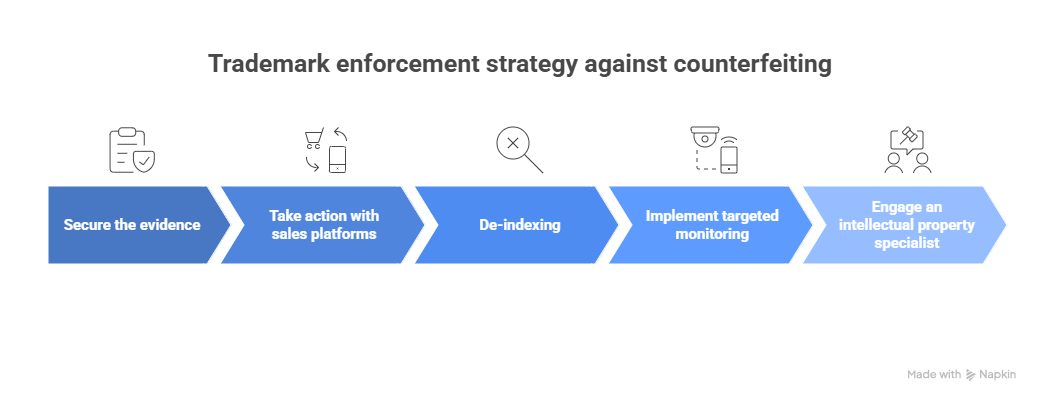
Conclusion

By combining local expertise with an international vision, Dreyfus law firm offers an innovative approach to protecting trademarks in a constantly evolving world. Whether through advisory services, management, or litigation, Dreyfus remains a trusted partner for companies looking to enhance their intangible assets.
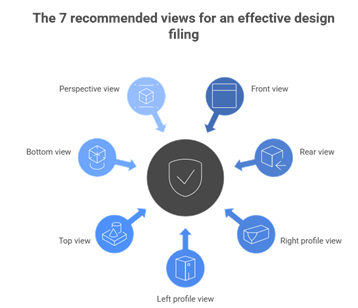
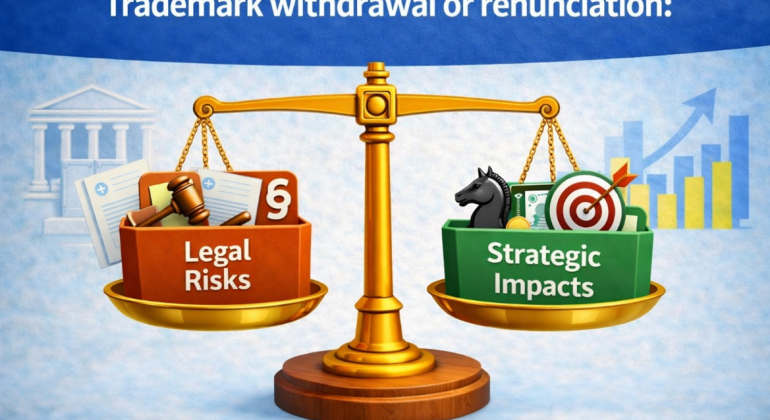
Join us on social media !

LinkedIn  

Instagram

Read More

Intellectual Property Law in the Wine Sector: Protecting heritage and innovation

The wine industry represents a unique confluence of tradition, innovation, and commerce. Intellectual property (IP) law plays a pivotal role in preserving this delicate balance by safeguarding trademark identities, regional heritage, and innovative practices. This article delves into the intricacies of IP law in the wine sector, examining the role of trademarks, geographical indications, and other IP tools in protecting the interests of stakeholders while fostering innovation.

The pillars of intellectual property in the wine industry

I – Trademarks: Securing brand identity

Trademarks are vital for distinguishing one producer’s products from another. In a competitive market, a strong trademark ensures brand recognition, consumer loyalty, and legal protection against imitation.

There are challenges in trademark registration :

  • Similarity of Products: Many wine trademarks fall under Class 33 (alcoholic beverages excluding beers). The dense registration landscape often leads to disputes regarding the similarity of products and signs.
    • Example: Opposition cases where trademarks like “MARQUIS DELATRE” and “MARQUÈS DEL ATRIO” were scrutinized for phonetic and visual resemblance.
  • Distinctiveness: Terms such as “Château” or “Domaine”, often used descriptively, require additional elements for registration.

Recent rulings from bodies like the French INPI and the EUIPO emphasize the need for trademarks to exhibit clear distinctiveness and avoid consumer confusion. For instance, rulings on marks like “LOUIS DE LA ROCHE” and “DOMAINE DE LA ROCHE” underline the importance of evaluating the overall impression of signs.

II- Geographical Indications: Preserving regional heritage

Geographical indications protect the names of regions associated with specific qualities or reputations, ensuring authenticity and preserving cultural heritage. Examples include Champagne, Bordeaux, and Chianti.

The EU’s comprehensive framework, such as the recent Regulation (EU) No. 2024/1143, governs the use and protection of GIs.

Some case studies :

  • Evocation and Misuse: Attempts to register terms evocative of protected geographical indication, such as “TIZZANO” for Corsican wines, often lead to legal challenges. Courts examine whether such terms might mislead consumers.
  • Modification of Specifications: Changes to PDO (Protected Designation of Origin) rules, such as permitting new grape varieties, must align with preserving the essence of the GI.

III – Innovation and patents in viticulture

Innovations in vineyard management and winemaking—from advanced irrigation systems to fermentation techniques—can be patented. Such protection incentivizes R&D while allowing producers to capitalize on their ingenuity.

While patents foster innovation, the wine sector’s reliance on tradition necessitates careful consideration of cultural impacts. For example, patents related to non-traditional production methods, like de-alcoholized wines, must respect established GI rules.

IV – Design Protection: Packaging and presentation

The aesthetic appeal of wine packaging often influences consumer choice. Design rights protect elements like bottle shapes, labels, and closures, ensuring that unique presentations remain exclusive to their creators.

Innovative designs, such as eco-friendly packaging, have gained traction. Protecting these designs reinforces a producer’s commitment to sustainability and brand differentiation.

Enforcement and Dispute Resolution

Infringement Challenges

The wine industry’s premium products are frequent targets of counterfeiting. IP enforcement mechanisms, such as customs interventions and litigation, are essential for combating this issue.

Domain Name Disputes

Cybersquatting cases, such as those involving domain names mimicking famous wine brands, highlight the need for vigilance in digital spaces. The UDRP (Uniform Domain-Name Dispute-Resolution Policy) provides an effective resolution mechanism.

Arbitration and Mediation

Given the international nature of the wine trade, alternative dispute resolution methods like WIPO arbitration offer efficient solutions to cross-border IP conflicts.

Navigating the Future of IP in the Wine Sector

Sustainability and IP

As sustainability becomes a market priority, producers are leveraging IP to protect eco-friendly innovations and branding strategies.

Digital Marketing and E-commerce

With the rise of e-commerce, protecting trademarks and designs in digital marketplaces is increasingly critical.

Strengthening International Cooperation

Harmonizing IP standards through international agreements, such as the Lisbon Agreement and TRIPS, is essential for ensuring robust protection across jurisdictions.
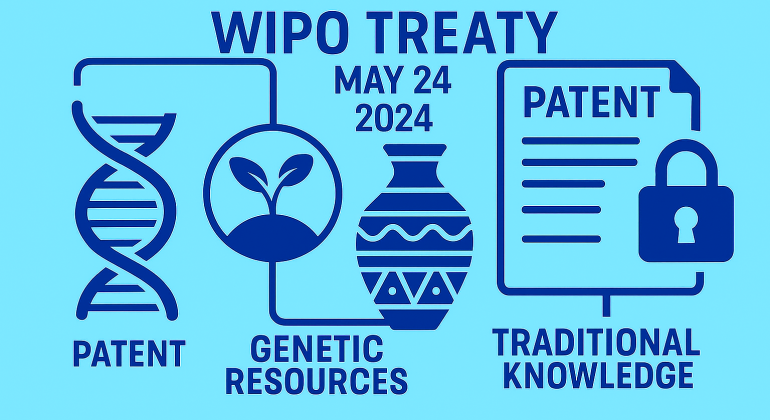
Conclusion

The wine industry’s reliance on intellectual property law underscores its commitment to preserving heritage while embracing innovation. By navigating the complexities of trademarks, geographical indications, patents, and design rights, stakeholders can protect their assets and ensure a thriving future for viticulture worldwide. Effective enforcement and adaptation to emerging trends will further solidify the role of IP as a cornerstone of the wine sector’s success.

Dreyfus Law Firm excels in protecting and promoting wine trademarks, as well as managing appellations of origin (AOC/AOP) and geographical indications (GI). With our deep expertise in intellectual property and wine law, we support producers, trade unions, and other stakeholders in safeguarding and enhancing their products.

Join us on social media !

LinkedIn  

Instagram

Read More

Precedent on Opposition and Cancellation Proceedings – 2024

In the dynamic landscape of intellectual property lawopposition and cancellation proceedings serve as vital instruments for ensuring trademark registries maintain integrity and relevance. In 2024, the INPI (Institut National de la Propriété Industrielle) and French courts delivered landmark decisions that clarified procedural subtleties and substantive grounds for action. This article explores key decisions, offering practitioners and businesses critical insights into the latest trends shaping French IP litigation.

Key procedural elements

Non-use cancellation and evidence requirements

Cancellation for non-use remains a critical aspect of trademark disputes. Recent decisions reflect the broad evidentiary approach adopted by the INPI. Undated documents such as marketing materials and screenshots, when evaluated collectively with dated items, have been deemed admissible (e.g., INPI, 2 May 2024, Bob dépannage!). This leniency underscores the need for comprehensive and detailed records of use.

However, the geographical scope of use remains tightly interpreted. For instance, evidence targeting a non-French market (Swiss company) in English were deemed insufficient to establish French usage (INPI, 11 March 2024, Bureau d’Idées), reminding trademark holders of the importance of local relevance.

Procedural standing and abuse of rights

A consistent theme in 2024 decisions is the public interest nature of cancellation proceedings, obviating the need for claimants to demonstrate personal interest. This principle highlights the role of such proceedings in ensuring the integrity of trademark registries and was reaffirmed in CA Paris, 24 April 2024, Vape, which emphasized the role of these actions in cleansing the registry.

Claims of abuse of rights require substantial evidence of malicious intent. In MySunbed (INPI, 27 May 2024), the INPI rejected bad faith allegations where the claimant’s actions were not clearly aimed at harming the trademark holder, setting a high bar for abuse-related defenses.

Temporal scope and legal framework

The temporal application of law remains pivotal in cancellation actions. Decisions such as Cavalride (INPI, 3 April 2024) reiterated that trademarks are assessed based on the legal framework at their filing date, making historical legal research an indispensable tool for practitioners.
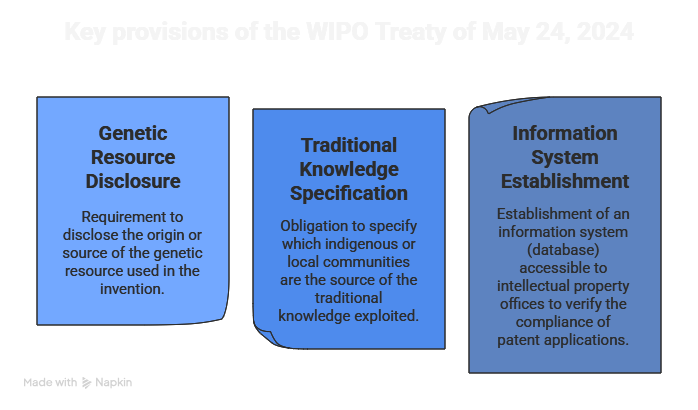
Expanded grounds for invalidity

Distinctiveness, deceptiveness, and public order

Distinctiveness remains a cornerstone of trademark registrability. The MySunbed case (27 May 2024) highlighted the evolving standards of consumer perception, particularly concerning basic English terms used in France (INPI, 27 May 2024). Meanwhile, decisions on deceptiveness emphasized the need for claimants to demonstrate misleading potential at the time of filing, rather than relying on post-registration evidence (INPI, 3 April 2024, NL 22-0199).

Public order considerations were addressed in cases like NL 23-0089, where the INPI dismissed claims that a trademark contravened legal restrictions, focusing on whether actual prohibitions existed at the time of filing (INPI, 18 March 2024).

Renown and parasitic intentions

Proving renown remains challenging, as it requires robust evidence such as prior judicial recognition or extensive consumer exposure (INPI, 12 July 2024, Immo Angels). Meanwhile, allegations of parasitic intent require clear links between the litgious trademark and a recognizable external reference, as demonstrated in the Cadault case (INPI, 29 April 2024).

Recent case-law trends in French IP litigation

French IP precedent in 2024 reveals a pro-business tilt, particularly in its evidentiary flexibility for proving use. However, the INPI’s stringent standards for distinctiveness and renown ensure that frivolous registrations face robust scrutiny. This balanced approach promotes a competitive yet fair trademark ecosystem.

Additionally, courts have shown increasing sophistication in addressing linguistic and cultural nuances. The La Chicha Loca case, for instance, highlighted the growing recognition of diverse public perceptions based on regional language comprehension (INPI, 26 January 2024).

Conclusion

The decisions of 2024 underscore the importance of strategic preparation in opposition and cancellation proceedings. Practitioners must anticipate evidentiary hurdles, leverage historical legal contexts, and adapt arguments to evolving standards of distinctiveness and public perception. Key takeaways include:

  • The INPI increasingly emphasizes public interest in cancellation actions.

  • Successful cancellation claims demand comprehensive, evidence-backed arguments, particularly regarding distinctiveness and renown.
  • Cultural and linguistic contexts play a growing role in trademark disputes.

Dreyfus Law firm assists its clients in managing complex intellectual property cases, offering personalised advice and comprehensive operational support for the full protection of intellectual property.

Dreyfus Law firm works in partnership with a worldwide network of lawyers specialising in Intellectual Property.

Join us on social media!

Nathalie Dreyfus with the assistance of the entire Dreyfus team.

FAQ

1. What is the difference between opposition proceedings and an action for invalidity?

Opposition seeks to prevent the registration of a pending trade-mark application, whereas an invalidity action attacks a registration that has already been granted.

2. When may revocation for non-use be brought?

An action for revocation may be filed once the mark has not been put to genuine use for an uninterrupted period of five years. The INPI will tolerate this period only where the proprietor can supply convincing evidence of use.

3. Must a trade-mark’s reputation be national in scope?

No. A sector-specific or regional reputation is sufficient, provided it is objectively established.

Read More

What are the different steps to register a trademark in the European Union (EU) ?

Introduction

Trademarks are a key intellectual property asset for companies of all sizes. They enable you to differentiate your products and services from those of competitors and provide legal protection allowing you to defend your protected names and logos. If you are considering filing a trademark benefiting from protection throughout the European Union (EU), this article briefly explains the different steps to follow.

Step 1: Prior art search

The first step is to verify the availability of the trademark you wish to file. Before any filing, it is essential to carry out a “prior rights search” to ensure that the name or logo you wish to protect is not already registered by a third party for identical or similar products or services. This approach helps to prevent the risk of future legal conflicts.

At first, the EUIPO’s trademark search tool is a good starting point to obtain an initial indication of any identical prior rights, both among EU trademarks and national trademarks of the various EU member states.

For an EU trademark project, it is generally essential to carry out a more in-depth search. This can be done with the assistance of an intellectual property attorney who has access to specialized tools and the expertise necessary to identify not only identical but also similar trademarks that basic identity searches may miss.

If no blocking prior rights are detected, you can then move confidently to the next step of the filing process.

Step 2: Filing of the trademark

The second step is to complete a trademark application form. This form must include several pieces of information: the name of the trademark and/or logo, the name of the company that will own the trademark, its contact details, and the classes of the goods and services covered. Drafting the specification of goods and services should be done with the assistance of an attorney. Once the form is completed and submitted, you must pay a so-called “filing” fee.

Step 3: Examination of the trademark application

The third step is no longer under your control. Once the trademark application has been submitted to the EUIPO, it will undergo a rapid examination of the substantive and formal conditions that every trademark application must meet, including notably:

  • Are the goods and/or services for which your trademark is filed correctly classified?
  • Has the application been correctly completed?
  • Has the fee been paid?

Please note: the EUIPO does not carry out a prior check of your trademark’s availability in relation to trademarks already registered in the European Union. However, it informs holders of earlier rights when a trademark application appears similar to their rights.

After this examination, the EUIPO will publish your trademark application in the Official Journal of the European Union. This informs third parties of your filing. From the date of publication, third parties have three months to oppose the registration of the trademark if they believe it infringes their own rights.

Step 4: Trademark registration

At the end of the examination process, the trademark is either accepted or refused for registration. If accepted, you will receive a digital registration certificate. This certificate provides proof of the legal protection granted to your trademark in the EU.

Finally, keep in mind that the EU trademark is protected for 10 years and is indefinitely renewable at the end of the initial protection period. A renewal fee must be paid to extend the protection for a new 10-year period.

Conclusion

trademark registration eu

To register a trademark in the EU and maintain its protection, each of these steps must be followed. The prior rights search is an essential prerequisite as it helps ensure, as far as possible, that no opposition will be filed after your trademark application.

Dreyfus & Associés can assist you at every stage of your trademark filing, from the prior rights search to its official registration, to secure your rights effectively.

Dreyfus & Associés works in partnership with a global network of attorneys specializing in Intellectual Property.

Nathalie Dreyfus with the support of the entire Dreyfus team

FAQ

1. What is an EU trademark and what are its advantages?
An EU trademark (EUTM) is a single title granted by the EUIPO which provides uniform protection in all 27 Member States. It simplifies and centralizes the filing, management and enforcement of your rights in the EU.

2. How much does it cost to file an EU trademark?
Official fees start at €850 for one class of goods or services. Additional fees apply for each extra class. Attorney’s fees are charged separately.

3. Is it better to file a national trademark or an EU trademark?
This depends on your objectives and geographic scope. Filing a national trademark is often suitable for companies that are just starting out and targeting only the French market. However, opting from the outset for an EU trademark offers the advantage of a single protection in 27 Member States and anticipates future expansion of the project to other countries, even if the activity initially remains focused on France.

4. Is a prior rights search mandatory before filing a trademark?
It is not legally mandatory but is strongly recommended to identify identical or similar trademarks already registered and reduce the risk of opposition.

5. What happens if I forget to renew my trademark?
Do not worry: if you forget to renew your trademark at the end of the 10-year period, the law provides for a six-month grace period from the date of expiration. During this period, you can still renew and preserve your rights, but an additional fee will be charged on top of the standard renewal fee. After this period, the trademark falls into the public domain and must be refiled to regain protection.

Read More

What are the costs of registering a trademark with an Intellectual Property Attorney in the EU?

Introduction

Registering a trademark is one of the most important steps in protecting it. A trademark is a sign or symbol that distinguishes your products and services from those of your competitors, and it can be a valuable asset for your business. But if you want to register a trademark in the EU, you will need to work with a lawyer or, more specifically, an Industrial Property Attorney (IPA), a professional specially qualified to assist you in this area. This article explains the cost of registering a European trademark when you seek the assistance of a lawyer or industrial property attorney.

Preliminary step: eligibility of the proposed sign as a trademark

The first step in the process of registering a trademark with a lawyer or industrial property attorney in the EU is to determine whether your trademark is eligible for registration. Under European law, a trademark must be capable of distinguishing the goods or services of its owner from those of other companies. It must also meet other strict criteria:

  • Non-descriptive character: the trademark must not consist exclusively of signs describing the quality, quantity, intended purpose, value, or origin of the goods/services designated.
  • Non-generic nature: the trademark must not consist of signs or indications that have become customary in the current language of trade.
  • The sign must not be contrary to public policy or morality.
  • The sign must not be deceptive, i.e., it must not be likely to mislead the public as to the nature, quality, or origin of the goods or services.

The trademark must therefore comply with the conditions set out in the Directive (EU) 2015/2436 of the European Parliament and of the Council of December 16, 2015. If your trademark meets these criteria, you can proceed to the next step.

Determining the cost

The next step is to determine the cost of registering a trademark with a lawyer or industrial property attorney. The cost of registration varies depending on the number of classes of goods and services designated. In addition, the fees of the lawyer or industrial property attorney must also be considered, as well as optional costs such as those related to prior art searches.

costs registration EU

Application submission and registration

Once the registration cost has been determined, you will then need to file an application with the EUIPO (European Union Intellectual Property Office). This application must include all the necessary information about your trademark, the subject of the registration, such as the sign (word mark or logo) and the classes of goods and services designated. The EUIPO will then examine your application.

If there are no oppositions filed against the trademark application, the registration process, from the date of filing to official registration, generally takes around four to six months.

Once accepted by the EUIPO, the trademark will be officially registered for a period of 10 years and you will receive a registration certificate.

2025 Update: What you need to know about official taxes

To ensure that this article remains up to date, it is important to note that the official filing fees of the European Union Intellectual Property Office (EUIPO) are subject to annual adjustments. It is essential to check the official fee schedules directly on the EUIPO website at the time of filing each year.

For example, in 2024, the basic fees for a European Union trademark (EUTM) covering one class have generally remained stable compared to 2023, but an increase in agency fees and specialized prior art search fees should be anticipated.

The importance of using an Industrial Property Attorney remains unchanged, as this professional ensures that your application complies with current regulations and administrative practices of the EUIPO.

Conclusion

The cost of registering a European trademark with a lawyer or industrial property attorney is an important consideration for any company wishing to protect its trademark. Although the cost of registering a trademark may vary, it remains a necessary and significant investment in the protection of your intangible assets, guaranteeing you protection for a minimum of 10 years (a trademark can be renewed indefinitely).

Dreyfus & Associés assists its clients in managing complex intellectual property cases, offering personalized advice and comprehensive operational support for the complete protection of intellectual property.

Dreyfus & Associés works in partnership with a global network of attorneys specializing in Intellectual Property.

Nathalie Dreyfus with the support of the entire Dreyfus team

FAQ

1. What is the European Union Intellectual Property Office?

The European Union Intellectual Property Office (EUIPO) is the entity responsible for registering European Union trademarks (EUTMs).

2. Is a prior art search mandatory before filing a trademark?

A prior art search is not strictly mandatory for filing a trademark with the EUIPO, but it is strongly recommended. It allows you to check whether an identical or similar trademark already exists and to assess the risks of opposition, thus avoiding unnecessary costs and procedures.

3. What rights does registering a European Union trademark with the EUIPO confer?

Registering a European Union Trademark (EUTM) with the EUIPO provides uniform protection in all current EU member states. The filing fees cover this pan-European protection.

4. How long is a European trademark valid for?

The registration of a European Union trademark (EUTM) is valid for a period of 10 years from the date of filing the application and is renewable indefinitely for periods of 10 years.

5. What is an opposition procedure and how does it affect the registration timeframe?

An opposition procedure is legal action brought by the owner of an earlier trademark who believes that your new trademark application infringes on their rights. If an opposition is filed, the registration timeframe can be significantly extended (often by more than a year) and requires the intervention of your attorney or industrial property attorney to reply to the opposition.

Read More

Brexit and intellectual property : Ensuring the continuity of rights in trademarks and designs

Introduction : The legal breakup after Brexit

The United Kingdom’s exit from the European Union (Brexit) has dramatically altered the legal landscape, particularly in terms of intellectual property. Before December 31, 2020, intellectual property rights such as trademarks and designs were uniformly protected across the European Union, including the United Kingdom. However, since the end of the transition period, the separation of legal systems has required separate management of intellectual property rights for the UK and the EU.

This article explores the consequences of Brexit on intellectual property rights, particularly for trademarks and designs, and offers solutions to ensure their protection in this new legal environment.

Trademarks after Brexit : what has changed ?

2.1 Automatic conversion of EU trademarks into UK rights

Before Brexit, a trademark registered with the EUIPO (European Union Intellectual Property Office) protected rights across all EU member states, including the UK. Since January 1, 2021, EU trademarks (EUTMs) no longer cover the UK. To prevent trademark holders from losing protection in the UK, the UK Intellectual Property Office (UKIPO) automatically converted EU trademarks into comparable UK rights. These “cloned” marks retain the same filing and priority dates as their EU counterparts but are now governed by UK law.

2.2 European legislative reforms after Brexit

Following Brexit, the European Union continued to strengthen its legal framework for trademark protection. Regulation (EU) 2017/1001 on the European Union trademark was revised to address new challenges, particularly in the areas of cybersecurity and counterfeiting. The EUIPO implemented new tools to facilitate the monitoring of online violations and simplify dispute resolution procedures. These reforms are specific to the EU and do not directly affect trademarks in the UK, but they help reinforce the protection of EU trademarks post-Brexit.

2.3 Post-Brexit UK legislative reforms

The UK has introduced its own distinct legislation for managing trademarks after Brexit. The UKIPO has strengthened its rules to ensure that trademarks in the UK continue to receive the same protection as before, while also aligning with international standards. The UK has also adapted its mechanisms for tackling counterfeiting and IP rights violations, now independent of the EU. This legislation aims to reinforce the protection of rights in the UK and address global challenges related to counterfeiting.

2.4 EU Trademarks still under registration on December 31, 2020

EU trademark applications that were still under registration as of December 31, 2020, benefit from a priority right to file the same application with the UKIPO within nine months after the end of the transition period. This procedure allows holders to maintain their protection in the UK with the same filing date and the same goods and services as their corresponding EUTM.

Designs after Brexit: The new rules in the United Kingdom

3.1 Automatic conversion of registered Community designs

  • Community designs registered before Brexit were automatically converted into equivalent UK rights.
  • This conversion was carried out at no additional cost to the holders.
  • The priority, filing, and renewal dates of the cloned UK rights are identical to those of the original Community designs, ensuring uninterrupted protection in the United Kingdom.


designs brexit

Steps to ensure protection of rights in the UK after Brexit

4.1 Verification of existing registrations and separate registration

After Brexit, it is essential to ensure that intellectual property rights have been properly converted into UK rights. Holders must verify that their trademarks and designs have been cloned in the UK. For new creations, it is imperative to proceed with separate registration with the UKIPO to guarantee continued protection in the UK.

4.2 Monitoring the use of rights : Proof of genuine use

Once rights are registered in both the UK and the EU, it is crucial to monitor the use of these rights in each jurisdiction. Use of the trademark or design in the EU no longer justifies use in the UK, and vice versa. To avoid the cancellation of your rights for non-use, you must be able to demonstrate genuine use in each territory. This step is essential for maintaining the validity of your trademarks and designs in both jurisdictions.

4.3 Defending intellectual property rights

The UK has an effective judicial system for handling intellectual property disputes. In the event of infringement, holders can send a cease and desist letter to demand the cessation of the infringement. If the situation persists, they can bring the matter to specialized intellectual property courts, such as the Intellectual Property Enterprise Court (IPEC), or the Patents Court for more complex cases.

Conclusion : protecting your rights after Brexit

Brexit has separated the systems for protecting intellectual property rights between the UK and the EU. Rights holders now need to manage their trademarks and designs separately in both territories. The key to maintaining continuous protection lies in distinct registration, monitoring the use of rights, and proactively managing disputes. The legislative framework has evolved to allow efficient management of rights in both the UK and Europe.


Dreyfus & Associates supports businesses in protecting their trademarks and designs against the legal challenges arising from Brexit and the separate management of rights between the European Union and the United Kingdom.

Nathalie Dreyfus, with the support of the entire Dreyfus & Associates team

FAQ

1. Does my EU trademark still protect me in the UK after Brexit ?
No, since January 1, 2021, EU trademarks no longer cover the UK. However, the UKIPO has generated comparable UK trademarks to maintain equivalent protection.

2. What should I do if I have a European trademark registered before Brexit ?
European trademarks were automatically converted into comparable UK trademarks without additional fees. You now need to manage your trademarks separately in the UK and the EU.

3. How can I ensure the protection of my designs in the UK after Brexit ?
Community designs were automatically converted into UK rights. However, for new designs, you must now file a separate application with the UKIPO to ensure protection in the UK.

4. What should I do if I haven’t yet filed my trademark or design in the UK ?
You need to file an application with the UKIPO to ensure the protection of your trademark or design in the UK. EU trademarks are no longer valid in the UK since January 1, 2021.

5. What steps should I take to maintain the protection of my rights after Brexit ?
It is essential to file separate applications with the UKIPO for the UK and the EUIPO for the EU. You must also prove the use of your rights in each territory to ensure their validity.

Read More

Fashion ID and Facebook : joint responsibility subject to debate

Introduction

The integration of third-party social plugins on professional websites has become a standard feature of digital strategies. Sharing buttons, advertising pixels, and analytics tools are widely perceived as levers for audience growth and commercial performance. However, these technical choices now entail legal responsibility for economic operators, particularly under European personal data protection law.

The Fashion ID judgment, handed down by the Court of Justice of the European Union, the July 19, 2019, constitutes a structuring decision in this respect. By recognising, under certain conditions, joint responsibility between a website publisher and Facebook as a result of integrating the “Like” button, the Court profoundly reshaped the analysis of digital chains of responsibility.

This solution, grounded in a functional and pragmatic approach, nevertheless continues to give rise to doctrinal and practical debate as to its actual scope and its operational implications.
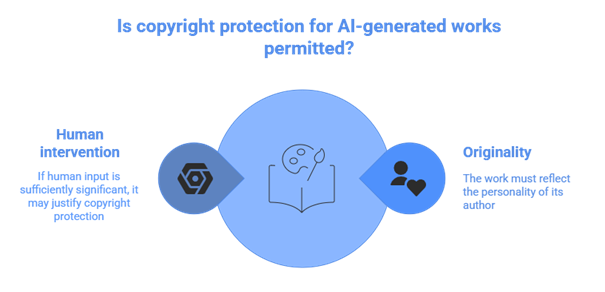
The Fashion ID decision : a landmark in European data protection law

In the Fashion ID case, the company operating an online retail website had integrated Facebook’s “Like” button. This plugin triggered, as soon as the page loaded, the automatic transmission of visitors’ personal data (IP address, browsing data), regardless of any voluntary interaction with the social network.

The central question concerned Fashion ID’s legal qualification : could it be regarded as a controller even though it neither had access to the transmitted data nor exercised control over their subsequent use by Facebook ?

The Court adopted a resolutely concrete approach. It held that the voluntary integration of the social plugin, for purposes of visibility and commercial promotion, was sufficient to characterise participation in determining the purposes and means of processing, at least for the data-collection phase.

Fashion ID was therefore classified as a joint controller, alongside Facebook, for that specific phase of processing.

The concept of joint controllership applied to social plugins

The Court confirms that joint controllership does not require equality of roles or identical access to data. It is based on a functional analysis, taking into account the effective involvement of each actor in the processing chain.

Accordingly, a website may be deemed a joint controller where it :

• deliberately chooses to integrate a third-party tool ;
• derives an economic or marketing benefit from that integration ;
• facilitates, even indirectly, the collection of personal data.

This analysis aligns with the positions adopted by European data protection authorities, in particular the recommendations issued by the CNIL regarding trackers and third-party tools.
The Court is careful to specify that joint responsibility is neither global nor unlimited. It is strictly confined to the operations over which the website publisher exercises real influence, namely the initial collection and transmission of data.
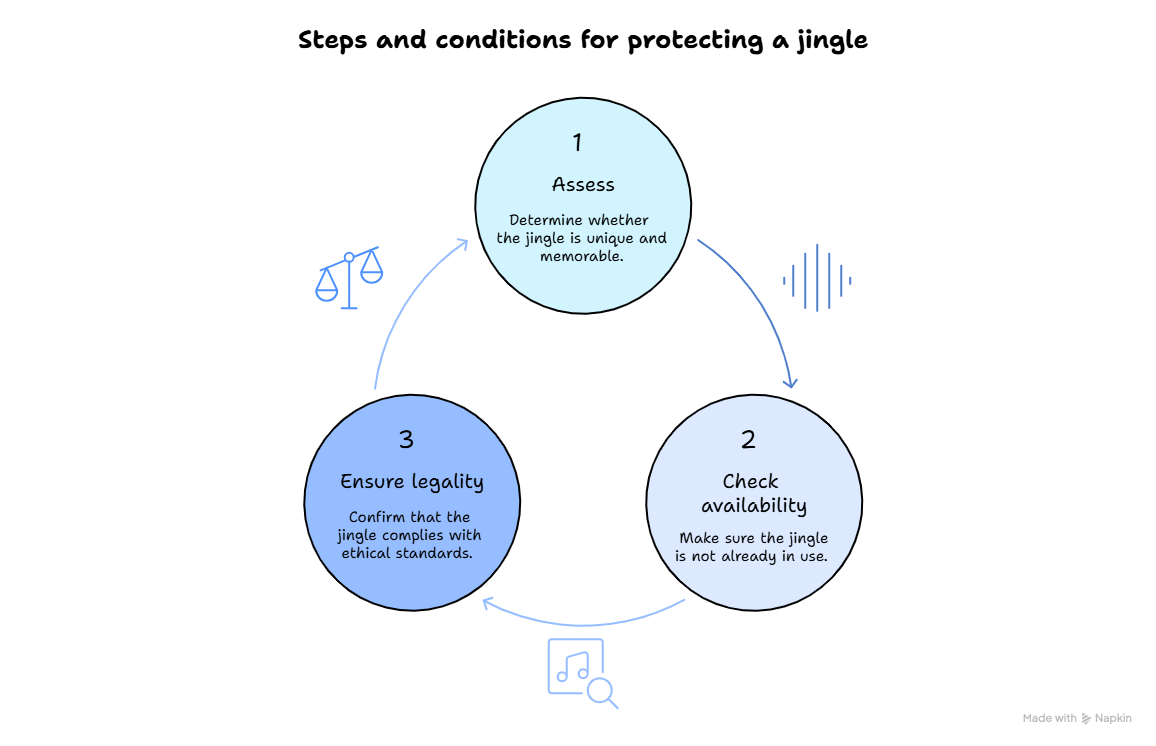
web publisher liability

The limits set by the Court : a strictly circumscribed responsibility

One of the key contributions of the Fashion ID decision lies in the clear delineation of responsibility. The website publisher is not held responsible for subsequent processing carried out by Facebook, insofar as it does not determine either the purposes or the modalities thereof.

This clarification is essential to preserving a balance between data protection and legal certainty for economic operators.

The decision does not establish a principle of automatic responsibility for any integration of a third-party module. Each situation must be assessed on a case-by-case basis, taking into account the reality of data flows, the intended purpose, and the degree of involvement of the website publisher.

Practical takeaways for companies and trademarks

Website publishers must clearly inform users of data collection through third-party modules, identifying joint controllers and the purposes pursued.

This transparency requirement is fully consistent with the General Data Protection Regulation of April 27, 2016 (GDPR) framework and the CNIL’s guidelines.

Where the data collected are not strictly necessary for the operation of the website, prior consent is required. Such consent must be effective, specific, and technically enforced, which often entails revisiting the default settings of social plugins.

Best practices and risk-management strategies

To limit legal exposure, companies may usefully implement the following measures :

• regular audits of integrated tools and plugins ;
• removal of non-essential modules ;
• use of deferred loading solutions (lazy loading) ;
• contractual framing of relationships with third-party providers ;
• documentation of technical and legal choices made.

Conclusion

The Fashion ID case clearly illustrates how the law now addresses digital architectures. Joint responsibility is no longer a theoretical construct, but a concrete operational risk for companies, particularly those whose reputation relies on their digital presence.

Dreyfus & Associés law firm assists assists its clients in managing complex intellectual property cases, ensuring GDPR compliance, and providing legal protection for their digital strategies.

Dreyfus & Associés works in partnership with a global network of specialised intellectual property lawyers.

Nathalie Dreyfus, with the support of the entire Dreyfus firm team.

Q&A

1. Can joint responsibility be established in the absence of a contractual relationship with Facebook ?
Yes. The existence or absence of a formal contract with Facebook is not decisive. The Court reasons outside any contractual logic, relying exclusively on the facts and the reality of data flows. A website may therefore be classified as a joint controller even if it has entered into no specific agreement with the provider of the social plugin.

2. What concrete risks arise in the event of an inspection by the CNIL or a European authority ?
The risks are multiple and cumulative: formal notice, injunctions to comply, administrative fines, as well as potential compensation claims by users. Beyond the financial aspect, reputational risk is often decisive, particularly for exposed trademarks or those operating in sensitive sectors.

3. Does removing the social plugin eliminate all legal risk ?
Not necessarily. Removal puts an end to future risk, but it does not erase past processing. Authorities may examine previous practices, especially where data were collected without proper information or valid consent. Hence the importance of documenting audits carried out and corrective measures implemented.

4. Can this case law extend to tools other than social networks ?
Yes, and this is a central point. The Fashion ID reasoning goes far beyond “Like” buttons alone. It is transposable to other technologies such as advertising pixels, audience-measurement tools, chat services, video players, or interactive maps, insofar as they entail the transmission of personal data to third parties.

5. How should joint controllership be distinguished from processing on behalf of a controller under the GDPR ?
The distinction is fundamental. A processor acts on behalf of the controller and in accordance with its instructions, which was not the case in Fashion ID. Where a third party pursues its own purposes, qualification as a processor is excluded.

6. Can a publisher rely on technical complexity to escape responsibility ?
No. The Court adopts a clear position : technical complexity does not constitute grounds for exemption. Companies are required to understand, at least in broad terms, the legal effects of the tools they integrate. This requirement reinforces the need for legal support upstream of technical decisions.

This publication is intended to provide general guidance and to highlight certain issues. It is not intended to apply to specific circumstances or to constitute legal advice.

Read More

Generic trademarks: good practices to avoid ‘genericide’

Protecting intellectual property assets is a major concern of companies. Trademarks are a subject of immediate interest, because they allow consumers to associate products and/or services with a specific company. The company is therefore more easily recognized and is more likely to see customers buy its products.


Once a trademark has been duly registered, a company can start to exploit it.  That is when we must be most vigilant. Indeed, a trademark may lose its distinctiveness after its registration, by becoming a generic trademark.


What is a generic trademark?


Put simply, a generic trademark is one that has become “The common name in trade for a product or service” One of the main criteria for the validity of a trademark is its distinctiveness (Article L. 711-2 of the French Intellectual Property Code). Under the article L. 714-6 of the French Intellectual Property Code, a generic trademark is devoid of distinctiveness because it has become “The common name in trade for a product or service”.


In other words, a generic trademark is a trademark that has become a common term for a type of product or service. It is used by both consumers and competitors of the trademark to refer to the product or service no matter by whom it has been provided. As a victim of its success, the trademark no longer enables consumers to identify products and services as coming from the company concerned. It falls therefore into the public domain.


As such, the company that created the trademark loses its exclusive right of exploitation. It will no longer be able to oppose the use of its trademark by third parties who seek to use it as the descriptive or ‘generic’ name of the product or service for which it has become famous. This is called genericide of a trademark.


Under the aforementioned article L. 714-6, an action for revocation or cancellation for genericide of a trademark that became generic requires two conditions:

– the trademark must have become the common name of the product or service;

– such use must be caused by the trademark owner, namely mostly his inaction.


Hence, the need for a company to act effectively against any use of its trademark as a generic term. If the owner acts effectively against any generic use, the trademark will continue to be protected by law.


Good practices to prevent a trademark from becoming generic


Acting before any commercialization, is the most effective way to prevent a trademark from becoming generic. It is also advisable not to misuse the trademark later on.


If you have created a totally new product or seek to become a brand leader in a new market, it is imperative to create – or use -a term to designate the new product, as there is a strong risk of confusion between the trademark and the product. For example, Apple’s trademark is iPhone, and the product to which it is applied is a “smartphone”.  Similarly, if a generic term exists but is particularly complex, it is useful to provide a simpler term, where your trademark is the market leader. It is also recommended to use the term defined in this way in agreements with third parties (e.g. letter of commitment, coexistence agreement, etc.).


In addition, the trademark must be used correctly in all circumstances, both externally and internally.


The use of the trademark must be particularly monitored during advertising campaigns. The trademark should be distinguished from the surrounding text promoting the marketed product or service by placing it in BLOCK LETTERS or, by Capitalising the first letter.

Using the trademark as a noun makes it more likely to be confused as the generic name. This practice should be discarded in favour of using it as an adjective. For example; “a Kleenex handkerchief” rather than “a Kleenex”.

Another good practice is to use the ® symbol or the ™ symbol. Although the latter have no legal value in France unlike in the United States, their use on the market is common. Promoting the trademark as an asset belonging to the company discouraging its use as a common term.


A trademark becomes generic mainly because of its misuse by the public. This misuse is not necessarily the result of an intend to harm. As such, it is recommended to carry out advertising campaigns aimed at consumers promoting correct use in order to avoid misuse. Preparing written standards defining the correct use of the trademark that can be easily distributed to third parties (licensees, consumers, etc.) also participates to this public education.

Avoiding misuse of the trademark also requires protection against abusive use of the trademark by third parties. It is therefore necessary to monitor product and service descriptions for new trademark applications and press publications mentioning the trademark.


Finally, because a trademark may be declared generic as a result of the owner’s actions or lack of action, it is in the company’s best interest to ensure that it can prove that it has taken steps to avoid the trademark becoming generic. In this respect, marketing files (advertising costs, unsolicited mentions in the press, etc.), letters of formal notice, summonses or even court decisions are all evidence to be kept.


In short, a potentially generic trademark remains protectable under trademark law if its owner has enforced actions against its misuse and gathered supporting evidences to prove that extent.


Dreyfus can assist you in the management of your trademarks portfolios in all countries of the world. Do not hesitate to contact us.

FAQ

What is a generic trademark?
A trademark that, through being used as a common name to designate a product or service, loses its distinctive function and falls into the public domain.

Can a trademark be protected against genericide?
Yes, by monitoring its use, educating the public and distributors, and ensuring it is always perceived as a trademark and not as a common name.

Can a generic trademark be recovered?
No, once a trademark has become generic and lost its legal protection, it is very difficult — if not impossible — to recover it as a registered trademark.

Read More

Disputes regarding domain names <.CN> and <.中国> : it is now possible to act before the WIPO Mediation and Arbitration Centre.

The China Internet Network Information Center (CNNIC), registry of the <.CN> and <.中国> ccTLDs, has designated WIPO to provide dispute resolution services under the China ccTLD Dispute Resolution Policy. Disputes in relation to these ccTLDs may be filed with WIPO from August 1, 2019.

The <.CN> Policy is ONLY applicable to <.CN> and <.中国> domain names that have been registered for less than three years.

This Policy applies to <.CN> and <.中国>domain names that are identical or confusingly similar, not only to a mark, but to any “name” in which the complainant has civil rights or interests (.CN Policy, article 8(a)), whereas the UDRP is limited to the protection of trademark rights.

It is sufficient for the complainant to prove that either registration or use of the disputed domain name is in bad faith, whereas the UDRP requires the complainant to prove both elements.

The appeal jurisdiction belongs to the Courts of China or the arbitration Chinese institution, and the proceedings language will be Chinese (unless otherwise agreed by the parties or determined by the Panel).

This adds to the over 75 other ccTLDs for which trademark owners can rely on WIPO’s dispute resolution services.

Read More

The Madrid System welcomes Thailand

Introduction

Since November 7, 2017, Thailand has officially become the 99th member of the Madrid Protocol, marking a major milestone in the expansion of the Madrid System, administered by the World Intellectual Property Organization (WIPO). This accession confirms the growing importance of this international mechanism in the global protection of trademarks.

Background and Thailand’s accession

The Madrid Protocol, in force since April 1996, allows applicants to protect a trademark in several countries through a single international application, filed with a member office and accompanied by a single set of fees. This centralized process is attractive due to its simplicity and efficiency.

Thailand deposited its instrument of accession in August 2017 during an official ceremony attended by government representatives. The accession entered into force on November 7, 2017, enabling, as of that date, trademark holders from Thailand or abroad to file an international application covering Thailand.

Advantages and challenges for applicants

Simplification and cost savings

Thanks to the Madrid System, applicants no longer need to file trademark applications country by country. A single procedure suffices to designate multiple jurisdictions, with one application and centralized fees.

Attractiveness for foreign businesses

Thailand’s accession enhances its appeal for foreign companies, which can now include Thailand in their international trademark portfolios through the Madrid System.

Regional strategy

This accession is part of a broader movement within ASEAN. With Thailand, eight of the ten ASEAN member states have joined the system a significant step toward regional harmonization in trademark protection.

advantages and challanges

Strategic perspectives in Asia

Thailand’s entry into the Madrid System represents a strategic opportunity for businesses targeting the Asian market and seeking to structure an international trademark protection strategy without multiplying individual national procedures.

Conclusion

Thailand’s accession to the Madrid Protocol, effective November 7, 2017, marks an important step in the expansion of the Madrid System. It provides tangible benefits in terms of simplicity, reduced costs, and broader geographic coverage for international applicants. This development also strengthens regional cohesion within ASEAN at a time when intellectual property protection is becoming a key competitive advantage.

Dreyfus Law firm assists its clients in managing complex intellectual property cases, offering personalized advice and comprehensive operational support for the complete protection of intellectual property.

Dreyfus Law firm is partnered with a global network of lawyers specializing in intellectual property.

Nathalie Dreyfus with the assistance of the entire Dreyfus team.

FAQ

1. Since when has Thailand been a member of the Madrid system?
Since November 7, 2017, following its official accession to the Madrid protocol.

2. What does the Madrid system offer in practice?
It allows applicants to file a trademark in multiple member states through a single international application and pay centralized fees.

3. Why is Thailand’s accession strategic?
It facilitates access to the Thai market through a single procedure and strengthens regional coverage within ASEAN.

4. How many members does the Madrid protocol have?
With Thailand’s accession, the system counted 99 member states as of its entry into force.

5. What perspectives does this accession offer?
It opens new opportunities for companies targeting Asian markets, notably by combining protection in Thailand with neighboring countries such as Cambodia, Vietnam, China, and Brunei.

Read More

Social media & justice: the French Court of Cassation rules on Facebook “friendship”

Introduction : impartiality tested by social media

The rise of social media has profoundly transformed human interactions, blurring the lines between private life and professional obligations. In the judicial context, this evolution raises delicate questions about the neutrality and independence of judges. The decision of 5 January 2017 (No. 16-12.394) of the French Court of Cassation illustrates this issue by ruling on the legal qualification of the “friend” link on Facebook. The highest court emphasised that such a virtual link, often created without any significant interaction, cannot automatically be equated with a genuine friendship. This clarification marks an important step in adapting case law to the realities of the digital age.


The distinction between virtual and real friendship

Facebook “friend”: a symbolic link, not presumed to be close

The Court of Cassation held that the term “friend” as used on Facebook reflects the platform’s own terminology rather than a traditional social recognition. In many cases, such a connection results from algorithms, professional contacts, or weak ties, without genuine personal involvement. A virtual connection therefore does not, in itself, indicate emotional closeness or influence. This position ends the automatic conflation of digital and personal relationships. It also reminds us that the law must take into account the specific practices of each digital environment.

No automatic presumption of bias

The decision confirms that a “friend” link on a social network is not, on its own, sufficient grounds to recuse a judge. Without factual evidence of a personal relationship or partiality, bias cannot be established. This stance protects the freedom to use social media while maintaining a high evidentiary standard. It thus strikes a balance between safeguarding the image of justice and acknowledging common digital practices. The Court reaffirmed that only concrete evidence can justify challenging a judge’s impartiality.


Concrete elements that may demonstrate bias

Evidence required by case law

For a recusal request to succeed, it is essential to provide tangible evidence. Such evidence may include:

  • Frequent and personalized exchanges between the judge and the party.
  • Public expressions of support or positions taken in favor of one party.
  • Joint participation in events directly related to the case.
  • Precise, verifiable evidence directly linked to the dispute.
  • Elements ensuring that recusal is not used as a dilatory or strategic tool without any objective basis.

Probative value and legal requirements

The elements presented must demonstrate an objective appearance of bias, as it would be perceived by a reasonable observer. The criteria include:

  • Rejection of isolated or anecdotal evidence (for example, a single screenshot or a one-off connection).
  • The need to establish an overall context and a significant frequency of interactions.

  • Consideration of consistent indicators demonstrating an objective risk of bias.
  • A rigorous factual approach, excluding purely subjective interpretations.

  • Ensuring legal certainty and the stability of rendered decisions.
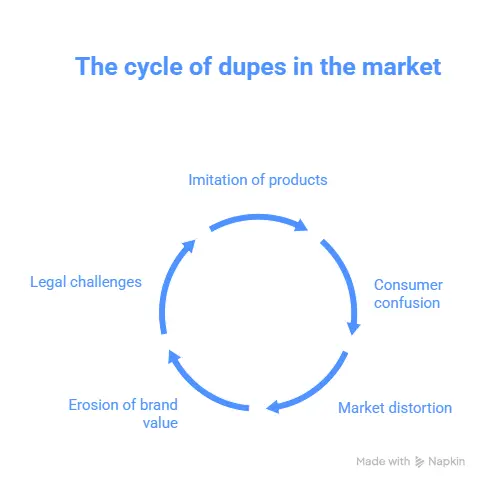
indicators recognized caselaw

Scope of the decision on judges’ use of social media

Recognition of digital realities

In ruling this way, the Court acknowledges the widespread use of social media and the connections they generate. Digital relationships can exist without implying a real personal bond, and their mere existence does not inherently threaten impartiality. This recognition marks progress in adapting the law to the digital era.

Freedom of use framed by ethical prudence

However, the decision does not exempt judges from their ethical obligations. Their online presence must remain compatible with the requirements of neutrality and restraint. Any interaction likely to create an appearance of bias should be avoided to maintain public confidence in the judiciary.
Implications for public perception of justice

A reassuring decision for judicial neutrality

By requiring concrete proof of bias, the Court reinforces confidence in the independence of judges. This stance reassures that objective criteria, rather than mere appearances, guide the assessment of impartiality.

Risks of negative public perception

Nevertheless, part of the public, unfamiliar with legal nuances, may view these virtual links as a potential source of conflict of interest. This calls on judges and judicial institutions to educate the public about the real significance of such digital connections.

Conclusion

The decision of 5 January 2017 is a cornerstone in defining judicial impartiality in the digital age. It makes clear that the mere existence of a virtual link cannot undermine a judge’s neutrality, absent tangible proof of closeness or influence. This ruling helps to stabilise case law on recusal while providing a clear framework for legal practitioners.

Dreyfus Law firm is part of a global network of lawyers specialising in Intellectual Property.
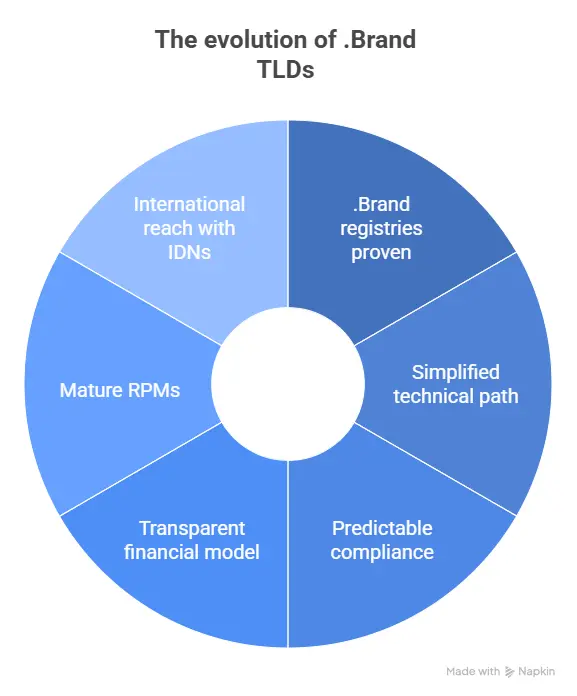
Nathalie Dreyfus with the assistance of the entire Dreyfus team.

FAQ


Can a judge be Facebook friends with a party to a case ?

Yes, but this link alone does not justify recusal.

What evidence can prove bias ?

Frequent exchanges, public support, or direct involvement in the case.

Does the private nature of exchanges affect the analysis ?

No, only proof of a concrete relationship matters.

Does this rule apply to LinkedIn or Instagram ?

Yes, it applies to all social networks.

Can a judge be sanctioned for online activities ?

Yes, in cases of breach of neutrality or restraint obligations.

Read More

The danger of trademark trolls!

Introduction

The term “trademark troll” refers to opportunistic actors who exploit trademark law for speculative or coercive purposes. This article examines the definition of trademark trolls, the dangers they represent, the means of protection against them, and the question of their potential strategic value.

Understanding trademark trolls

Definition and essential characteristics

A trademark troll files a mark without any genuine intention of use, with the aim of demanding royalties, blocking market access, or exerting legal pressure.

Origins: from patent trolling to trademark trolling

Inspired by practices in the field of patents, this misuse relies on the “first-to-file” principle. Trolls take advantage of companies’ delays or oversights to pre-empt their filings.

Why trademark trolls are dangerous

Legal and commercial risks

Such practices generate costly litigation, slow down innovation, and force businesses into unjustified financial concessions.

Concrete examples

  • Snapchat vs. 47/72 Inc.: the filing of “OH SNAP! CHAT” risked diverting Snapchat’s image.
  • Castel frères in China: fraudulent pre-registration of the name “Ka Si Te” led to penalties and market losses.
  • Apple-proview: Apple was forced to pay USD 60 million to secure the “iPad” trademark in China.

How to protect against trademark trolls

Proactive filing strategies

An effective policy includes:

  • Early filing of key trademarks.
  • Coverage of all relevant classes.
  • Active monitoring to detect suspicious filings.

Legal remedies and procedural safeguards

Available tools include:

  • Opposition proceedings before INPI, EUIPO, or other trademark offices.
  • Revocation for non-use actions.
  • Recognition of bad faith, illustrated by the recent EUIPO decision invalidating a fraudulent “TESLA” filing.

In 2022, Tesla filed a cancellation action against the European trademark “TESLA,” registered by Capella Eood, a company associated with an individual known for “trademark trolling” practices. Tesla argued that Capella Eood employed speculative strategies to register trademarks in order to block other companies’ operations and extort financial settlements. The EUIPO’s Cancellation Division held that the mark had been filed in bad faith and declared it invalid.

For more information on this matter: https://www.dreyfus.fr/en/2025/01/06/tesla-and-the-euipo-halt-trade-mark-trolling/

eng troll danger

Trademark trolls: A possible strategy?

Opportunism or legitimate filing

While trolls act for speculative purposes, some defensive filings may be considered strategic, provided they rest on a genuine intention of use.

Regulatory responses and recent case law

Offices and courts are progressively reinforcing the fight against abusive practices. The Tesla/Capella Eood decision confirms Europe’s determination to sanction speculative filings.

Conclusion

Trademark trolls represent a growing threat for businesses. Only proactive protection strategies and swift legal responses allow companies to safeguard their intangible assets.

Dreyfus Law firm assists its clients in managing complex intellectual property cases, offering personalized advice and comprehensive operational support for the complete protection of intellectual property.

Dreyfus Law firm is partnered with a global network of lawyers specializing in intellectual property.

Nathalie Dreyfus with the assistance of the entire Dreyfus team.


FAQ


What is a trademark troll?
A trademark troll is a filing made without any real intention of use, solely to block or monetize rights.

What are the risks associated with trademark trolls?
They lead to costly litigation, delay market entry, and impose unjustified financial concessions.

How can a fraudulent filing be anticipated?
By filing trademarks early and implementing active monitoring systems.

What remedies are available in France and Europe?
Opposition proceedings, non-use cancellation actions, and claims based on bad faith.

Is revocation for non-use an effective tool?
Yes, it is an effective means of cancelling trademarks held by trolls.

Should start-ups fear trademark trolls as much as large corporations?
Yes, because their financial vulnerability and growing visibility make them particularly exposed.

What is the difference between a defensive filing and a troll filing?
A defensive filing aims to protect legitimate use, while a troll filing relies on abusive speculation.

Read More

How does the French Digital Republic Act regulate the operation of online platforms?

Introduction

The French Digital Republic Act of October 7, 2016 laid the foundation for a structured regulatory framework governing online platforms in France. It introduced transparency, fairness and accountability obligations designed to rebalance the relationship between platforms, professionals and users.

In an ecosystem now largely shaped by the GDPR and the Digital Services Act (DSA), these obligations must be reassessed and updated. In this article, we offer a comprehensive analysis of the actual scope of the statutory provisions: first, what the law truly provides for, and then how those provisions fit into a legal landscape that has been profoundly reshaped since 2016.

Core obligations imposed on online platforms

Legal definition of online platforms

The Digital Republic Act introduced a precise definition of online platforms, formerly codified in the old Article L.111-7 I of the French Consumer Code. Services were considered platforms when they professionally offered, whether for remuneration or not, an online communication service to the public based on:

  • The ranking or referencing of content, goods or services;
  • The facilitation of interactions between several parties for the purpose of a transaction.

This definition covered a broad range of services: comparison tools, marketplaces, directories, search engines, social networks and intermediation services.

Its purpose was clear: to acknowledge the significant influence of these operators and to establish a protective framework built on three core principles, transparency, fairness and responsibility.

Article L.111-7 I of the Consumer Code was revoked in 2022. The applicable definition is now the one set out in the Digital Services Act, which qualifies an online platform as any intermediary service that stores and makes information accessible to the public at the request of users.

Differentiation between operators

The law distinguishes between:

  • Online platform operators, subject to general transparency rules;
  • Influencer platforms or hyperscale operators, now primarily regulated at the EU level by the DSA.

This structure enables obligations to be calibrated according to the platform’s economic influence.

Strengthened transparency and fairness requirements

Enhanced information obligations

Article L.111-7 of the French Consumer Code requires platforms to inform users of the criteria determining the ranking of content or offers. This information must be clear, intelligible and easily accessible.

This obligation, innovative in 2016, anticipated today’s concerns regarding algorithmic manipulation and the transparency of recommendation systems.

Disclosure of contractual relationships

Platforms must also indicate whether the advertiser or seller is acting as a professional, a consumer, or an uncertified reseller.

This enables users to determine whether consumer protection provided by law applies.

Identification of sponsored content

The law requires clearly identifiable disclosures when content has been paid for or promoted.
These provisions foreshadowed today’s standards set by:

  • The ARPP (French Autorité de régulation professionnelle de la publicité) for influencers,
  • The DSA for digital services,
  • Established case law on hidden advertising.

Increased accountability of digital actors

Reporting mechanisms

Platforms must provide a user-friendly mechanism enabling individuals to report illegal content, including: counterfeiting, hate speech, privacy violations, fraud, and other unlawful activities.

This obligation strengthens the notice-and-takedown regime established by the French Law on confidence in the digital economy (LCEN) of June 21, 2004 by requiring faster action.

Communication of pre-contractual information

When a platform connects professionals, sellers or service providers with consumers, it must provide a space enabling them to communicate the pre-contractual information required under Articles L.221-5 and L.221-6 of the French Consumer Code.

Fair information on online reviews

Since the French Decree of September 29, 2017, adopted to clarify the Digital Republic Act, platforms displaying reviews must disclose:

  • Their moderation methods,
  • Any financial consideration,
  • Their verification methodology.

These obligations aim to reduce fake reviews, a major concern for both the DGCCRF and French courts.

Interactions with European regulations

Compatibility with the GDPR

The Digital Republic Act paved the way for enhanced personal data protection, now fully governed by the GDPR.

Platforms must ensure:

The Act has been largely absorbed by this EU framework while retaining its additional economic transparency requirements.

Complementarity with the Digital Services Act

The DSA, applicable since 2024, has established a comprehensive EU-wide regime for platforms. The DSA notably imposes increased responsibility on platforms regarding the moderation of illegal or harmful content. They must implement mechanisms to detect and remove such content, failing which they may face sanctions.

French Digital Republic Act remains relevant, particularly for:

  • Economic fairness obligations,
  • Online review regulation,
  • Consumer information duties.

Oversight and sanctions

The competent authorities include: the DGCCRF, CNIL, Arcom, and civil and criminal courts.
Sanctions can include fines, corrective measures, and even temporary bans on operations.

Practical considerations for professionals

Businesses operating a platform must now navigate several layers of regulation: the Digital Republic Act, LCEN, GDPR, DSA and the French Consumer Code.

regulation plateform

To ensure robust compliance, platforms must:

  • Map national and EU obligations,
  • Document ranking criteria,
  • Enhance algorithmic transparency,
  • Structure moderation procedures,
  • Anticipate regulatory requests,
  • Update their terms of use, privacy policies and notices.

Conclusion

The Digital Republic Act remains a fundamental component of the French regulatory framework for online platforms. It establishes an environment based on transparency, responsibility and user protection, now reinforced by the GDPR and the Digital Services Act. Businesses must adopt an integrated approach combining legal compliance, algorithmic governance and consumer protection to secure their digital operations.

Dreyfus & Associés assists its clients in managing complex intellectual property cases, offering personalized advice and comprehensive operational support for the complete protection of intellectual property.

Dreyfus & Associés works in partnership with a global network of attorneys specializing in Intellectual Property.

Nathalie Dreyfus with the support of the entire Dreyfus team

FAQ

1.Can a platform be held liable for content posted by a user?
Yes. A platform becomes liable if it fails to remove manifestly illegal content promptly after being informed of it.

2.Can a user challenge a platform’s decision to remove content?
Yes. Platforms must provide an internal complaint mechanism allowing users to contest removal or delisting decisions. Under the DSA, this mechanism must be accessible and include human review.

3.Can French law require a platform to disclose the identity of a user who posted illegal content?
Yes, but only under strict conditions. Disclosure can only be ordered by a judicial authority when there is evidence of illegal activity.

4.Must a platform located outside the EU comply with French law when targeting French users?
Yes. If it targets the French or EU market, it remains subject to local legislation.

5. What best practices should online platform operators adopt?
Platform operators should implement a comprehensive compliance strategy that integrates both national and European legal requirements. This includes documenting ranking criteria, strengthening transparency in commercial practices, structuring content moderation procedures, ensuring the reliability of online reviews, and regularly updating terms of use, privacy policies and mandatory disclosures.

This publication is intended to provide general guidance to the public and highlight certain issues. It is not intended to apply to specific situations or constitute legal advice.

Read More

Why is there a significant increase in trademark fees in the Middle East?

Introduction

The significant increase in trademark fees in the Middle East has become a key strategic parameter for any company operating in or planning to expand in the region. Far from being a simple, one-off budgetary adjustment, this development reflects a structural transformation of public intellectual property policies. Several Middle Eastern states have undertaken in-depth reforms of their national trademark offices, resulting in a marked revaluation of filing, registration, renewal, and post-registration fees.

This evolution directly affects the budget planning of international groups, the structuring of their trademark portfolios, and their regional expansion strategies. A rigorous legal and economic analysis is therefore essential to secure intangible investments in these rapidly evolving jurisdictions.

A marked and progressive increase in trademark fees in the Middle East

The first increases: a turning point in the United Arab Emirates

The first significant changes appeared in 2015 in the United Arab Emirates, with a substantial revision of official fees applicable to trademark filings, publications, and registrations. This reform marked a clear break from nearly a decade of relative fee stability.

Subsequently, Kuwait followed a similar trajectory, introducing an even more pronounced increase in administrative costs related to registration formalities. More recently, Bahrain and Syria have also revised their fee schedules upward, affecting filing procedures and pre-registration stages.

In Saudi Arabia, the restructuring implemented by the Saudi Authority for Intellectual Property led to a reassessment of registration and renewal fees as part of a broader economic modernization policy.

These adjustments have reshaped the economic balance of regional trademark protection strategies. The Gulf countries now rank among the most expensive jurisdictions for trademark registration.

An aggravating factor: the single-class filing principle

A significant feature of several Middle Eastern jurisdictions is the requirement to file a trademark application on a single-class basis. Unlike the multi-class system in force within the European Union and other international countries, each class requires a separate application and, consequently, separate official fees.

For companies operating across diversified sectors, this rule has a direct and substantial impact on overall protection budgets. A trademark covering five classes entails five distinct procedures and five sets of official fees.

This structural constraint mechanically amplifies the financial impact of the fee increases observed in recent years.

A more demanding local procedure: strengthened documentary formalities and increased compliance requirements

Beyond official fees, local procedures frequently require the submission of specific documents. Authorities may request legalized powers of attorney, priority documents, or additional certificates depending on the circumstances.

These formalities must comply with strict deadlines. Failure to meet these deadlines may result in refusal of registration or loss of priority rights. In certain jurisdictions, notarization or consular legalization procedures remain mandatory, thereby extending processing times and generating indirect costs.

The regional trend also reflects stricter formal and substantive examinations. Trademark offices now scrutinize applications more rigorously. While this enhances the legal security of registrations, it requires applicants to prepare their filings with greater precision and strategic planning.

The economic and legal foundations of the fee increase: modernization and regional harmonization

One of the main explanations for the increase in trademark fees lies in the modernization of public intellectual property services. Gulf states have invested heavily in the digitalization of procedures, the creation of online platforms, and improved access to trademark databases.

This administrative upgrading requires additional financial resources, which partly justifies the revaluation of official fee schedules.

The evolution of fees must also be understood within the context of legislative harmonization among the Member States of the Gulf Cooperation Council (GCC). The revised GCC Trademark Law aims to unify substantive rules applicable in Bahrain, Kuwait, Oman, Qatar, Saudi Arabia, and the United Arab Emirates.

Protection remains national in scope and requires a separate filing in each country. Nevertheless, the harmonization of procedural and substantive rules contributes to the modernization and coherence of the regional system.

foundations tax increases

Strategic consequences for businesses

The significant increase in trademark fees in the Middle East requires companies to reassess their portfolio strategies. Businesses must now make precise determinations regarding priority territories, genuinely exploited classes, and renewal timelines.

A purely expansive filing strategy is no longer economically neutral. Trademark protection must be calibrated in accordance with commercial realities and local competitive risks.

Recourse to the Madrid System, administered by the World Intellectual Property Organization (WIPO), may constitute an alternative for Member States such as Bahrain and Oman. However, it does not cover all Gulf countries, making a jurisdiction-by-jurisdiction analysis necessary.

Conclusion

In light of rising costs, trademark portfolio management must be reconsidered within a comprehensive strategic framework. Companies should identify priority markets, anticipate renewals, and assess the coherence between legal protection and actual commercial exploitation.

Targeted and controlled protection enables businesses to optimize investments while securing intangible assets in high-potential markets. The response cannot be improvised. It must rely on coordinated strategic, financial, and legal analysis, integrating local specificities and commercial objectives.

Dreyfus & Associés assists its clients in managing complex intellectual property matters by providing tailored advice and comprehensive operational support to ensure full protection of intellectual property rights.

Dreyfus & Associés works in partnership with a global network of intellectual property attorneys.

Nathalie Dreyfus with the support of the entire Dreyfus team

Q&A

Which countries are most affected by these increases?
Saudi Arabia and the United Arab Emirates are among the jurisdictions that have implemented the most significant revisions, but other Gulf states have also adjusted their fee schedules.

Do the increases affect renewals as well?
Yes, the increases apply not only to initial filings but also to renewals and post-registration formalities.

Is there a single GCC trademark registration?
No, despite harmonized rules, there is no unitary GCC trademark. Separate filings are required in each country.

What is the Madrid System administered by WIPO?
It allows applicants to file a single international application, in one language, and designate multiple Member States.

Should companies reconsider their filing strategy in the region?
Yes, a strategic review is essential to align protection with commercial objectives and budgetary constraints.

Is it still advisable to invest in trademark protection in the Middle East?
Despite increased costs, the region remains strategically important due to its economic dynamism and role as an international commercial hub.

This publication is intended to provide general guidance and highlight certain issues. It is not intended to apply to specific situations or to constitute legal advice.

Read More

UDRP/URS: Guide to the 10 Best Practices for a Successful Proceeding

Introduction

The UDRP (Uniform Domain Name Dispute Resolution Policy) and the URS (Uniform Rapid Suspension System) are two essential extrajudicial mechanisms for effectively combating cybersquatting and abusive domain name registrations. Administered under the auspices of ICANN, these procedures provide trademark owners with a fast and targeted means of enforcing their rights globally, without resorting to lengthy and costly court actions.

However, the success of any action largely depends on the strategic choice of the arbitration and mediation center. Each institution has its own specific features in terms of procedural rules, timelines, costs, and the quality of its decisions. Given this diversity, it is essential to adopt a methodical approach, based on objective criteria and a careful analysis of your needs.

In this article, we share 10 key tips to help you make this crucial decision and optimise the protection of your digital assets.

Legal framework of UDRP and URS proceedings

Tip 1 : Determine whether your dispute requires a UDRP or a URS

Before initiating any action, it is essential to assess the nature of the infringement. UDRP is appropriate where the objective is the transfer or permanent deletion of the domain name, for instance, in cases of clear cybersquatting. URS, which is faster and less expensive, is limited to temporary suspension and applies only to new gTLDs. A strategic review of the facts, the commercial risk, and long-term objectives will ensure that you choose the most appropriate procedure and avoid wasting time on an unsuitable path.

Tip 2 : Review the Supplemental Rules of the selected center

Each accredited center applies the baseline rules defined by ICANN but adds “Supplemental Rules” that can influence the process. These set deadlines for filing, evidence formats, accepted languages, and proof requirements. A thorough review before filing allows you to anticipate constraints and prepare a compliant case file, reducing the risk of dismissal for procedural defects.

Choosing based on the disputed domain name

Tip 3 : Check the policy applicable to the domain extension

Not all extensions fall under UDRP or URS. Certain ccTLDs voluntarily adopt UDRP (e.g., .tv, .me), while URS applies only to new gTLDs such as .shop, .app, or .paris. Before starting a procedure, confirm the applicability of the rules with the registry of the extension. This is critical to avoid initiating an inapplicable action, which could waste costs and delay enforcement.

Tip 4 : Select a center adapted to the language and time zone

The language of the proceedings directly impacts speed and cost. Choosing a center that operates in your language, or in the registration agreement’s language, avoids high translation costs and reduces the risk of errors. Time zone alignment is also important, as it facilitates communication with panelists and administrative staff particularly for urgent exchanges or submission of additional evidence under tight deadlines.

Assessing costs, timelines, and procedural rules

Tip 5 : Balance budget, urgency, and expected outcome

Costs and timelines vary significantly. URS generally costs between USD 300 and 500 and can conclude in under 20 days, but only provides suspension. UDRP, which is more expensive (often several thousand euros), takes an average of 60–75 days and results in a transfer or permanent deletion. Your choice should be guided by whether you prioritise speed or the permanence of the remedy.

Tip 6 : Anticipate technical and administrative constraints

Some centers require specific electronic formats, online filing tools, or strict file size and format rules. Others still require physical submission of signed documents. Failing to anticipate these requirements can lead to delays or even dismissal of the complaint. Preparing for these in advance ensures smooth procedural progress.

Service quality and legal expertise

Tip 7 : Choose a center with a rich and consistent body of case law

Centers such as WIPO have extensive decision databases and research tools that consolidate international case law. This consistency is invaluable for predicting the likely outcome of a case and crafting a strong argument. A center with few precedents offers less predictability in decision-making trends.

Tip 8 : Opt for a center offering flexibility and adaptability

Some disputes require procedural flexibility, such as extensions of deadlines, acceptance of late-filed evidence, or hearings in an additional language. A center capable of tailoring its process to the complexity of your case can greatly improve your chances of success, especially in multi-respondent or cross-border matters.

Other decisive factors

Tip 9 : Consider the reputation and experience of the center

A center’s reputation is often tied to the quality of its panelists and the consistency of its rulings. An experienced center inspires trust among the parties and can also facilitate enforcement of decisions by registrars and registries. This institutional credibility is a key factor in legal security.

Tip 10 : Assess additional services and avenues for appeal

Some centers provide added value through technical assistance, practical guides, or an appeal mechanism in case of an adverse decision. Such features can be decisive, particularly under URS where an appeal process exists. Evaluating these advantages ensures you select a center offering more than just case management.

Conclusion

Selecting the right arbitration and mediation center for UDRP/URS proceedings is a strategic decision that must account for the nature of the dispute, the domain extension, timelines, costs, language, and the institution’s experience and reputation. Applying these ten tips will maximise your chances of success and secure the protection of your digital assets.

chose udrp procedure

Dreyfus & associés assists clients at every stage of these proceedings, backed by its recognised expertise in Internet and domain name litigation.

Nathalie Dreyfus with the support of the entire Dreyfus team.


FAQ


What is the difference between UDRP and URS ?

UDRP allows transfer or permanent deletion; URS provides only temporary suspension.

How do I know if my domain name is eligible for URS ?

URS applies only to new gTLDs approved by ICANN.

Which center should I choose to maximise my chances of success ?

Select a center with a rich case law history and recognised decision consistency, such as WIPO.

Do costs vary from one center to another ?

Yes, each center sets its own fees and terms.

Can an URS decision be appealed ?

Yes, some centers provide an internal appeal mechanism.

Read More

Trunki, ten years on: from jurisprudential shock to strategic maturity in design law

Introduction

Ten years after the judgment delivered on March 9, 2016 by the UK Supreme Court in PMS International Ltd v. Magmatic Ltd (UKSC/2014/0147), commonly referred to as the “Trunki” case, its full significance can now be properly appreciated. While the decision is today regarded as a leading authority in design law, its outcome and strict reasoning initially took many practitioners by surprise in 2016.

In order to understand its enduring influence, it is necessary to revisit both the factual background and the judicial trajectory of this landmark case.

The facts of the case: confrontation between a registered design and an inspired product

In the mid-2000s, the British company Magmatic Ltd marketed the “Trunki” children’s suitcase, designed as cabin luggage that could also be ridden by children. The product’s commercial success relied heavily on its appearance: a rigid shell with rounded contours, incorporating protruding elements suggestive of the horns of a stylized animal, combined with a smooth and minimalist surface.

To protect this appearance, Magmatic filed a Registered Community Design pursuant to Regulation No 6/2002. The filed representations consisted of computer-generated images depicting a suitcase devoid of visible ornamentation and characterized by marked tonal contrast. No written claim or description accompanied the filing.

In 2013, PMS International marketed a competing suitcase in the United Kingdom under the name “Kiddee Case.” While it adopted the concept of an animal-shaped ride-on suitcase for children and featured similar protrusions at the front, those elements more closely resembled ears or antennae rather than horns. In addition, the Kiddee Case incorporated decorative elements and color combinations absent from Magmatic’s registered representations.

Alleging infringement of its Registered Community Design, Magmatic initiated proceedings under Articles 10 and 19 of Regulation No 6/2002, contending that the Kiddee Case produced the same overall visual impression on the informed user.

Judicial trajectory: a progressive redefinition of the scope of protection in design law

The significance of the case lies as much in its procedural path as in its outcome, revealing initial judicial hesitations concerning the interpretation of the “overall impression” test.

judicial history trunki

The UK Supreme Court ultimately reaffirmed several foundational principles of design law:

  • Protection extends solely to the appearance of the product as represented in the registration.
    In the absence of any written claim, the registered images alone determine the scope of the exclusive right.
  • A registered design does not protect a general idea or product concept.
    The concept of an animal-shaped ride-on suitcase is not, as such, appropriable; only the specific appearance embodied in the representations may be protected.
  • Visible graphical elements, including tonal contrasts and the absence of ornamentation, constitute defining characteristics of the design.
    The monochrome treatment and smooth surface were not neutral features; they contributed to the overall visual impression conveyed by the registered design.

The UK Supreme Court emphasized that the distinction between “horns” and “ears” was not a trivial detail. Consequently, the Kiddee Case did not produce the same overall impression as the protected design, and the infringement claim was definitively dismissed.

This reasoning was consistent with established case law of the Court of Justice of the European Union, notably PepsiCo v Grupo Promer (C-281/10 P, 2010), which confirms that assessment of overall impression must take into account the designer’s degree of freedom and must be based on the visible characteristics of the design as disclosed. In this respect, the UK Supreme Court did not depart from the European framework; rather, it applied its methodological requirements with particular rigor.

A divided reception: rigor in the service of legal certainty

In 2016, the Trunki decision prompted contrasting reactions within professional circles. Many designers and rights holders perceived the ruling as severe, even unsettling. The notion that a product clearly inspired by a commercially successful model could avoid a finding of counterfeiting appeared counterintuitive from an economic and creative standpoint. However, such reactions reflected a persistent confusion between commercial inspiration and legally relevant reproduction.

By contrast, litigation practitioners and design law specialists regarded the judgment as a welcome clarification. The UK Supreme Court unequivocally reiterated that the monopoly conferred by a registered design is strictly confined to the graphical representations filed under Regulation No 6/2002. The judgment reaffirmed that protection extends neither to ideas, nor to market positioning, nor to product concepts, but exclusively to the appearance as objectively fixed in the registration.

Ten years later, this strict approach appears less as a restriction than as a salutary clarification. It has reinforced legal predictability in design litigation and confirmed that the scope of protection cannot exceed what has been formally disclosed and registered.

The emergence of a litigation-conscious filing strategy

The most enduring impact of Trunki lies in its influence on filing strategies. The case served as a revealing reminder that graphical representations are not mere illustrations; they define the very boundaries of the exclusive right.

Since 2016, filing practices have evolved significantly. Applicants increasingly favor line drawings to prevent shading effects, tonal contrasts or decorative details from being interpreted as limiting characteristics. Multiple variants are more systematically filed to encompass different aesthetic iterations of a product. The use of broken lines and visual disclaimers has developed to delineate precisely which features are claimed and which are excluded.

Most importantly, strategic reflection now takes place upstream. Color contrasts, neutral areas and visible structural elements are carefully assessed in light of their potential impact on the overall visual impression. Filing is no longer regarded as a mere administrative formality at the end of the creative process; it has become a structuring legal act undertaken in anticipation of possible litigation and judicial scrutiny by reference to the informed user.

The decision also contributed to a clearer articulation between different intellectual property regimes. This clarification has fostered more sophisticated combined strategies. Companies developing design-driven products now secure, where appropriate, the appearance through registered designs, technical features through patents, and distinctive signs through trademarks including three-dimensional or figurative trademarks. In this respect, Trunki did not merely refine infringement analysis; it professionalized design protection strategy and reinforced the principle that effective protection rests on a comprehensive and coordinated IP approach.

Conclusion

Ten years after its delivery, Trunki no longer appears as a harsh decision but rather as a mature and methodologically clarifying judgment. By reaffirming that the exclusive right arises from and is limited by the filing, the UK Supreme Court firmly anchored design law within a framework of objectivity and predictability.

More than a simple infringement case, Trunki marked a methodological turning point: it shifted the center of gravity of protection to the act of filing itself. In design law, strategy now begins well before litigation.

Dreyfus & Associés assists its clients in managing complex intellectual property cases, offering personalized advice and comprehensive operational support for the complete protection of intellectual property.

Dreyfus & Associés works in partnership with a global network of attorneys specializing in Intellectual Property.

Nathalie Dreyfus with the support of the entire Dreyfus team.

FAQ

1. What is “overall visual impression” in design law?
Overall visual impression refers to the overall perception produced by a design on the informed user. It is not the result of a point-by-point analytical comparison, but rather a holistic assessment of the visible characteristics of the design, taking into account the designer’s degree of freedom in the relevant sector.

2. Who is the “informed user”?
The informed user occupies an intermediate position between the average consumer and the technical expert. This user is familiar with existing designs in the sector, demonstrates a heightened degree of attention, yet does not engage in technical or expert analysis.

3. Does the unregistered community design provide equivalent protection?
No. The unregistered community design offers a shorter term of protection (three years from first disclosure within the European Union) and generally requires proof of deliberate copying.

4. Is the infringer’s intention relevant?
In the context of registered design infringement, intention is in principle irrelevant. The decisive criterion remains whether the contested product produces the same overall visual impression on the informed user.

5. Can a registered design be modified after registration?
Only corrections of clerical errors or obvious inaccuracies are permitted. No substantive modification affecting the visible characteristics of the registered design is allowed after filing. Any alteration of the appearance requires the filing of a new design in order to preserve legal certainty and priority.

6. What is the principal strategic lesson derived from the Trunki case?
That effective design protection is constructed at the filing stage. Litigation cannot remedy an imprecise or poorly structured registration.

The purpose of this publication is to provide general guidance to the public and to highlight certain issues. It is not intended to apply to particular situations or to constitute legal advice.

Read More

Does the reproduction of a trademark in a URL or in a website’s source code constitute trademark infringement?

Introduction

The reproduction of a trademark in a URL or in the source code of a website raises recurring legal issues for companies confronted with unauthorized digital uses of their distinctive signs.

At a time when online visibility conditions access to the market, such practices directly call into question trademark law, as well as the boundaries between infringement, search engine optimization, lawful technical uses and unfair competition.

The central question appears simple at first glance: does the insertion of a trademark into a URL, an HTML tag or a website’s source code automatically constitute trademark infringement? In practice, the answer is nuanced. It requires a detailed legal analysis of the nature of the use, its economic context and its concrete effects on the relevant public.

Legal qualification of the reproduction of a trademark in a URL

Under both French law and European Union law, trademark infringement requires that several cumulative conditions be met. The trademark must be used in the course of trade, in relation to identical or similar goods or services, and such use must be liable to adversely affect one of the functions of the trademark, foremost among them its essential function of indicating the commercial origin of goods or services.

The analysis is therefore not limited to the mere material reproduction of the sign, but focuses on its economic role and the effect it produces on the perception of the relevant public.

In this context, the presence of a trademark in a URL must be assessed in light of its function and its effects. A URL is not a neutral or purely technical element; it contributes to the identification of the website, its memorability for internet users, and its indexing and ranking by search engines. As such, it constitutes a vector of commercial visibility, the effects of which may be comparable to those of a domain name or a sign displayed directly on a webpage.

Where a trademark is incorporated into the URL of a website offering goods or services, such reproduction may be characterized as use in a distinctive capacity, particularly where it seeks to capture qualified traffic or to create, in the mind of the public, an association with the legitimate trademark owner. In this respect, the URL forms part of the overall commercial presentation of the website and contributes to shaping the perception of the reasonably well-informed and reasonably observant internet user.

process litigious URL

This approach has been upheld by case law, notably in a judgment of January 29, 2016. In Un Amour de Tapis v. Westwing (Paris Court of First Instance, 3rd Chamber, 3rd Section, 29 January 2016, No. 14/06691), the court found trademark infringement on the basis of the unauthorized use of a trademark in the URL of a private sales website in the context of a one-off commercial operation. The court held that such reproduction was likely to create a risk of confusion as to the origin of the goods offered and to give the impression of the existence of a link, endorsement or participation by the trademark owner in the operation at issue.

The decisive impact of URLs on organic search rankings

The use of a trademark in the source code of a website presents a specific and significant feature. Although such use is invisible to the end user, it plays a decisive role in organic search rankings and in the way search engines identify, classify and promote a website’s content.
The source code therefore directly contributes to the visibility of an offer on the market.

The insertion of a trademark into strategic elements such as title tags, meta descriptions, HTML headings or alt attributes may constitute use in the course of trade where it is intended to improve the website’s positioning for searches associated with that trademark. Such use cannot be regarded as purely technical where it pursues an objective of attracting traffic and influencing the behavior of internet users.

Case law now consistently recognizes that the invisible nature of the use does not, in itself, preclude a finding of trademark infringement. In its judgments of March 23, 2010 (CJEU, March 23, 2010, joined cases C-236/08 to C-238/08), the European Union Court of Justice held that the assessment must focus on the effects produced on the economic behavior of internet users, in particular through the results displayed by search engines.

Where the use of a trademark in the source code enables the capture of qualified traffic, diverts the attention of internet users or creates an undue association with the legitimate trademark owner, an infringement of the functions of the trademark may be established, irrespective of the sign’s direct visibility on the page consulted.

The criteria applied to establish trademark infringement

In order to assess whether trademark infringement has occurred, courts carry out an overall assessment of the circumstances of the case.

The first criterion consists in determining whether the trademark is used as a distinctive sign in the URL, that is, as an indicator of commercial origin, rather than as a purely descriptive, informational or strictly necessary reference. The targeted and repeated insertion of the trademark into strategic elements such as the URL or certain component of the source code tends to reveal use as a trademark where it contributes to attracting the public and promoting the offer.

The likelihood of confusion remains a central criterion. It is assessed on a concrete basis, taking into account in particular the full or near-full reproduction of the trademark, the identity or similarity of the goods or services offered, as well as the overall presentation of the website and its digital environment. Taken together, these factors may lead internet users to mistakenly believe that there is an economic, organizational or contractual link with the trademark owner.

Beyond the likelihood of confusion, courts also take into consideration harm to the other functions of the trademark. Unauthorized use may adversely affect its advertising function by unduly exploiting its power of attraction, its investment function by weakening the efforts made by the owner to enhance the value of the sign, or its communication function. Such impairments may be sufficient to establish counterfeiting, even in the absence of immediate confusion.

Lawful uses and the boundary with unfair competition

Not every reproduction of a trademark in a digital environment is necessarily unlawful. Certain uses may be permitted where they are strictly necessary, proportionate and devoid of any distinctive character, in particular for descriptive, informational or fair comparative purposes.

That boundary, however, is a narrow one. Where the use goes beyond what is necessary to inform the public and tends to unduly capture customers or to take unfair advantage of the trademark’s reputation, the risk of a finding of infringement re-emerges.

In practice, where the strict conditions for trademark infringement are not fully met, the conduct at issue may nevertheless fall within the scope of unfair competition or parasitism, particularly where it reveals an intent to capitalize on the reputation of an established operator or to divert its online traffic.

Conclusion

The reproduction of a trademark in a URL or in the source code of a website cannot be only reduced to a purely technical use. Where it influences the visibility of the website, its organic search ranking and the economic behavior of internet users, it may constitute a use in the course of trade that adversely affects the functions of the trademark.

The assessment must remain concrete and based on the actual effects of the use. Regardless of whether the sign is visible or invisible to the user, URLs and source code fully form part of a website’s commercial presentation and may, as such, give rise to a finding of trademark infringement.


Dreyfus & Associés assists its clients in managing complex intellectual property cases, offering personalized advice and comprehensive operational support for the complete protection of intellectual property.

Dreyfus & Associés works in partnership with a global network of attorneys specializing in Intellectual Property.

Nathalie Dreyfus with the support of the entire Dreyfus team.


Q&A


Is it necessary to prove fraudulent intent in order to establish trademark infringement?
No. Trademark infringement is an objective form of liability. While intent may be relevant to the assessment of damages or the measures ordered, it is not a condition for establishing infringement.

Can the use of a competitor’s trademark in a URL be justified by comparative SEO practices?
Very rarely. Lawful comparative practices require information that is fair, objective and proportionate. In practice, the insertion of a trademark into a URL is difficult to justify under these standards.

Is the use of a trademark in a URL for purely internal (back-office) purposes risky?
In principle, no, provided that the URL is neither indexed nor accessible to the public.

Is an action based on unfair competition preferable where the use is described as “technical”?
It may offer greater flexibility in certain situations, particularly where the qualification of trademark infringement is uncertain. Both legal grounds may, however, be relied upon in a complementary manner.

Is the use of a trademark in a URL by an authorized distributor lawful?

This depends on the contractual framework and the conditions of use. In the absence of express authorization, excessive or misleading use may go beyond the distributor’s rights.

Do well-known trademarks benefit from enhanced protection in this context?
Yes. Harm to the investment function or the reputation of the trademark may be established even in the absence of a likelihood of confusion, thereby facilitating enforcement actions.


The purpose of this publication is to provide general guidance to the public and to highlight certain issues. It is not intended to apply to particular situations or to constitute legal advice.

Read More

Reform of South Korean trademark law: what are the major developments since the law of September 1, 2016 ?

Introduction

On February 29, 2016, the National Assembly of the Republic of Korea adopted legislation profoundly reforming the trademark law framework. This reform entered into force on September 1, 2016 and represents one of the most significant developments in South Korean trademark law since the major revisions of the 1990s.

Trademark protection in South Korea is obtained through registration with the Korean Intellectual Property Office (KIPO), the competent administrative authority for intellectual property matters and the functional equivalent of the French INPI.

Since 2016, several successive waves of amendments have pursued the same objective: improving procedural efficiency, introducing greater flexibility for applicants, and strengthening remedies against infringement and intentional misconduct.

The challenge is clear: filing in South Korea is no longer merely about “reserving” a sign. It now requires anticipating a modernized legal framework in which use, coexistence, and procedural speed play a central role.

The pillars of the 2016 reform of South Korean trademark law

A Deliberately more “functional” definition of a trademark

Prior to the reform, Article 2(1)(i) defined a trademark as “a means used on goods related to the business of a person engaged in commercial activities […] to distinguish them from the goods of others.” This definition was accompanied by an exhaustive list of visually recognizable signs, including symbols, characters, illustrations, three-dimensional shapes, or combinations thereof.

This approach, strongly rooted in the requirement of visual perception, had become increasingly ill-suited to contemporary developments in marketing and the identification of products and services.

Since September 1, 2016, Korean law defines a trademark in deliberately functional and abstract terms as “a sign used to identify and distinguish the goods or services of one person from those of another.” The explicit reference to the form of expression has been abandoned. This evolution allows for a broader understanding of distinctive signs, regardless of their mode of perception, and aligns Korean law more closely with international standards.

Removal of the legal standing requirement

Under Korean law, a registered trademark may be cancelled if it has not been put to genuine and continuous use during the three years preceding the cancellation request.

Under the former legislation, Article 73(6) restricted non-use cancellation actions to “interested parties,” requiring applicants to demonstrate a direct and current legal interest.

The reform expressly removed this requirement. Article 119(5) of the revised law now provides that “any third party,” without having to justify a specific interest, may file a non-use cancellation action. This legislative choice marks a clear break with previous practice and reflects a strong commitment to clearing the register of dormant trademarks.

Retroactive effect of judicial cancellation

The reform also amended the former Article 73(7), which provided that trademark rights ceased on the date when the cancellation decision became final. Article 119(6) now introduces retroactive effect: the right is deemed to have ceased as of the filing date of the cancellation request.

This retroactivity significantly strengthens the effectiveness of cancellation actions and their impact on related proceedings, particularly on the examination of subsequent applications.

Modification of the examination of identical or similar trademarks

Korean law prohibits the registration of trademarks identical or similar to earlier registered trademarks. Former Article 7(1)(vii) required examiners to assess similarity as of the filing date. Any subsequent changes affecting the earlier mark, such as cancellation, invalidation, abandonment, or assignment, were irrelevant.

Article 34(2) of the revised law introduces a fundamental change: examination must now be conducted as of the examination date, not the filing date. As a result, a cancellation or invalidation decision issued during the examination process must be taken into account and may allow the later mark to proceed to registration.

Abolition of statutory waiting periods: towards a more streamlined trademark life cycle

The 2016 reform repealed the rule under former Article 8, which imposed a six-month waiting period between the filing of a trademark application and the initiation of a non-use cancellation action against an earlier trademark.

Today, only the criterion of anteriority between the registration application and the cancellation request remains, without any minimum waiting period.

The reform also repealed Article 7(1)(viii), which imposed a one-year waiting period before filing a trademark identical or similar to a cancelled third-party trademark. Its removal contributes to shortening registration timelines and improving system predictability.

New provisions of trademark law in South Korea: Exceptions, letters of consent, and modifications to opposition period

The previous user in good faith: an exception to consumer confusion

The Korean Unfair Competition Prevention Act (UCPA) defines consumer confusion as an act of unfair competition. However, the issue of whether the continued, good faith use of an identical or similar mark before it became widely known constitutes unfair competition has been a subject of debate. The Supreme Court of Korea ruled in 2004 that such use should be considered as unfair competition.

However, the amended Korean Consumer Protection Act (UCPA) introduces an exception for previous users in good faith. It stipulates that, in certain cases, the continued use of the mark by these users does not constitute unfair competition, as long as they used the mark before it became widely recognized and without malicious intent. The law also grants owners of well-known marks the right to request preventive measures to avoid confusion among consumers.

New provision of the 2024 reform: acceptance of letters of consent

A provision that entered into force on May 1, 2024 introduced a legally recognized possibility to accept letters of consent issued by prior rights holders in order to overcome examiner objections based on identity or similarity.

This measure applies to all pending applications and allows applicants to submit a letter of consent to address confusion risks identified by examiners, without immediately resorting to litigation or cancellation proceedings.

On this basis, an applicant facing a provisional refusal based on similarity may:

• submit a letter of consent from the prior trademark owner,
• accompany it with a broader coexistence agreement governing future use,
• or establish contractual restrictions designed to prevent confusion in relevant markets.

This provision enhances flexibility under Korean trademark law and aligns Korean practice with that of other jurisdictions that recognize contractual consent mechanisms.

Key changes in 2025: accelerated opposition proceedings

As of July 22, 2025, the opposition period has been reduced from two months to 30 days for trademarks published from that date onward.

This change has significant implications, as monitoring systems must become more responsive and internal processes detection, assessment, decision-making, and file preparation—must be optimized.

major changes trademarks

Conclusion

The reform of South Korean trademark law represents a decisive shift towards broader, more deterrent, and more internationally aligned protection.

In an economic environment where trademark value is central, this reform requires heightened vigilance and advanced legal expertise in order to transform legislative developments into sustainable competitive advantages.

Dreyfus & Associés assists its clients in managing complex intellectual property cases, offering personalized advice and comprehensive operational support for the complete protection of intellectual property.

Dreyfus & Associés works in partnership with a global network of attorneys specializing in Intellectual Property.

Nathalie Dreyfus with the support of the entire Dreyfus team

Q&A

Is it mandatory to appoint a local representative to file a trademark in South Korea?
Yes. Applicants who have neither domicile nor establishment in South Korea must act through a KIPO-accredited representative. This requirement applies to both national filings and subsequent procedures, including responses to objections, oppositions, and cancellation actions.

What is the term of protection of a trademark in South Korea and how can it be renewed?
A registered trademark is protected for ten years from the date of registration. Upon expiry, the owner must renew the registration to extend protection for a further ten-year period. This process may be repeated indefinitely, subject to compliance with applicable formalities and deadlines.

What are the average timelines for trademark registration in South Korea?
In the absence of objections or opposition, registration generally takes between six and eight months. However, shortened opposition periods and active examination practices may significantly extend the process in contested cases.

Is prior use required before registration?
No. The Korean system is based on the filing principle rather than prior use. However, failure to make genuine use for a continuous three-year period exposes the trademark to cancellation for non-use, now available to any third party.

Does KIPO conduct an ex officio examination of distinctiveness?
Yes. Distinctiveness is examined ex officio. Descriptive, generic, or non-distinctive signs may be refused even in the absence of earlier rights.

This publication is intended to provide general guidance and highlight certain issues. It is not intended to apply to specific circumstances or to constitute legal advice.

Read More

Can a semi-figurative trademark used without its logo constitute genuine use? Key lessons from the “Fuette / Fusette” case law

Introduction: a landmark dispute

In its decision of February 16, 2016, delivered by the Commercial Chamber of the Cour de cassation, the dispute opposed Le Fournil, the owner of the French semi-figurative trademarkla fuettela fuette nb” designating bread and bakery services and used as a trade name and shop sign, to the company Coup de Pâtes, which marketed a pre-baked bread product called “Fusette.” Claiming that this designation infringed its trademark rights, Le Fournil brought an action for trademark infringement.. In response, Coup de Pâtes sought the revocation of the trademark for lack of genuine use.

The Paris Tribunal de grande instance, upheld by the Paris Court of Appeal declared the revocation of the “La Fuette” trademark. However, the Cour de cassation overturned that decision, providing important clarifications regarding the requirement of genuine use of a trademark. The following article examines this ruling and outlines the practical lessons to be drawn for managing and protecting a trademark.

The legal framework: Article L. 714-5 of the French Intellectual Property Code and the notion of genuine use

Article L. 714-5 of the French Intellectual Property Code provides that the owner of a trademark may be subject to revocation if the trademark has not been put to genuine use for an uninterrupted period of five years, unless there are proper reasons.

Genuine use implies that the use is real, public, and in line with the essential function of the trademark: to guarantee the commercial origin of the goods or services. Evidence may be submitted by any means, provided that it reflects authentic and sufficiently significant commercial exploitation, rather than merely token use.

pillars genuine use

The system also includes a specific rule: use resumed within the three months preceding the filing of a revocation action can only be taken into account if it occurred before the owner became aware of the action or its imminence. This often-overlooked rule plays a decisive role in assessing whether genuine use has been proven.

All these elements show that the assessment of genuine use is highly contextual, depending both on the nature of the goods or services and on the concrete conditions under which the trademark is exploited. These are precisely the aspects on which the decision analysed here offers valuable guidance.

Detailed analysis of the February 16, 2016 ruling of the Cour de cassation

In its judgment of October 11, 2012, the Paris Tribunal de grande instance, followed by the Paris Court of Appeal in its decision of January 17, 2014,revoked the “La Fuette” trademark on the grounds that its use was not genuine: the trademark was neither affixed to the bread nor used with its figurative logo, and the evidence provided (receipts, bags, display panels) merely reflected the bakery’s activity rather than genuine trademark use.

The courts also held that using the verbal element alone altered the distinctiveness of the registered sign. Lastly, certain evidence of use was disregarded because they were dated after the three-month period prior to the revocation action, without verifying whether the trademark holder was aware of that action.

In its judgment of February 16, 2016 (No. 14-15.144), the Commercial Chamber of the Cour de cassation overturned and cancelled the decision of the Paris Court of Appeal.

The need for a complete and coherent body of evidence

The Cour de cassation criticised the lower courts for adopting an excessively restrictive approach to evidence of use.

Since the trademark could not physically be affixed to bread produced in a bakery, it was incumbent upon the Court of Appeal to take into account all relevant supports on which the trademark could also be used: bread bags, labels, advertising materials, the store sign, and invoices linked to the products sold, rather than relying solely on the absence of affixing on the product itself.

The Court reaffirmed that genuine use must be assessed globally, on the basis of a set of converging indicators, rather than a single isolated element.

Use of the verbal element alone: an acceptable modified form of use

Another key aspect of the ruling concerns the use of the term “La Fuette” without its figurative component “ la fuette.”

The Cour de cassation held that Court of Appeal should have determined whether the verbal element constituted the dominant and distinctive component of the semi-figurative trademark. If so, the use of the verbal element alone could be sufficient to demonstrate genuine use, provided that such use does not alter the distinctive character of the registered trademark.

This reasoning is consistent with established European case law, including the landmark Sabel judgment of 11 November 1997 (ECJ, C-251/95), which holds that a “global assessment must be based on the overall impression conveyed by the trademarks, taking into account their distinctive and dominant elements. The perception of the average consumer plays a decisive role, and the consumer normally perceives a trademark as a whole rather than analysing its individual details.”

Considering evidence within the critical three-month period

The ruling also recalls that resumed use within the three months prior to the revocation action can preserve the trademark, but only if the proprietor had not yet become aware of the impending action.

The Court of Appeal had rejected some evidence simply because it was dated after this period. The Cour de cassation held that this was legally incorrect: before excluding such evidence, the appellate judges should have verified whether Le Fournil was aware of the revocation action at the relevant time.

Practical implications for trademark owners

This decision highlights several essential points for effective portfolio management:

  • Semi-figurative trademarks must be used on all supports adapted to the nature of the product, even where the product itself cannot bear the trademark.
  • Evidence of use may consist of a wide variety of documents: receipts, display materials, commercial documentation, packaging, digital and traditional communications.
  • Using only the verbal element may be sufficient where it is the dominant component of the trademark.
  • Timing is critical: any threat of revocation must be anticipated so that a documented and timely resumption of use can be secured.

For more detailed guidance on assessing the genuine use of a trademark, please refer to our previously published article on the subject.

Strategic recommendations

In light of this case law, trademark owners should adopt a rigorous and proactive approach to documenting use. Systematic and dated retention of all materials demonstrating commercial exploitation (packaging, display items, advertising, digital content, invoices) remains essential.

From the moment the trademark is filed, identifying its dominant distinctive element helps guide how the trademark should be used and ensures consistency between the registered sign and its actual use.

If commercial exploitation becomes limited, a documented and timely resumption of use should be organised to avoid revocation. Evidence should always rely on a consistent and converging set of documents rather than a single isolated document.

Finally, when actual use differs from the registered sign, filing complementary variants may be an effective way to secure long-term protection.

Conclusion

The decision of February 16, 2016 adopts a pragmatic approach: genuine use must be assessed in light of commercial reality and the constraints inherent to the product. It also confirms that using only the verbal element of a semi-figurative trademark can amount to genuine use when that verbal element is the dominant component of the sign.

This decision is therefore a key reference for owners of semi-figurative trademarks, particularly where the nature of the product does not allow the sign to be affixed directly. It encourages trademark owners to document use rigorously, make systematic use of all available supports, and develop a proactive and structured evidentiary strategy.


Q&A

1. What is genuine use of a trademark?

It is the real and effective use of the trademark in the course of trade, enabling it to fulfil its essential function of identifying the commercial origin of goods or services.

2. Can a trademark be preserved if the owner proves that the lack of use is due to “proper reasons” under Article L. 714-5?

Yes. Article L. 714-5 explicitly provides that revocation cannot be ordered if non-use is justified by proper reasons. Case law interprets this narrowly: the obstacles must be beyond the owner’s control, directly linked to the trademark, and must objectively prevent its exploitation. Force majeure, administrative bans, pending litigation, or insurmountable regulatory barriers may be accepted; economic or strategic choices are not.

3. How can evidence of use be effectively secured?

The owner should systematically retain dated materials showing commercial use, regularly document actual exploitation, analyse the trademark’s structure to identify its dominant element, and, where necessary, file variants corresponding to the forms actually used.

4. Is use of a modernised version of a trademark (new design, updated typography) considered genuine use?

Yes, provided that the modernisation does not alter the distinctive character of the registered sign. Updated versions, such as changes in typography, simplified graphics, refined styling, are generally acceptable as long as the dominant element remains recognisable. A thorough redesign may, however, break the continuity of use.

5. Can digital use (website, social media) constitute evidence of use?

Yes. Digital materials showing visible and commercially meaningful use of the trademark can be accepted as part of a broader body of evidence demonstrating genuine use

Read More

Long live Marseille! The trademark “P’tit Zef” copies the trademark “Le Petit Marseillais” but the latter is not misleading

Introduction

The decision rendered on April 12, 2016 by the Paris Court of Appeal  in the dispute between the “Le Petit Marseillais” and “Le P’tit Zef” trademarks constitutes a landmark ruling in the field of trademark protection in the cosmetics and hygiene sector. By confirming the distinctiveness of the earlier trademark and sanctioning the imitation embodied by the later trademark, the Court reaffirmed a rigorous approach to addressing parasitic appropriation strategies.

Beyond the specific dispute, this decision illustrates how French courts currently assess the economic value of trademarks, the construction of a coherent commercial identity, and the protection of intangible investments. It forms part of an evolving body of case law aimed at ensuring enhanced legal certainty for rights holders.

Assessment of the validity of the trademark “Le Petit Marseillais”

The company CILAG GmbH International, owner of the trademark “Le Petit Marseillais” , registered in Class 3 for soaps and cosmetic products, initiated counterfeit proceedings against Sir Philippe LE HIR, owner of the trademark “Le P’tit Zef” . In response, the latter sought to invalidate the earlier trademark on the ground that it was deceptive in character.

In the present case, the owner of the “Le P’tit Zef” trademark attempted to justify its position by arguing that the “Le Petit Marseillais” trademark was liable to mislead the public, by suggesting that the products were genuine Marseille soap, whereas this was allegedly not the case. Article L.711-3 of the French Intellectual Property Code provides that a sign may not be adopted as a trademark if it is likely to mislead the public, in particular as to the nature, quality, or geographical origin of the goods or services.

The Court of appeal recalled that the term “Marseille soap,” although deeply embedded in the collective imagination, does not constitute a protected geographical indication but rather refers to a traditional manufacturing method. This conclusion was supported in particular by a Wikipedia page submitted as evidence, according to which Marseille soap is defined by its production process rather than by an exclusive geographical origin. This interpretation is consistent with the regulatory framework overseen by the DGCCRF (branch of the French Ministry of the Economy).

The Court therefore inferred that, in the mind of the average reasonably attentive consumer, the name “Le Petit Marseillais” does not necessarily designate a product manufactured in Marseille or Provence. Instead, it refers to an evocative brand embedded in a recognizable marketing universe, reinforced by the figurative element depicting a child in maritime attire on the product packaging.

This analysis led the court to dismiss the argument alleging that the sign was deceptive and, consequently, to reject the counterclaim for invalidity brought in response, thereby confirming the validity of the “Le Petit Marseillais” trademark as a protectable distinctive sign.

Assessment of the infringing nature of the trademark “Le P’tit Zef”

Once the validity of the earlier trademark had been confirmed, the Court proceeded to analyze the likelihood of confusion between “Le Petit Marseillais” and “Le P’tit Zef,” in light of the products designated, all falling within Class 3.

The Court of Appeal first noted that the signs share a strong linguistic similarity in their structure, the initial element of both trademarks being almost identical (“Le Petit” / “Le P’tit”). Although the terms “Marseillais” and “Zef” differ visually and phonetically, this distinction is not sufficient to rule out any likelihood of confusion.

From a conceptual standpoint, the judges considered that both signs refer to comparable images, namely that of a child associated with a major French port city, Marseille for the earlier trademark and Brest for “Le P’tit Zef.” This interpretation led the Court to conclude that the public might perceive “Le P’tit Zef” as a regional variation or thematic extension closely associated with the earlier trademark.

The Court also took into account the figurative elements displayed on the packaging, which showed comparable visual configurations, thereby reinforcing the impression of association between the two trademarks.

This overall assessment led the judges to find the existence of a likelihood of confusion and association and, consequently, to characterize the use of the trademark “Le P’tit Zef” as an infringement of the trademark “Le Petit Marseillais”

trademark infringing

Practical and strategic lessons for trademark owners

The decision of April 12, 2016 confirms, first, that a trademark referring to a region or a traditional product, in this case, Marseille soap, is not, per se, liable to mislead the public, provided that an overall assessment of the elements perceived by consumers, including figurative components, clearly identifies the true origin of the goods and rules out any false geographical representation.

Second, the assessment of likelihood of confusion extends beyond purely verbal elements. The ruling illustrates that a judge’s global analysis include conceptual and figurative elements relating to the visual representation of the signs, thereby strengthening the protection afforded to a strong trademark when a competitor adopts a similar graphic or conceptual universe.

Conclusion

The judgment of April 12, 2016 rendered by the Court of Appeal of Paris confirms that the “Le Petit Marseillais” trademark, registered in Class 3, is not misleading within the meaning of Article L.711-3 of the French Intellectual Property Code, even though it evokes a reputed traditional manufacturing method.

This decision validates a contextual reading of consumer behavior and of the perception of signs as a whole. It also demonstrates that the overall comparability of trademarks may suffice to establish infringement when a competitor develops a similar brand, both visually and conceptually.

Dreyfus & Associés assists its clients in managing complex intellectual property cases, offering personalized advice and comprehensive operational support for the complete protection of intellectual property.

Dreyfus & Associés works in partnership with a global network of attorneys specializing in Intellectual Property.

Nathalie Dreyfus with the support of the entire Dreyfus team

FAQ

1. Can a trademark evoke a geographical origin without being considered misleading?
Yes. A trademark may refer to a region or territory provided that this reference does not lead consumers to believe, incorrectly, that the products actually originate from that place. In this case, the Court held that “Le Petit Marseillais” referred to a marketing universe rather than to a geographical guarantee.

2. Is the actual place of manufacture decisive in assessing trademark validity?
Not systematically. The place of manufacture becomes legally relevant only if the trademark explicitly suggests a protected or certified origin. In the absence of an official geographical indication, a mere discrepancy between the evocation of the sign and the actual production site is insufficient to establish deception.

3. Is the mere use of different terms sufficient to exclude a likelihood of confusion?
No. The presence of different terms does not, in itself, exclude the likelihood of confusion. Judges assess the sign as a whole, including its structure, rhythm, positioning, and overall impact. In this case, despite the differences between “Marseille” and “Zef,” the overall similarity was decisive.

4. Do packaging and commercial presentation influence legal analysis of counterfeiting?
Yes. Courts take into account the overall presentation of products, including graphic elements, colors, illustrations, and visual identity. When these elements reinforce the proximity between two brands, they may contribute to a finding of imitation.

5. What risks does a company face when adopting a trademark too close to that of an established competitor?
It may face counterfeit proceedings resulting in a prohibition on use, withdrawal of products from the market, payment of damages, and, in some cases, destruction of infringing materials. It may also suffer lasting commercial harm due to loss of credibility.

This publication is intended to provide general guidance and to highlight certain issues. It is not intended to address specific situations nor to constitute legal advice.

Read More

France: has the entry into force of the digital publishing contract redefined the balance between authors and publishers?

Introduction

The entry into force of the digital publishing contract in France constitutes a structural reform of copyright law as applied to the book industry. By formally incorporating digital exploitation into the intellectual property Code, the French legislature put an end to persistent legal and contractual uncertainty and rebalanced the relationship between authors and publishers.

Digital publishing can no longer be treated as a mere technical extension of print publishing. It is now governed by an autonomous, demanding and strictly regulated legal framework. This evolution raises practical questions: What new obligations do publishers face? How is digital remuneration calculated? Under what circumstances may an author recover their digital rights?

A reform integrated into the French Intellectual Property Code

The ordinance of November 12, 2014 formally integrated digital exploitation into the statutory regime governing publishing agreements. Articles L.132-1 et seq. of the French Intellectual Property Code establish a fundamental principle: digital exploitation must be expressly provided for and precisely regulated.

This clarification put an end to overly broad clauses providing for the transfer of rights “on all media now known or unknown.” Such wording is no longer sufficient to secure the lawful exploitation of works in digital form.

Publishing agreements must now distinguish between print and digital modes of exploitation while ensuring overall economic consistency. This requirement directly addresses a recurring question raised by authors: may a publisher exploit a work in digital format without a specific clause? The answer is clearly no.

Digital exploitation: an autonomous and regulated obligation

One of the reform’s major contributions is the extension of the obligation of continuous and permanent exploitation to digital formats. A publisher cannot rely on mere passive availability. It must ensure effective distribution, genuine accessibility and consistent promotion of the work across digital platforms.

This obligation implies active conduct. The work must remain available to the public under normal commercial conditions. Prolonged unavailability or total absence of promotional efforts may constitute a contractual breach.

Transparency is the second cornerstone of the system. Royalty statements must clearly distinguish between print and digital sales. Authors must be able to identify download volumes, generated revenues and the calculation basis for their remuneration. This annual reporting obligation restores informational balance in a technological environment often characterized by opacity.

Author remuneration in the digital environment

The guiding principle remains proportional remuneration. In the digital sphere, this rule is particularly significant given the multiplicity of technical intermediaries involved in distribution.

Authors’ royalties are calculated on revenues derived from digital exploitation, in accordance with contractual provisions that must be precisely defined. Although digital platforms have reshaped the value chain, they have not altered contractual responsibility. The publisher remains the author’s primary contractual counterpart.

It is the publisher’s responsibility to ensure financial traceability and to avoid ambiguity regarding the royalty calculation basis. In practice, negotiations frequently focus on whether royalties are calculated on the retail price, the publisher’s net receipts, or the actual revenues received after platform commissions.

Termination, reversion of rights and corrective mechanisms

The entry into force of the digital publishing contract introduced reinforced protective mechanisms. In the event of failure to comply with the obligation of continuous and permanent exploitation, the author may formally notify the publisher to remedy the breach. If the publisher fails to comply within the prescribed period, termination may be declared.

This procedure serves as a critical safeguard, preventing publishers from retaining digital rights without genuine intent to exploit them.

The reform also provides for mechanisms allowing the re-examination of economic conditions. Where market developments substantially alter the contractual balance, renegotiation may be requested. This reflects an adaptation of copyright law to technological and commercial evolution.

termination review corrective

Strategic implications for authors and publishers

The entry into force of the digital publishing contract extends beyond a technical adjustment. It reshapes contractual governance within the book industry.

For publishers, it requires rigorous legal structuring and transparent accounting practices. Any drafting imprecision may result in litigation or loss of exploitation rights.

For authors, it strengthens control over the digital dissemination of their works. They are entitled to demand effective exploitation, detailed reporting and remuneration consistent with statutory principles.

In a context where ebooks coexist with audiobooks, subscription models and international platforms, contractual security has become a central component of publishing strategy.

Conclusion

The entry into force of the digital publishing contract in France represents a decisive step in adapting intellectual property law to contemporary uses. It imposes transparency, effective exploitation and economic balance.

This new legal framework enhances author protection while professionalizing publishing practices. It calls for heightened vigilance in drafting and negotiating publishing agreements.

Dreyfus & Associés assists its clients in managing complex intellectual property matters by providing tailored advice and comprehensive operational support for the full protection of intellectual property rights.

Dreyfus & Associés works in partnership with a global network of specialized intellectual property lawyers.

Nathalie Dreyfus with the support of the entire Dreyfus team.

FAQ

1. Must a digital publishing contract include a specific digital clause?
Yes. Since the 2014 reform, digital exploitation must be expressly provided for and governed by distinct contractual provisions. A general clause is no longer sufficient to secure the transfer of digital rights.

2. What does the obligation of continuous and permanent exploitation mean in digital publishing?
The publisher must ensure effective and ongoing digital availability of the work. Merely listing the work online without active distribution or promotion may constitute a contractual breach.

3. How are royalties calculated for an ebook?
Royalties are generally based on a percentage of revenues derived from digital exploitation. The contract must clearly define the calculation basis to prevent ambiguity or disputes.

4. Does an old clause covering “all media now known or unknown” include digital formats?
Not necessarily. Current legal standards require precise identification of transferred rights. Overly broad clauses may be challenged if digital exploitation is not specifically detailed.

5. Under what circumstances may an author recover their digital rights?
An author may seek termination of its publishing contract in the event of failure to ensure continuous exploitation or other serious contractual breaches. After formal notice and absence of remedy, digital rights may revert to the author.

This publication is intended for general public guidance and to highlight issues. It is not intended to apply to specific circumstances or to constitute legal advice.

Read More

Can retail services be protected as trademarks in Class 35?

Introduction

The Court of Justice of the European Union (CJEU) has provided an essential clarification: retail services, when properly defined, can be protected as services falling under Class 35 of the Nice Classification. This recognition applies not only to the sale of goods but also to the sale of services, thereby expanding the scope of trademark protection for businesses operating in hybrid commercial environments. Understanding the legal framework, the conditions of admissibility, and the practical implications is crucial for any company wishing to secure its brand.

The legal framework of retail services in Class 35

Trademark law in the European Union was harmonised by Directive 2008/95/EC, later replaced by Directive (EU) 2015/2436. Class 35 of the Nice Classification covers services such as advertising, business management, and retail trade.

The long-debated question was whether the act of commercialising goods or services constituted an autonomous service eligible for trademark protection. The CJEU answered positively, provided that applications respect the requirement of clarity and precision set out in EU law.

The conditions of admissibility for retail services

To be accepted in Class 35, retail services must:

  • Specify the types of goods or services concerned (cosmetics, clothing, financial services, etc.);
  • Be presented as an activity distinct from the goods themselves;
  • Be drafted so that authorities and competitors can clearly understand the scope of protection claimed.

protection trademark 35

This requirement stems directly from the IP Translator judgment (CJEU, C-307/10), which imposes a precise and unequivocal wording of trademark specifications.

The Netto Marken-Discount ruling: scope and practical implications

In this case (10 july 2014 C-420/13), the CJEU confirmed that retail services cover both goods and services. These activities therefore fall within Class 35, as long as their wording is sufficiently precise.

Practical implication: a trademark registration can now protect both the physical sale of goods (e.g., supermarkets, fashion stores) and the sale of intangible services (e.g., online travel agencies, financial service platforms).

This reinforces the ability of brand owners to act against third parties seeking to exploit a trademark in a distribution context.

The boundary between goods and services in retail

The ruling clarifies a previously delicate distinction. Traditionally, goods fell within Classes 1 to 34, while services belonged to Classes 35 to 45. By recognising the retail of services, the CJEU acknowledges the evolution of commerce, where companies often act as both producers and service providers.

Example: a telecom operator markets mobile phones (goods) but also mobile subscription plans (services). Trademark protection must reflect this dual reality.

Jurisprudential developments in 2025

Since the 2014 ruling, EUIPO practice has evolved. In 2025, case law confirms that:

  • Specifications such as “retail services for pharmaceutical preparations” are admissible;
  • Overly broad wording such as “all retail services” is refused;
  • Courts require that evidence of use specifically relates to retail services, pursuant to Article 18 EUTMR.

The General Court has recently emphasised that these services must demonstrate a separate economic value to justify protection.

Practical guidance for trademark applicants

To optimise protection, businesses should:

  • Seek advice from industrial property specialists;
  • Draft specific descriptions of retail services;
  • Prepare evidence of use in advance;
  • Anticipate international divergences, as some jurisdictions (United States, China) do not recognise retail services in the same way.

An integrated strategy is therefore essential to avoid gaps in brand protection.

Conclusion

The recognition of retail services in Class 35 represents a significant step forward for trademark protection. The CJEU’s approach reflects commercial developments and provides businesses with an effective tool to secure their activities, both for goods and for services.

Dreyfus Law firm assists its clients in managing complex intellectual property cases, offering personalized advice and comprehensive operational support for the complete protection of intellectual property.

Dreyfus Law firm is partnered with a global network of lawyers specializing in intellectual property.

Nathalie Dreyfus with the assistance of the entire Dreyfus team.


FAQ

1. Does the CJEU recognise retail services as protectable in Class 35?
Yes, provided they are defined with clarity and precision.

2. Does this protection cover only goods?
No, it also extends to intangible services.

3. What details must the application include?
It must specify the types of goods or services concerned.

4. What is the risk of overly broad or vague wording?
The application may be refused for lack of precision.

5. What is the practical importance of the Netto Marken-Discount ruling?
It broadens trademark protection to new forms of commerce.

Read More

How has the admissibility of evidence by the judicial judge from the Archive.org website evolved?

Introduction

The admissibility of evidence from the Archive.org website has gradually become an important debate in intellectual property and digital litigation. In disputes over trademarks, domain names, unfair competition or online counterfeiting, the ability to establish the state of a website on a given date is often a decisive factor in the outcome of the case.

Long regarded with suspicion by the French courts, the captures from  Wayback Machine have seen a notable jurisprudential evolution, under the combined effect of the maturation of judicial reasoning in terms of digital evidence and the massive increase in litigation related to digital uses.

Internet Archive.org: nature and functioning

Archive.org is a foundation with the mission of preserving and archiving the memory of the web on a global scale. Through its emblematic tool, the Wayback Machine, it carries out an automated collection of freely accessible online content, allowing to consult previous versions of websites on given dates, sometimes over several decades.

The functioning of this tool is based on automated indexing and archiving processes, without systematic human intervention and outside any contradictory framework. The captures made result from periodic passages of indexing robots, whose frequency, completeness and scope are neither constant nor exhaustive. Consequently, the proposed archives do not guarantee either the total integrity of the contents displayed on a given date or the absence of subsequent modifications affecting certain elements of the site concerned.

The starting point of digital evidence in French law

In French law, the proof of legal facts is governed by the principle of freedom of evidence. In accordance with Article 9 of the French Code of Civil Procedure, it is for each party to establish the facts necessary for the success of its claims. Legal facts can thus be demonstrated by any means, including elements of a technical or digital nature.

This principle cannot, however, be interpreted as conferring an equivalent probative value on all the pleadings produced. The freedom of evidence is tempered by the sovereign power of assessment of the judge, who remains particularly attentive, in matters of digital evidence, to the reliability, integrity and authenticity of the evidence with regard to its evolving character and easy alteration.

It is in this context that the evidentiary question of the archives from Internet Archive.org fits. The captures generated by the Wayback Machine result from an automated archiving process, carried out outside any contradictory framework and without certification of the collected content. They do not, therefore, benefit from any legal presumption of reliability and are clearly distinguished from traditionally recognized forms of evidence, such as the judicial officer’s certificate, which has enhanced probative force.

The jurisprudential assessment of the admissibility of web archives

For several years, the French courts excluded the archives from Internet Archive.org, considering that they were not sufficient to guarantee neither the exhaustiveness of the archived contents nor their exact conformity with the state of the site at the invoiced date, in the absence of sufficient guarantees regarding their method of collection and conservation.

However, the case law has evolved gradually, first at the level of the courts and then at the level of the courts of appeal. Faced with the increasing difficulty of establishing the previous state of digital content, jurisdictions have started to admit these archives for information purposes, before recognizing them a more substantial probative value when they were corroborated by other elements contributed to the debates. This development reflects a pragmatic approach, based on a concrete assessment of the circumstances of the case. The French Cour de Cassation, on the other hand, has not yet ruled on this probative question.

Practical conditions of admissibility before the judicial judge

As part of this in-depth assessment, the judge examines in particular the consistency of the archives produced with the other elements of the file, the stability of the archived content over time, and the absence of serious objections to their manipulation or alteration. These criteria reflect a requirement of overall reliability of the evidence, assessed in the light of all the circumstances of the case.

In contentious practice, the archives from the Wayback Machine thus gain credibility and effectiveness before the judicial courts and appellate courts when they are systematically corroborated by complementary elements. They can thus usefully be associated with:

This cumulative approach makes it possible to place the web archives in a bundle of concordant clues, the only one capable of satisfying the judicial judge’s requirements regarding digital evidence.

Evolution of the probative value of digital archives

Towards enhanced security of digital evidence: the contribution of blockchain technologies

The identified limits of traditional digital evidence modes have led to the emergence of technical solutions aimed at strengthening the reliability and traceability of produced elements in court. Among these, blockchain-based technologies occupy a growing place.

The principle is based on writing the cryptographic fingerprint (hash) of a digital content in a distributed, tamper-proof and time-stamped register. This footprint, unique in nature, varies from the slightest modification of the original file. Its registration in the blockchain thus makes any subsequent alteration detectable, giving this process strong guarantees of integrity and dating.

Unlike automated archiving systems, blockchain is based on a decentralized validation mechanism and the immutability of registered blocks. Judicial jurisdictions have started to admit evidence based on this process as serious evidentiary elements, notably to establish the anteriority and integrity of digital content, as illustrated in particular by the judgment of the judicial tribunal of Marseille (1st ch., March 20, 2025, RG n° 23/00046).

However, blockchain proof cannot be understood as an exhaustive probative solution. If it can attest to the existence of content at a given date and guarantee its integrity, it remains insufficient, on its own, to establish the ownership of rights or the identity of the author of the time-stamped content. It attests to a fact, not a right. In practice, it does not reveal either the real identity of the applicant or the conditions for creating content, except to be linked with additional identification elements.

Blockchain evidence thus finds all its relevance when it is part of a broader evidentiary framework, notably associating contractual elements, dated exchanges, findings or other consistent technical evidence.

Conclusion

The admissibility of evidence from Internet Archive.org is accepted at certain levels, but their probative value remains limited and subject to an assessment in concreto. The inherent limitations of automated archiving require, in practice, systematic corroboration by other evidence.

In this logic, the blockchain appears as a complementary probative security tool, offering reinforced guarantees in terms of dating and integrity of digital content. It cannot, however, be a substitute for the legal requirements relating to the establishment of ownership of rights, which presupposes the production of a set of coherent indices.

Dreyfus & Associés assists its clients in managing complex intellectual property cases, offering personalized advice and comprehensive operational support for the complete protection of intellectual property.

Dreyfus & Associés works in partnership with a global network of attorneys specializing in Intellectual Property.

Nathalie Dreyfus with the support of the entire Dreyfus team

Q&A


Does the absence of a position by the French Cour de Cassation create legal insecurity?

The absence of a position from the French Cour de Cassation does not call into question the admissibility of these digital evidence elements which are partly admitted by the courts on the merits. This lack of position, however, maintains an assessment essentially in concreto, leaving variations according to the jurisdictions and circumstances of the case.

In practice, this situation does not prohibit the use of these elements, but it requires increased vigilance in the evidentiary strategy, which must be systematically corroborated in order to limit the vagaries related to the judge’s sovereign discretion.

Is the use of a bailiff’s report sufficient to permanently secure evidence from Internet Archive.org?

The bailiff’s report significantly strengthens the credibility of the evidence, but it does not transform the web archives into perfect proof. The judge retains the right to assess its scope, particularly if the method of consultation, the technical parameters or the date of the archives are contested in a serious manner.

Does digital evidence require an adaptation of traditional litigation reflexes?

Absolutely. Digital evidence requires increased anticipation, methodical collection of technical elements and rigorous articulation of the evidence. It is no longer limited to noting a fact, but requires demonstrating its stability, context and accountability.

Can a blockchain proof be disregarded for lack of sufficient technical explanation?

Yes. A blockchain proof produced without explanation about the protocol used, the hash method or the registration conditions can see its probative scope greatly reduced, or even be dismissed. The technical evidence must be intelligible to the judge in order to be usefully used.

Can a blockchain proof be combined with a bailiff’s report?

Yes, and this combination is a particularly effective practice. The bailiff’s report allows secure access to the evidence and its attachment to a party, while the blockchain reinforces the guarantees of integrity and dating of the observed content.

Read More

Does the reputation of a trademark suffice to create a likelihood of confusion? The Ballon d’Or / Golden Balls case

Introduction

The dispute between Éditions P. Amaury, holders of the iconic “BALLON D’OR” trademark, and the British company Golden Balls Ltd, applicant for the “GOLDEN BALLS” trademark, sharply illustrates the complexity of assessing the likelihood of confusion within the European Union. By confronting two signs that differ linguistically yet are conceptually close, the various rulings highlight the limits of protection afforded to a well-known trademark when its intrinsic distinctiveness remains weak.

The origin of the dispute: confusion or linguistic coincidence?

The dispute began when Golden Balls Ltd sought to register the trademark “GOLDEN BALLS as an EU trademark for goods and services partially identical or similar to those covered by the earlier trademark “BALLON D’OR”.

Les Éditions P. Amaury opposed the registration on two main grounds:

The General Court’s 2013 rulings: dissimilarity prevails

In its initial judgments in 2013 (T-437/11 and T-448/11), ), the EU General Court ruled in favour of Golden Balls Ltd, an outcome that initially surprised many intellectual property specialists. The judges found that the signs were visually and phonetically dissimilar. The signs differed notably in their language. Even if a conceptual similarity could be identified, it was deemed insufficient to create a likelihood of confusion in the mind of the average EU consumer. Consequently, the application for “GOLDEN BALLS” was provisionally accepted.

The ECJ’s historic correction in 2014: fame must be assessed

The French publisher appealed. In 2014, the Court of Justice of the European Union (ECJ) handed down a landmark decision, overturning the 2013 judgments of the General Court. The ECJ held that the General Court had failed to adequately examine the ground based on damage to fame, thereby committing an error of law.

The ECJ further clarified that even a low degree of similarity between two signs may be sufficient to establish a link in the mind of the relevant public, provided that the earlier trademark enjoys a high degree of distinctiveness and fame.

Following this decision, the case underwent a long and complex procedural journey, marked by several intermediate decisions issued by the EUIPO Opposition Division and Boards of Appeal, including a   decision in 2016 (R 1962/2015‑1), before being referred back to the General Court.

In 2018, the General Court handed down its judgment in a confirming the fame of the “BALLON D’OR” trademark while adopting a nuanced stance on whether a sufficiently close link existed between the signs to justify a finding of unfair advantage.

Specifically, the Court clarified that Article 8(5) of Regulation (EU) 2017/1001 protects a well-known trademark only if the public establishes a link between the signs and if the use of the contested sign takes unfair advantage of or is detrimental to the fame of the earlier trademark. The “GOLDEN BALLS” trademark thus remained valid for classes of goods and services considered too far removed from the sporting field to give rise to unfair advantage.

The unexpected turning point: partial revocation of the “BALLON D’OR” trademark for lack of genuine use

A few years later, Golden Balls Ltd initiated revocation proceedings against the BALLON D’OR mark for non-use, under  Article 58(1)(a) EUTMR.

In its judgment of July 2022 ((T-478/21), the General Court issued a nuanced decision redefining the scope of protection of the “BALLON D’OR trademark.

While the Court accepted that the “organisation of sporting competitions and award ceremonies” constituted sufficient proof of use for the broader category of “entertainment services”, it upheld partial revocation for numerous other goods and services (such as printed matter, films, and telecommunications).

The evidence provided failed to demonstrate use of the trademark for each specific subcategory claimed during the preceding five-year period.

To learn more about assessing genuine use of a trademark for all classes of goods and services for which it is registered, please see our previously published article.

summary ballon dorProving genuine use of a trademark: evidence and best practices

To establish genuine use of a trademark, various forms of evidence may be submitted, such as:

  • Invoices, purchase orders, or delivery note;
  • Catalogues, brochures, and packaging displaying the trademark;
  • Print and digital advertisements;
  • Dated and archived website screenshots;
  • Market studies and opinion surveys demonstrating the fame
  • Contracts or licence agreements with third parties using the trademark.

Each item must be dated and correspond precisely to the goods and services covered by the registration. Use limited to only part of the designated goods or services may result in partial revocation.

Moreover, use must be uninterrupted or duly justified if interrupted. Sporadic or symbolic use is insufficient; the evidence must show an actual commercial presence, not merely internal use.

Conclusion

The Ballon d’Or vs Golden Ball dispute serves as a crucial reminder for trademark owners: fame is a powerful asset in trademark litigation, but it does not exempt the owner from the fundamental duty to prove genuine use for all registered goods and services.

A lack of proof, even for seemingly secondary classes, may result in partial revocation, thereby reducing the overall scope of trademark protection.

It is therefore recommended to engage an IP law firm or trademark attorney both upstream, to craft a precise and relevant specification of goods and services aligned with actual or intended use, and downstream, to evaluate risk, identify relevant evidence, and implement a robust use strategy that preserves the integrity of trademark rights.

Dreyfus & Associés assists its clients in managing complex intellectual property cases, offering personalized advice and comprehensive operational support for the complete protection of intellectual property.

Dreyfus & Associés works in partnership with a global network of attorneys specializing in Intellectual Property.

Nathalie Dreyfus with the support of the entire Dreyfus team

Q&A


1.What is revocation for non-use of a trademark?
Under Article 58(1)(a) EUTMR, a registered trademark may be revoked if its proprietor fails to prove genuine use of the trademark for the goods and services claimed during an uninterrupted period of five years. Revocation may be partial if use is shown only for certain goods or services.

2.What is the key takeaway from the Ballon d’Or / Golden Balls decision for owners of well-known trademarks?
The main lesson is to meticulously document genuine use for each product and service designated in the registration, particularly during the first five years following registration, to avoid subsequent revocation.

Can use in a single EU Member State preserve an EU trademark?
Ye, if that use produces commercial effects within the internal market, taking into account the economic context

4.What happens after revocation for non-use?
Once revoked, the trademark is deemed never to have produced effects from the date set by the decision. It retroactively loses protection for the relevant goods and services. The proprietor can no longer rely on exclusive rights, oppose similar trademarks, or prevent third-party use. The trademark may then be re-registered by another party, provided this does not create a likelihood of confusion with still-valid prior rights.

5.What practical steps help prevent revocation and preserve a trademark’s evidentiary strength?
It is essential to:

  • actively monitor the trademark’s use and archive evidence (invoices, ads, publications, screenshots, etc.);
  • periodically renew communication campaigns linked to the trademark;
  • audit the portfolio to detect inactive registrations;
  • restrict filings to goods and services genuinely used, thus avoiding vulnerabilities in non-use challenges.

This publication is intended to provide general guidance to the public and to highlight certain issues. It is not designed to apply to specific situations, nor does it constitute legal advice.

Read More

New Domain Name Extensions and the UDRP : an overview of the current landscape and strategies

Introduction

Since the launch of ICANN’s New gTLD Program in 2012, the domain name landscape has undergone a profound transformation. This initiative has enabled the introduction of hundreds of new thematic, geographic, and sector-specific extensions (.shop, .paris, .app, .law, etc.), offering businesses enhanced opportunities for online positioning. However, this diversification has also brought increased risks of cybersquatting and brand infringement, compelling rights holders to adapt their protection strategies.

The Uniform Domain-Name Dispute-Resolution Policy (UDRP) remains the central, globally recognised mechanism for resolving disputes over domain names registered in bad faith, whether they involve legacy extensions (.com, .net) or the new gTLDs. Today, the UDRP must address a rising volume of disputes and increasingly varied contexts, requiring more tailored approaches.

This article provides a comprehensive overview of developments since the landmark Canyon.bike case in 2014, examines recent trends in UDRP disputes involving new extensions, and outlines strategic recommendations for trademark owners in 2025.


Context and scope of the UDRP for new extensions

Adopted by ICANN in 1999, the UDRP applies to all generic top-level domains (gTLDs), whether they are legacy extensions or part of the New gTLD Program. It allows a trademark owner to obtain the transfer or cancellation of a domain name where three cumulative conditions are met:

  • The domain name is identical or confusingly similar to the trademark;
  • The domain name holder has no rights or legitimate interests in respect of the domain name;
  • The domain name has been registered and is being used in bad faith.

This framework applies to all new extensions, thereby ensuring legal consistency on a global scale.

three udrp conditions

Evolution of new extensions since 2014

Growth and diversification of gTLDs

Since 2014, the number of available extensions has increased dramatically, now exceeding 1,200 delegated gTLDs. These fall into several categories:

  • Thematic extensions (.shop, .tech, .app) targeting specific industries;

  • Geographic extensions (.paris, .london) highlighting local presence;
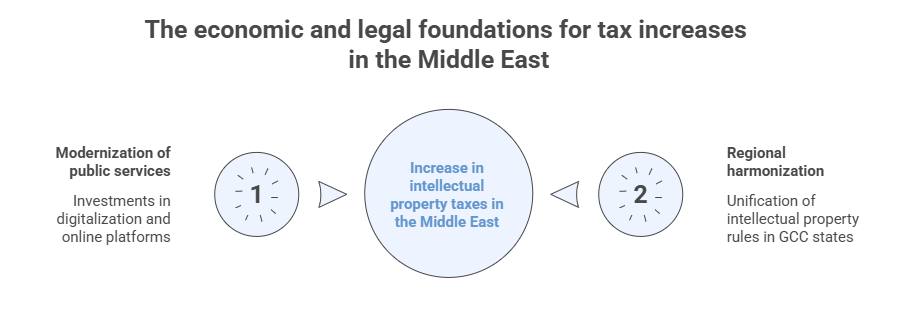
  • Community or specialised extensions (.law, .bank), often subject to strict eligibility requirements.

Trends and most-used extensions

Some new extensions have quickly gained prominence due to their universal appeal and marketing potential, such as .xyz, .online, and .shop. These have also become prime targets for cybersquatters, necessitating enhanced monitoring measures.


Case law and landmark decisions

The Canyon.bike case (2014)

This decision remains the first known UDRP case involving a new extension. It confirmed that the extension itself does not influence the assessment of similarity between the trademark and the domain name: the decisive element is the string to the left of the dot.

Recent jurisprudential developments

Since 2014, numerous cases have involved new extensions. UDRP panels apply the same criteria to recent gTLDs as to legacy ones, while considering the specific context of certain extensions, particularly when the extension reinforces the association with the trademark’s industry sector. Decisions also show heightened vigilance toward multiple registrations across different extensions targeting the same brand.


Issues and strategies for trademark owners

Monitoring and anticipation

The proliferation of extensions makes it essential to implement automated and targeted monitoring of trademark terms across all relevant extensions.

Selecting the appropriate procedures

Depending on the case, several options are available:

  • UDRP: to obtain permanent transfer or cancellation;
  • URS (Uniform Rapid Suspension): for clear-cut cases of cybersquatting, enabling swift suspension;
  • Local procedures: such as Syreli for .fr, when the domain name falls under a ccTLD.

Building strong cases

The success of a complaint hinges on demonstrating all three UDRP criteria with clear, tangible evidence of the trademark’s reputation and the respondent’s bad faith (e.g., multiple registrations, deceptive use, redirection to competitor websites).


Conclusion

New extensions offer businesses unprecedented opportunities for online visibility but also open new fronts for rights infringements. The UDRP remains as relevant and effective as ever, provided it is integrated into a comprehensive strategy combining monitoring, rapid action, and careful selection of dispute resolution procedures.


Dreyfus & Associés assists clients in protecting and defending their rights across all extensions, in partnership with a global network of intellectual property law specialists.


Nathalie Dreyfus, with the support of the entire Dreyfus team


FAQ

What is a new gTLD?

A generic top-level domain introduced after 2012, such as .shop, .paris, or .app, expanding the range of available domain name choices.

Does the UDRP apply to new extensions?

Yes. It covers all ICANN-approved gTLDs, whether legacy or new.

Should all extensions be monitored?

It is advisable to target the extensions most relevant to your sector and market to optimise monitoring costs and effectiveness.

Can multiple domain names be challenged in a single procedure?

Yes, if they are registered to the same holder and circumstances justify joint action.

How can a respondent’s bad faith be proven?

Through evidence such as the trademark’s reputation, redirection to a competitor’s site, or offering the domain for sale at an excessive price.

Read More

New gTLDs: the National Arbitration Forum (NAF), first arbitration center chosen for the administration of the Uniform Rapid Suspension (URS)

Introduction

The expansion of new generic top-level domains (gTLDs) has revolutionized how businesses and individuals create unique digital identities. As a result, intellectual property holders face significant challenges in protecting their trademarks from cybersquatting. To address these concerns, the Uniform Rapid Suspension (URS) system was introduced, offering a fast and cost-effective way to resolve domain name conflicts. The National Arbitration Forum (NAF) was chosen in 2013 as the primary center to administer this procedure, playing a critical role in protecting trademarks in the digital world. Today, the Asian Domain Name Dispute Resolution Center (ADNDRC) is also responsible for some URS procedures, but its use is more marginal.

What is the Uniform Rapid Suspension (URS)?

The URS is a domain name dispute resolution procedure, introduced by the ICANN, designed to offer a quick and cost-effective solution for trademark holders seeking to suspend domain names that infringe upon their rights and are identical or confusingly similar to their registered trademarks. Unlike other dispute resolution mechanisms like the Uniform Domain Name Dispute Resolution Policy (UDRP), which may lead to the transfer of the disputed domain name, the URS only provides for the suspension of the domain name in question. The suspended domain name remains registered in the name of the defendant but is deactivated, can no longer be used or transferred, and the suspension lasts until the domain name expires.

The role of the National Arbitration Forum (NAF)

Founded in 1986, the NAF is one of the world’s leading providers of alternative dispute resolution services. Chosen by ICANN (Internet Corporation for Assigned Names and Numbers) in 2013 to manage the URS procedure, it is responsible for handling disputes related to new gTLDs (namely .online, .site, etc.), complementing the UDRP, which remains applicable for traditional gTLDs (e.g., .com, .net, .org).

Trademark holders who believe their intellectual property rights are being violated can file a complaint with the NAF.

The NAF reviews the complaint and the evidence provided by both parties, considering, among other things:

  • Trademark ownership: The complainant holds a valid, registered trademark that is identical or similar to the disputed domain name.
  • Bad faith registration: The domain name was registered or is being used in bad faith, typically indicated by the intent to exploit the reputation of the trademark holder.
  • Lack of legitimate interest or right to the domain.

If these criteria are met, the NAF will suspend the domain name for the remaining term of its registration. Although temporary, the suspension may be extended for an additional year.

disputes resolution names

The benefits of the URS for trademark holders

The URS, administered by the NAF, offers several benefits to trademark holders seeking to quickly and efficiently resolve cybersquatting issues:

  • Speed and efficiency: The URS procedure is designed to be fast, with most cases resolved within 48 hours to 14 calendar days. This is particularly important when the infringement causes immediate harm (e.g., consumers are misled into thinking they are interacting with an official site or purchasing counterfeit products).
  • Cost-effectiveness: Legal procedures and the UDRP can be expensive and time-consuming, especially for companies with limited resources. The URS provides a solution with reduced fees and streamlined administrative management.
  • Temporary suspension: The URS allows for the temporary suspension of the disputed domain name, enabling the trademark holder to resolve the issue quickly and mitigate any reputational damage associated with the domain.

The NAF arbitration process

The NAF arbitrators are experts in domain name law and intellectual property. By offering a quick and affordable alternative to traditional litigation, the NAF ensures that trademark holders are not left without recourse in the face of cybersquatting and other malicious actors.

Conclusion

The URS, administered by the NAF, is a vital tool for trademark holders, allowing them to quickly and efficiently resolve domain name conflicts related to cybersquatting. The NAF is positioned as a key player in the protection of intellectual property rights online, and its role continues to grow, as new domain extensions are introduced. By providing trademark holders with an effective solution, the NAF ensures critical protection for online assets.

Dreyfus & Associés assists its clients in managing complex intellectual property cases, offering personalized advice and comprehensive operational support for the complete protection of intellectual property.

Dreyfus & Associés works in partnership with a global network of specialized intellectual property lawyers.

Nathalie Dreyfus with the support of the entire Dreyfus team.

FAQ

1. What types of cases can be handled by the URS?
The URS is designed to resolve conflicts where a domain name has been registered in bad faith, with the intent to exploit the reputation of an existing trademark. Typical cases include domain names that are identical or confusingly similar to registered trademarks.

2. Why procedure should be chosen between URS and UDRP ?
The URS and UDRP are both domain name dispute resolution mechanisms, but they differ in their goals and procedures. The URS only allows for the suspension of the domain name, while the UDRP may result in the transfer of the domain name to the trademark holder. The choice between the two depends on the trademark holder’s strategy. (For more information, refer to this article).

3. What evidence is required to initiate a URS procedure ?
To initiate a URS procedure, the complainant must prove that they own a valid, registered trademark, that the domain name is identical or similar to the trademark, and that the domain name was registered in bad faith. Evidence such as screenshots of the disputed domain’s website, copies of the trademark registration, or evidence of the intent to harm the trademark may be required.

4. What happens if a domain is suspended via the URS ?
If a domain is suspended through the URS, it will no longer be accessible to the public for the duration of its registration, but the domain holder does not necessarily lose ownership.

5. What remedies are available to a cybersquatter if its domain name is suspended under the URS?
If a cybersquatter believes the suspension of their domain is unjustified, they can challenge the decision through the appeal process provided by the URS. They will need to provide evidence demonstrating that they have a legitimate right to the domain, such as proof of commercial use of the domain or prior rights to the term.

This publication is intended for general public guidance and to highlight issues. It is not intended to apply to specific circumstances or to constitute legal advice. 

Read More

The WIPO out-of-court dispute resolution procedure in France: SYRELI, PARL EXPERT and recent developments

Introduction

The resolution of domain name disputes has become a major issue with the exponential growth of the Internet. Conflicts concerning the ownership of domain names are thus becoming more and more frequent, and their settlements more and more burdensome due to the overload of courts but also due to the high costs that traditional legal procedures can generate. Faced with these challenges, extrajudicial dispute resolution mechanisms have been put in place to offer faster, less expensive and accessible solutions, in order to effectively meet the needs of the parties concerned.

Historical context of domain name dispute resolution in France

Since its introduction in 2011, the SYRELI procedure (Dispute Resolution System) is the oldest out-of-court procedure offered by the AFNIC (French Association for Internet naming in cooperation). It allows the applicant to request from AFNIC the deletion or transmission of a domain name registered in [.fr] when it would infringe prior rights such as a trademark, a trade name, a right of personality…

This procedure is generally aimed at relatively simple and obvious disputes, where the application of Article L.45 2 of the CPCE is manifest.

The case law of the Court of Appeal of Versailles (2011)

The same year, on September 15, 2011, the Versailles Court of Appeal (RG n°2009/07860) was confronted with a case highlighting the limits of AFNIC’s liability in the management of domain names in [.fr]. The court ruled that AFNIC could not be held responsible for the publication or maintenance of a disputed domain name because it did not have an autonomous jurisdictional competence to settle intellectual property disputes. In essence, the judgment stressed that AFNIC, as a registration office, could not replace national courts to assess the existence or infringement of intellectual property rights. This decision highlighted a major issue: the lack of an impartial and independent mechanism capable of effectively resolving these disputes outside the judicial sphere.

Need for improved domain name out-of-court dispute resolution

It is this question of potential bias, inherent in decisions rendered without the intervention of completely independent third parties (AFNIC being in charge of managing domain names under .fr), which led the legislator and practitioners to foresee a more structured response in the 2013 legislative framework. The objective was to provide a balanced, fast and accessible framework for conflicts related to domain names in .fr, while respecting the rights of holders and applicants.

The integration of new legislative principles

An updated legislative framework

Although the SYRELI procedure has been in place since 2011, the legislative power has strongly reformed the framework surrounding the management of domain name disputes in France. It imposed an update of the out-of-court dispute resolution procedure, by integrating the intervention of independent third party in disputes between right holders and domain name holders.

This reform aimed to strengthen the impartiality of the alternative dispute resolution process and improve the management of cybersquatting and trademark infringement disputes It has made it possible to better regulate procedures by establishing more transparent mechanisms but also by allowing a much more in-depth legal analysis of the situation, necessary for the resolution of complex disputes.

The promise of an impartial procedure: the EXPERT PARL procedure

This procedure comes in response to the promise of successive reforms around 2013 and has been introduced in 2016 in partnership with the WIPO, thus allowing an alternative to the SYRELI procedure thanks to the intervention of independent experts selected by WIPO and AFNIC to examine the requests.

These procedures apply to domain names under the extensions managed by AFNIC:

• . fr
• . re (Reunion Island)
• . yt (Mayotte)
• . tf (the Southern and Antarctic Lands)
• . wf (Wallis and Futuna)
• . pm (Saint Pierre and Miquelon)

They are available to any person who can prove an interest in bringing proceedings under Article L.45 2 CPCE (infringement of intellectual property rights, personality rights, public order, etc.).
The main objective is to increase the decision-maker’s independence in cases that raise more complex issues or require an in-depth legal analysis, outside of AFNIC’s internal college.

info comparision SYRELI PARLAFNIC mediation: towards an amicable resolution

In parallel with the SYRELI and PARL EXPERT procedures, which although of an extrajudicial nature remain particularly formal, the settlement of disputes before AFNIC is governed by a framework close to judicial litigation. Indeed, the consent of both parties as to their presence in the proceedings is not required, the decision rendered by AFNIC is binding on the parties (subject to possible legal recourse) and the proceedings also involve procedural costs. The functioning of these mechanisms thus presents strong analogies with that of legal disputes.

It is in this context that AFNIC has introduced, since 2023, a completely free mediation procedure, based on the consent of both parties, encouraging, de facto, an amicable resolution of disputes upstream or as a complement to one of the amicable dispute settlement procedures. This mediation is distinguished by its speed, its flexibility (generally limited to a few days), its strictly confidential nature and the absence of automatic freezing of the domain name concerned.

Conclusion

The settlements of extrajudicial disputes relating to domain names in [.fr] enriched by the SYRELI and PARL EXPERT systems, constitutes today a set of efficient, fast and adapted solutions. While SYRELI remains appropriate for clear and simple disputes, PARL EXPERT offers a genuine impartial analysis by an independent expert, responding to the historical issue of neutrality highlighted by case law. Finally, the recent mediation procedure introduced by AFNIC complements these options to strengthen the use of amicable dispute resolution.

Dreyfus & Associés assists its clients in managing complex intellectual property cases, offering personalized advice and comprehensive operational support for the complete protection of intellectual property.

Dreyfus & Associés works in partnership with a global network of specialized intellectual property lawyers

Nathalie Dreyfus with the support of the entire Dreyfus team

Q&A

1.What is an out-of-court dispute resolution procedure?
The extrajudicial procedure allows a conflict to be resolved without going through the courts. It relies on the intervention of a neutral third party who makes a decision on the merits of the dispute, thus offering a quick and often less costly solution than traditional legal actions.

2.Are the decisions taken under these procedures binding?
The decisions taken within the framework of the SYRELI and PARL EXPERT procedures are not directly binding on the parties. They are binding on AFNIC, which must implement the decision. However, if one of the parties is not satisfied with the decision, it may apply to the competent courts to challenge the decision, in particular to request a judicial review of the merits of the dispute

3.What is the duration of an out-of-court dispute resolution procedure?
The duration of an out-of-court procedure varies depending on the complexity of the dispute. In general, procedures like SYRELI are faster (a few weeks), while complex disputes handled by PARL EXPERT may take a little longer, depending on the elements to be examined.

4.Is it possible to resort to an out-of-court procedure for a dispute concerning a domain name outside the extensions managed by AFNIC?
No, the SYRELI and PARL EXPERT procedures are only applicable to domain names registered under extensions managed by AFNIC (such as .fr, .re, .yt, etc.). For other extensions, there are similar mechanisms managed by other registry organizations.

5.Can AFNIC mediation be used after the decision by PARL EXPERT?
No, the mediation must be initiated before or in parallel with the formal procedures. Once a decision has been rendered in the context of PARL EXPERT, it is no longer possible to resort to mediation. However, the parties can still explore other amicable settlement mechanisms after the decision.

6.Do the parties need to be represented by a lawyer as part of the SYRELI or PARL EXPERT procedures?
No, representation by a lawyer is not mandatory in these proceedings. However, in complex disputes, it may be advisable to seek the assistance of a lawyer or an intellectual property expert to maximize the chances of success.

This publication is intended for general public guidance and to highlight issues. It is not intended to apply to specific circumstances or to constitute legal advice.

Read More

On the new eligibility criteria applicable to “.fr” domain names

Introduction

The .fr domain name does not fall within a simple commercial reservation mechanism. It is part of a structured legal framework, based on the Naming Charter of the Association Française pour le Nommage Internet en Coopération (AFNIC), which sets out the rules governing the registration and management of French domain name extensions.

This Charter constitutes the normative foundation of the .fr extension. It governs not only the technical conditions of allocation, but above all the eligibility criteria, the obligations relating to registrant identification, the monitoring mechanisms, and the corrective powers vested in AFNIC. Unlike generic extensions, access to the .fr extension is therefore subject to legal requirements linked to territorial anchoring and registrant responsibility.

The new eligibility criteria applicable to .fr domain names, introduced by the Charter in 2011 and subsequently consolidated, reflect a profound evolution: opening the extension to European stakeholders while strengthening legal certainty, traceability, and the fight against abusive uses. These rules have direct implications for French companies, international groups, trademark owners, and legal and digital teams.

The legal and regulatory framework governing eligibility for .fr

AFNIC administers the .fr extension under a public service delegation. As such, its role is not limited to a technical function: it implements an allocation policy based on public-interest objectives, including the security of exchanges, the reliability of actor identification, and the protection of third-party rights.

The Naming Charter is binding on all registrars and registrants. It grants AFNIC the power to verify eligibility at any time, to request supporting documents, and, where appropriate, to suspend or delete a domain name in the event of non-compliance.

The .fr regime is grounded in the French Postal and Electronic Communications Code (CPCE). This legal basis gives the eligibility criteria binding legal force, going well beyond a simple contractual relationship between the registrant and the registrar.

The new eligibility criteria applicable to .fr domain names

The reform has profoundly changed the philosophy of eligibility. Nationality is no longer relevant. The decisive criterion is the existence of an objective territorial link with Europe.

A .fr domain name may be registered by:

  • natural persons residing within the territory of one of the Member States of the European Union, or within Iceland, Liechtenstein, Norway, or Switzerland;
  • legal entities established within those same territories.

Domain names registered prior to the entry into force of these criteria were not called into question. Historical registrants may continue to renew and use their domain names, even if they would no longer meet today’s eligibility conditions.

This grandfathering mechanism ensures legal stability and protects existing digital investments.

The new criteria are accompanied by heightened requirements regarding the quality and accuracy of registrant data. Registrants must be reachable and identifiable at all times. AFNIC may carry out spot checks or targeted audits, particularly in the event of a dispute or a report.

Eligibility in practice: natural persons and legal entities

A natural person is eligible provided that they can demonstrate effective residence in an eligible territory. A mere domiciliation or accommodation address is insufficient. AFNIC may require evidence establishing the reality of such residence.

Companies must demonstrate an effective establishment: registered office, branch, subsidiary, or permanent establishment. For international groups, the creation of a European entity often constitutes a strategic lever for securing a .fr domain name portfolio.

Alignment between domain name ownership and the company’s actual legal structure is therefore decisive.

Strategic impacts for businesses, trademarks, and SEO

The .fr extension remains a strong marker of credibility for French users. It enhances consumer trust, facilitates the identification of the economic operator, and improves local visibility on search engines.

Eligibility does not confer any proprietary right. A domain name may be fully eligible while still infringing a prior trademark, a company name, or a trade name.

The analysis must therefore be twofold:

  • Compliance with AFNIC eligibility criteria, on the one hand;
  • Lawfulness with regard to prior rights, on the other.

strategics impacts fr

Eligibility, compliance, monitoring and dispute mechanisms

Eligibility is not assessed solely at the time of registration. It constitutes a continuing obligation. Any change in circumstances (restructuring, relocation, transfer) may affect the validity of the domain name.

In cases of abusive or bad-faith registration, right holders have access to specific procedures enabling them to seek the cancellation or transfer of the domain name (including UDRP proceedings). Reliable identification of the registrant then becomes a major procedural advantage.

Conclusion

The new eligibility criteria for .fr domain names, as set out in AFNIC’s Naming Charter, reflect a clear objective: to maintain a reliable, traceable, and legally secure French digital space, while opening it to European economic actors.

The .fr extension remains a strategic asset, the management of which requires a rigorous and forward-looking legal approach.

Dreyfus & Associés law firm assists its clients in managing complex intellectual property cases, offering personalized advice and comprehensive operational support for the complete protection of intellectual property.

Dreyfus & Associés works in partnership with a global network of specialized intellectual property lawyers.

Nathalie Dreyfus with the support of the entire Dreyfus team.

FAQ

1. Is using a French service provider or registrar sufficient to meet the eligibility requirements?
No. Eligibility is assessed solely at the level of the domain name holder. Relying on an intermediary established in France does not satisfy the requirement of an effective territorial link.

2. Can a change in a group’s legal structure weaken a .fr domain portfolio?
Yes. A merger, assignment or transfer of activity may disrupt the alignment between the domain name holder and the eligible entity, exposing the domain name to a risk of non-compliance.

3. Does eligibility provide protection against trademark-based actions?
Absolutely not. Compliance with AFNIC rules does not exclude trademark infringement or unfair competition claims. A compliant domain name may still be challenged on the basis of prior rights.

4. Is the .fr extension suitable for an international digital strategy?
Yes, provided it is integrated into a coherent domain name architecture. The .fr extension should be coordinated with other TLDs to avoid conflicts and optimise territorial protection.

5. Why is legal anticipation essential when managing a .fr domain name?
Because the .fr extension is governed by a specific legal framework that goes beyond purely technical considerations. A proactive legal approach makes it possible to ensure compliance with AFNIC’s rules, prevent infringements of third-party rights, and secure both the ownership and the use of the domain name. It thereby reduces the risks of suspension, forced transfer or litigation, and ensures continuity of operations.

This publication is intended to provide general guidance to the public and to highlight certain issues. It is not intended to apply to specific circumstances or to constitute legal advice.

Read More